
- Technology explained – technology and procedures
Welding processes: MAG, TIG or MMA – which for what
By Tobias Schott · 5-minute read · Updated November 2026
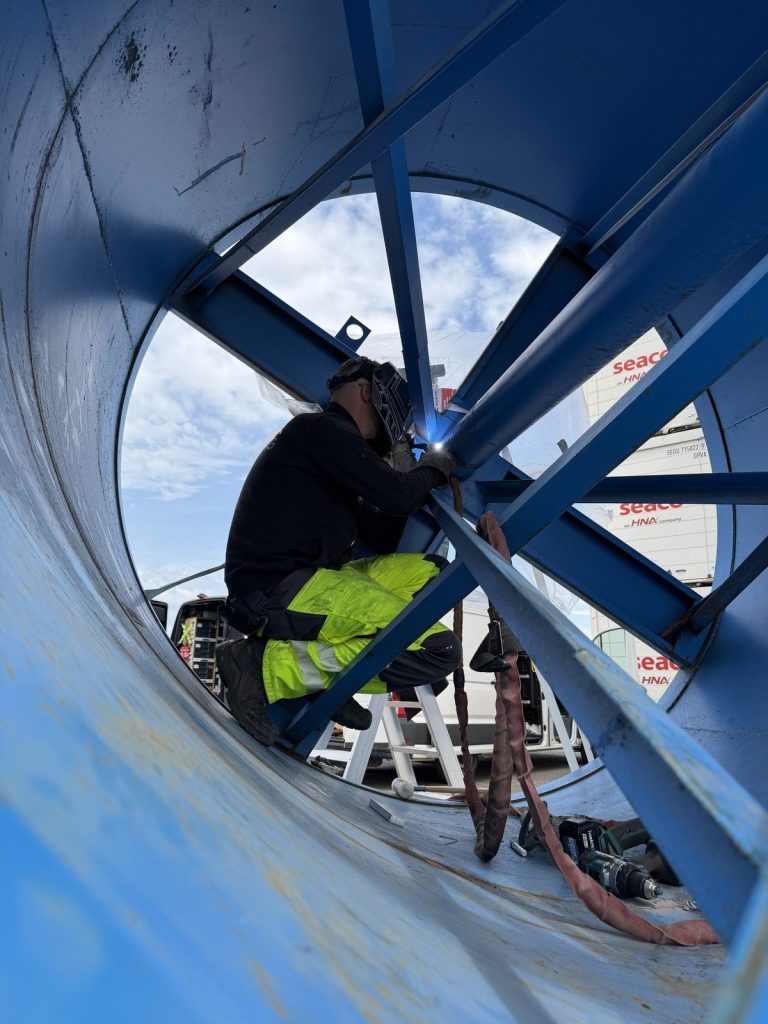
MAG, TIG and MMA are the three welding processes most often used in installation and maintenance: MAG for steelwork and speed, TIG for clean, thin and tight welds, MMA for outdoors, in wind and with little equipment.
Anyone having a cracked bracket, a leaking tray or a damaged shaft repaired is soon asked: with which process? The answer depends on the material, the wall thickness, the space and whether the welding is indoors or outdoors.
Here we explain how the three processes work, what belongs to a MAG welding set, what positional welds are and what matters when welding on site.
What is a welding process?
A welding process describes how two components are joined permanently by heat – with which heat source, which filler material and how the molten metal is protected from the air. In arc welding, an electric arc melts the parent and filler material.
The processes have short names and numbers to ISO 4063: MAG is 135, TIG is 141, MMA is 111. Welding procedure specifications and test reports often show only these numbers.
Key facts
- MAG: metal active gas, consumable wire electrode, fast, for steel and steelwork.
- TIG: tungsten inert gas, non-consumable electrode, filler added by hand, for clean and tight welds.
- MMA: manual metal arc welding with a coated stick electrode, robust, insensitive to wind.
- Weld protection: shielding gas for MAG and TIG, coating and slag for MMA.
- Positional welds: vertical up, vertical down, horizontal, overhead – common on site.
- Also needed on site: fume extraction, fire protection, protection of adjacent components.
How do the three processes work?
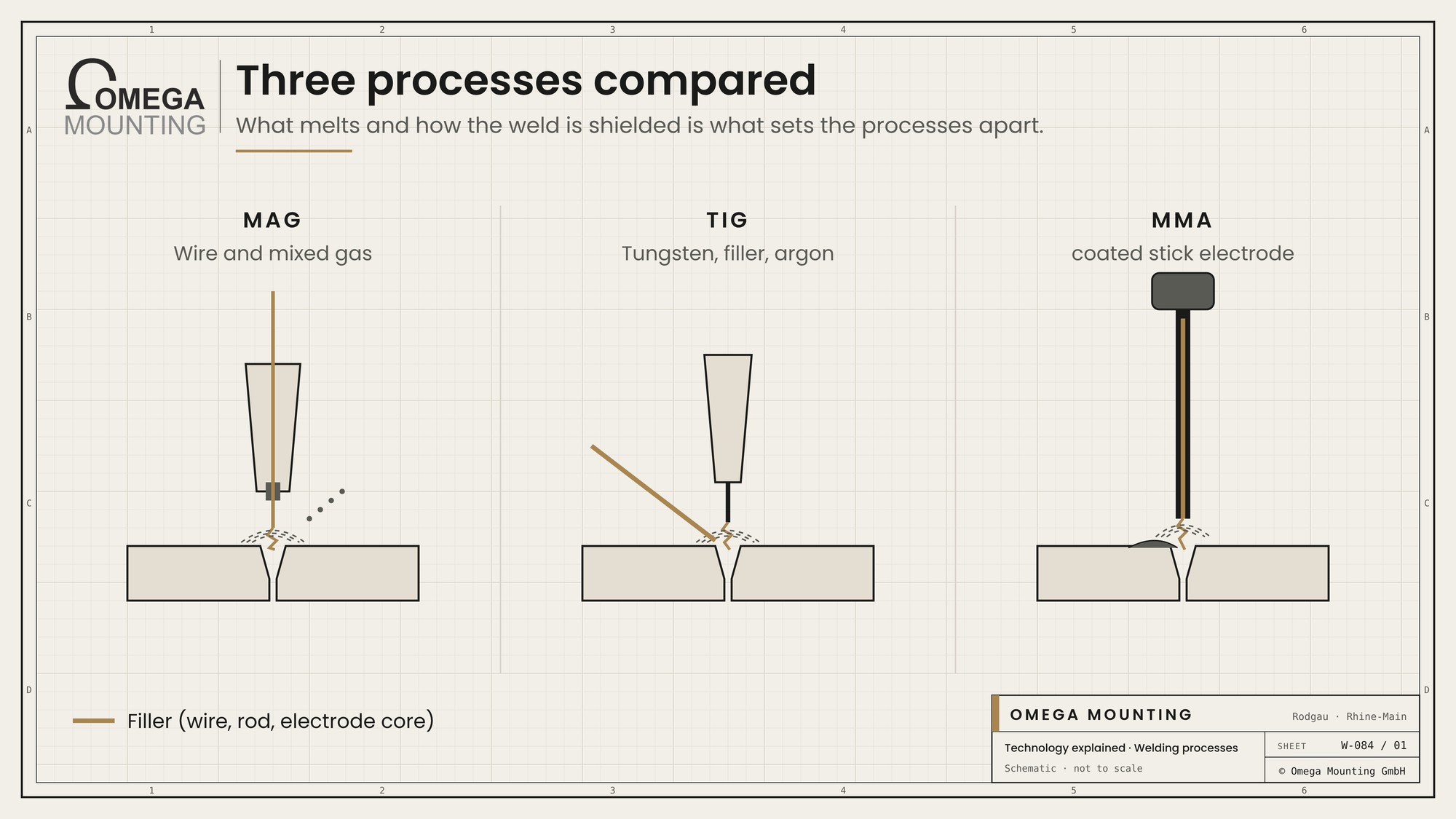
All three weld with an arc. They differ in what melts and how the weld is protected.
| Method | How it works | Strengths | Limits |
|---|---|---|---|
| MAG | A wire runs through the torch, melts in the arc and is surrounded by mixed gas. | High deposition rate, quick weld build-up, strong joints in steelwork. | Shielding gas blows away in wind, lots of spatter. |
| TIG | A tungsten electrode creates the arc, filler is fed by hand, argon protects. | Very clean, tight welds, easy to control, for stainless steel, pipes and thin sheet. | Slower, needs a steady hand and still air. |
| MMA | A coated stick electrode melts, the coating forms gas and slag. | Hardly any equipment, usable outdoors and in wind, even on material that is not perfectly clean. | Slag has to be removed, electrode changes, less fine. |
There is also MIG with inert gas for aluminium, and oxy-fuel welding with a gas flame, which in maintenance today is used more for brazing and heating.
What belongs to a MAG welding set
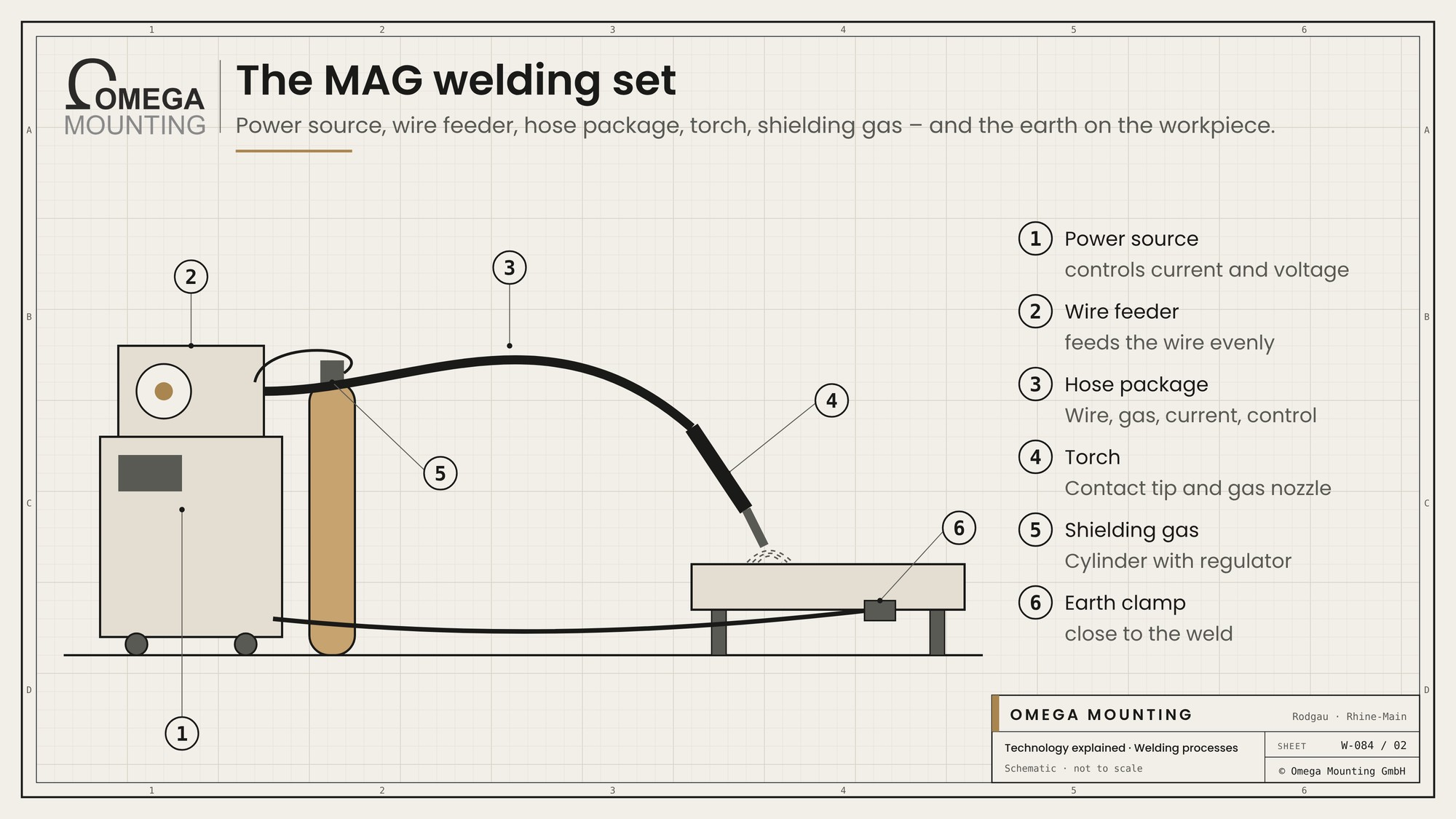
A MAG welding set consists of several parts that must work together.
- Power source: supplies the welding current and regulates the voltage.
- Wire feeder: feeds the wire evenly through the hose package – often as a case that can go closer to the weld.
- Hose package: carries wire, gas, current and control line to the torch.
- Torch: with contact tip and gas nozzle, where the arc forms.
- Shielding gas: cylinder with regulator, usually an argon mix.
- Earth clamp: closes the circuit on the workpiece – as close to the weld as possible.
TIG needs a suitable power source, a TIG torch, argon and filler rods. Mobile TIG equipment fits into any service vehicle.
Welding positions and positional welds
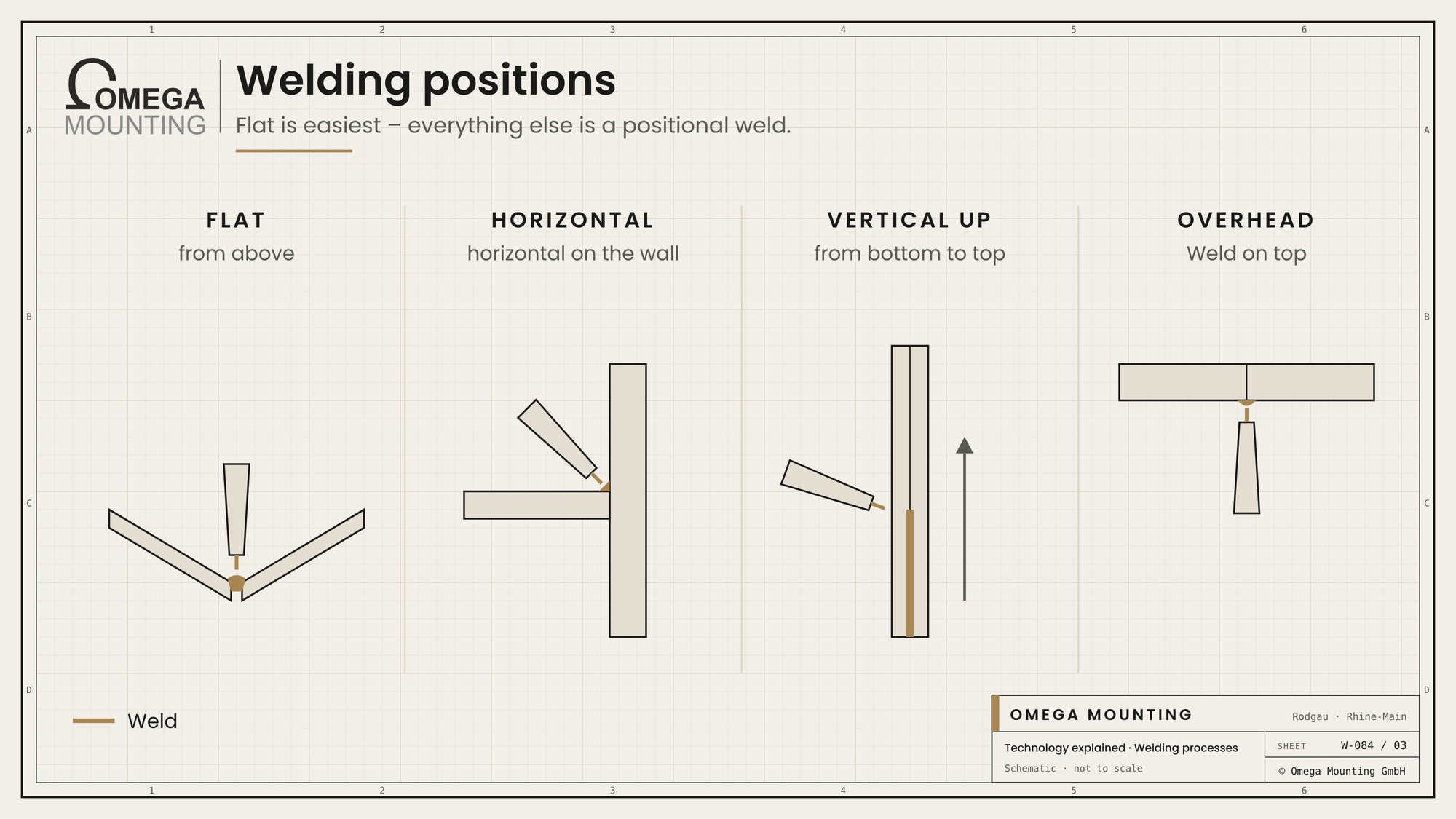
In the workshop the component is turned so that it can be welded flat – from above, so the molten metal stays in place. On site this is rarely possible.
- Flat: weld lies at the bottom, easiest.
- Horizontal: weld runs horizontally on a vertical wall.
- Vertical up: weld runs vertically and is welded from bottom to top.
- Overhead: weld is above, the welder works upwards.
Everything except flat counts as a positional weld. The molten metal wants to run down, and the welder has to hold it with technique and experience. That is why welders are qualified for specific positions. How an on-site repair works overall is described in our guide on repair welding in industrial plants.
Welding on site: protection and safety
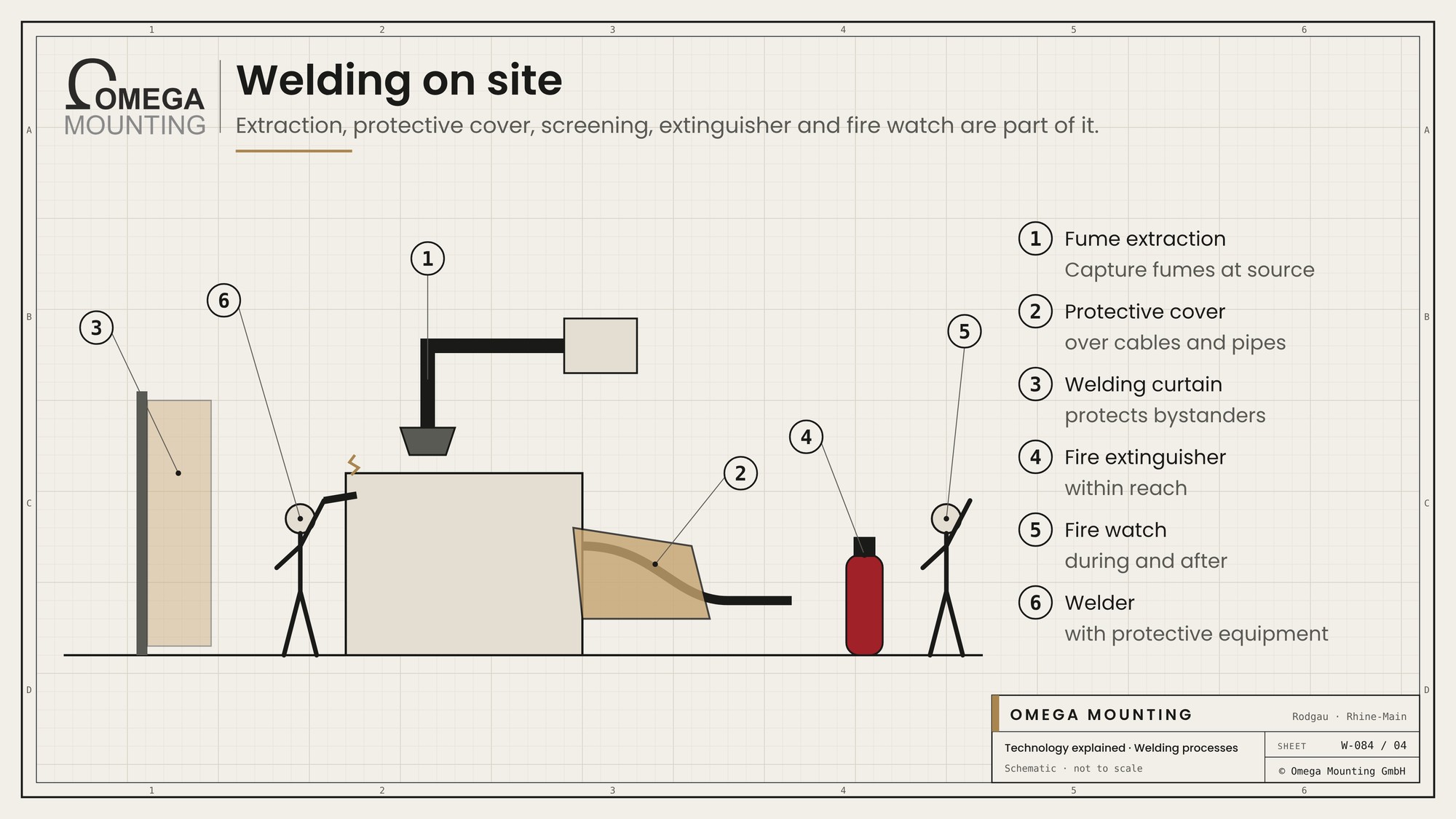
Welding in a running plant is hot work. There is more to it than the equipment.
- Extraction: welding fumes are extracted at the source, in confined spaces with fresh air supply.
- Protection of adjacent components: heat-resistant covers over cables, hoses and coatings.
- Screening: welding curtains protect bystanders from light and spatter.
- Fire protection: remove or cover combustible material, fire extinguisher ready, fire watch during and after the work.
- Approval: In many companies, welding requires a permit.
How a work permit is structured is explained in our article on the Permit to Work.
Preparation decides the weld
The quality of a weld is created before the arc is struck. Before any welding work we clarify:
- Material: Steel grade, thickness and coating determine process, filler and preheating.
- Joint preparation: Bevels, gap and cleanliness of the joints are checked. Rust, paint and oil have no place in the weld.
- Qualification: For load-bearing parts only welders with a valid test for the process and position weld.
- Hot work permit: In operating plants the welding is approved beforehand; fire watch and extinguishers are ready.
- Weather protection: Wind and wet disturb the shielding gas. On site, tents or sheets protect the work.
After welding, every seam is first inspected visually: shape, transitions, spatter, cracks. For components with inspection requirements, the specified test methods follow. The documentation records who welded which seam with which process.
What we pay attention to
Before we weld, we decide how.
- We choose the process according to material, wall thickness, position and surroundings.
- We grind out cracks and old welds completely before re-welding.
- We protect adjacent components and provide extraction and fire protection.
- For positional welds we use welders who are practised in them.
- We protect the finished weld against corrosion and document the repair.
Where we use it
At the port of Aschaffenburg we repaired the tubular shaft of a cable drum on site – with mobile TIG equipment, accurately fitting repair pieces and partly in confined positions between the bracing. The high-voltage cable stayed on the reel and was protected with a heat-resistant cover.
At a loading dock we renewed defective welds after the statutory inspection – ground out and re-welded with MAG and deep penetration, in snow with an industrial heater. In a test bay we welded an oil tray around a test bed foundation leak-tight – in a confined basement room with fume extraction and fresh air supply.
More technology explained
Technology explained
the permit for hot work.
Technology explained
where MAG welds carry load cycles every day.
Technology explained
how a machine gets clean before the repair.
Do you have questions about how this works on your site?
Do you have a crack, a leaking weld or a broken component – and it should be repaired on site? We choose the right process and weld where the damage is. Request a callback.
Our service for this: Custom fabrication and welding →
Free, no-obligation callback

About the author
Tobias Schott
Managing director of Omega Mounting GmbH, Rodgau · more than 20 years of hands-on experience in installation and maintenance
A trained mechatronics technician, working in maintenance, servicing and industrial installation since 2004 – first alongside his father, and with Omega Mounting since 2012: from overhead conveyors in Frankfurt to the crane system in a new-build hall. He plans and leads lifting operations as an appointed person (AP) in data centers and on industrial sites in the Rhine-Main region, trains and examines operators of cranes, mobile elevating work platforms and telehandlers, and is a qualified occupational safety specialist. On jobs abroad he is known as the “German Troubleshooter” – the person you call when a site gets stuck. He learned what quality means from his father, not from a manual: Made in Germany as a standard for his own work, not a label. That is why quality comes first at Omega Mounting – ahead of speed and price. The Technology explained articles cover the equipment and techniques his team uses every day: what counts on site is in them – what only appears in the brochure is not.
 English
 German