
- Technology explained – technology and procedures
Dry-ice blasting: cleaning with frozen CO₂ – no water, no blasting media residue
By Tobias Schott · 5-minute read · Updated November 2026
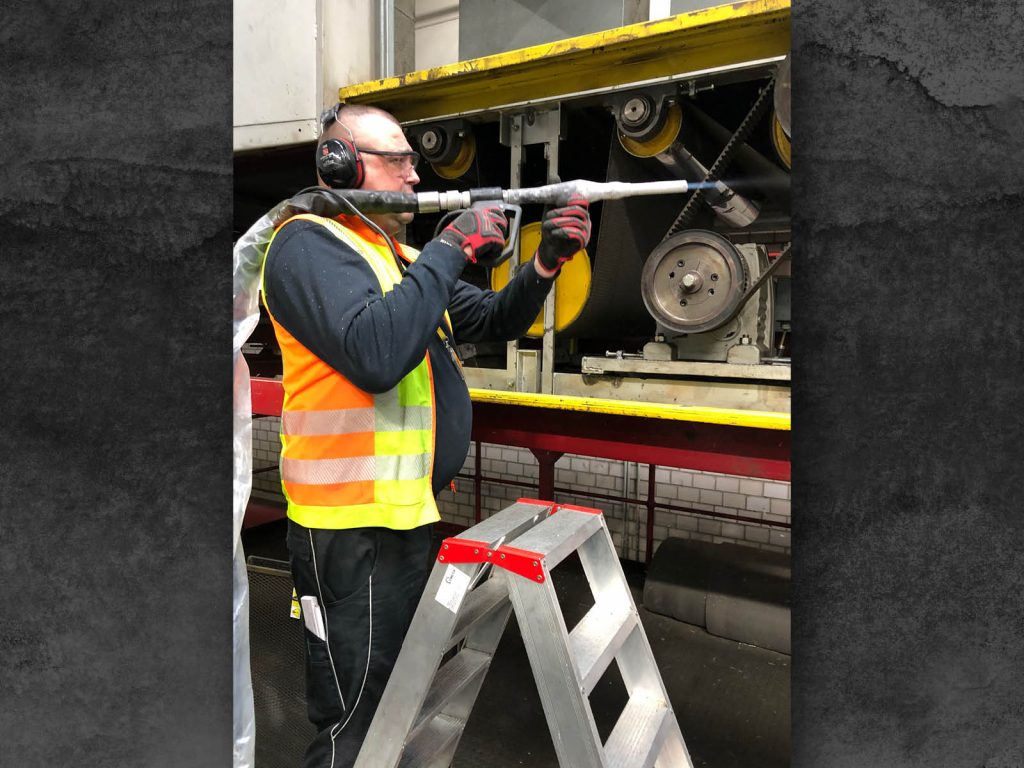
In dry-ice blasting, frozen carbon dioxide is shot at dirty surfaces with compressed air – the dirt comes off, the ice turns to gas, and what remains is a dry, clean machine.
You come across dry-ice blasting wherever machines need to be cleaned without dismantling them, getting them wet or damaging them with sand: on drives, conveyor systems, moulds, control cabinets after isolation, in the food industry. It is loud, it steams – and afterwards a machine that has built up twenty years of dust and oil looks like new.
Here we explain how dry-ice blasting works, what the equipment includes, how it differs from sand and water blasting and what matters for occupational safety.
What is dry-ice blasting?
Dry-ice blasting is a cleaning method in which pellets or particles of dry ice are blasted onto a surface with compressed air and remove contamination without leaving any residue of the blasting media. Other names are dry-ice cleaning, ice blasting or CO₂ blasting; in German it is called Trockeneisstrahlen.
Dry ice is solid carbon dioxide. At −78.5 °C it passes directly from the solid to the gaseous state without becoming liquid – experts call this sublimation. That is why nothing of the blasting media is left behind and nothing gets wet.
Key facts
- Blasting media: Dry ice as pellets or finely shaved particles.
- Drive: Compressed air from a powerful compressor.
- Residue: No blasting media, only the loosened dirt, which is vacuumed up or swept.
- Suitable for: Oil, grease, dust, deposits, release agents, production residues; electrical components after isolation.
- Limits: Rust down to bare metal, hard paints and mill scale can hardly be removed.
- Protection: Hearing protection, face protection, cryogenic gloves, ventilation and a CO₂ detector in confined spaces.
How does dry-ice blasting work?
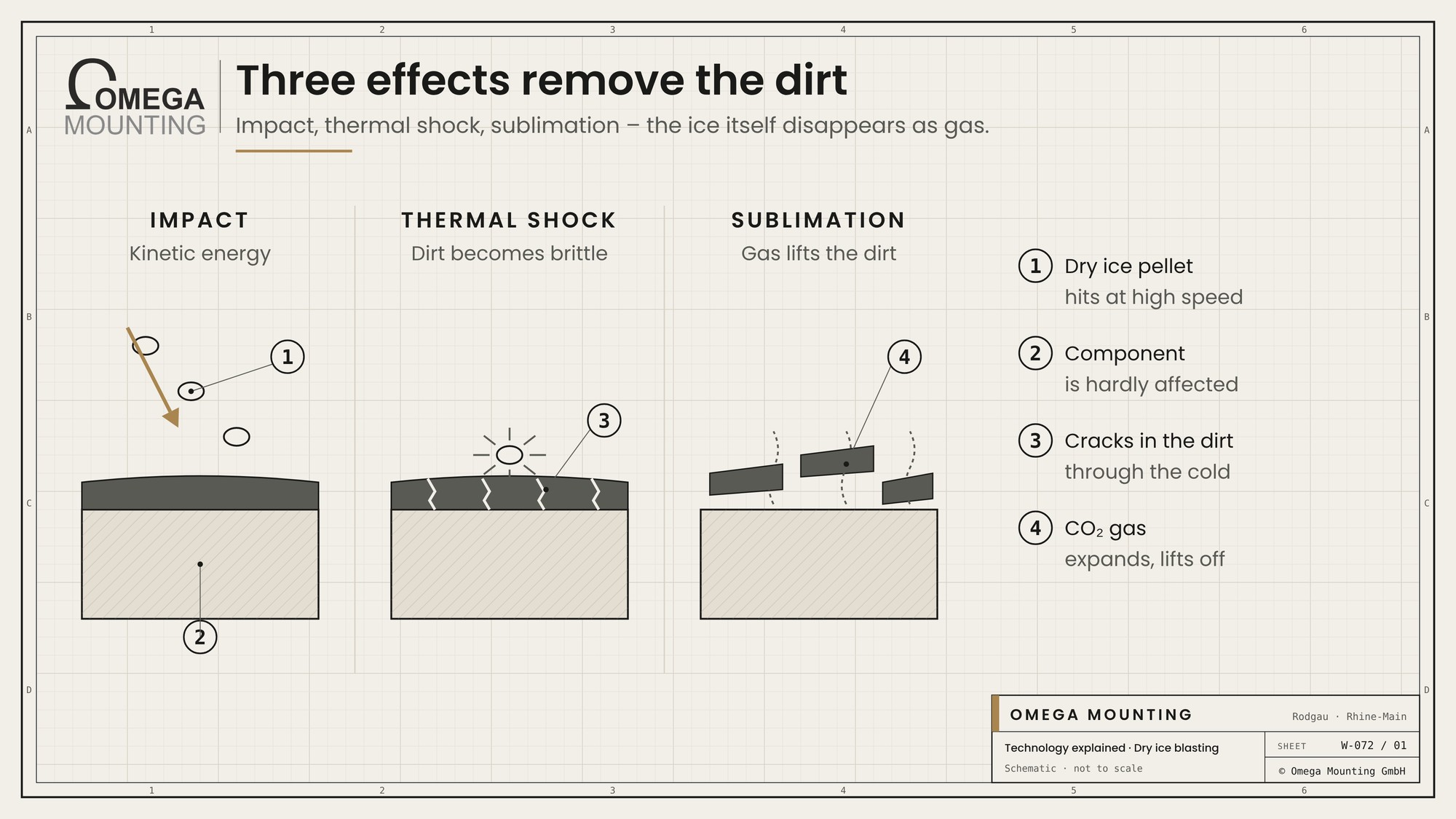
Dry-ice blasting works through three effects that happen almost simultaneously: the impact, the thermal shock and the sublimation.
Impact. The pellets hit the layer of dirt at high speed and transfer their kinetic energy. Because dry ice is comparatively soft, it does not abrade the surface underneath.
Thermal shock. The extreme cold makes the contamination brittle and causes it to shrink. Cracks form between dirt and component, and adhesion weakens. Oil and grease freeze and break down into a kind of dust.
Sublimation. On impact the pellet turns into gas and expands many times over. The gas penetrates the cracks and lifts the dirt off from below.
What remains is the loosened dirt – dry and loose, so it can be picked up with an industrial vacuum cleaner.
What does the equipment include?
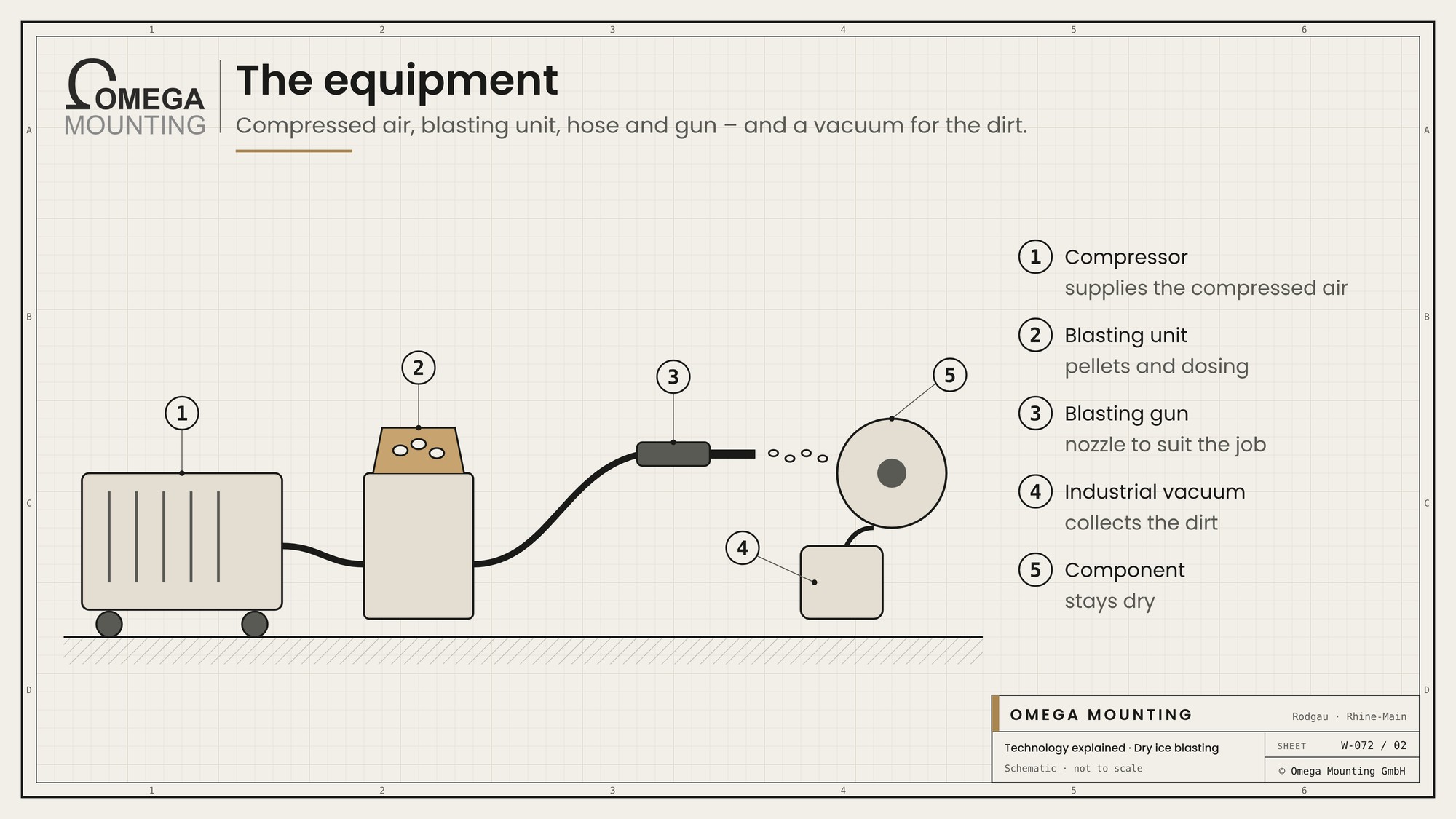
Dry-ice blasting needs four parts: compressed air, blasting unit, hose with gun and extraction for the dirt.
- Compressor: supplies the compressed air that accelerates the pellets – often the largest piece of equipment on site.
- Blasting unit: a hopper for the pellets with a metering unit that feeds the ice into the air stream.
- Hose and gun: with interchangeable nozzles for wide surfaces or tight corners.
- Industrial vacuum cleaner: picks up the loosened dirt so that it does not settle elsewhere.
The dry ice is delivered shortly before use and stored in insulated containers, because it slowly turns to gas even there.
Dry ice, sand or water?
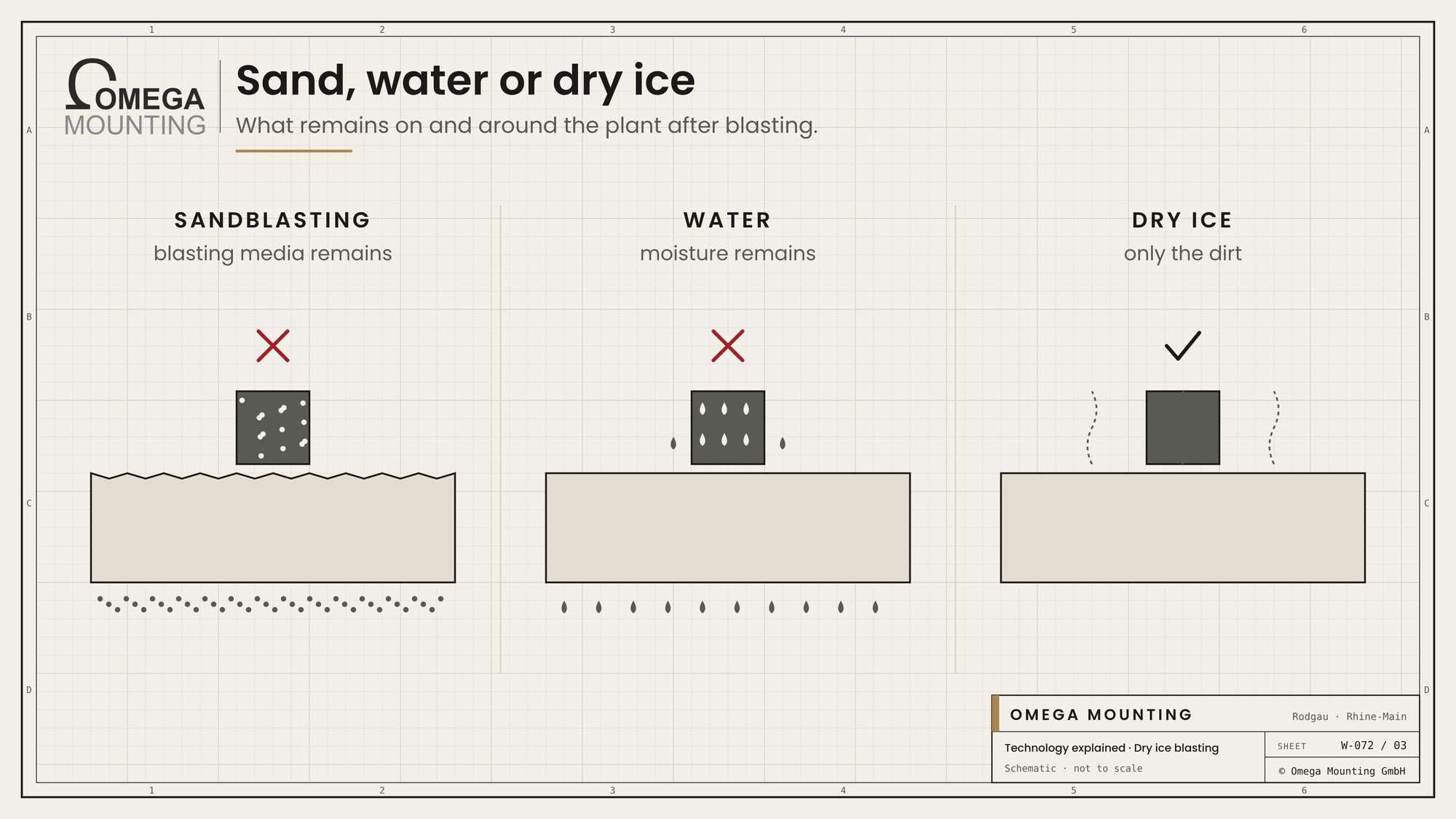
Dry ice differs from other blasting methods in that no blasting media is left behind, nothing gets wet and the surface is hardly affected.
| Method | Residue | Surface | Electrics and machine |
|---|---|---|---|
| Sandblasting | Blasting media stays behind and gets into bearings and gaps. | Is roughened and removed. | Only after dismantling or covering. |
| High-pressure water | Water and dirt spread, wetness remains. | Mostly gentle. | Wetness on bearings and electrics is a risk. |
| Solvents | Solvent and dissolved dirt must be disposed of. | Gentle, depending on the agent. | Fumes and hazardous substances. |
| Dry ice | Only the loosened dirt. | Hardly affected. | Dry, often without dismantling, after isolation also on electrics. |
The downside: dry ice needs a lot of compressed air, is loud and is not suitable for removing rust or hard coatings down to the metal. For refurbishment down to bare steel, sandblasting remains the method of choice.
Safety: cold, noise and CO₂
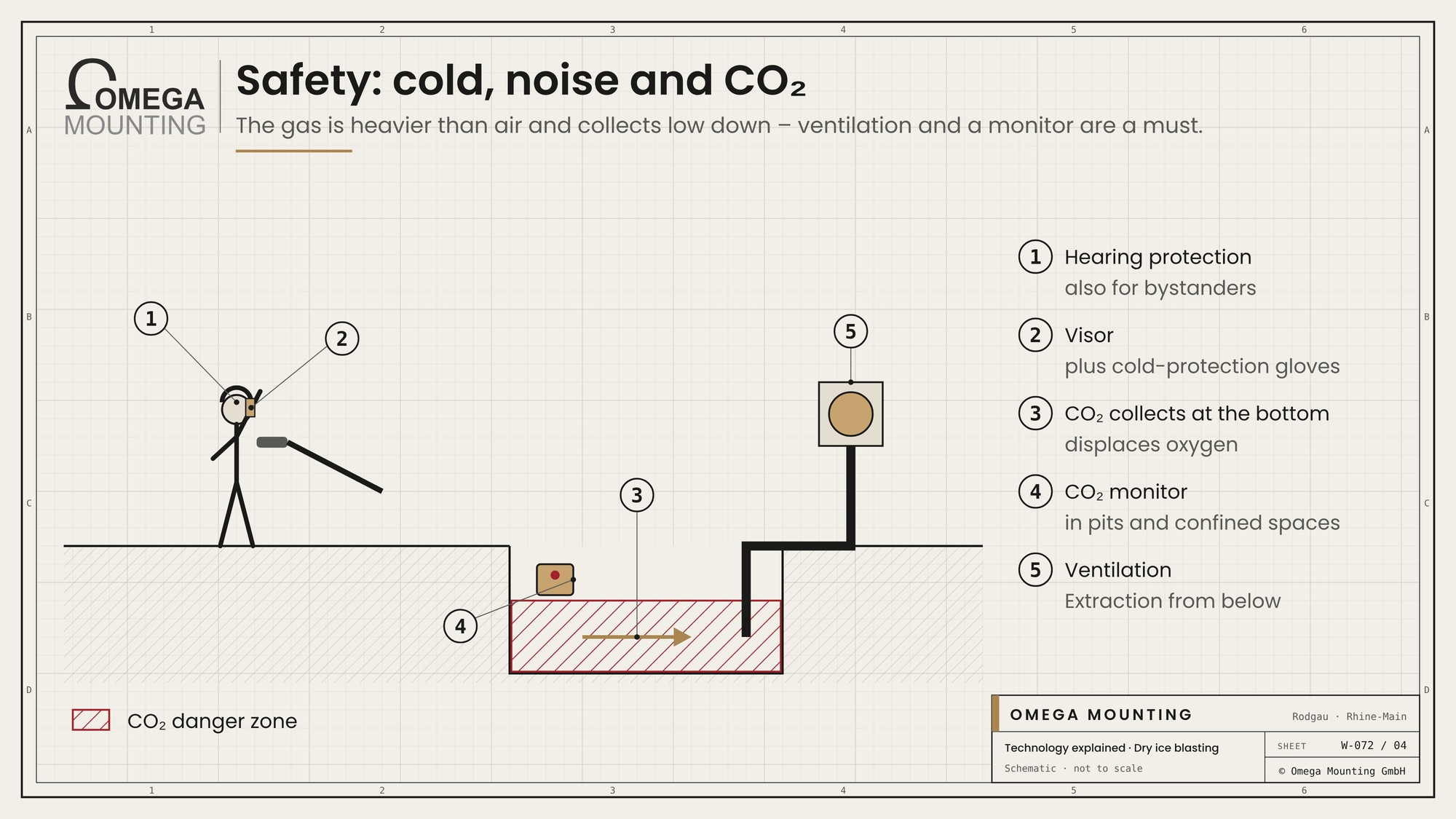
Dry-ice blasting involves three hazards you need to know: the cold, the noise and the gas.
- Cold: Dry ice causes cold burns on skin contact. Pellets are only handled with cryogenic gloves.
- Noise: Blasting is very loud, hearing protection is mandatory – also for people nearby.
- CO₂: The gas is heavier than air, sinks and can collect in pits, basements and confined spaces, where it displaces the oxygen. Ventilation and a CO₂ detector are needed there.
- Face and eyes: Rebounding particles and dirt – visor or safety goggles.
The machine itself is isolated beforehand and secured against being switched back on. How this works is explained in our guide on lockout/tagout.
Preparing a job
Dry ice blasting is fast if the preparation is right. Before the job we clarify these points:
- What is being cleaned?: Soiling and substrate determine pressure, nozzle and ice quantity. A test area shows what is achievable.
- Ventilation: The ice turns into CO₂ gas. In enclosed rooms ventilation and gas monitoring are needed.
- Covering: Loosened dirt flies around. Sensitive components and neighbouring areas are covered.
- Compressed air: Compressor and lines must deliver the necessary air volume, otherwise performance drops.
- Ice supply: Dry ice also sublimates in the container. Delivery is matched to the day of the job.
Electrical equipment is only blasted when isolated; electricians handle the isolation. After cleaning we collect the loosened dirt – the ice itself leaves nothing behind, but the removed deposit does.
What we pay attention to
Before we blast, we clarify whether dry ice is the right method.
- We look at the contamination: oil, dust and deposits yes, rust down to the metal no.
- We isolate and secure the machine before blasting.
- We cover sensitive areas and plan where the loosened dirt will fall.
- We provide ventilation and measure CO₂ where the gas can collect.
- We vacuum the dirt directly and use the clean machine for the maintenance that follows.
Where we use it
Together with a partner company we cleaned 25 complete drive stations with dry ice – with all rollers and moving, mechanical and electrical components. For more than 20 years no maintenance had been done there; dust, wood and production residues had built up, and normal cleaners could no longer cope. The cleaning was the precondition for servicing the drives and preparing them for new sensors. More under Maintenance and servicing.
More technology explained
Guide
isolation before every cleaning job.
Technology explained
where cleaning fits into maintenance.
Technology explained
what you can see on a clean machine.
Do you have questions about how this works on your site?
Has your equipment built up years of dirt, and you want to service it without dismantling it? We check whether dry ice is suitable, and clean and service in one go. Request a callback.
Free, no-obligation callback

About the author
Tobias Schott
Managing director of Omega Mounting GmbH, Rodgau · more than 20 years of hands-on experience in installation and maintenance
A trained mechatronics technician, working in maintenance, servicing and industrial installation since 2004 – first alongside his father, and with Omega Mounting since 2012: from overhead conveyors in Frankfurt to the crane system in a new-build hall. He plans and leads lifting operations as an appointed person (AP) in data centers and on industrial sites in the Rhine-Main region, trains and examines operators of cranes, mobile elevating work platforms and telehandlers, and is a qualified occupational safety specialist. On jobs abroad he is known as the “German Troubleshooter” – the person you call when a site gets stuck. He learned what quality means from his father, not from a manual: Made in Germany as a standard for his own work, not a label. That is why quality comes first at Omega Mounting – ahead of speed and price. The Technology explained articles cover the equipment and techniques his team uses every day: what counts on site is in them – what only appears in the brochure is not.
 English
 German