
- Technology explained – key term
Permit to Work System Explained: Types, Contents and Process
By Tobias Schott · 8-minute read · Updated October 2026
A permit to work is the written, time-limited authorisation to carry out a specific hazardous task at a specific location with a named team – and without it, the welding set stays off and the crane hook stays up. If you install equipment in a data center, at an airport or in an industrial plant, you will meet the permit to work on your first morning at the latest. The tender says “client’s PTW system”; on site, the question is “Have you got a permit?”. In German, it is called “Erlaubnisschein” or “Arbeitsfreigabe”.
This article explains what a permit is, which types exist, what goes on it and how the process runs. How to isolate and lock off a plant is covered in our lockout/tagout guide – we do not repeat it here.
What is a permit to work?
A permit to work (PTW) is a written document in which the operator, or someone appointed by the operator, authorises a specific task for a limited period and sets the conditions for it. It ties together three things: the location, the task and the people carrying it out. Added to these are the hazards and the controls that must be in place before work starts.
The permit does not replace the risk assessment or the method statement. It is the last step before work starts: confirmation that the planned controls are actually in place at this location on this day. German practice uses the written permit mainly for hot work and for entry into vessels and confined spaces.
Key facts
- Definition: Written, time-limited authorisation of a specific hazardous task at a specific location for a named team, with conditions and signatures from both sides.
- Also known as: Work permit, PTW; in German “Erlaubnisschein” or “Arbeitsfreigabe”.
- Terminology: Permit to work (PTW) or work permit; sub-types include hot work permit, confined space permit, isolation permit and lifting permit.
- Where you find it: Live data centers, airports and security areas, chemical and energy plants, food production, and any site run to UK or US safety standards.
- Often confused with: The risk assessment or RAMS (which describes the risks – the permit authorises the work), isolation (a control listed in the permit), the operating instruction (permanent – a permit applies once) and the access pass (it opens the door, not the work).
- Who issues it: The operator or the issuer appointed by the operator – never the contractor carrying out the work.
Which types of permit are there – and what for?
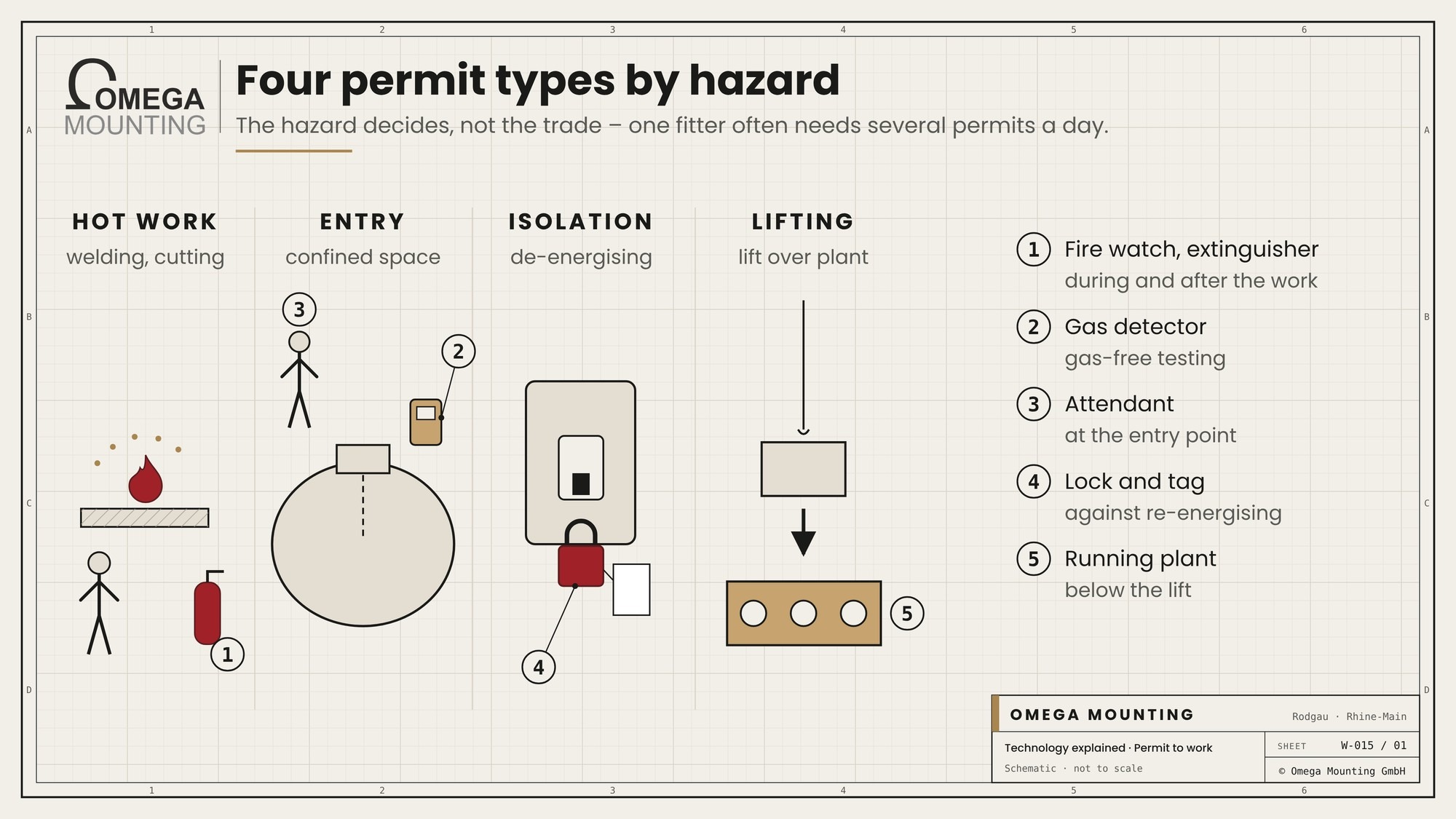
The type of permit depends on the hazard, not on the trade – one fitter may need three different permits in a single day. Names vary from operator to operator, but the basic types and the typical conditions in the table are much the same everywhere.
| Permit type | Used for | Typical conditions |
|---|---|---|
| Hot work permit | Welding, flame cutting, grinding, soldering, work with naked flames or sparks | Remove or cover combustible material, extinguisher to hand, fire watch during and after the work; fire detectors isolated and reinstated by the operator only |
| Confined space permit | Work in vessels, tanks, shafts, ducts and containers without adequate ventilation | Gas testing with a gas detector, ventilation, attendant at the entrance, rescue equipment on site |
| Electrical or isolation permit | Work on or near electrical installations and on machines with stored energy | Five safety rules, lock-off and tagging (lockout/tagout), sign-off by a qualified electrician |
| Working at height permit | Work on roofs, on crane runways, in high-bay racking, with a MEWP at defined locations | Fall protection, exclusion zone below, rescue plan |
| Lifting permit | Crane lifts, tandem lifts, lifts over plant or traffic routes | Lift plan, appointed person for lifting operations, exclusion zone, weather limits |
| Live environment permit or change request | Work in or next to live infrastructure – data center, sorting system, production line | Fixed time window, escort by operations staff, fallback plan, approval by operations management |
On the German side, the first row has a model form: the permit for hot work is described in DGUV Information 205-002 on fire protection during hot work. For the other types there is no standard German form, but there is the duty to carry out a risk assessment under the German Occupational Safety Act (ArbSchG), which leads to the same controls. UK readers: the HSE’s guidance on such systems is HSG250, “Guidance on permit-to-work systems”. This is not legal advice – it is the context you need to read a tender.
What goes on a permit?
On one or two pages, a permit answers where, what, when, who, which hazard and which control – and carries the signatures of both sides. The structure is almost the same with every operator; only the forms look different.
- Location: Building, level, room, often the asset number.
- Task: The task described so precisely that an outsider would recognise it – “weld flange joint on line X”, not “installation work”.
- Validity: Start and end of validity. A permit is always time-limited; the operator’s procedure sets how long.
- Hazards and controls: What can happen and what prevents it – isolation, fire watch, gas detector, barriers, personal protective equipment.
- Reference: The number of the RAMS on which the permit is based.
- Signatures: In UK and US practice: the issuer (or authorised person), the leader of the team doing the work (performing authority) and, where needed, an acceptor who hands over the area – for example the qualified electrician after isolation.
- Hand-back: A close-out section: work complete or not complete, area cleared, plant back in its normal state, signatures of both sides.

These role names are not standardised. In practice, the issuer is the operator, and the performing authority is our foreman on site.
How does a permit work on site?

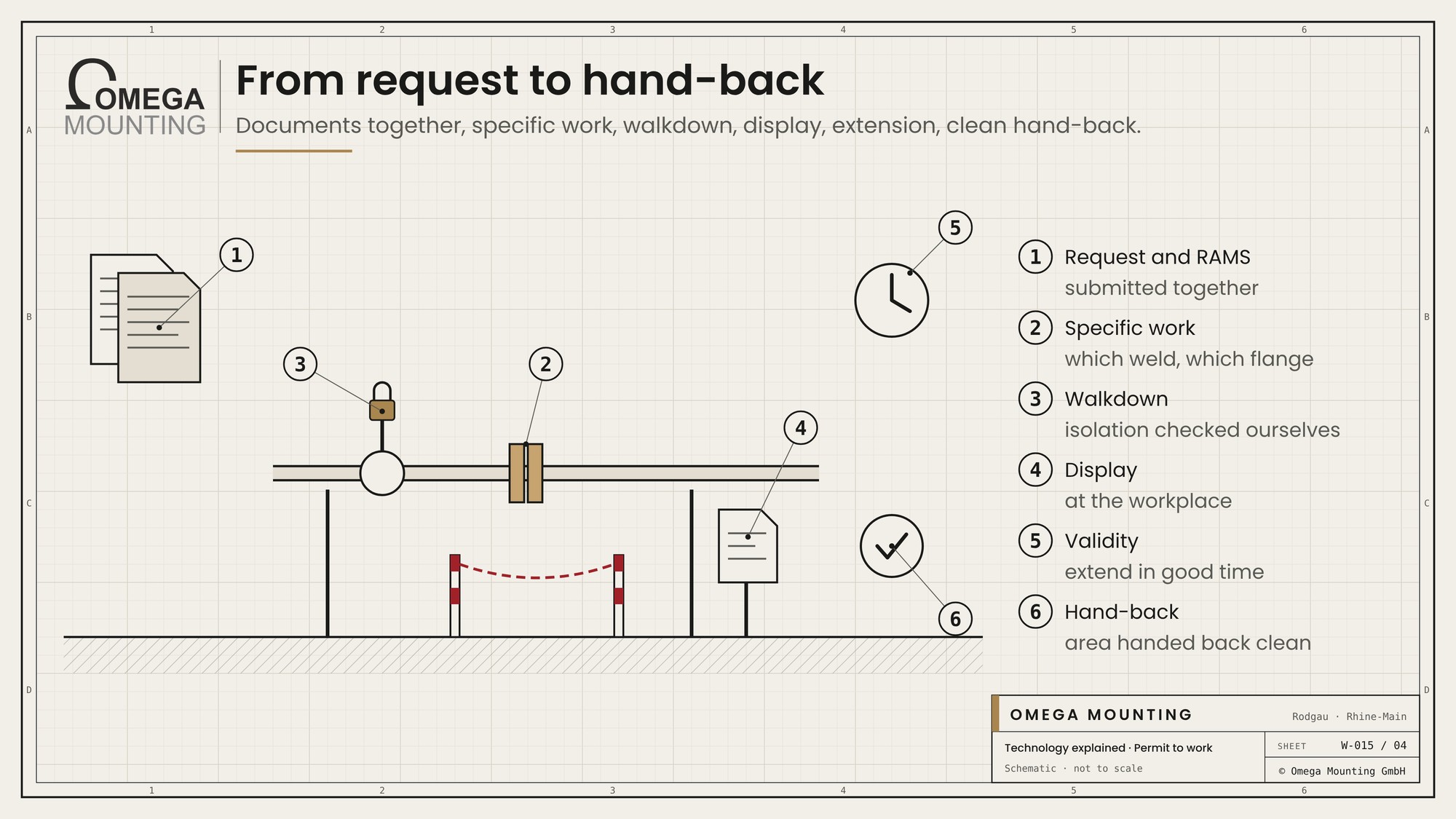
A permit passes through seven steps, and the first often comes days before anyone picks up a tool.
- Submit RAMS. The risk assessment and method statement have been submitted to the operator and accepted.
- Apply for the permit. The contractor enters location, task, period and team, and states the permit type.
- Joint inspection. Issuer and foreman check at the workplace that the controls are in place: isolated, barriered off, extinguisher present, gas detector calibrated?
- Sign-off. Both sign. Only now does work begin – for hot work, only once the fire watch is in position.
- Work under the permit conditions. The permit is displayed at the work area. If the situation changes – for example, a second trade starts work in the same room – work stops and the permit is reassessed.
- End of shift or extension. When validity runs out, the permit is extended or a new one is requested; there is no quietly carrying on.
- Hand-back and close-out. The foreman hands the area back, and the issuer inspects it and closes the permit. Only then may the plant return to its normal state.
Where do things get stuck in practice?
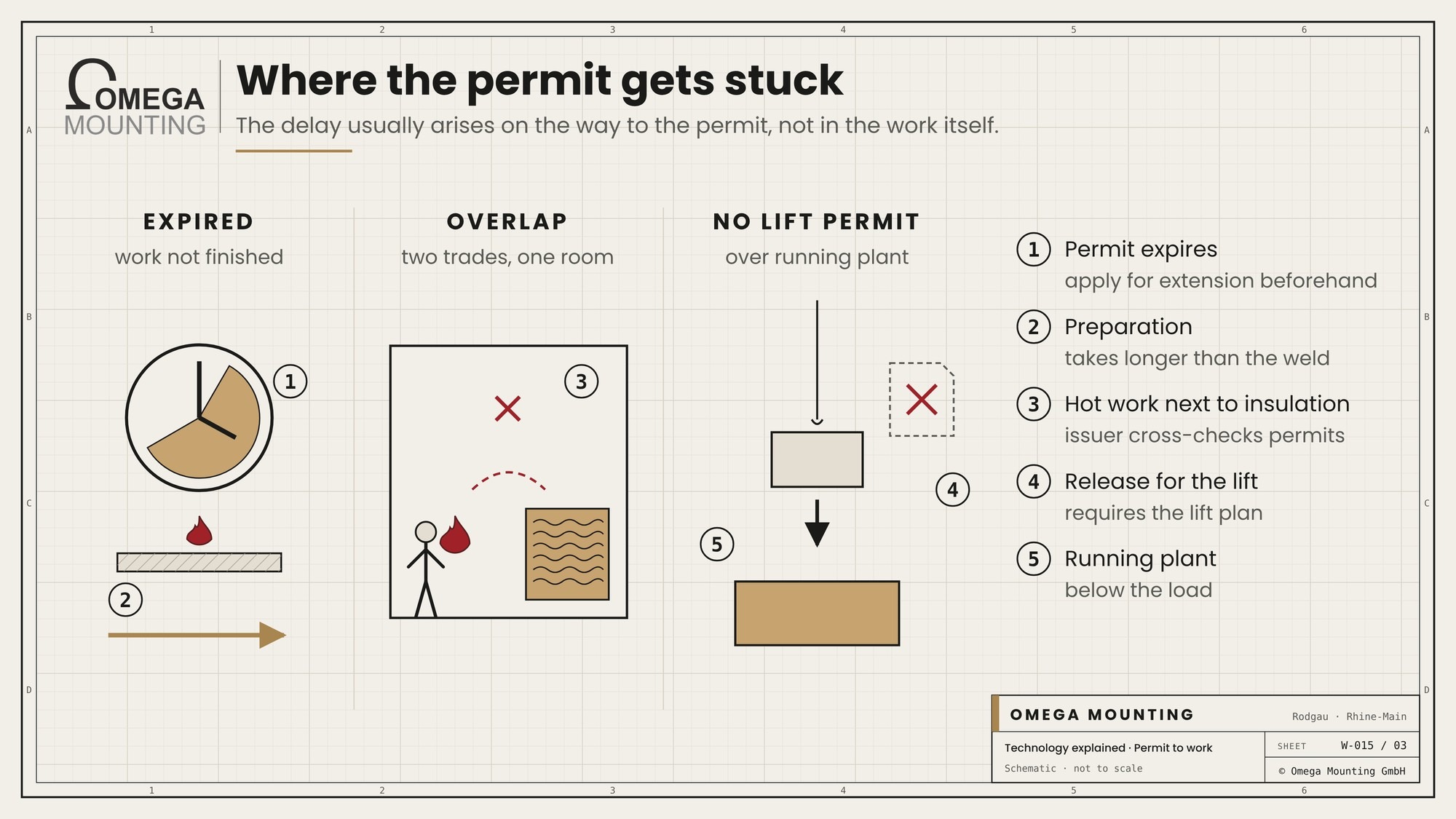
Most delays on permit sites are caused not by the work itself but by the route to the permit. We see three patterns again and again.
- The permit expires before the work is done. Especially with hot work, where preparation takes longer than the weld itself. Request the extension before expiry, not after.
- Trades overlap. A hot work permit in a room where another team is laying insulation at the same time is a contradiction. The issuer checks permits against each other – and the contractor helps by reporting the conflict.
- The permit for the lift is missing. Many people think of welding and electricity when they hear “permit”, not of the crane. A lift over live plant needs its own authorisation, and that requires the lift plan.
Then there is the difference between the systems: few written permits in German plants, many permits with operators following UK or US practice. Both are occupational safety, just organised differently – if you know this, you plan in the lead time.
What we pay attention to
Our fitters treat the permit like a tool: it is ready before work starts, not fetched when it is needed.
- We submit RAMS and the permit application together, so the issuer does not have to ask for missing controls.
- We describe the work precisely – which weld, which flange, which line – instead of “installation work”.
- We attend the joint inspection, check isolation and barriers ourselves and only sign once both are in place.
- We display the permit at the work area and report every change, even if another trade caused it.
- We request the extension before validity ends – or let the permit lapse and start again cleanly.
- We only hand the area back once tools, covers and barriers are gone and the plant is in its normal state.
Where we use it
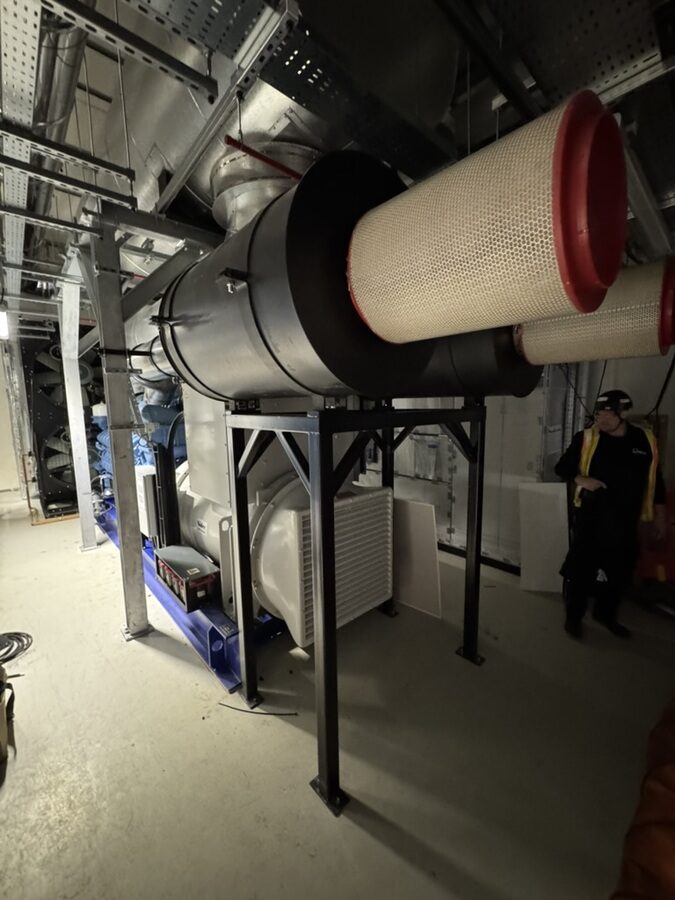
In the Rhine-Main region, permit systems are everyday practice in data centers and at the airport. During the installation of twelve turbo silencers in a data center in Offenbach we worked in the generator rooms next to live critical infrastructure – we know the safety, access and permit processes this involves. The welding of a sump on a test rig in a basement room, with fume extraction, fresh-air supply and fire protection, is exactly the kind of hot work a hot work permit is meant for. During the installation of a nitrogen fire suppression system in a data center near Frankfurt with an operating pressure of around 300 bar, sign-off by operations is as much part of the process as the leak test on every fitting. We carry out jobs like these as industrial installation in existing buildings – with fitters who know what a permit requires.
More technology explained
Technology explained
the evidence process in which permits are requested again for every test.
Technology explained
the equipment a working at height permit assumes.
Guide
the guide to isolation, which appears in the permit as a control.
Need fitters who know this process?
Planning a project that requires a permit-to-work system, and need fitters who know it and plan in the lead time? We bring RAMS, the application and the joint inspection, and we keep to the conditions. Request a callback – we will get back to you.
Free, no-obligation callback

About the author
Tobias Schott
Managing director of Omega Mounting GmbH, Rodgau · more than 20 years of hands-on experience in installation and maintenance
A trained mechatronics technician, working in maintenance, servicing and industrial installation since 2004 – first alongside his father, and with Omega Mounting since 2012: from overhead conveyors in Frankfurt to the crane system in a new-build hall. He plans and leads lifting operations as an appointed person (AP) in data centers and on industrial sites in the Rhine-Main region, trains and examines operators of cranes, mobile elevating work platforms and telehandlers, and is a qualified occupational safety specialist. On jobs abroad he is known as the “German Troubleshooter” – the person you call when a site gets stuck. He learned what quality means from his father, not from a manual: Made in Germany as a standard for his own work, not a label. That is why quality comes first at Omega Mounting – ahead of speed and price. The Technology explained articles cover the equipment and techniques his team uses every day: what counts on site is in them – what only appears in the brochure is not.
Frequently asked questions
Yes. The permit is always issued by the operator or the issuer they appoint, never by us. We submit RAMS together with the permit application, attend the joint inspection at the workplace, display the permit at the work area and request extensions before it expires. When the work is finished, we hand the area back with tools, covers and barriers removed and the plant in its normal state.
Often, yes. Many operators require a lifting permit for crane lifts, tandem lifts and lifts over live plant or traffic routes. It builds on the lift plan, the appointed person for lifting operations, an exclusion zone and weather limits. UK readers: lift planning by an appointed person follows BS 7121-1 and LOLER 1998 regulation 8.
 English
 German