
- Technology explained – equipment and protection
Fall arrest PPE: harness, lanyard, self-retracting lifeline – what each part does
By Tobias Schott · 8-minute read · Updated October 2026
Fall protection PPE only protects if harness, lanyard, energy absorber and anchor point fit together as one system. The tender says “work with fall protection PPE”, on site you see the fitter in a harness with a line to the girder. In between lies knowledge that is in no specification: what each part does, how much space a fall needs and what happens afterwards.
This article explains components, basic principles and inspection. How to organise fall protection on an installation job is covered in the guide to fall protection PPE for installation work.
What is fall protection PPE (PSAgA)?
Fall protection PPE (German: PSAgA) is personal protective equipment against falls from height: a system of full-body harness, lanyard and anchor device that either prevents a person from falling or arrests a fall in a way they can survive. In English the system is called “fall protection equipment”, the harness a “fall arrest harness”, the line a “lanyard” and the self-retracting device a “self-retracting lifeline”, SRL for short.
Fall protection PPE is at the very bottom of the hierarchy of protective measures. First comes collective protection – guardrails, edge protection, safety nets, work platforms with a basket – which protects everyone without anyone having to put anything on. Only where that is not possible does the individual secure themselves with PPE. This hierarchy, the STOP principle, is explained in the guide.
Key facts
- Purpose: Prevents the fall (restraint) or limits it so that the person can withstand the fall distance and arrest force (fall arrest).
- Types: Full-body harness, lanyard with energy absorber, self-retracting device, guided type fall arrester, anchor device, karabiner.
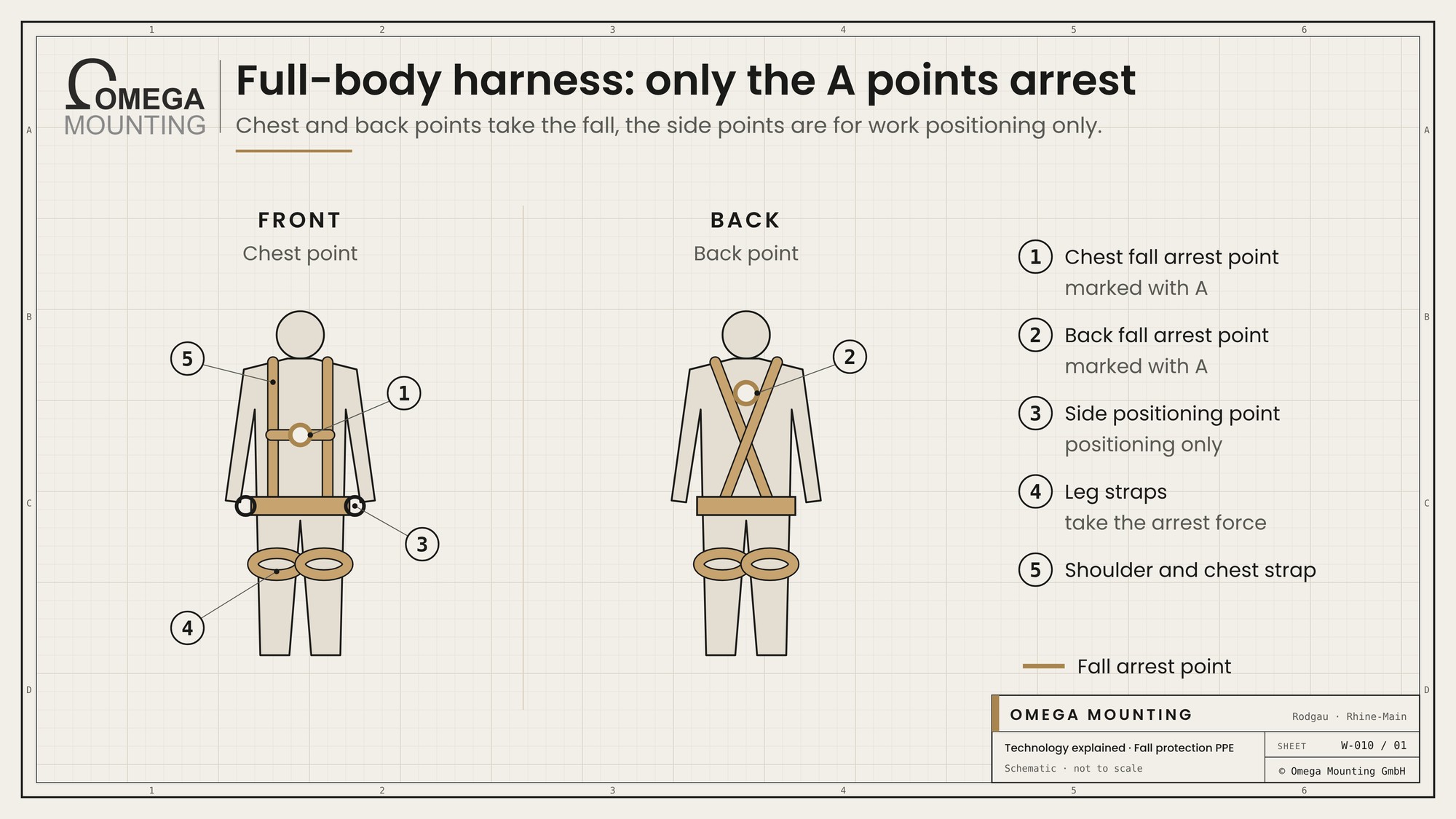
- Marking: CE mark, standard, manufacturer’s data, year of manufacture or serial number, permitted user weight; fall arrest points on the harness are marked with an “A”.
- Inspection duty and interval: Visual and function check by the user before every use; inspection by a competent person at least once a year and after every fall – based on DGUV Rule 112-198 on the use of fall protection PPE.
- Discard criteria: After a fall, in case of cuts, frayed seams, deformed metal parts, contact with chemicals or heat, illegible marking or expired service life according to the manufacturer.
- Operator qualification: Instruction with practical exercises before first use; anyone wearing fall protection PPE must be able to be rescued.
Which parts make up fall protection PPE – and what does each do?
Fall protection PPE consists of five building blocks, and each has exactly one job: the harness spreads the force over the body, the lanyard connects, the energy absorber brakes, the self-retracting device shortens the fall, the anchor point holds everything.
The full-body harness surrounds shoulders, chest and thighs with webbing. Only the fall arrest points on the back or chest marked “A” may take the fall. Side points on the waist belt are positioning points – arresting a fall there injures the spine.
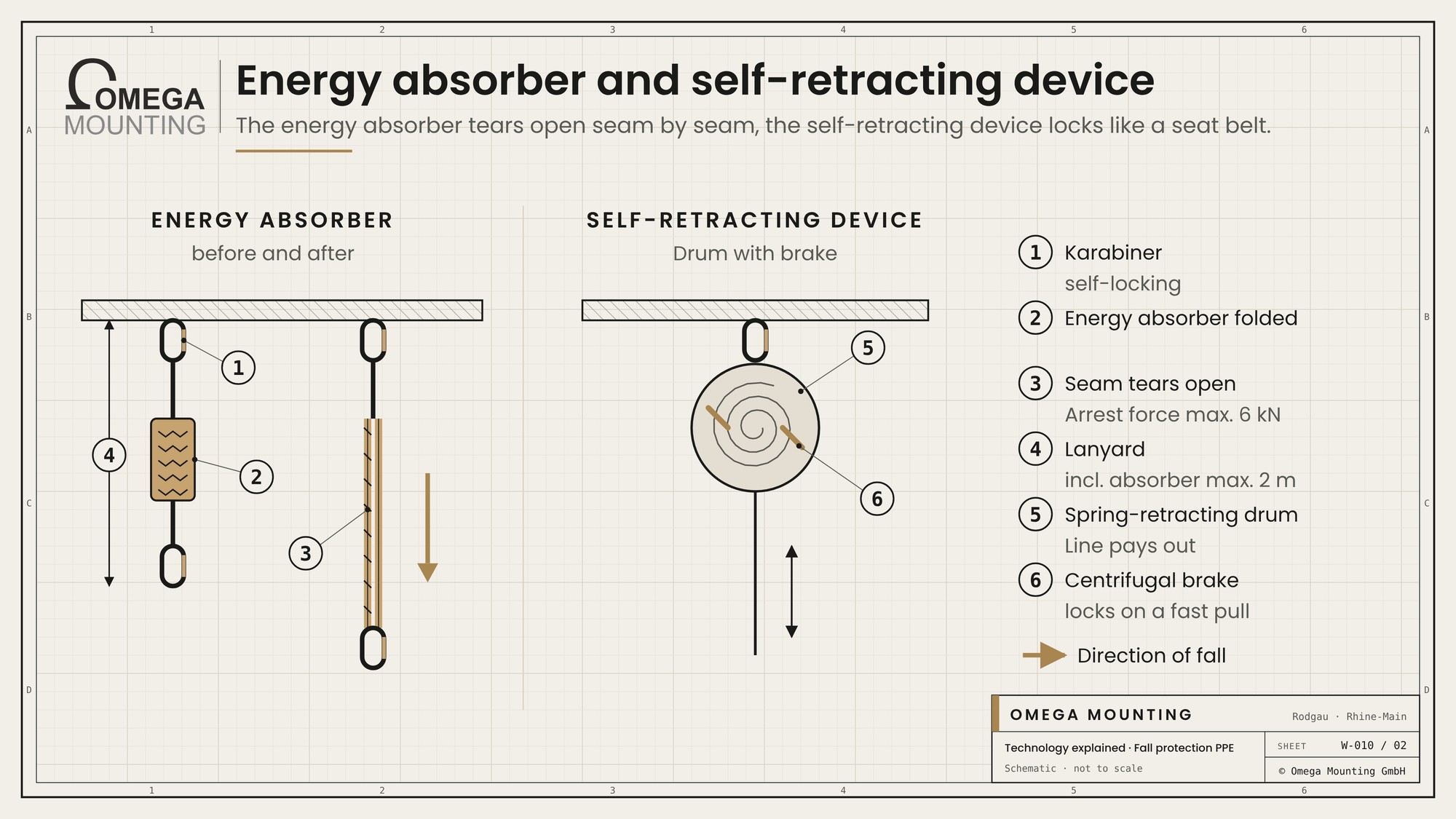
The lanyard is the line between harness and anchor point. In a fall arrest system it always has an energy absorber: a folded, stitched strap that tears open seam by seam during a fall and so limits the braking force. The standard for energy absorbers, EN 355, allows an arrest force of no more than six kilonewtons; lanyards including absorber may be no longer than two metres according to EN 354.
The self-retracting device, SRL for short, replaces the fixed line with a rope or strap on a spring-retracting drum. It pays out during work, keeps the connection taut and locks on a fast pull via a centrifugal brake – like a seat belt in a car. Devices used horizontally over an edge must be tested for that.
The guided type fall arrester slides along a guide – a rail or rope on fixed ladders, or a flexible kernmantle rope – and clamps in a fall. The anchor device is the point everything hangs on: an eye on steelwork, an anchor sling around a girder, a tripod or a horizontal lifeline; the requirements are in standard EN 795. Karabiners must be self-closing and self-locking.
| Part | Task | Typical mistake |
|---|---|---|
| Full-body harness | Spreads the arrest force over thighs, pelvis and chest and keeps the body upright after the fall. | Worn too loose; lanyard on the side positioning point instead of the fall arrest point. |
| Lanyard with energy absorber | Connects harness and anchor point and limits the braking force in a fall. | Line led over a sharp edge; absorber shortened by tying a knot. |
| Self-retracting device | Keeps the connection taut and stops the fall after a short distance. | Anchored to the side or below the user; device used horizontally without edge testing. |
| anchor device | Takes up the forces of the fall and transfers them into the structure. | Anchored to a pipe, cable tray or guardrail without proof of capacity. |
| Karabiner | Connects the parts detachably and securely. | Gate not locked; loaded across its axis. |
Restraint, fall arrest, work positioning: what distinguishes the three systems?
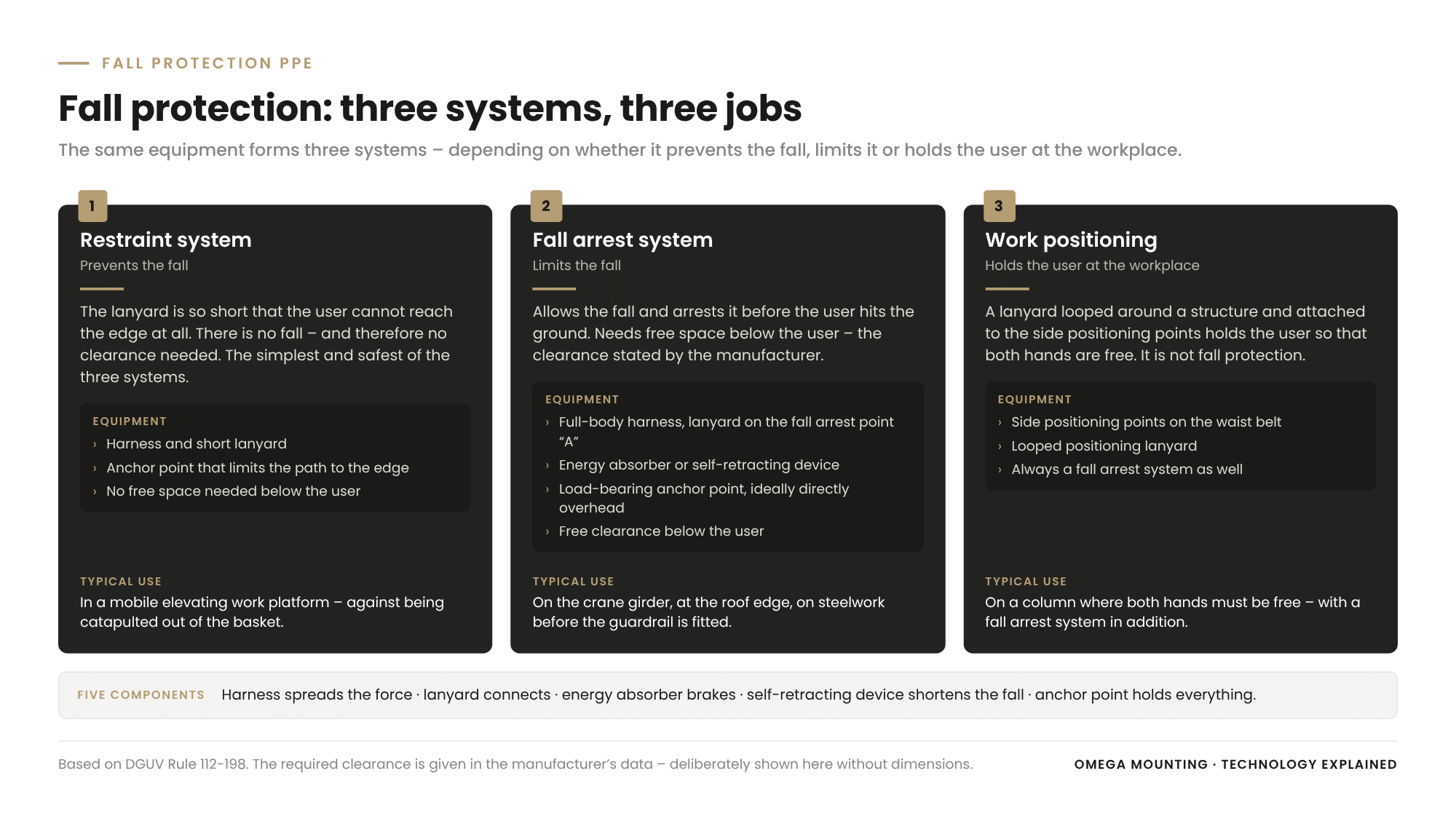
The same equipment forms three systems, depending on whether it prevents the fall, limits it or holds the user at the workplace. The restraint system is the simplest and safest: the lanyard is so short that the user cannot reach the edge at all. It needs no clearance because there is no fall. That is how we work in a mobile elevating work platform – against being catapulted out of the basket.
The fall arrest system allows the fall and arrests it. It needs a full-body harness, an energy absorber or self-retracting device, a load-bearing anchor point and free space below the user. In return it allows work where restraint is not enough: on the crane girder, at the roof edge, on steelwork before the guardrail is fitted.
Work positioning holds the user with a lanyard looped around a structure and attached to the side positioning points so that both hands are free – for example on a column. It is not fall protection; every positioning set-up also needs a fall arrest system.
What happens in a fall – clearance, swing fall, suspension trauma?
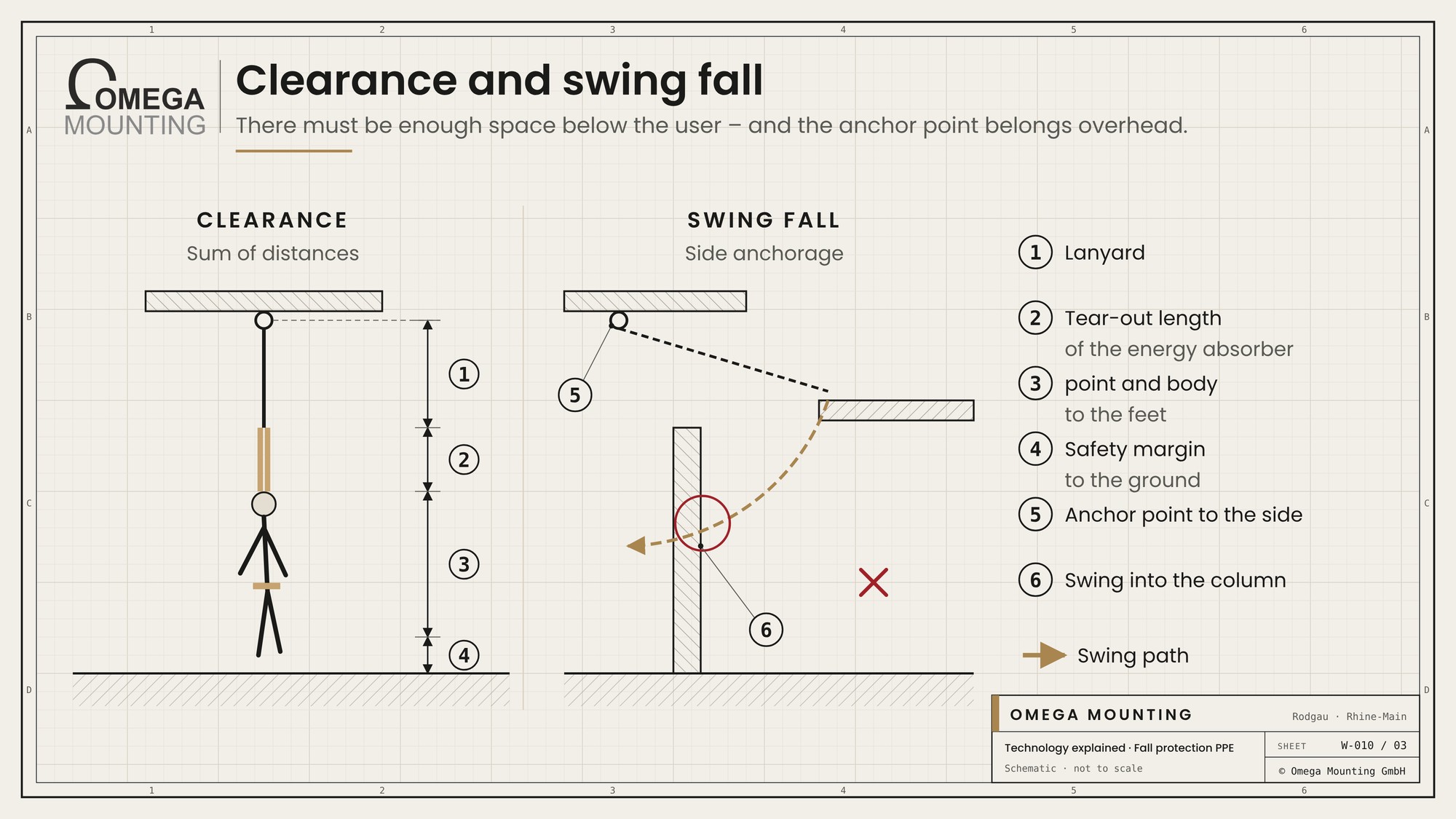
A fall into a fall arrest system needs free space below the user, and this space is larger than most people think. The fall distance includes the length of the lanyard, the tear-out length of the energy absorber, the shift of the attachment point on the body and a safety margin to the ground. This sum – the required clearance – is given in the manufacturer’s data. If the clear height is not enough, the user hits the ground before the system engages; then a self-retracting device or a restraint system is needed.
The swing fall is the second hazard. If the anchor point is to the side instead of above the user, they swing into a column, wall or girder after the fall, and the line chafes over edges. Hence the rule: anchor point directly overhead wherever possible.
After the fall the user hangs in the harness – and now the clock is ticking. The leg straps press on the blood vessels, blood pools in the legs and after a short time suspension trauma with circulatory failure threatens. Anyone using fall protection PPE therefore needs a practised rescue plan: a second person within calling distance, a rescue device for lowering or raising, relief straps on the harness to take the load off the legs. DGUV Rule 112-199 on rescue from heights and depths describes these plans. An emergency call alone is not enough, because the response takes longer than a suspended person can wait. This is not legal advice but site practice.
When is fall protection PPE ready for discard – and who inspects it?
Fall protection PPE is ready for discard as soon as damage or an event could reduce its protective effect, and the first to decide is the user before every use. They check webbing for cuts, abrasion and melted fibres, seams for pulled threads, metal parts for deformation and corrosion, karabiners for secure locking. On a self-retracting device they pull the line out sharply and check that the brake locks.
Any equipment that has arrested a fall must be discarded – even if it looks undamaged. Add to that contact with chemicals, heat from welding spatter or grinding sparks, UV light and the end of the service life set by the manufacturer. If the marking is missing, the equipment is also taken out of use.
The second level is the competent person for fall protection PPE. They inspect every item at least once a year and after every fall, document date and findings and release it or discard it. The manufacturer’s data specify what they inspect and which parts they may replace – for self-retracting devices often only the manufacturer.
What we pay attention to
Our fitters treat fall protection PPE like a tool with an expiry date: every set has an inspection record and a fixed place in the vehicle.
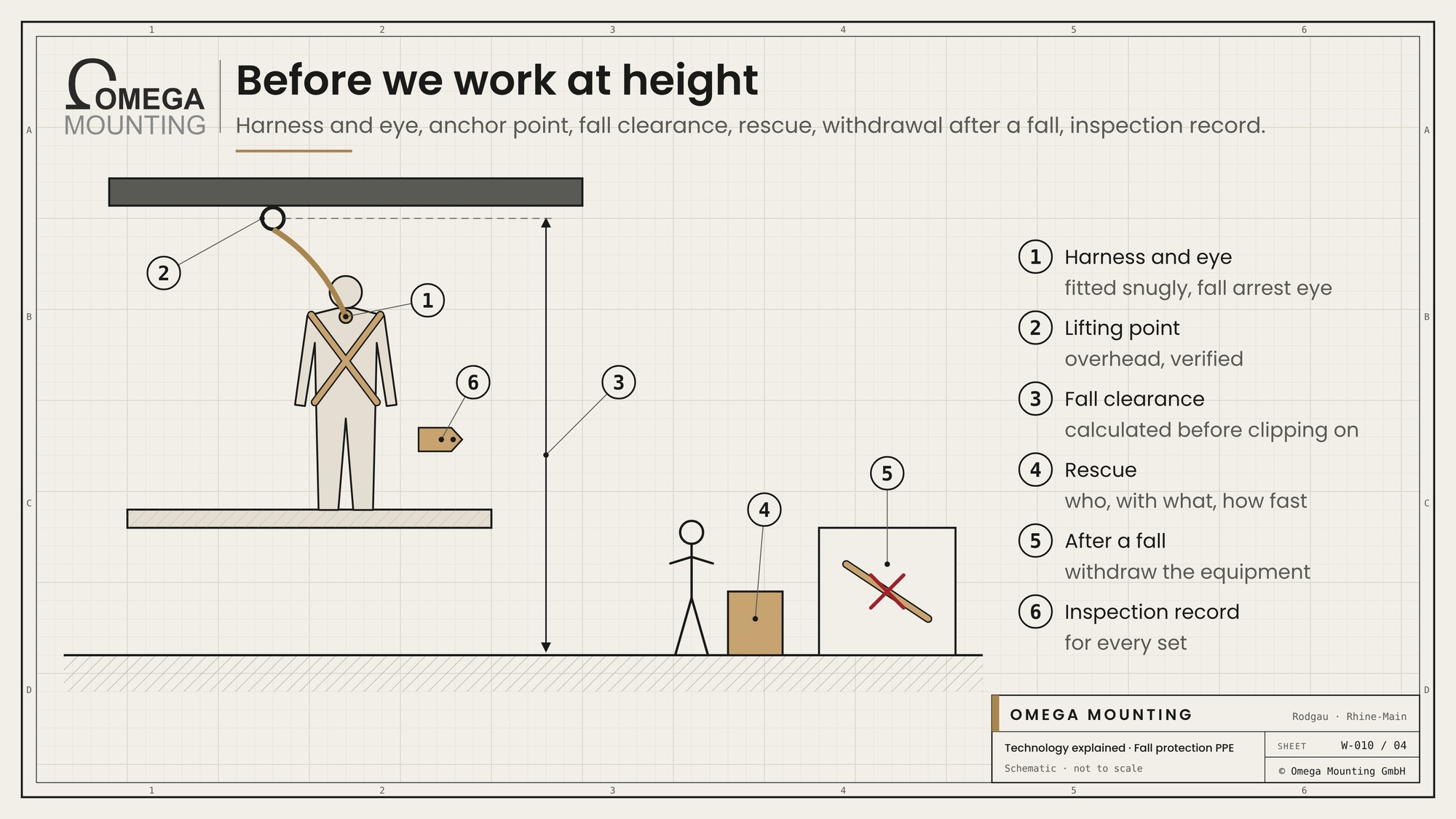
- We put the harness on tight and check each other that the lanyard is on the fall arrest point, not the positioning point.
- We look for an anchor point overhead and ask for proof of load-bearing points on the structure – pipes, cable trays and guardrails are off limits.
- We calculate the clearance from the manufacturer’s data before we clip in; if the height is not enough, we switch to a self-retracting device or restraint system.
- We plan the rescue before the first step up: who rescues, with what, how quickly. Nobody works alone at height with us.
- We discard every piece of equipment after a fall and take it to the competent person instead of back into the box.
Where we use it
In the Rhine-Main region fall protection PPE is part of every installation where there is no guardrail. On the installation of a 16-tonne crane at a height of over 30 metres three fitters worked for a day where only their own fall protection stood between them and the hall floor. On the Steel platform at Kassel Airport we fit guardrails and stairs as soon as the first floor plates are down – collective protection grows with the platform, the PPE bridges the time before. On the maintenance of an overhead monorail system in Frankfurt our technicians work from mobile scaffolds and ladders on around 100 switches below the hall ceiling. We plan and carry out such work in the area of Steel structures and work platforms; which system hangs where is set beforehand in the risk assessment.
More technology explained
Technology explained
collective protection, which often replaces fall protection PPE, and the restraint system in the basket.
Technology explained
textiles under load, edge protection and discard.
Guide
the guide to organisation: risk assessment, hierarchy, permit.
Do you have questions about how this works on your site?
Do you have questions about how fall protection works on your site or which system suits your structure? We look at anchor points, clearance and rescue route together with you. Request a callback – we will get back to you.
Free, no-obligation callback

About the author
Tobias Schott
Managing director of Omega Mounting GmbH, Rodgau · more than 20 years of hands-on experience in installation and maintenance
A trained mechatronics technician, working in maintenance, servicing and industrial installation since 2004 – first alongside his father, and with Omega Mounting since 2012: from overhead conveyors in Frankfurt to the crane system in a new-build hall. He plans and leads lifting operations as an appointed person (AP) in data centers and on industrial sites in the Rhine-Main region, trains and examines operators of cranes, mobile elevating work platforms and telehandlers, and is a qualified occupational safety specialist. On jobs abroad he is known as the “German Troubleshooter” – the person you call when a site gets stuck. He learned what quality means from his father, not from a manual: Made in Germany as a standard for his own work, not a label. That is why quality comes first at Omega Mounting – ahead of speed and price. The Technology explained articles cover the equipment and techniques his team uses every day: what counts on site is in them – what only appears in the brochure is not.
 English
 German