
- Technology explained – equipment and protection
Round sling, webbing sling, chain sling: what each lifting accessory can do
By Tobias Schott · 8-minute read · Updated October 2026
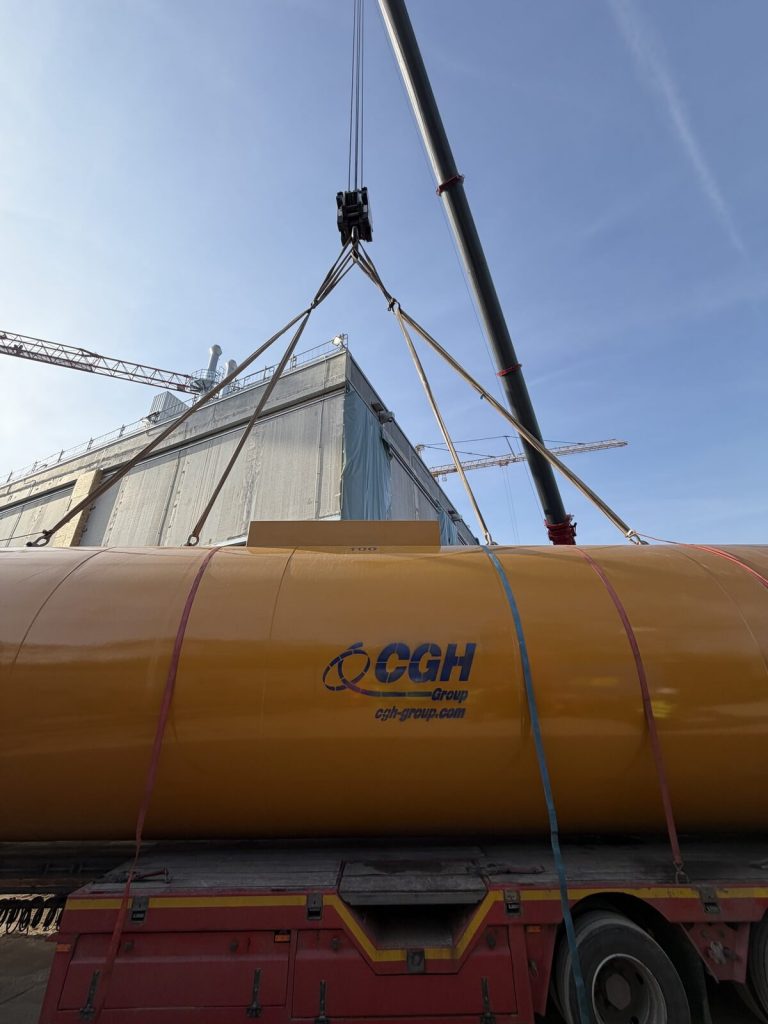
Round slings, webbing slings, chain slings and wire rope slings connect the load to the crane hook. Each has a strength, a weakness and a limit, and the limit is on its label. If you order or oversee lifting work, you see them on every lift: the brightly coloured round sling, the flat webbing sling, the chain sling with its hooks. Tenders call them lifting accessories; on site they are “the sling” or “the chain”.
This article explains how each accessory is built, what its marking means and why the same accessory carries different loads depending on how it is slung. Choosing the right one for your load is covered in our guide on lifting accessories for heavy loads, so we do not repeat it here.
What is a round sling – and how does it differ from a webbing sling and a chain sling?
A round sling is an endless coil of polyester yarn inside a protective sleeve, used as a closed loop around the load or in the hook. A webbing sling is a flat woven strap with reinforced eyes at both ends. A chain sling has a master link, one to four chain legs and hooks or other fittings at the ends.
All three are lifting accessories: detachable connections between the crane hook and the load.
Key facts
- Purpose: Connects crane hook and load; takes the lifting force and transfers it into the lifting points or around the load
- Types: Round sling (endless, textile), webbing sling (flat, textile, with eyes), chain sling (steel, one to four legs), wire rope sling (wire rope with ferrules or splice), shackle as connecting fitting
- Material and temperature: Polyester tolerates frost and moderate warmth but not heat; grade 8 chain works well above that but gradually loses capacity at high temperatures
- Marking: Sewn label (textile) or tag (chain, rope) showing capacity per slinging method, material, standard, manufacturer and CE mark; round sling colour shows capacity to EN 1492
- Inspection duty and interval: Pre-use check by the slinger every time; inspection by a competent person (befähigte Person) at least once a year, plus a crack test on chains at longer intervals – based on DGUV Rule 100-500. UK: LOLER requires a thorough examination of lifting accessories at least every 6 months
- Discard criteria: Cuts or exposed core on textile; missing label; on chains stretch, deformation, cracks, hooks with opened throats; on wire rope broken wires and kinks

How are round slings, webbing slings, chain slings and wire rope slings built?
Each lifting accessory carries the load in its own way, and that defines its strengths and weaknesses. A round sling carries on many parallel layers of yarn inside; the protective sleeve carries nothing. If the core shows through the sleeve, the sling must be discarded.
A webbing sling is woven in one or more plies and has sewn eyes at the ends. It lies flat against the load and spreads the pressure over a larger area. It is vulnerable to edges running along the webbing and to twisting in the hook.
A chain sling uses grade 8 round steel chain to EN 818. One to four legs hang from the master link, with hooks at the ends and often shortening clutches. A clutch shortens a leg link by link – that is how we level a load with an off-centre centre of gravity.

A wire rope sling is a wire rope with eyes formed by ferrules or a splice. It handles edges better than webbing and is lighter than chain, but it is sensitive to kinks and tight bends. The shackle is the detachable connecting fitting between sling and lifting point. It counts as a lifting accessory and is inspected like one. A D-shackle is straight; a bow shackle is widened to take round slings.
| Lifting accessory | Strength | Weakness | Typical use |
|---|---|---|---|
| Round sling | Light, flexible, kind to coated surfaces; capacity shown by colour | Sharp edges, heat, chemicals; core hidden from view | Painted machines, vessels, lifting points with shackles |
| Webbing sling | Wide contact face, low surface pressure; good in a basket hitch around smooth loads | Edges along the webbing, twisting, UV ageing | Pipes, vessels, packed machines |
| Chain sling | Edge-resistant, heat-resistant, adjustable length; capacity stays stable under rough site use | Heavy, noisy, marks paint and coatings | Steel components, cable drums, containers with fixed eyes |
| Wire rope sling | Handles edges better than textile, lighter than chain, high strength at small diameter | Kinks, tight bends, broken wires; length not adjustable | Long loads, spreader beams, continuous use on the crane hook |
What does the marking tell you – label, tag and colour code?
The marking is the accessory's ID: without a label or tag there is no rated capacity, and the accessory must not be used. On textile slings the label is sewn in; on chain and wire rope slings a tag hangs from the master link.
It shows the capacity per slinging method, the material, the standard, the manufacturer, a traceability number and the CE mark. Chain tags add the grade, number of legs and permitted leg angle. Many companies add the inspection date with a sticker.

The colour of a round sling shows its capacity in a straight vertical lift, following a fixed system set by the standard:
| Round sling colour | Capacity in a straight lift |
|---|---|
| Violet | 1 tonne |
| Green | 2 tonnes |
| Yellow | 3 tonnes |
| Grey | 4 tonnes |
| Red | 5 tonnes |
| Brown | 6 tonnes |
| Blue | 8 tonnes |
| Orange | 10 tonnes |
Above ten tonnes the sleeve stays orange, and the capacity is shown only on the label. The label on textile slings is colour-coded too: blue for polyester, green for polyamide, brown for polypropylene.
Why does the same round sling carry one tonne on one lift and two tonnes on another?

The capacity on the label applies to a straight vertical lift; every other slinging method changes it by a fixed factor. In a choke hitch – the sling pulled through its own eye – 80 % of the capacity remains. In a basket hitch – U-shaped under the load with both ends in the hook – the same sling carries twice as much.
The leg angle comes on top. When two legs hang at an angle, the force in each leg rises with the angle from the vertical. The German guidance for slingers, DGUV Information 209-021, gives the mode factors: two legs up to 45 degrees 1.4, between 45 and 60 degrees only 1.0; three and four legs 2.1 and 1.5 respectively. A four-leg sling is rated like a three-leg sling, because all four legs rarely share the load equally. Above 60 degrees, slinging is not permitted.
In practice, a wide, flat sling arrangement looks harmless but is the more dangerous one. A near-vertical arrangement needs headroom – if there is none, a spreader beam keeps the legs vertical. The ratio between breaking force and capacity differs by material: a safety factor of 7 for textile, 5 for wire rope and 4 for chain. That is why a ten-tonne round sling is so thick and a chain so slim.
When must a lifting accessory be discarded – and who decides?
A lifting accessory must be discarded as soon as damage could reduce its capacity. The first judge is the slinger, during the pre-use check before the lift. On textile, that means cuts, abrasion, melted spots, knots and an exposed core. Chains have clear limits: more than 5 % stretch in a leg or more than 10 % opening of the hook throat. On wire rope, broken wires, birdcaging, kinks and corrosion count.

The second check is the competent person, who inspects the accessory at least once a year and records the result. Chains also get a crack test at longer intervals, because hairline cracks cannot be seen with the naked eye. An accessory without a legible label is withdrawn, even if it looks new. That is site practice, not legal advice.
Edge protection prevents early discard. An edge with a small radius cuts textile under load, and the cutting force rises with angled pull. Protective sleeves, corner pads and timber packing spread the force. Chain resists edges itself but does not protect the load – there, timber goes between steel and paint.
What we pay attention to
Our fitters check every lifting accessory twice: when it is loaded into the van and when it goes on the hook.

- We read the label, not the colour: the colour shows the class, the label the capacity per slinging method.
- We calculate the leg angle before the lift, not once the load hangs crooked; if there is not enough headroom, we plan in a spreader beam.
- We sling from lifting points – never around painted casings, cladding or pipework.
- We put edge protection under every textile sling that touches an edge, even if the edge looks blunt.
- We screw the shackle pin fully home and back it off a quarter turn so it does not jam under load.
- We immediately withdraw textile with cuts, chain with stretch and any accessory without a label – into the scrap bin, not into a corner.
Where we use it
In the Rhine-Main region, almost every lift we do hangs on one of these connections. When five diesel tanks were installed in Raunheim, each tank weighed about 16 tonnes and was lifted by an arrangement of round slings and shackles on four welded-on lifting points. A round sling around the shell was ruled out because of the coating. On standby generator installations we use chain rather than round slings wherever edges are sharp. A cable drum at an inland port on the Main weighing about 22 tonnes hung from the chain sling on the spreader of the handling machine. We plan and carry out these lifts as part of Lift & Shift; the appointed person for lifting operations decides beforehand which accessory with which capacity is used.
More technology explained
Technology explained
the crane hook that every lifting accessory hangs from.
Technology explained
the lifting appliance for interiors, where every centimetre of headroom counts for the sling arrangement.
Guide
the guide to choosing, for when you have to decide.
Do you have questions about how this works on your site?
Questions about slinging on your site, or which sling arrangement suits your load? We look at the load, lifting points and headroom together with you. Request a callback – we will get back to you.
Free, no-obligation callback

About the author
Tobias Schott
Managing director of Omega Mounting GmbH, Rodgau · more than 20 years of hands-on experience in installation and maintenance
A trained mechatronics technician, working in maintenance, servicing and industrial installation since 2004 – first alongside his father, and with Omega Mounting since 2012: from overhead conveyors in Frankfurt to the crane system in a new-build hall. He plans and leads lifting operations as an appointed person (AP) in data centers and on industrial sites in the Rhine-Main region, trains and examines operators of cranes, mobile elevating work platforms and telehandlers, and is a qualified occupational safety specialist. On jobs abroad he is known as the “German Troubleshooter” – the person you call when a site gets stuck. He learned what quality means from his father, not from a manual: Made in Germany as a standard for his own work, not a label. That is why quality comes first at Omega Mounting – ahead of speed and price. The Technology explained articles cover the equipment and techniques his team uses every day: what counts on site is in them – what only appears in the brochure is not.
Frequently asked questions
The appointed person for lifting operations decides before the lift which accessory with which capacity is used, how it is slung and at what leg angle. We calculate the angle before the load is on the hook and plan in a spreader beam if there is not enough headroom for a near-vertical arrangement. The slinger checks every accessory and its label before use.
Yes. We put edge protection under every textile sling that touches an edge – even one that looks blunt. Where there is not enough headroom for a near-vertical sling arrangement, or a long load must hang level, we plan a spreader beam into the lift. Only beams with a rating plate, CE marking and a current inspection go on the hook.
Yes. Every sling, chain and shackle we use is inspected by a competent person at least once a year under German rules, and the result is recorded. The inspection certificates are available in English or bilingual and go into the documentation with the RAMS and lift plans. Note for UK-run sites: LOLER requires a thorough examination of lifting accessories at least every six months – if your site rules apply that interval, agree it before mobilisation.
 English
 German