
- Technology explained – machines and equipment
Mobile Crane, Crawler Crane, All-Terrain Crane: Which Crane Does What – and What It Does Not
By Tobias Schott · Reading time approx. 8 minutes · Last updated: October 2026
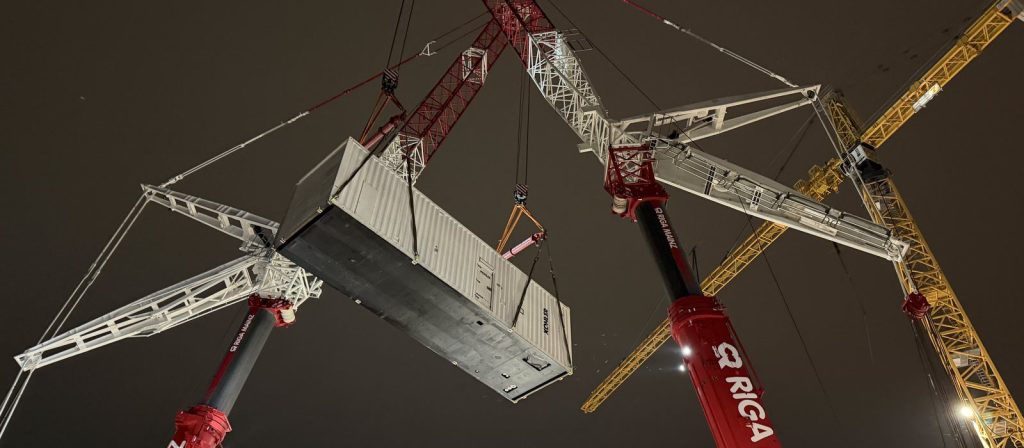
A mobile crane is the crane that drives to the site on its own axles, sets up on its outriggers and drives away again after the lift – and its limit is almost never the capacity but the radius and the ground it stands on.
You will come across the mobile crane in every tender in which something heavy has to go over a façade, into a shaft or onto a roof. Alongside it are terms such as all-terrain crane, crawler crane and loader crane, which are often mixed up. Anyone who separates them cleanly understands why a crane company sends a machine with a capacity of many hundreds of tonnes for a 16-tonne load.
We do not drive cranes. We plan and lead the lift, sling the load and give the signals. That is why we need to know what each type can do and where it stops.
What is a mobile crane?
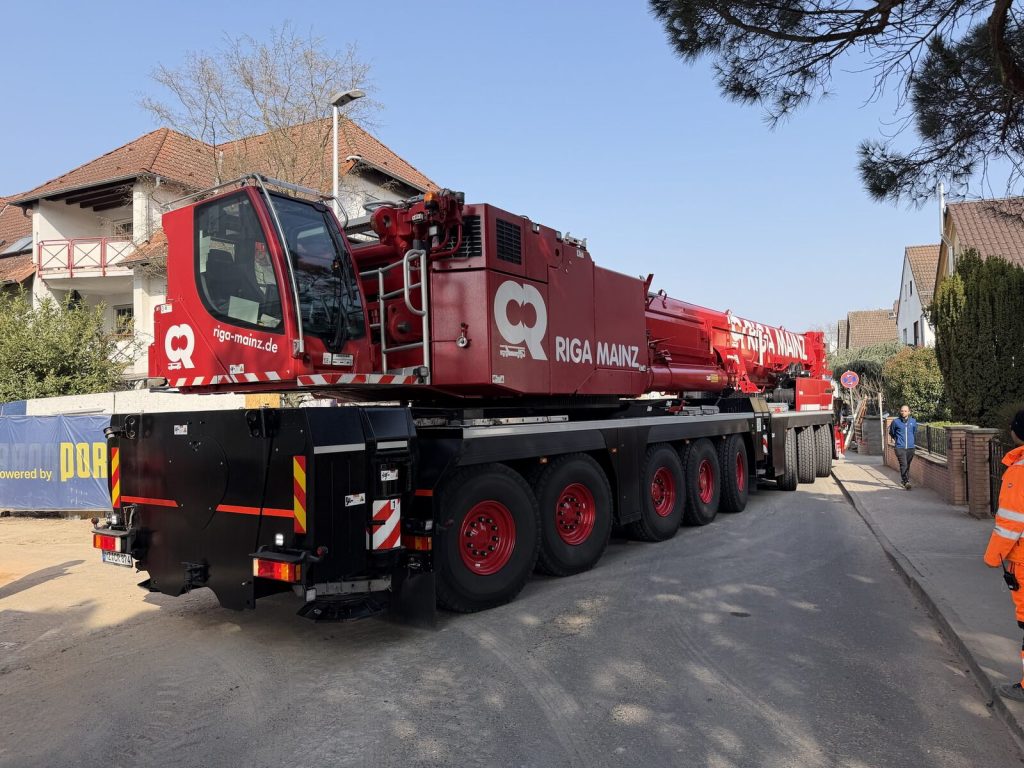
A mobile crane is a crane with a telescopic boom on a road-going chassis that transfers its load into the ground via extended outriggers. Depending on the design it is called an all-terrain crane or a truck crane (crane on a lorry chassis). In the broad sense, mobile crane is the umbrella term for all cranes that change location under their own power – including the crawler crane and the mini crane. In everyday use, however, "mobile crane" usually means the all-terrain crane.
Profile
- Type: Telescopic boom on a multi-axle chassis, slewing superstructure, support via four extendable outriggers.
- Typical capacity: from a few dozen tonnes to well over a thousand tonnes rated load, whereby the rated load applies only at the smallest radius.
- Drive: Diesel engine for travel and crane operation, on large machines separate engines for carrier and superstructure.
- Field of use: Moving in over façades and through shafts, installation of plant on roofs, setting tanks and containers, crane construction at great height.
- Requirements: load-bearing crane set-up area, clear access, verified outrigger support with load spreading plates, distance to overhead lines, wind limit observed.
- Operator qualification: Crane operator from the crane company, trained and appointed in writing in accordance with the German crane regulation (DGUV Regulation 52); a named person is responsible for the lifting operation.
Mobile crane, all-terrain crane, crawler crane, loader crane: who belongs where?

Mobile crane is the umbrella term; all-terrain crane, crawler crane, loader crane and mini crane are the types beneath it – and each has a field in which it is superior to the others. The all-terrain mobile crane is the all-rounder: quick to arrive, quick to rig, sufficient for most industrial lifts. The crawler crane carries more, stands on its crawler tracks without outriggers and may travel with a load, but needs low-loaders, an assembly area and days for rigging. Its lattice boom is lighter than a telescopic boom and therefore has the advantage at great heights and radii.
The loader crane sits behind the cab of a lorry and loads what the lorry itself brings; its limit is the small load moment, stated in tonne-metres. The mini crane, also called a spider crane, is the only type that drives through a door into the building.
| Type | Field of use | Strength | Limit | Preparation |
|---|---|---|---|---|
| Mobile crane | Outdoor lifts over façade, shaft and roof; installation at great height. | Drives to site itself, rigs in hours, wide range of capacities. | Needs a level, load-bearing set-up area and space for the outriggers. | Clarify crane set-up area, access, ground verification, overhead lines. |
| Crawler crane | Very heavy loads, long standing times, lifts with travel under load. | Highest capacity, travels with load, manages without outriggers. | Delivered in parts, assembly area, days of rigging. | Low-loader logistics, assembly area, travel path for the crawler tracks. |
| Loader crane | Loading and unloading at the lorry, small installation lifts directly from the vehicle. | Transport and lift in one vehicle, no second machine. | Small load moment, low lifting height, little radius. | Standing place for the lorry, outriggers, know the load weight. |
| Mini crane | Interiors, basements, halls without a crane runway. | Fits through standard doors, electric operation possible. | A few hundred kilograms to a few tonnes, small outrigger area. | Check slab load, door widths, outrigger points. |
How does the crane carry the load? Load moment, radius, counterweight
A crane carries a load not according to its rated load but according to the load moment: the product of load weight and radius, i.e. the horizontal distance between the slewing centre and the hook. If the radius doubles, the permissible load halves. Any capacity figure without a radius is therefore worthless.
What the crane may do at which radius and boom length is stated in the manufacturer's load chart. It applies only to the configured rigging state: counterweight on the superstructure, outrigger base, boom length and, where applicable, fly jib. The counterweight balances the tipping moment of the load; without the right counterweight, no line of the chart is valid. The load moment limiter stops the movement before the crane tips – but it is no substitute for planning.
The outriggers bring the forces into the ground. At the four outriggers, support forces arise that reach many tonnes per outrigger depending on crane and load. Load spreading plates increase the contact area and reduce the ground pressure, i.e. the force per square metre. Whether the ground can take it is decided not by the surface but by what lies beneath: shafts, ducts, basement slabs, backfilled pits.
An example from our practice: for moving a standby power system into the second floor, around 16 metres lifting height, two mobile cranes with a capacity of 650 tonnes each were set up. This figure says less about the weight of the load than about the radius at which the work had to be done.
What is a tandem lift?
A tandem lift is a lift in which two cranes carry the same load at the same time because it is too heavy, too long or too bulky for one crane. The classic case is a long container that has to stay level and whose lifting points are far apart.
The tandem lift is more than two single lifts side by side. The load is distributed unequally between the two hooks according to the position of the centre of gravity, and every tilt shifts this distribution. That is why we calculate a surcharge on each crane's share of the load and keep both hooks plumb throughout the entire lift. Both cranes move only on command, and that command is given by exactly one person.
Which crane carries which share, in what order the load is raised, slewed and set down, and where the load can be set down if the lift is aborted, is stated in the lift plan, the written lifting plan. What this plan contains and who approves it is explained in the guide on the appointed person for lifting operations.
What must the operator prepare before the crane job?
Before the crane job, the operator must clarify four things: the crane set-up area, the access, the overhead lines and the weather. All four decide whether the crane ordered can work at all.
- Crane set-up area. It must be level, sufficiently large and load-bearing right down into the subsoil. A ground verification clarifies which support force the area can take; shafts and ducts beneath it are the most common surprise.
- Access. A mobile crane is manoeuvrable thanks to its all-wheel steering, but long. Turning radii, gates and barriers are measured, escort vehicles and counterweight trucks included.
- Overhead lines. Graduated safety distances of one to five metres depending on voltage apply to live lines; if the voltage is unknown, the largest value applies. Otherwise the line is switched off or barriered.
- Wind limit. The load chart applies only up to the wind speed stated in the operating manual – a common reference value is around nine metres per second. Large load surfaces such as containers reduce this limit considerably.
Added to this is the division of tasks, which we record in writing beforehand: the crane company provides crane, crane operator and counterweight and remains responsible for the safe operation of the machine. We plan the lift, determine lifting accessories and lifting points, sling, give the signals and release every lift. This is not legal advice but the division of labour that has proven itself on our sites.
What we pay attention to
On every crane job we check the same points, because that is where the errors accumulate.
- We ask about the set-up area first, then about the crane. The machine that just reaches from the permitted area is the right one – more capacity also means more weight, more outrigger area and more space for rigging.
- We read the load chart with the actual rigging state. Counterweight, outrigger base and boom length on site must match the line that the lift needs. Anything else is a calculation error.
- We calculate the load weight including lifting accessories, spreader beam and hook block. On a tandem lift, the surcharge for the unequal load distribution is added.
- We secure the set-up area against changes. An area that carries today no longer carries tomorrow if excavation takes place next to it.
- We check the lifting points before the hook arrives. Visual inspection and recalculation of the geometry are part of the release, even if the manufacturer of the load has specified the points.
- We stop the lift when an assumption no longer holds. Wind, visibility, a vehicle in the slewing range: the release applies only to the planned situation.
Where we use it
In the Rhine-Main region, mobile cranes are part of almost every lift & shift job we do, i.e. the lifting and relocation of heavy plant. During the tandem lift of a standby power system into the second floor two mobile cranes with a capacity of 650 tonnes each carried a container unit over the façade; the heaviest container solution we have moved in to date weighed 54 tonnes. When setting five diesel tanks into a pit in Raunheim the set-up area decided the machine: the crane with a 52-metre main boom and up to 44 metres of radius fitted in only a few places, and the gate system had to make way. What we provide in the process is described on our page on Lift & Shift.
More technology explained
Technology explained
the smallest type when no mobile crane can get there any more.
Technology explained
the stationary crane that the mobile crane often installs in the first place.
Guide
how planners define set-up areas and access routes at the design stage.
Do you need this machine together with a team on site?
Do you need a crane lift including planning, slinging and signalling from a single source? We coordinate crane, set-up area and lift plan with the crane company and lead the lift on your site. Request a callback – we will take a look at your site.
100% free and without obligation

About the author
Tobias Schott
Managing director of Omega Mounting GmbH, Rodgau · more than 20 years of hands-on experience in installation and maintenance
A trained mechatronics technician and at home in maintenance, servicing and industrial installation since 2004 – first at his father's side, since 2012 with Omega Mounting: from the overhead conveyor in Frankfurt to the crane system in a new-build hall. As appointed person for lifting operations he plans and leads lifting operations in data centers and on industrial sites in the Rhine-Main region, is an instructor and examiner for cranes, MEWPs and telehandlers as well as a safety officer. On jobs abroad he is known as the "German Troubleshooter" – the one you call when things get stuck on site. He learnt what quality means not from a manual but from his father: Made in Germany as a standard for his own work, not as a label. That is why it comes first at Omega Mounting – before speed and before price. The Technology explained articles explain the machines and the technology his team works with every day: what counts on our sites is in there – what only appears in the brochure is not.
 English
 German