
- Technology explained – machines and equipment
The Spider Crane: How a Mini Crane Gets Through the Door and into the Basement
By Tobias Schott · Reading time approx. 7 minutes · Last updated: October 2026
The spider crane is a compact mini crane with four fold-out outrigger legs that drives through a normal door and lifts loads weighing tonnes indoors – exactly where mobile cranes and overhead cranes cannot reach. When a machine has to go into the basement, a robot comes out of a production line or an air-conditioning unit is replaced on the second floor, one word often appears in the tender: spider crane. Many people know the machine by sight; few know how it carries its load and where its limits lie.
This article explains the machine: design, types, load moment, outriggers and safety. We do not make the decision between spider crane and mobile crane here – that is what the guide at the end is for.
What is a spider crane?
A spider crane is a mini crane with a telescopic boom that travels on tracks or wheels and sets itself down on four fold-out outrigger legs for lifting. The name comes from precisely these legs: unfolded, they look like spider legs. The machine is also known as a mini crawler crane.
Mini crane is the generic term for small, mobile cranes with a low dead weight. The spider crane is the most common type. Other mini cranes stand on a wheeled chassis or work without outriggers and then lift considerably less.
Profile
- Type: Mini crane with telescopic boom, crawler or wheeled undercarriage, four individually adjustable outrigger legs.
- Typical capacity: depending on the type, a few hundred kilograms up to several tonnes at short radius.
- Typical dimensions: folded, narrower than a standard door and lower than a door lintel; hook heights typically from a few metres to over ten metres.
- Drive: Electric motor on a mains cable or battery, diesel engine, often as a hybrid with both drives.
- Field of use: Interiors, basements, production lines, data centers, glazing work, refurbishment of existing buildings.
- Requirements: load-bearing, preferably level floor; space for the unfolded legs; clearance and headroom for the route and the lift.
- Operator qualification: briefed crane operator appointed in writing, operation via radio remote control.
How does a spider crane work?
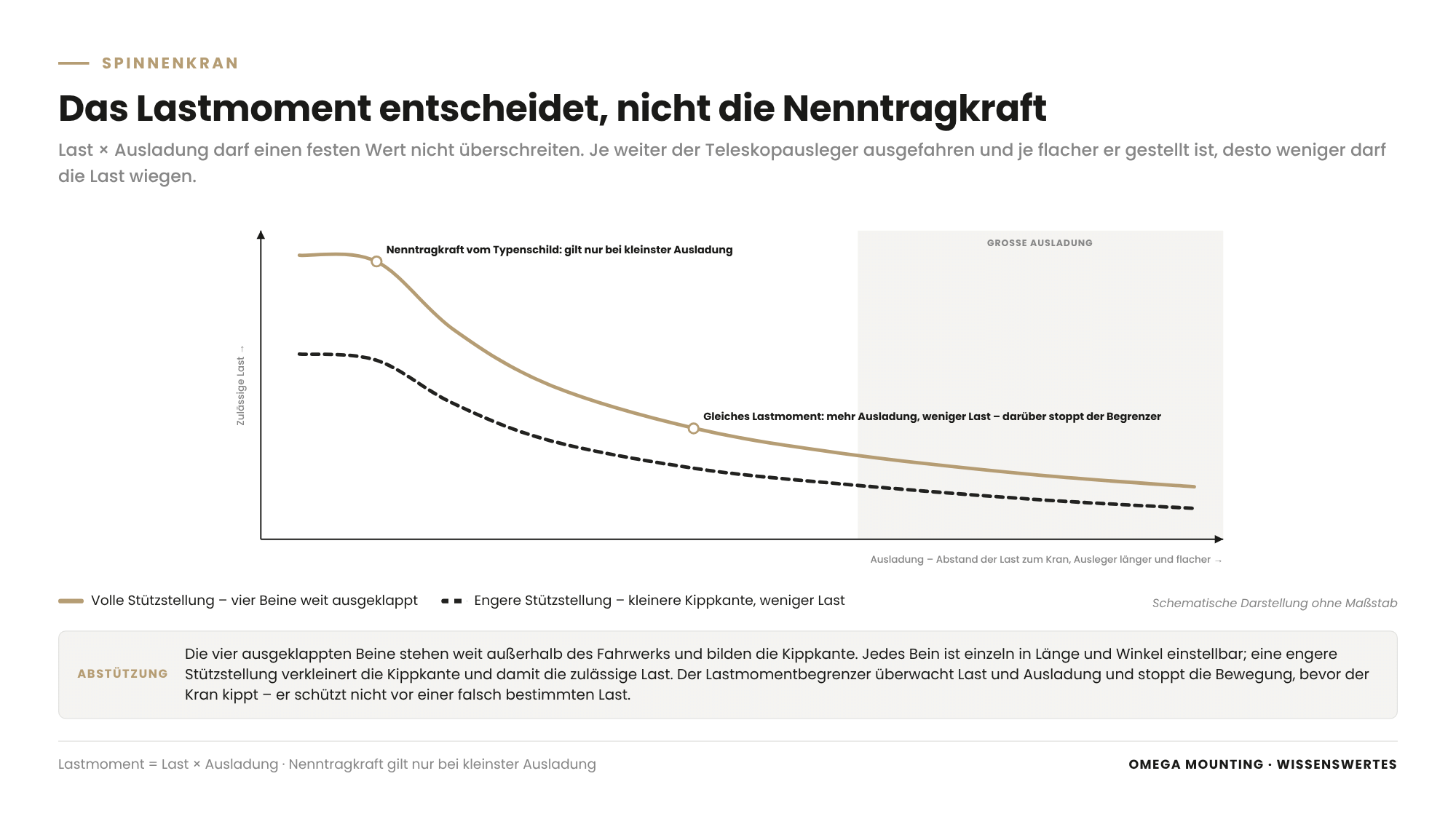
Like every boom crane, a spider crane lifts via the load moment: the weight of the load multiplied by its distance from the crane must not exceed a fixed value. This distance is called the radius. The further the telescopic boom is extended and the flatter it is set, the smaller the permissible load. The rated capacity on the type plate applies only at the smallest radius.
The outrigger legs are what make the crane a crane. Folded, the machine is a narrow vehicle. Unfolded, the four legs stand well outside the undercarriage and form the tipping line. Each leg can be adjusted individually in length and angle, so the crane adapts to walls, machines or stair treads. Many machines also allow a narrower outrigger setting – with a correspondingly lower capacity.
Hydraulics move the boom, telescope and outriggers; a cable winch raises the hook. The operator stands with the radio remote control wherever they can see the load best. A load moment limiter monitors load and radius and stops the movement before the crane tips.
Inside a building, the drive matters. A diesel engine produces exhaust fumes and noise, which is why interiors are worked electrically – on a three-phase cable or with a battery. When retrieving a spider crane from the basement of a data center, we laid a long three-phase cable for this purpose because diesel operation inside the building was out of the question.
Which types are there?
Spider cranes differ mainly in undercarriage, drive and size – and this decides whether the machine can get through the route to the lift. The table classifies the common types.
| Type | Drive | Strength | Limit |
|---|---|---|---|
| Crawler spider crane, small. | Electric or hybrid. | Drives through standard doors, turns almost on the spot, quiet and emission-free. | Capacity in the range of a few hundred kilograms to around one tonne, short radius. |
| Crawler spider crane, large. | Diesel or hybrid. | Lifts several tonnes, greater hook height, also for outdoor use. | Wider and heavier, needs more outrigger area and higher floor load-bearing capacity. |
| Spider crane with fly jib. | as the base machine. | Reaches over obstacles, more hook height. | Considerably lower capacity at the tip. |
| Mini crane on wheels. | Electric. | Protects sensitive floors, quickly repositioned inside the building. | Less suited to rough terrain, often lower capacity. |
Crawler undercarriages usually have rubber tracks that protect floors and leave hardly any marks on screed or raised floors. Depending on the type, the crane may travel with a raised load (pick-and-carry), but on many machines this is only permitted with a small load or not at all. This is stated in the operating manual and is clarified before the job.
Where are the limits of a spider crane?
The limit is almost never set by the capacity but by the location: floor, outrigger area, headroom and route. Four points decide whether the lift is possible at all.
- Floor: The entire load plus the crane's dead weight rests on four outrigger pads. A slab that carries a car is far from carrying an outrigger pad with a point load of several tonnes. Load spreading plates distribute the force but are no substitute for a structural engineer's assessment.
- Outrigger area: The legs need space. Between machines, columns or racking, the area is often only enough for a narrower outrigger setting – and therefore for less load.
- Headroom: The boom has to be raised, otherwise the radius stays large and the capacity small. A low ceiling can make the lift impossible even though weight and door fit.
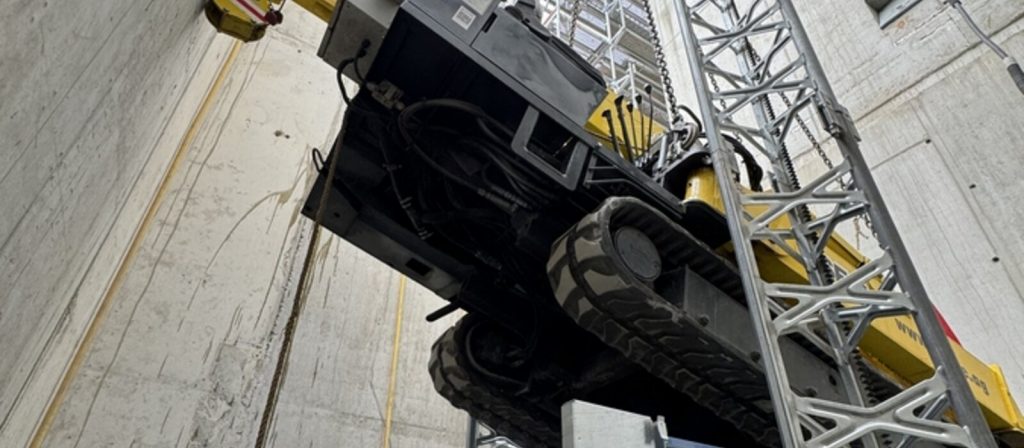
- Route: Every centimetre along the transport route counts – doors, ramps, shafts, lifts. When retrieving a crane from the basement of a data center, the shaft was 2 centimetres short. The solution was angled slinging with an adjustable chain so that the crane fitted through the opening at an angle.
The fourth limit is the load moment limiter itself. It protects against tipping, not against an incorrectly determined load. Anyone who estimates the weight instead of weighing it only notices the error when the crane shuts down – in the worst case with the load in the air above a production line.
What does safety involve with a spider crane?
Safety involves three things: load-bearing outrigger support, a qualified operator and a cordoned-off working area. Everything else builds on that.
The outrigger pads always stand on load spreading plates or timber baulks, even on concrete. This reduces the surface pressure, and a locally weak floor does not give way immediately. After unfolding, the crane is levelled; most machines display the inclination and block the lift if they are standing too far out of level.
Spider cranes are cranes within the meaning of the German accident prevention regulation for cranes (DGUV Regulation 52). They are inspected by a competent person before first use and periodically thereafter, at least once a year. The crane operator must be briefed, appointed in writing and familiar with the machine. For use on a construction site, the Industrial Safety Ordinance (BetrSichV) also requires a risk assessment. This article is not legal advice; which requirements apply in the individual case is clarified by the occupational safety specialist.
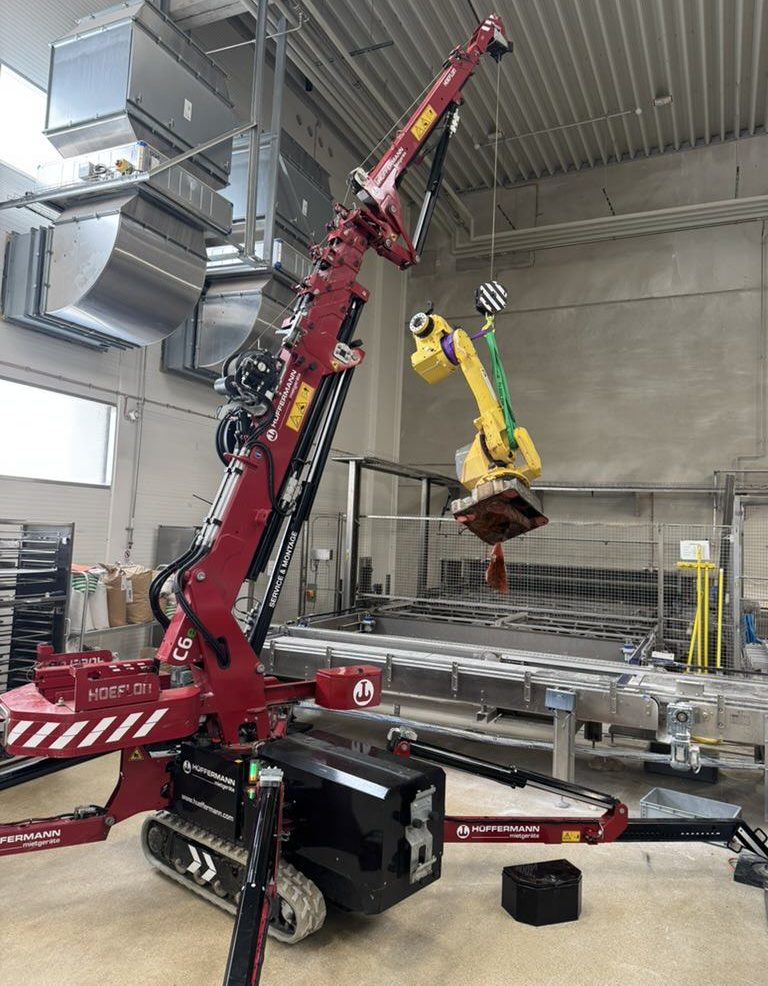
During operation, the area beneath the load and around the outriggers is kept clear. The operator stands with the radio remote control outside the slewing range, and a banksman keeps the load in view where the operator cannot see it. Lifting accessories are checked before every lift – when removing a robot from a bakery near Fulda, for example, a robot weighing around 600 kilograms hung in one piece from inspected round slings above a running production belt.
What we pay attention to
With a spider crane, many people underestimate the outrigger area and the route – not the weight. That is why we check these points before every job:
- Survey of the route: We measure door widths, lintel heights, ramp gradients, lift dimensions and thresholds ourselves, not from the drawing.
- Floor clearance: For each outrigger pad we clarify the point load and load distribution, on slabs and raised floors together with the structural engineer or operator.
- Load moment instead of rated capacity: We calculate with the actual radius at the target point and the outrigger setting that the room allows.
- Drive inside the building: Electric operation is the standard indoors; we plan the power supply in as well, right down to the cable route.
- Floor protection: Protective fleece or plates along the route before the undercarriage travels the first metre.
- Plan a reserve: If centimetres are missing on the drawing, we need a second solution on site – adjustable chain, different lifting point, different route.
Where we use it
We use spider cranes mainly in existing buildings: in data centers, production plants and workshops where large cranes cannot reach. When retrieving a spider crane from the basement of a data center , four fitters manoeuvred the machine through the basement in one day and pulled it through the shaft with a tower crane – even though 2 centimetres were missing. When removing a robot from a bakery near Fulda , a mini crane lifted the robot weighing around 600 kilograms out from between the conveyor belts in one piece. And where even a spider crane cannot find room, we work with other compact lifting equipment via radio remote control, as in the replacement of a CRAH unit in a live data center. All three jobs are part of our service Lift & Shift.
More technology explained
Technology explained
the spider crane's big brothers and what they do outdoors.
Technology explained
the alternative when the ceiling is too low for a boom.
Guide
the guide to the decision, with matrix and practical examples.
Do you need this machine together with a team on site?
Do you need this machine together with a team on site? Send us your survey or a few photos of the route, and we will tell you whether the spider crane fits – or what to use instead. Request a callback – we will get back to you in the Rhine-Main region and beyond.
100% free and without obligation

About the author
Tobias Schott
Managing director of Omega Mounting GmbH, Rodgau · more than 20 years of hands-on experience in installation and maintenance
A trained mechatronics technician and at home in maintenance, servicing and industrial installation since 2004 – first at his father's side, since 2012 with Omega Mounting: from the overhead conveyor in Frankfurt to the crane system in a new-build hall. As appointed person for lifting operations he plans and leads lifting operations in data centers and on industrial sites in the Rhine-Main region, is an instructor and examiner for cranes, MEWPs and telehandlers as well as a safety officer. On jobs abroad he is known as the "German Troubleshooter" – the one you call when things get stuck on site. He learnt what quality means not from a manual but from his father: Made in Germany as a standard for his own work, not as a label. That is why it comes first at Omega Mounting – before speed and before price. The Technology explained articles explain the machines and the technology his team works with every day: what counts on our sites is in there – what only appears in the brochure is not.
 English
 German