
- Technology explained – machines and equipment
Gantry Crane and Hydraulic Gantry: Lifting Where No Overhead Crane Hangs
By Tobias Schott · Reading time approx. 8 minutes · Last updated: October 2026
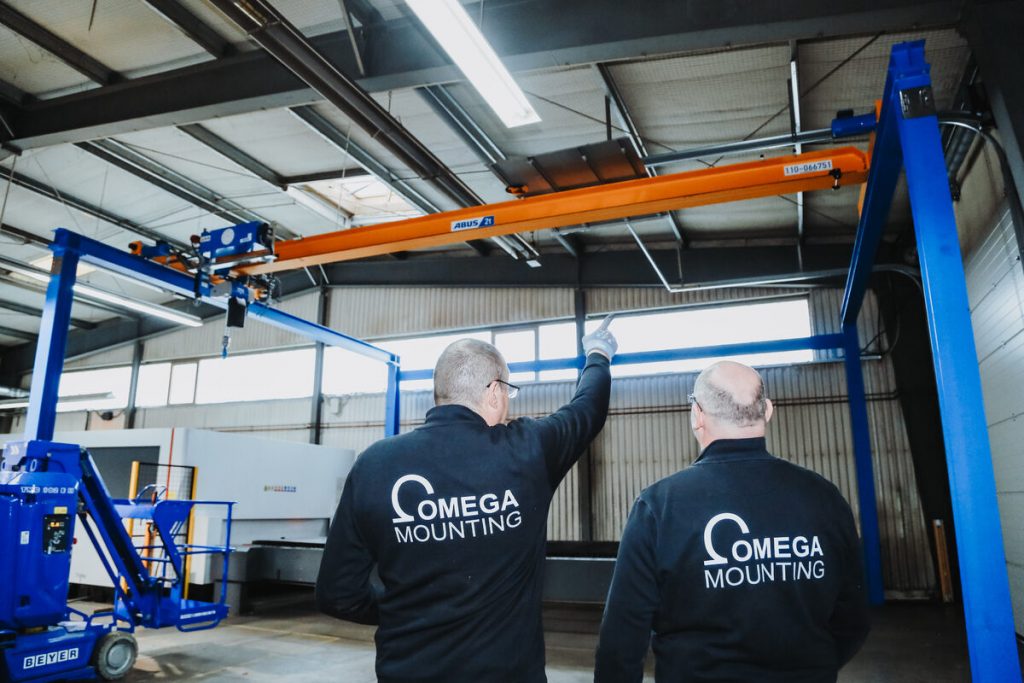
A gantry crane carries its load into the floor via its own legs; a hydraulic gantry lifts machines weighing tonnes without any crane runway: both solve the same problem – heavy lifting in a hall whose roof cannot carry a crane. You will find the gantry crane in the storage yard of a steel fabricator, in a workshop with a light hall roof or as a compact unit beside a production line. You see the hydraulic gantry less often – usually only on the day a transformer, a press or a machine tool has to go onto its foundation without an overhead crane. In tenders, both terms are often mentioned in the same breath, although they describe different equipment.
We separate the two cleanly here: what a gantry crane is, which types there are, how a hydraulic gantry works and when which equipment fits. In the Rhine-Main region, both are part of our everyday work in assembly and lift & shift.
What is a gantry crane?
A gantry crane is a crane whose bridge stands on two legs of its own, forming a gantry with them under which the load is moved. Unlike the bridge crane, also called a travelling crane, it needs no crane runway on the hall columns. It runs on rails on the floor or stands free in the hall as a steel gantry. The floor therefore carries the load and not the building – which is exactly what makes it interesting for existing halls whose roof cannot accommodate a crane.
The hydraulic gantry is not a crane in the narrow sense but a mobile lifting device. Four hydraulic legs carry two header beams from which the load hangs. It is set up for an installation, lifts the load, repositions it and is dismantled again.
Profile
- Type: Gantry crane as full gantry or semi-gantry, with single or double girder bridge; hydraulic gantry as a four-leg lifting unit with header beams.
- Typical capacity: Workshop and hall gantries typically from a few hundred kilograms to a few tens of tonnes; hydraulic gantries typically from several tens to several hundred tonnes of lifting capacity – in each case as a range, depending on type.
- Drive: Gantry crane with electric chain hoist or wire rope hoist, travel drive on bridge and trolley; hydraulic gantry with hydraulic power unit and cylinders in the legs.
- Field of use: Gantry crane in continuous operation at a fixed location such as storage yard, workshop or test bay; hydraulic gantry temporarily for moving in, skidding and machine relocation.
- Requirements: Level, load-bearing floor, sufficient headroom, space around the load, inspected lifting points.
- Inspection: Have cranes inspected by a qualified person before first use and periodically – the framework is the German crane regulation DGUV Regulation 52; as work equipment, the hydraulic gantry is subject to the Industrial Safety Ordinance (BetrSichV). This is not legal advice.
- Operator qualification: Briefed crane operator appointed by the employer; for the hydraulic gantry, a trained lifting team under an appointed person for lifting operations.
How is a gantry crane constructed?
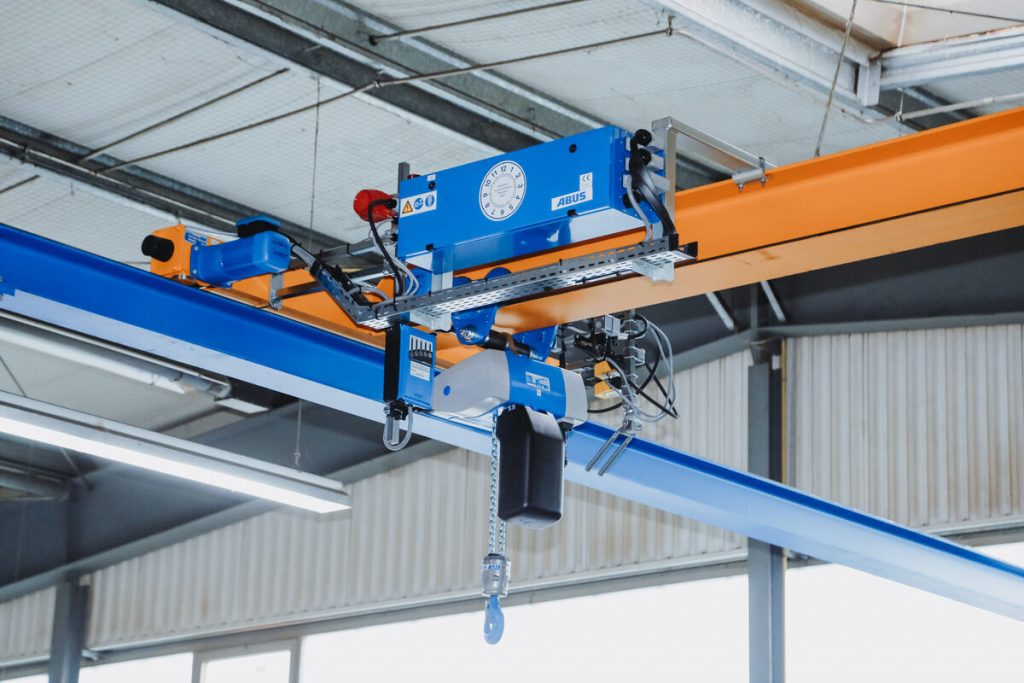
A gantry crane consists of legs, gantry runway, crane bridge, trolley with hoist and power supply. The legs stand on base plates that are anchored to the hall floor and grouted – or on travel gear running on floor rails. The runway girders rest on the legs. This is the gantry runway on which the crane bridge travels.
On a single girder crane, the crane bridge is a single section from which the chain hoist hangs underneath. On a double girder crane, two girders run in parallel and the trolley travels on top. This gives more hook height and more capacity. The crane receives power via a conductor rail or cable management along the runway. Pre-limit and limit switches restrict the travel path, and buffers stop the bridge at the end of the runway. The electrical connection is made by a qualified electrician.
Whether the bridge later travels cleanly is decided when aligning the legs. We measure height, alignment and diagonal dimensions with the laser before the grout cures. A millimetre of offset in the gauge is invisible – until the bridge rubs on the runway.
What distinguishes full gantry, semi-gantry and hydraulic gantry?

The difference lies in where the load goes into the floor and whether the equipment stays: the full gantry stands on two rows of legs of its own, the semi-gantry uses a high wall-mounted runway on one side, and the hydraulic gantry stands only for the duration of a lift. In between is the mobile workshop gantry crane, which is pushed on castors to wherever lifting is required.
| Type | Where the load goes | Strength | Limit | Typical use |
|---|---|---|---|---|
| Full gantry crane, stationary. | Both legs on floor rails or base plates. | Building remains unloaded, large spans possible. | Needs space for both rows of legs and a level track. | Storage yards, steel construction, halls without a load-bearing roof. |
| Semi-gantry crane. | One leg on the floor, the other side on a high crane runway on the wall. | Saves one row of legs; the area under the runway remains clear. | Wall or bracket must take the load. | Halls with a load-bearing longitudinal wall. |
| Mobile workshop gantry crane. | Four swivel castors or travel gear on the hall floor. | Can be pushed to wherever lifting is required; fits into tight recesses. | Limited capacity, can only be moved on a smooth floor. | Assembly, maintenance, bearing replacement on individual units. |
| Hydraulic gantry, mobile. | Four hydraulic legs on load spreading plates or rails. | Lifts loads weighing tonnes without a crane runway, can travel the load. | Set up only for the lift; needs space around the load and lifting height under the ceiling. | Transformers, presses, machine tools, skidding. |
How does a hydraulic gantry work?
A hydraulic gantry lifts the load by means of four hydraulic cylinders in the legs pushing the header beams, together with the slung load, evenly upwards. The procedure begins with setting up the legs around the load – on load spreading plates that distribute the pressure into the floor, or on rails. Then the header beams are placed on top and the load is slung with chains or a spreader beam.
A hydraulic power unit supplies all four legs. The control system keeps the legs at the same height, and that is the heart of the matter: if the load hangs askew, lateral forces arise that the gantry is not meant to take. If the gantry runs on rails, the raised load can be travelled in the longitudinal direction. A trolley or a push cylinder on the header beam provides the transverse movement. This is how a machine gets from the low-loader onto its foundation without a crane standing in the hall.
The limits are tangible: the lifting height ends with the leg length and the ceiling height, the ground pressure under four feet is high, and set-up and dismantling take time. If the space around the load is not enough for a gantry, the skidding system takes over the horizontal route.
When which equipment – and what limits apply?
A gantry crane pays off when lifting is carried out repeatedly at a fixed location; a hydraulic gantry when a heavy load has to be moved once and no crane can get into the hall. Three questions decide almost every choice:
- How often is lifting carried out? Daily: gantry crane. Once in the machine's life: hydraulic gantry or mobile crane.
- What does the floor carry? A gantry crane distributes its load via base plates or rails; a hydraulic gantry concentrates it on four points. With hollow floors, basement slabs and old screeds, this is the first point to check.
- How high is the ceiling? On a gantry crane, the usable hook height is the gantry height minus bridge and hoist. For the hydraulic gantry: leg height plus header beam plus load must fit under the ceiling.
We see typical errors again and again: the ceiling height is measured only at the lifting location, not along the travel path. The load's centre of gravity is estimated instead of read from the documents. And the barrier around the suspended load is missing because the lift is "only brief". If an outdoor area rather than the hall is under discussion, read which lifting method fits there: spider crane or mobile crane for moving in.
What we pay attention to
Before a gantry stands or a hydraulic gantry lifts with us, five things are clarified:
- Floor before equipment. We check the load-bearing capacity and levelness of the set-up area and lay load spreading plates before the first leg stands.
- Alignment with the laser. We measure height, alignment and diagonal dimensions of the legs before the grout cures – afterwards, correction is expensive.
- Centre of gravity from the documents. Lifting points and centre of gravity come from the drawing or type plate, not from eyeballing.
- Lift evenly. On the hydraulic gantry, the four legs travel synchronously; one person monitors only the height level and the pressure at the control.
- Barriers and signalling. The load zone is closed off, an appointed person for lifting operations releases every lift and directs the crane operator.
- Testing before release. We test pre-limit and limit switches, buffers and travel paths without load before the first load hangs.
Where we use it
We use gantries where the building cannot carry a crane. In Babenhausen, two fitters erected a free-standing steel gantry in two working days, aligned it with the laser and on the second day lifted in the single girder bridge with a capacity of two tonnes – read about it in the gantry crane installation in Babenhausen. At a paint shop in the Offenbach area, a compact gantry crane with a self-welded rail system lifted the motor-fan unit weighing tonnes where neither forklift nor overhead crane had room: fan bearing replacement at the paint shop. And where even the gantry cannot reach, two transformers of around 52 tonnes in a data center near Frankfurt show the hydraulic route without a crane: skidding and setting down with hydraulic jacking blocks. How we move heavy plant in is described on our page Lift & Shift.
More technology explained
Technology explained
the gantry crane's brother, which hangs from the building instead of standing on the floor.
Technology explained
what comes after the hydraulic gantry when the load has to continue horizontally.
Guide
the guide to the step after that: from the hook onto the foundation.
Do you need this machine together with a team on site?
Do you need a gantry together with a team that sets it up, aligns it and lifts the load safely? We plan the lift, set up the equipment and bring the machine onto its foundation. The quickest way is a callback appointment – briefly describe your hall, load and date to us.
100% free and without obligation

About the author
Tobias Schott
Managing director of Omega Mounting GmbH, Rodgau · more than 20 years of hands-on experience in installation and maintenance
A trained mechatronics technician and at home in maintenance, servicing and industrial installation since 2004 – first at his father's side, since 2012 with Omega Mounting: from the overhead conveyor in Frankfurt to the crane system in a new-build hall. As appointed person for lifting operations he plans and leads lifting operations in data centers and on industrial sites in the Rhine-Main region, is an instructor and examiner for cranes, MEWPs and telehandlers as well as a safety officer. On jobs abroad he is known as the "German Troubleshooter" – the one you call when things get stuck on site. He learnt what quality means not from a manual but from his father: Made in Germany as a standard for his own work, not as a label. That is why it comes first at Omega Mounting – before speed and before price. The Technology explained articles explain the machines and the technology his team works with every day: what counts on our sites is in there – what only appears in the brochure is not.
 English
 German