
- Technology explained – machines and equipment
Overhead Crane and Crane Runway: How 16 Tonnes Hang Safely from Two Girders
By Tobias Schott · Reading time approx. 8 minutes · Last updated: October 2026
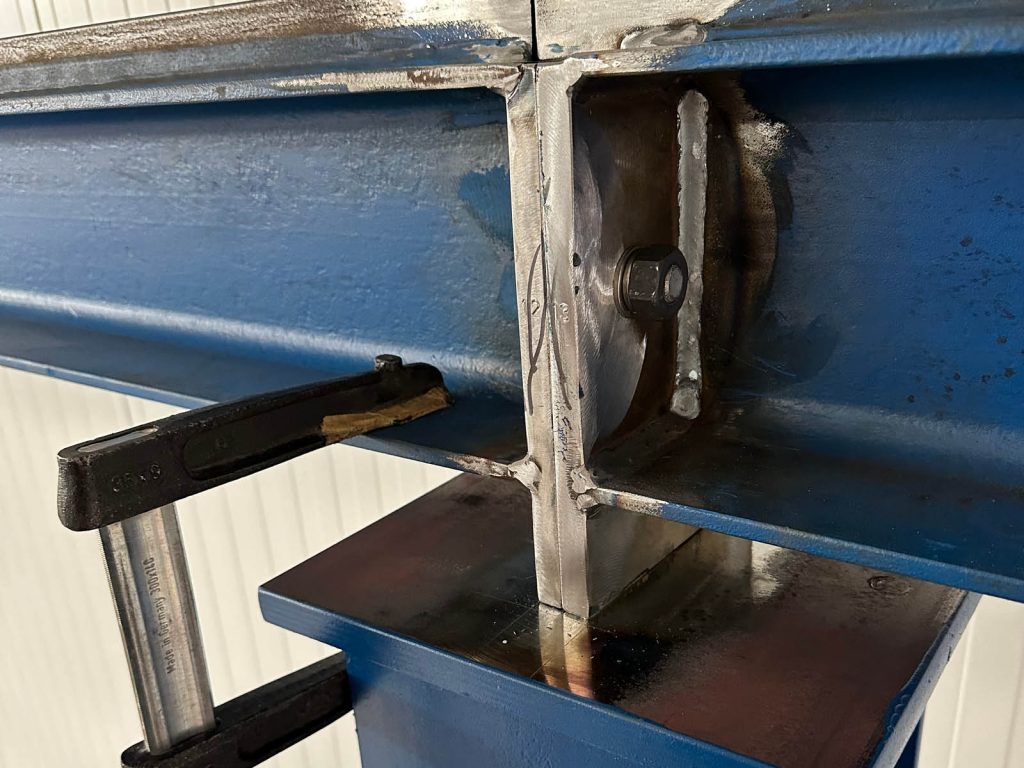
An overhead crane never carries the load alone: hook, trolley, bridge, crane runway and columns form a chain – and the crane runway is the link that is underestimated most often.
You will find an overhead crane in almost every production or logistics hall: as a bridge crane under the roof, as a jib crane at the workstation or as an underslung crane above the assembly line. It lifts components and machines that no forklift can move any more, and it comes up again and again on the desks of planners and maintenance managers for new builds, conversions and crane replacements.
Anyone who understands the technology behind it reads tenders and quotations with different eyes. This article explains the design, the types, the key figures and the reason why the crane runway must be surveyed before the first hook lifts.
What is an overhead crane?
An overhead crane is a stationary lifting appliance that stands on a crane runway or its own pillar, lifts loads with a hoist and travels them across the working area on a bridge or a jib. The bridge crane is also called a bridge crane or EOT crane, the pillar type a jib crane.
Overhead crane is a collective term. The most common form is the bridge crane, also called a travelling crane: a bridge made of one or two girders that travels on two crane runways under the hall roof. Added to this are underslung cranes, which run beneath the runway, and jib cranes, which cover a circle or semicircle with a jib. Unlike a mobile crane, the overhead crane stays in place and fetches the load with bridge and trolley.
Profile
- Type: Bridge crane (single girder or double girder), underslung crane, gantry crane, pillar or wall-mounted jib crane.
- Capacity: Typically from a few hundred kilograms for jib cranes up to three-digit tonnages for double girder bridge cranes; the value is marked on the crane and recorded in the inspection logbook.
- Span: Distance between the two crane runways, typically a few metres to several tens of metres; it follows the hall width.
- Drive: Electric travel drives and hoists; power supply via conductor rail or festoon cable; small jib cranes also with manual chain hoist.
- Control: Floor control via pendant, radio remote control or cab on the crane.
- Requirements: Load-bearing crane runway or foundation, runway surveyed for gauge, alignment and level, clear travel path, inspection before first use.
- Operator qualification: Briefed and appointed crane operators; inspection is carried out by a qualified person or an expert.
Which types are there – and how do they differ?

The types of overhead crane differ in where the bridge or jib runs and how the load gets into the floor. On a bridge crane the bridge travels on top of the crane runway rails; on an underslung crane it hangs beneath the runway girders. The jib crane needs no runway but an anchored pillar or a load-bearing wall.
| Type | Where does the load run? | Strength | Limit |
|---|---|---|---|
| Single girder bridge crane | Trolley beneath one bridge girder on two crane runways. | Light, low runway loading, typically up to around ten tonnes. | Less hook height, trolley hangs beneath the girder. |
| Double girder bridge crane | Trolley travels on top between two bridge girders. | High capacity, large spans, two trolleys possible for tandem operation. | Heavier, needs the stronger runway and more space under the roof. |
| Underslung crane | Bridge hangs beneath the runway girders on the hall roof structure. | Several runways side by side, transfer from bay to bay possible. | Roof structure must carry the load. |
| Gantry crane | Bridge stands on its own legs and travels on floor rails. | Independent of the building, also outdoors. | Own track and foundation required – more on this in the article on the gantry crane. |
| Pillar jib crane | Jib rotates on an anchored pillar, up to 360 degrees. | Workstation crane without crane runway and without connection to the building. | Reach ends with the jib. |
| Wall-mounted jib crane | Jib on a wall or column, usually up to 180 degrees. | Saves the pillar and the floor space. | Wall or column must take the moment. |
The choice between single girder and double girder is decided by capacity, span and hook height. The double girder provides the greater hook height because the trolley travels on top, and it accommodates two hoists.
How does the crane runway carry the crane?
The crane runway carries the crane via two parallel runway girders on which the wheels of the end carriages travel; it transfers dead weight, load and travel forces into columns or brackets and from there into the foundation or the hall steelwork. The runway comprises the girder, the welded-on or clamped rail, the end stops with buffers and the power supply, usually a conductor rail along the runway.
For the crane to travel smoothly, the runway must be correct in three directions:
- Gauge: The distance between the two rails must be the same over the entire length, otherwise the wheels bind.
- Alignment: Each rail must lie in a straight line; a kink acts like a set of points.
- Level: Both rails must be at the same height, otherwise the bridge runs skewed and one wheel carries more than the other.
We check these values by laser survey – a rotating laser levels the heights, and the alignment is measured over the length of the runway. The permissible tolerances are small, even though a crane runway is many metres long. A runway outside tolerance shows up later in worn wheel flanges, loud travel noise and cracks at the connections.
That is why installation begins at the columns: fix with anchors and adjusting screws, level the heights with the laser, grout under the base plate. Only then does the runway go onto the columns, is brought into gauge and alignment, welded or bolted and surveyed. The crane is placed on it once the survey report is correct.
Capacity, span, hook height: what the key figures mean
The capacity is the maximum load on the hook, the span is the distance between the two crane runways and the hook height is the distance from the floor to the hook in its highest position. The three values are linked: the larger the span, the heavier the bridge for the same capacity – and the more headroom is lost under the roof.
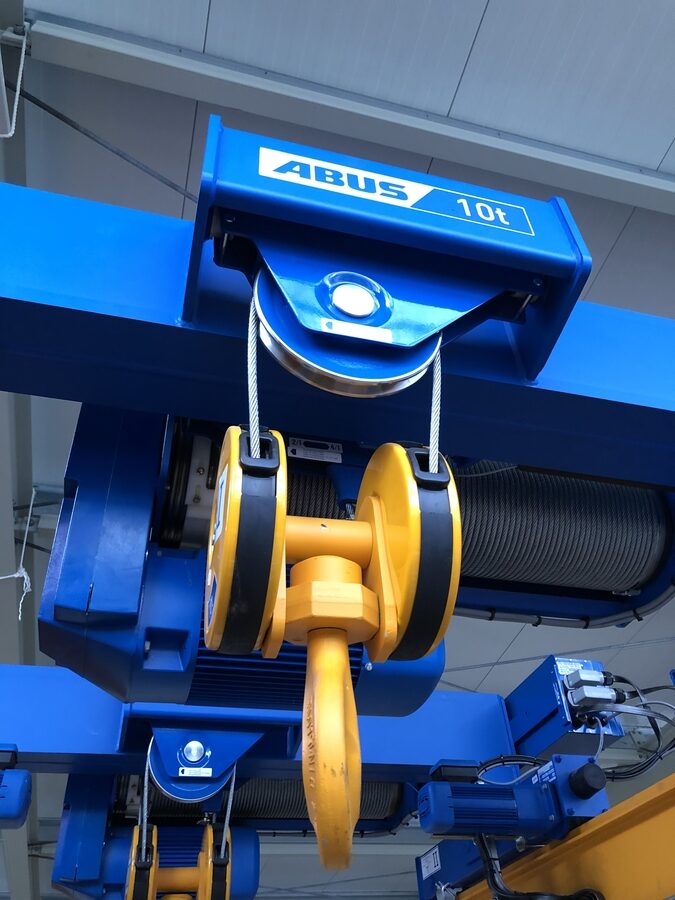
The hoist sits in the crab. It travels across the bridge, the bridge travels along the runway; this is how the hook reaches every point of the hall floor. On a double girder travelling crane, two crabs can travel on one bridge. A crane with a total capacity of 16 tonnes then carries two crabs of 10 tonnes each, which lift a long load together and level in tandem operation.
Design includes classification by duty: cranes are grouped by operating time and load spectrum. A crane that lifts full loads every day is designed differently from one that works rarely and lightly. This classification determines the service life of the mechanisms and thus the remaining service life. The decision between maintenance, general overhaul and a new crane is covered in the guide on crane systems.
Which inspections are mandatory for an overhead crane?
An overhead crane must be inspected before first use, after significant modifications and periodically; the basis is DGUV Regulation 52 "Cranes". The periodic inspection by a qualified person normally takes place annually; for certain cranes and before first use, the crane regulation requires an expert. This is not legal advice – the regulation itself remains authoritative.
The inspection ends in the crane inspection logbook: findings, deadlines, rectification of defects – the book accompanies the crane throughout its entire service life. The crane runway is part of the crane system and is included in the inspection after installation, extension or shortening.
| Reason for inspection | Who inspects? | What is inspected? |
|---|---|---|
| Before first use | Qualified person, for certain cranes an expert. | Completeness, function, load test, runway and limit switches. |
| Periodic | Qualified person, normally annually. | Wear on rope, chain, brakes, wheels and runway. |
| After significant modification | Qualified person or expert depending on scope. | Conversion, crane runway modification, new crab, higher capacity. |
What we pay attention to
With overhead cranes and crane runways, quality is decided in places that nobody sees later. This is what we pay attention to:
- Survey before placing: We do not place a crane on a runway that has not been measured for gauge, alignment and level – even when the schedule is pressing.
- Diagonal dimension of the bridge: In a finished hall, it is the diagonal dimension, not the span, that decides whether the bridge can be rotated into position. We check this before delivery.
- Grout and anchors: Resin anchors and grout need the right mixing ratio, tight formwork and the full curing time. Anyone who cuts corners builds on a base that will settle.
- Plumb pillar on the jib crane: We align the pillar with two spirit levels offset by 90 degrees and get the last millimetre with shim plates. A pillar out of plumb lets the jib drift on its own.
- End stops and buffers: If a runway is shortened or extended, we fit new end stops and support blocks – the crane must never be able to leave the runway.
- Clean handover: Mechanical work by us, electrical work up to the main switch, handover to the plant electrician, inspection before first use. No acceptance without an inspection logbook.
Where we use it
Overhead cranes and crane runways are among our core topics in the Rhine-Main region and beyond. During the installation of a crane runway for an overhead crane , we shortened the runway, welded on new end stops, levelled the columns with a rotating laser and placed the runway with two forklifts. For the double girder travelling crane with 16 tonnes , two fitters lifted the bridge with two 10-tonne crabs into a new-build hall in a single working day. Crane runways, brackets and reinforcements are fabricated by our own steel workshop in Rodgau – find out more under industrial installation for crane construction.
More technology explained
Technology explained
the type with its own legs when roof and runway cannot carry the load.
Technology explained
the mobile cranes that first get the overhead crane under the roof.
Guide
when a general overhaul pays off and when a new crane does.
Do you need this machine together with a team on site?
Do you need an overhead crane with crane runway installed, replaced or surveyed – with a team that measures first and then places? Then let us talk about your hall, your loads and your schedule: Request a callback.
100% free and without obligation

About the author
Tobias Schott
Managing director of Omega Mounting GmbH, Rodgau · more than 20 years of hands-on experience in installation and maintenance
A trained mechatronics technician and at home in maintenance, servicing and industrial installation since 2004 – first at his father's side, since 2012 with Omega Mounting: from the overhead conveyor in Frankfurt to the crane system in a new-build hall. As appointed person for lifting operations he plans and leads lifting operations in data centers and on industrial sites in the Rhine-Main region, is an instructor and examiner for cranes, MEWPs and telehandlers as well as a safety officer. On jobs abroad he is known as the "German Troubleshooter" – the one you call when things get stuck on site. He learnt what quality means not from a manual but from his father: Made in Germany as a standard for his own work, not as a label. That is why it comes first at Omega Mounting – before speed and before price. The Technology explained articles explain the machines and the technology his team works with every day: what counts on our sites is in there – what only appears in the brochure is not.
 English
 German