
- Technology explained – machines and equipment
The skidding system: when the transformer does not fit through the gate
By Tobias Schott · 8-minute read · Updated October 2026
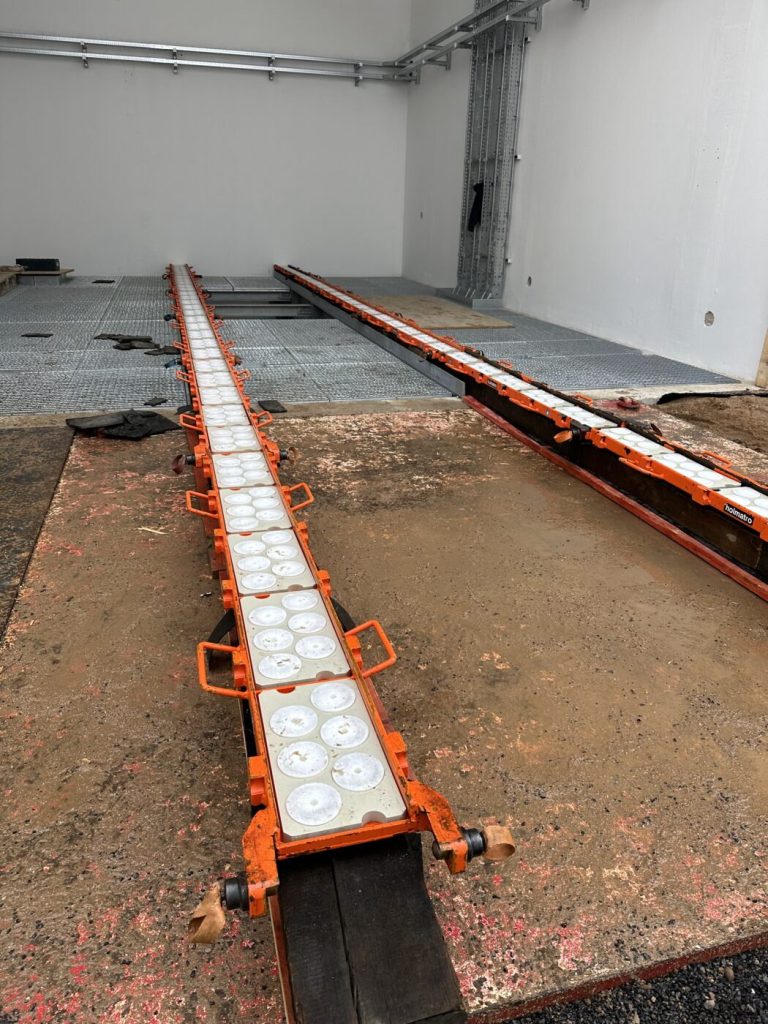
A skidding system pushes loads of many tonnes horizontally over steel rails to where no crane hook can reach any more – and thus decides whether a transformer gets into its finished building at all. You usually only come across the skidding system once the crane has reached its limit. The building is closed, the roof opening long since sealed, the transformer is standing on the low-loader outside the door. The crane brings the load up to the opening – through the gate and into the transformer cell it has to continue at floor level. That is exactly what a skidding system is laid for.
In data centers, substations and machine halls this is a standard case: the building comes early, the heaviest plant comes late. Here we explain what a skidding system is, how it is constructed, how a skidding operation proceeds and when we prefer it to skates or a crane.
What is a skidding system?
A skidding system is a rail or slide track of steel elements laid on the floor. Hydraulic cylinders or a winch push a heavy load along it horizontally to its installation position. The method is called skidding – in the UK usually jacking and skidding – and the track a skid track. The load does not roll; it slides: between load and rail sit skid shoes with a low-friction sliding pair. As a result, a pushing force amounting to only a fraction of the load weight is sufficient.
The skidding system is part of the toolkit of Lift & Shift. It is not a permanent installation like an overhead crane but is laid, operated and dismantled again for a single job.
Key facts
- Type: Modular rail track made of steel girder elements with skid shoes and hydraulic push cylinders; simpler as a slide track made of slide plates with a winch.
- Typical capacity: Depending on the system, typically from several tens to several hundred tonnes – as a range, not equipment data.
- Drive: Hydraulic power unit with control and pressure gauge; push cylinders that brace against the rail; for light loads a cable winch or chain hoist.
- Field of use: Transformers, generators, presses, machine tools – wherever the load is too heavy for skates or the crane does not reach the foundation.
- Requirements: Load-bearing ground with known slab load, levelled track, space for cylinders and control, defined support points on the load.
- Inspection: Track, cylinders and power unit are work equipment within the meaning of the Industrial Safety Ordinance (BetrSichV) – visual inspection of the elements, hydraulic lines and cylinder anchoring before every job; this is not legal advice.
- Operator qualification: Trained lifting team, hydraulic control by an experienced fitter, every stroke approved by the appointed person for lifting operations
How is a skidding system constructed?
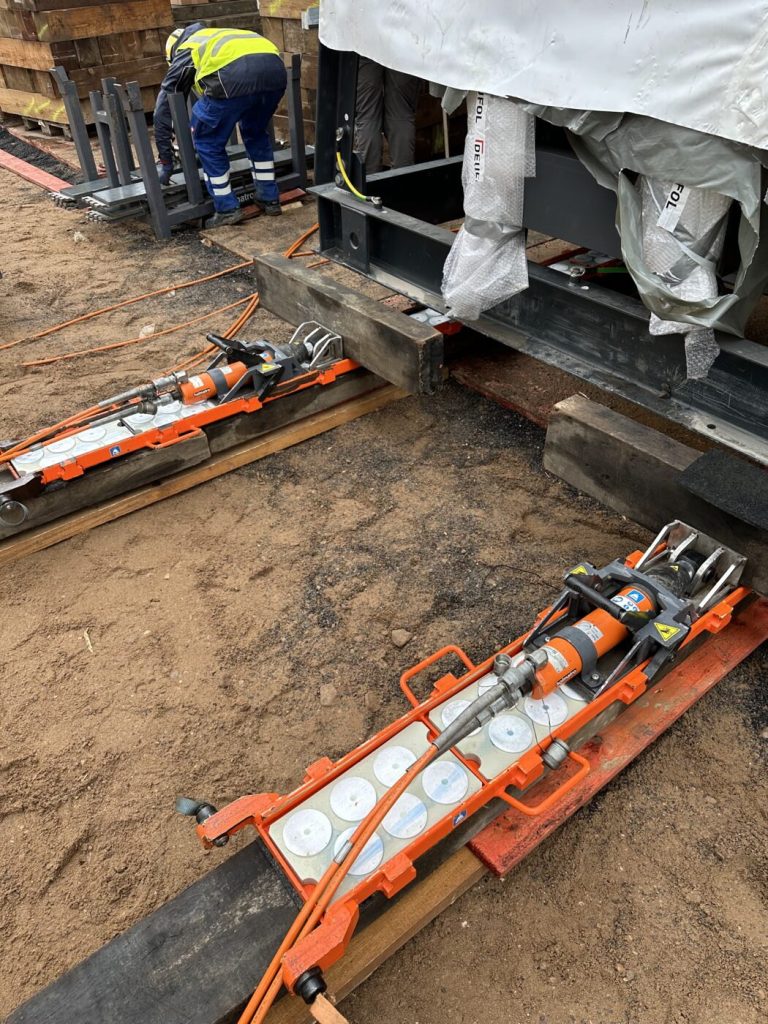
A skidding system consists of rail elements, skid shoes, push cylinders, a hydraulic power unit and the packing:
- Rail elements. Steel girders in modular lengths, coupled end to end, form the track from the unloading point to the foundation. The sliding surface is on top, the toothing for the cylinders at the side.
- Skid shoes. Steel frames, often called sledges or push blocks, which run under the load on the sliding surface. Their plastic sliding pads keep friction low.
- Push cylinders. Hydraulic cylinders that anchor themselves in the rail with a claw or pin and push the sledge forward by one stroke length – depending on the design, typically several decimetres up to around one metre.
- Power unit and control. The pump delivers the pressure, the control distributes it to the cylinders of both track strands. The pressure gauge shows how much force the load currently needs.
- Packing. Timber baulks, steel plates and load spreading plates compensate for differences in height and distribute the support forces into the floor.

Two track strands run in parallel under the load, spaced at the support points. If the floor is missing at one point – for example over a transformer pit – the track spans the gap as a girder.
How does a skidding operation proceed?

A skidding operation proceeds in four phases: lay and level the track, set the load down on it, push stroke by stroke, set down on the foundation. The first phase is the longest.
- Laying and levelling. The track must be correct in alignment and level over its entire length. Every element is packed, measured, repacked and measured again. Otherwise, steps in the floor end up as a tipping moment in the load.
- Setting down. The crane sets the load onto the skid shoes – ideally directly from the low-loader, without intermediate set-down. The centre of gravity must lie centrally between the track strands, otherwise the friction becomes uneven.
- Stroke. The cylinder engages in the rail, pushes the load by one stroke length, releases, retracts and engages again. After every stroke the load stands still. This pause is intentional: pressure, position and alignment are checked before the next stroke follows.
- Setting down. At the destination, hydraulic jacks (climbing jacks) lift the load off the track. The rail elements are pulled out from under the suspended load, then the load is lowered onto the prepared set-down points or directly onto the foundation.

Because of these pauses, a skidding operation over a few metres often takes longer than the crane lift before it. The slow pace is not a shortcoming but the safety principle of the method.
Where does the load go – slab load and load distribution?
The load does not go into the floor over an area but at points via the supports of the track. The path is always the same: skid shoe, rail, packing, floor. At each support, part of the load weight acts as a point load.
With a ground-bearing slab this is rarely a problem. On a suspended floor it is different: slabs are designed for distributed loads, but a skidding system introduces point loads. Load spreading plates and additional steel girders distribute them over several slab bays or carry them to the column lines. Which slab carries which load belongs in the installation planning – the guide on slab loads, openings and crane standing areas explains what the planner has to provide.

Raised floors in data halls are a special case: they carry cabinets but not a skidding system. There, the raised floor is opened or the load is transferred via steel plates down to the structural slab. Where the track spans a pit, we check the pit edges separately – that is where the support force is concentrated on a few points.
Skidding system, machine skates or crane: when which method?
The skidding system is the method for the heaviest load on the most difficult route – everywhere else there are faster ways:
| Method | Strength | Limit | Typical case |
|---|---|---|---|
| skidding system | Carries very heavy loads, guides them precisely, bridges pits and edges, needs no hook height. | Set-up and levelling time, space for track and cylinders, ground must carry the supports. | Transformer or generator into a closed cell |
| Machine skates | Fast, manoeuvrable, curves and changes of direction without reconfiguration. | Floor covering and ground pressure, thresholds and gradients, high centre of gravity. | Machine tool through the hall on a level industrial floor. |
| Hydraulic gantry | Lifts loads weighing tonnes without a crane runway, repositions them. | Lifting and short distance only, needs space around the load. | Press from the transport frame onto the foundation. |
| Mobile crane | Fast over great height and distance, one lift instead of many strokes. | Needs an opening from above, set-up area and free hook height. | Shell building without roof, plant is lifted in from above. |
In practice we combine the methods: the crane brings the load to the opening, the track takes over the last few metres, hydraulic jacks set it down. We choose skates when load and floor allow it – then the track is simply too elaborate. What drives the effort is not the metres but differences in height, lack of space for the packing and waiting time for crane and low-loader.
What we pay attention to
In skidding, preparation decides the day. We check this before the load goes onto the track:

- Level before pushing. A height offset between two elements costs force at the transition and tips the load. We measure the whole track, not just the start and end.
- Pushing direction and alignment. Both track strands must be parallel and on the axis of the foundation. Correcting afterwards with the full load on the track is hardly possible.
- Securing against slipping. No stroke without an anchored cylinder, no standstill on a gradient without a stop. The cylinder holds the load even against the direction in which it wants to move.
- Watch the pressure. If the pressure on the gauge rises for no apparent reason, the stroke stops. Usually a skid shoe is jammed or an element has settled.
- Set-down points before the load. Timber baulks, foundation plates and hydraulic jacks are ready before the load reaches the end of the track. Nobody improvises under a suspended load.
- Barriers and communication. Nobody stands beside the load in the pushing zone; hands stay away from rail and cylinder. The appointed person for lifting operations approves every stroke.
Where we use it
We use the skidding system where the load is too heavy for skates and the building too enclosed for the crane. In a data center in the Frankfurt area, two fitters and a lift supervisor skidded two transformers of around 52 tonnes into their cells in one working day. They went straight from the low-loader onto the track, with just over an hour of pure skidding time each. Set-down was on stacked timber baulks in the transformer pit – read about it in the report on two transformers on the skidding system. The track there was provided by the client; our team packed it, levelled it and operated it. The counter-example shows when no track is needed: for the roll-out of 160 power distribution cabinets across four levels, a heavy-duty lift, a lifting gantry and a hall floor under protective plates and fleece were sufficient. How we bring heavy plant from the lorry to the foundation is described on our page Lift & Shift.
More technology explained
Technology explained
The faster alternative when load and floor allow it.
Technology explained
The lifting device that raises the load before and after skidding.
Guide
The guide for planners, so that the track later finds a route and a load-bearing floor.
Do you need this machine together with a team on site?
Do you need a skidding system together with a team that lays it, levels it and brings the load safely into the cell? We plan the route from the low-loader to the foundation and run the skidding operation. The quickest route: callback – briefly describe your load, building and date.
Free, no-obligation callback

About the author
Tobias Schott
Managing director of Omega Mounting GmbH, Rodgau · more than 20 years of hands-on experience in installation and maintenance
A trained mechatronics technician, working in maintenance, servicing and industrial installation since 2004 – first alongside his father, and with Omega Mounting since 2012: from overhead conveyors in Frankfurt to the crane system in a new-build hall. He plans and leads lifting operations as an appointed person (AP) in data centers and on industrial sites in the Rhine-Main region, trains and examines operators of cranes, mobile elevating work platforms and telehandlers, and is a qualified occupational safety specialist. On jobs abroad he is known as the “German Troubleshooter” – the person you call when a site gets stuck. He learned what quality means from his father, not from a manual: Made in Germany as a standard for his own work, not a label. That is why quality comes first at Omega Mounting – ahead of speed and price. The Technology explained articles cover the equipment and techniques his team uses every day: what counts on site is in them – what only appears in the brochure is not.
Frequently asked questions
We do not bring our own skidding system: it is provided by the client, the haulier or a specialist partner. We lay, pack and level the track and operate the system on site; our appointed person (AP) plans the move. On the job near Frankfurt the client provided the track, and we laid, levelled and operated it.
There is no single figure – the limit is set by the system and above all by the floor. Depending on the system, skidding systems typically move from several tens to several hundred tonnes; what decides is the slab load at each support, the pit edges and the space for packing. Our documented reference is two transformers of around 52 tonnes each, skidded into a data center near Frankfurt in one day.
A pit, yes: where the floor is missing, the track spans the gap as a girder. We check the pit edges separately, because that is where the support force is concentrated on a few points. Raised floors in data halls are different – they carry cabinets but not a skidding system. There, the raised floor is opened or the load is transferred via steel plates down to the structural slab.
 English
 German