
- Technology explained – machines and equipment
Machine Skates and Heavy-Duty Skates: How Tonnes Roll Through the Hall
By Tobias Schott · Reading time approx. 8 minutes · Last updated: October 2026
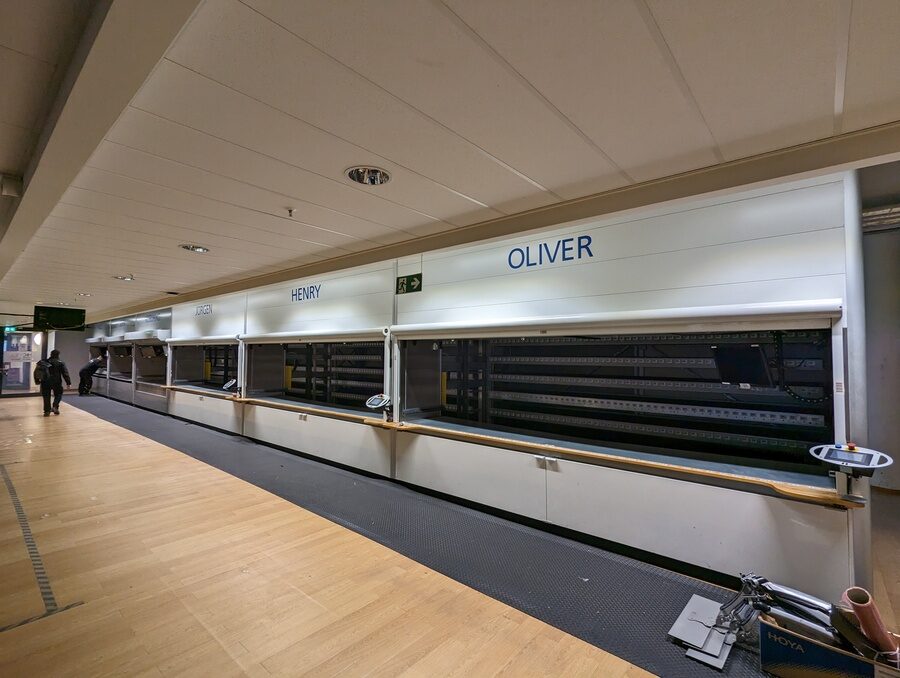
Machine skates are compact dollies with many small rollers that carry a machine weighing tonnes across the hall floor – and they decide whether a relocation is possible without a crane. When a machine has to change position inside the hall, the tender often contains just one sentence: "Relocation within the building." Behind it is almost always the same equipment. Machine skates, usually called heavy-duty skates or moving dollies on site, take care of the route from the old foundation to the new location.
Anyone who knows the equipment understands why, before a relocation, we look at the floor first and not at the machine. This article explains the design, types, procedure and limits.
What is a machine skate?
A machine skate is a flat transport device with several steel or polyurethane rollers that is pushed under a heavy load and carries it rolling across the floor. It is also known as a machine moving skate. The terms heavy-duty skate, tank roller and transport dolly all mean the same equipment in practice.
The principle: the load is raised only a few centimetres, set down on the skates and then pulled or pushed. The many small rollers distribute the weight, which is why a skate the size of a hand carries loads that no forklift can pick up any more.
Profile
- Type: Flat steel housing with a roller chain of many small rollers, as a steerable skate with turntable and tow bar or as a fixed skate without steering.
- Typical capacity: A few tonnes to several dozen tonnes per skate, correspondingly more as a set of three or four skates; the figure applies only on a level, load-bearing floor.
- Roller material: Polyurethane protects the floor and runs quietly; steel carries more and withstands heat and edges.
- Drive: No drive of its own; pulled or pushed by hand, with a hand winch, cable puller, forklift or electric tug.
- Field of use: Relocation of machines, control cabinets, transformers and plant components inside halls and buildings where no crane hangs.
- Requirements: Level, hard and load-bearing floor, a clear travel path without thresholds, a lifting device for getting underneath and space for manoeuvring.
- Operator qualification: No separate licence, but a briefing in accordance with the Industrial Safety Ordinance (BetrSichV) and a responsible person who leads the procedure – this is not legal advice.
Which types of skate are there?
There are four basic types, which differ in steering, capacity and floor protection: steerable skate, fixed skate, skate set with connecting frame and dolly.
| Type | Design | Strength | Limit |
|---|---|---|---|
| Steerable skate | Roller block with turntable and tow bar, usually at the front under the load. | Steers the load around corners and through doors. | Often carries less than a fixed skate of the same size. |
| Fixed skate | Roller block without steering, usually at the rear under the load. | Highest capacity per size, very low profile. | Travels straight ahead only; curves only in combination with the steerable skate. |
| Skate set with frame | Two to four skates connected by bars or a frame. | Load distribution is maintained while travelling; skates cannot drift apart. | More space required, more set-up time. |
| Dolly | Flat plate with many small polyurethane rollers. | Protects sensitive floors, fits under low loads, can be moved by hand. | Only for lighter parts; no steering, no tow bar. |
On the steerable skate, the steering sits in a turntable, i.e. a rotatably mounted support plate. The tow bar, a long drawbar, gives the fitter the leverage to turn the load into line. Fixed skates are pure load rollers, which is why they are lower and carry more.
The difference between three and four support points is important. Three skates always carry simultaneously, even on a slightly uneven floor. Four skates can rock on a bump in the floor, and then for a moment only one pair carries the entire weight. For heavy loads on four points we therefore use a connecting frame or level the height with packing plates.
How does the load get onto the rollers?
The load gets onto the rollers with a lifting device that raises it only far enough for the skates to fit underneath. Three tools come into question:
- Toe jack: A hydraulic jack with a flat toe at the base. It grips under edges that are only a few centimetres above the floor.
- Hydraulic jack with ram: A classic hydraulic cylinder placed under a beam or the machine frame; it lifts higher but needs more space underneath.
- Lifting gantry: A gantry made of beams with a chain hoist that raises the load on round slings when it cannot be gripped from below; the large version is the hydraulic gantry.
This always includes the packing of timber baulks, planks and load spreading plates. The load never remains standing on the jack but is set down layer by layer onto timbers until the skates fit underneath.
How does a relocation with machine skates work?
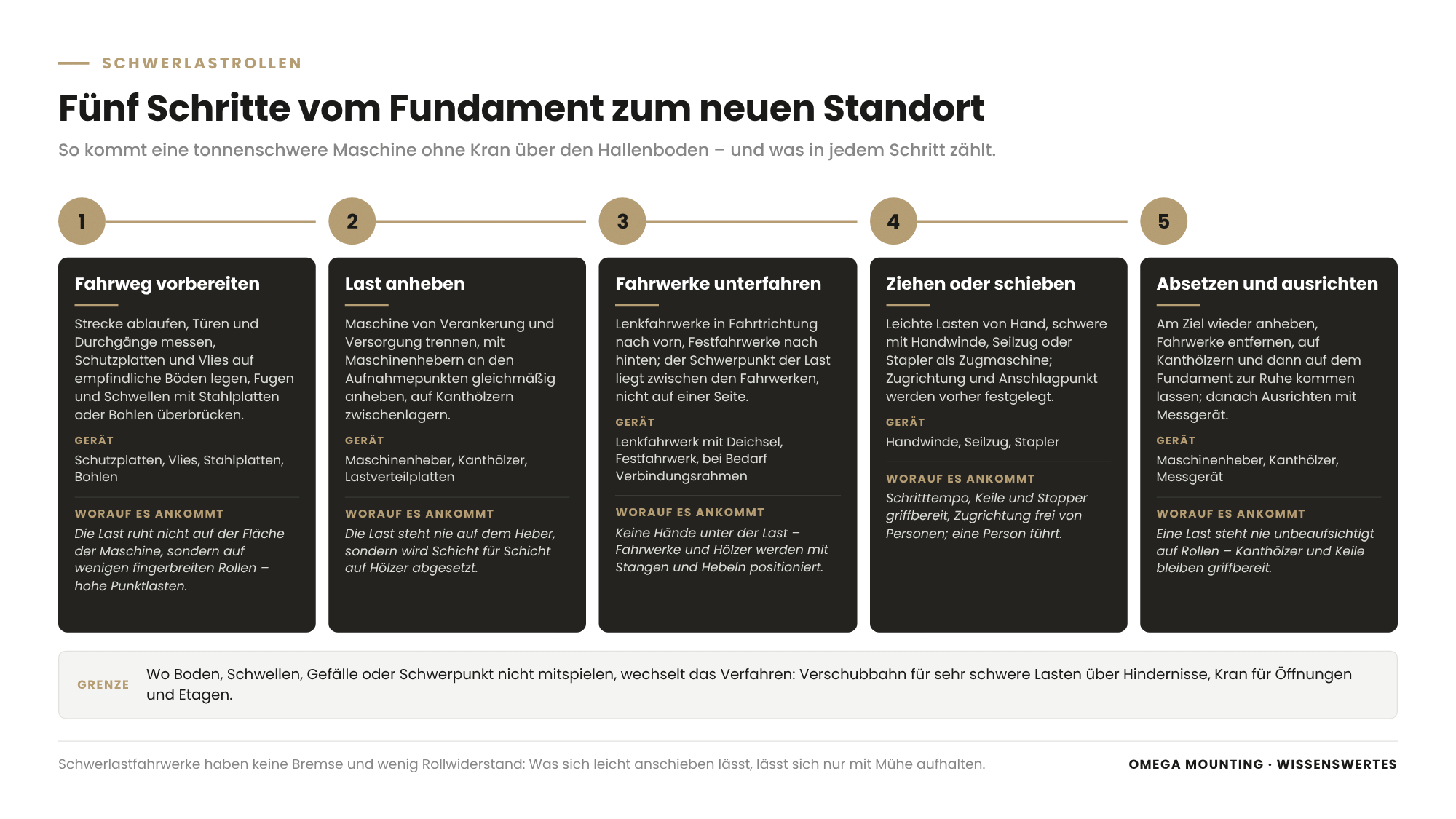
A relocation on machine skates takes place in five steps: prepare the travel path, raise the load, position the skates, pull the load, set the load down and align it. The effort lies in the first step.
- Prepare the travel path. We walk the route, measure doors and passages, lay protective plates and fleece on sensitive floors and bridge joints and thresholds with steel plates or planks.
- Raise the load. The machine is disconnected from its anchoring and supplies, then raised evenly with machine jacks at the lifting points and temporarily supported on timber baulks.
- Position the skates. Steerable skates go at the front in the direction of travel, fixed skates at the rear; the centre of gravity of the load must lie between the skates, not on one side.
- Pull or push. We move light loads by hand, heavy ones with a hand winch, cable puller or forklift as the tractor; the pulling direction and the anchor point are defined beforehand.
- Set down and align. At the destination the load is raised again, the skates are removed and the machine comes to rest on timber baulks and then on the foundation; this is followed by alignment with measuring equipment.
The rolling resistance of a machine skate is low, on smooth concrete typically only a few per cent of the load weight. That is the strength of the equipment and at the same time its danger: a machine that can be pushed with little force can also only be stopped with effort.
What limits do floor, thresholds and centre of gravity impose?
The limit of machine skates is not their capacity but the floor they run on. With machine skates, many people underestimate that the load does not rest on the footprint of the machine but on a few finger-wide rollers – this produces high point loads.
- Floor covering: Screed, tiles and parquet do not take these point loads; there, load spreading plates or a dolly are needed. Grating and raised floors in data centers carry rolling loads only with plates over the pedestals.
- Slab load-bearing capacity: On suspended floors, what counts is not the distributed load of the machine but the individual load per skate; that is checked by the structural engineer, not by the assembly team.
- Thresholds and joints: Every edge higher than the roller radius stops the skate abruptly. Expansion joints, gate thresholds and transitions are bridged or bypassed.
- Gradient: Even a slight gradient produces a downhill force that is greater than the rolling resistance. Then the load rolls on its own, and it is held only by the winch, never by hand.
- Centre of gravity: Tall, narrow loads tip when starting and braking; they are picked up lower, supported wider or transported lying down.
Where these limits are reached, the method changes: for very heavy loads over obstacles, the skidding system is used; for openings and storeys, the crane. Which lifting method then fits is explained in our guide spider crane or mobile crane for moving in.
What we pay attention to
With machine skates, the experience lies not in the equipment but in what happens before and after. Our team checks this before every move:
- Floor before load. We look at the travel path first, then at the machine; an unknown slab or a concealed floor build-up is the most common reason to postpone a relocation.
- Determine the centre of gravity. We determine the centre of gravity from the drawing, type plate or trial lift and position the skates so that it lies in the centre of the set.
- No hands under the load. Skates and timbers are positioned with bars and levers; anyone who would have to reach under the load has found a fault in the set-up.
- Set down on timber baulks. A load never stands on the jack and never unattended on rollers; timber baulks and wedges are always within reach.
- Securing against rolling away. Machine skates have no brake; we secure with winch, wedges and stoppers and keep the pulling direction clear of people.
- Travel slowly. Walking pace, every change of direction is called out; one person leads, everyone else follows.
Where we use it
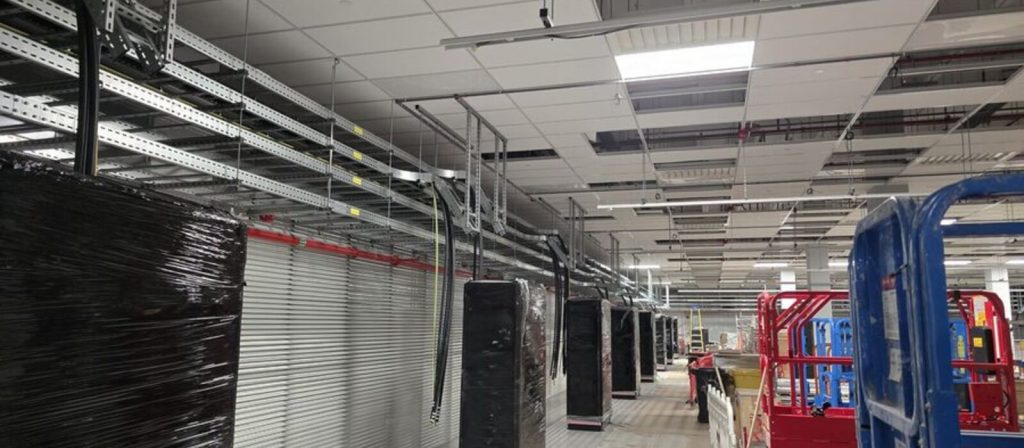
In the Rhine-Main region we mainly roll machines, control cabinets and storage equipment in buildings where no crane and often no forklift is allowed. During the relocation of six automated storage units from a Frankfurt office building , a parquet floor around the units had to be preserved, so dollies and muscle power were the only means of transport; three interior doors set the maximum dimension of every component. During the installation of 160 power distribution cabinets in eight data halls , protective plates and fleece lay on all travel and working paths, and an aluminium gantry with chain hoist set the cabinets from the pallet onto the hall floor. This work is part of our service Machine relocation: dismantle, move, start up.
More technology explained
Technology explained
the method when rollers are no longer enough for the load.
Technology explained
the lifting device that sets the load onto the skates.
Guide
the guide to the whole process, from planning to start-up.
Do you need this machine together with a team on site?
Do you need this equipment together with a team on site because a machine in your hall has to change position? We look at the travel path and tell you whether it rolls or is lifted. Request a callback – a photo of the machine and a look at the hall layout are enough for the first step.
100% free and without obligation

About the author
Tobias Schott
Managing director of Omega Mounting GmbH, Rodgau · more than 20 years of hands-on experience in installation and maintenance
A trained mechatronics technician and at home in maintenance, servicing and industrial installation since 2004 – first at his father's side, since 2012 with Omega Mounting: from the overhead conveyor in Frankfurt to the crane system in a new-build hall. As appointed person for lifting operations he plans and leads lifting operations in data centers and on industrial sites in the Rhine-Main region, is an instructor and examiner for cranes, MEWPs and telehandlers as well as a safety officer. On jobs abroad he is known as the "German Troubleshooter" – the one you call when things get stuck on site. He learnt what quality means not from a manual but from his father: Made in Germany as a standard for his own work, not as a label. That is why it comes first at Omega Mounting – before speed and before price. The Technology explained articles explain the machines and the technology his team works with every day: what counts on our sites is in there – what only appears in the brochure is not.
 English
 German