
- Technology explained – equipment and protection
The lifting point: where a load may be picked up
By Tobias Schott · 5-minute read · Updated November 2026
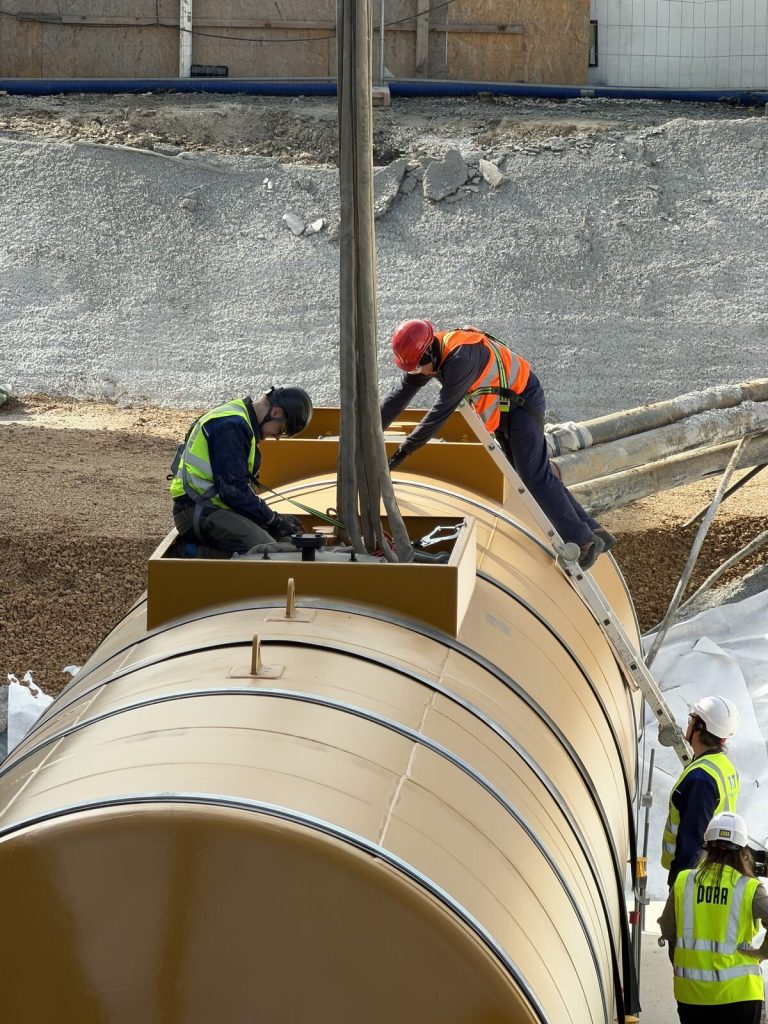
A lifting point is the place on a load where a lifting accessory may be attached – an eyebolt, an eye, a lug or a trunnion, designed for the weight and for a specific direction of pull.
A heavy load must not be picked up just anywhere. Sheet metal bends, coatings crack, housings break out, and an incorrectly loaded eyebolt can tear off. That is why machines, control cabinets, tanks and containers have fixed lifting points – and whoever slings them must know what they can and cannot do.
Here we explain which types there are, in which direction they may be loaded, how layout and centre of gravity are related and what is checked before every lift.
What is a lifting point?
A lifting point is a component permanently attached to or screwed into the load, to which shackles, hooks or slings are attached. Other names are lifting eye, load eye or lifting lug; in German it is called Anschlagpunkt.
It connects two worlds: the lifting accessory – chain, round sling, spreader beam – and the load itself. Its capacity is marked on the component or given in the manufacturer's data. Where it sits and how many there are is set by the manufacturer of the load, because only they know which points can take the forces.
Key facts
- Purpose: Connect the load to the lifting accessory at a point designed for it.
- Types: Eyebolt, swivel lifting point, welded-on lug, trunnion, cast-in eye.
- Loading: only in the permitted direction and up to the stated capacity.
- Layout: by the manufacturer of the load, matched to centre of gravity and stiffness.
- Marking: Capacity and manufacturer on the component.
- Inspection: visual check before every lift, periodically by a competent person.
Which types are there?

The types differ in how they are attached and which direction of pull they can take.
| Type | Fixing | Strength and limit |
|---|---|---|
| Eyebolt | Screwed in, ring fixed. | Simple and widespread; full capacity only along the axis. |
| Swivel lifting point | Screwed in, bow swivels and pivots. | Aligns with the pull, made for angled pulls. |
| Lug | Welded or bolted on, with a hole. | For shackles, loadable in the plane of the lug. |
| Trunnion | On the side of the load, round. | For large, heavy parts, often with a spreader beam or sling. |
There are also cast-in eyes in concrete elements and lifting holes in frames. The same applies to all of them: load them only as specified by the manufacturer. An eyebolt to DIN 580 is a different component from an eyebolt from the DIY store.
In which direction may it be pulled?
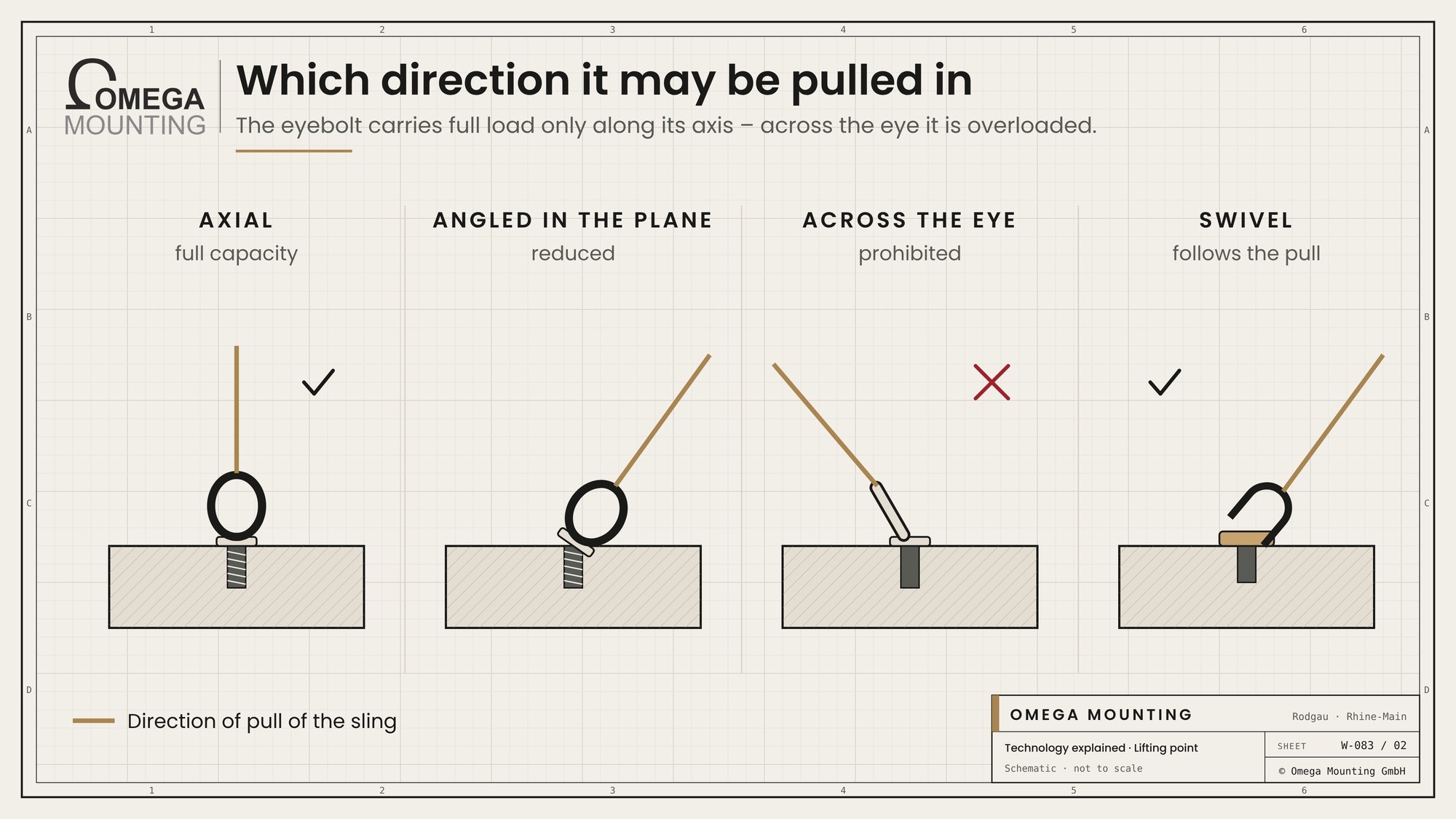
The direction of pull decides how much a lifting point carries.
- Axial: If the sling pulls exactly along the axis of the bolt, the eyebolt carries its full capacity.
- Angled in the plane of the ring: If the sling pulls at an angle but in the plane of the ring, the capacity drops considerably.
- Across the plane of the ring: If the sling pulls sideways against the ring, it is loaded in bending – this is prohibited.
- Swivel lifting point: The bow turns into the direction of pull and is designed for angled pulls.
Multi-leg slings almost always create angled pulls. Anyone slinging eyebolts with several legs therefore needs swivel lifting points or a spreader beam that makes the legs vertical. Which lifting accessories suit which load is explained in our guide on lifting accessories for heavy loads.
Layout and centre of gravity
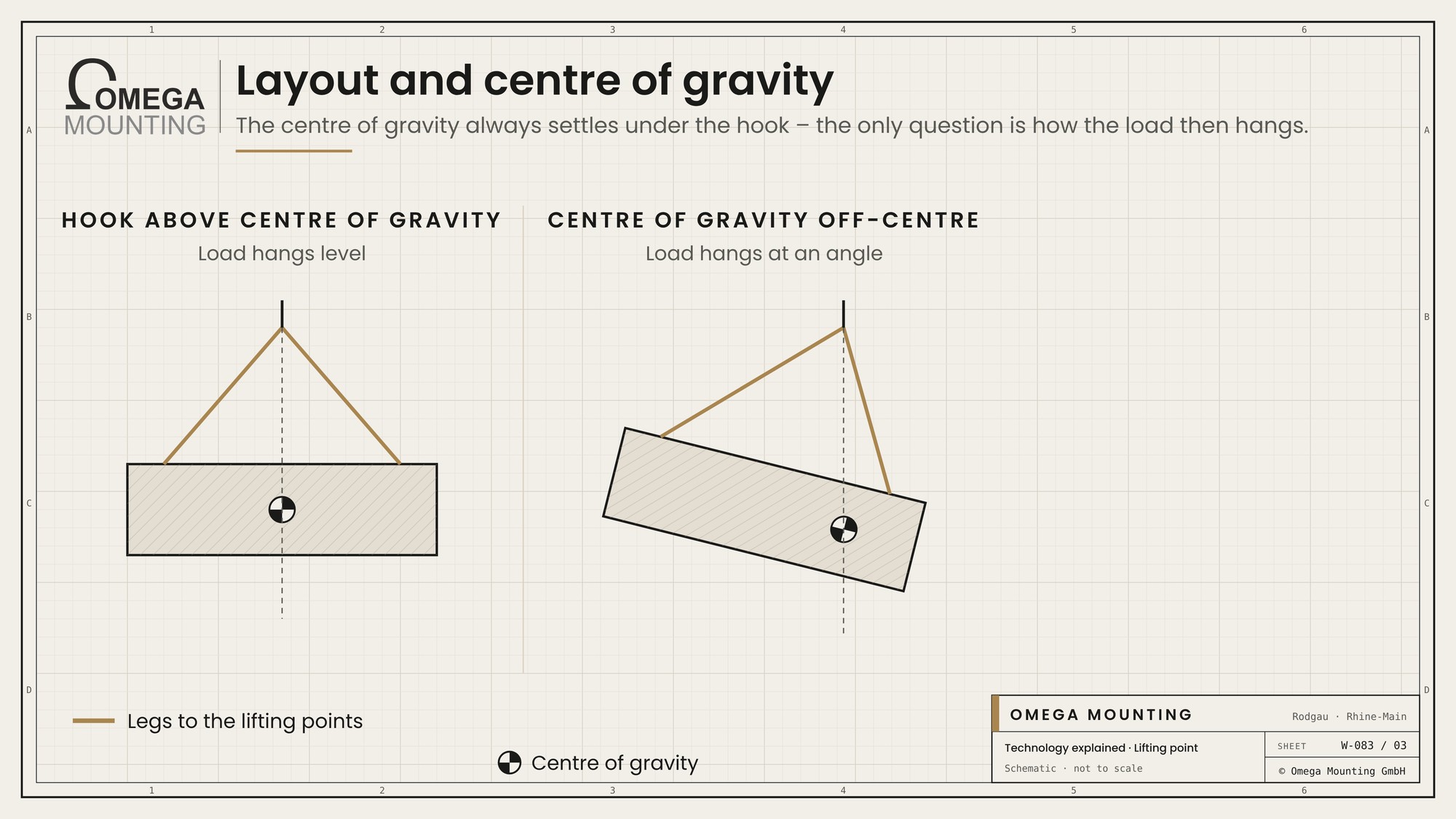
A load always hangs so that its centre of gravity is exactly below the hook.
- Hook above the centre of gravity: The load hangs as it is meant to stand – usually level.
- Hook beside the centre of gravity: The load tilts when lifted until the centre of gravity is below the hook.
- Unequal legs: If the centre of gravity is not central, the legs carry different amounts.
- Long, thin-walled loads: need several lifting points along their length so that they do not bend.
The manufacturer places the lifting points so that the load hangs level with the intended sling. Anyone deviating from this must recalculate. How a spreader beam helps is explained in our article on the Spreader beam.
Check before every lift
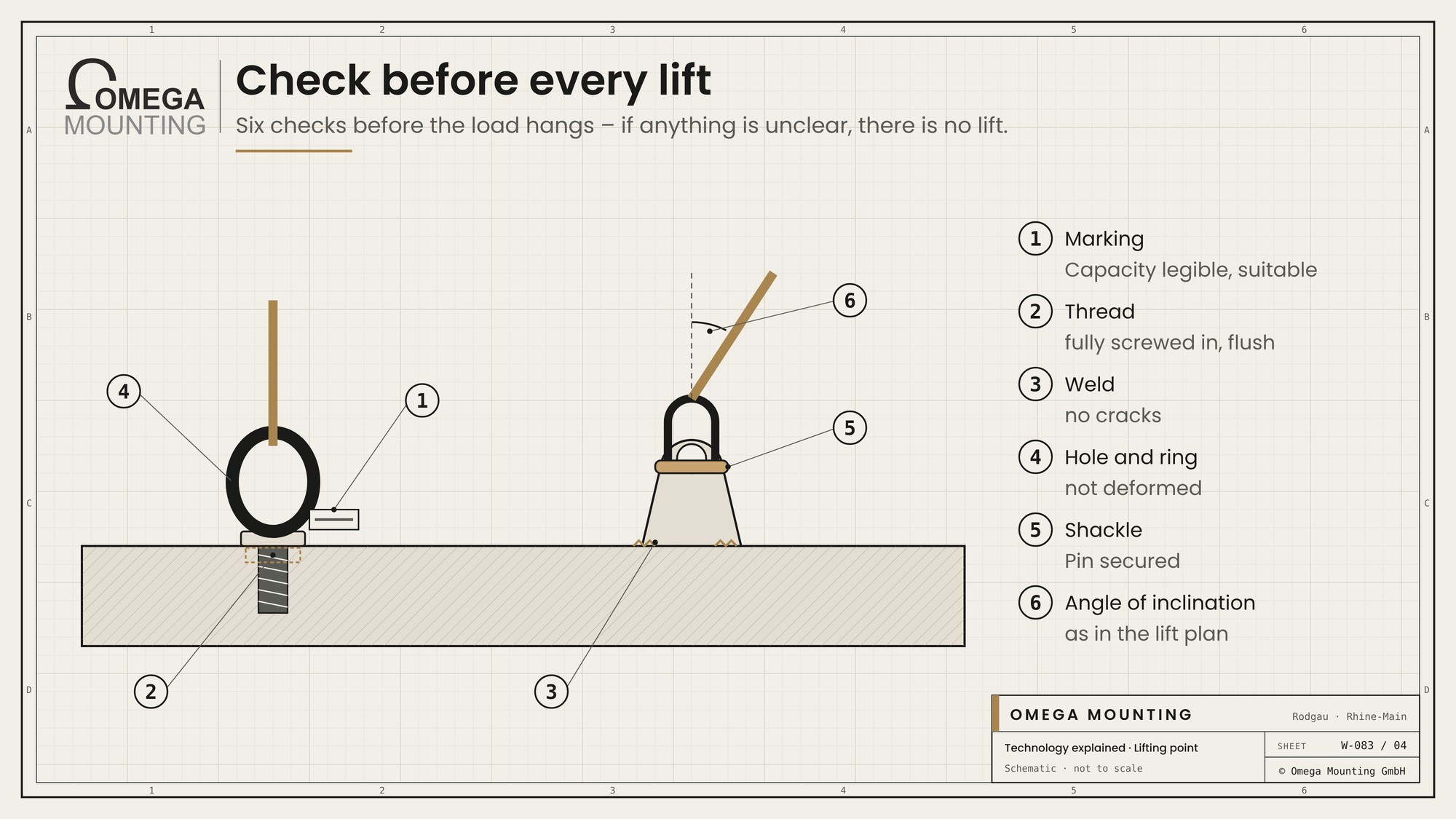
A lifting point is looked at before every lift – not just the first.
- Marking: Capacity and manufacturer legible, capacity suits the load.
- Thread: Eyebolt fully screwed in, seating lies flush.
- Weld: no cracks on welded-on lugs.
- Deformation and wear: ring not bent open, hole not worn oval.
- Shackle: correct size, pin secured.
- Angle of inclination: as provided for in the lift plan.
If anything is unclear, there is no lift. Who may carry out which inspection is explained in our article on the competent person.
Retrofitting and marking lifting points
Not every load has suitable lifting points from the factory. When they are retrofitted, clear rules apply:
- Ask the manufacturer: The first step is to clarify whether the manufacturer provides lifting points or has prepared tapped holes for them.
- Screw-in lifting points: They are screwed into existing threads. Thread size, engagement length and material must match the lifting point’s specification.
- Weld-on lifting points: They are only welded on with proof: suitable base material, a qualified welder, specifications for weld and position.
- Marking: Every lifting point carries its working load limit. If the marking is missing, it is not used.
- Inspection: Like slings, lifting points are subject to regular inspection by a competent person.
If there are no lifting points and they cannot be retrofitted, the load is slung around or lifted in a frame. Edge protection and the right slinging method are then particularly important so that nothing slips and no sling tears on an edge.
What we pay attention to
Before we sling, we clarify what the lifting points can do.
- We obtain position, number and capacity of the lifting points from the manufacturer of the load.
- We check and recalculate whether sling and angle of inclination suit them.
- We prevent angled pulls where the lifting points cannot take them – with a spreader beam or swivel points.
- We never sling from pipes, handles or sheet metal not made for it.
- We look at every lifting point before the lift and stop if something is not right.
Where we use it
In Raunheim, as lifting appointed person, we had five diesel tanks lifted in. A round sling around the coated, thin-walled shell was out of the question. Instead, the tank manufacturer welded four lifting points onto the crown. We checked and recalculated them, and a sling set of round slings and shackles spread the load over all four.
In Fulda we set up GRP tanks, whose lifting eyes were bonded on. An angled pull could have torn them out of the tank. That is why lifting points and lifting gear were agreed with the manufacturer, a purpose-built lifting beam was used and a tag line was attached against swinging.
More technology explained
Technology explained
what hangs on the lifting point.
Technology explained
how legs become vertical.
Technology explained
a load with welded-on points.
Do you have questions about how this works on your site?
Do you have a heavy load and are not sure where and how it may be slung? We check the lifting points, plan the sling and lift. Request a callback.
Our service for this: Lift & shift: rigging and lifting →
Free, no-obligation callback

About the author
Tobias Schott
Managing director of Omega Mounting GmbH, Rodgau · more than 20 years of hands-on experience in installation and maintenance
A trained mechatronics technician, working in maintenance, servicing and industrial installation since 2004 – first alongside his father, and with Omega Mounting since 2012: from overhead conveyors in Frankfurt to the crane system in a new-build hall. He plans and leads lifting operations as an appointed person (AP) in data centers and on industrial sites in the Rhine-Main region, trains and examines operators of cranes, mobile elevating work platforms and telehandlers, and is a qualified occupational safety specialist. On jobs abroad he is known as the “German Troubleshooter” – the person you call when a site gets stuck. He learned what quality means from his father, not from a manual: Made in Germany as a standard for his own work, not a label. That is why quality comes first at Omega Mounting – ahead of speed and price. The Technology explained articles cover the equipment and techniques his team uses every day: what counts on site is in them – what only appears in the brochure is not.
 English
 German