
- Technology explained – equipment and protection
Spreader Beam vs Lifting Beam: Why Two Lifting Points Fall Short
By Tobias Schott · 8-minute read · Updated October 2026
A spreader beam is a load-bearing beam or frame between crane hook and load that keeps the sling legs vertical – making long, sensitive or off-centre heavy loads safe to lift in the first place. When a tank, a container or a crane girder is on the hook, the first thing you often notice is not the slings but the beam above them: the spreader beam. Tender documents call it a lifting beam or below-the-hook lifting device; on site it is simply “the beam” or “the spreader”.
This article explains what sets a spreader beam apart from a round sling or a chain, how it changes the forces in a lift and which type suits which job. How to choose the lifting accessory itself is covered in our guide to lifting accessories for heavy loads – we do not repeat it here.
What is a spreader beam?
A spreader beam is a non-fixed below-the-hook lifting device made of one or more steel girders. It hangs between crane hook and load and distributes the lifting force over several lifting points. At the top sits the suspension for the hook; at the bottom are lugs or pins from which round slings, chains or wire ropes run to the load. The beam does not hold the load by friction or clamping force – it gives it a geometry: the legs below run vertically, however long the load is.
German uses one word, “Traverse”, for what English splits into two terms. A lifting beam has a single central suspension point and works in bending; the slings below hang vertically. A spreader beam is connected to the hook by two angled legs and therefore works in compression. The difference decides the cross-section of the girder – more on that below.
Key facts
- Purpose: Spread the lifting force from the hook over two or more lifting points; keep sling leg angles small; keep compressive forces off the load; compensate for an off-centre centre of gravity
- Types: Lifting beam (single girder), H-frame beam, spreader frame, cross beam, adjustable beam with several rows of holes, telescopic beam
- Material and dead weight: Structural steel as rolled section or welded box girder, aluminium for light-duty designs; the beam's own weight adds to the hook load and is shown on the rating plate
- Marking: Rating plate with working load limit (WLL), own weight, manufacturer, serial number and CE marking; operating instructions listing the permitted slinging configurations
- Inspection duty and interval: Pre-use check by the slinger every time; inspection by a competent person at least once a year under DGUV Rule 100-500 (German statutory rule on load-handling equipment), and after any repair or overload
- Discard criteria: Bent or twisted girder, cracked welds or lugs, elongated or worn holes, worn pins, missing or illegible rating plate
Why are two lifting points often not enough?

Two legs running straight from the hook to the ends of a long load are angled so far from the vertical that they squeeze the load, and each carries more than half its weight. The physics is simple: the force in an angled leg splits into a vertical part that holds the load and a horizontal part that pushes inwards on it.
The flatter the leg, the greater this horizontal component. At an angle of 45 degrees to the vertical, each of the two legs carries around 0.7 times the load weight instead of half. At 60 degrees, each leg carries the full weight of the load, and the load is squeezed from both sides with almost its own weight. Under DGUV Information 209-021, slinging at more than 60 degrees is not permitted.

For a long load there are two ways out: a near-vertical sling arrangement, which needs a lot of headroom, or a spreader beam. Under a hall roof, in a basement or when lifting through a facade opening, headroom is almost always too tight. The spreader beam makes the legs below it vertical, takes the horizontal thrust off the load and needs only its own overall height to do so.
Sensitive loads cannot take that thrust anyway: thin-walled tanks dent, containers rack at the corners, control cabinets and cladding buckle. The spreader beam costs kilograms: the hook load is the load plus lifting accessories plus beam. Forget the beam's weight and you undersize the crane.
Which types are there – and how does each carry the load?
The type of beam follows the shape of the load and the question of whether the girder works in bending or in compression. A lifting beam with a central suspension point is a bending member: the hook pulls upwards in the middle, the load pulls downwards at the ends. It therefore needs a deep cross-section, but has a low overall height and is easy to handle.
A spreader beam works the other way round: two legs run at an angle from the hook to the ends of the beam, which is therefore loaded in compression. For the same weight, steel carries compression better than bending. That is why a spreader beam manages heavy loads with a slimmer tube – but it costs headroom for the upper sling set.

| Type | Design | Strength | Limit | Typical use |
|---|---|---|---|---|
| Lifting beam (single girder) | One girder, central suspension, two or more lugs underneath | Low overall height, quick to rig, often with adjustable lugs | Works in bending – gets heavy with long loads and high capacity | Machines, vessels, loads with two lifting points |
| Spreader beam | Beam with a sling set running up to the hook, vertical legs below | Works in compression – light section at high capacity | Needs headroom for the upper sling set | Long steel components, crane girders, pipes, tanks |
| H-frame beam | Two parallel girders joined by cross members, four lugs | Four vertical legs, load hangs without twisting | Large and heavy, needs space to set down | Containers, frames, switchgear, platforms |
| Cross beam | Two crossed girders, suspension at the crossing point, four lugs | Four points on a compact footprint | Fixed point spacing, one load size per beam | Square loads, machine frames, housings |
| Adjustable beam | Beam with a row of holes or sliding lugs | Point spacing and off-centre centre of gravity adjustable | Each setting has its own rated capacity in the load table | Changing loads on installation work |
| Telescopic beam | Extending girder with locking pins | Wide range of lengths in one device | Capacity drops as the beam extends; pins wear | Installation and hire work, varying container lengths |
There are also special designs such as turning beams for rotating loads, or beams for tandem lifts on which two cranes pull. For every type: the rated capacity on the rating plate is tied to a slinging configuration. Different angles or different holes mean a different rated capacity.
Below-the-hook lifting device or lifting accessory – why the difference matters
A spreader beam is a below-the-hook lifting device, a round sling is a lifting accessory, and together with the crane hook they make up the complete lifting arrangement. The terms come from the German inspection rule for hoisting operations and define who inspects what and who is responsible:

- Crane-fixed lifting gear: Part of the crane and permanently attached to it – bottom block and crane hook. They are covered by the crane inspection.
- Below-the-hook lifting devices: Detachable from the crane, they pick up the load – spreader beam, C-hook, grab, tongs, vacuum lifter, forks. They count as machinery under the EU Machinery Directive, so they carry CE marking and a declaration of conformity; the safety requirements are set out in EN 13155.
- Lifting accessories: The connection between crane-fixed gear or below-the-hook lifting device and the load – round sling, webbing sling, chain sling, wire rope, shackle.
For the lift, this means the spreader beam has its own rated capacity, its own inspection record and its own weight. A sling set hangs above it and lifting accessories hang below it – each with its own rated capacity and leg angle.
Inspection works as for lifting accessories: a competent person inspects girder, welds, lugs and pins at least once a year and records the result. That is site practice under the German rules, not legal advice. A home-made beam without certification and rating plate does not go on the hook, however solid it looks.
What we pay attention to
Our fitters treat the spreader beam as part of the calculation before the lift, not as an accessory.

- We calculate the hook load including beam, sling set and lifting accessories – a heavy beam can weigh as much as a small load.
- We check whether the beam’s slinging configuration matches the lifting points on the load: point spacing, lug orientation, shackle size.
- We find the centre of gravity before the lift and set the lugs so that the load hangs level, instead of correcting the tilt afterwards with shortening clutches.
- We measure the headroom with the beam in place: underside of ceiling, hook, upper sling set, beam, legs, load. If we are a metre short, we change the beam type.
- After the lift we set the beam down on timber, never on its edge, and never park it above people.
- We read the rating plate and inspection date before every use – and for hired beams the operating instructions too.
Where we use it
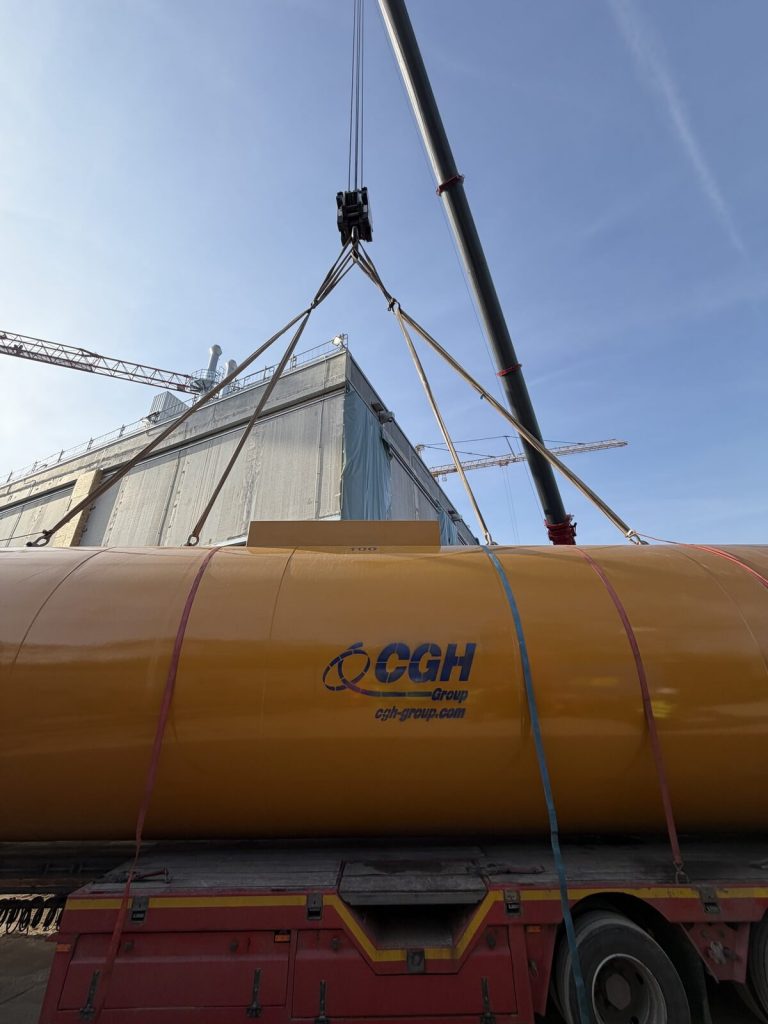
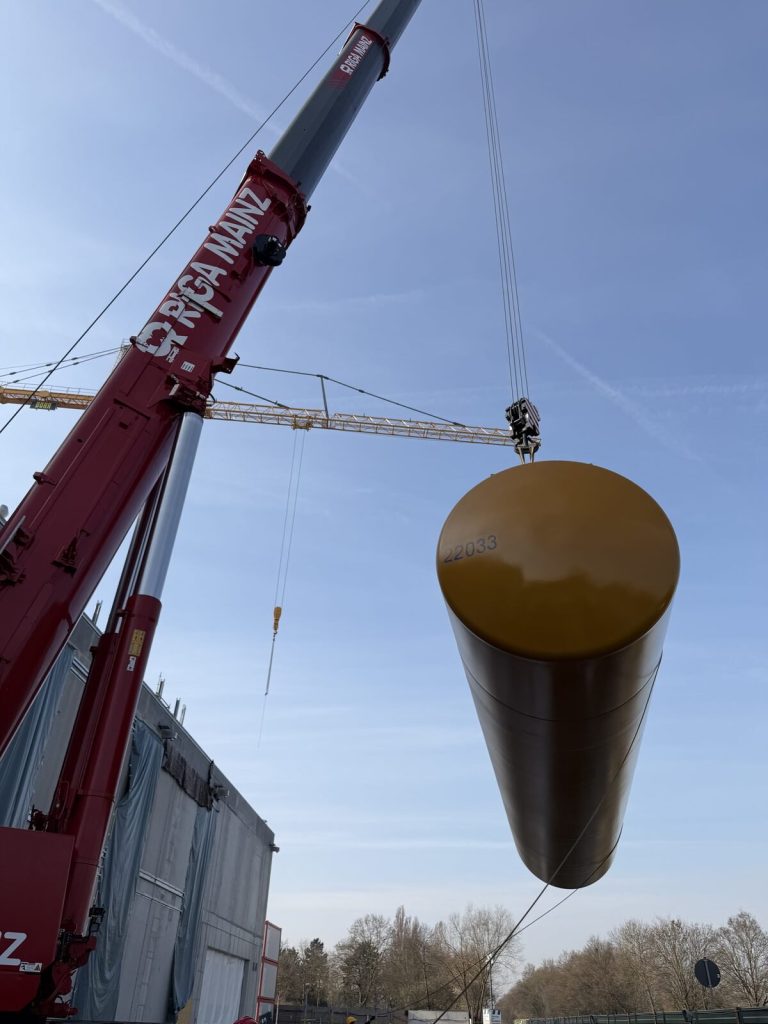
In the Rhine-Main region we use spreader beams wherever loads are long, sensitive or heavy off-centre. When five diesel tanks were installed in Raunheim, each tank for the data center – about 16 metres long and 16 tonnes in weight – hung from a sling set on four welded-on lifting points. With a load like that, the slinging geometry dictates the lift. During the installation of a double-girder overhead crane in Aschaffenburg, the crane bridge itself was the long load that had to be manoeuvred onto the runway below the ceiling. During the tandem lift of a standby power system in a container, four lifting points guided a 54-tonne load. What hangs between hook and load on lifts like these is set out beforehand in the lift plan by the appointed person for lifting operations – part of our work in Lift & Shift.
More technology explained
Technology explained
the lifting accessories above and below the spreader beam.
Technology explained
the crane whose rated capacity also has to carry the weight of the beam.
Guide
the guide to choosing, for when you have to decide for your load.
Do you have questions about how this works on your site?
Questions about a lift with a spreader beam on your site – whether the headroom is enough, which type suits your load or who inspects the beam? We will look at the load, lifting points and available space together with you. Request a callback – we will get back to you.
Free, no-obligation callback
About the author
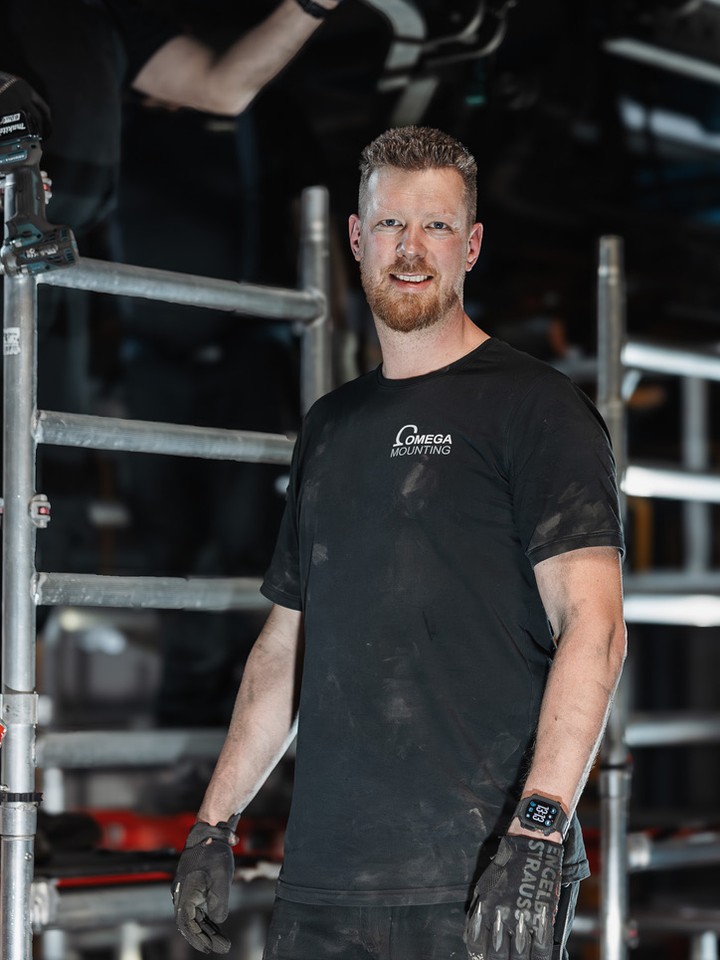
Tobias Schott
Managing director of Omega Mounting GmbH, Rodgau · more than 20 years of hands-on experience in installation and maintenance
A trained mechatronics technician, working in maintenance, servicing and industrial installation since 2004 – first alongside his father, and with Omega Mounting since 2012: from overhead conveyors in Frankfurt to the crane system in a new-build hall. He plans and leads lifting operations as an appointed person (AP) in data centers and on industrial sites in the Rhine-Main region, trains and examines operators of cranes, mobile elevating work platforms and telehandlers, and is a qualified occupational safety specialist. On jobs abroad he is known as the “German Troubleshooter” – the person you call when a site gets stuck. He learned what quality means from his father, not from a manual: Made in Germany as a standard for his own work, not a label. That is why quality comes first at Omega Mounting – ahead of speed and price. The Technology explained articles cover the equipment and techniques his team uses every day: what counts on site is in them – what only appears in the brochure is not.
Frequently asked questions
The hook load is the load plus lifting accessories plus beam plus the sling set above it. We take the beam’s own weight from its rating plate into the hook load before the crane is selected – a heavy beam can weigh as much as a small load. We also measure the headroom with the beam in place and check that its slinging configuration matches the load’s lifting points.
Yes. For long, sensitive or off-centre loads we plan the right beam type into the lift – single-girder, H-frame, cross or telescopic beam. Only beams with a rating plate, CE marking and a documented inspection by a competent person go on the hook; for hired beams we also read the operating instructions. A home-made beam without certification is never used.
Yes. Our own metalwork shop in Rodgau fabricates spreader and lifting beams for special loads. An external structural engineer calculates the design; every beam is CE-marked and marked with its working load limit (WLL). Our appointed person (AP) plans the beam into the lift, including its own weight in the hook load.
 English
 German