
- Technology explained – key term
Competent person, qualified person, expert: who may inspect what
By Tobias Schott · 8-minute read · Updated October 2026
A competent person inspects work equipment on behalf of the operator, the qualified inspector (Sachkundiger) is usually the same inspector under an older name, and the authorised expert (Sachverständiger) comes into play where the regulations require an independent body from outside. You come across the three terms in the crane logbook, on the label on the chain sling, in the list of defects after the racking inspection and in tenders that require “proof of the competent person”. On site they are constantly mixed up: anyone who says “expert” often means a competent person – and vice versa.
This article explains what lies behind each term, who appoints whom, what is inspected and what the proof looks like. Your inspection duties in detail are covered in the guide to inspection duties for operators – we do not repeat them here.
What is a competent person?
A person qualified to inspect (German: befähigte Person) is a person who, through vocational training, professional experience and recent professional activity, has the expertise to inspect a specific item of work equipment. The term comes from the German Ordinance on Industrial Safety and Health, BetrSichV for short, and is specified in the Technical Rule TRBS 1203. The decisive word is “specific”: nobody is a competent person for everything, but always for one item of work equipment or one group – lifting accessories, ladders, racking, dock levellers, cranes.
In British English the role is called “competent person”. However, the British term does not match the German one exactly: in the UK it also covers inspections that are reserved for the authorised expert in Germany.
Key facts
- Definition: Inspector with expertise for a specific item of work equipment, appointed by the employer or operator for this inspection.
- Also known as: Person qualified to inspect, Sachkundiger (older term from the accident prevention regulations of the German statutory accident insurance institutions), racking inspector for racking systems, inspector in everyday use.
- Terminology: Competent person; for the authorised expert “authorised inspector” or “third-party inspector” – the terms are not identical.
- Where you find it: Logbook and inspection report, inspection label, list of defects, tender (“proof of inspection by a competent person”), letter of appointment in the company.
- Standard: The ordinance and the Technical Rule above; the regulations of the accident insurance institutions also use the term Sachkundiger.
- Often confused with: With the authorised expert (independent, authorised body), with the occupational safety specialist (advises but does not inspect work equipment) and with the publicly appointed expert witness in court.
Who inspects what: competent person, qualified inspector or authorised expert?
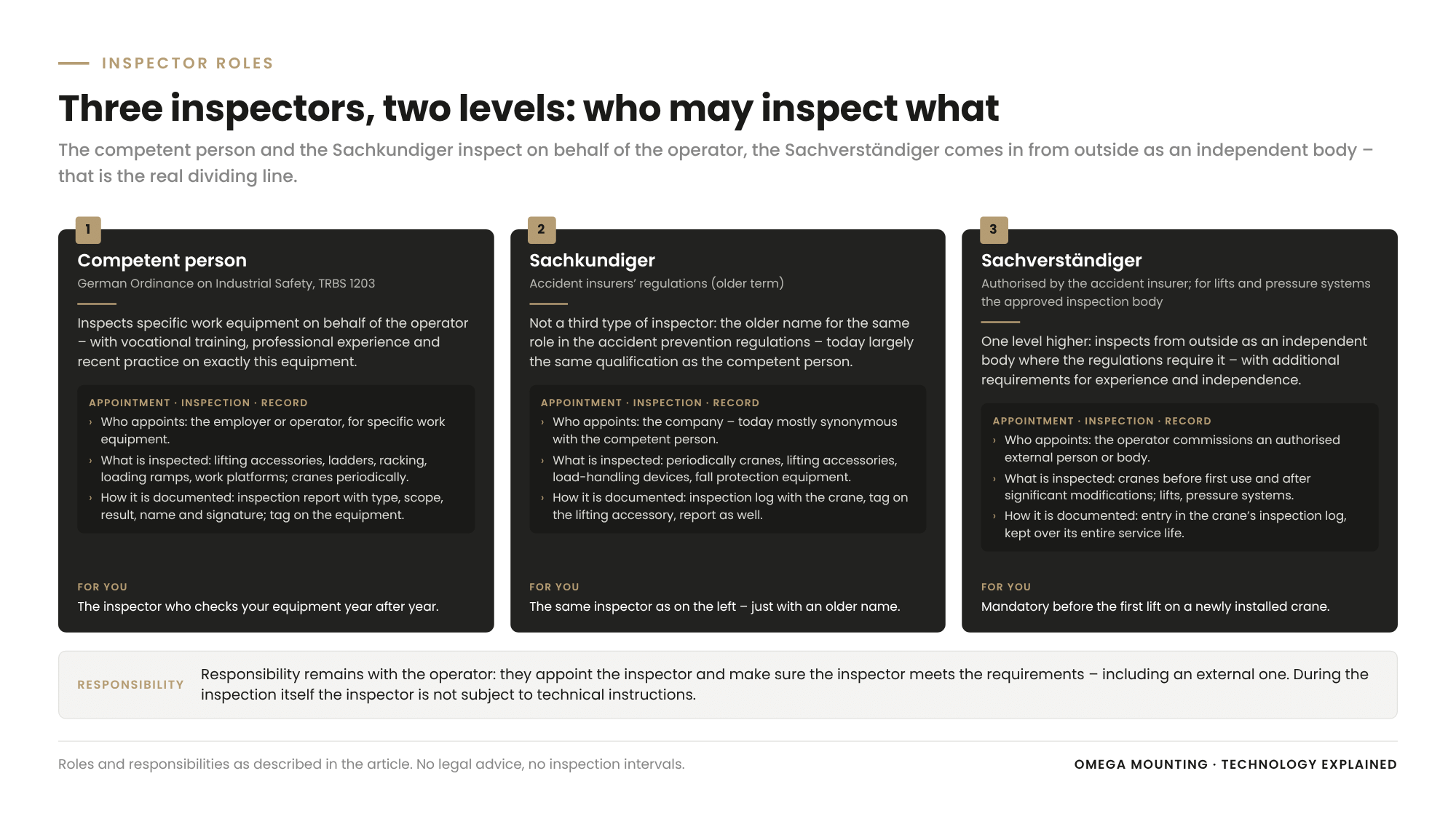
The competent person and the qualified inspector inspect on behalf of the operator, the authorised expert inspects as a body from outside – that is the real dividing line. The qualified inspector is not a third type of inspector. The regulations of the accident insurance institutions are older than the ordinance and call the inspector Sachkundiger, for example for cranes and lifting accessories. Today this largely means the same qualification as the competent person.
The authorised expert, on the other hand, is one level above. For cranes, they are authorised by the accident insurance institution and, under the crane regulation DGUV Regulation 52, usually inspect power-driven cranes before first commissioning and after significant modifications. The ordinance speaks here of inspection experts – competent persons with additional requirements for training, experience and independence. For installations requiring monitoring such as lifts and pressure systems, an approved inspection body (ZÜS) carries out the inspection.
| Term | Basis | Typical inspection | Who appoints |
|---|---|---|---|
| Person qualified to inspect | The ordinance with its Technical Rule. | Lifting accessories, ladders, racking, dock levellers, mobile elevating work platforms; cranes on a recurring basis. | The employer or operator, for a specific item of work equipment. |
| Qualified inspector | Regulations of the accident insurance institutions (older term). | Recurring inspection of cranes, lifting accessories, load handling attachments, fall protection equipment. | The company; today mostly synonymous with the competent person. |
| Authorised expert | Authorisation by the accident insurance institution; for installations requiring monitoring, the approved inspection body. | Cranes before first commissioning and after significant modifications; lifts, pressure systems. | The operator commissions an authorised person or body from outside. |
In practice this means: anyone who has a new overhead crane installed needs the authorised expert before the first lift. Anyone who has the same crane inspected year after year needs a competent person – whether they are called qualified inspector or simply inspector.
How does someone become a competent person – and who appoints them?
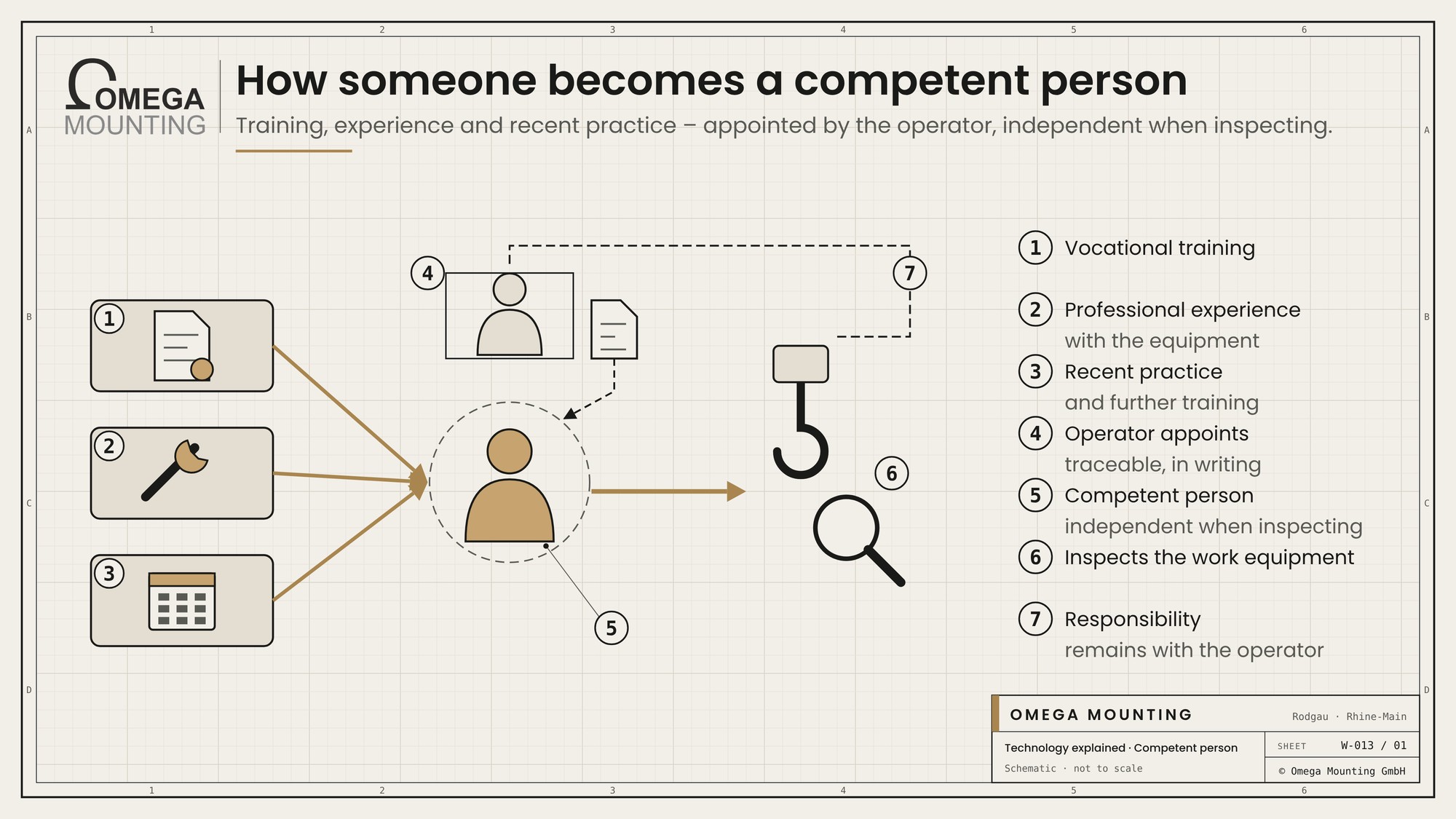
Three things make someone a competent person: suitable vocational training, professional experience with the work equipment and recent professional activity, i.e. regular work with it. The Technical Rule names these three criteria and expects the inspector to keep their knowledge up to date – through inspection work and further training. A course alone does not make anyone a competent person, and neither does a master craftsman’s certificate without practice on the equipment.
The competent person is appointed by the employer or operator. They decide who inspects which work equipment and record this in a traceable way – in practice in writing, so that the appointment can be shown during an inspection visit. First, the competent person must not be subject to any technical instructions during the inspection: nobody may tell them to overlook a defect. Second, responsibility for the inspection remains with the operator, even if they commission an external inspector. They must make sure that the inspector meets the requirements.
This is not legal advice but the logic of the system: the operator knows the work equipment and the duties, the inspector brings the expertise.
What is inspected – and when?
Work equipment is inspected on three occasions: before first commissioning, on a recurring basis at set intervals and after modifications, repairs or exceptional events. The inspection before first commissioning is mandatory where safety depends on the installation conditions – an overhead crane on its crane runway is the classic example. The operator sets the recurring inspection in their risk assessment; for lifting accessories, DGUV Rule 100-500 requires an inspection by the qualified inspector at least once a year. After a repair to load-bearing parts, the re-inspection follows before the work equipment goes back into operation.
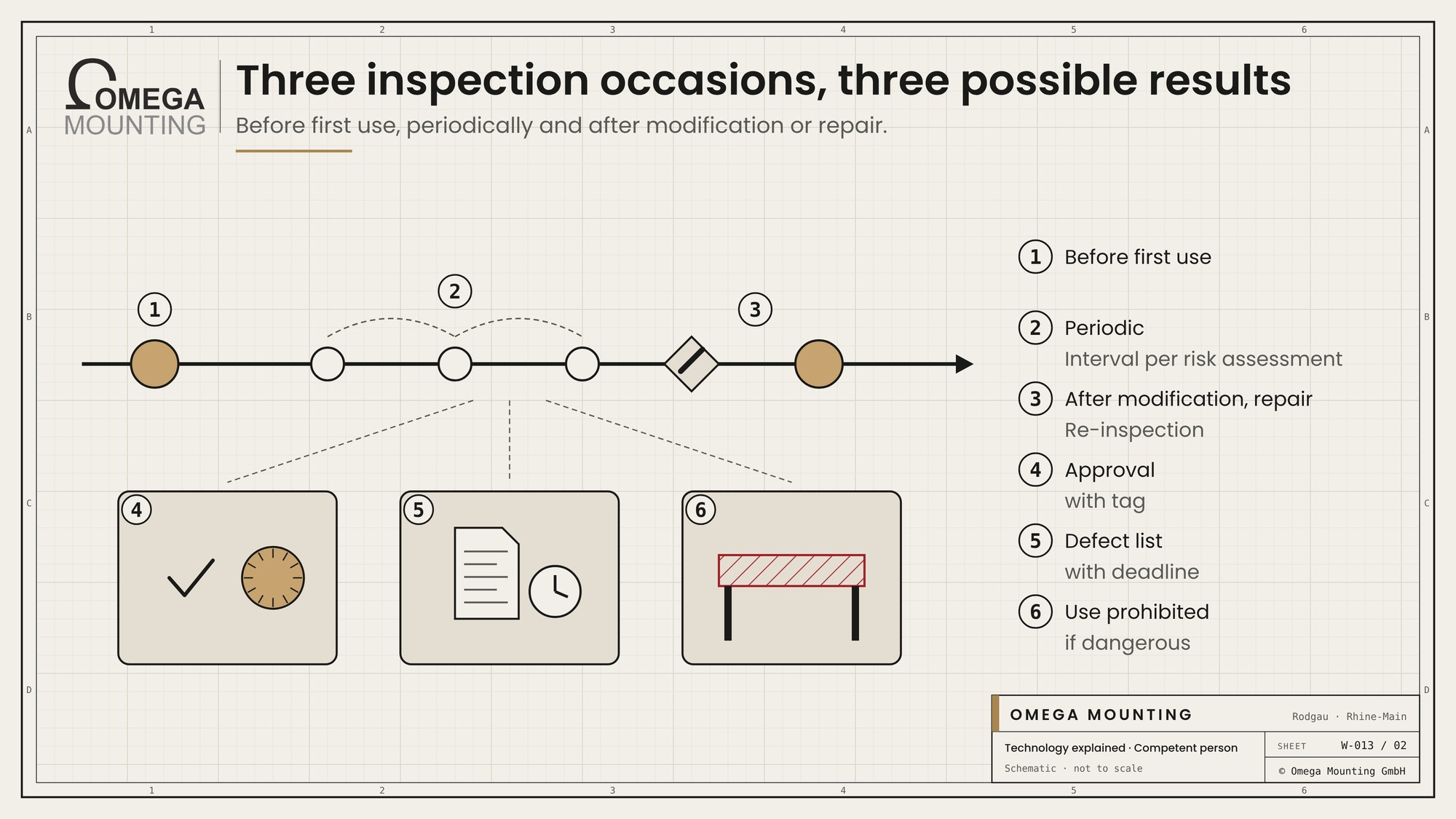
What the inspector does depends on the work equipment. On a chain sling they measure the elongation of the links and look for cracks and spreading on the hook. On a dock leveller they examine welds, brackets, bearings and safety devices. On pallet racking, the standard for storage equipment DIN EN 15635 lists upright damage, missing safety pins and overload among the typical findings. The result is either a release or a list of defects with a deadline – and, in case of danger, a prohibition of use.
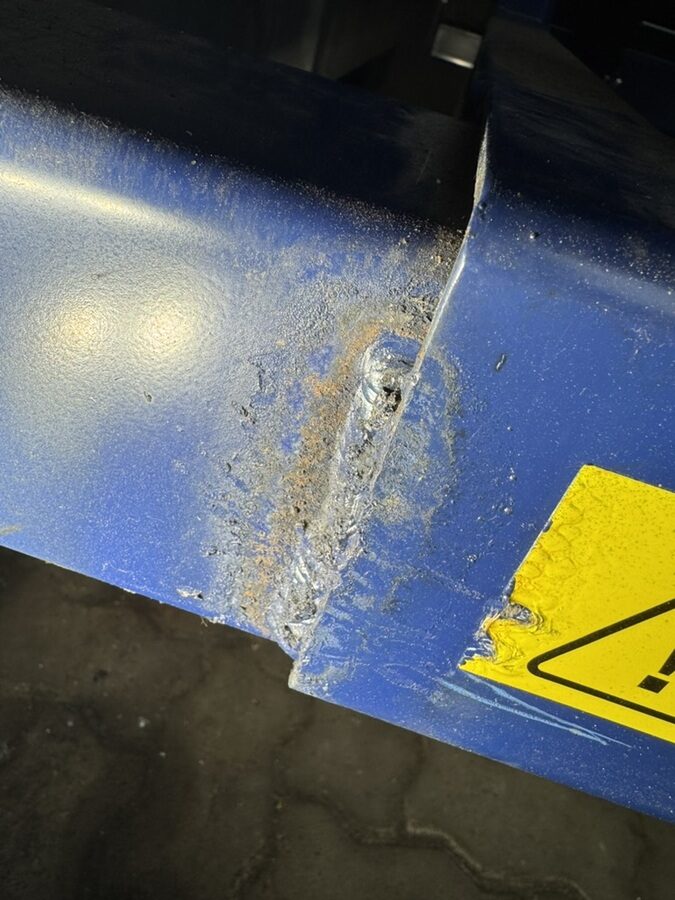
A flagged weld on a dock leveller shows how closely inspection and repair are linked: without an inspection stamp the door stays locked until the re-inspection releases the repaired bracket.
What goes in the logbook, report and label?
An inspection only counts once it is recorded, and the record must contain at least the type, scope and result of the inspection as well as the name and signature of the inspector. In practice date and occasion are included too. The inspection rule TRBS 1201 describes this minimum content and also says how long the record is kept: until the next inspection, for cranes for the entire period of use.
The three forms of proof complement each other:
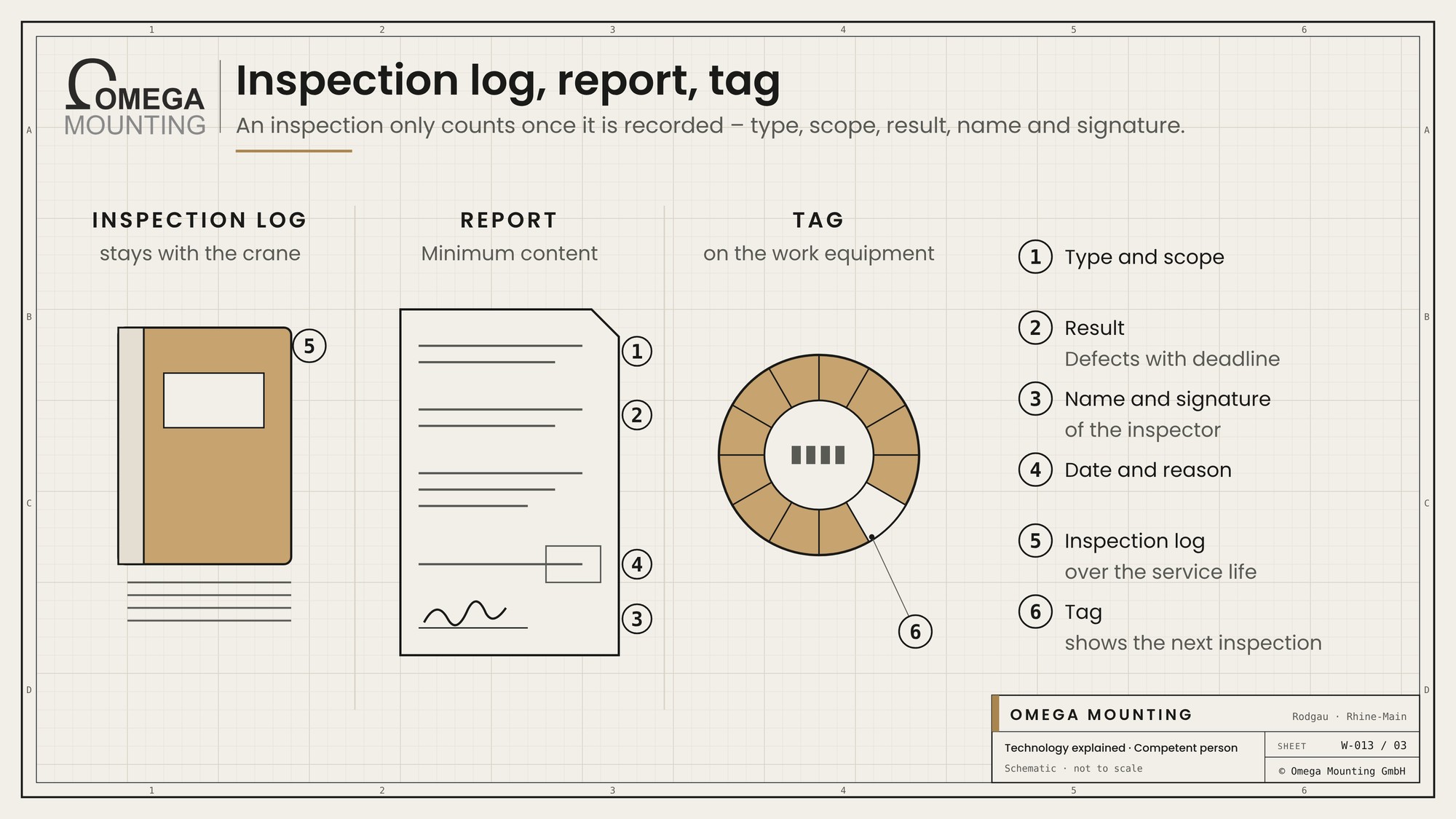
- Logbook: The running file of an item of work equipment, typical for cranes. It contains all inspections, defects and repairs in chronological order.
- Inspection report: The record of a single inspection with findings, list of defects and release or prohibition of use.
- Inspection label: The notice on the equipment showing when it was inspected and when the next inspection is due. It only proves that an inspection took place – not that the equipment is free of defects.
For lifting accessories that move between sites, the label on the master link has become standard, supplemented by a copy of the report in the vehicle.
What we pay attention to
Our fitters are themselves appointed as competent persons for what they install and repair – and know exactly where their responsibility ends.
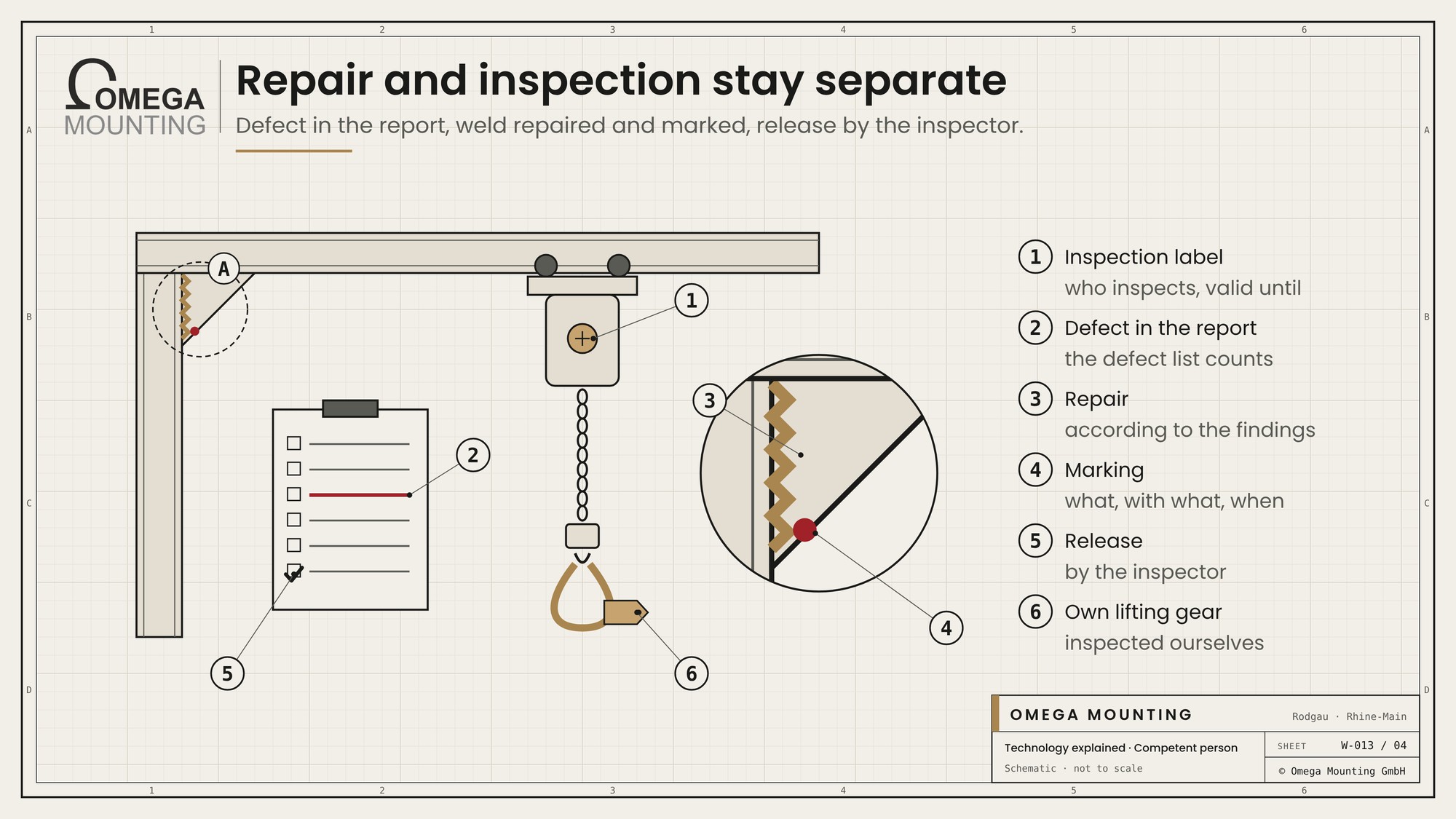
- Before the job we ask who inspects the work equipment we work on: the operator’s inspector, an external qualified inspector or an authorised expert. That determines who gives the release.
- We separate repair and inspection: whoever re-welds a seam prepares the re-inspection – the release is given by the inspector who flagged the defect.
- We read the report, not just the label: the list of defects tells us what needs to be done.
- We document every repair so that the inspector can follow it: what was damaged, what was replaced or welded, with which material.
- We do not claim the competence of an authorised expert. We obtain the acceptance of a newly installed crane, a lift or a pressure system via the operator from the authorised body.
- We inspect our own lifting accessories and our fall protection equipment ourselves – at least once a year by an appointed competent person, and additionally before every use by the slinger.
Where we use it
In the Rhine-Main region many maintenance jobs start with an inspector’s list of defects. During the repair of cracked welds on two dock levellers the annual statutory inspection had revealed the defect; two fitters ground out the seams in one working day, re-welded them and handed the brackets over for re-inspection. During the racking repair in a high-bay warehouse in Fulda the starting point was a racking inspection with a list of defects; we replaced uprights, beams and bracing during ongoing operation, after which the customer received a new racking inspection. Where we install a double-girder overhead crane, our work ends with the handover from the main switch – the acceptance of the crane lies with the inspector appointed for it. This work is part of our Maintenance and servicing.
More technology explained
Technology explained
the work equipment where both the authorised expert and the competent person are involved.
Technology explained
the equipment that the qualified inspector handles every year.
Guide
the guide for when your crane inspection is due or has revealed defects.
Need fitters who know this process?
Are you planning a project that requires inspection by competent persons and need fitters who know what the inspector wants to see? We repair, document traceably and prepare the re-inspection. Request a callback – we will get back to you.
Free, no-obligation callback

About the author
Tobias Schott
Managing director of Omega Mounting GmbH, Rodgau · more than 20 years of hands-on experience in installation and maintenance
A trained mechatronics technician, working in maintenance, servicing and industrial installation since 2004 – first alongside his father, and with Omega Mounting since 2012: from overhead conveyors in Frankfurt to the crane system in a new-build hall. He plans and leads lifting operations as an appointed person (AP) in data centers and on industrial sites in the Rhine-Main region, trains and examines operators of cranes, mobile elevating work platforms and telehandlers, and is a qualified occupational safety specialist. On jobs abroad he is known as the “German Troubleshooter” – the person you call when a site gets stuck. He learned what quality means from his father, not from a manual: Made in Germany as a standard for his own work, not a label. That is why quality comes first at Omega Mounting – ahead of speed and price. The Technology explained articles cover the equipment and techniques his team uses every day: what counts on site is in them – what only appears in the brochure is not.
 English
 German