
- Technology explained – machines and equipment
The radiator on a standby generator: how the engine gets rid of its heat
By Tobias Schott · 6-minute read · Updated November 2026
The radiator is the cooler of the standby generator: it takes the heat from the diesel engine's coolant and releases it to the air via a fan. Without a tight, clean radiator, no generator set runs under load.
A large diesel engine turns only part of the energy in the fuel into electricity. The rest becomes heat – in the exhaust, in the charge air and in the engine block. The coolant carries the heat away from the engine block. The radiator passes it on to the surroundings.
Here we explain how the cooling circuit works, how a radiator is built, how it is installed in the room and what matters for maintenance and repair.
What is a radiator on a standby generator?
A radiator is a heat exchanger between liquid and air. The hot coolant flows through many thin tubes. Air flows between the tubes and takes the heat with it.
On standby generators the radiator is usually a large, flat component with its own fan. It either sits directly on the base frame in front of the engine or is installed remotely as a separate assembly, for example on the façade or on the roof.
On site it is usually just called the “cooler”. It has nothing to do with the dry cooler of a refrigeration plant – that one does not cool engine water but the refrigerant or chilled water of the air-conditioning system.
Key facts
- Task: Release heat from the engine coolant to the air.
- Medium: coolant made of water with frost and corrosion protection.
- Key parts: Tanks, radiator core of tubes and fins, fan, frame.
- Types: mounted on the generator set or remote with its own piping.
- Weak points: thin fins, brazed joints, hoses, fan bearings.
- Interfaces: Engine manufacturer, ventilation design, noise control, building.
- Our part: Rigging in, installation, piping, maintenance access, on-site repair.
How the cooling circuit works
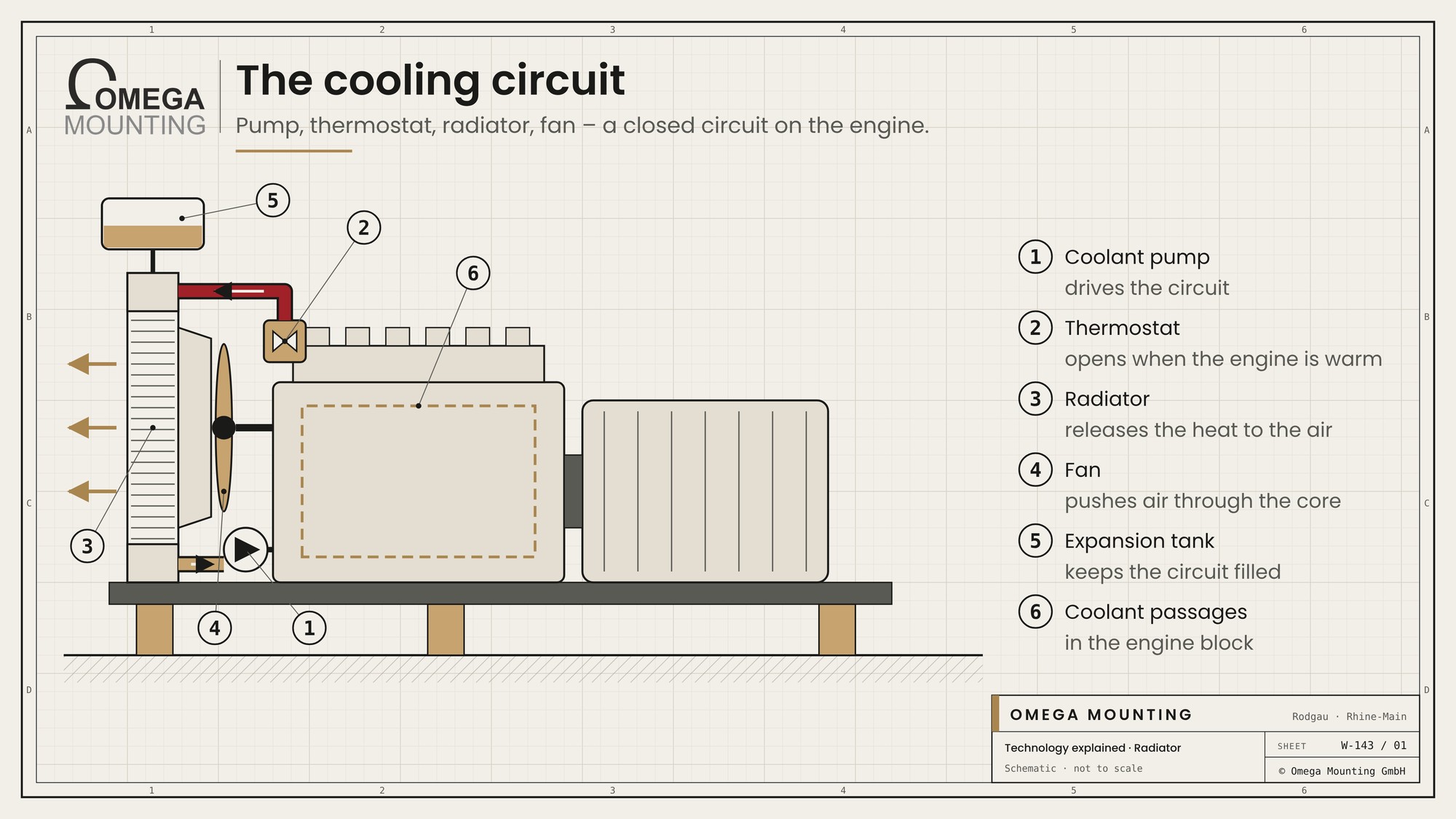
The cooling circuit of a diesel engine is a closed loop. It consists of just a few stations:
- Pump: The coolant pump drives the coolant through the passages in the engine block and the cylinder head.
- Thermostat: As long as the engine is cold, the thermostat keeps the path to the radiator closed. The coolant flows back in the small circuit and the engine warms up faster.
- Radiator: Once the engine is warm, the thermostat opens. The coolant flows through the radiator and releases heat there.
- Expansion tank: It takes up the volume by which the coolant expands when it heats up, and keeps the circuit filled.
Many large engines also have a second circuit for the charge air cooler. The radiator then has two separate sections in the same frame.
Standby generators in data centers often have a preheater. It keeps the engine warm at standstill so that it can take on load immediately in a power failure.
How the radiator is built
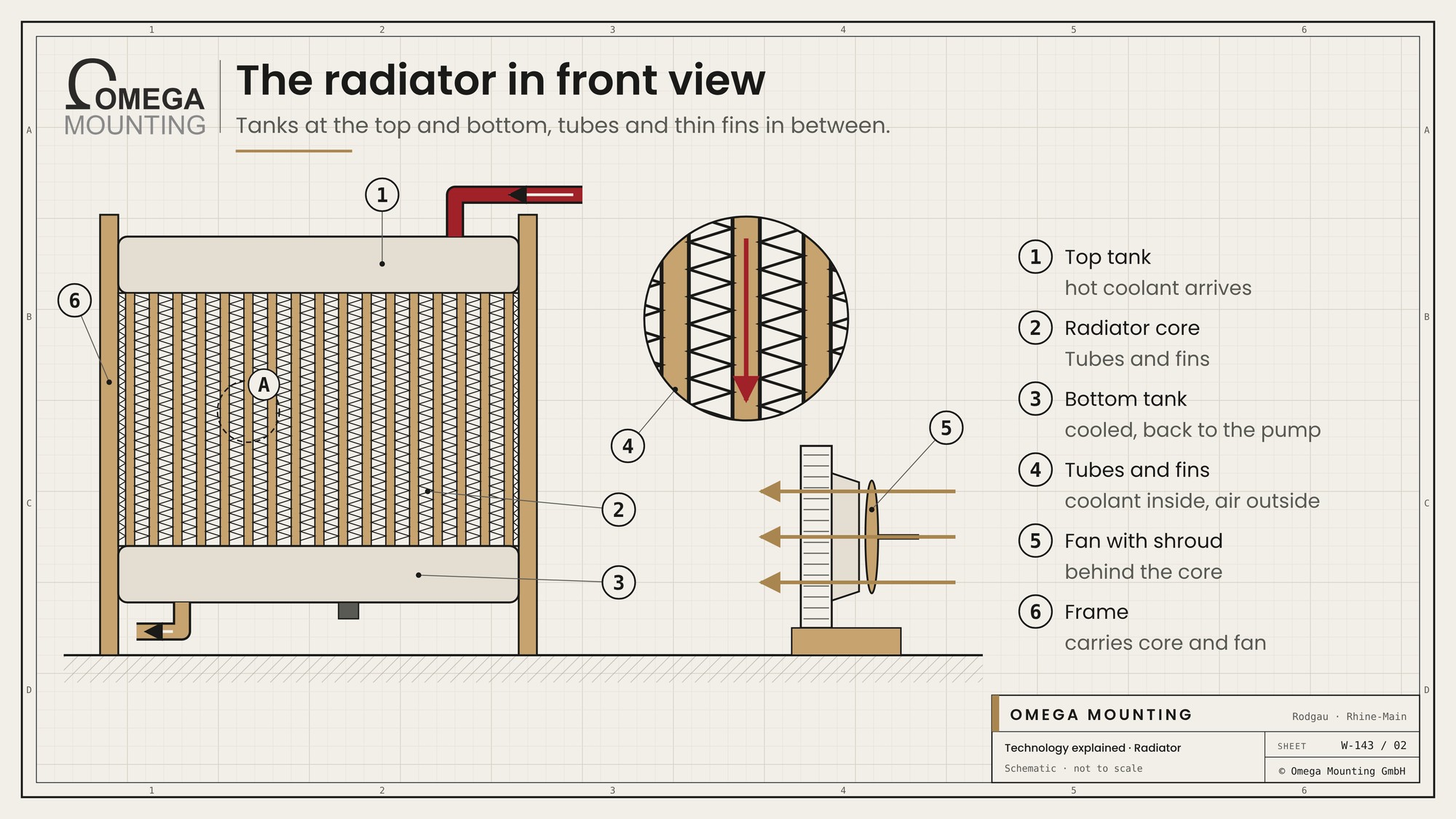
| Component | Task | What matters |
|---|---|---|
| Top tank | Distributes the hot coolant to the tubes. | Tight, connection free of stress. |
| Radiator core | Tubes with fins release the heat to the air. | Clean, straight fins, no leaks. |
| Bottom tank | Collects the cooled coolant. | Drain accessible. |
| Fan | Moves air through the core. | Bearings, belt or drive, guard. |
| The frame | Carries the core and fan. | Well supported, mounted with low vibration. |
| Connections | Connect radiator and engine. | Hoses, clamps, expansion joints intact. |
The fins are very thin, often made of copper or aluminium. They enlarge the surface on which the air picks up the heat. At the same time they are the most delicate part of the radiator. A knock during transport or a hard water jet during cleaning bends them over.
Designs and installation
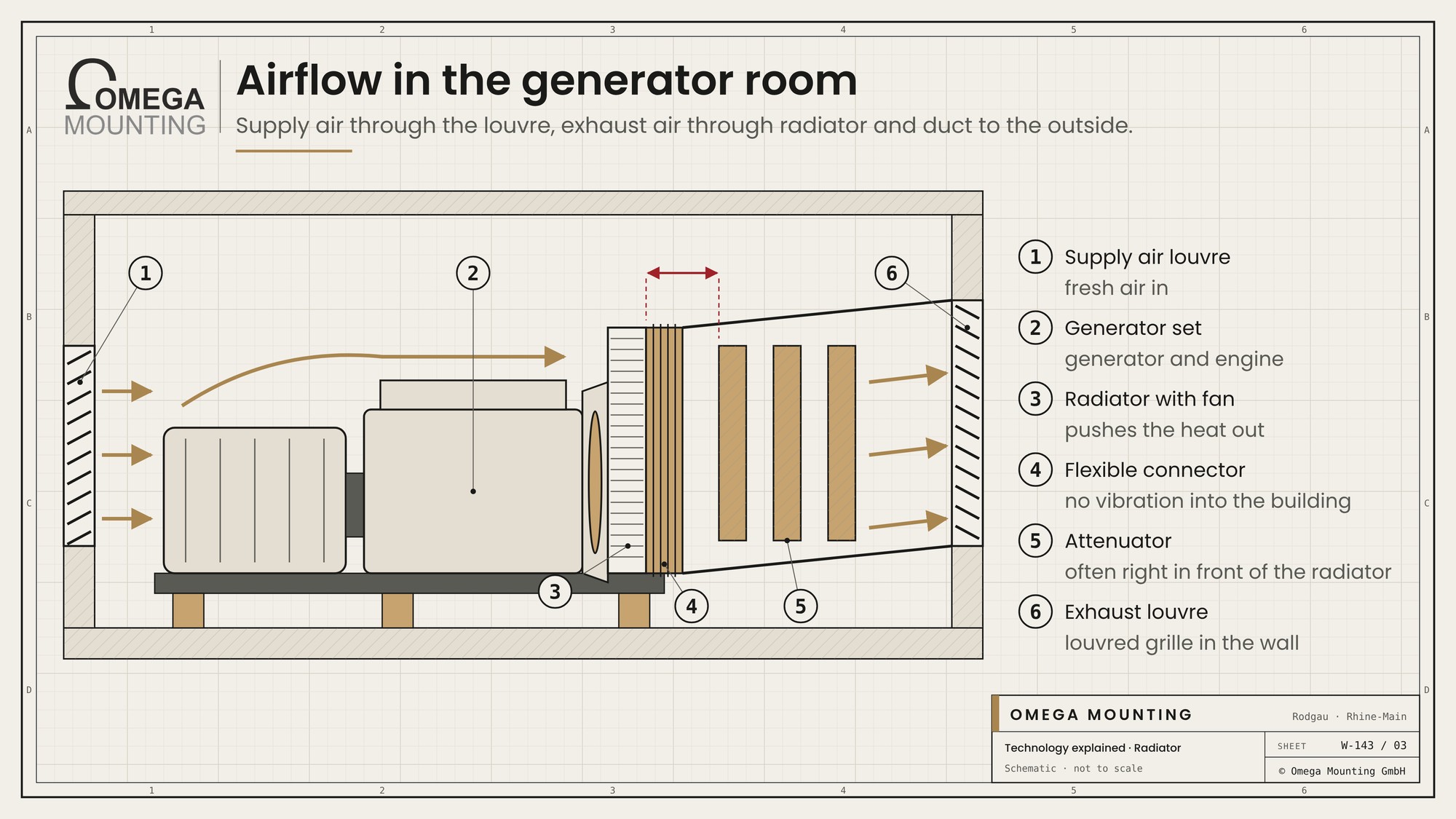
Set-mounted radiator: Engine, generator and radiator sit on a common base frame. The fan is usually driven by the engine and pushes the air outwards through the core. This is the usual design for containerised solutions.
Remote radiator: The cooler stands somewhere else, for example on the façade or on the roof. Coolant lines connect it to the engine, and the fan runs electrically. This way the heat can be released where there is enough air.
With an indoor solution, the airflow is what counts:
- Supply air: Fresh air flows into the room through a louvre.
- Exhaust: The fan pushes the warmed air through the core into an exhaust duct and through an exhaust louvre to the outside. A louvre is a fixed slatted grille in the outer wall.
- Flexible connection: A flexible connector sits between the radiator and the duct so that vibrations do not pass into the building.
- No short circuit: Warm exhaust air must not be drawn in again.
Attenuators often sit in front of the exhaust louvre. Then it gets tight: between radiator, duct and attenuator there is sometimes hardly any room for hands and tools.
Maintenance and typical damage
The radiator is part of the cooling system at every maintenance of the standby power system. These points in particular are checked:
- Coolant: Level, frost protection and condition. Old coolant loses its corrosion protection.
- Core: Dirt and bent fins. Dust, leaves or insects clog the core.
- Tightness: Traces on tubes, tanks and connections. Dried coolant often leaves light-coloured or coloured crusts.
- Fans: Bearing noise, play, belt tension, secure guard.
- Hoses and clamps: Cracks, swelling, loose clamps.
The core is cleaned carefully, usually against the normal air direction and with little pressure. Bent fins can be straightened with a fin comb.
Typical damage includes leaks at brazed joints and tubes, corrosion from the wrong coolant and vibration cracks at poorly supported connections. A leak often only shows under load, when pressure and temperature in the circuit rise. That is why a test run with real load, for example via a load bank, is part of the check. During short runs without load the circuit often does not get properly warm.
Repair on site
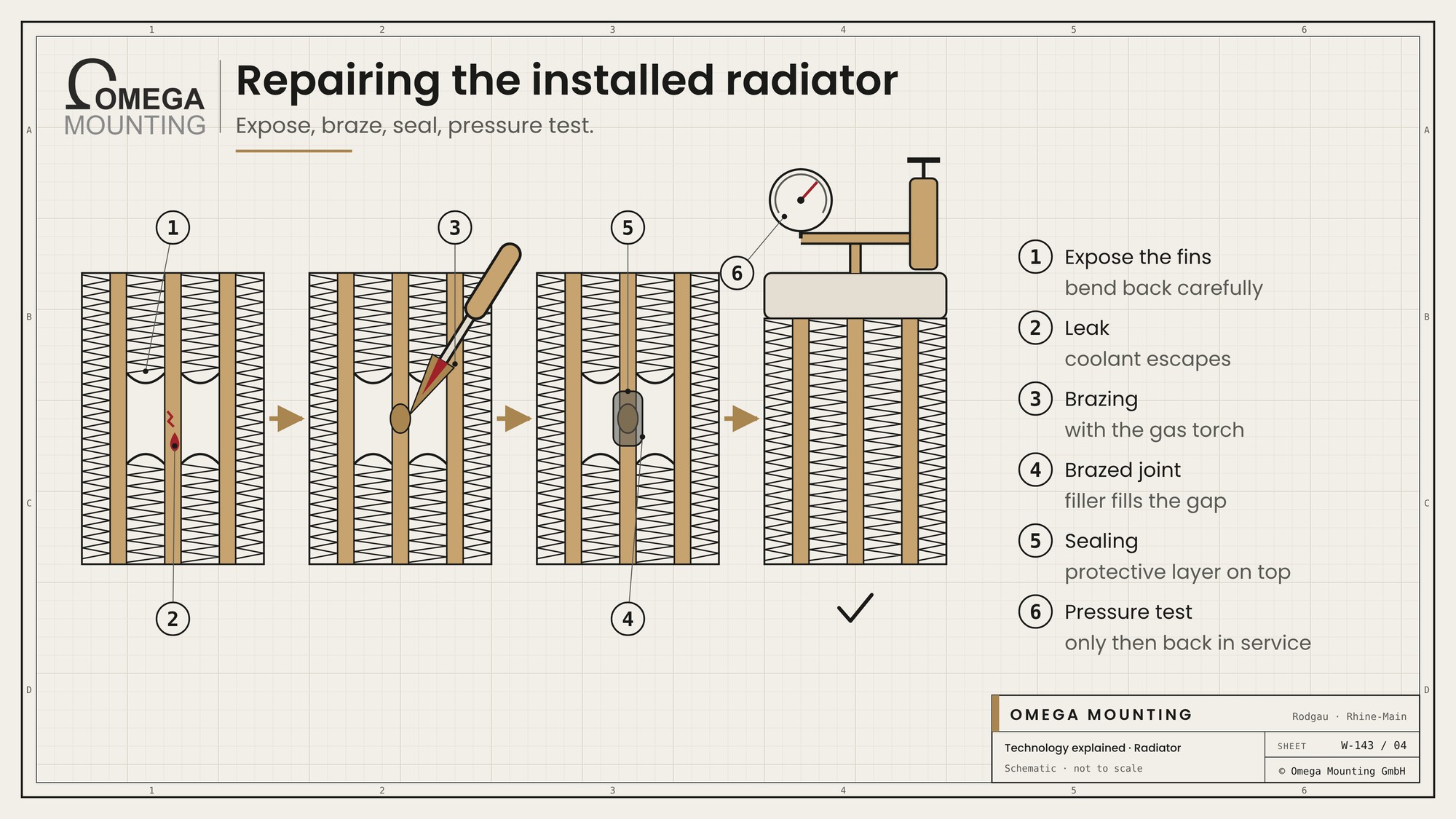
A leaking radiator does not always have to be replaced immediately. Small leaks can often be repaired directly on the installed cooler.
Welding is usually out of the question. Tubes and fins are too thin; the heat of a welding torch would burn through them. Instead the leak is brazed: a filler metal melts at a much lower temperature than the base material and flows into the gap.
The procedure on site:
- Drain the coolant, protect the surroundings, register hot work.
- Carefully expose the fins at the leak.
- Braze the leak with the gas torch.
- Additionally seal the spot, for example with a special metal adhesive.
- Refill the circuit and check it for tightness with a pressure test.
Such a repair is often a temporary solution. It keeps the generator set ready for operation until the radiator is overhauled or replaced without time pressure.
What we pay attention to
When rigging in, installing and repairing radiators, we pay attention to the parts that cause problems later.
- We only attach slings to radiators at the designated points and protect the core during transport.
- We route the piping free of stress and support it.
- We keep space free for cleaning, fan maintenance and later repairs.
- For work with an open flame we register hot work and provide a fire watch.
- Coolant selection, settings and commissioning are handled by the manufacturer.
Where we use it
In a data center in Offenbach, the radiator of an installed standby generator had a leak – four days before going live. Between radiator, louvre and attenuator there was barely a hand's width of space. The copper fins were too thin to weld. The leak was exposed, brazed with the gas torch, sealed and checked with a pressure test. The generator was ready for operation again the same day.
During the installation of standby generators in data centers the indoor solution included the radiator with its piping to the engine. More about our services is on the page energy and standby power.
More technology explained
Technology explained
everything that belongs to emergency power in a data center.
Guide
our guide to maintenance, repair and replacement.
Do you have questions about how this works on your site?
Is your radiator losing coolant or does it need to go into the building? We repair on site, rig in and install. Request a callback.
Free, no-obligation callback

About the author
Tobias Schott
Managing director of Omega Mounting GmbH, Rodgau · more than 20 years of hands-on experience in installation and maintenance
A trained mechatronics technician, working in maintenance, servicing and industrial installation since 2004 – first alongside his father, and with Omega Mounting since 2012: from overhead conveyors in Frankfurt to the crane system in a new-build hall. He plans and leads lifting operations as an appointed person (AP) in data centers and on industrial sites in the Rhine-Main region, trains and examines operators of cranes, mobile elevating work platforms and telehandlers, and is a qualified occupational safety specialist. On jobs abroad he is known as the “German Troubleshooter” – the person you call when a site gets stuck. He learned what quality means from his father, not from a manual: Made in Germany as a standard for his own work, not a label. That is why quality comes first at Omega Mounting – ahead of speed and price. The Technology explained articles cover the equipment and techniques his team uses every day: what counts on site is in them – what only appears in the brochure is not.
 English
 German