
- Technology explained – machines and equipment
The SCR catalyst on a standby generator: how urea reduces nitrogen oxides
By Tobias Schott · 6-minute read · Updated November 2026
An SCR catalyst reduces the nitrogen oxides in the exhaust of a diesel engine: a urea solution is sprayed into the hot exhaust, and in the catalyst nitrogen and water are formed from it – provided temperature, dosing and installation are right.
Large standby generators in data centers are diesel engines with considerable output. Burning diesel produces nitrogen oxides. Depending on the permit and location, they must be reduced in the exhaust. An SCR system in the exhaust line does this.
Here we explain how exhaust aftertreatment with urea works, which parts it consists of, what the urea supply needs and what matters when installing it in the exhaust line.
What is an SCR catalyst?
SCR stands for selective catalytic reduction. An SCR catalyst is a component in the exhaust line in which nitrogen oxides are converted into nitrogen and water with the help of ammonia.
The ammonia is not carried as a gas. It forms in the hot exhaust from an aqueous urea solution that is sprayed in ahead of the catalyst. The solution is non-toxic, but sensitive to contamination and frost.
SCR systems are familiar from trucks, ships and power plants. In data centers they sit on the standby generators of the backup power system, usually as a large housing between the engine and the silencer.
Key facts
- Task: Reduce nitrogen oxides in the exhaust of diesel engines.
- Operating fluid: aqueous urea solution from its own tank.
- Key parts: Dosing unit, dosing lance, mixing section, catalyst, sensors, controls.
- Condition: sufficiently hot exhaust.
- Location: in the exhaust line between engine and silencer.
- Interfaces: Engine manufacturer, controls, exhaust system, fire safety, permit.
- Our part: rigging in, installation, supports, access for maintenance.
How the SCR catalyst works
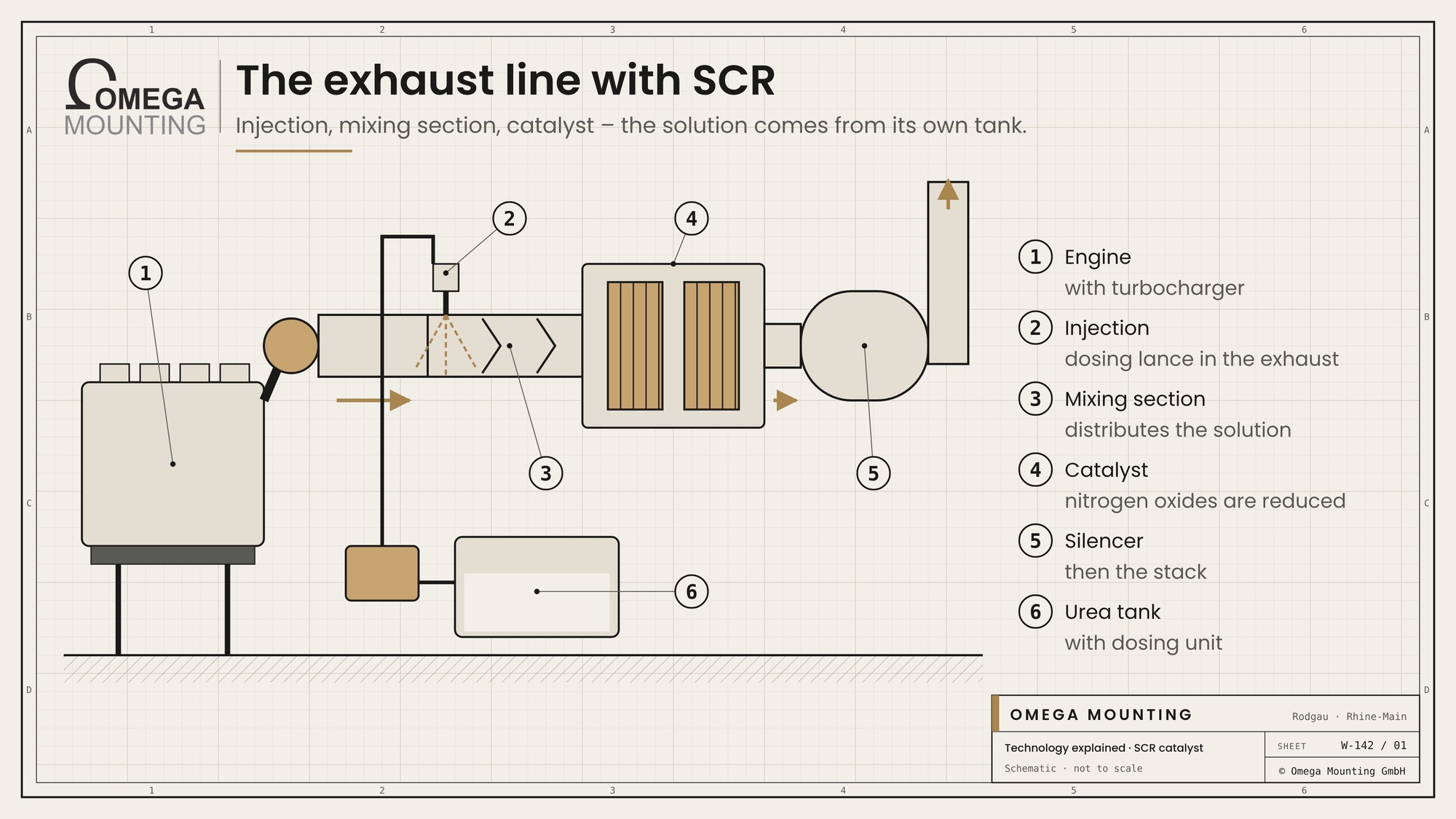
The exhaust leaves the engine via the turbocharger and manifold. Three stations follow:
- Injection: A dosing lance sprays the urea solution finely into the exhaust.
- Mixing section: On a section with mixers the solution evaporates, and the urea breaks down into ammonia. The ammonia spreads evenly through the exhaust.
- Catalyst: In the catalyst, ammonia and nitrogen oxides react on a coated surface to form nitrogen and water.
Sensors before and after the catalyst measure the nitrogen oxides. From this the controls calculate how much solution is dosed. Too little means the nitrogen oxides remain. Too much means unused ammonia gets into the exhaust air.
The reaction needs heat. Only when the exhaust has reached a certain temperature does dosing begin. With cold exhaust the solution would not break down completely and would form deposits.
Structure of the catalyst
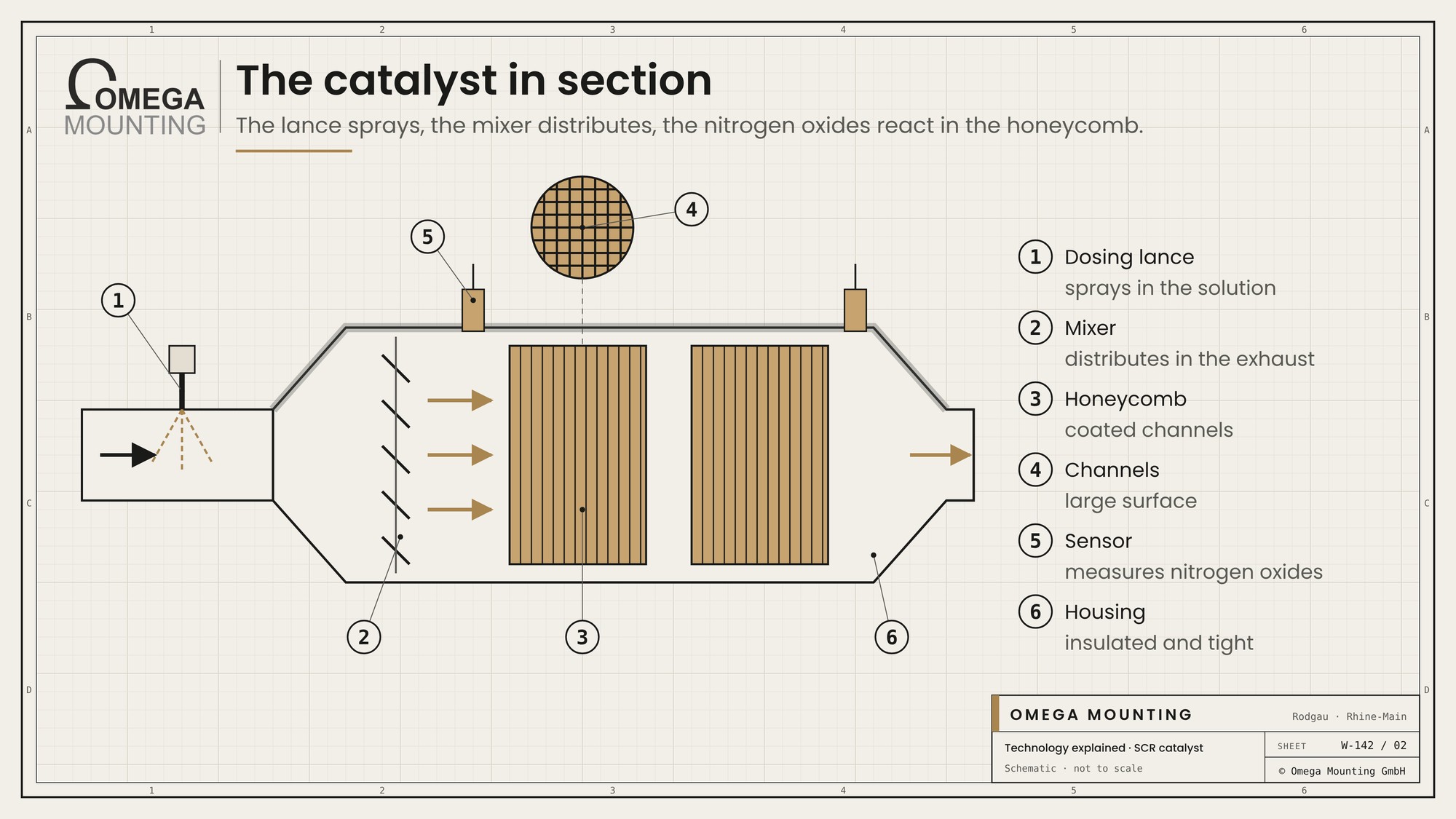
| Component | Task | What matters |
|---|---|---|
| Dosing lance | Sprays the solution into the exhaust. | Clear nozzle, correct spray angle. |
| Mixer | Distributes the solution in the exhaust. | Firmly seated, free of deposits. |
| Honeycomb | Coated surface for the reaction. | Undamaged, not blocked. |
| Housing | Holds the honeycombs, guides the exhaust. | Tight, insulated, well supported. |
| Sensors | Measure nitrogen oxides and temperature. | Correctly fitted, cables protected. |
| Controls | Regulate the dosing. | Set by the manufacturer. |
The honeycombs are ceramic or metal blocks with many fine channels. They are sensitive to impacts. During transport and installation the housing is therefore only slung and set down at the designated points.
Urea supply
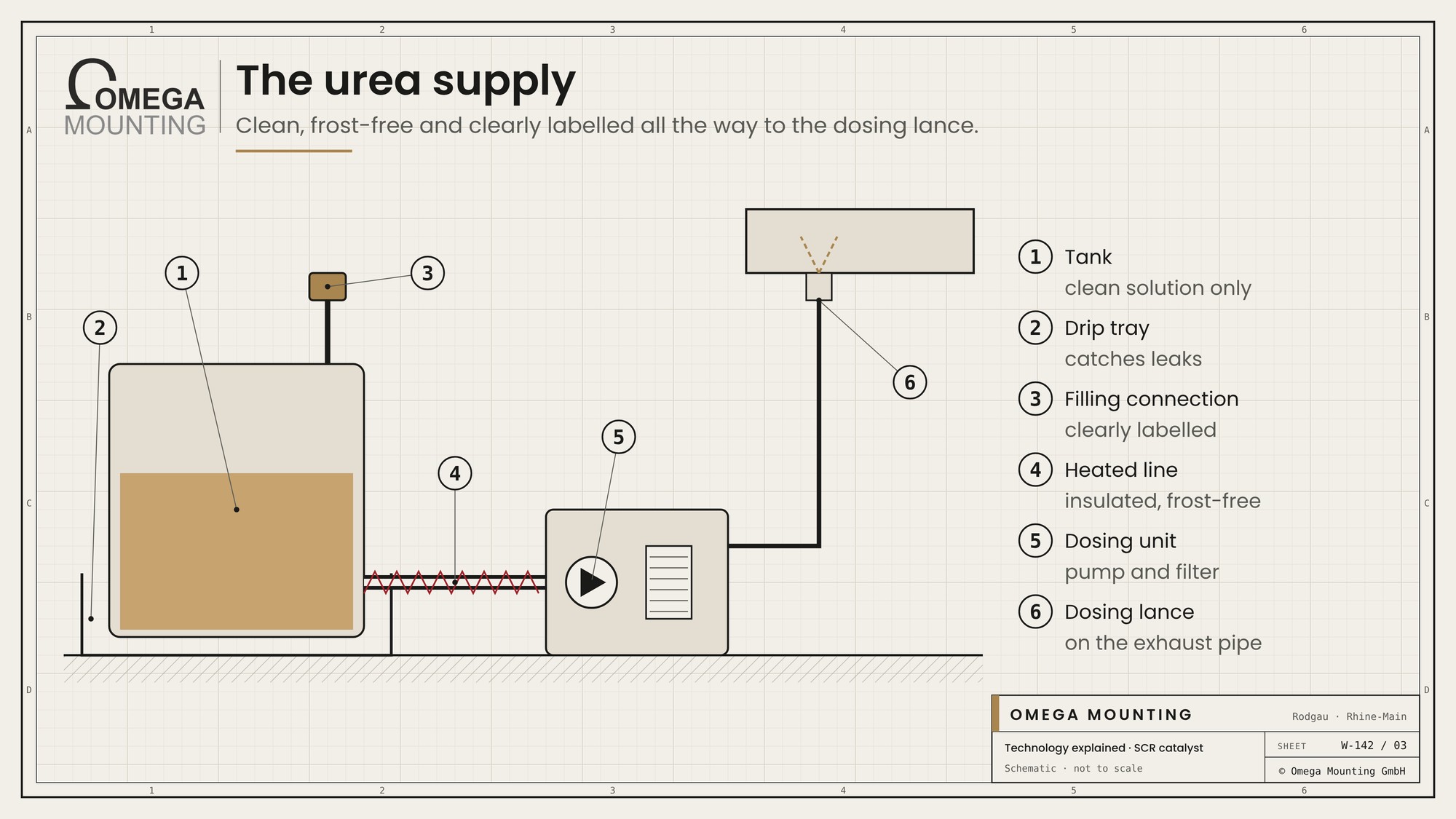
The urea solution needs its own clean supply.
- Tank: Depending on the plant, a day tank at the generator or a larger storage tank, usually with a drip tray.
- Filling connection: easy to reach and clearly labelled so that nobody fills in diesel.
- Cables: made of a resistant material, heated and insulated where there is a risk of frost. The solution freezes at sub-zero temperatures.
- Dosing unit: Pump, filter and valves deliver the solution to the dosing lance.
Urea solution attacks some metals. Copper, brass and galvanised parts do not belong in the line. Contaminated solution blocks filters and nozzles. That is why it is only topped up from clean containers and via closed systems.
Installation in the exhaust line
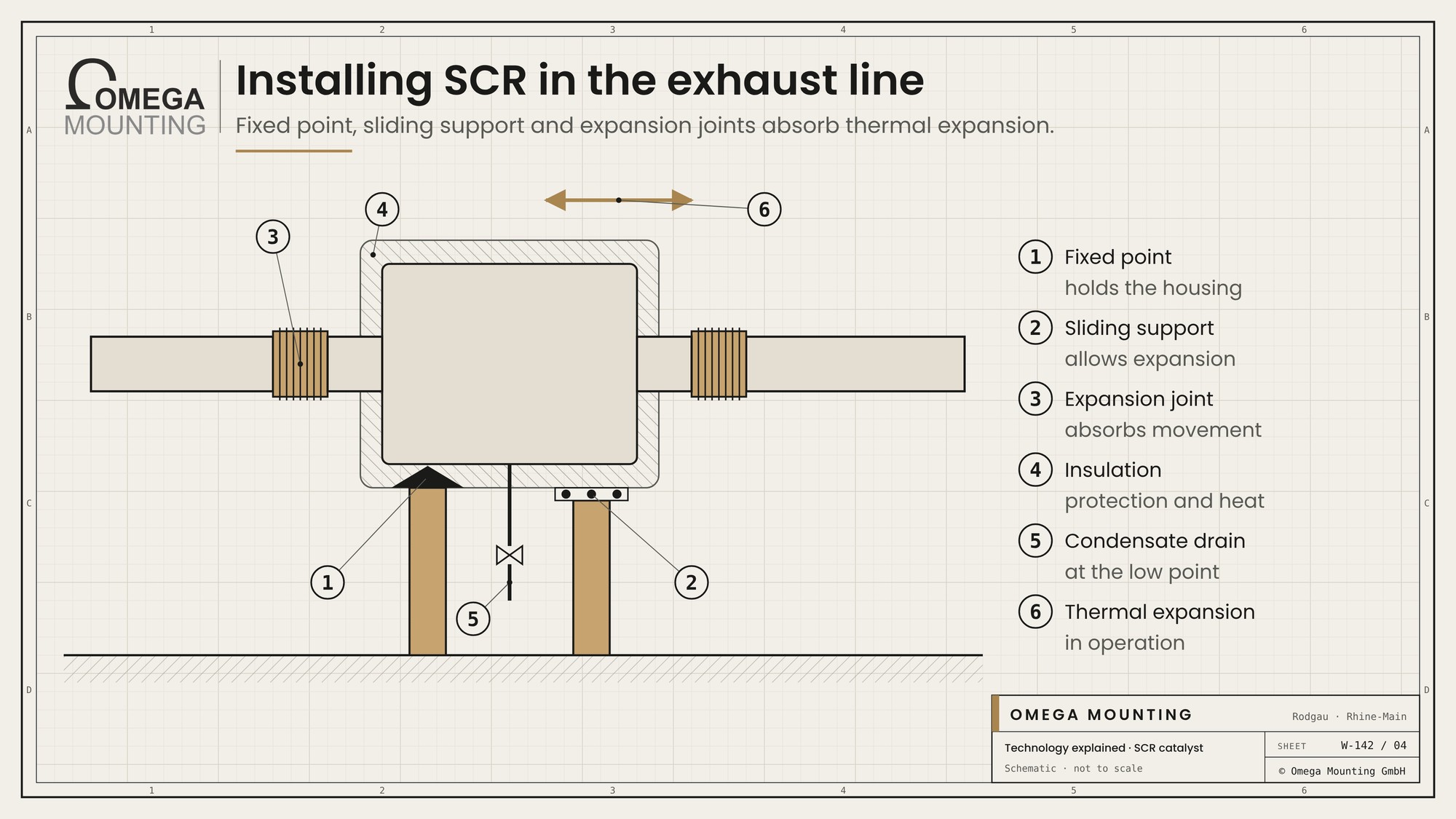
An SCR housing is heavy, hot in operation and connected to a line that expands with heat. Four points matter during installation:
- Fixed point and sliding support: The housing has a fixed point. On the other side there are sliding supports so that the line can expand.
- Expansion joints: Bellows between the components absorb thermal expansion and vibration. They are not misused to compensate for installation offset.
- Insulation: protects people from hot surfaces and keeps the exhaust warm so that the reaction works.
- Condensate and access: A drain removes condensate. There is space for checking and replacing sensors, lance and honeycombs.
In data centers the generator often stands in a plant room or on a roof. The SCR housing then has to reach its position by crane, installation opening or skidding track. The routes are measured in advance, and slinging points and centre of gravity are taken from the manufacturer's documents.
Maintenance and test runs
Standby generators rarely run. For the SCR system this is a challenge.
During short test runs at low load the exhaust often does not get hot enough. Dosing then does not start or only briefly, and deposits can form in the line. That is why regular runs under real load are important, for example with a load bank.
Maintenance includes checking the dosing lance, filters and sensors, a visual inspection of the honeycombs and replacing the solution if it has been stored too long. Urea solution ages, especially in heat.
Whether and which exhaust aftertreatment a plant needs is set by the permit and emission requirements. Operator, planner and authority clarify this. We do not give legal advice on this.
Typical faults
Most problems on the SCR system have a simple cause.
Deposits on the dosing lance or in the mixing section form when dosing has too often taken place with cold exhaust. They narrow the cross-section and disturb the distribution. A blocked nozzle or a clogged filter in the dosing unit means that too little solution arrives. The controls then report excessive nitrogen oxides.
Error messages also come from the sensors. A sensor that was damaged during installation, or whose cable touches a hot component, gives false readings. Leaking expansion joints or flanges let exhaust into the plant room. This often only shows up during a test run under load.
Many of these faults can be avoided during installation: clean lines, protected sensor cables, a stress-free line and enough distance from hot surfaces.
What we pay attention to
When rigging in and installing SCR systems, we pay attention to the mechanics and to later operation.
- We only sling housings at the designated points and set them down without impact.
- We align the exhaust line so that expansion joints do not have to compensate for offset.
- We fit fixed points and sliding supports according to the drawings.
- We keep access to lance, sensors and honeycombs clear.
- Commissioning, controls and setting of the dosing are carried out by the manufacturer.
Where we use it
During the rigging in standby generators in data centers in the Frankfurt area the interior solution also included the SCR system and the tanks for the urea solution alongside the radiator and exhaust line. The manufacturer carried out commissioning. During the generator overhaul of a backup power system the SCR system is one of the areas kept in view during maintenance. More about our services can be found on the page energy and standby power.
More technology explained
Technology explained
everything that belongs to emergency power in a data center.
Technology explained
how the engine gets rid of its heat.
Guide
our guide to maintenance, repair and replacement.
Do you have questions about how this works on your site?
Are you planning a backup power system with an SCR system or do you need to replace a housing? We take care of rigging in and installation and coordinate with the manufacturer. Request a callback.
Free, no-obligation callback

About the author
Tobias Schott
Managing director of Omega Mounting GmbH, Rodgau · more than 20 years of hands-on experience in installation and maintenance
A trained mechatronics technician, working in maintenance, servicing and industrial installation since 2004 – first alongside his father, and with Omega Mounting since 2012: from overhead conveyors in Frankfurt to the crane system in a new-build hall. He plans and leads lifting operations as an appointed person (AP) in data centers and on industrial sites in the Rhine-Main region, trains and examines operators of cranes, mobile elevating work platforms and telehandlers, and is a qualified occupational safety specialist. On jobs abroad he is known as the “German Troubleshooter” – the person you call when a site gets stuck. He learned what quality means from his father, not from a manual: Made in Germany as a standard for his own work, not a label. That is why quality comes first at Omega Mounting – ahead of speed and price. The Technology explained articles cover the equipment and techniques his team uses every day: what counts on site is in them – what only appears in the brochure is not.
 English
 German