
- Guide – Maintenance
Creating a maintenance concept: from reactive to planned
By Tobias Schott · 21-minute read · Updated October 2026

A maintenance concept sets out how your company keeps its plants running: how critical each plant is, which strategy it runs under, who does what and how you can tell whether it works – seven steps lead from the asset list to the first review.
Your maintenance works. It reliably repairs what fails, and it knows every plant. But little of it is planned. Breakdowns set the week, not the plan. Anyone who wants to create a maintenance concept in this situation faces a blank sheet and many questions: where do I start? What goes in? And how do I stop it from becoming a binder nobody reads?
A good concept is not a thick manual. It is a document with a few chapters that records decisions. Which plant may run until it fails? Which needs a maintenance plan? Who calls whom in a breakdown? Which parts are on the shelf? Anyone who answers these questions in writing once gains predictability – for the budget and the shutdown windows too.
This guide shows what a maintenance concept is, when reactive maintenance is enough and how to build the concept in seven steps. On top of that come an outline for the document and the typical mistakes. Which maintenance strategies exist and how they differ is explained in our basic article on maintenance strategy. This one is about the document that results from it.
We write from the point of view of an installation and maintenance contractor from Rodgau near Frankfurt. We help put concepts into practice and therefore see where they fail in practice.
Key points at a glance
- A maintenance concept is the written document that brings together a company's plants, strategy, inspection duties, servicing, spare parts, organisation and key figures.
- The strategy is one building block of the concept; maintenance plan, budget and calendar put it into practice.
- Reactive maintenance is permissible and often right – but only where it has been chosen deliberately and written down.
- The concept is created in seven steps: asset list with criticality, strategy per plant group, inspection duties, maintenance plan, spare parts strategy, organisation and key figures with review.
- Key figures show the direction, not the target value; you derive targets from your own history.
- The concept belongs to the operator – external partners provide findings and proposals, but not the decision.
- A concept that is not reviewed soon describes a company that no longer exists in that form.
What is a maintenance concept?
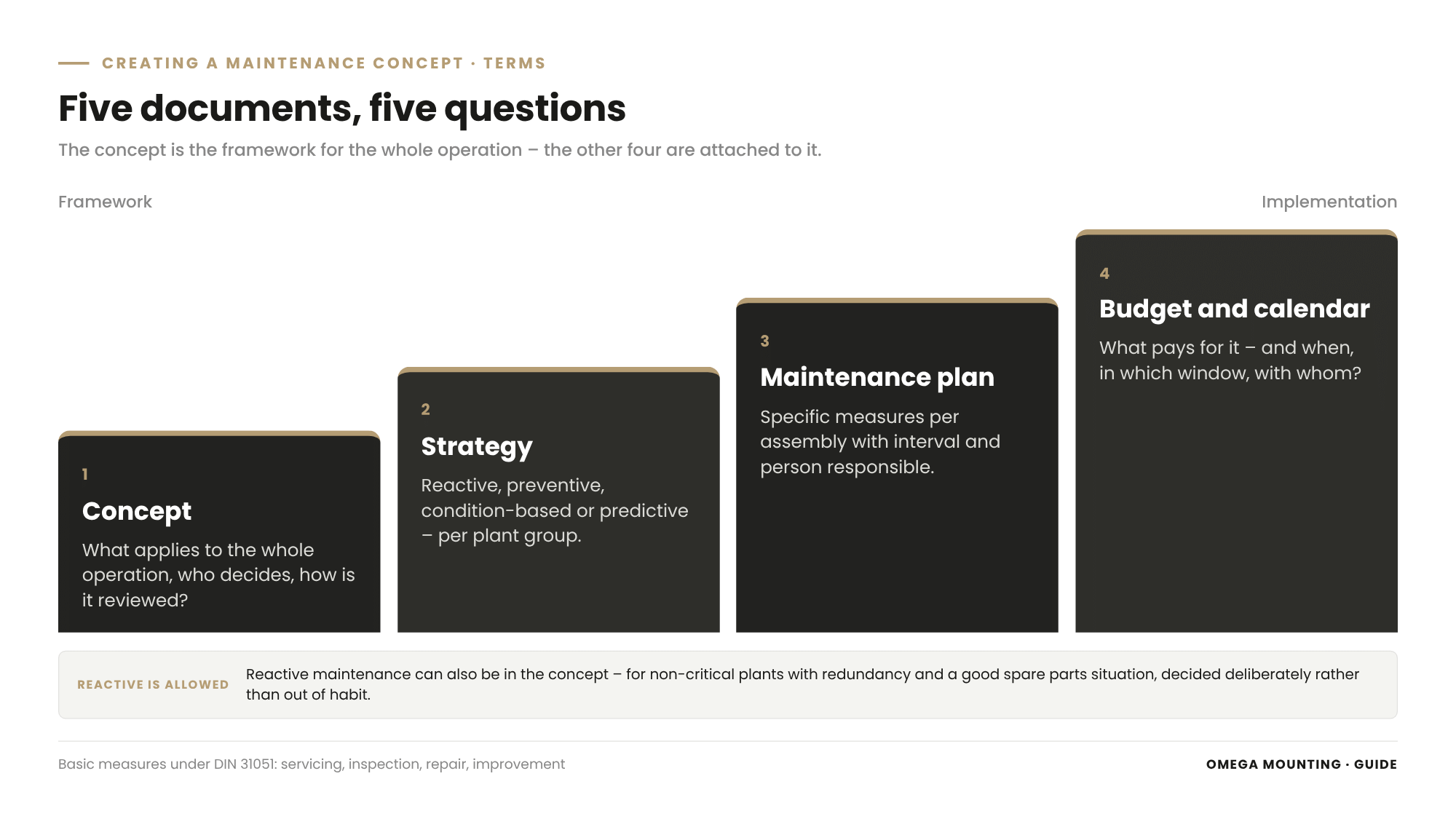
A maintenance concept is a company's written policy document that sets out how its plants are kept running: which plants there are, how critical they are, which strategy they are maintained under, who is responsible and how success is reviewed.
The DIN 31051 standard divides maintenance into four basic measures: servicing, inspection, repair and improvement. The concept sets out the balance between these four measures in your own company – and who carries them out. It is therefore the framework for all maintenance planning.
Distinction: concept, strategy, maintenance plan, budget and calendar
In practice, five terms are often mixed up. Telling them apart helps keep the concept lean.
- Maintenance concept. The framework: what applies to the whole operation, who decides, how is it reviewed?
- Maintenance strategy. The decision per plant or plant group: reactive, preventive, condition-based or predictive.
- Maintenance plan. The specific measures per assembly with interval and person responsible. How it is drawn up is shown in our guide Creating a maintenance plan.
- Budget. The funds for one year, broken down by budget pot. This is described in the guide to the maintenance budget.
- Calendar. What takes place when, in which window, with whom. How to plan and bundle maintenance is shown in our guide to the maintenance calendar.
The concept refers to the other four; it does not replace them. It says that there is a maintenance plan, who maintains it and how it is reviewed. The plan itself is in the plan.
How extensive does a concept have to be?
As short as possible. A concept that every maintenance technician can explain in a meeting has more effect than a manual only its author knows. For a medium-sized company, a few pages plus the asset list are often enough. The depth lies in the supporting documents, not in the concept itself.
Who a concept pays off for
A concept pays off for every company in which more than one person makes decisions about maintenance. At the latest when external partners, a second shift or another site are added, knowledge in people's heads is no longer enough. Audits, insurers and customers are also increasingly asking how maintenance is organised. A concept answers this question with a document instead of a tour of the hall.
Reactive maintenance: when it is enough and when it is not
Reactive maintenance is enough where a failure affects neither production nor safety nor inspection duties, the spare part is available and the repair succeeds without preparation.
Reactive maintenance means: action is only taken after the failure. That is not a mistake in itself. A hall light, a redundant fan or a small drive with a spare on the shelf may run until they fail. Any preventive measure there would be effort without benefit.
It becomes a problem when reactive was not chosen but simply happened. Then a critical plant runs until it fails just like the hall light. The difference only shows when it stops – usually at the worst possible moment. Why this ends up more expensive is explained in detail in the basic article on maintenance strategy; here only the conclusion for the concept counts.
Three conditions that should be in the concept
If you deliberately run a plant reactively, record three things.
- No failure impact beyond the component. Production, safety and adjacent components are not affected.
- A replacement is available quickly enough. The part is on site or can be delivered at short notice, and the swap needs no shutdown window.
- The classification is documented. The asset list says “reactive”, with reason and date.
That turns chance into a decision. And a decision can be reviewed when the situation changes.
The way out of reacting
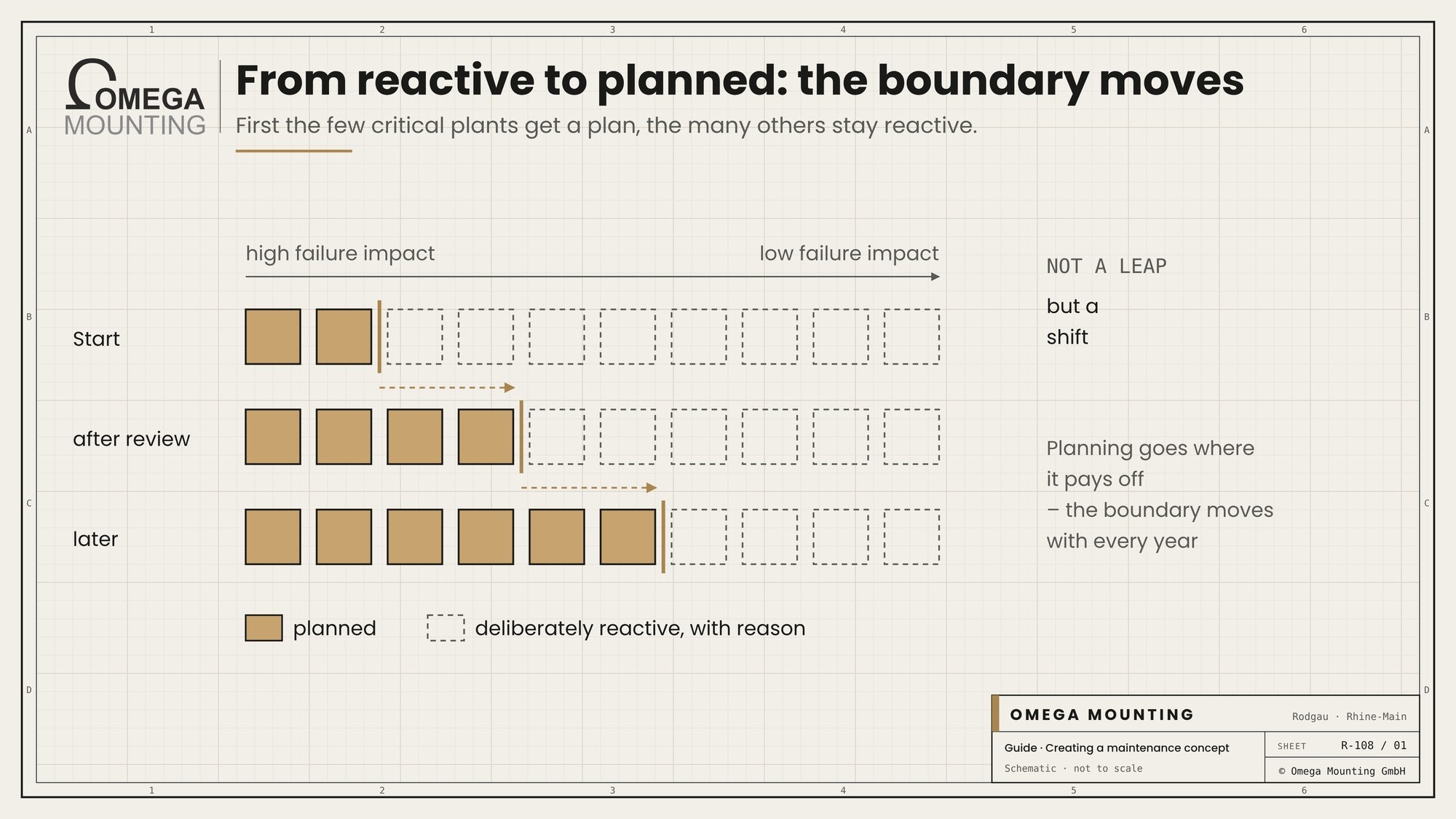
The step from reactive to planned is not a leap but a shift. First the few critical plants get a plan, the many non-critical ones deliberately stay reactive. With every year the boundary moves further. Preventive maintenance – i.e. work before the failure, by calendar, running time or finding – grows where it pays off.
Creating a maintenance concept: the seven steps
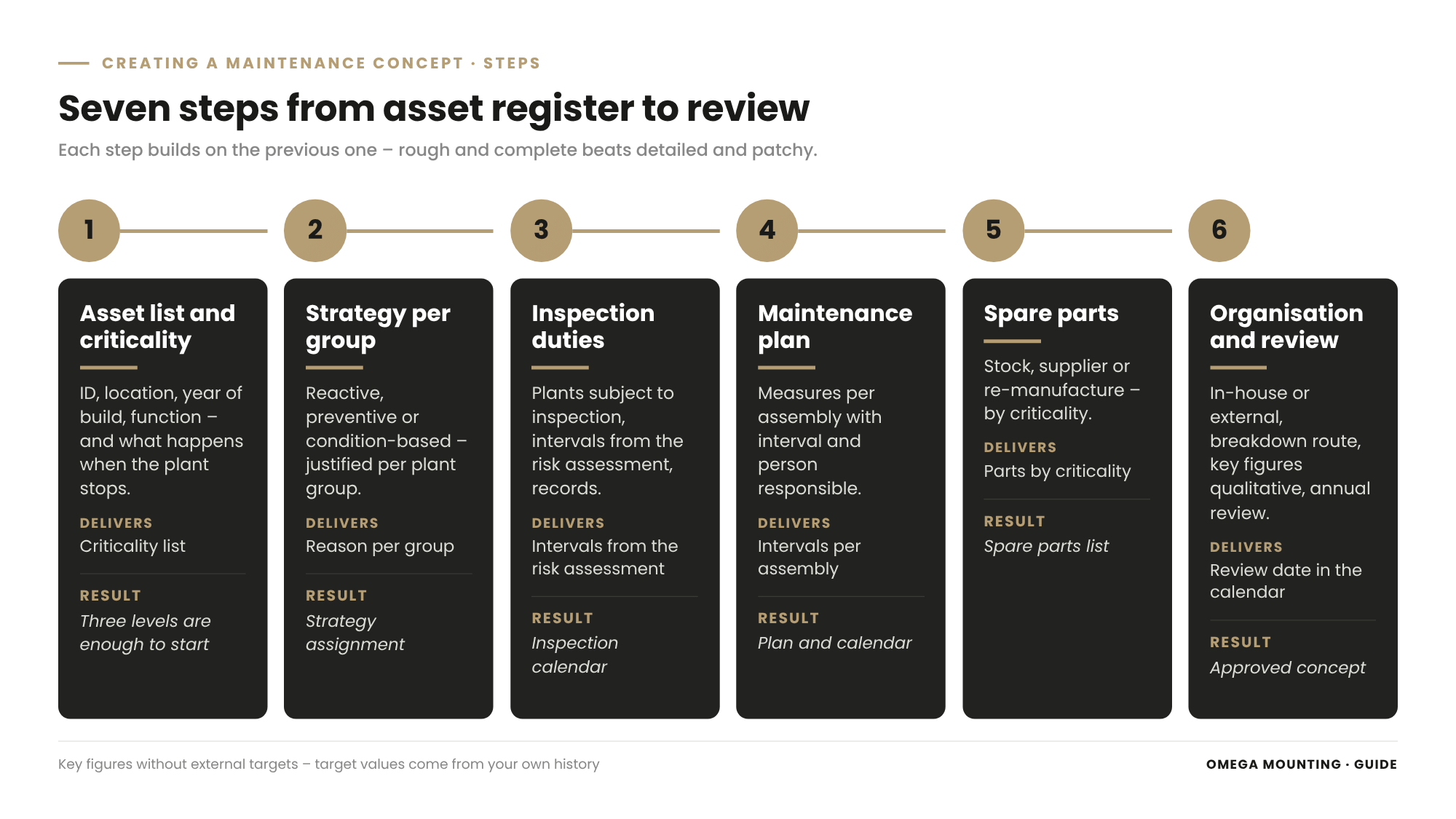
A maintenance concept is created in seven steps: asset list with criticality, strategy per plant group, inspection duties, maintenance plan, spare parts strategy, in-house or external organisation and key figures with review.
The order matters. Each step builds on the previous one. Anyone who starts with the maintenance plan plans plants whose importance nobody has assessed.
Step 1: asset list and criticality
The asset list is the foundation. Each plant gets a unique ID, location, year of build, function and the existing documents. Then comes the most important column: criticality. It answers the question of what happens when the plant stops. Does production stop? Is anyone at risk? Is there a way out via a second plant?
Better to assess roughly and completely than in detail and with gaps. Three levels are enough to start with. How to combine failure probability and failure impact in a matrix is shown in our guide to risk-based maintenance.
Do not assess criticality within maintenance alone. Production knows which plant forms a bottleneck and which has a way out. Occupational safety knows where a failure puts people at risk. A joint session with the asset list on the table achieves more than any assessment at a desk.
Step 2: strategy per plant group
In the second step you assign a strategy to each plant group. Groups instead of individual plants keep the concept readable: all roller doors, all chain conveyors, all standby generator sets. The criticality from step 1 sets the direction. High failure impact means planned, low failure impact allows reactive.
Between the poles lies condition-based maintenance, in which inspection findings trigger the work. It fits wherever wear is visible or measurable. Which maintenance strategies are available and by which criteria you assign them is set out in the guide to maintenance strategy per plant. The concept only states the result: group, strategy, reason.
Step 3: inspection duties
Plants subject to inspection are never reactive. Cranes, hoists, racking, power-operated doors and pressure systems have periodic inspections. As the operator, you set the type, scope and intervals in the risk assessment under the German Ordinance on Industrial Safety and Health. On top of that come manufacturer's specifications and accident insurance regulations.
The concept states which plant groups are subject to inspection, who organises the inspections and where the records are kept. The intervals themselves belong in the inspection calendar. Which work equipment is typically subject to inspection is shown in our guide to inspection obligations for operators.
Step 4: maintenance plan
The maintenance plan results from strategy and inspection duties. It translates the decisions into measures per assembly. The sources are the manufacturer's documents, your own breakdown history and the inspection findings. The concept regulates three things: who maintains the plan? Who approves changes? How do findings flow back?
Maintenance planning without these rules leads to plans only their author understands. With them, the plan becomes a tool for the whole team.
Also record in the concept how the plan gets into the calendar. Measures that need a shutdown are bundled and agreed with production. Inspections and servicing on the same plant belong in the same window wherever possible. That way each plant costs one shutdown instead of two.
Step 5: spare parts strategy
The spare parts strategy sets out which parts are kept in your own stock, which the supplier holds and which are only procured when needed. The yardstick is again criticality. For a critical plant with a long lead time, the wear part belongs on the shelf. For a non-critical plant, the source in the list is enough.
Older plants are a point of their own. Where parts have been discontinued, a solution belongs in the concept before the part breaks: stockpiling, re-manufacture to measure or replacement. The usual routes are described in our guide to spare parts that are no longer available.
The spare parts list itself is attached to the concept as an annex. For each critical plant it gives the part number, source, storage location and minimum stock – you set the minimum stock from lead time and failure impact, not from a rule of thumb.
Step 6: in-house and external organisation
A concept that nobody implements is paper. That is why step 6 sets out who carries out what. What does your own team do? What goes to specialist contractors for electrics, controls or inspection? What does an installation contractor take on for mechanics, lifting equipment and welding? And who coordinates everyone?
Organisation also includes the breakdown route: who reports, who decides, who comes. How to organise maintenance when your own capacity is not enough is shown in our guide Outsourcing maintenance or doing it in-house.
The interfaces are the most sensitive part. Who isolates before an external company works? Who does the test run after the repair? Who enters the finding in the list? A small table with tasks and responsibilities answers these questions before someone asks them in a breakdown.
Step 7: key figures and review
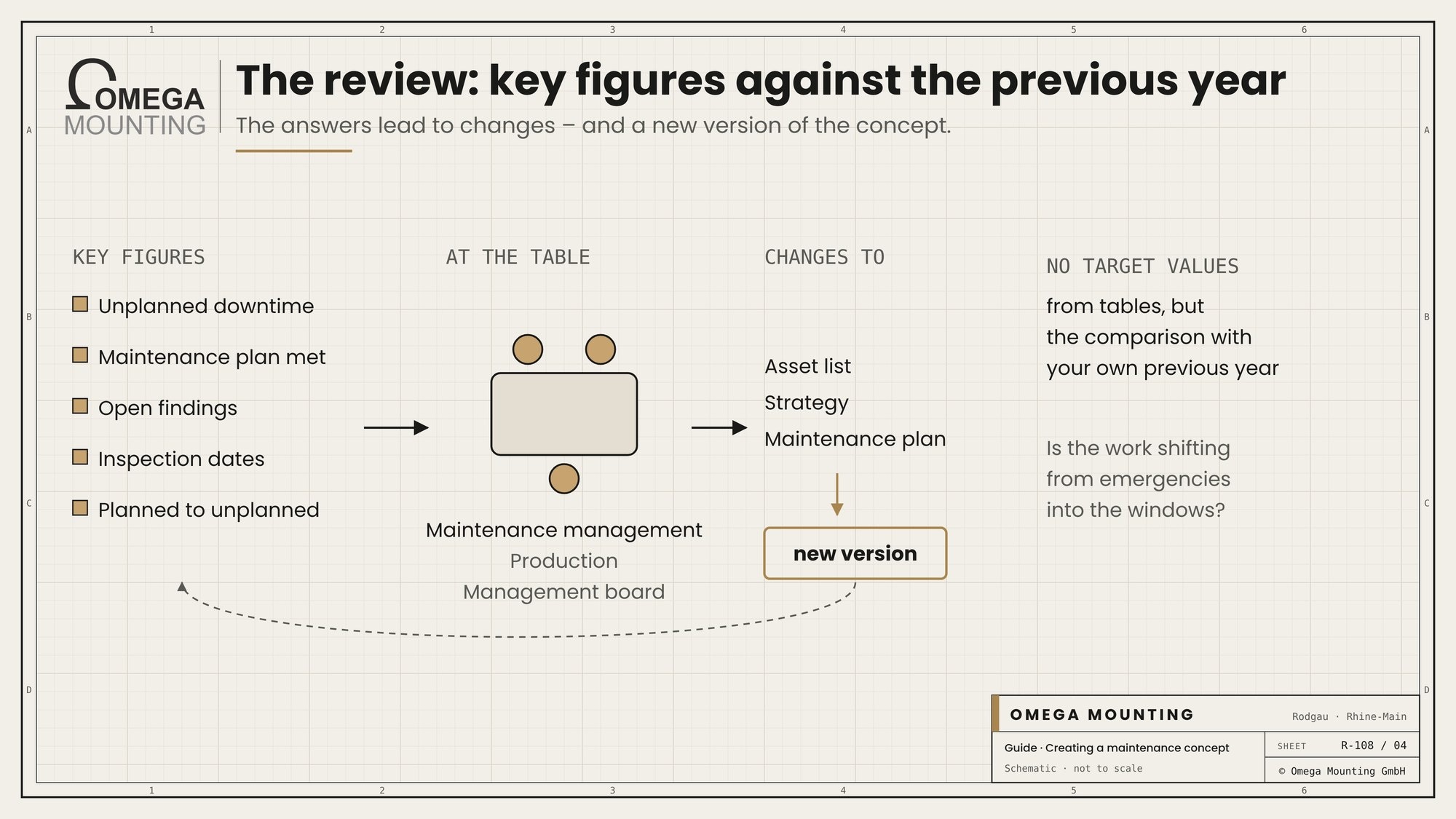
Key figures show whether the concept is working. You do not need target values from tables for this, but a comparison with your own previous year. A few measures that can be collected without software have proven themselves.
- Unplanned downtime. How often was a critical plant down unplanned, and for how long?
- Maintenance plan compliance. How many planned measures were completed, how many postponed?
- Open findings. How many findings are open, and how old are they?
- Inspection dates. Were all inspections carried out on time and defects dealt with?
- Ratio of planned to unplanned. Is the work shifting from emergencies into the windows?
How maintenance affects overall equipment effectiveness is shown in our guide to OEE in maintenance. For the concept, the direction is enough. The review sets when these figures come to the table and who derives changes from them.
Maintenance management, production and a representative of the management sit at the review. The agenda is short: what has moved in the key figures? Which breakdowns did we have, and was the criticality right? Which plants were added or dropped? The answers lead to changes to asset list, strategy or maintenance plan – and a new version of the concept.
Start small: one area first
You do not have to cover the whole company at once. A pilot has proven itself: one area, one hall or one plant group with high failure impact. There you go through all seven steps and learn what the outline needs for your company. Then you transfer the approach to the other areas. That way the concept grows out of experience, not at a desk.
The outline: what is in the document
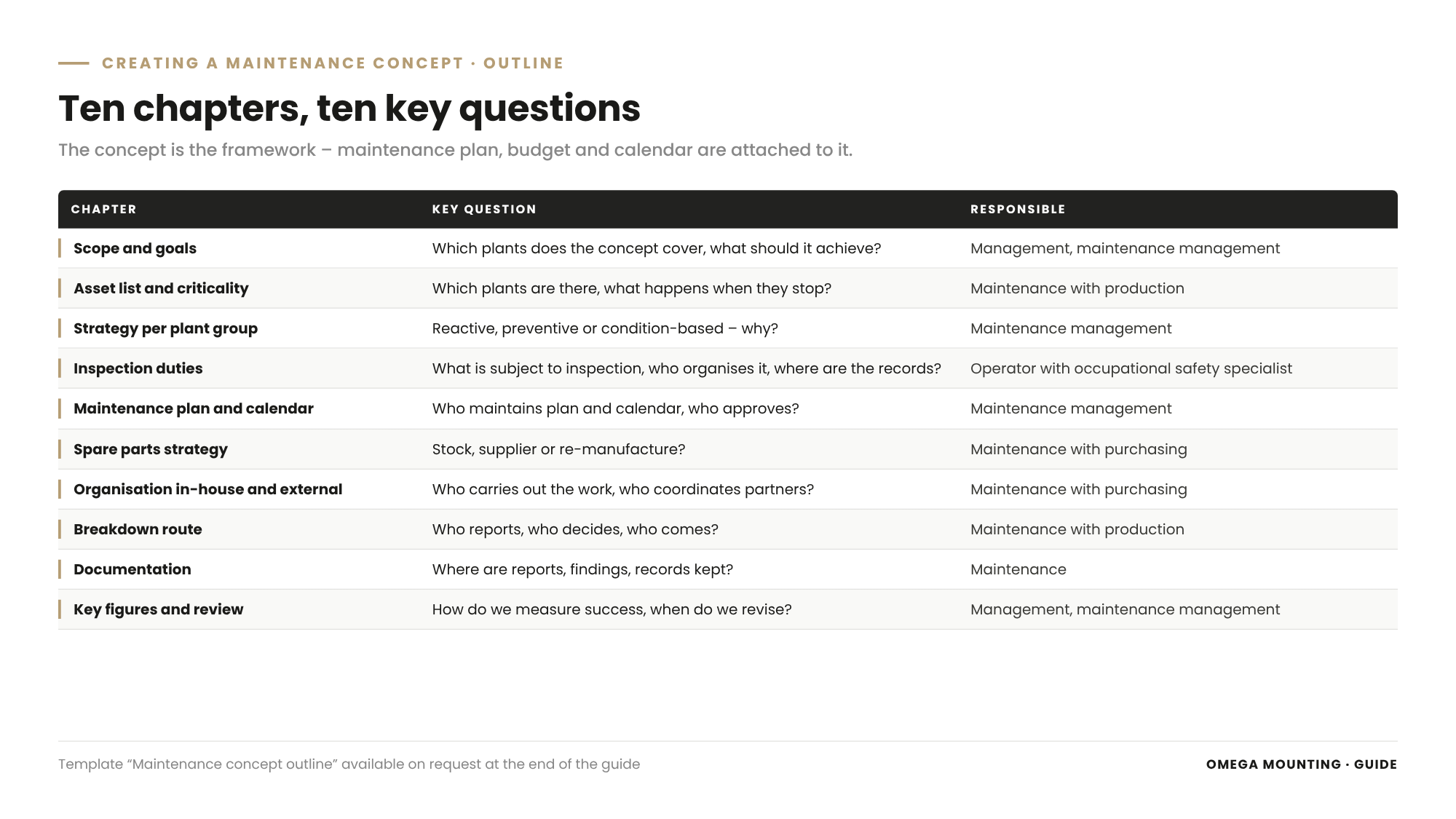
A maintenance concept is divided into ten chapters, each answering one key question – from scope to review.
The table shows a proven outline. It fits a site with a mixed plant fleet and can be shortened or extended.
| Chapter | Key question | Responsible |
|---|---|---|
| Scope and goals. | Which plants and sites does the concept cover, and what should it achieve? | Management with maintenance management. |
| Asset list and criticality. | Which plants are there, and what happens when they stop? | Maintenance management with production. |
| Strategy per plant group. | Which group runs reactively, preventively or condition-based – and why? | Maintenance management. |
| Inspection duties. | Which plants are subject to inspection, who organises, where are the records kept? | Operator with occupational safety specialist. |
| Maintenance plan and calendar. | Who maintains plan and calendar, who approves changes? | Maintenance management. |
| Spare parts strategy. | What is in stock, what at the supplier, what is re-manufactured? | Maintenance with purchasing. |
| In-house and external organisation. | Who carries out what, who coordinates the partners? | Maintenance management with purchasing. |
| Breakdown route. | Who reports, who decides, who comes? | Maintenance management with production. |
| Documentation | Where are reports, findings and records kept, and who keeps them? | Maintenance. |
| Key figures and review. | How do we measure success, and when do we revise the concept? | Management with maintenance management. |
Supporting documents instead of continuous text

Asset list, maintenance plan, inspection calendar and spare parts list are attached to the concept as annexes. That keeps the policy document short, and the lists can be kept up to date without approving the concept again. What a file looks like that also stands up to an audit is shown in our guide to maintenance documentation for audits.
Approval and version
The concept carries a date, version and approval by the management. That sounds formal, but there is a practical reason. Only with approval are shutdown windows, spare parts stock and external services covered. Without a signature the concept remains a proposal from maintenance.
The breakdown route on one page
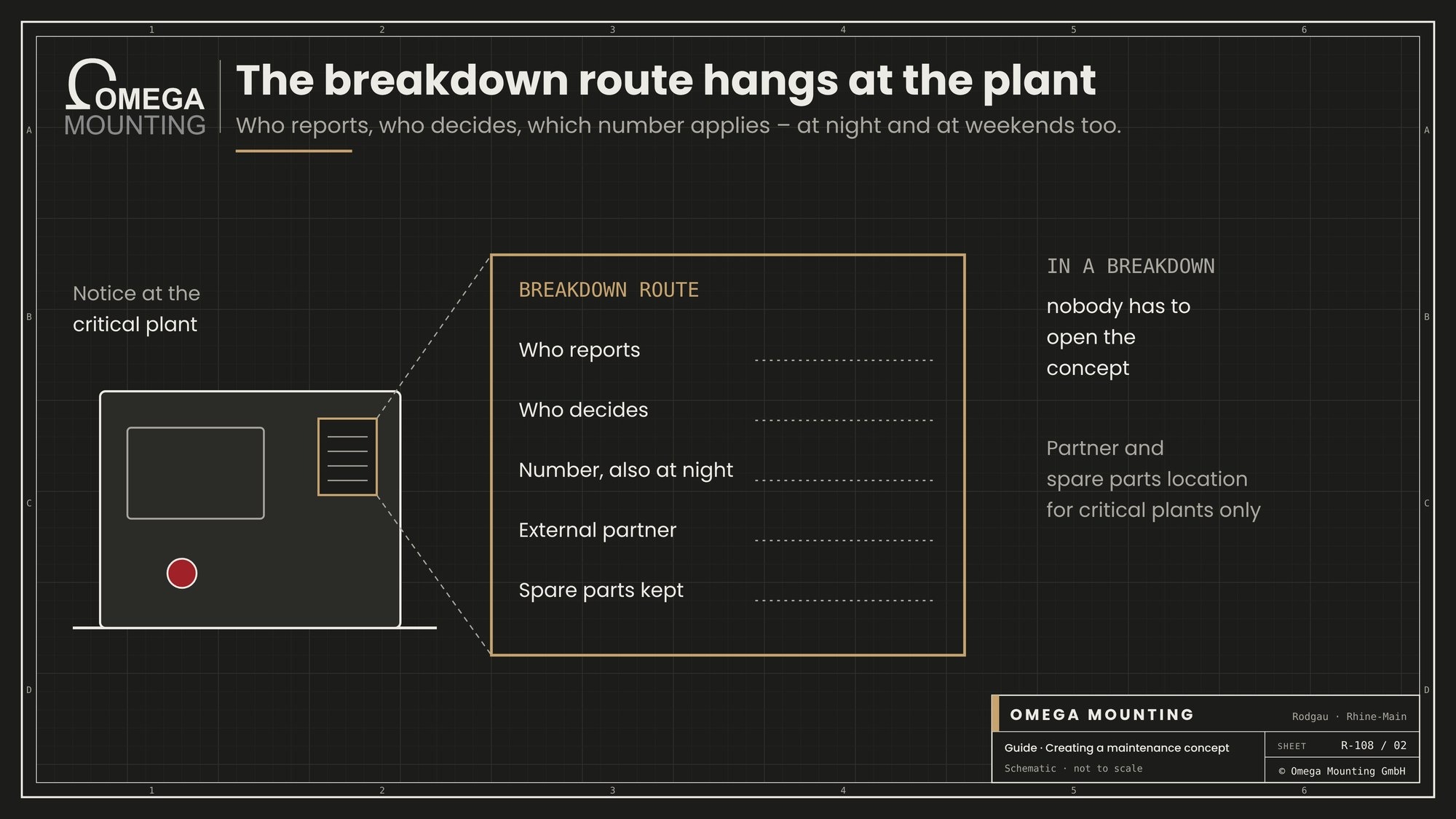
One chapter is often underestimated: the breakdown route. It belongs not only in the concept but as a notice at the plant. It states who reports, who decides and which number applies – at night and at weekends too. For critical plants you also name the external partner and where the spare parts are kept. That way nobody has to open the concept in a breakdown.
Typical mistakes
The typical mistakes when creating a maintenance concept are planning mistakes: too much theory, too few decisions, no responsibilities and no review.
- Concept as a textbook. Pages of strategies and standards, but not a line on which plant runs how.
- No criticality. All plants are equally important – so none is.
- Reactive without a reason. Plants run until they fail without anyone having decided so.
- Inspection duties kept separately. The inspection calendar is in another department, findings get lost.
- Spare parts forgotten. The plan is finished, the part for the critical plant has a long lead time.
- Nobody responsible. The concept names tasks, but no names or functions.
- Software before concept. A program is bought before it is clear what it should map.
- No review. After conversions, new plants and staff changes, the document no longer fits.
The unwritten concept
Many companies have a concept – it just isn't written down anywhere. It is in the head of the most experienced maintenance technician. He knows which plant causes trouble and where the spare part is. That works until the holiday or retirement. The first draft is therefore best created in conversation with exactly this person.
Concept without budget
A concept that provides for shutdown windows, spare parts stock and external services needs funds. Anyone who writes it without aligning it with the budget finds in the first quarter that some of the measures are not funded. So put concept and budget planning side by side. What is not funded appears in the concept as an open item – not as a completed measure.
Creating a maintenance concept in the Rhine-Main region: how it works with us
In the Rhine-Main region we support companies with their maintenance concept with what an installation and maintenance contractor can contribute: site visit, findings, condition survey of the mechanical assemblies and proposals for servicing, spare parts and windows.
From Rodgau, Frankfurt, Offenbach, Hanau, Darmstadt and Aschaffenburg are short trips. The starting point is a site visit with maintenance management and, where possible, with the operators. They often hear noises and faults first. Then we assess the critical plants and provide a findings list with photos and proposals. You use it to feed the asset list, maintenance plan and spare parts strategy.
We say beforehand where our work ends. The concept and its decisions stay with you. Our own electricians take on the plant electrics up to the main switch; power supply and building electrics stay with your electricians or building services, controls and software with the manufacturer. The periodic inspection is carried out by the person qualified to carry out inspections, i.e. someone with training, professional experience and current work on this type of plant. We coordinate dates and documentation with these partners. The scope of our Maintenance and servicing for industrial plants is set out on our service page.
For a maintenance concept in the Rhine-Main region this means: one partner for mechanics, lifting equipment and welding with its own workshop in Rodgau and short distances in a breakdown. Whether your company is in Dietzenbach, Rüsselsheim or Seligenstadt makes no difference to this process.
Project examples
Three jobs from our project diary show building blocks of a concept. To be honest up front: none of them was the creation of a maintenance concept. They show what inventory and prioritisation, a breakdown as the trigger for a concept decision and a planned annual package look like in practice.
Overhead monorail system in Frankfurt: inventory and prioritisation
With the maintenance of an overhead monorail system in Frankfurt the task was a roughly thirty-year-old system with around a hundred switches in two operating areas. An overhead monorail system is a suspended conveyor whose vehicles run on a rail below the hall ceiling. Every switch was documented and assessed. Spare parts, scope of work and sequence were agreed with the customer. Badly damaged switches and those of high importance for production came first. Running wheels, guide rollers and switch shoes were ready before every visit. The work ran during several weekend shutdowns, sometimes with around 36 hours between end of production and restart. Switches previously taken out of service were reintegrated into the system.
For your concept this means: this is exactly what steps 1, 4 and 5 look like on a single plant. Record, prioritise by importance for production, provide parts in advance, work through them in the window.
Sunday evening at a logistics company: a breakdown becomes a concept decision
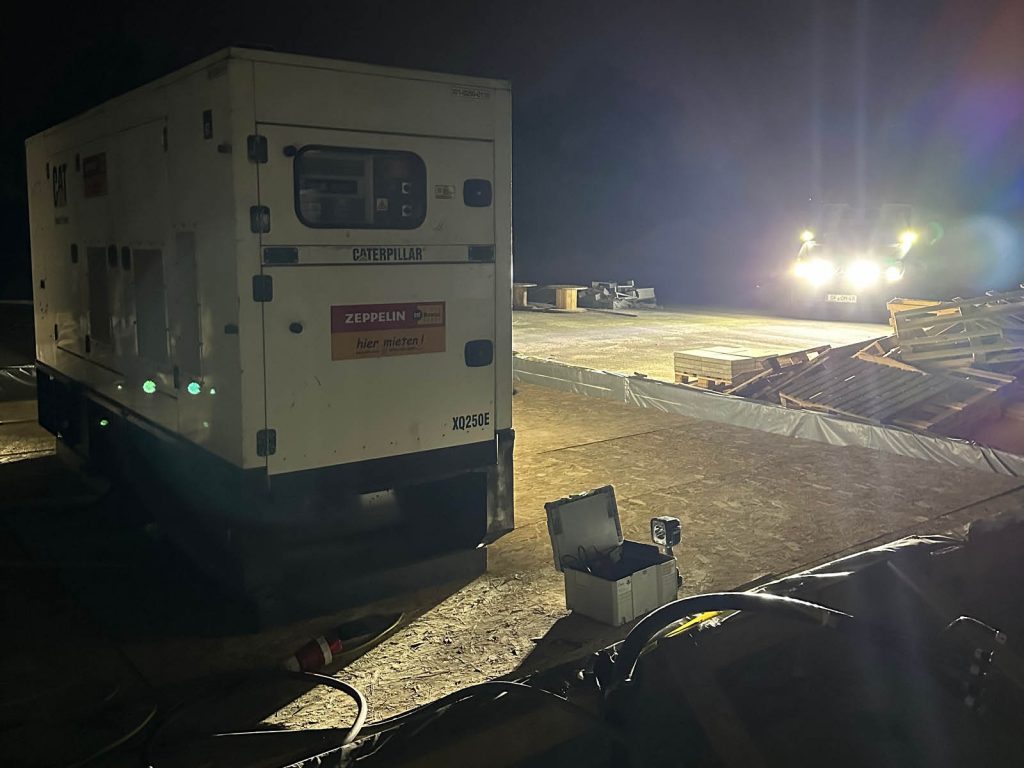
A logistics company on a construction site drew its power from a standby generator. During our emergency call-out on a Sunday evening the generator had problems starting. Production was due to start on Monday at four o'clock. The generator was no longer operational, and a replacement generator was brought in. Its connection panel was different from the old one, and suitable cable lugs and heat-shrink sleeves could not be obtained during the night. A temporary supply kept emergency operation going, and by Monday midday the new generator was running. Afterwards we proposed a second generator for redundancy, and the company implemented it.
For your concept this means: a breakdown shows where criticality was misjudged. Redundancy turns a critical failure into a plannable swap. Such decisions belong in the review – and then in the concept.
Standby generator set in the Rhine-Main region: the planned annual package
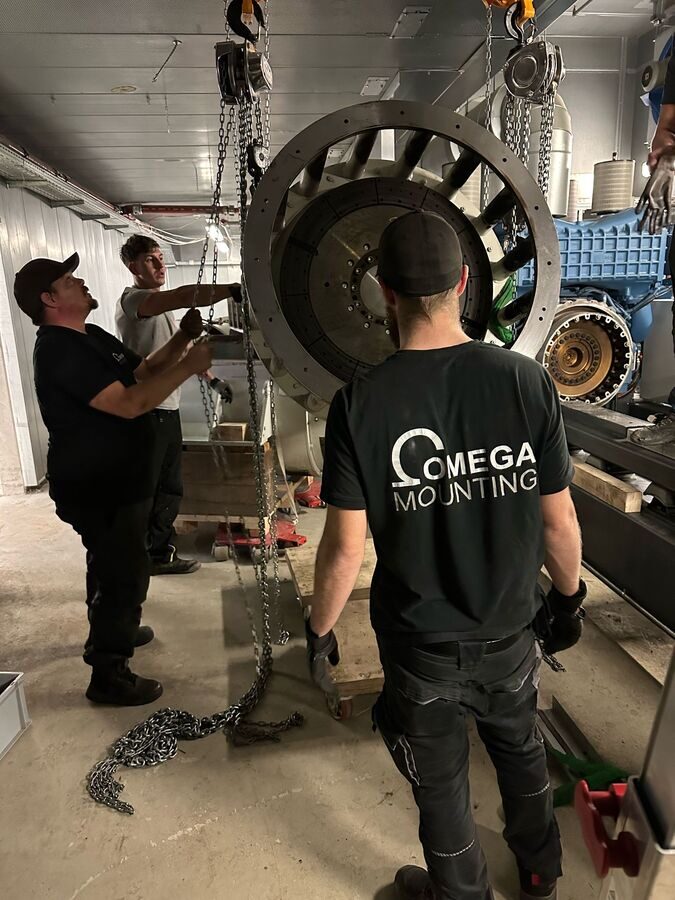
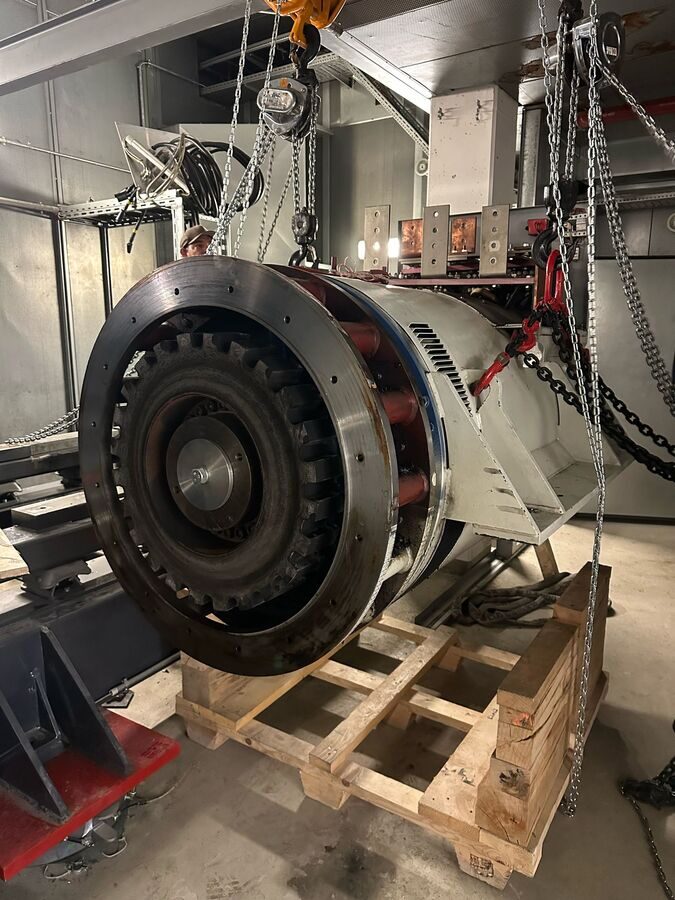
With the maintenance of the generator of a standby power system in a larger building complex in the Rhine-Main region, the lift plans were in place before the job. Passage widths, space for lifting out, lifting accessories, chain hoists and the load capacity of the suspension points had been checked. Dismantling the enclosure was included in the schedule from the start. Transport frames were built on site, skates brought the components to the installation shaft, and a mobile crane lifted them out. A lifting contact coordinated, three mechanics carried out the work.
For your concept this means: major overhauls are not just a line in the maintenance plan. Routes, suspension points and lifting equipment belong in the plant's documents – then the next overhaul can be planned.
Do you want to put your maintenance concept on a solid footing?
Then get in touch with us. Send us your asset list or a description of the critical plants. During a site visit we show where an assessment is missing and which mechanical items belong in the plan.
What this means for your role
For buyers: The concept is your basis for every award. Criticality, strategy and organisation determine what you award as a maintenance contract, a framework agreement or an individual call-off. Ask for the asset list with strategy per group before every tender.
For designers: Every new plant ends up in the concept. Hand over maintenance documents, spare parts lists and accessibility so that the plant can be classified on day one. Lubrication points without access and assemblies without a suspension point make any strategy difficult.
For project managers and site managers: As a project manager, you hand over a plant not just with acceptance but with criticality, inspection duty and spare parts list – ready for the concept. As a site manager, you make sure that maintenance and operators are instructed on site.
For maintenance managers: You write the concept. Start with the asset list and criticality, not with the maintenance plan. Record reactive plants deliberately, and fix the review with a date.
For operations and plant managers: A concept costs shutdown windows before it saves downtime. Release the windows the plan needs, and sign the concept. Measure maintenance by unplanned downtime, not by the number of repairs.
For facility managers and operators: You bear operator responsibility, even if service providers do the work. Check whether the concept fits your risk assessment and whether inspection duties and maintenance plan match. This is the first place an auditor looks.
Maintenance concept outline: template on request
The maintenance concept outline is a two-page working document. Page 1 contains the ten chapters from this article with two to three key questions each. Page 2 offers fields for approval, responsibilities per chapter and the date of the next review. It deliberately contains no figures, target values or intervals – they belong to your company. As a maintenance concept template, it helps structure the first draft in a meeting. Request the outline via our contact form – keyword “Maintenance concept outline”.
Why Omega Mounting?
We are based in Rodgau near Frankfurt, can be reached by phone (Mon–Fri 9 am–3 pm) and via WhatsApp, and have our own workshop. The linked jobs show both sides of maintenance. On the overhead monorail system in Frankfurt, inventory and prioritisation came before the first repair. On the Sunday evening came the breakdown, followed by the recommendation for redundancy. And on the standby generator set, the lift plans were fixed before the first task. For you this means: a single point of contact for assessment, servicing, repair and lifting equipment who puts your concept into practice in the hall – with short distances in the Rhine-Main region.
Conclusion
Anyone who wants to create a maintenance concept does not need a thick manual, but decisions on a few pages. The seven steps lead from the asset list with criticality via strategy, inspection duties, maintenance plan, spare parts and organisation to key figures and review. Reactive maintenance remains allowed where it has been chosen deliberately. Key figures show the direction, the review keeps the document up to date. If you want to start on your concept, send us your asset list and known faults – we'll come back with a site visit date and an honest assessment.
Planning a move-in, installation or maintenance in the Rhine-Main region?
Tell us briefly what you need – we'll come back with an honest assessment.
Free, no-obligation callback
You may also be interested in these guides
Maintenance & Servicing
Maintenance & Servicing

About the author
Tobias Schott
Managing director of Omega Mounting GmbH, Rodgau · more than 20 years of hands-on experience in installation and maintenance
A trained mechatronics technician, working in maintenance, servicing and industrial installation since 2004 – first alongside his father, and with Omega Mounting since 2012: from overhead conveyors in Frankfurt to the crane system in a new-build hall. He plans and leads lifting operations as an appointed person (AP) in data centers and on industrial sites in the Rhine-Main region, trains and examines operators of cranes, mobile elevating work platforms and telehandlers, and is a qualified occupational safety specialist. On jobs abroad he is known as the “German Troubleshooter” – the person you call when a site gets stuck. He learned what quality means from his father, not from a manual: Made in Germany as a standard for his own work, not a label. That is why quality comes first at Omega Mounting – ahead of speed and price. He writes these guides from that practice: what works on our sites is in them – what exists only on paper is not.
Frequently asked questions
In seven steps: asset list with criticality, strategy per plant group, inspection duties, maintenance plan, spare parts strategy, in-house and external organisation and key figures with review. Start with the question of what happens when a plant stops. Anyone who wants to create a maintenance concept then records the decisions on a few pages and attaches the lists as annexes. The management approves the document.
Reactive maintenance only takes action after the failure. It is enough if the failure affects neither production nor safety nor inspection duties, the spare part is available and the swap succeeds without preparation. Typical examples are lighting, redundant pumps or small drives with a spare on the shelf. What matters is that the classification is documented in the concept.
The strategy decides per plant whether it is maintained reactively, preventively, condition-based or predictively. The concept is the framework around it: it contains the strategies, but also the asset list, inspection duties, spare parts, organisation and review. The strategy is therefore one chapter of the concept, not the concept itself.
Usually maintenance management, with input from production, purchasing and occupational safety. It should be approved by the management, because it commits windows, stock and external services. External partners provide findings, condition surveys and proposals for their trades. The decisions stay with the operator.
At least once a year in the review and additionally after every major change. This includes new or decommissioned plants, conversions, a breakdown with major consequences and changes of staff or service providers. For the review, you hold the key figures, findings list and breakdowns of the previous year against the concept.
No law prescribes a maintenance concept as a document. However, the German Ordinance on Industrial Safety and Health requires you to operate work equipment safely and to set the type, scope and intervals of inspections in the risk assessment. The concept is the clear place where these specifications come together. This note is not legal advice.
Yes, the seven steps apply to every plant fleet; only the focus shifts. In logistics, conveyors, doors and racking shape the concept. In data centers, redundancy rules, approvals and maintenance windows are added. In food companies, hygiene windows and cleaning play a major role.
For the mechanical part, installation and maintenance contractors from the region are the shortest route. From Rodgau we assess conveyors, cranes, overhead monorail systems, drives and standby generator sets in Frankfurt, Offenbach, Hanau, Darmstadt and Aschaffenburg. You get a findings list, photos and proposals for servicing and spare parts. On request, our own electricians take on the plant electrics; controls and inspection stay with the responsible partners.
Via a short enquiry with three details: your asset list or a description of the critical plants with age and location, the recent breakdowns and the shutdown windows your company can offer. We arrange a site visit, assess the critical plants and send a written assessment with proposals for the mechanical items. Your contact is Tobias Schott – reachable via our contact form.
 English
 German