
- Project diary – workshop fit-out in a nuclear facility
Workshop Fit-Out in a Nuclear Facility: Two Pillar Jib Cranes Installed
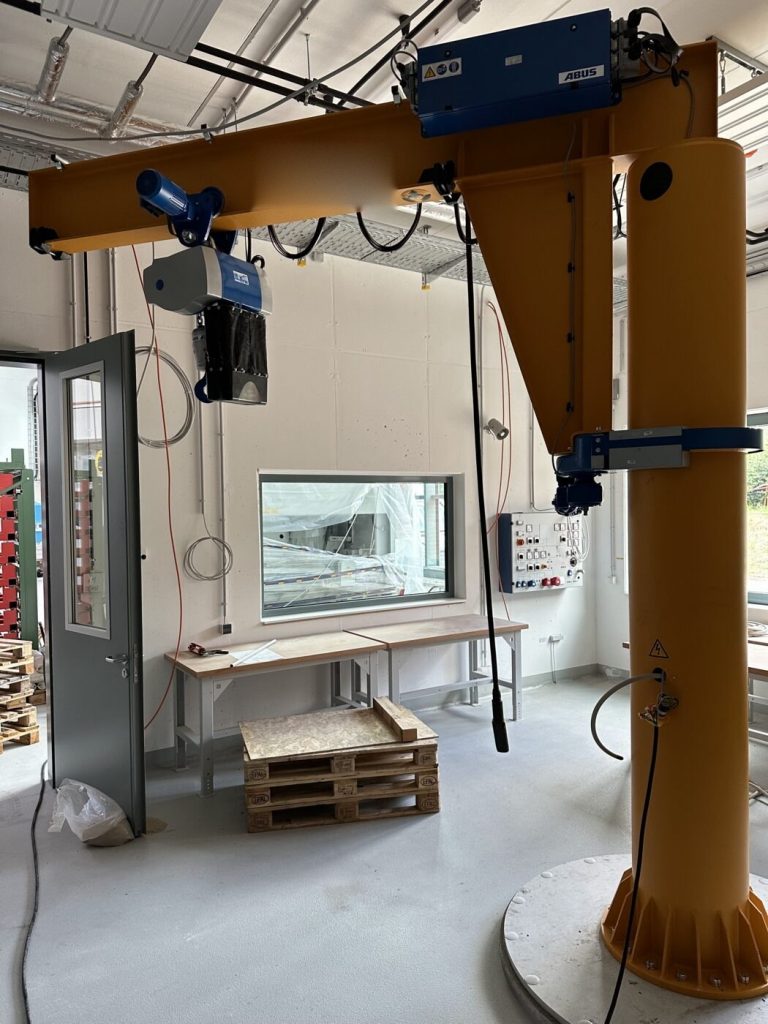
How two mechatronics technicians fitted out a complete workshop in two working weeks – and why each of them first had to undergo a nuclear-law reliability check
Some jobs are technically routine and still something special. Installing two pillar jib cranes, setting up workbenches, connecting power distribution boards, aligning and fixing a press brake – that is workshop fit-out as we do it regularly. The difference was not in the technology. It was in where we installed it.
The site was a repository for radioactive waste in Germany. Before our fitters were allowed to touch so much as a bolt there, each of them had to undergo the nuclear-law reliability check – a procedure under Section 12b of the German Atomic Energy Act that takes weeks and must be completed long before the first day of installation.
Added to this was a second special feature that applies on every site and was particularly strict here: The area was finished. Finished floors, finished plant, cranes already installed. We were the trade building into a completed room without leaving any trace.
Project profile
- Scope: Complete workshop fit-out – installation of two pillar jib cranes (one in the test laboratory, one in the large workshop), setting up workbenches, connecting the power distribution boards, and aligning and fixing a large press brake, TIG-welded to the hall floor
- Team: 2 mechatronics technicians from Omega Mounting
- Project duration: two jobs of one week each
- Client: Supplier of workshop and plant equipment, long-standing customer of Omega Mounting
- Location: Repository for radioactive waste in Germany – location not named at the customer's request. Our team travelled from Rodgau.
- Special feature: Access only after passing the nuclear-law reliability check per person; work in an already completed area with full floor and plant protection
- Result: Both cranes installed and handed over, workshop fully fitted out – and vetted personnel permitted to work in nuclear facilities
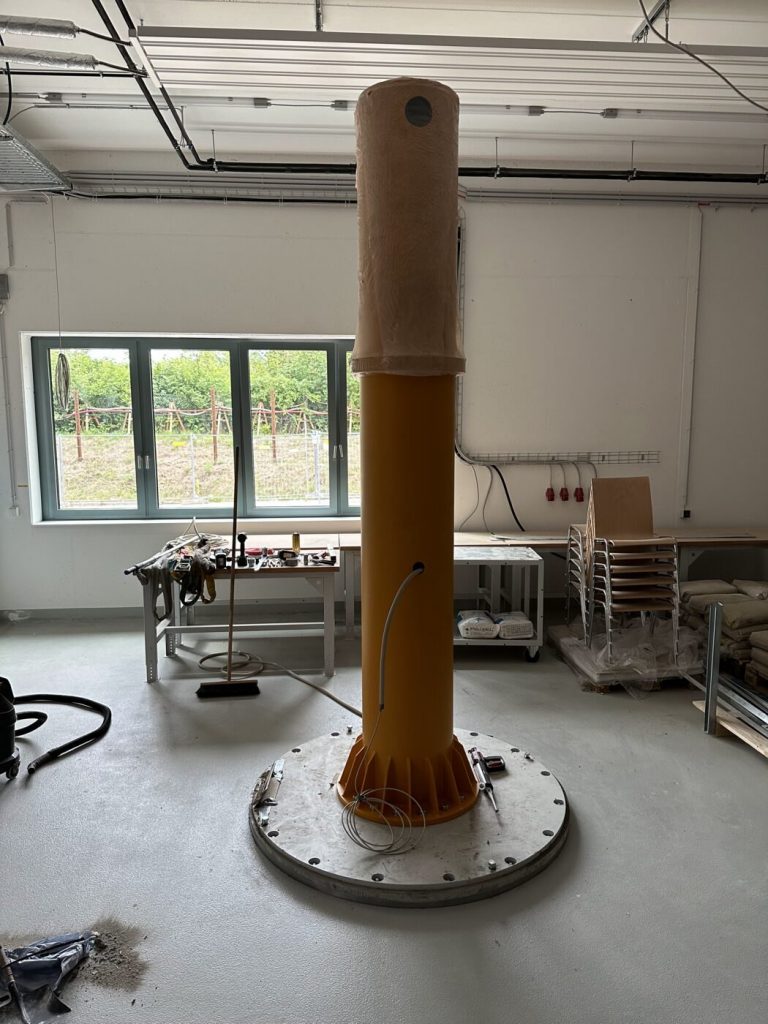
What is a pillar jib crane?
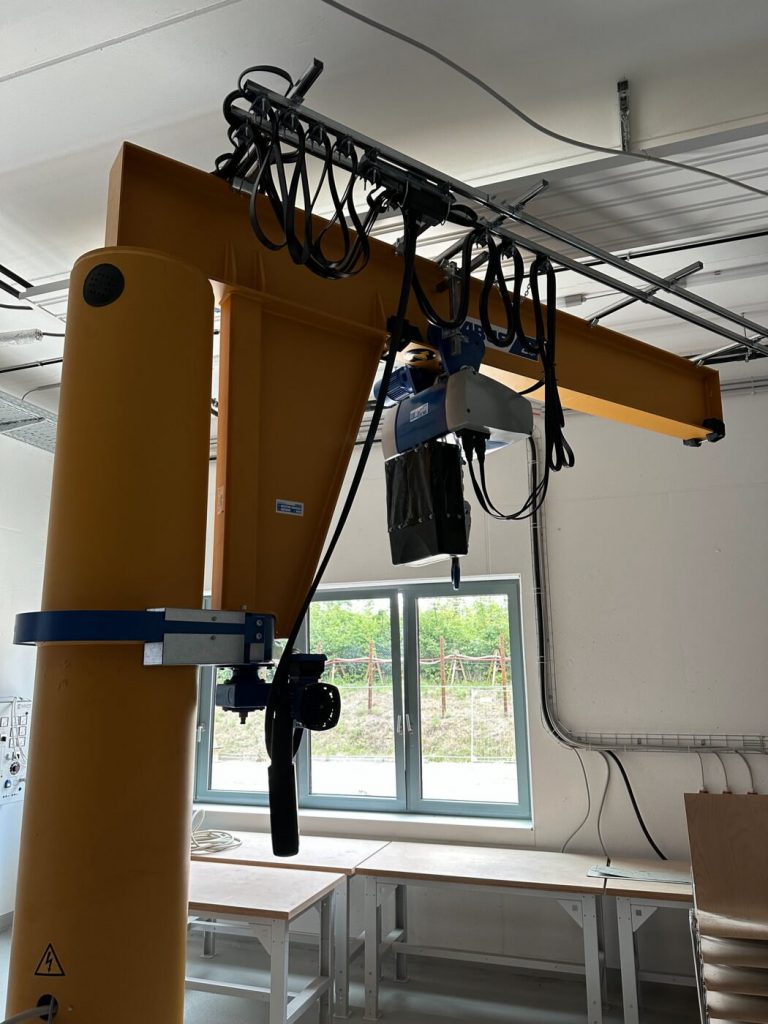
A pillar jib crane is a lifting appliance that stands on its own pillar and whose jib rotates around this pillar. It needs no crane runway, no load-bearing hall structure and no connection to the building – it stands on its own base and serves the circle described by its jib.
That is exactly what makes it so popular for workshops. At a workstation where heavy parts are regularly moved, turned or placed into a machine, it replaces lifting by hand. It is quickly available, needs no coordination with the overhead crane and blocks nobody.
The price for this is the force transfer. What the jib lifts acts as a bending moment on the pillar and from there on the base plate. A pillar jib crane therefore does not load the floor evenly but on one side and alternately – depending on where the jib happens to be. That is why the anchoring decides everything.
Why does a workshop installation require a reliability check?
Because access to the site, not the installation itself, is the real hurdle. Anyone working in a nuclear facility must have their reliability checked under Section 12b of the German Atomic Energy Act. This is regulated in the Nuclear Reliability Assessment Ordinance (AtZüV) – the ordinance on reliability checks for protection against the theft or release of radioactive substances.
Important to understand: this is not a company certification but a check of every individual person. Each fitter fills in a declaration form, the competent authority checks it, and only then may this person enter the site. This is not a form you fill in on the day of arrival but a procedure that runs for weeks.
For us, this was a deliberate step. Our people have been through this procedure and have been permitted to work in such areas ever since. This is a door that cannot be opened at short notice – and that is exactly why it is valuable.
For our customers this means something concrete: anyone planning an installation in an area with access vetting does not first have to put an installation team through the procedure and lose weeks in the process. Our people are already vetted. We know the same logic from other security areas – at Frankfurt Airport, on military sites in the Taunus, in power stations and in data centers with access control.
What did the workshop fit-out include?
Four trades at one site, and none of them stands alone:
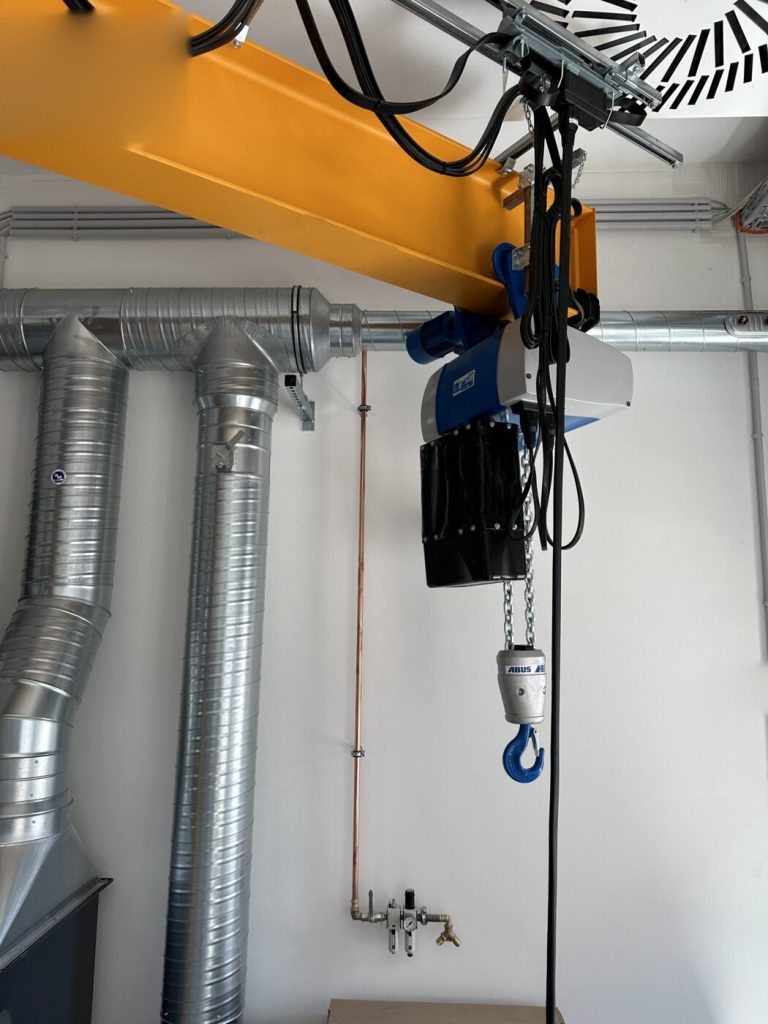
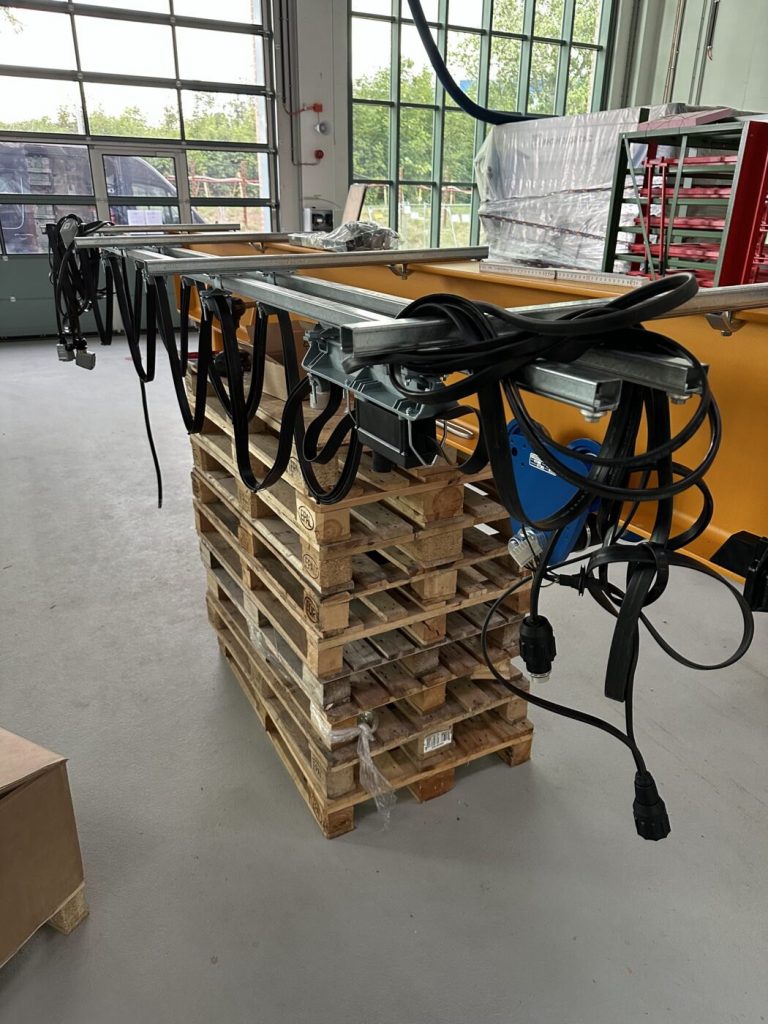
- Two pillar jib cranes. One in the test laboratory, one in the large workshop. Two different rooms, two different working situations – more on that below.
- Workbenches. Set up, aligned and positioned so that workstations, crane radii and traffic routes fit together.
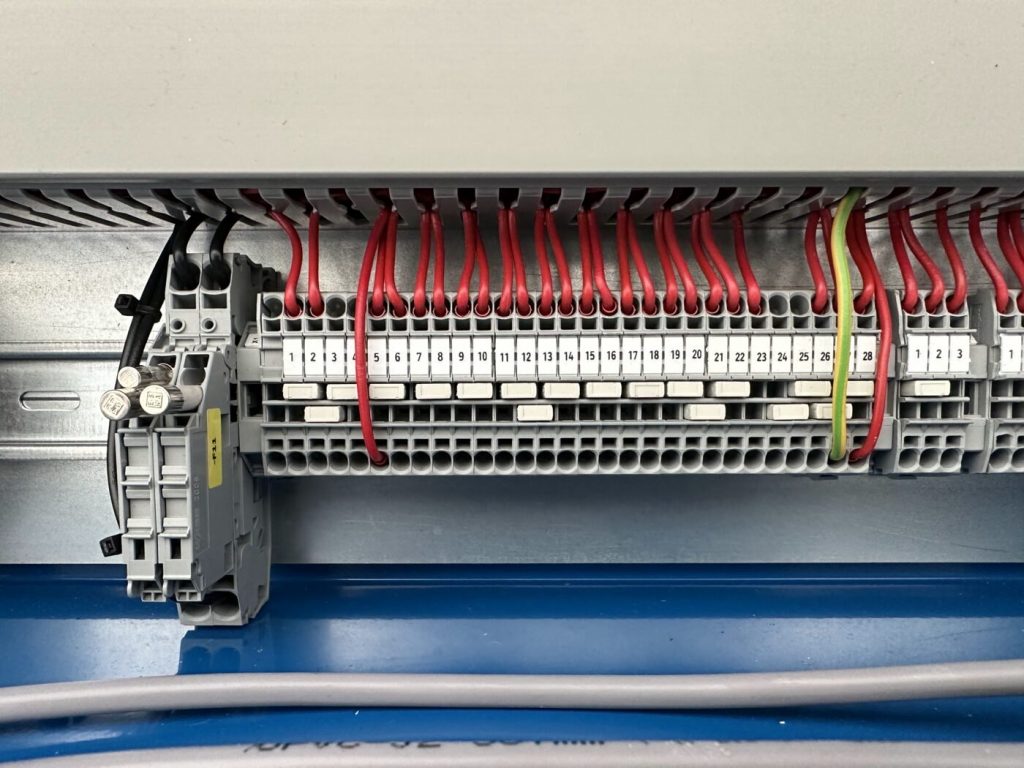
- Power distribution boards. Connected and commissioned so that the workstations and machines are supplied.
- A large press brake. Positioned, aligned and welded to the hall floor.
That all of this comes from one team is the real value. Anyone ordering crane, workbench, power and machine from four companies coordinates four call-outs, four schedule chains and four contacts – on a site that not everyone can get into.
How do you install a pillar jib crane on a finished floor?
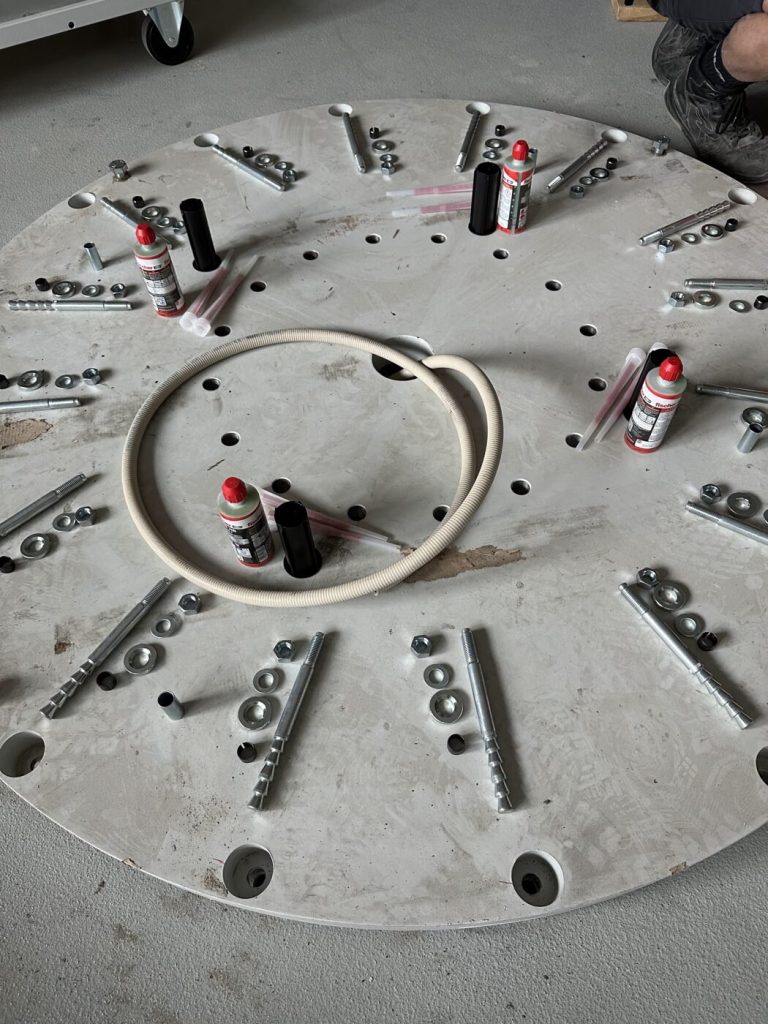
The short answer: with resin anchors, cleanly drilled, cleanly cleaned and aligned plumb. The long answer explains why each of these four steps counts.
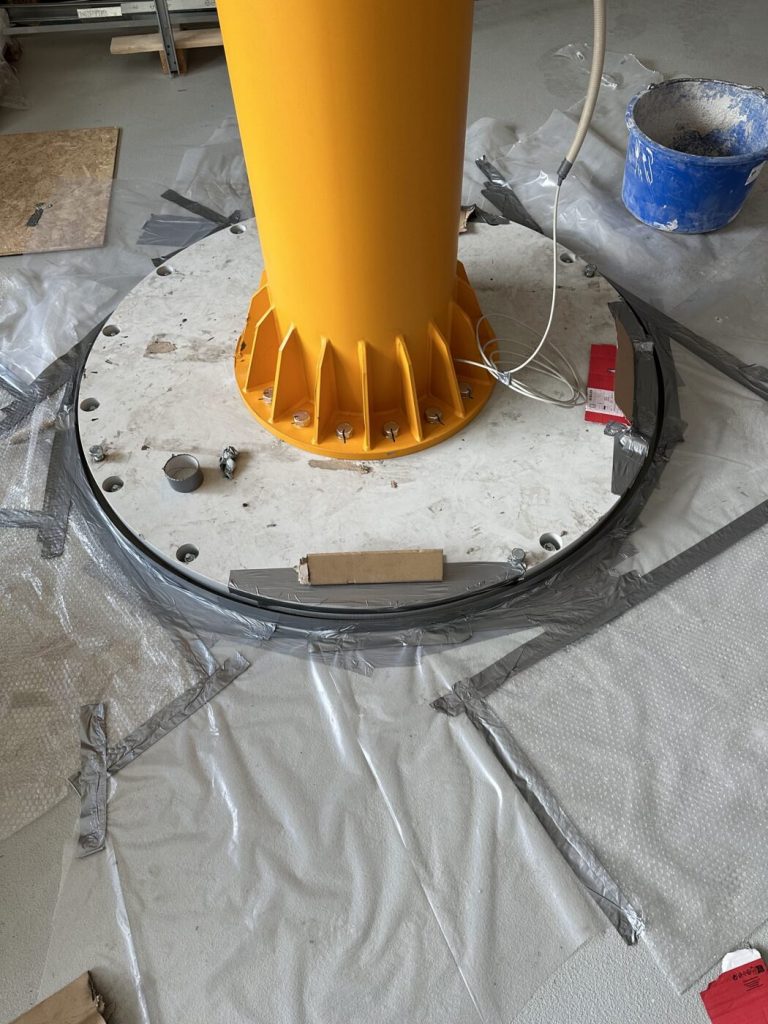
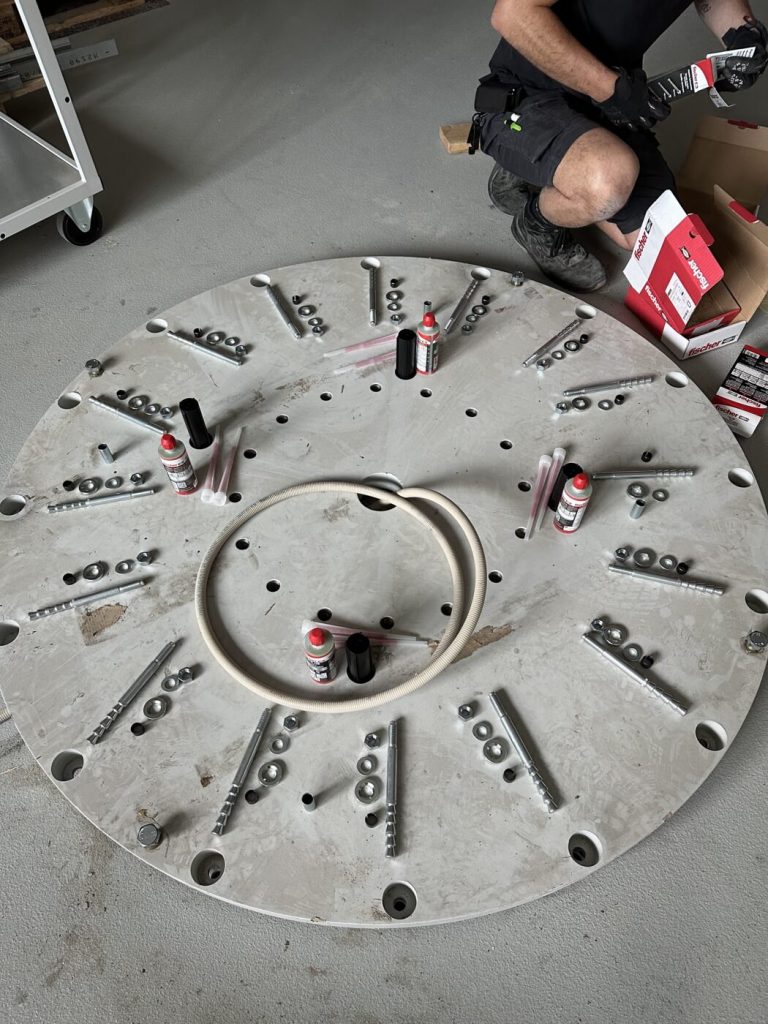
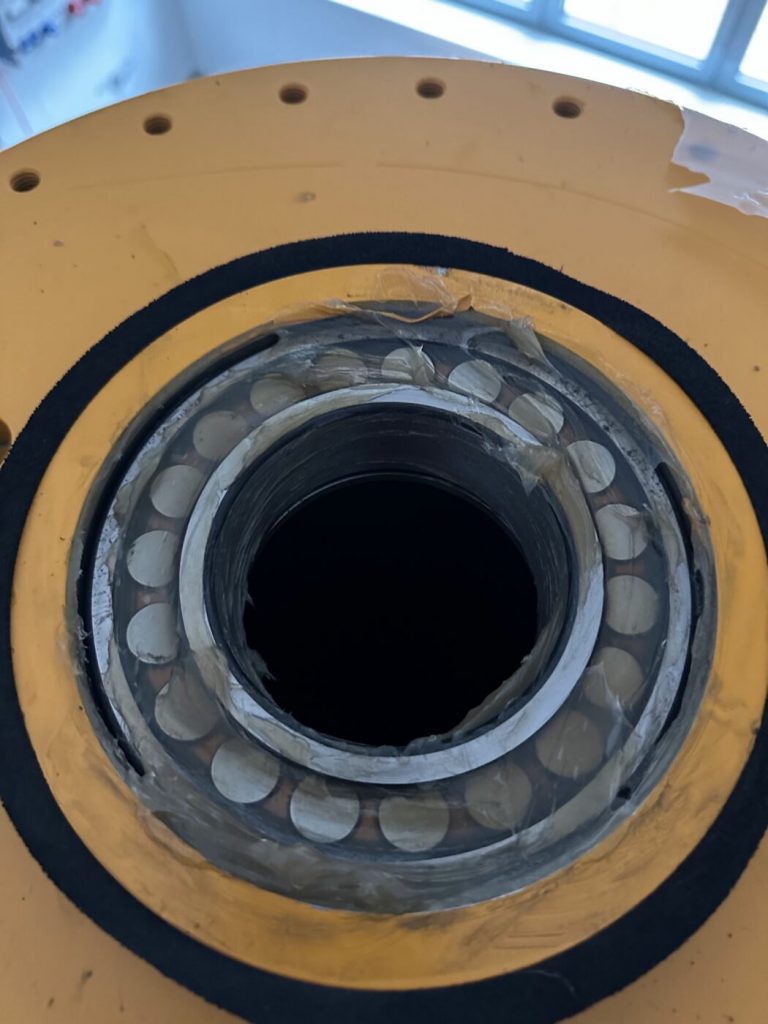
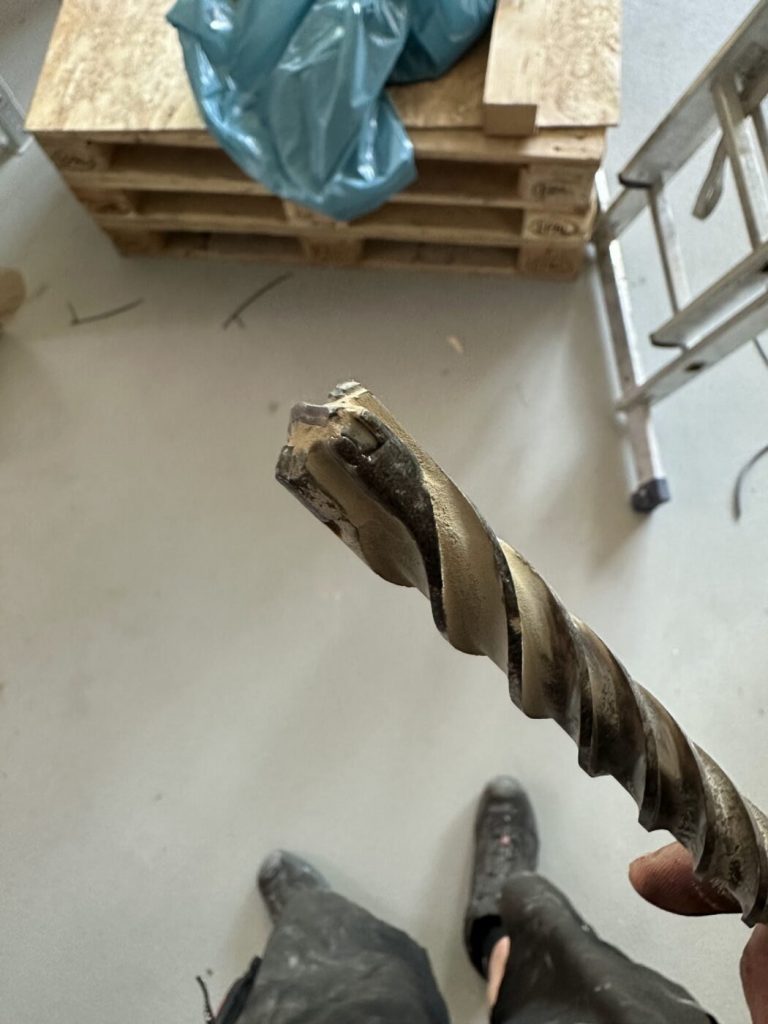
Drilling. The base plate is marked out and the hole pattern drilled into the concrete floor. Clearly visible in the photos: drilling was done with dust extraction directly on the drill. In a finished area this is not a convenience but an obligation – drilling dust that has once spread over a finished floor and into finished plant can never be completely removed.
Cleaning. The drill hole must be blown out and brushed out. Resin bonds to the wall of the drill hole – on a layer of dust it does not bond to the concrete but to the dust. This is the step you do not see and that decides the load-bearing capacity.
Setting. The cartridges are inserted, the anchor rods screwed in, then the curing time runs. This depends on temperature and product and cannot be shortened. Anyone who loads the pillar too early pulls the anchor out of the still-soft resin – and may only notice it months later.
Aligning. The pillar is set plumb with two spirit levels offset by 90 degrees. A pillar that is only slightly out of plumb gives the jib a favourite direction: it runs to the lowest point on its own. That is not a cosmetic flaw but a safety problem – a jib that moves by itself under load is exactly what a jib crane must not do. Fine adjustment with shim plates under the base plate, then tighten.
Why are two cranes in two locations not the same thing twice?
Because the test laboratory and the workshop work differently. In the laboratory, it is about defined, recurring operations at a fixed place – the crane has to serve exactly this place cleanly and must not disturb anyone else. In the large workshop, more is moving: there are traffic routes, other workstations and an overhead crane above.
That is why exactly where the pillar stands is decided on site. The slewing range must reach the workstations without projecting into traffic routes or the working area of the neighbours. This can be prepared on the drawing but only finally assessed in the room – with the jib swung round once before drilling.
How is a press brake aligned and fixed?
A press brake – the machine that bends sheet metal over a length of several metres in a single stroke – stands or falls with its alignment. If it is not level, it bends to different depths along its length. A straight sheet then becomes a part that fits at one end and not at the other.
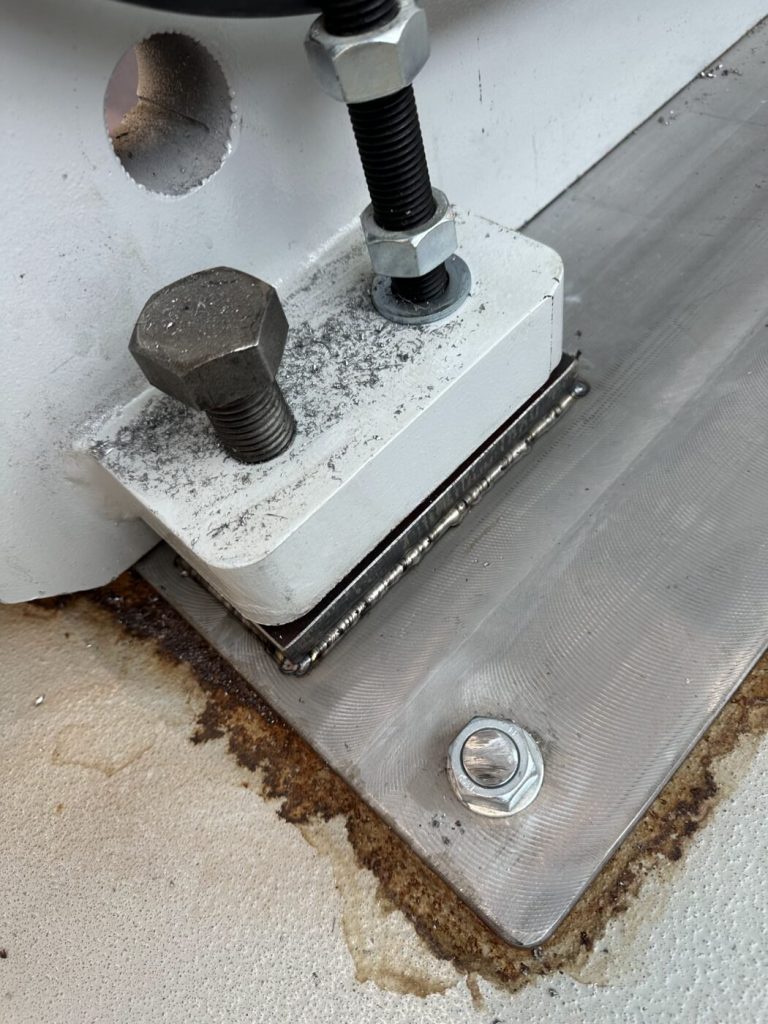
That is why such a machine is not just placed but surveyed in: height and level over the entire length, then fine adjustment, then fixed. In this case we welded it to the hall floor – TIG, because the process produces little spatter and stays clean in a finished room. This is the connection that is loosened neither by vibration nor by the forces during bending.
That we can do this without bringing in an outside company is part of our everyday work: mechanical, electrical and welding in one team. That is exactly why we were able to complete crane, workbench, power distribution and machine in one go.
How do you protect an area that is already finished?
By planning the protection before the first tool is unpacked. The area was completely finished – floors laid, plant installed, cranes already in place. Everything we carried in could have damaged something.
Our approach:
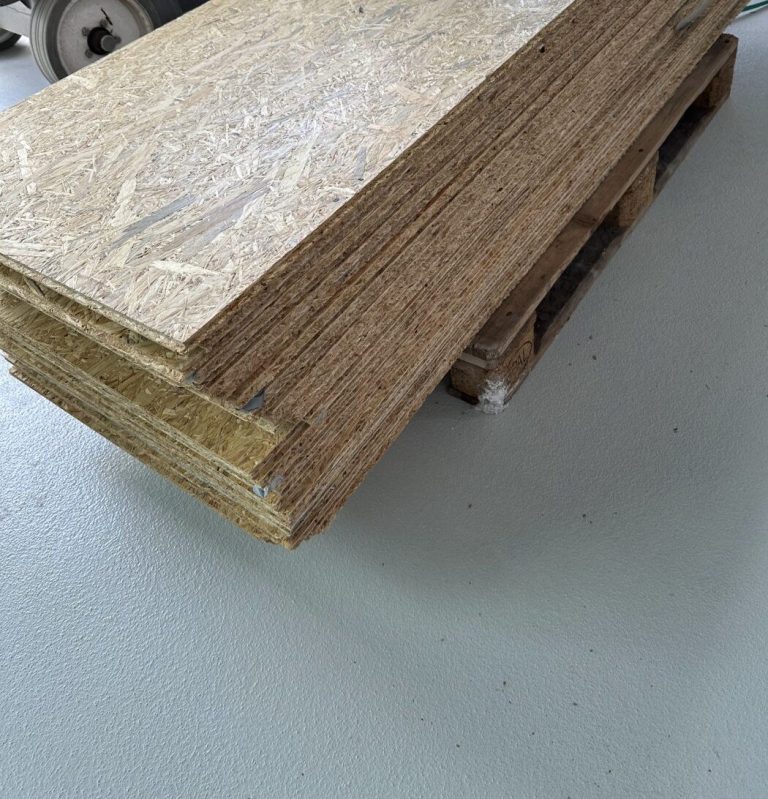
- Cover the floorsbefore material comes in. Visible in the photos: the stacks of boards used to cover the walkways and working areas. Not only where drilling takes place – also on the routes there.
- Cover existing cranes and plant componentsso that neither dust nor sparks nor a carelessly set-down component causes damage.
- Extract dust at source instead of sweeping up afterwards.
- Coordinate and safeguard hot work. When welding the press brake to the floor, flying sparks and fire protection are treated as a topic in their own right, not as a side issue.
- Hand over clean. The area looks the same afterwards as before – only with a fitted-out workshop inside.
That sounds obvious, but it is not. The damage an installation team causes on a finished area costs the client more than the installation itself – and it is noticed immediately.
What the site did to our fitters
An honest postscript that has nothing to do with technology: it was impressive. Looking down once into the depths of such a facility and seeing the effort that goes into it stays with you. Anyone permitted to enter such places works with more concentration – not because someone is watching, but because you realise the context in which your own work stands.
For us as a company, it was one of those jobs that people still talk about later.
Why Omega Mounting?
- Access you cannot get at short notice. Our fitters have been through the nuclear-law reliability check under the AtZüV. We bring the same experience from airport, military and data center areas.
- All trades from a single source. Crane, workbench, power distribution, machine alignment and welding work – one team, one call-out, one contact.
- Installation in finished areas. Floor protection, dust extraction, covered plant, clean handover. We are used to being the last trade.
- Crane technology across the board. From the pillar jib crane via the underslung crane and the double girder travelling crane to the free-standing gantry crane and the crane runway.
- Aligning machines instead of just placing them. Survey in, fine-adjust, fix – only then does a machine work the way its data sheet promises.
- Rooted in the region: From Rodgau throughout the Rhine-Main region – and throughout Germany when the job demands it.
Conclusion
Two pillar jib cranes, workbenches, power distribution boards and an aligned press brake – completed by two mechatronics technicians in two working weeks. From the workshop's point of view a complete fit-out, from our point of view a job that shows where our strength lies. Not in a single installation, but in bringing several trades together at a hard-to-access location without anyone having to clean up afterwards.
The customer accepted both cranes to their satisfaction. And we took away something that has an effect beyond this job: vetted personnel permitted to work in nuclear facilities.
Are you planning a workshop fit-out, a machine installation or a crane installation – possibly in an area that not every company can get into? Talk to us before the floor is laid. Then the protection can be planned instead of improvised.
Request a callback for your project now – Omega Mounting GmbH, Rodgau. We install cranes, machines and complete workshop fit-outs in Rodgau, Offenbach, Hanau, Darmstadt and Aschaffenburg – and wherever our customers need us. 100 % without obligation and free of charge.
Photo gallery of the job
Are you planning an installation in an area that not every company can get into?
Tell us briefly what it is about – we will come back to you with an honest assessment.
100% free and without obligation
Related guides for this project

About the author
Tobias Schott
Managing director of Omega Mounting GmbH, Rodgau · more than 20 years of hands-on experience in installation and maintenance
A trained mechatronics technician, at home in maintenance, servicing and industrial installation since 2004 – first alongside his father, and since 2012 with Omega Mounting: from the overhead conveyor in Frankfurt to the crane system in a new-build hall. As appointed person for lifting operations, he plans and leads lifting operations in data centers and on industrial sites in the Rhine-Main region, is an instructor and examiner for cranes, aerial work platforms and telehandlers, and a safety officer. On assignments abroad he is known as the "German Troubleshooter" – the one you call when things get stuck on site. He did not learn what quality means from a manual, but from his father: Made in Germany as a standard for his own work, not as a label. That is why quality comes first at Omega Mounting – before speed and before price. The project diary shows the jobs his team has planned and carried out – without customer names, but with everything that can be learned from them.
Frequently asked questions
The pillar jib crane stands on its own pillar anchored in the floor and usually serves a circle of up to 360 degrees. The wall-mounted jib crane is fixed to a load-bearing wall or a column and serves a semicircle. The pillar version is independent of the building – which is why it is the right choice when the hall has no suitable fixing points or when the crane is to stand in the middle of the room.
Yes, that is in fact the normal case. The decisive factors are the condition and thickness of the floor slab and whether there are pipes or heating coils under the planned location. Both are clarified before drilling, not afterwards.
Because the resin has to bond with the wall of the drill hole. If drilling dust remains in the hole, the anchor bonds to the dust instead of the concrete, and the load-bearing capacity drops considerably. Blowing out and brushing out are therefore a fixed part of the setting process – even if the result is not visible later.
Bolted connections can loosen under vibration and alternating loads and have to be retightened. A welded fixing stays where it is. The prerequisite is that the machine has been precisely surveyed in beforehand – after welding, no more correction is possible.
It works inaccurately, and increasingly so over the entire working length. For a press brake this means different bend angles at the ends of the same sheet. On other machines, stresses in the frame lead to increased wear on guides and bearings. Alignment is therefore not a finishing touch but part of commissioning.
It is regulated in Section 12b of the German Atomic Energy Act and the Nuclear Reliability Assessment Ordinance (AtZüV) and concerns persons who are to be given access to nuclear facilities or radioactive substances. Each person concerned fills in a declaration form, and the competent authority checks the information. Only after a positive conclusion may the person enter the site. The procedure takes weeks – anyone who only starts it when the contract is awarded loses this time.
Yes. Our fitters are vetted for several such areas – including nuclear facilities, Frankfurt Airport, military sites and data centers with access control. When awarding contracts, it pays to clarify early on which companies can already provide vetted personnel.
Yes. We are based in Rodgau in the Offenbach district, and our focus is on the Rhine-Main region – from Frankfurt and Hanau via Darmstadt to Aschaffenburg. For jobs like this one we travel throughout Germany.
The installation itself can be done in one day. However, the sequence is determined by the curing time of the resin: between setting the anchors and loading the pillar, the resin must cure completely. This time depends on product and temperature and cannot be shortened – anyone who wants to save time here pays for it twice later.
 English
 German