
- Project report – moving load banks and generators into a data centre
Moving load banks and generators into a Frankfurt data centre – lift & shift with a 220-tonne mobile crane
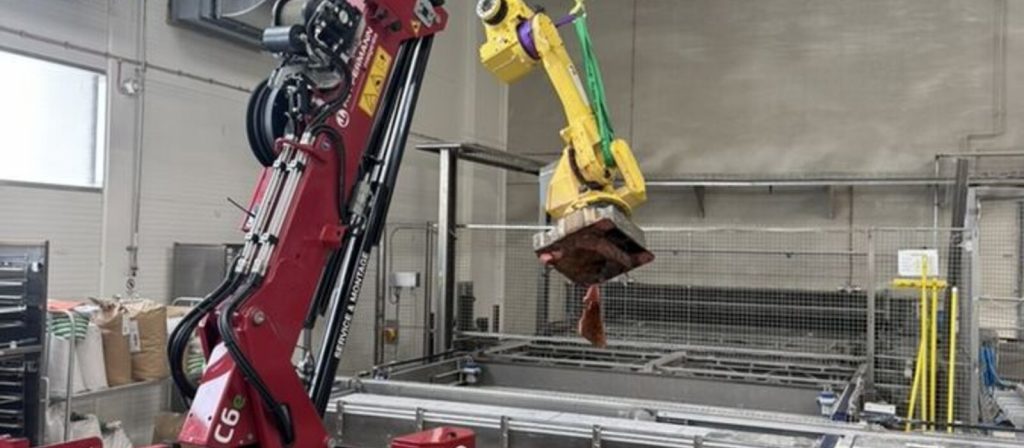
Five heavy transports, a 220-tonne mobile crane, one long working day: moving generators and load banks in, from the kerbside to their final position
When a data centre tests and extends its emergency power supply, generators and load banks weighing tonnes have to go exactly where they are needed – often into areas that standard logistics cannot reach. That is where our work begins.
At a data centre in Frankfurt am Main we were entrusted by a world-leading provider of mobile power and temperature solutions with the complete delivery, unloading and moving in of generators and load banks. From unloading the heavy transports and setting up the mobile crane to lifting the containers into the prepared steel structure to the millimetre, the entire process was in our hands.
What made this project special: all the lifts were carried out in a single, very long working day – possible only through detailed lift planning, a well-practised sequence and the right crane technology.
Project profile
Performance
- Coordinating and unloading five heavy transports
- Moving in generators and load banks
- Setting up and operating a 220-tonne mobile crane (Tadano ATF 220G-5)
- Preparing and agreeing the lift plans
- Rigging and slinging work
- Lift & shift management on site
- Positioning all components right through to their final installation position
- Team
- 1 data centre lift & shift manager (project management on site)
- 3-man crane crew
- 5 lorry drivers on scheduled delivery runs
- Project duration: 1 working day (long shift)
- Location: Data centre in Frankfurt am Main (Rhine-Main region)
What is a load bank?
A load bank is a mobile test unit used to test a data centre’s emergency power supply under real conditions. It simulates the electrical load of the servers and equipment and so ensures that generators reliably deliver full output when it matters.
For load tests, load banks are set up and cabled on site together with the associated generators. As both components are built as heavy container modules, moving them in is a classic lift & shift task: high weights, tight installation areas and an environment where damage has to be ruled out.
In the Frankfurt area in particular, one of the largest data centre locations in Europe, jobs like these are among the most demanding tasks in heavy lifting.
Why is moving equipment into a data centre especially demanding?
The short answer: because on an active data centre site nothing is left to chance – every lift, every route and every piece of equipment has to be planned, documented and approved in advance.
Several factors came together on this project:
- limited manoeuvring and set-up space for heavy transports and the crane
- precisely defined installation positions between the fuel tank, generators and existing equipment
- Hübe in unmittelbarer Nähe einer mehrstöckigen Stahlkonstruktion
- strict safety and access requirements set by the operator
- a tight time window that required the entire move-in to happen in one day
The installation areas and crane positions were therefore defined during the planning phase in a detailed move-in drawing – the plans show clearly how tight the space between the tank installation, the generators and the access road was.
How were the crane lifts planned?
Every single lift was calculated in lift plans before the job and agreed with the operator – including load weights, radii, crane position and safety zones.
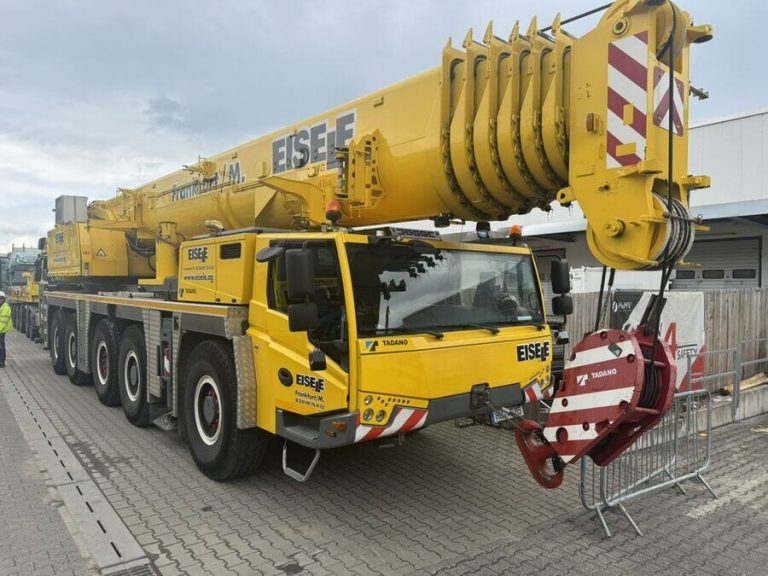
A Tadano ATF 220G-5 was used for the lifts, a mobile crane in the 220-tonne class. With 71 tonnes of counterweight and a 30-metre boom, about 28 tonnes of capacity were still available at a radius of around 20 metres – ample reserve to move the container modules safely and under control at all times.
The lift plans were filed and approved digitally in the operator’s contractor management system. Only after that approval could the first lift begin. That also included proof of the current recurring crane inspection under § 14 BetrSichV – in the data centre environment every piece of equipment is documented and checked.
Our crew set up the mobile crane themselves: ballasting, outriggers and rigging configuration were established exactly as per the lift plan.

How did the delivery of the generators and load banks proceed?
The generators and load banks arrived on site on five heavy transports with low-loaders – timed so that unloading and moving in dovetailed without waiting.
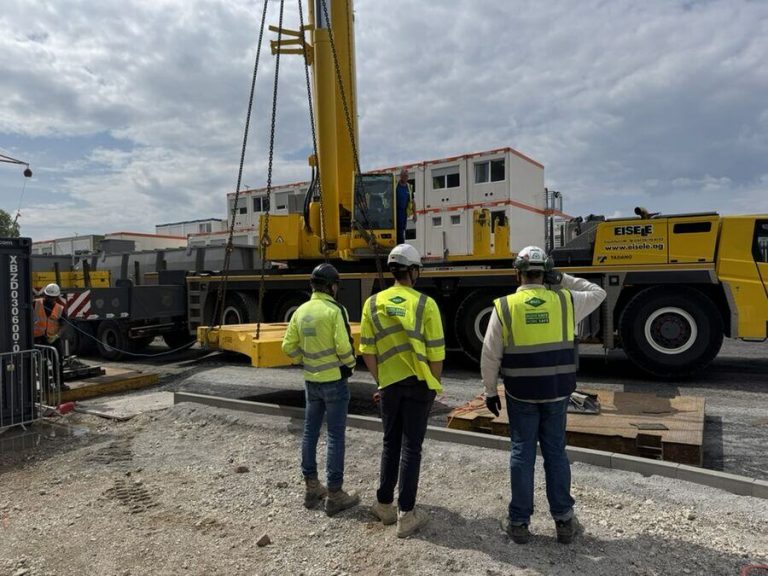
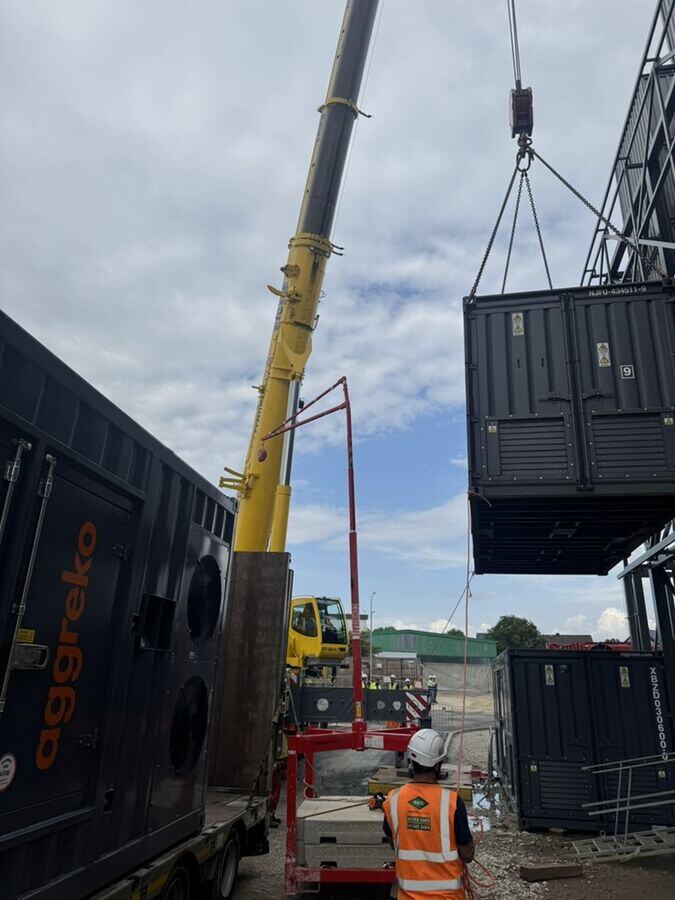
Our five drivers positioned the transports one after another exactly at the planned unloading point. The photos show the convoy of low-loaders clearly: container after container, ready for the lift. Besides the units themselves we had loaded all the material needed for installation – cables, connectors and fixing materials.
Because transport, crane and rigging team were tightly sequenced, every low-loader could be unloaded immediately on arrival. That turned five heavy transports, one crane and a tight time window into one continuous, smooth operation.
How were the load banks lifted in to the millimetre?
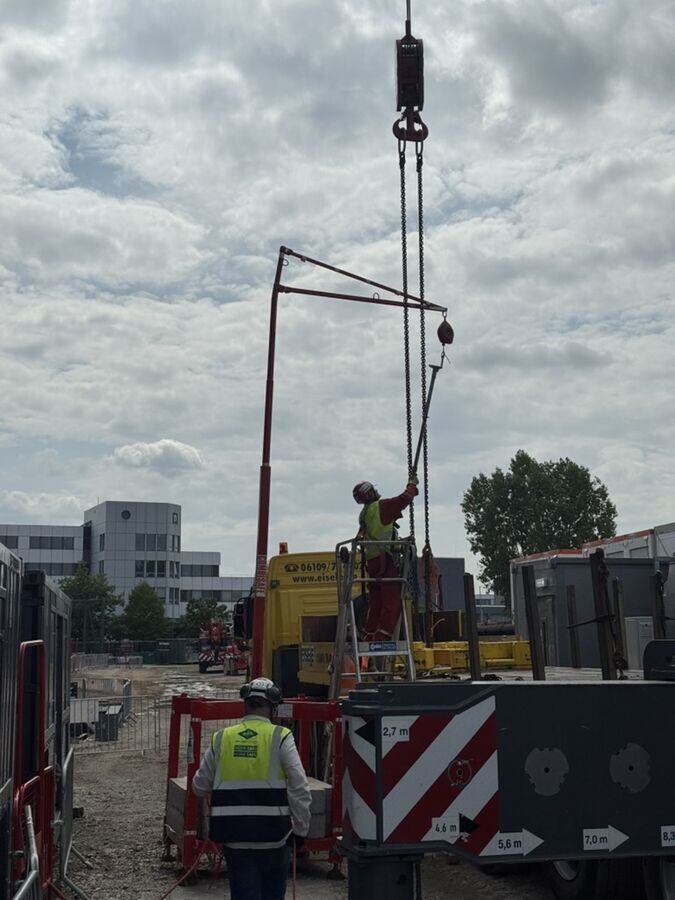
The container modules were slung with chain slings, guided over the steel structure by the mobile crane and set down to the centimetre – in places stacked over several levels.
The close-ups show how precisely the work had to be done: the load banks came in right beside the multi-storey steel frame structure they were set into. Our riggers guided the loads with taglines to rule out any uncontrolled movement.
A mobile work platform was used for slinging and unslinging at height. While one rigger released the chain slings, a colleague on the ground secured the area and kept permanent contact with the crane operator. Every movement was made on command – slowly, under control and without haste, even at the end of a long working day.

Occupational safety and documentation in the data centre environment
Data centre sites are among the most strictly regulated working environments there are – and that is exactly how we work.
For this project that meant, among other things:
- inspected and documented crane equipment and inspected lifting gear
- approved lift plans for every single lift
- cordoned-off slewing and danger zones
- all loads guided with taglines
- full personal protective equipment for the entire team
- constant communication between crane operator, riggers and the lift & shift manager
Our data centre lift & shift manager coordinated the whole job, kept in constant contact with the customer and made sure every step was carried out exactly to plan and approval.
From the kerbside to the fully installed unit
Our customer had nothing to worry about: we took on the complete process from the arrival of the heavy transports at the kerbside to the fully positioned unit with all components installed.
That end-to-end responsibility is the decisive advantage for our clients. Instead of coordinating several trades individually – haulier, crane company, riggers, installation team – there is one point of contact who plans, directs and takes responsibility for the whole sequence.
Our many years of experience in the data centre environment benefited the project directly: we know the safety processes, the documentation requirements and the way things run on data centre sites – which is why we can reliably meet tight time windows too.
Why Omega Mounting for lift & shift in a data centre?
As an installation company from Rodgau in the Rhine-Main region we specialise in demanding heavy-lift and move-in projects – from planning to finished installation.
Our services include, among others:
- Lift & shift and heavy-lift installation
- Moving in generators, load banks, CRAH units and technical plant
- Crane and rigging work including lift plans
- Transport coordination and unloading of heavy transports
- Data centre installations under the strictest safety requirements
- Project management by experienced lift & shift managers
- Preparation of RAMS, risk assessments and work permits
Conclusion
Five heavy transports, a 220-tonne mobile crane, nine men on the job – and at the end of a long working day every generator and load bank stood exactly in position in the Frankfurt data centre.
This project shows what professional lift & shift management means: precise lift planning, documented safety, well-drilled teams and the ability to combine transport, crane and installation into one seamless operation. For our customer that meant one single point of contact, one single day on site – and a result with no delays, no damage and no rework.
Are you planning a move-in or a lift & shift project?
Whether data centre, industrial plant or power equipment: we take on your project from the kerbside to the finished installation. As a team from Rodgau we are quickly on site throughout the Rhine-Main region – Frankfurt, Offenbach, Hanau, Darmstadt or Aschaffenburg – and we deliver projects across the whole of Germany as well.
Wie eine Netzersatzanlage überhaupt an ihren Platz kommt – vom Tandemhub bis zur Montage im Generatorenraum – haben wir im Überblick Notstromgeneratoren einbringen im Datacenter zusammengefasst.
Talk to us – request a call-back appointment for your project now.
Photo gallery of the job
Are you planning a project of this kind?
Tell us briefly what it is about – we will come back to you with an honest assessment.
100% free and without obligation
Frequently asked questions
A load bank is a mobile test unit that simulates the electrical load of a data centre. It is used to test whether emergency generators reliably deliver their full output when it matters. For the tests, load banks are delivered as container modules and set up on site together with the generators.
The modules arrive by heavy transport and are unloaded by mobile crane and lifted to their final position – including into multi-storey steel structures where required. Every lift is calculated in advance in a lift plan and approved by the operator.
A lift & shift manager plans and directs the entire move-in: lift plans, transport coordination, crane and rigging work, safety approvals and communication with the operator. They are the customer’s central point of contact and are responsible for the safe running of the job on site.
That depends on weight, radius and the space available. On this project a Tadano ATF 220G-5 in the 220-tonne class was used – with 71 tonnes of counterweight and around 28 tonnes of capacity at a 20-metre radius. The choice is always made on the basis of the lift plan.
Yes – with the right preparation. Scheduled heavy transports, a lift plan approved in advance and a well-drilled team made it possible on this project to unload and move in all generators and load banks in one long working day.
Yes. Our company is based in Rodgau near Frankfurt – jobs in Frankfurt am Main, Offenbach, Hanau, Darmstadt and the whole Rhine-Main region are everyday business for us. The short journey keeps us flexible even with tight time windows.
Yes. We coordinate and handle the complete process from the kerbside to the fully installed unit – including heavy transport coordination, unloading, crane work, rigging and positioning.
 English
  German