
- Project report – moving in and setting up 160 PDCs in a data centre
Moving in and installing 160 PDCs in a data centre – lift & shift across eight data halls in the Rhine-Main region
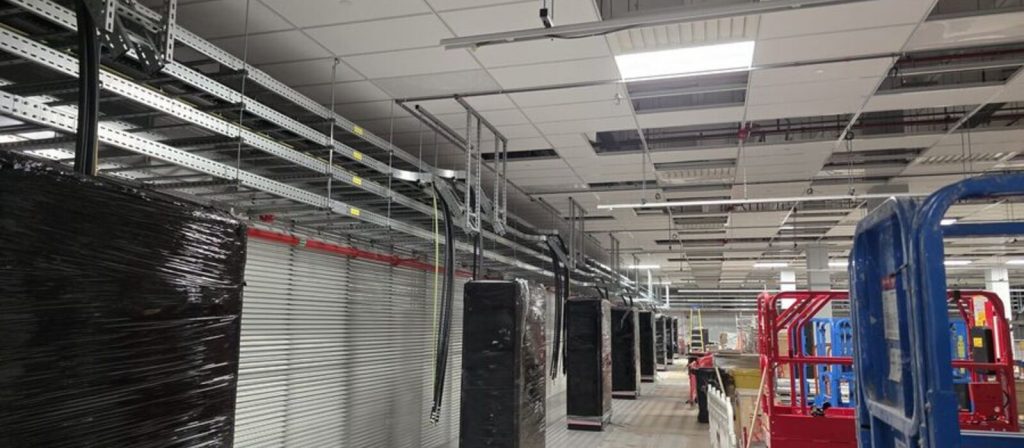
Spread over four levels from the basement to the second floor: 6 lift & shift mechanics set up 160 power distribution cabinets to the millimetre – ready for electrical connection
When a new data centre is fitted out, the moment comes when hundreds of cabinets weighing tonnes have to go exactly where they will stand for decades. That moment was our job.
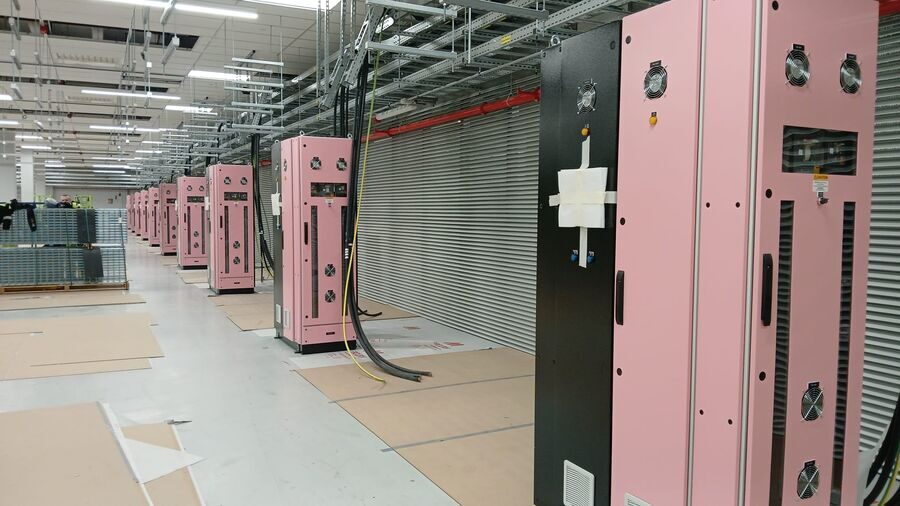
At a data centre in the Rhine-Main region we were entrusted with moving in and setting up all the PDCs (power distribution cabinets): 160 units spread across 8 data halls – each hall with 20 PDCs in two rows of 10 cabinets.
Our team handled the entire mechanical process: from transport into the building through distribution across four levels – basement, ground floor, first and second floor, the upper floors by heavy-duty lift – unpacking from the wooden crates, lifting off the pallets, right up to laser-measured positioning – aligned and prepared for the electrical connection work carried out afterwards by the electrical trade.
Project profile
Performance
- Moving 160 PDCs into the building and distributing them across four levels (basement, ground, first and second floor – by heavy-duty lift)
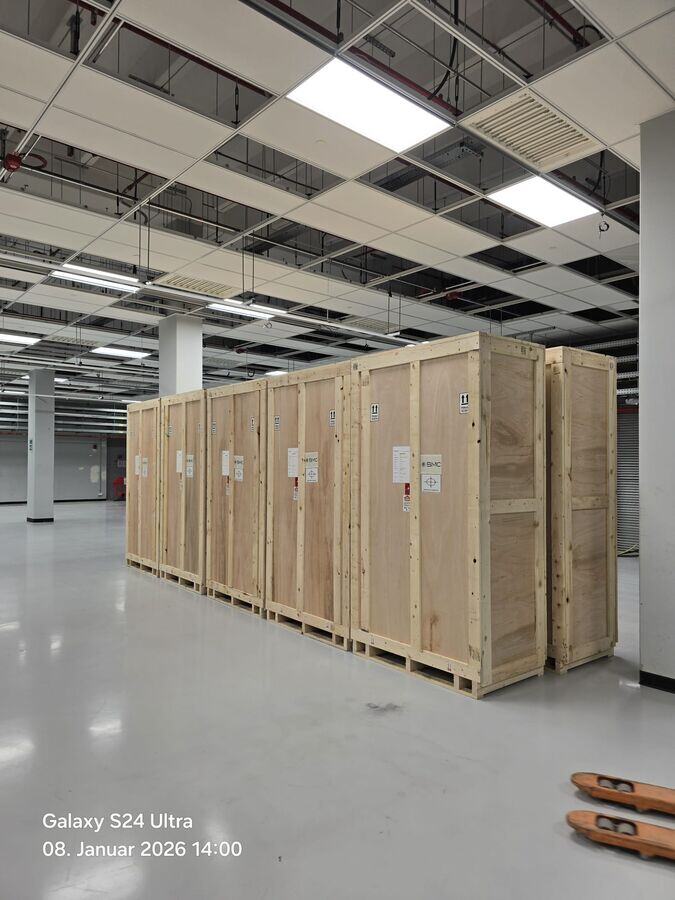
- Distribution and interim storage in the data halls (packed in wooden crates)
- Unpacking and preparation for the lift
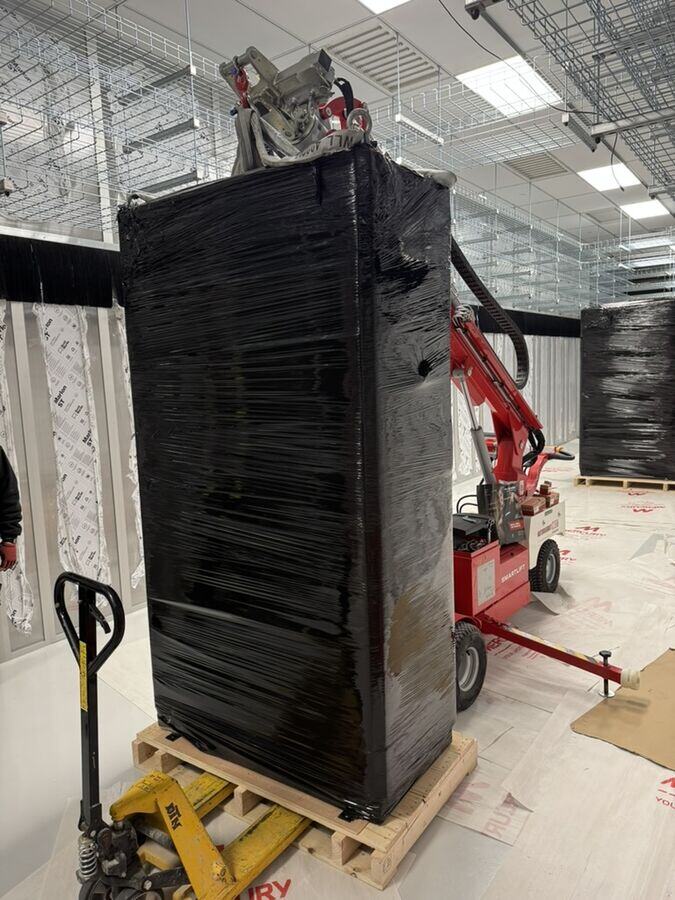
- Lifting off the pallets with a Smartlift and a lifting frame of aluminium truss
- Laser surveying of the complete halls
- Positioning and alignment to the millimetre at the set-down points
- Preparation for the electrical connection work (carried out by the electrical trade)
- Project scope
- 160 PDCs in total
- 8 data halls with 20 PDCs each (2 rows of 10 cabinets), spread over 4 levels: basement, ground floor, first and second floor (40 PDCs there)
- Team: 6 Lift-&-Shift-Mechaniker
- Project duration: several weeks on site
- Location: Data centre in the Rhine-Main region (operator confidential)
What is a PDC?
A PDC (power distribution cabinet) is a central power distribution unit in a data centre: it takes the power from the main distribution and feeds it in a controlled way to the server racks in the data hall. The cabinets are packed with switching and distribution equipment – correspondingly heavy and sensitive at the same time.
In modern data centres PDCs stand in long rows along the data halls, connected via cable trays in the ceiling. Their position is planned to the millimetre: every cabinet has to stand exactly under its cable drop and in line with its row.
For the installation that means the same precise sequence 160 times over – without fatigue or routine being allowed to cause mistakes.
How do you distribute 160 PDCs across four floors?
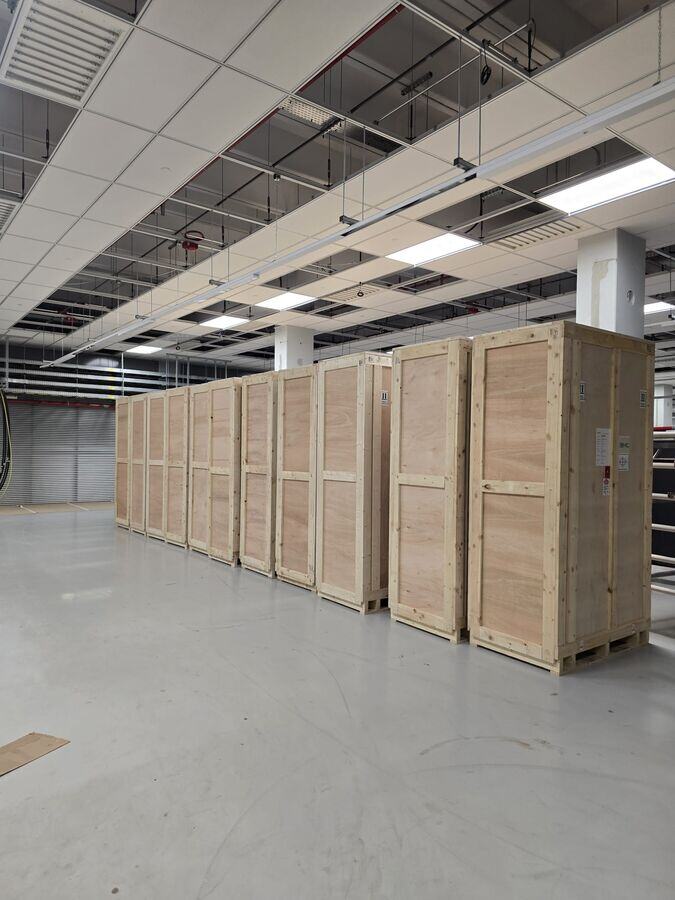
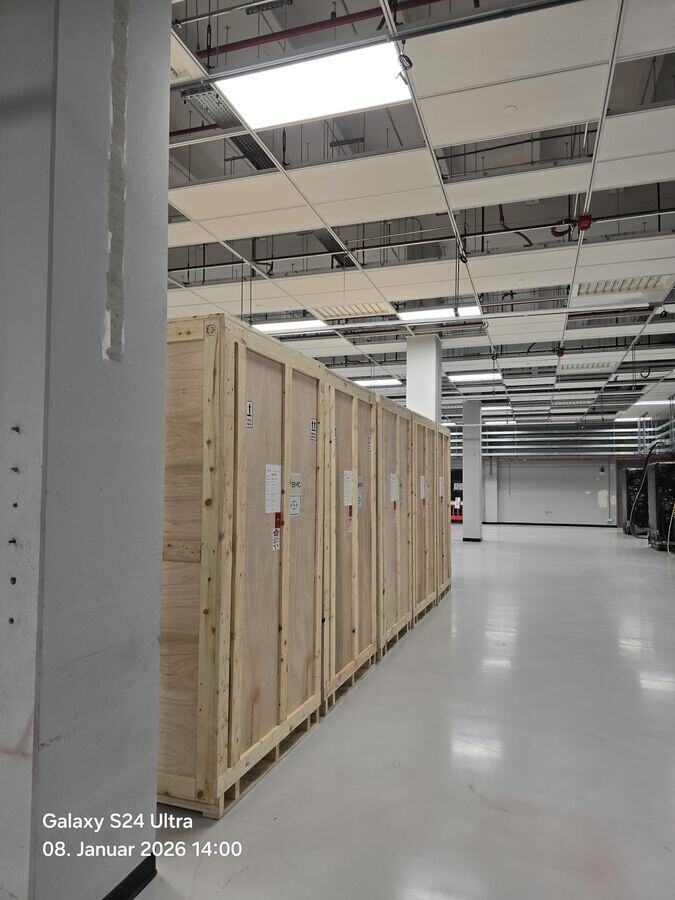
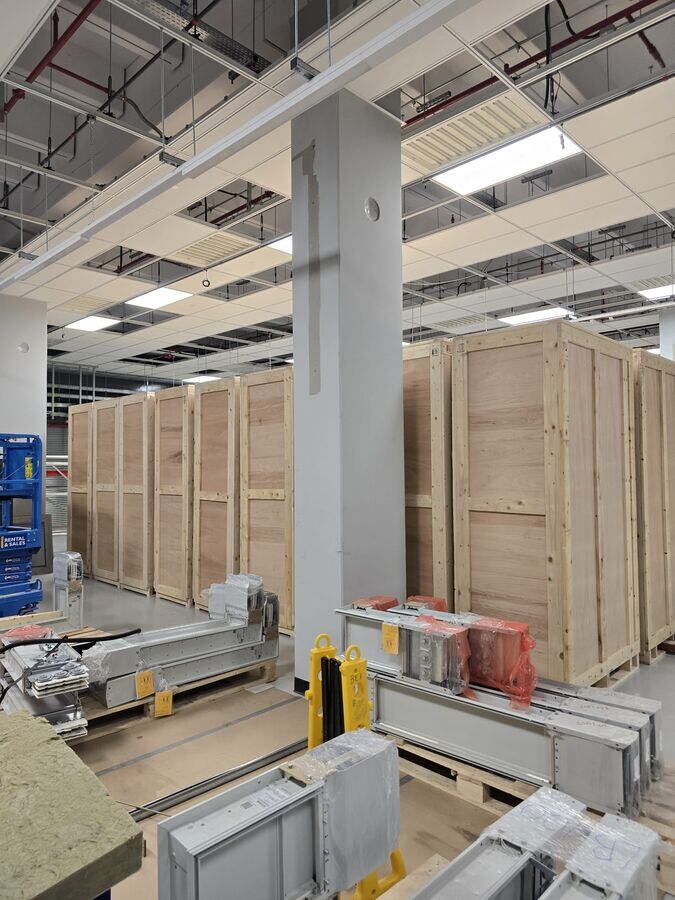
Level by level, cabinet by cabinet. The data halls are spread over four floors of the building: basement, ground floor, first and second floor – on the second floor alone there were 40 PDCs. After delivery, the PDCs packed in wooden crates were moved into the building, taken to their respective level by heavy-duty lift and set down in the data halls.
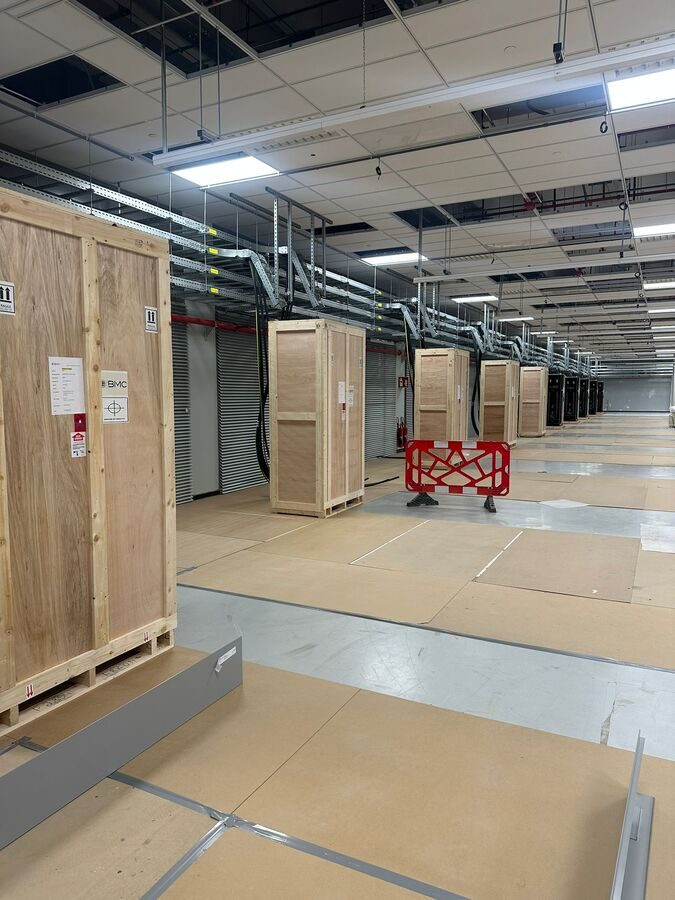
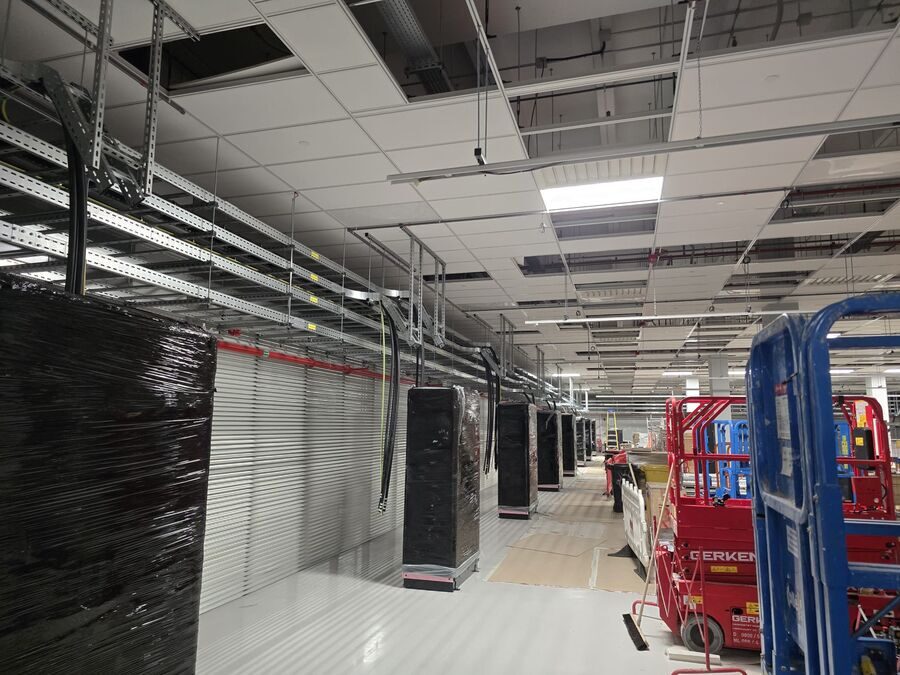
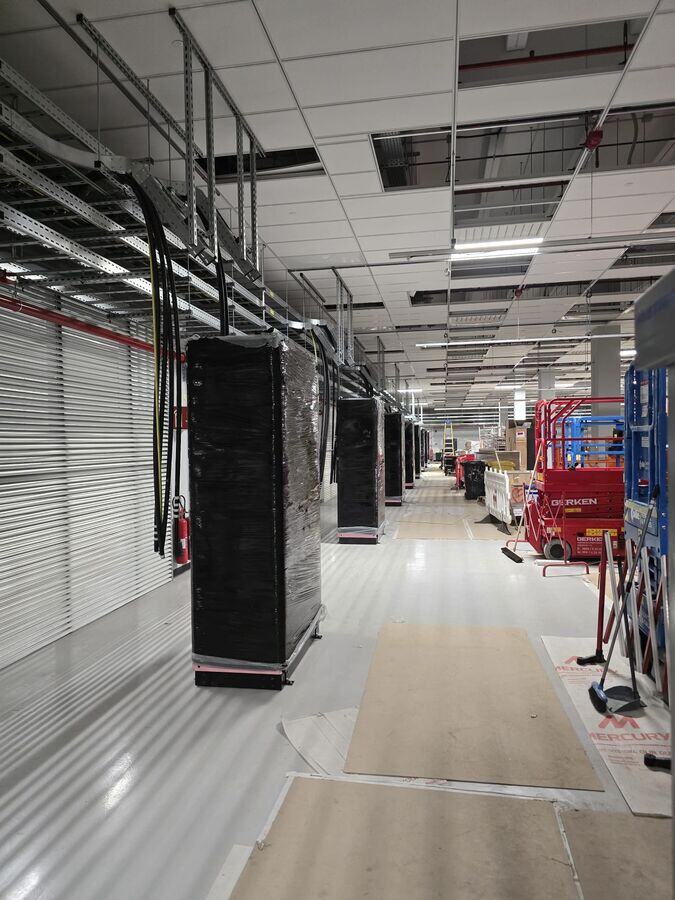
The photos show the scale of the project: whole rows of transport crates lined up in the halls, with the cable trays already prepared in the ceiling. The logistics – which crate goes to which level and which hall, and when – were a planning topic in their own right: with 160 cabinets, four floors, one heavy-duty lift as the bottleneck and a project running several weeks, the flow of material has to be sequenced just as carefully as the installation itself.
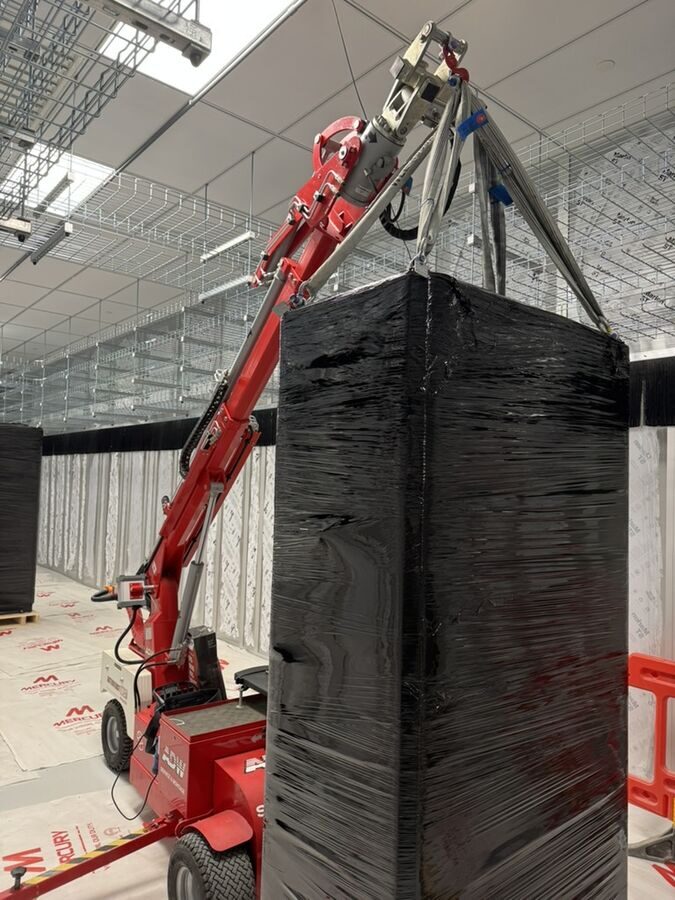
Unpacking and lifting: Smartlift and truss lifting frame
The first step in the build-up was to unpack the PDCs from their wooden crates and prepare everything so they could come off their pallets safely.
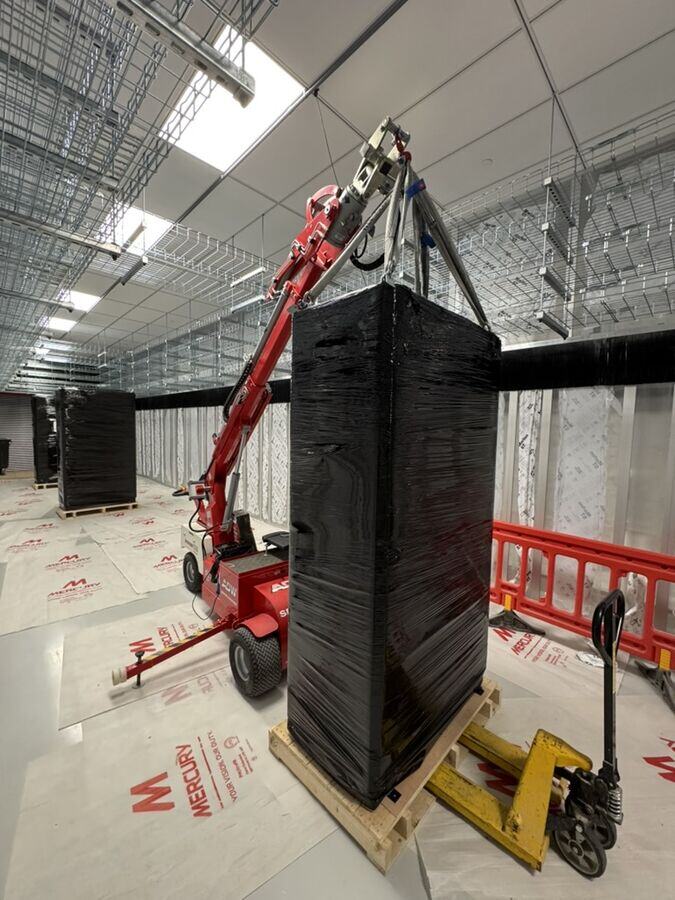
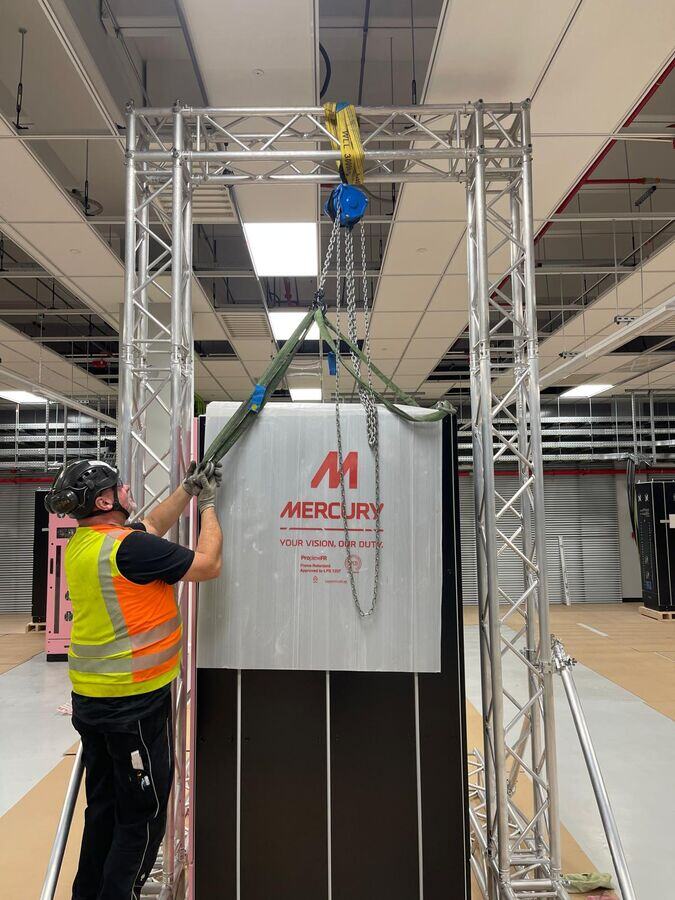
Two lifting methods were used: the Smartlift, which picks up and moves the packed cabinets in a controlled way – and a lifting frame of aluminium truss with a chain hoist, used to raise the PDCs off the pallet onto their own feet. The truss gantry is clearly visible in the photos: the cabinet hangs in round slings on the chain hoist, is raised, the pallet is taken away, and the PDC settles gently onto the hall floor.
This combination is ideal for data halls: compact, quiet, emission-free – and precise enough to move sensitive electrical equipment without vibration.
Laser surveying: millimetre work times 160
Before a single cabinet reached its final position, the entire hall was laser-surveyed. Based on that survey the set-down positions of all PDCs were marked precisely – the marking lines on the floor protection are clearly visible in the photos.
Each PDC was then placed at its position, aligned with its row and positioned exactly under its cable drop. With two rows of 10 cabinets per hall, any deviation shows up immediately – the alignment has to hold over the whole length of the row.
Only once position, alignment and levelling are right is the cabinet fixed and released to the next trade.
A clean interface: preparation for the electrical work
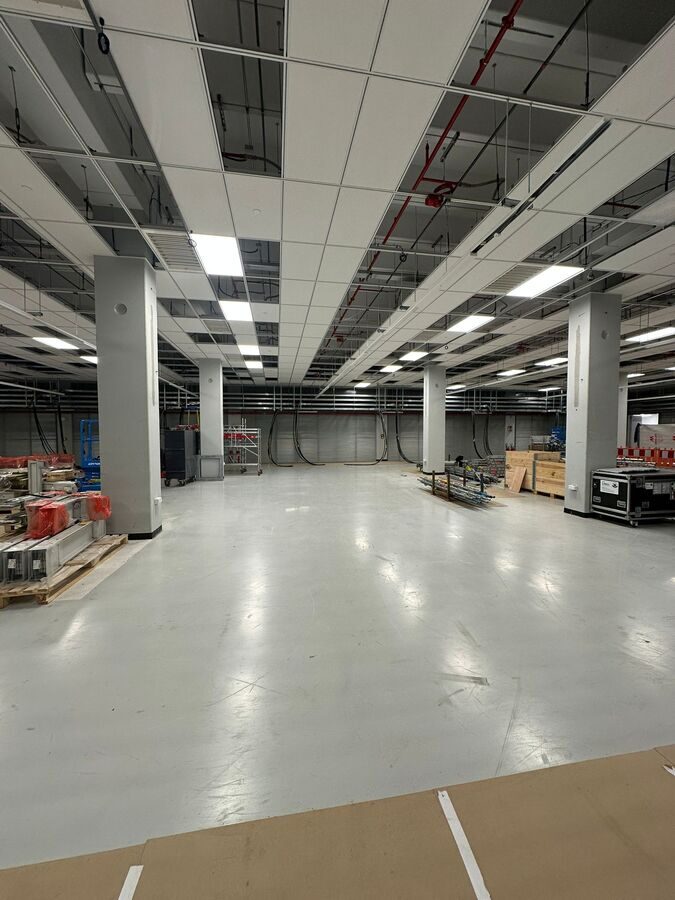
The electrical connection work was not part of our scope on this project – it was carried out afterwards by the electrical trade. That is exactly why a clean handover mattered: every PDC stood exactly at its surveyed position, aligned and ready for connection to the prepared cable trays.
This clear separation of trades is everyday practice in data centre construction – and it only works if every trade serves its interface precisely. A cabinet standing crooked or in the wrong place would immediately cause delays for the electrical team. With 160 cabinets there was exactly zero rework.
Protecting the finished data halls
As on all jobs in finished data centres the rule was: not a scratch on the floor or on existing equipment. All travel and working routes were laid with protective boards and fleece, and the hall walls were screened off.
All machine movements took place in a controlled way on the protected routes – over several weeks, in eight halls, without a single instance of damage.
Why Omega Mounting for data centre rollouts?
After CRAH units and load banks, this project is the next building block in our data centre experience – this time as a series rollout running several weeks:
- Moving in and setting up PDCs, CRAH units and technical plant
- Lift & shift with Smartlift and truss lifting frames
- Laser surveying and positioning to the millimetre
- Series installation at consistent quality – even over 160 repetitions
- Working to data centre safety requirements with complete surface protection
- Clean trade interfaces with the electrical work
Conclusion
160 PDCs, 8 data halls, 6 mechanics, several weeks – and at the end every cabinet stands to the millimetre at its surveyed position, ready for electrical connection.
This project shows a side of lift & shift that is often underestimated: precision in series. Setting one cabinet exactly is craftsmanship – setting 160 cabinets at consistent quality is process discipline. That is exactly what our teams bring to every data centre project.
Are you planning a rollout in your data centre?
Whether PDCs, CRAH units, load banks or racks: we handle moving in, setting up and positioning – to the millimetre, documented and handed over cleanly to the following trades. From Rodgau we are on site at the data centre locations in the Rhine-Main region – Frankfurt, Offenbach, Hanau – in next to no time.
Zur Stromversorgung eines Rechenzentrums gehört auch die Netzersatzanlage – wie sie ins Gebäude kommt, beschreiben wir unter Notstromgeneratoren einbringen im Datacenter.
Mehr zu unseren Einsätzen im Stadtgebiet, zu Anfahrt und Einsatzgebieten: Industriemontage in Frankfurt.
Talk to us – request a call-back appointment for your project now.
Photo gallery of the job

Are you planning a project of this kind?
Tell us briefly what it is about – we will come back to you with an honest assessment.
100% free and without obligation
Passende Ratgeber zu diesem Einsatz

Über den Autor
Tobias Schott
Geschäftsführer Omega Mounting GmbH, Rodgau · über 20 Jahre Praxis in Montage und Instandhaltung
Gelernter Mechatroniker und seit 2004 in Wartung, Instandhaltung und Industriemontage zu Hause – zuerst an der Seite seines Vaters, seit 2012 mit Omega Mounting: von der Elektrohängebahn in Frankfurt bis zur Krananlage im Hallenneubau. Plant und leitet als Lifting Appointed Person Hebearbeiten in Rechenzentren und auf Industriebaustellen im Rhein-Main-Gebiet, ist Ausbilder und Prüfer für Krane, Hubarbeitsbühnen und Teleskopmaschinen sowie Sicherheitsbeauftragter. Bei Einsätzen im Ausland kennt man ihn als „German Troubleshooter“ – der, den man ruft, wenn es auf der Baustelle klemmt. Was Qualität heißt, hat er nicht aus einem Handbuch, sondern von seinem Vater gelernt: Made in Germany als Anspruch an die eigene Arbeit, nicht als Etikett. Deshalb steht sie bei Omega Mounting an erster Stelle – vor Tempo und vor Preis. Das Auftragstagebuch zeigt die Einsätze, die sein Team geplant und umgesetzt hat – ohne Kundennamen, aber mit allem, was man daraus lernen kann.
Frequently asked questions
A PDC (power distribution cabinet) is a power distribution unit that takes the power from the main distribution and feeds it to the server racks in the data hall. PDCs stand in long rows in the data halls and are connected via cable trays in the ceiling.
By heavy-duty lift and lift & shift technology: the cabinets, packed in wooden crates, are moved into the building, taken to their respective level – on this project from the basement up to the second floor – and stored temporarily in the data halls. For installation they are unpacked and lifted off the pallet onto their feet with a Smartlift or a truss lifting frame.
On this project with a lifting frame of aluminium truss and a chain hoist: the cabinet is slung, raised, the pallet is taken away and the PDC is set down on the hall floor in a controlled way – free of vibration and without tilting, which is crucial with sensitive electrical equipment.
Because every PDC has to stand exactly under its cable drop and in line with its row. The laser survey transfers the planning data onto the hall floor; every set-down position is marked before the first cabinet is placed. That way the alignment holds even across rows of 10 cabinets.
Not on this project – the connection work was carried out by the electrical trade. Our task was the mechanical side: moving in, setting up, aligning and a clean handover to the electrical team. Depending on the project our mechatronics teams can also take on connection work.
Our company is based in Rodgau, in the middle of the Rhine-Main region – one of the largest data centre locations in Europe. Jobs in Frankfurt and the surrounding area are core business for us; we take on projects across Germany as well.
 English
  German