
- Data Center Services – Lifting & Rigging
Lifting & rigging in data centers: engineered lifts instead of risked loads
At Omega Mounting, a Lifting AP (Appointed Person) plans, checks and owns every critical lift in the data center (UK: data centre) – from the lifting tackle to the exclusion zone. That turns tandem lifts, confined routes and multi-ton loads into a controlled sequence.
Lifting operations with an Appointed Person (Lifting AP)
On international data center sites, lifting is not a hand movement but a documented process: lift plan, RAMS, permit, approval. We master that process from daily practice – not from a textbook.
Behind every lift stand our certified competence for lifting tackle and spreader beams, in-house trainers and examiners for cranes, access platforms and telehandlers – and the experience of 12 documented data center projects.
At a glance
- Lifting AP (Appointed Person) in-house
- Lift plans & RAMS in German and English
- Tandem lifts and heavy rigging
- Crane supervision, including third-party cranes
- Certified competence for lifting tackle & spreader beams
- In-house trainers & examiners for cranes and platforms
What to expect on this page
Click any topic to jump straight to that section:
What does a Lifting AP (Appointed Person) do?
A Lifting AP (Appointed Person) is the individual who plans, approves and owns all lifting operations on a project – from selecting the lifting equipment through the lift plan to releasing each individual lift. On the sites of international general contractors this role is mandatory for critical lifts.
The practical difference: a rigger attaches a load. A Lifting AP has decided beforehand whether this lift may happen this way at all – and carries the responsibility. With us, that competence is embedded in the team.
Our rules for every lift
Five figures from our EHS Standard 2026 apply to every lift we perform – regardless of how urgent the schedule is:
- Max. 80% of rated capacity – reserves are not a luxury but an obligation.
- Wind limit 10 m/s – above that, nothing gets lifted.
- Exclusion zone: load area + 5 m – consistently enforced.
- Trial lift of 10 cm – check first, then lift.
- 0 people under the load – no exceptions.
When it gets tight: confined routes, shafts, existing buildings
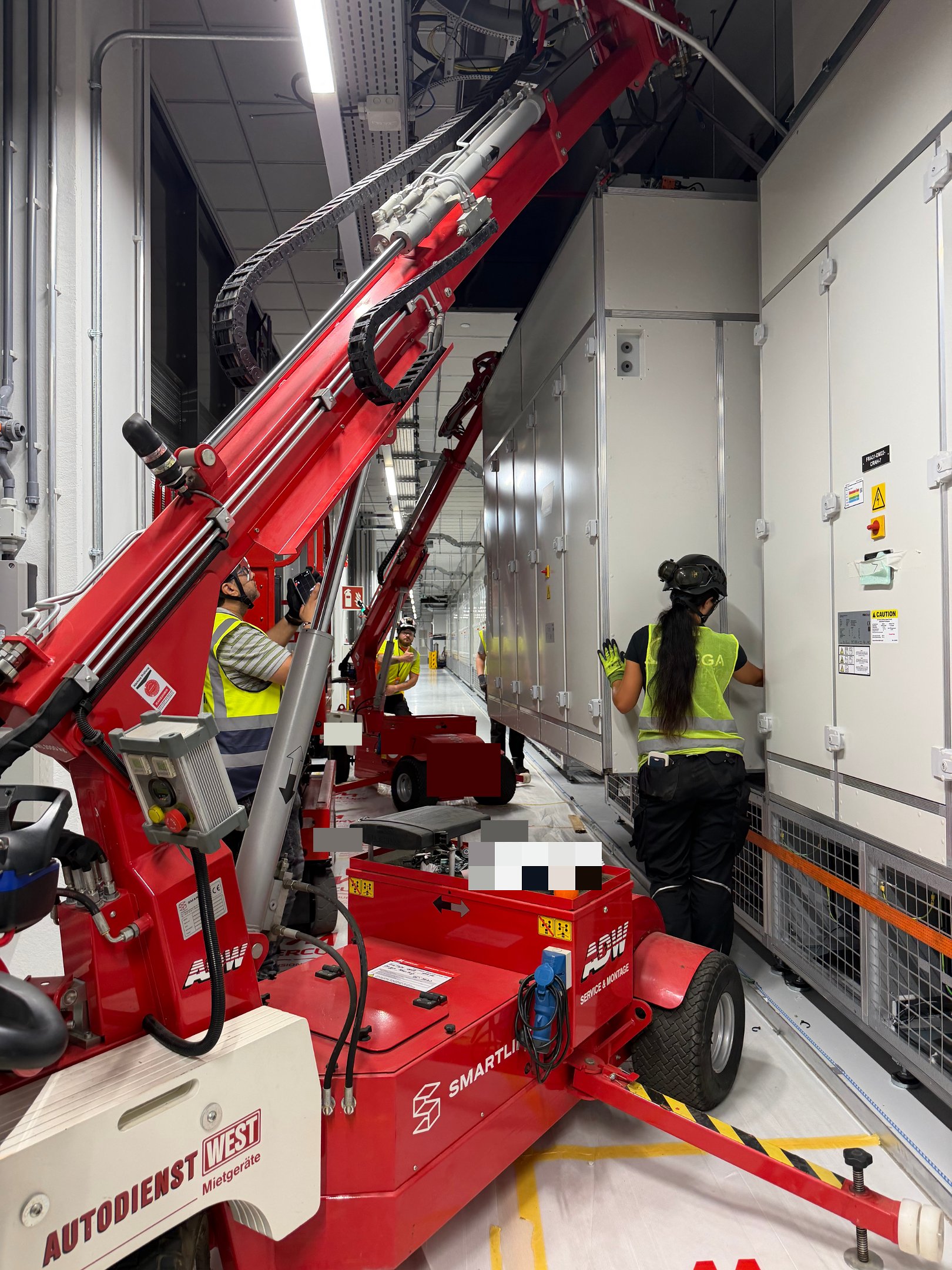
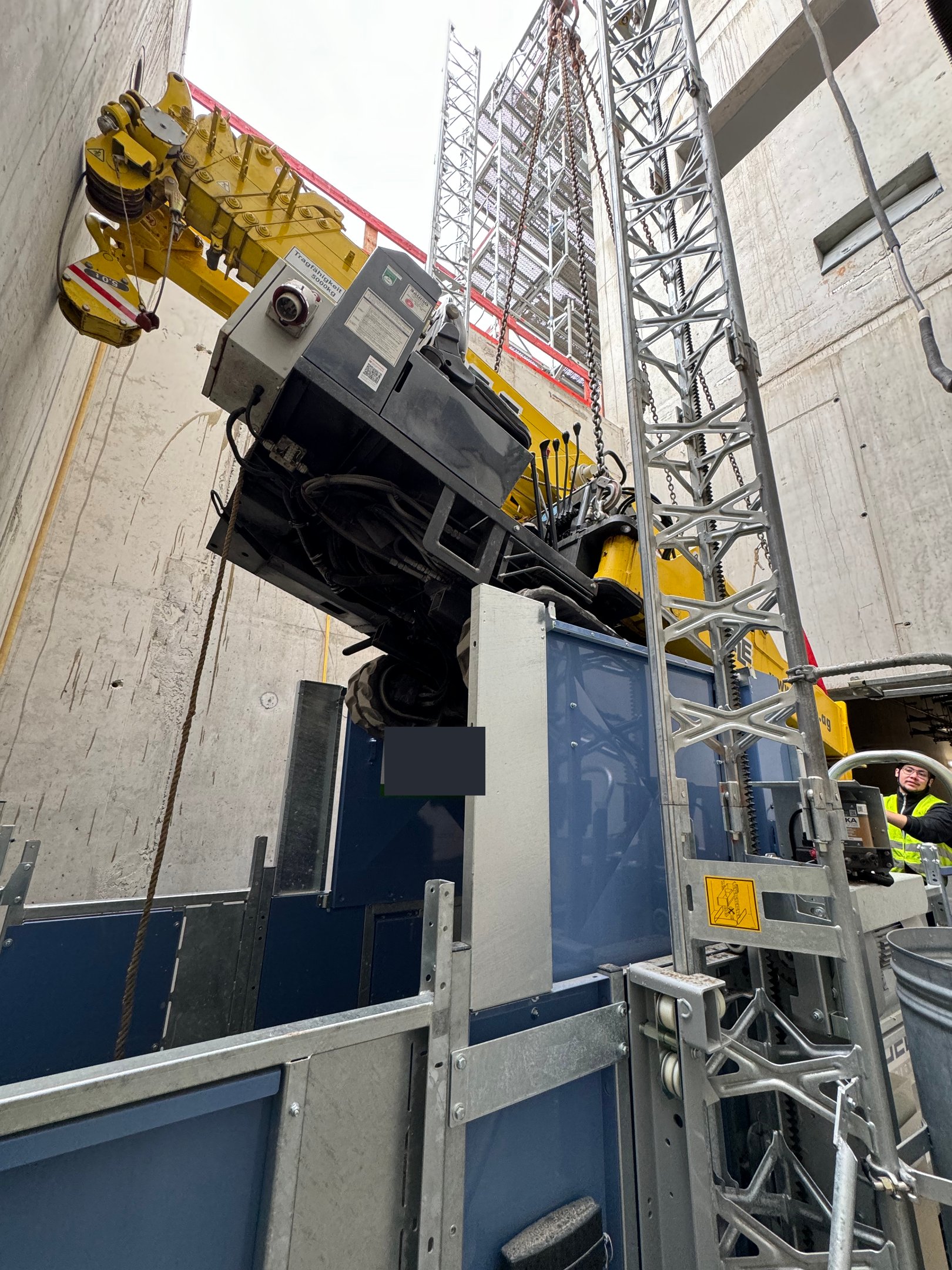
The hardest lifts in a data center are rarely the heaviest – they are the tight ones: the spider crane that has to come out through a basement shaft with a construction hoist standing in it. The CRAH unit that must travel a technical corridor with finished equipment left and right.
One example from our project diary: during a crane extraction from a data center basement we had measured correctly – and still two centimeters were missing. The solution was an inclined hitch on an adjustable chain, planned rather than improvised. That is precisely what lift plans are for.
Why lifting in data centers is a discipline of its own
A lift inside a data center differs fundamentally from a lift on a greenfield site. The loads are not just heavy but sensitive: an impact a steel beam would shrug off can cause damage inside a cooling unit or switchgear that only shows up during testing. The environment is tight, built-up and often live – above, below or beside the lift run systems whose downtime costs a multiple of the installation contract.
Add the market’s framework: fixed delivery windows, crane slots shared with other trades, neighborhoods that demand consideration – like our series installation in a residential area, where time windows, barriers and swift lifts were part of the plan. Working here without structured lift engineering risks not just the load, but the entire project schedule.
Our answer is the strict separation of planning and execution: first the lift plan, checked and approved by the Lifting AP – then the lift. That order sounds obvious. On schedule-driven sites, it is not. With us, it is non-negotiable.
The lift plan in detail: what goes in it – and why
A lift plan is more than a sketch with a crane hook. Ours contain the load data including centre of gravity and lifting points, the selected equipment with utilization evidence, the tackle with inspection status, standing areas and floor loads – particularly critical in data centers, where raised floors and slabs have defined limits – the exclusion zones, weather and abort criteria, and the sequence step by step with responsibilities.
Why the effort? Because each of those items is a documented thinking process that finds mistakes before the lift instead of after: the floor load nobody calculated, the sling unsuited to the edge, the escape route running through the exclusion zone – all of it surfaces in the plan while it still costs nothing.
For general contractors the lift plan has a second value: it is the shared language between our teams, your site management and your EHS organisation. Approved, distributed, available on site – everyone involved knows before the first lift what will happen. On request we produce lift plans in German and English, compatible with the templates of the major GCs.
Equipment to match the task: from 220-ton crane to electric mini crane
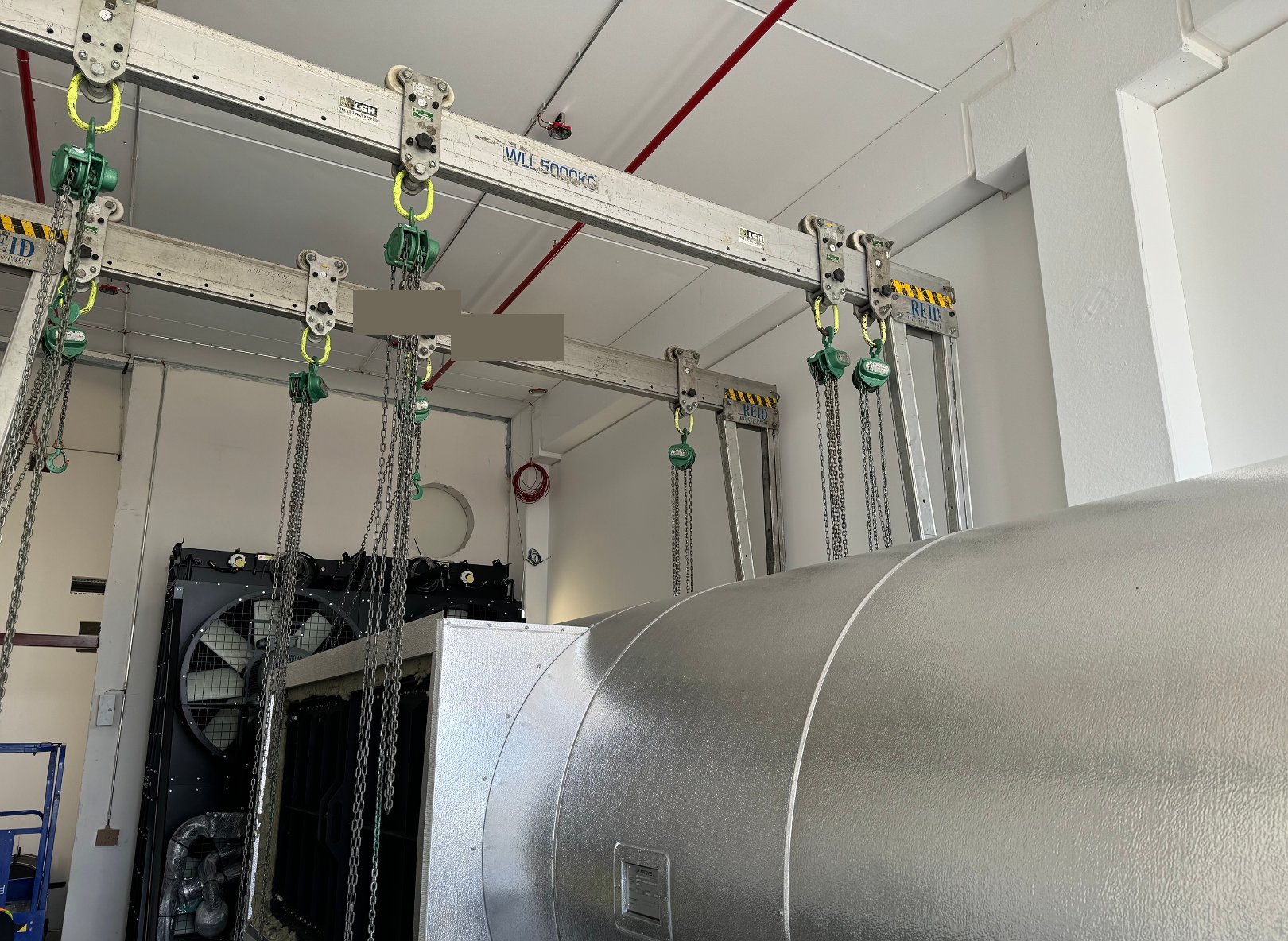
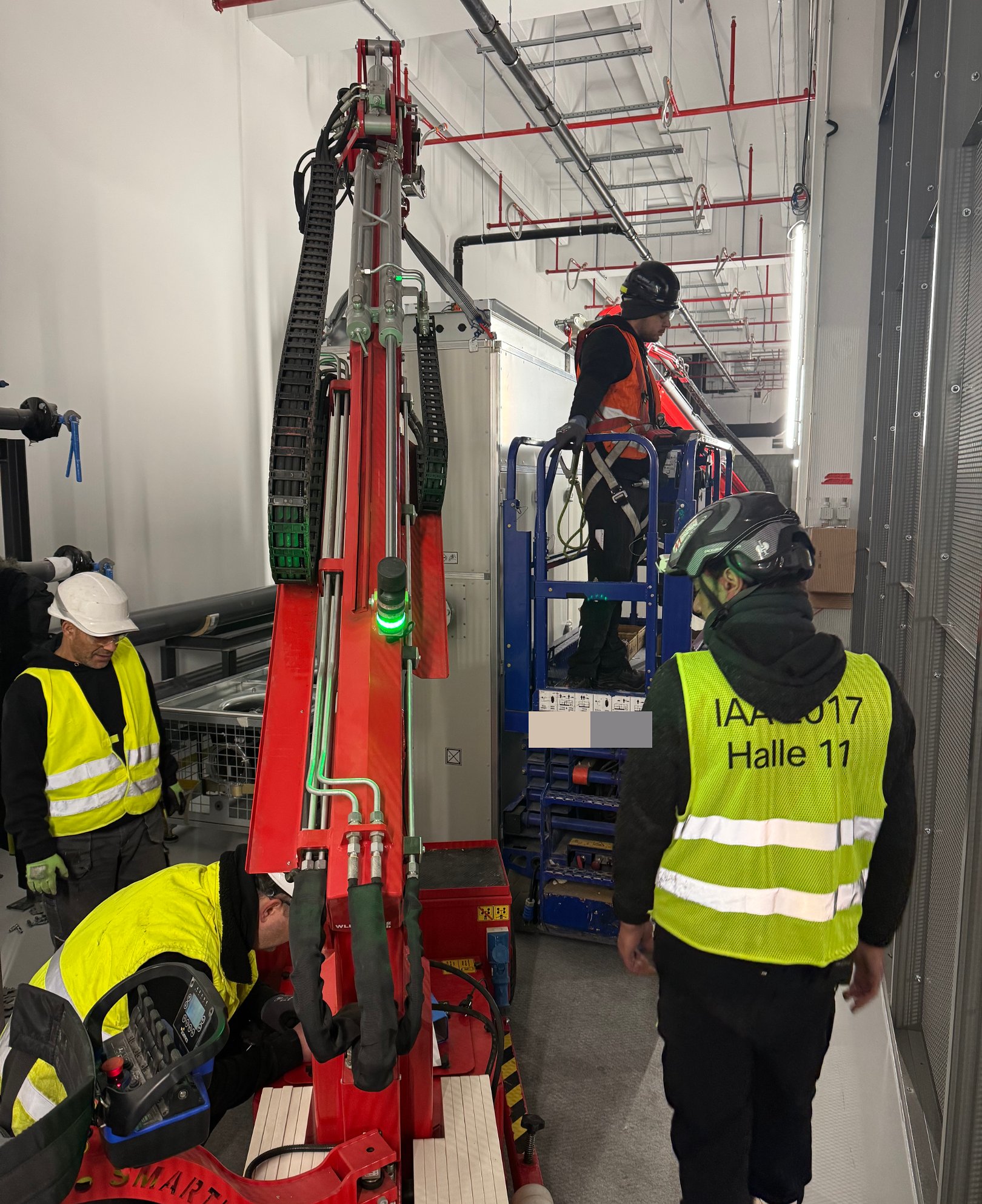
Our documented projects show the range: 220-ton-class mobile cranes for load banks and generators, spider cranes for basements and confined routes, mobile gantry cranes with four chain hoists for tandem lifts on SCR systems, electric mini cranes for technical corridors – plus machine skates, heavy-load dollies, spreader beams and load-spreading plates for sensitive floors.
What matters is not what sits in the yard but what the task demands. An electric mini crane wins indoors: emission-free, quiet, agile. A gantry crane wins where no crane can reach from outside. And sometimes the simplest solution wins: during a crane extraction from a data center basement, timber cribbing under the construction hoist solved a problem every high-tech option would have failed at.
We make that selection early and with reasons – in the lift plan, not on the fly. For you as the client this means: no surprises in equipment cost, no waiting for the wrong machine, and a lift that runs exactly as discussed.
Tandem lifts and special cases: when one crane is not enough
Some loads cannot hang from a single hook: too long, too unstable, too awkward in their centre of gravity. Then the lift goes tandem – two cranes or hoists, one load, one precisely synchronized sequence. In 2026 we carried lead responsibility for a mega tandem lift for a leading general contractor in the Frankfurt area; in series work we routinely lift SCR systems on two gantry cranes with four chain hoists.
Tandem lifts forgive no ambiguity. Our rules: one command, one language, defined signals, radio discipline – and a Lifting AP who directs the lift rather than merely observing it. Every winch and every chain hoist has a named operator; the load path is planned in stages with hold points where checks happen before the lift continues.
Special cases also include inclined hitches on adjustable chains – documented at an extraction where two centimeters were missing despite correct measurement – mid-air rotations, and lifts above live equipment. All of it is feasible. But only planned.
Rigging documentation: provably safe
Every piece of lifting tackle we use has a history: inspection date, inspector, condition, limits of use. Our certified competence for lifting tackle and spreader beams ensures chains, slings and beams are not merely present but suited to the specific load – including the details that separate professionals from occasional users: chains instead of round slings on sharp edges, timber spreaders against geometry change, four-leg hitches with correctly calculated leg loads.
After the lift comes the record: photo documentation of the hitch points, deviation reports where something differed from plan, and a clean handover to the next trade. These records go to the client – audit-proof, in English on request, compatible with the documentation requirements of international projects.
The effect for you: when an auditor, an insurer or your own customer asks how this machine got to its place, the answer is a signed document – not a memory.
From rigger to Appointed Person: why GCs trust us
Our lifting competence was not bought – it was earned. The path led across years of international data center sites: from rigger to lifting supervisor and finally to Appointed Person, planning and owning all lifting operations of a project. You do not get that role through a certificate alone but through proven practice under the eyes of demanding general contractors.
Today we pass that knowledge on internally: with our own trainers and examiners for cranes, access platforms and telehandlers we qualify our operators ourselves – to the same standards we were measured against. The next generation of riggers and supervisors grows in-house instead of being hunted on the market.
For new clients this is a double promise: you get experienced lifting professionals today – and the certainty that this competence will still be available tomorrow when your project enters its next phase.
Wind, weather, night work: lifting under real conditions
Lift plans are written at a desk – lifts happen outside. Every plan therefore contains defined abort criteria: above 10 m/s of wind, nothing gets lifted, no debate. Rain, icing and darkness change tackle, visibility and communication – and with them the plan. Underrated but essential: the courage to abort in a controlled way is one of a Lifting AP’s most important skills.
At the same time, night and weekend lifts are routine in the data center world, because crane slots, road closures and operating windows demand them. We plan such jobs with adapted lighting, extended set-up times and communication discipline – radio instead of shouting, defined signals instead of interpretation.
A documented example of consideration as a planning parameter: the series delivery in a residential area where time windows, barrier concept and swift lifts were scheduled so that neighbours and the hotel next door could live with us. Professionalism is also measured by how quiet it is.
Checklist: what we want to know before every lift
When you inquire about a lift, we work through a fixed list of questions – here is an excerpt so you know what to expect:
- The load: weight (weighed or per nameplate?), dimensions, centre of gravity, defined lifting points, sensitivities such as maximum tilt or shock limits.
- The route: delivery, crane position, rigging openings with dimensions, floor capacity along every meter, obstacles above and beside the load path.
- The environment: live operation yes/no, exclusion-zone options, other trades in the area, access and approval procedures.
- The frame: time window, contact with decision authority, required documentation, language of the paperwork.
Got a load that needs to move?
Send us the key data – weight, dimensions, route. The Lifting AP will come back to you with an honest assessment of whether and how the lift can be done safely.
100 % non-binding & free of charge · Direct line: +49 6106 239 25 88
Frequently asked questions
A lift plan is the documented planning of a lift: load data, crane or hoist selection, lifting gear, centre of gravity, standing areas, exclusion zones and sequence. On data center sites it is mandatory for critical lifts – with us it is prepared and approved by the Lifting AP (Appointed Person).
RAMS stands for Risk Assessment and Method Statement – the combination of risk assessment and work method description that international general contractors require before work starts. We prepare RAMS in English and German and work with them every day.
As soon as a lift is critical – tandem lifts, tight spaces, high utilisation or loads above areas where people work – general contractors require an Appointed Person who plans and is responsible for the lifting operation. At Omega Mounting the Lifting AP is a permanent part of the team, not bought in.
Yes. Tandem lifts – one load on two cranes or hoists – are part of our daily work, for example long SCR systems on two gantry cranes with four chain hoists. In 2026 we were also responsible for a mega tandem lift for a leading general contractor in the Frankfurt area.
Yes. When the tower crane or mobile crane is provided by the site, we take over supervision: we plan the lift, brief the team, coordinate the banksmen and are responsible for the sequence – the crane operator drives, we lead.
Yes. If your project needs an Appointed Person or approved lift plans but the executing company cannot provide them, we take over planning, approval and supervision as a stand-alone service – in English and German, compatible with the templates of international general contractors.
Ideally load data with weight and centre of gravity, dimensions, lifting points according to the manufacturer, floor plans with the rigging route, and information on floor loading and surroundings. If something is missing, we determine it during a site survey – we do not estimate.
The planning itself is fast – the limiting factors are usually crane slots, delivery windows and approvals on site. In the Rhine-Main region we often carry out well-prepared lifts within a few days; in an emergency our 24/7 on-call service applies.
Then the fallback level defined in the lift plan applies: set the load down or secure it in a controlled manner, assess the situation, adapt the plan, re-approve. We do not improvise – not even under schedule pressure. Every deviation is documented and feeds into future planning.
Yes, as part of the operational coordination: we agree crane standing areas, permits and closures with the crane partner and the authorities and schedule them into the lift plan – one less item for you to take care of.