
- Data Center Services – Installation & White Space
White space installation: CRAH units, fan walls and steelwork on takt
We install the cooling and air-handling equipment inside data centers – from a single CRAH replacement in live operation to the series installation of 320 units across every floor of a new build. Plus steelwork, support systems and custom fabrications from our own workshop in Rodgau.
Cooling installation from a single unit to full series
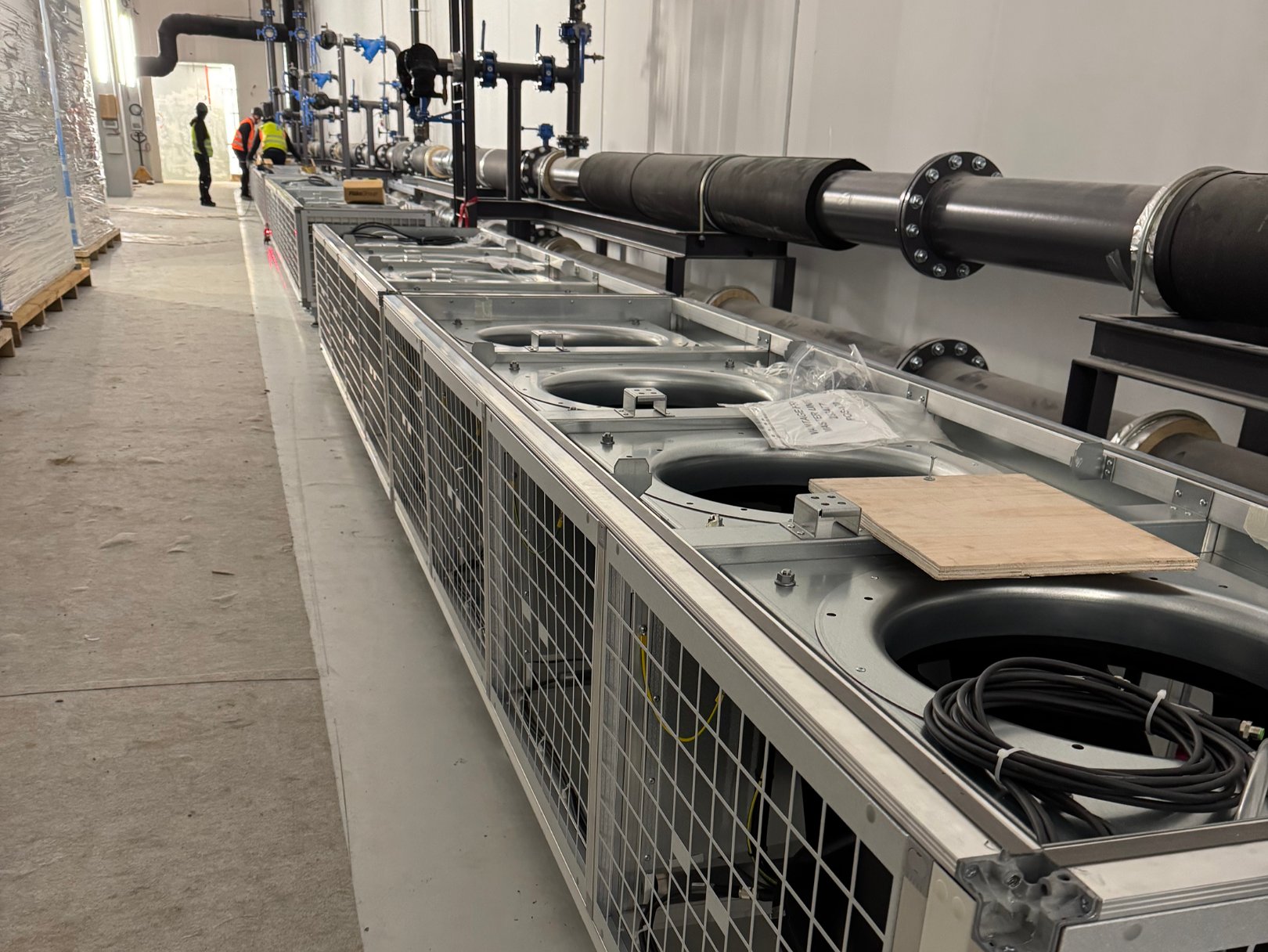
Series installation is a discipline of its own: the 80th lift has to sit as cleanly as the first. That takes takt, defined handover points and measurement across the whole row – such as line-laser alignment along the full length of the fan bases.
What is not available off the shelf, we build ourselves: our Rodgau workshop fabricates substructures, adapters and special parts – short-notice and precisely fitted to the site.
At a glance
- CRAH/CRAC installation and fan walls
- Series installation on takt – documented up to 320 units in one building
- Air handling and mechanical support systems
- Steelwork & custom fabrication from our own workshop
- Work in existing and live environments
- Rigging across all floors – planned and documented
What to expect on this page
Click any topic to jump straight to that section:

What is a fan wall?
A fan wall is a continuous cooling wall made of individual CRAH modules standing edge to edge on fan bases and mechanically joined into one wall. It replaces many single units with one shared air front – more efficient, easier to maintain, scalable.
Installation decides performance: if the modules are not exactly in line and level, the wall does not close tightly – and the system loses efficiency. That is why we align the fan bases with a line laser across the entire row before the first unit is set.
Series installation: the 80th lift as clean as the first
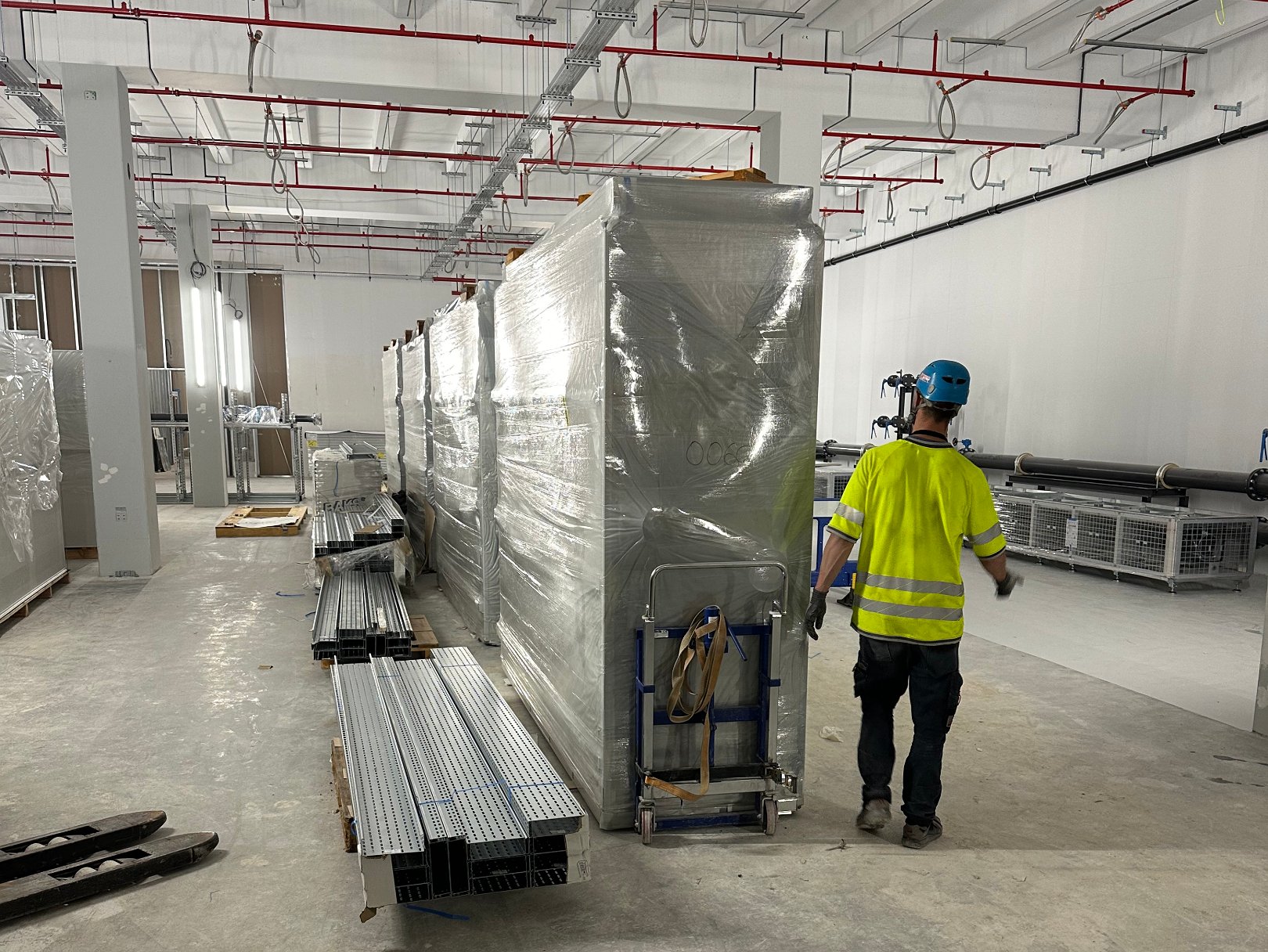
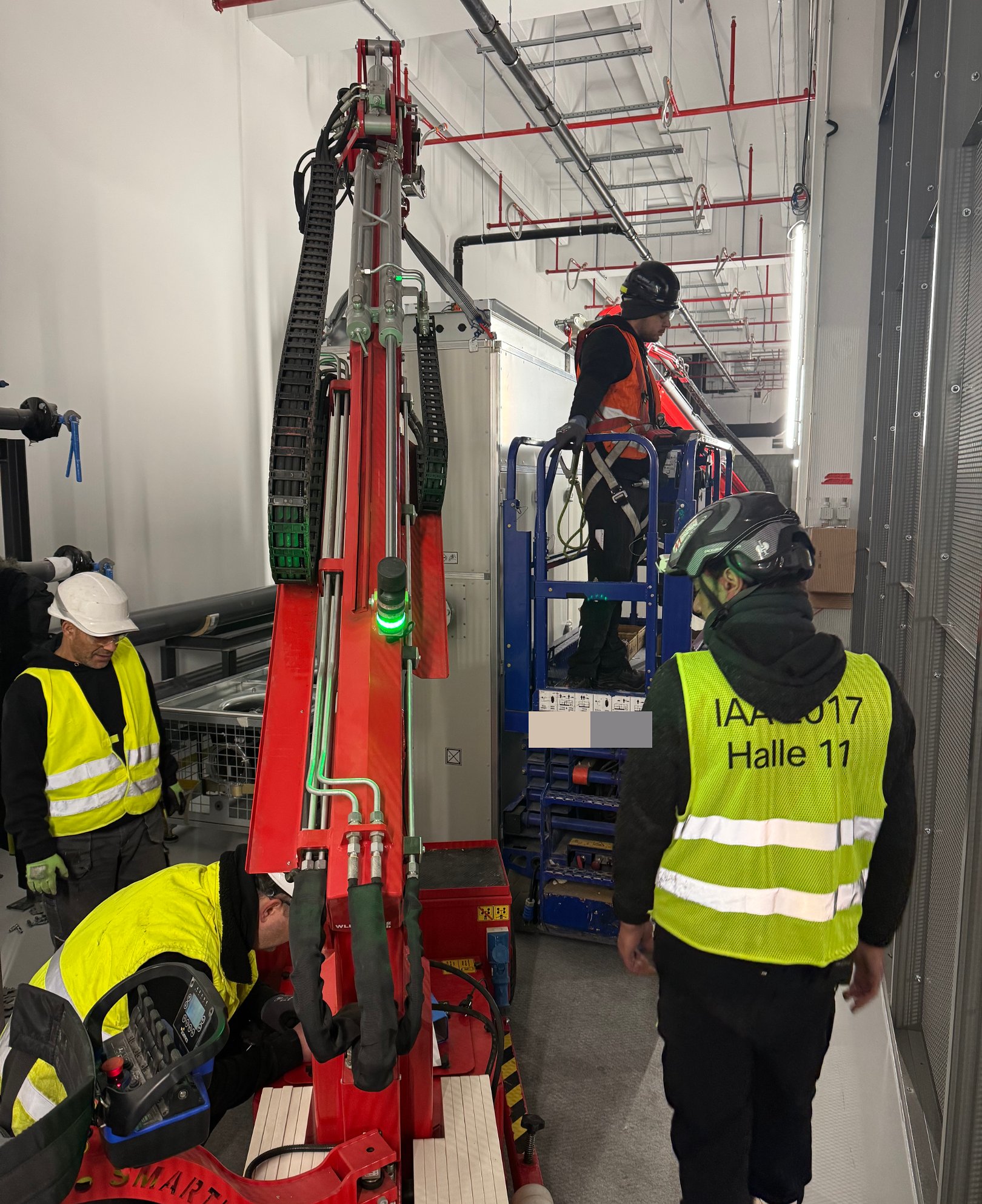
In Raunheim we installed all 320 CRAH units of a data center across every floor – documented in a three-part series in our project diary. In the basement alone: 80 units, set on takt with spider crane and spreader beam.
Series installation means fixed sequences, fixed roles, fixed quality gates. Every unit is hitched, lifted and aligned the same way – routine as a quality feature, not a risk.
Rigging across all floors
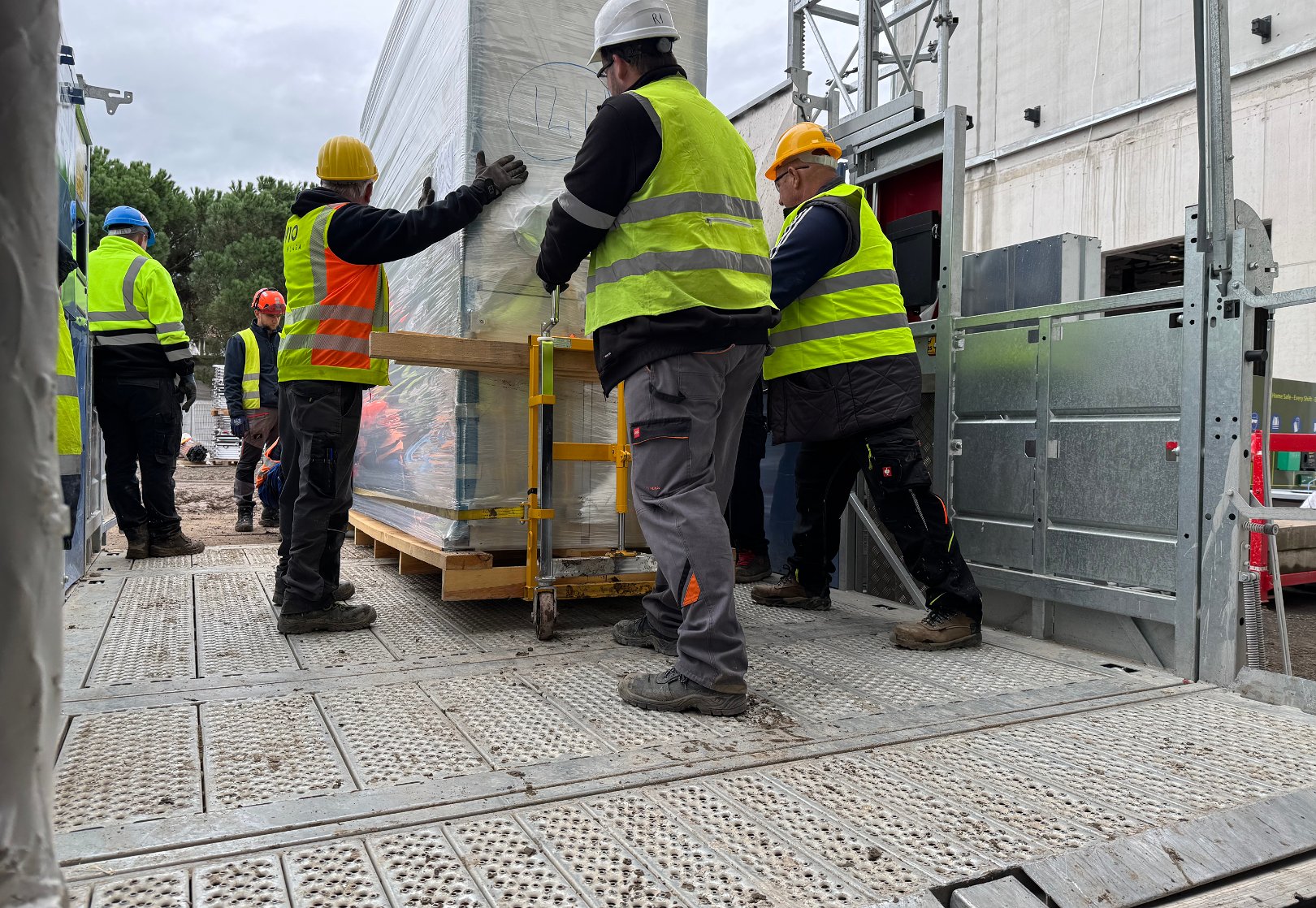
The route is half the installation: truck, telehandler or crane, loading platform at the hoist, floor level, electric mini crane, fan base. Every handover point in this chain is planned, every pinch point measured beforehand.
Inside the building we work with emission-free electric lifting gear and complete floor protection – even a shell-phase site is no excuse for scratches in the screed.
Steelwork & custom fabrication from Rodgau
Fan bases, elevation frames, adapter structures, impact protection: much of the white space is made-to-measure. Our workshop in Rodgau – with welding, turning and milling capacity – fabricates custom parts at short notice and delivers them to the Frankfurt sites twenty minutes later.
So even surprises stay plannable: when a detail does not fit on site, it gets fabricated – not improvised.
Precision as a system property: why millimetres decide efficiency
Cooling is, next to power, the biggest operating-cost block of a data center. Every leak in a cooling wall, every gap between two modules, every unit out of line lets air flow where it cannot work – and the fans compensate with speed and electricity. Installation quality is not an aesthetic question; it is an operating-cost question over the system’s whole life.
Every row we install therefore starts with measurement: fan bases aligned in line and level with a line laser across the full row length before the first unit is set. Tolerances are not passed from module to module until they pile up at the end of the row – they are eliminated at the start.
The result is tangible: connectors that close without force. Gaskets that carry along their full length. A wall whose 80th module looks like its first. Our photo documentation records exactly that – not as advertising, but as evidence.
Cleanliness in the white space: floor protection, dust discipline, electric equipment
Different rules apply in the white space than in a shell build: the raised floor carries defined loads and forgives no point loading, dust is the natural enemy of every server room, and combustion engines have no place inside the building. Installing here takes more than tools – it takes discipline.
Our standards are simple and consistent: complete floor protection on all transport routes, load spreading under every machine and roller, emission-free electric lifting equipment indoors, clean cutting stations with extraction, daily housekeeping as duty rather than choice. A documented CRAH replacement in a live gallery shows it in detail – down to the careful floor protection before the first machine movement.
For operators this pays twice: the facility stays clean – and approval processes get easier, because your facility team knows our crews do not just sign the house rules but live them.
Organizing series installation: takt, roles, quality gates
You do not install 320 units across a building on enthusiasm – you do it with a system built on three parts. First, the takt: every unit passes the same stations – delivery, transport, lift, alignment, fixing, check – in the same order with the same motions. Second, the roles: everyone on the team owns a defined task in the takt; handover points are agreements, not shouts. Third, the quality gates: checks and documentation happen after defined steps, not at the end of the row.
This approach makes performance plannable: the daily count shows everyone involved – including your project controller – whether the job is on schedule. Deviations surface within hours, not weeks. And because every motion is standardized, speed scales without quality drifting: the 80th lift sits as cleanly as the first – with us a documented project outcome, not a slogan.
For manufacturers and general contractors this capability is hard cash: series installation on takt means reliable milestones, calculable follow-on trades and an acceptance process without punch lists.
More than cooling: PDCs, support systems, custom steelwork
The white space is more than cooling equipment. Our documented projects include rigging and installing 160 power distribution cabinets in a Rhine-Main data center – series logistics on takt, cabinet by cabinet into position. Add mechanical support systems, elevation structures, platforms and frames on which equipment stands safely and stays maintainable.
What the market does not supply, we fabricate: our Rodgau workshop builds substructures, adapter frames and custom parts to measure – welded, drilled, coated and delivered just in time. A documented SCR series installation got its complete elevation structure this way; other projects their impact protection, spacer plates and brackets found in no catalogue.
This combination – series installation plus in-house fabrication – solves the classic site problem of “doesn’t fit”: instead of waiting weeks for a spare part, the right part is made today and installed tomorrow.
Working in live environments: next to production IT
Not every project is a new build. Just as often the job is swapping a failed unit in a live gallery, retrofitting a cooling row in operation, or extending an existing room – work where a few meters away production systems run whose downtime costs a multiple of the contract value.
We have fixed rules for this: segregated and marked work areas, approval windows agreed with the operator, quiet and emission-free methods, dust protection at every interface – and the ground rule that nothing on an active system is touched without written release. Our documented CRAH replacement in live operation shows the sequence from delivery to handover.
What operators value most in these jobs is predictability: a fixed sequence plan, a named person in charge on site, and the certainty that our team will stop and ask when in doubt – instead of pushing on and hoping.
From shell to handover: our role in the construction flow
We are most valuable when involved early. In the planning phase we verify rigging routes, shaft dimensions, floor loads and time windows – experience from dozens of rigging jobs that costs little on paper and saves weeks on site. A documented counter-example: a spider crane brought in during the shell phase, around which the building literally grew shut – its extraction months later became an engineering task of its own.
During construction we slot into the overall flow: delivery windows with site logistics, crane slots with the other trades, installation progress with the follow-on piping and electrical trades. Our principle at every interface: hand over actively instead of waiting passively – with photos, protocols and a short conversation that prevents misunderstandings.
At handover we deliver what acceptance and operations need: installation records, inspection evidence, photo documentation and an honest open-points list. That turns an installation into a completed trade – and a first order, more often than not, into the start of a long relationship.
Fire suppression infrastructure: 240 cylinders, one concept
The white space includes the system that saves it in an emergency: the gas suppression system. In a Frankfurt-area data center we erected the complete suppression center mechanically – 240 nitrogen cylinders positioned in rows, fixed and connected, as installation partner of the fire protection specialist.
Such projects show a pattern manufacturers and specialist firms appreciate: we do not intrude on their system responsibility; we deliver the precise mechanical execution beneath it – placement, fixing, piping preparation – to their specification and with our documentation. The specialist keeps authority over its system; we provide the installation quality it builds on.
This installation-partner model works wherever specialist firms have strong products but scarce installation capacity – from fire protection through exhaust technology to HVAC. If you are a manufacturer or specialist firm: this model was built for you.
Working with facility and operations teams
A system’s real life begins after handover – and with it the collaboration with the people who run it. We do not hand over into a void: on request we brief facility teams on the mechanical particulars of the installed systems, document maintenance points and access, and remain available when the first operational question comes up.
Our installations profit from operator knowledge in return: the people who will maintain a system know where the wrench needs space and which access routes are actually used. We collect that perspective early – an hour with the operations team before installation saves years of irritation after.
This is how an installation contract often becomes the entry into long-term support: whoever built a system is its best maintainer. Our page Maintenance & 24/7 describes how that transition works.
CRAH units, a fan wall or steelwork to install?
Single swap or series installation: send us quantities, floors and time windows – we will come back with a concrete installation concept.
100 % non-binding & free of charge · Direct line: +49 6106 239 25 88
Frequently asked questions
The white space is the area where the IT sits: server rooms and the associated technical areas. Everything installed here – cooling equipment, support systems, containment – works directly on the availability of the data center. The requirements for cleanliness, precision and documentation are correspondingly high.
Both cool the white space: a CRAC unit (Computer Room Air Conditioner) has its own refrigeration circuit, a CRAH unit (Computer Room Air Handler) works with centrally produced chilled water and fans. Modern data centers often rely on CRAH units that are joined into continuous fan walls.
A fan wall is a cooling wall made of individual CRAH modules that are mounted edge to edge on fan bases and joined into one continuous wall. Installation quality decides the efficiency: only a tightly sealed, precisely aligned wall delivers the designed air performance.
Via a documented rigging chain: from the truck by telehandler or crane onto the loading platform at the hoist or scaffold tower, into the floor and from there by electric mini crane or pallet truck onto the fan base. Every handover point is planned – so the 80th lift is as clean as the first.
Yes. In existing facilities we work with cordoned-off areas, floor protection, agreed time windows and quiet, emission-free lifting equipment such as electric mini cranes – documented, among others, in a CRAH replacement during live operation.
With consistent load distribution and complete floor protection: travel routes are covered, point loads are spread over plates, transport equipment is selected according to the permissible floor loading. Before work starts we clarify the floor load limits with the operator or structural engineer – not afterwards.
Yes, we work manufacturer-neutral. Installation follows the specifications of the respective manufacturer – from the lifting point to the torque value. This neutrality is an advantage for operators and general contractors: one partner for all makes in the building.
Then our goods-receipt routine applies: document the damage, photograph it, report it immediately to the client and the supply chain – before the carrier is released. That keeps warranty and schedule manageable instead of arguing about responsibilities weeks later.
As installation partner of the respective fire protection specialist, yes – documented with a complete suppression centre with 240 nitrogen cylinders. System responsibility and acceptance remain with the specialist trade; we deliver the mechanical execution to its specifications.
In a structured way: record the change, name the impact on schedule and effort, agree it in writing, then implement. Thanks to our own fabrication in Rodgau we can often respond to changes faster than the spare-parts market.