- Data Center Services – EHS & Certifications
EHS & certifications: safety that passes audits
The Omega EHS Standard 2026 defines how we work across 28 chapters – in German and English, compatible with the minimum requirements of international general contractors. Add Avetta registration, security-vetted personnel and our own trainers and examiners.
Safety is not a binder on a shelf
Whoever works on data center sites is measured by their credentials before the first move: prequalification, induction, RAMS, permits. We went through that path as a subcontractor to international general contractors – program by program.
The result: a company that has not merely satisfied the safety logic of major sites but translated it into its own structure – down to fixed figures for every single lift.
At a glance
- Omega EHS Standard 2026: 28 chapters, German & English
- Avetta-registered, listed in GC contractor programmes
- Security-vetted personnel for restricted areas
- In-house trainers & examiners: cranes, platforms, telehandlers
- Safety officer & competent persons in-house
What to expect on this page
Click any topic to jump straight to that section:
The Omega EHS Standard 2026
Six parts, 28 chapters, one logic: from principles through work preparation, site routine and work at height to lifting & moving and plant, environment and behavior, the standard defines bindingly how Omega Mounting works – including our ten safety rules and a written confirmation by every employee.
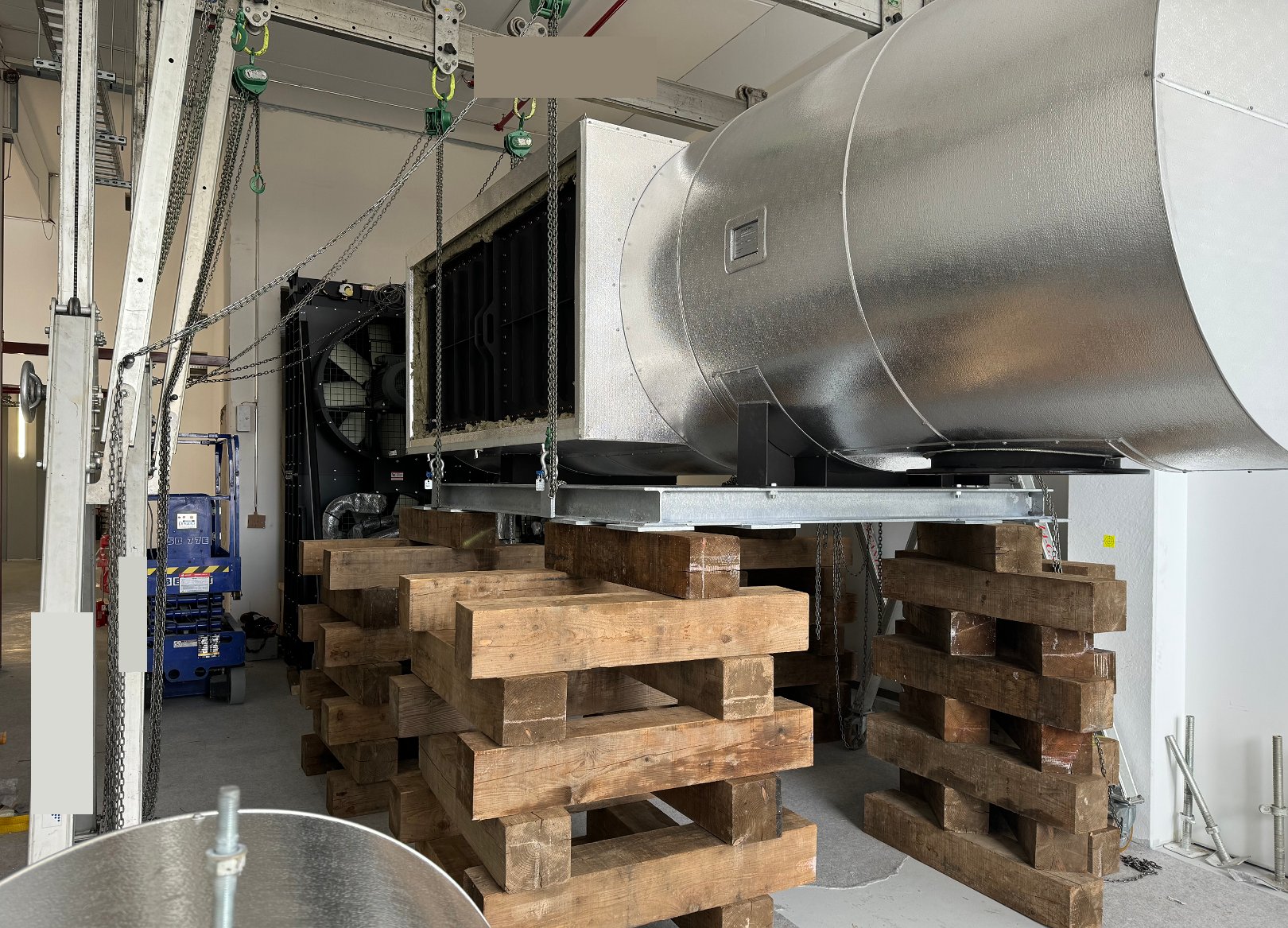
One example of rules lived: under a raised load, work starts only once it is doubly secured – mathematically one securing device is enough; for people underneath it is not.
Qualification from our own house
We train and examine our operators ourselves: for cranes, access platforms and telehandlers we hold trainer and examiner qualifications in-house. Add certified competence for lifting tackle and spreader beams, competent persons for fall-arrest PPE, and Cat. II refrigeration certification.
The effect on site: short paths, current briefings and operators who genuinely master their machines – provable, not claimed.
Registered, vetted, cleared for access
Prequalification is a craft of its own: Avetta registration, the contractor certification programmes of international general contractors, governmental reliability checks for restricted areas – we maintain these credentials continuously so projects never fail on formalities.
For your procurement this means: the documents for your vendor review are ready to send – just share your requirements list.
Safety culture you can see on site
Between a safety binder and a safety culture lies a long road. You spot the difference not in the audit but on the floor: does everyone wear their PPE when nobody watches? Are unsafe situations reported – or worked around? Does a fitter stop the job when something feels wrong, or push through because the deadline presses?
With us, the simplest and hardest rule of international construction applies: everyone – apprentice to managing director – has the right and the duty to stop unsafe work. No justification pressure, no loss of face, no schedule discount. A stopped lift costs minutes; a pushed-through mistake can cost a life.
This attitude is not an imported GC requirement but grown conviction: our fitters work under suspended loads, in confined spaces, at height and on energized systems. People who work like that understand safety not as bureaucracy – but as what brings them home at night.
The EHS Standard 2026 in detail: six parts, one system
Our EHS Standard 2026 spans 28 chapters in six parts – from principles through work preparation and site routine to work at height, lifting & moving, and plant, environment and behavior. It translates German regulations such as DGUV rules, the Industrial Safety Ordinance and TRBS into concrete working rules – and merges them with the minimum requirements of international general contractors into a single, living document.
At its core sit our ten safety rules – short, unambiguous principles from handling suspended loads to fall protection and workplace order – plus the fixed lifting figures described on our Lifting & Rigging page. Every employee signs the standard; every lesson from projects flows into the next revision.
The standard exists in full in German and English. For your procurement that means: you don’t have to ask about our safety organisation – you can read it. The review copy ships on request.
Permits, isolation, toolbox talks: daily life on GC sites
International data center sites run on a dense web of approval processes: permit-to-work for hazardous activities, hot-work permits for welding and cutting, isolation and lockout procedures on energized systems, daily safety briefings before work starts. For some companies that is culture shock – for us it is routine.
Our teams master these processes in both languages: applying for and documenting permits correctly, coordinating isolations with the operator, working on energized systems only after disconnection and securing are proven, and talking through the day’s hazards every morning in the toolbox talk – short, concrete, tied to the work at hand.
The effect for general contractors: a subcontractor who carries the processes instead of braking them. Our supervisors run the documentation independently, keep briefing records current, and appear in the EHS walk-through as an example – not as a risk.
Risk assessments and work instructions: the OM register
Behind our EHS standard sits a maintained register of risk assessments and work instructions for the recurring activities of our trade – from fall-arrest PPE through lifting operations to welding and confined spaces. Every document has an owner, a revision and a trigger for review.
What matters to us is practical relevance: a risk assessment nobody reads protects nobody. Our documents are short, task-based and written in the language of the people doing the work. Special jobs get project-specific supplements – wherever environment, loads or interfaces deviate from the standard.
For clients with their own management systems we dock cleanly: your project rules are mapped against our register, gaps closed, duplication avoided. The result is exactly one valid set of rules per project – not two that contradict each other.
Qualification matrix: every credential on demand
On high-security sites the question is not whether your fitters are qualified – but whether you can prove it, today. We therefore run a central qualification matrix: who may operate which machine, who is briefed for which task, which credentials expire when. Deadlines are monitored and refreshers scheduled before a certificate becomes a project risk.
The range spans operator licenses for cranes, platforms and telehandlers, certified competence for lifting tackle and fall-arrest PPE, specialist qualifications such as Cat. II refrigeration – and governmental vetting for restricted areas. Because we qualify operators with our own trainers and examiners, the matrix stays current and independent of external course schedules.
For your prequalification that means: one call, one package. Personnel lists with credential status, certificate copies and insurance confirmations arrive bundled – in the structure your system requires.
Safety pays: the case for your procurement team
Safety is often misread as a cost factor. The project-level math says otherwise: a subcontractor with a lived safety organisation produces fewer incidents – and thus fewer standstills, fewer investigations, fewer reports to owners and insurers, less reputational damage for everyone involved. On sites where a day of delay can cost six figures, that is not a soft metric.
Add predictability in procurement: our credentials – from the EHS standard to Avetta registration – are ready before you ask. Your vendor review takes days instead of weeks; your EHS team reviews a system instead of a paper stack.
And long-term, the strongest argument: companies with a real safety culture keep their experienced people. The fitters who deliver your project cleanly today are the same ones who return for the follow-up – briefed, known, practiced. Continuity is the most underrated safety feature of all.
Environmental protection on site: quiet, clean, provable
EHS does not end with occupational safety – the E stands for environment, and we take it seriously. On our sites that means: operating fluids handled over drip trays, indoor emissions avoided through electric lifting equipment, waste separated and disposed of verifiably, noise minimized through planning – documented for instance in our series installation in a residential area, where consideration was part of the construction sequence.
Two documented examples show the range: a test-rig conversion with a perimeter drip pan, TIG-welded tight so no drop reaches the ground in a leak – and the sorted recycling of a dismantled crane system, cut into fractions instead of mixed into a container.
For operators and GCs with their own environmental targets such evidence is increasingly procurement-relevant: serious sustainability reporting needs contractors whose practice matches. Our documentation supplies the proof.
Health in the trade: ergonomics and manual handling
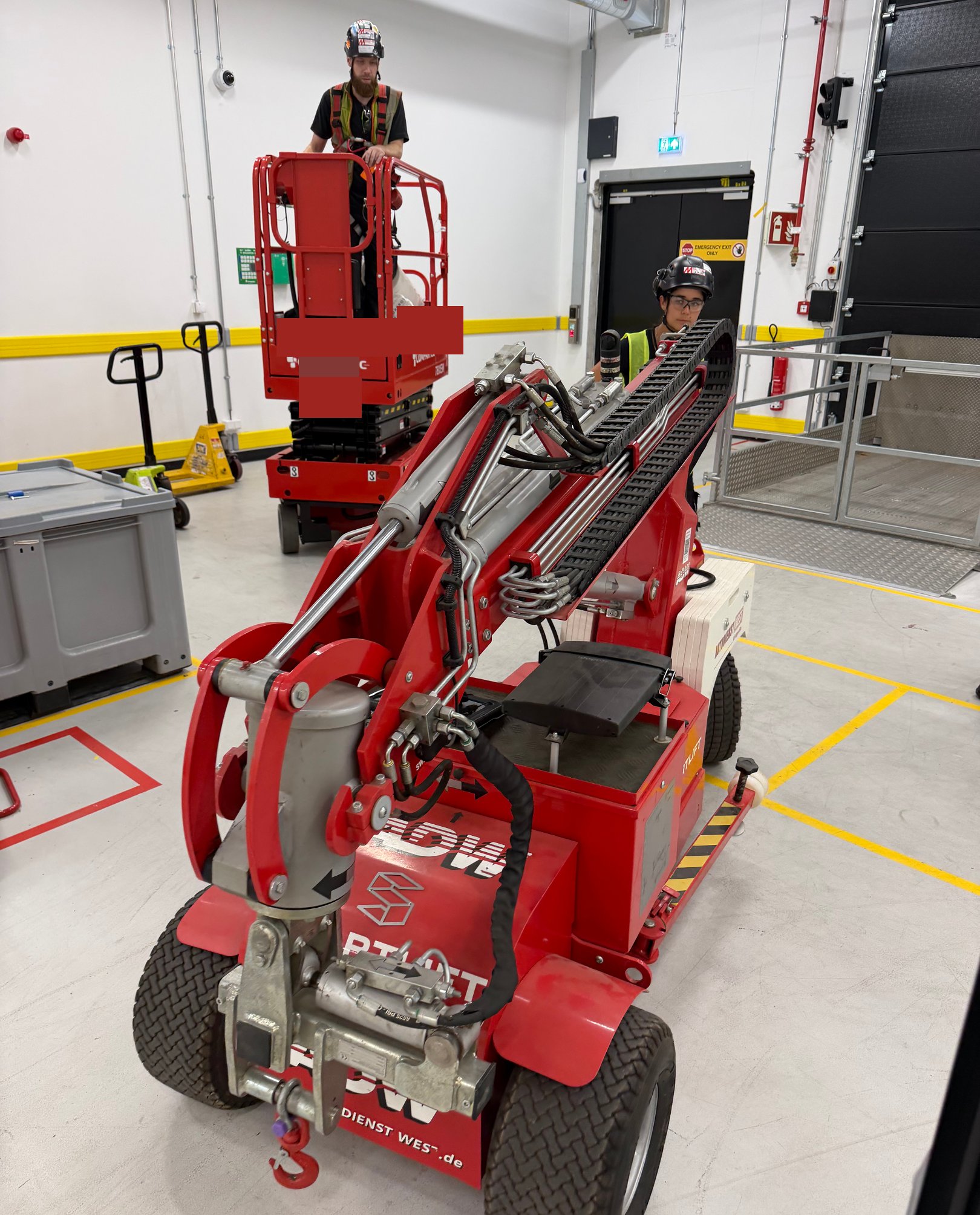
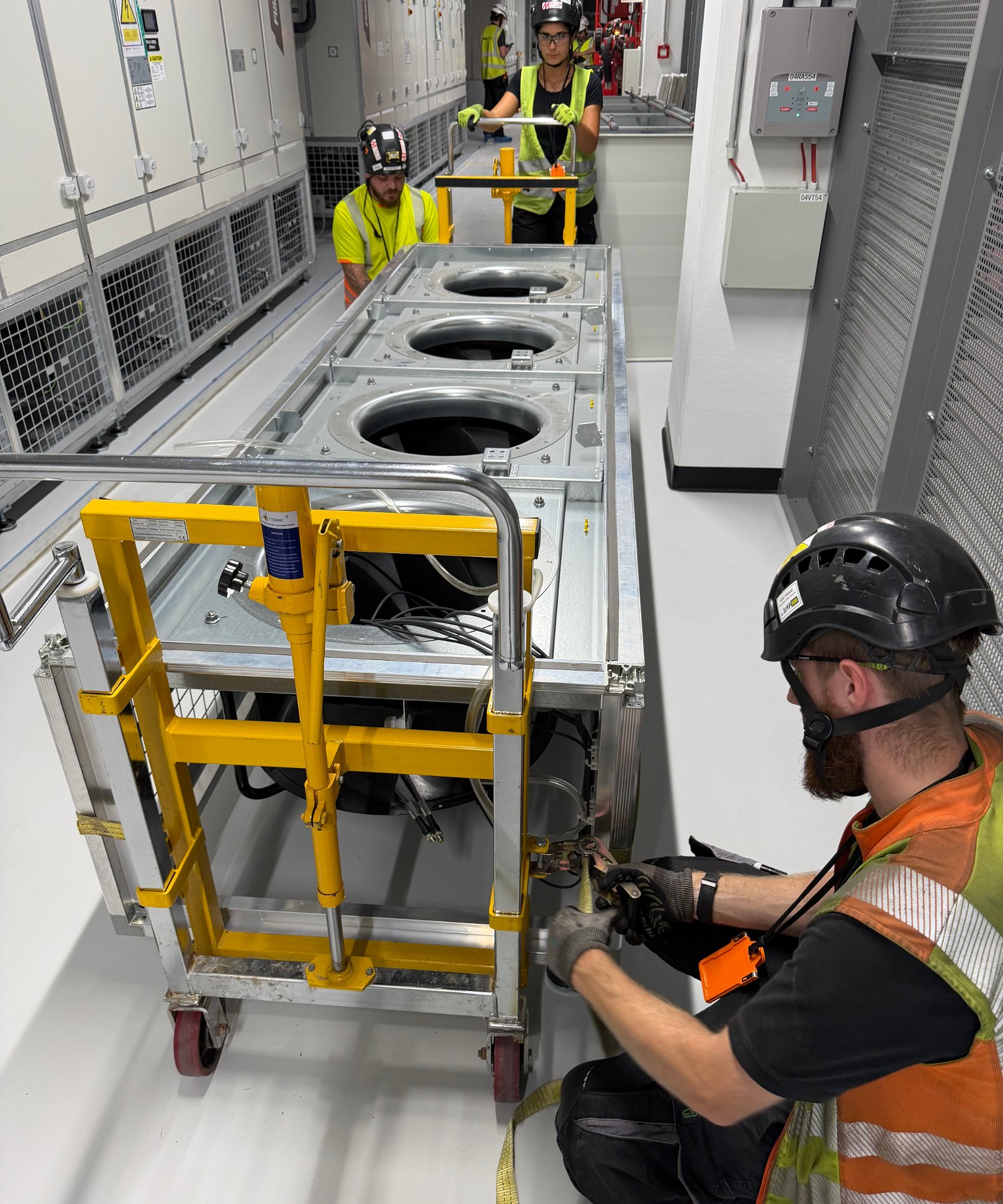
The most common injuries in installation work are unspectacular: backs, shoulders, knees – wear from badly handled loads, day after day. Our EHS standard therefore treats manual handling as its own chapter: assessment by recognized methods, technical aids before muscle, two-person rules for defined weights, lifting aids as standard rather than extras.
That is enlightened self-interest: our experienced fitters are our most valuable asset, and we want them healthy in this trade until retirement. Every machine skate, every mini crane and every well-planned transport route pays into that.
Confined-space work – no rarity in the data center world – follows fixed rules too: risk assessment, ventilation, communication and defined rescue concepts guided by the applicable DGUV rules. Sounds like a lot of effort for a basement corridor? Exactly that attitude separates routine from risk.
Prepared for the emergency: site emergency organisation
Good safety work prevents emergencies – professional safety work prepares for them anyway. Every deployment includes defined emergency information: the site’s rescue chain and emergency numbers, assembly points, locations of first-aid equipment and extinguishers, the specific risks of the work area.
For work with elevated hazard potential – at height, in confined spaces, under suspended loads – rescue concepts are part of work preparation: how does an injured colleague get out of the harness, out of the shaft, out of the machine? Whoever asks that question only in the emergency asks it too late.
Prequalifying contractors right now?
Send us your EHS and procurement requirements – you will receive our credentials bundled, and on request the Omega EHS Standard 2026 as a review copy.
100 % non-binding & free of charge · Direct line: +49 6106 239 25 88
Frequently asked questions
Avetta is an international platform through which clients prequalify their subcontractors: evidence on occupational safety, insurance and quality is checked centrally. Omega Mounting is Avetta-listed – one of the building blocks with which we meet the certification programmes of major clients.
The Zuverlässigkeitsüberprüfung (ZÜP) under Section 12b of the German Atomic Energy Act is an official background check for people working in sensitive areas. Our personnel for security areas has been vetted accordingly – a door-opener wherever access is strictly regulated.
Our EHS Standard 2026 sets out in 28 chapters across six parts how we work: from principles and work preparation through work at height and lifting to equipment, environment and behaviour – including our 10 safety rules and fixed key figures for every lift. It is available in full in English and German.
Yes. The standard is also our management tool for our own subcontractors: anyone working for us confirms the rules in writing and is briefed and led accordingly – in the supervisor model with clear responsibility per crew.
Yes. RAMS, lift plans, briefings and our EHS standard are available in English and German – on international data center sites English is our working language, not a translation effort.
Yes, and it applies without exception: every employee has the right and the duty to stop unsafe work immediately – without pressure to justify it. The situation is clarified, documented and work resumes only after release. A stopped work step is a success of the system for us, not a blemish.
Through the central qualification matrix with deadline monitoring: recurring briefings are scheduled before they expire, project-specific inductions are carried out and documented before every deployment. Our own trainers and examiners make us independent of external training dates.
Yes. We compare your requirements with our EHS standard, close gaps project-specifically and commit our teams to them in writing. The result is a single valid set of rules for your project – agreed, documented, lived.
Separated by fraction and disposed of with proof – including recycling certificates for dismantling work. Operating fluids are handled in suitable containers and drip trays; project-specific disposal concepts are agreed with your site rules.
Yes – disposal certificates, emission avoidance through electric lifting equipment and documented environmental measures are delivered as part of the project documentation, so your reporting can draw on reliable data.