- Data Center Services – References
Data center references: documented projects instead of promises
Twelve documented data center projects stand in our public project diary – anonymized, with real photos and honest details down to the two centimeters that were once missing. Operators and clients are never named: discretion is part of the service.
Twelve projects, one public diary, zero names
The documented entries are only an excerpt: in total we have delivered lift & shift, installation and commissioning projects in 23 data centers – from bare shell to live operation.
For serious inquiries we assemble a reference package with more specific details – just ask. A selection of the documented projects follows below; the full reports live in the project diary.
At a glance
- Lift & shift, installation and commissioning projects in 23 data centers
- 12 documented data center projects in the public diary
- Largest documented series: 320 CRAH units in one building
- Tandem lift responsibility for a leading general contractor
- Operators are never named publicly
- Reference package with details on request
What to expect on this page
Click any topic to jump straight to that section:
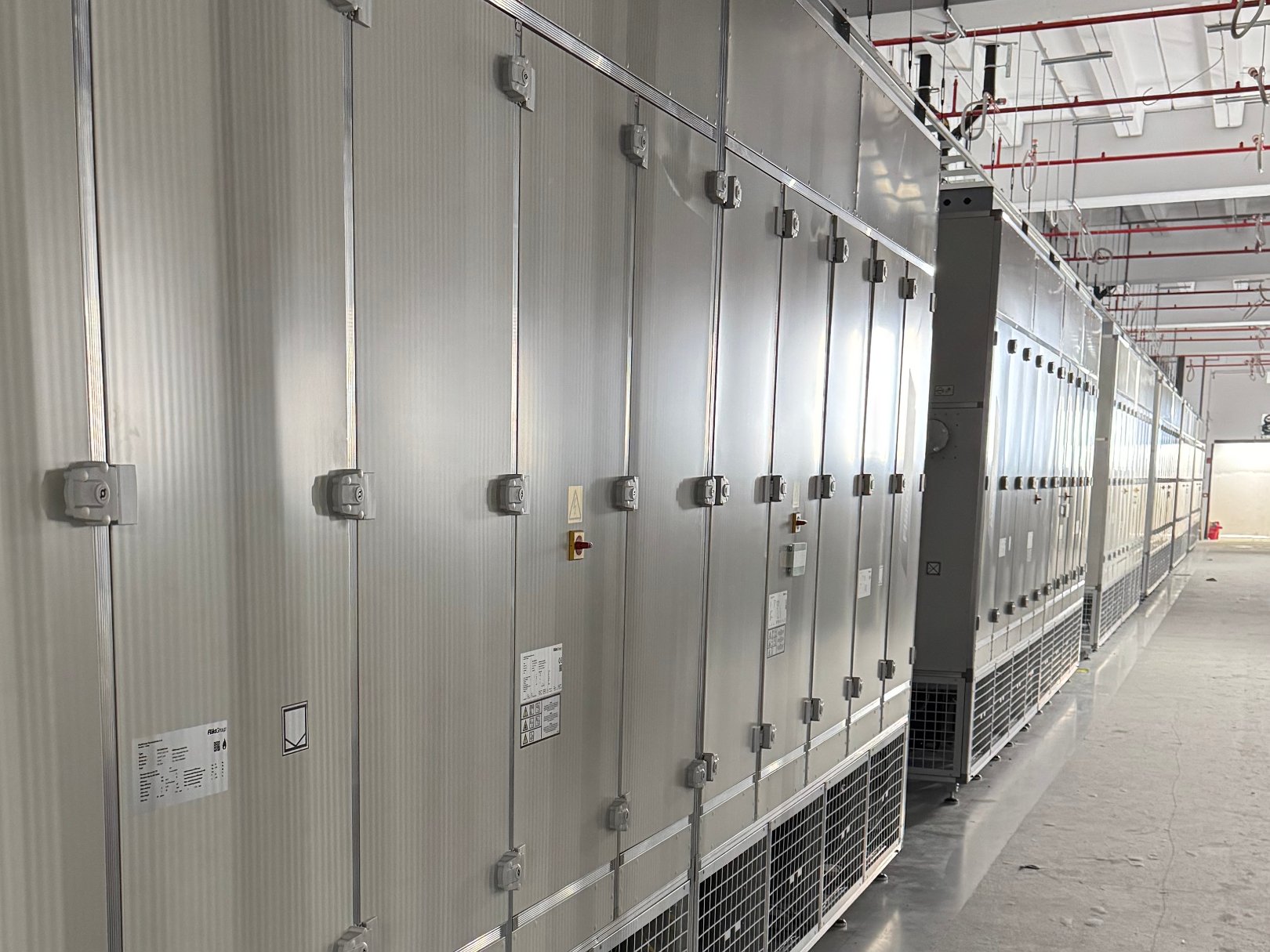
320 CRAH units across every floor
One data center in Raunheim, all of its cooling units, every floor: from truck delivery via the loading platform to the finished fan wall, we installed all 320 CRAH units – documented in a three-part series in the project diary, from the basement to the team photo at the end.
Spider crane out of the basement: two centimeters decide
A mini crane, brought in during the shell phase, had to come out months later – but the building had grown shut around it. Route measured, lift plan produced, construction hoist supported on timber cribbing. On the final lift, two centimeters were missing despite correct measurement: solved with an inclined hitch on an adjustable chain. Planned, not improvised.

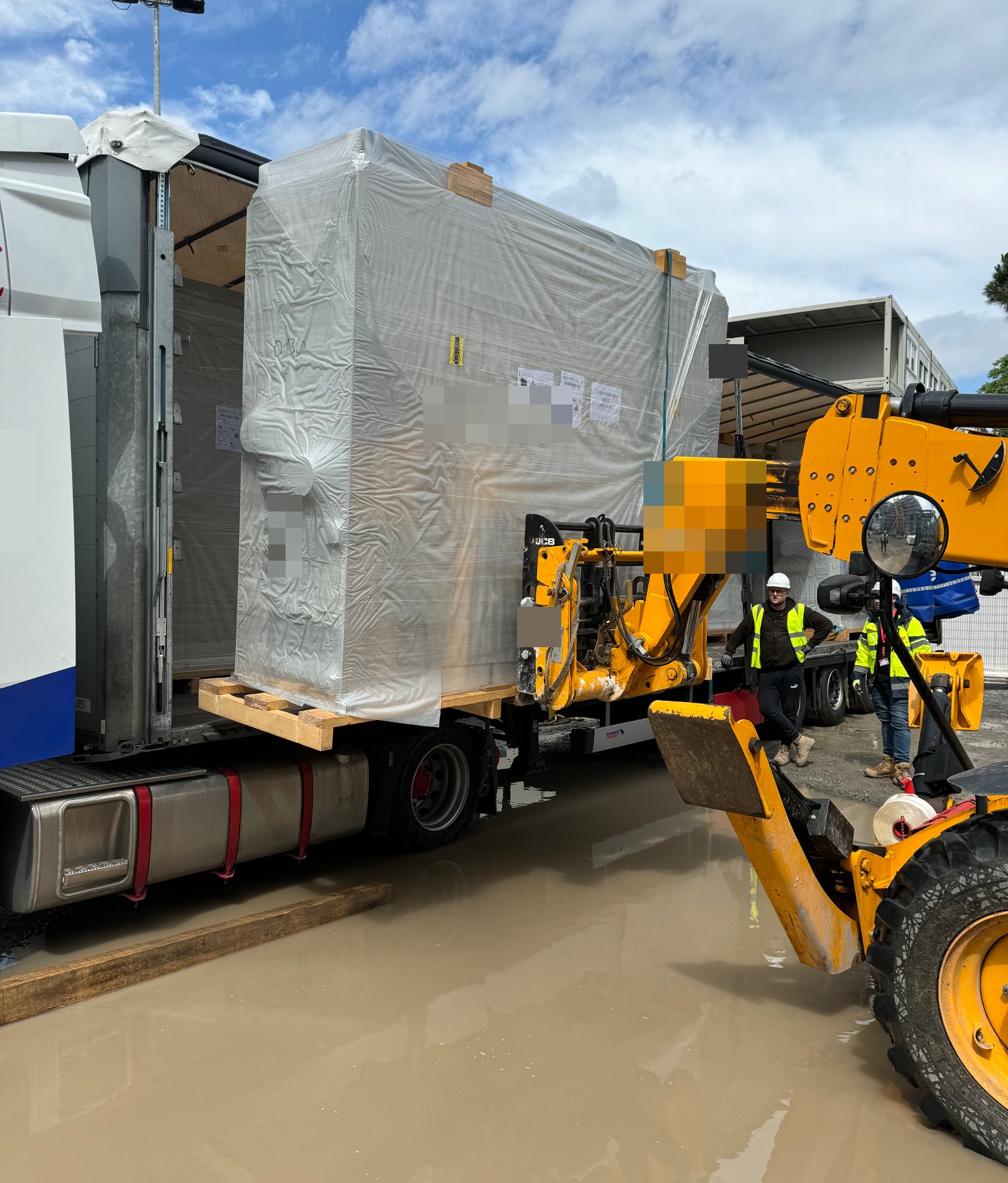
Load banks & generators on a 220-ton crane
For a Frankfurt data center’s load testing we rigged load banks and generators with a 220-ton-class mobile crane – multi-ton containers, tight positions, fixed windows. A follow-up project brought a single 16-ton load bank lift: unspectacular, because well planned.
26 SCR systems in series
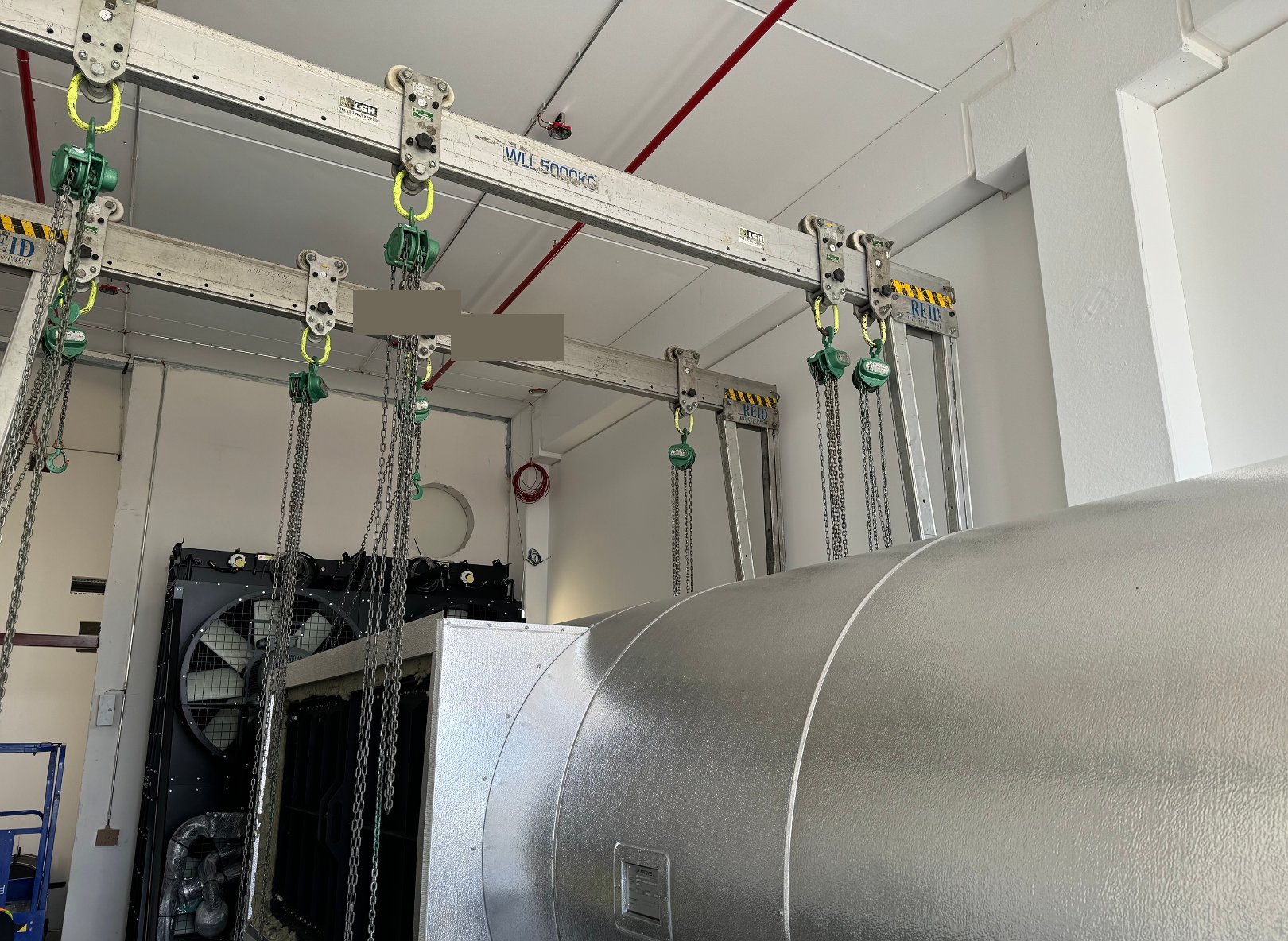
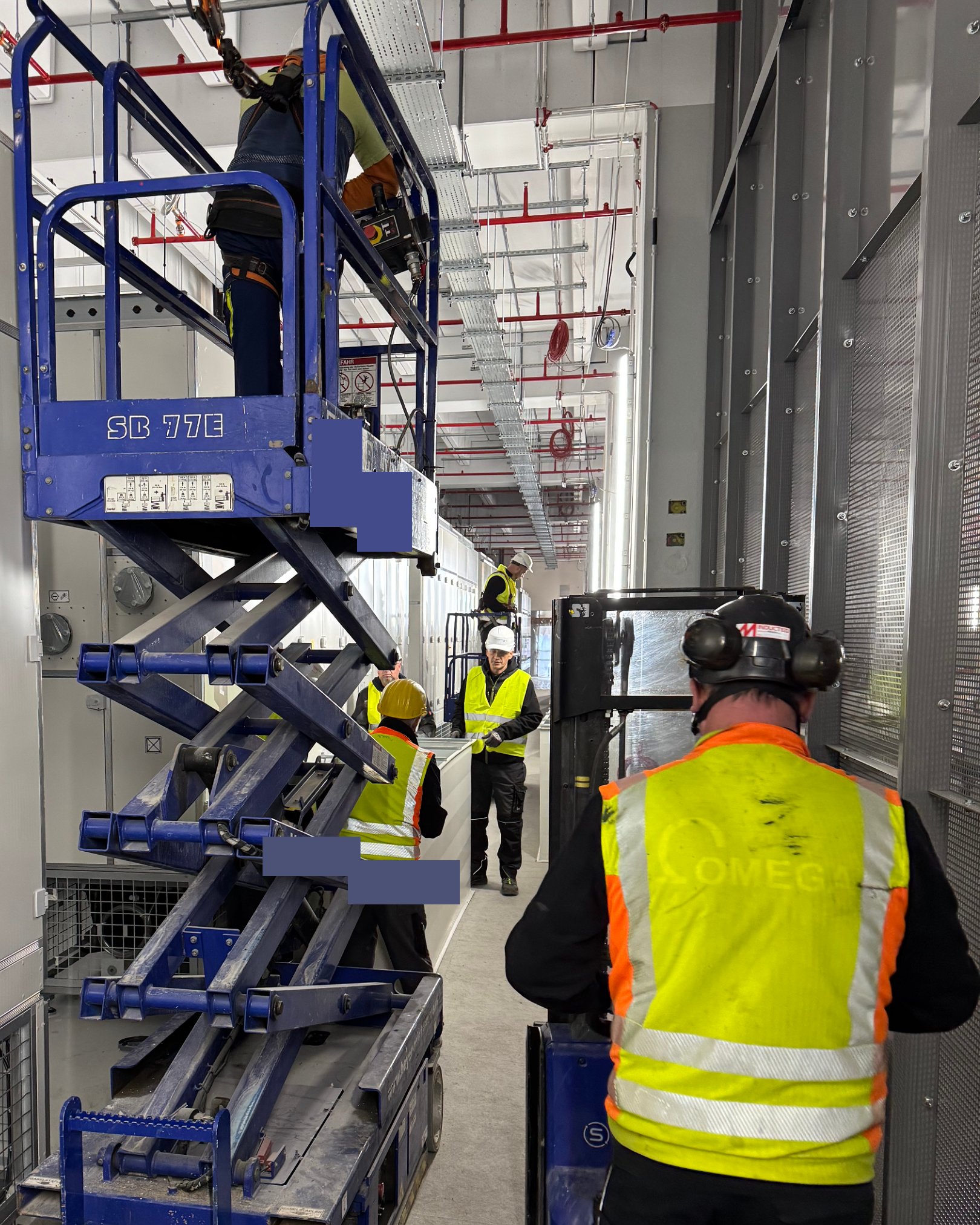
In a Frankfurt-area data center we installed and elevated 26 SCR exhaust-treatment systems – each positioned exactly above its generator with two mobile gantry cranes and four chain hoists, in series, on the site’s takt.
CRAH replacement in live operation
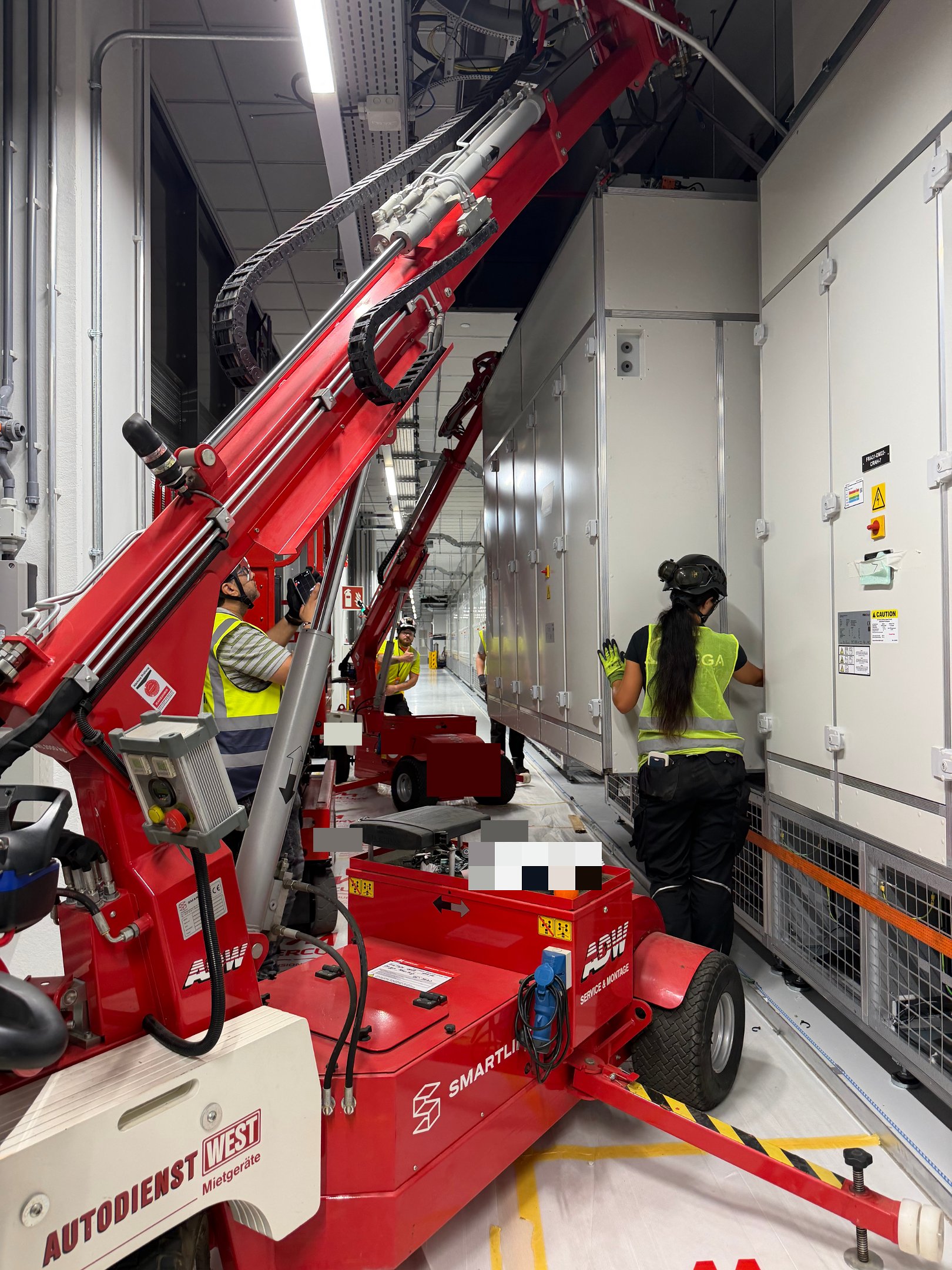
A damaged heat exchanger, a live gallery, zero tolerance for dust or impact: replacing a single unit in an existing facility proves that diligence is not a question of volume – floor protection, radio remote control, fall-arrest PPE and a cleanly documented sequence belong to the single unit too.
The Raunheim trilogy: one data center, three chapters
No project shows our data center competence more completely than the three-part series from Raunheim. Chapter one: 80 CRAH units in the basement – series installation with spider crane and spreader beam, fan bases aligned with a line laser across entire rows. Chapter two: extracting that same spider crane from the basement after the building had grown shut around it – lift plan, cribbed construction hoist, inclined hitch for the famous missing two centimeters. Chapter three: the fan wall installation across every floor, until all 320 units of the building stood.
Why we documented this series so thoroughly: it shows the full life cycle of our work in a single building – rigging in, working, rigging out; single lift and series; planning and a ban on improvisation. And it shows the side conditions rarely talked about: a construction site in a residential neighborhood, with time windows, barriers and consideration as part of professionalism.
For new clients the trilogy is the most honest shop window we have: no gloss, but traceable work with photos, figures and the problems that belong to real projects – along with their solutions.
Backup power references: the complete chain from one partner
Across several documented projects we have worked every station of the backup power train: generators and load banks rigged with a 220-ton-class crane, a 16-ton load bank lifted precisely over the site fence, twelve twin turbo silencers installed, 26 SCR systems elevated in series, a radiator on a backup generator overhauled, and a complete generator set replaced in a Sunday-evening emergency.
Taken together, these single projects add up to a rare reference: the complete mechanical chain of emergency power – rigging, installation, exhaust line, cooling, testing, maintenance, emergency – proven in real projects instead of a brochure. Operators and GCs looking for one partner for “everything around the genset” find the evidence here.
Per-project details sit anonymized in the project diary; more specific data – scopes, timelines, interfaces – belongs in the reference package we assemble for serious inquiries.
Restricted areas: vetted, cleared, proven
Some references may only be hinted at – which is exactly what makes them valuable. Our teams have worked for years in areas requiring governmental reliability vetting: at Frankfurt Airport as well as on critical-infrastructure facilities whose operators and locations we never name. One documented project describes erecting a complete container facility on a military site – awarded for placement only, extended to every trade, because the vetted company was on site and could deliver.
For data center clients this profile is directly relevant: data centers are critical infrastructure, access is strictly controlled, and a partner whose people have already passed vetting saves weeks of lead time – and spares you the awkward question of whether the subcontractor is even allowed on the premises.
Discretion is part of the deal: what we learn about your facility stays with us. The same rule that forbids us to advertise with client names protects your data tomorrow.
Why we document publicly – and what that says about us
A public project diary is unusual in the installation business. The norm is reference lists with logos and superlatives. We chose the other path: real projects, real photos, real details – including the moments when things got difficult. The crane that was short two centimeters despite correct measurement. The mounting face machined crooked at the factory. The weekend window that held only because the plan had reserves.
Behind it stands a simple conviction: whoever shows only successes tells half the story. Professionalism is not the absence of problems – it is the structured response when they occur. Clients who find us through the project diary know how we think, work and communicate before the first call.
And the documentation does one more thing: it disciplines us. Whoever knows that every project will be publicly readable works in a way they can write down with a clear conscience. We have yet to find a better quality incentive.
The reference package: what serious prospects receive
A blog is not enough for procurement processes – that is what our reference package is for. It contains project sheets with more specific data on scope, role and timeline of selected projects, an overview of our data center service areas, the relevant certificate and insurance records and – where client releases exist – named contacts for follow-up questions.
We assemble the package per inquiry: a general contractor looking for a lifting partner gets different emphases than an operator tendering maintenance or a manufacturer outsourcing series installation. On request we deliver in your structure – many procurement systems have fixed formats, and we adapt to them, not the other way round.
The route is deliberately short: an inquiry through the contact form or a call, a brief conversation about your plans, then the package. No registration loops, no hold music – if in doubt, you are talking to the managing director.
From first project to partnership: how our client relationships grow
Almost all of our long-term client relationships follow the same pattern – and it starts small. A unit swap, a weekend window, a lift nobody else wanted to touch: the first project. Then the second inquiry, usually bigger. Then the phase where we are consulted before tenders are written. Finally the framework: recurring scopes, fixed contacts, practiced routines.
That pattern is no accident – it is our business model: we do not buy contracts through price; we earn follow-up work through performance. For you as a new client this has a pleasant side effect: the entry risk is minimal. Test us with a manageable job; everything else follows from the result.
Our promise is the same one that started every one of those relationships: an honest assessment before the job, clean work during it, complete documentation after it – and a contact who still answers the phone after the invoice.
Numbers that speak for themselves
References tell stories – numbers make them verifiable. The current state of our data center work in figures:
- Lift & shift, installation and commissioning projects in 23 data centers – from bare shell to live operation.
- More than 2,650 days of data center experience since our first deployment on May 20, 2019 – the counter on our main page runs daily.
- Over 1,000 tons of equipment installed – extrapolated from the documented projects and the deployments we keep confidential.
- 320 CRAH units in one building, 160 PDCs, 26 SCR systems, 240 nitrogen cylinders – series installation, proven rather than claimed.
- 12 publicly documented data center projects in the project diary – with photos, sequences and honest details.
Three entries to start with: our reading recommendation
If you want to get to know us through the project diary, we recommend three entries as a starting point. First, the fan wall installation across every floor – it shows series installation, rigging logistics and teamwork at the largest documented scale. Second, the spider crane extraction from the basement – it shows how we think when things get tight: lift plan, fallbacks and the famous two centimeters. Third, the generator set replacement in a Sunday-evening emergency – it shows what 24/7 means with us in practice.
These three jobs span the range we move in daily: planned series, solved complication, mastered emergency. Everything else – from the live-environment CRAH swap to the SCR series – lives in the project diary, continuously extended with new work.
And if you would rather listen than read: call us. Twenty minutes about your project say more than any reference list – and you will quickly sense whether the chemistry is right. In long partnerships, that is what counts in the end.
Discretion as a reference: what we do not show
There is a second reference list nobody gets to see – and that is precisely its value. Projects on critical-infrastructure facilities, deployments in restricted areas, work for clients whose competitors read our website just like you do: all of it is documented internally with the same care, and none of it is published.
When you work with us, that rule automatically covers you too: your project appears in the diary only if you explicitly release it – anonymized, reviewed, with no way to infer site or operator. Trust is the hardest currency in the data center market. We treat it accordingly.
Want details on our projects?
Request the reference package: more specific project data, scopes and – where releases exist – contacts for follow-up questions.
100 % non-binding & free of charge · Direct line: +49 6106 239 25 88
Frequently asked questions
Because discretion is part of the service in the data center industry: operators and clients do not disclose their sites and partners publicly – and neither do we. Our projects are documented anonymized, but with real photos and verifiable details.
Yes. For serious inquiries we assemble a reference package with more specific details and – where client releases exist – named contacts for follow-up questions. Just get in touch.
The focus is the Frankfurt Rhine-Main region – continental Europe’s largest data center market. In total we have delivered lift & shift, installation and commissioning projects in 23 data centers.
Yes. Between replacing a single CRAH unit and series-installing 320 of them lies our entire spectrum – what matters is not size but that the job is planned and documented properly.
In the data center world that decision sits with the respective operator or general contractor – access is strictly controlled. Where releases are possible we gladly arrange visits; alternatively we walk you through projects in detail using photo documentation and project sheets from the reference package.
Yes, with both worlds: series installations and new builds in the context of large campus projects, as well as swaps, retrofits and maintenance for colocation operators in live environments. The ways of working differ – our standards do not.
Where our clients agree, yes. Discretion comes first – so we actively request a release for every mention. The reference package marks which projects allow follow-up questions.
The project diary is continuously extended – new projects are added after completion and internal release. Key figures on these pages are updated on significant changes; the day counter on the main page runs automatically.
Because in a data center the follow-on cost of one mistake exceeds any price difference by orders of magnitude: a damaged unit, a missed milestone or a safety incident costs more than any saving on the hourly rate. Our margin is the quality buffer that prevents those mistakes – that is not an excuse, it is a calculation.