
- Technology explained – site power & infrastructure
Site Power and Site Lighting in the Rhine-Main Region: Why We Work Together with Eventwerk Rodgau
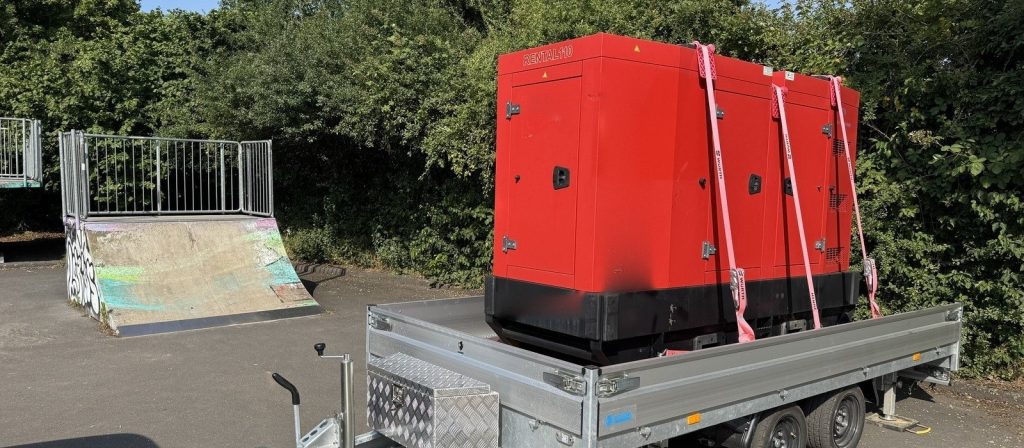
Generators from 2 to 110 kVA, lighting masts, distribution boards and cables – from a single source together with the installation, from one yard in Rodgau
The machine has been delivered, the crane is booked, the installation team is ready from Monday. And then the call comes from the site manager: the site connection has not been installed yet. Or it has been installed, but at 16 amps it does not deliver what a welding machine, a core drill and a site compressor draw at the same time.
We know this situation from our own jobs. During a crane lift at a data center in the Rhine-Main region there was simply no site power at the decisive point – we brought it ourselves. That is exactly how a service came about that we now offer instead of merely improvising it.
This is possible because Omega Mounting does not stand alone. Our sister company, Eventwerk Rodgau GmbH, hires out generators, distribution boards and site power infrastructure from Rodgau – same management, same location, a hire fleet that has grown over years. What supplies marquees, stages and events there supplies a construction site, a hall under conversion or a location without a working supply just as reliably.
Project profile
- Generators in five fixed sizes: 2 · 3 · 7.3 · 48 · 110 kVA. From 7.3 kVA with CEE outlet and 400 volts.
- The 110 kVA generator on a trailer – quiet, suitable for continuous operation, regularly tested; the size for entire construction sites, drying phases or failure of the main supply.
- Lighting masts and floodlights for working areas, traffic routes and night shifts.
- Distribution boards: CEE distribution units and site distribution boards for sub-distribution across the area.
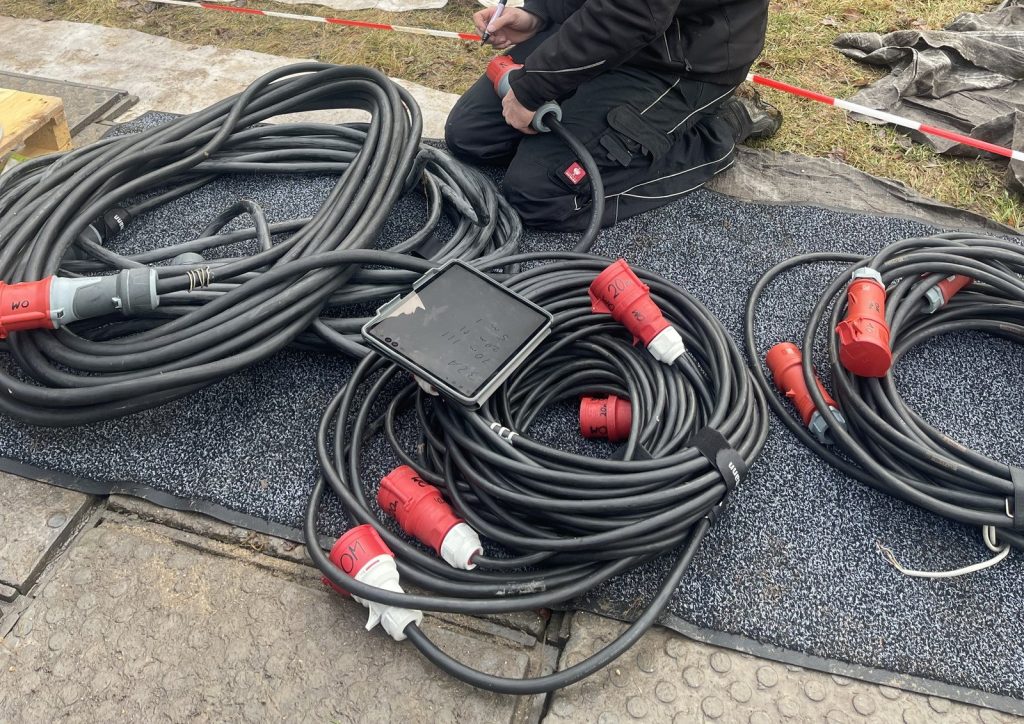
- Three-phase cables in four sizes: 16 A, 32 A, 63 A and 125 A – from the feed to an individual device to the main line with which a 110 kVA generator can be sensibly connected in the first place.
- Cable ramps – so that the cable route does not become a trip hazard or a crushed cable.
- Site heaters – electric at 400 volts, as a diesel heater with flue or as a gas unit, for drying, screed and workplaces in the winter months.
- Delivery, set-up and support within a radius of around 40 kilometres of Rodgau; beyond that we agree it on a project basis.
- On request complete with our installation – then the infrastructure comes with the team that is working on your site anyway.
What does kVA mean – and how much generator does a construction site need?
The short answer: kVA is apparent power, kW is active power. For selecting a generator, what counts is not the watts stated on your equipment's data sheet, but what it draws on start-up.
A generator is rated in kilovolt-amperes because it also has to cover the reactive power component produced by motors, transformers and frequency converters. The usable active power is lower – at a typical power factor of 0.8, a 110 kVA generator corresponds to around 88 kW.
Start-up is more decisive. A three-phase motor draws a multiple of its rated current when starting. Anyone who just adds up the type plates chooses too small: the generator sags as soon as two consumers start at the same time, and in the worst case the whole site goes down.
The second question is voltage. From 7.3 kVA we offer 400 volts with CEE outlet – and this question decides the selection faster than any consumption calculation. Anyone who runs a core drill, site heater or welding rectifier on three-phase needs the larger class, even if the pure power would be smaller.
16, 32, 63 or 125 amps – which cables do you need?
The short answer: the connector size depends not on what hangs at the end of the line, but on how much else comes after it. That is why we keep all four sizes in stock – 16 A, 32 A, 63 A and 125 A.
This is how the distribution looks on a typical construction site:
- 125 A is the main line. A 110 kVA generator delivers around 158 amps at 400 volts – anyone who connects it with a 63 A line gives away more than half the power they hired it for. The 125 connects the generator to the main distribution board.
- 63 A is the floor or zone line. With it you go from the main distribution board to sub-distributions at the working areas – for site heaters, welding rectifiers and anything that combines several consumers.
- 32 A supplies the powerful individual device: core drill, compressor, larger construction machine.
- 16 A is the last mile to the tool – blue for 230 volts, red for three-phase.
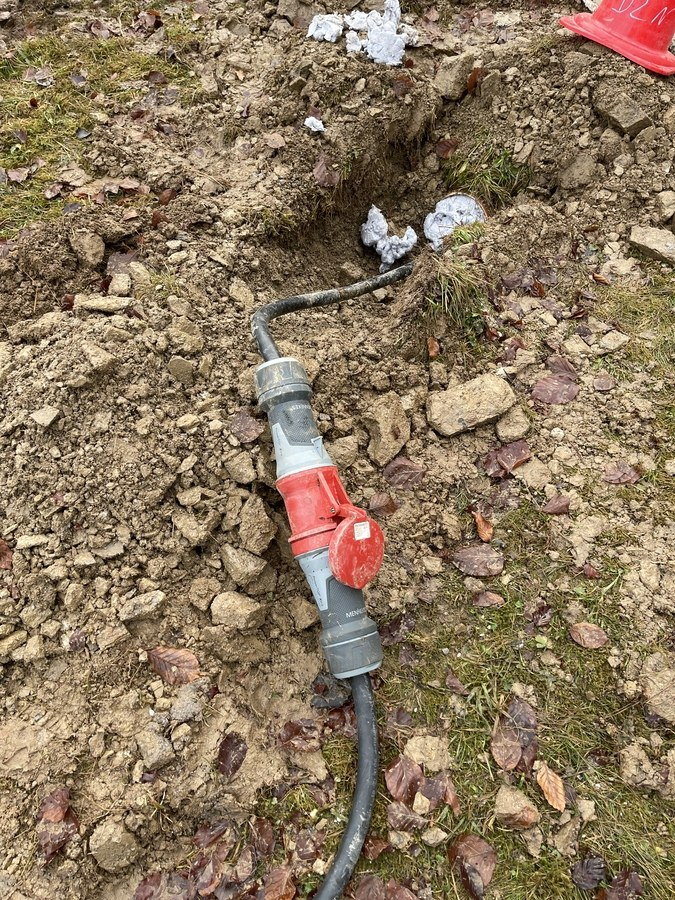
The point that decides on long routes is the voltage drop. Over a hundred metres of cable, voltage is lost – and all the more so the smaller the cross-section and the higher the current. At the end of an undersized route, motors run hot, frequency converters trip on fault, and nobody understands why, because the generator at the front is running perfectly. If you tell us the distance from the set-up location to the last work point, we plan the route with the appropriate cross-section instead of with whatever happens to be on the trailer.
Why do we work together with Eventwerk Rodgau?
Because the chain gets shorter. If you book installation with us and power from a hire fleet somewhere in the Rhine-Main region, you coordinate two dates, two contacts and, in case of doubt, two sets of finger-pointing when something does not fit together. Within the group, this interface disappears.
Three things make the difference in everyday work:
One location. Generator, distribution boards, cables and lighting masts are in Rodgau – where our workshop and our vehicles are too. What is missing on site in the morning can be delivered by midday without anyone opening a hire contract.
One contact. You describe the project once. We handle the split between installation and infrastructure internally – you get one date and one coordination.
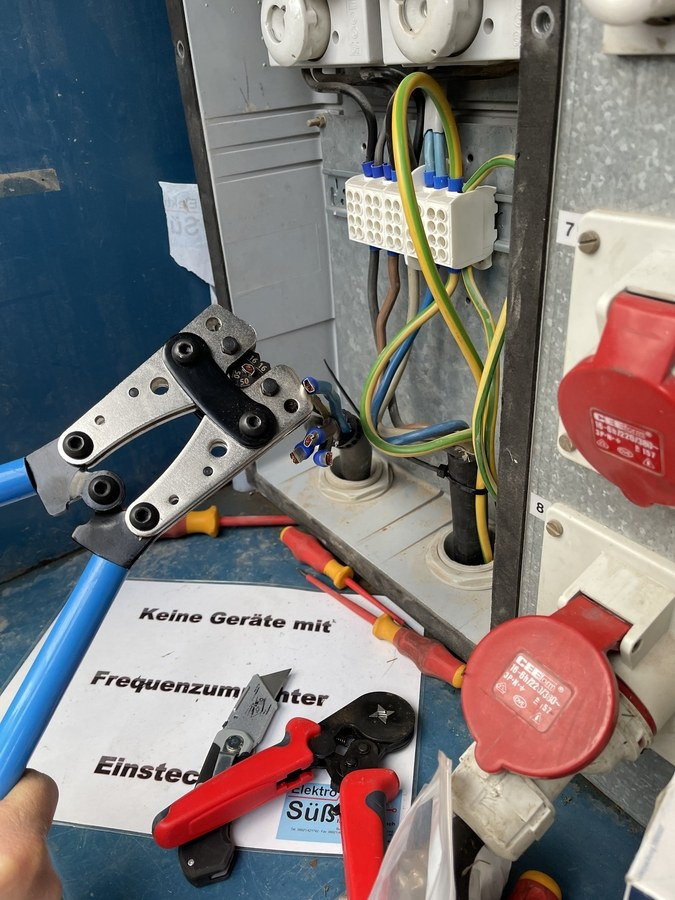
One team that is allowed to do both. Our fitters are mechatronics technicians: mechanical and electrical in one person. Whoever sets up the distribution board with us can also connect it and commission the system – instead of waiting for a third company to travel out for twenty minutes of work.
Who is Eventwerk Rodgau GmbH?
Eventwerk Rodgau GmbH is an event service provider and hire company in the Rhine-Main region – with a hire fleet that goes far beyond events: generators, distribution boards and cables, lighting and sound equipment, marquees, heaters, stage decks and sanitary solutions. It is precisely this combination that makes it interesting for construction sites. Anyone who reliably supplies a marquee with power, light and heat has learnt to build temporary infrastructure so that it does not fail – because at an event there is no second attempt.
You will find the complete range directly at Eventwerk: generator and site power hire in Rodgau as well as lighting equipment hire – from floor spots to large floodlights. Delivery is within a radius of around 40 kilometres of Rodgau, on request with set-up and on-site support.
What are the concrete advantages for you?
The short answer: you are not buying equipment but a working construction site – and you do not bear the schedule risk alone.
- The infrastructure is tied to your installation date, not to a hire calendar. If your maintenance window shifts by a week, we shift both together.
- No double call-out. Generator, distribution and installation team arrive on the area in the same move.
- Failure is not a project stop. If the site supply fails or is not yet ready, the alternative is already on site – or half an hour's drive away.
- One responsibility. When power, light and installation come from a single source, there is no discussion about whose fault it was when a fault occurs.
- Existing material instead of new procurement. For a weekend, a night shift or a drying phase, buying is not worthwhile. The hire fleet is there, inspected and ready for use.
Site heaters: heat belongs in the power calculation, not on top
The short answer: a site heater is the largest single consumer on the area – anyone who adds it afterwards puts the design at risk.
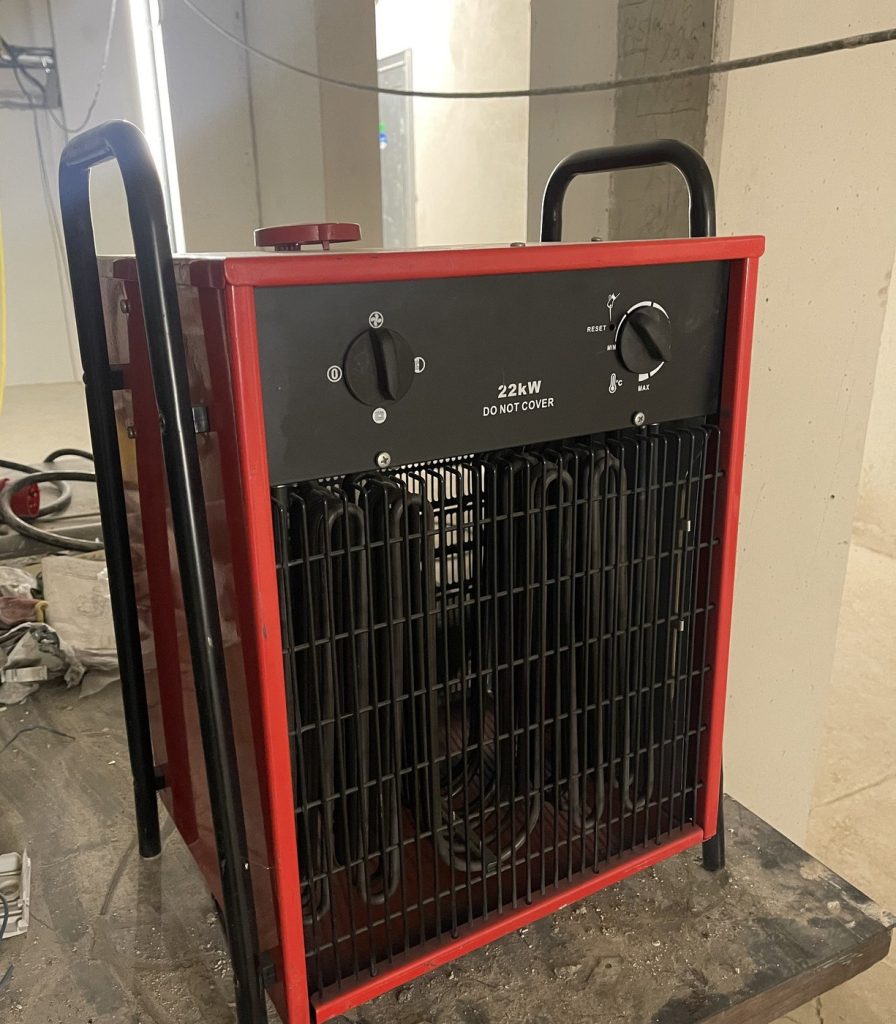
Do a quick calculation: an electric heater with 22 kW draws around 32 amps at 400 volts. It alone occupies a complete 32 A outlet – and around half the usable power of a 48 kVA generator. Two of them in a hall, and the unit that was generously sized a moment ago is maxed out.
That is why the heating question often determines the generator size more than the machines themselves. There are three ways:
- Electric – clean, quiet, may stand in the room. But needs three-phase power and therefore almost always a generator or a robust supply.
- Diesel heater – high output without significant power demand, but with a flue to the outside and a tank that needs supplying.
- Gas – independent of power, good for individual workplaces and outdoor areas.
For drying phases, screed and winter sites, the same rule applies as for lighting: the heating belongs in the design before the generator is ordered – not in the second week.
Light on the construction site: more than just brightness
The short answer: site lighting is occupational safety, not comfort. The German Technical Rules for Workplaces (ASR A3.4) specify minimum values for lighting – graded by activity. A traffic area needs less than a workplace where assembly, welding or measuring takes place.
In the winter months, light simply decides how many hours a day you can work. Between November and February, practically nothing sensible can be done on an outdoor site before eight and after four o'clock without artificial lighting.
What matters with lighting masts in practice:
- Avoid glare. A mast that shines directly into the face of the crane operator or the slinger is more dangerous than too little light.
- Think about shadows. A single source produces hard shadows behind every component. Two masts from different directions are almost always better than one with twice the power.
- Stability in wind. A fully extended mast is sensitive to wind. Set-up location, guying and lowering in a storm warning are part of the briefing.
- Include the power demand. Lighting runs whenever work is going on – it belongs in the generator design, not on top.
Inspection duty and documentation – the point that is often forgotten
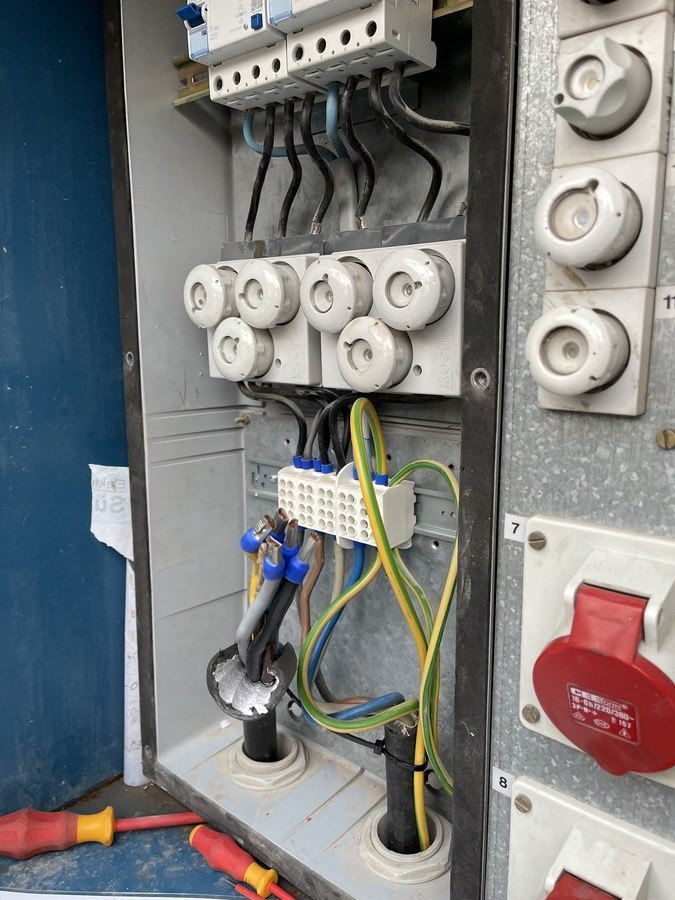
Site distribution boards, cables and generators are electrical equipment and are subject to periodic inspection in accordance with DGUV Regulation 3. On commercial construction sites, the health and safety coordinator asks about this – at the latest when something has happened.
Anyone who hires material hires the inspection status with it. That is the quiet advantage over the box of extension cables that has been lying on the workshop shelf for three years and that nobody has ever tested. We deliver the equipment in inspected condition and give a briefing at handover.
Safety around the generator
Three rules that are non-negotiable with us:
A combustion generator never belongs in an enclosed room, never in a marquee and never under an enclosure. Carbon monoxide is odourless, and the cases where this goes wrong regularly end fatally. The set-up location is chosen according to wind direction, at a distance from openings and air intakes.
Cable routes are planned, not just laid. Where a route crosses a traffic path, a cable ramp goes over it. Where it lies on an edge, it is protected. A cable crushed under a forklift wheel is a short circuit with personal injury, not just material damage.
Refuelling only with the generator stopped and cooled down, with a drip tray and outside areas where welding or grinding is taking place.
Why Omega Mounting?
- Power infrastructure is not something we buy in, but experience from our own projects – from site power distribution and 63 A distributions to long three-phase cable routes under difficult conditions.
- Standby power is one of our core businesses: We install, maintain and test standby power systems in data centers and industrial plants – from generator maintenance via the exhaust side to the load test with load banks.
- Mechanic and electrician in one person: Our fitters set the system, connect it and commission it.
- Group instead of subcontractor chain: With Eventwerk Rodgau we have material, vehicles and personnel for temporary infrastructure in-house.
- We say what does not work. If a generator is too small for your needs or the supply should technically be solved differently, you will hear it from us before hiring – not afterwards.
- Rooted in the region: From Rodgau we are on site in Offenbach, Frankfurt, Hanau, Dietzenbach and Seligenstadt in a short time – and work throughout Germany.
Conclusion
Power and light are not a side issue on a construction site but the prerequisite for any work being done at all. Anyone who only organises both when the installation team is already standing there pays for the delay twice: once in hours, once in the schedule.
With generators from 2 to 110 kVA, lighting masts, distribution boards and cables within our own group, we can take this question off your hands. You commission the installation – and get the infrastructure needed for it at the same time.
Request a callback for your project now – Omega Mounting GmbH, Hügelstraße 5, 63110 Rodgau. We advise you on site power, lighting and installation in Rodgau, Offenbach, Frankfurt, Hanau and Aschaffenburg – and wherever your project takes us.
More about our work in the city, access routes and service areas: Industrial installation in Frankfurt.
Is your construction site missing power, light or heat?
Tell us briefly what it is about – we will come back to you with an honest assessment.
100% free and without obligation
Frequently asked questions
Five fixed sizes: 2, 3, 7.3, 48 and 110 kVA. From 7.3 kVA with 400 volts and CEE outlet. The 110 kVA generator is trailer-mounted, suitable for continuous operation and regularly tested.
Tell us which consumers are to run at the same time and whether 400 volts are needed. We factor in the starting currents and design with a reserve. For a first assessment, a phone call with the list of equipment is usually enough.
Yes. The installation comes from Omega Mounting, the temporary infrastructure from our sister company Eventwerk Rodgau. For you it remains one contact and one coordinated date.
Yes. The delivery area for material covers around 40 kilometres around Rodgau, so Offenbach, Frankfurt, Hanau, Dietzenbach, Seligenstadt and Aschaffenburg are regularly covered. For projects outside this radius we agree the logistics on a project basis.
No. A combustion generator always belongs outdoors, at a distance from doors, windows and air intakes and with regard to wind direction. Carbon monoxide is odourless – that is not a formality but the reason for the rule.
Three-phase cables in 16 A, 32 A, 63 A and 125 A, plus the matching CEE distribution boards and cable ramps for traffic path crossings. The 125 is the main line from the large generator to the distribution board, 63 A goes to sub-distributions, 32 A and 16 A to the individual device. Tell us the distance to the last work point – on long routes, the voltage drop decides the cross-section.
Yes – electric at 400 volts, as a diesel heater with flue or as a gas unit. What matters is that we know the heating output before the generator is selected: a 22 kW electric heater alone occupies around 32 amps.
Yes. Site distribution boards, cables and generators are subject to periodic inspection in accordance with DGUV Regulation 3. We hand over the equipment in inspected condition and give a briefing on site.
Yes. Hiring a generator, distribution, cables and lighting masts also works without our installation service – with delivery and set-up or for self-collection by arrangement.
For continuous operation, the refuelling logistics in particular need to be clarified: consumption, refuelling interval, accessibility for the fuel tanker and the question of who refuels. We define this before the hire begins, not in the second week.
 English
 German