
- Camps and field sites
Equipping entire camps: complete infrastructure from one contractor
From planning and costing through power, water and network to containers, tents and air conditioning: we build the infrastructure that makes a camp work – and dismantle it again in an orderly way at the end.
camps of that size we have planned and built completely, in Germany and abroad
largest power supply built for a camp – up to 1 MW in a data centre
Mechanical, electrical and control work in the same crew
Available for existing clients – also at night and at weekends
- The task
A camp is a site where every trade starts at the same time
A camp is not a small building site. It is a site where every trade has to start at the same time. Power, water, waste water, network, heating, cooling and accommodation do not arrive one after another but in parallel – usually under time pressure, because the camp has to be ready on a fixed date.
That is what we are built for. Omega Mounting is an installation company based in Rodgau near Frankfurt with its own fitters, its own lifting equipment and its own workshop. Mechanical work, electrical work and control technology come from the same team. We plan the infrastructure, cost it, build it, commission it – and dismantle it again at the end.
What that looks like in practice is shown by a job that was never planned: in 2021 we built the complete power supply for a relief organisation’s helper camp in the Ahr valley after the flood.
You are currently viewing placeholder content from YouTube. To access the actual content, click the button below. Please note that doing so will share data with third-party providers.
More informationWe plan a camp from the gate inwards. Access route and ground bearing capacity, offloading and staging areas, hardstanding for containers and tents, cable and water runs, the position of the standby generator and the bulk fuel and refuelling arrangement. On German sites the requirement comes from the local Bundeswehr service centre (BwDLZ) or, for larger works, from the federal construction administration – in Hesse the LBIH, which also builds for the US forces in Germany. On US installations it is the garrison Directorate of Public Works (DPW). In practice we are most often brought in by a prime contractor as the host-nation subcontractor.
Ahr valley, 2021: around one kilometre of cable, feed-in, sub-distribution boards and 63 A outlets for a helper camp. The job in our project diary (German)
- Services
What we take on in a camp
Six areas that belong together – which is why we do not split them across six companies.
Planning and cost estimate
Record what is needed, calculate loads and consumption, define cable routes and standing areas, cost out material, manpower and dates. You get a firm figure and a schedule – not a guess over the phone.
Generators, standby power and refuelling systems
Setting up gensets and standby power systems, feed-in, distribution and protection. For smaller projects we have our own 110 kVA genset; larger units and the refuelling technology – tanks, fuel lines, bunds – are hired in and connected by us. Standby power is core business for us, not a sideline.
Standby power and energyCables and utility lines
Laying and installing power, water, waste water and data lines: routes, crossings, drive-over protection, strain relief, frost protection – documented, so that later everyone knows what runs where.
Water, waste water and sanitary facilities
Placing and connecting sanitary containers and units: toilets, showers, hot water, supply and disposal. The plumbing installation itself is usually done by our partner company – when it is urgent, our people work alongside them.
Network and communications
Laying routes and conduits, setting distribution points, connecting containers and tents. Simple networks we build ourselves, anything larger together with our IT partner.
Containers, tents and air conditioning
Setting up, levelling and bolting together container complexes and room modules, erecting tents, installing air conditioning and heating. What we do not hold ourselves we organise at short notice through our partners – tents and event technology through our sister company Eventwerk Rodgau.
- How it runs
How a camp comes together: four steps
Site visit and survey
We look at the ground before we calculate: bearing capacity, access, existing feed-in, water connection and disposal, distances, fire protection, escape routes. Only then do we write an offer that holds.
Planning, load calculation and procurement
How much power does the camp need at peak, how many outgoing circuits, what protection, what reserve? That determines genset size, cable cross-sections, the distribution concept and the order list. Containers, tents and air conditioning units are procured in parallel.
Build-up in one go
Place, lay, connect, test – with one crew in which mechanical and electrical work go hand in hand. In shifts where the date demands it. What we build, we document with photos and an as-built plan.
Commissioning, operation and dismantling
Function test, measurement record, user briefing. During operation we are available for faults – for clients with a running contract or framework agreement also at night and at weekends. And when the camp ends, we dismantle it in an orderly way – sorted, documented, nothing left behind.
- Evidence
Documented in our own jobs
Not a reference list, but jobs documented in our project diary.
Power supply for a relief camp in the Ahr valley
Feed-in, around one kilometre of cable, sub-distribution boards and 63 A outlets – built so that work was possible at all.
Read the jobContainers for a relief organisation
Containers placed and fitted out – the accommodation and storage side of the same task.
Read the jobContainer complex for site security
Placing, joining and fitting out a container complex on a works site in the Taunus.
Read the jobSite power and site lighting
Temporary power supply and lighting for a site in the Rhine-Main region.
Read the jobCompany profile as a PDF
Company profile, scope of services and documents at a glance – to pass on to procurement, engineering or security management (German).
Open the PDF- Questions
Camps and field sites: answered directly
Do you equip a complete camp or only individual trades?
Both. We take on the complete infrastructure from planning to commissioning, but we are just as happy to act as an extended workbench for a single section – only the power supply, only the containers, only the utility lines. What we do not do: guarding, catering and running the camp.
How quickly can you build a camp?
That depends on procurement, not on installation. If gensets, containers and tents are available, a simple camp is supplied within a few days – in the Ahr valley we started moving material within a few days of the call; large installations take correspondingly longer. We plan realistically instead of promising a date that lead times will not support.
Do you also handle generators and their refuelling?
Yes. Standby power systems are our core business: setting up, feeding in, distributing, protecting – for smaller projects we have our own 110 kVA genset, larger units and tank systems are hired in and connected by us. We also service existing systems and deal with faults.
Can you also procure containers, tents and air conditioning units?
Yes. We do not hold everything ourselves, but we have worked with the same partners for years – containers, room modules, tents, gensets, air conditioning and heating are organised at short notice – tents and event technology through our sister company Eventwerk Rodgau. You still deal with a single point of contact.
Do you also work on military sites and in secured areas?
Yes. We have worked on an ammunition depot, a military training area and an army maintenance facility, and for years in the security area of Frankfurt Airport and in data centres requiring escorted access. Access rules, permits and handover documentation are routine for us.
What does equipping a camp cost?
There is no flat answer, because the effort is not driven by size but by the ground, the routes and the existing connections. We walk the site before quoting and calculate afterwards. A fixed price without a site visit would be estimated, not calculated.
Do you dismantle the camp again at the end?
Yes. Dismantling is part of the job: isolating installations, pulling cables, dismantling containers and tents, sorting material and handing over a cleared site – documented like the build-up.
How many people can you provide at short notice?
Our core crew is in house. Through subcontractors we have worked with for years we scale up to 30 to 40 people at short notice. For planning that means: the crew is rarely the bottleneck – procurement of material is.
Who do you usually work for on a camp or training-area project?
On Bundeswehr sites the local Bundeswehr service centre (BwDLZ), or the federal construction administration for larger works – in Hesse the LBIH, whose military construction division also covers the US forces in Germany. On US installations the requirement comes from the garrison Directorate of Public Works (DPW) and the award from the supporting contracting office. In disaster relief it is a district, a city or an aid organisation, usually as a direct award because it has to happen fast. Most often we are the host-nation subcontractor to a prime contractor.
Are you planning a camp or a field site?
Describe the framework: site, number of people, period, existing connections. We will tell you what it takes – and what it costs.
100 % non-binding and free of charge · Omega Mounting GmbH, Rodgau near Frankfurt
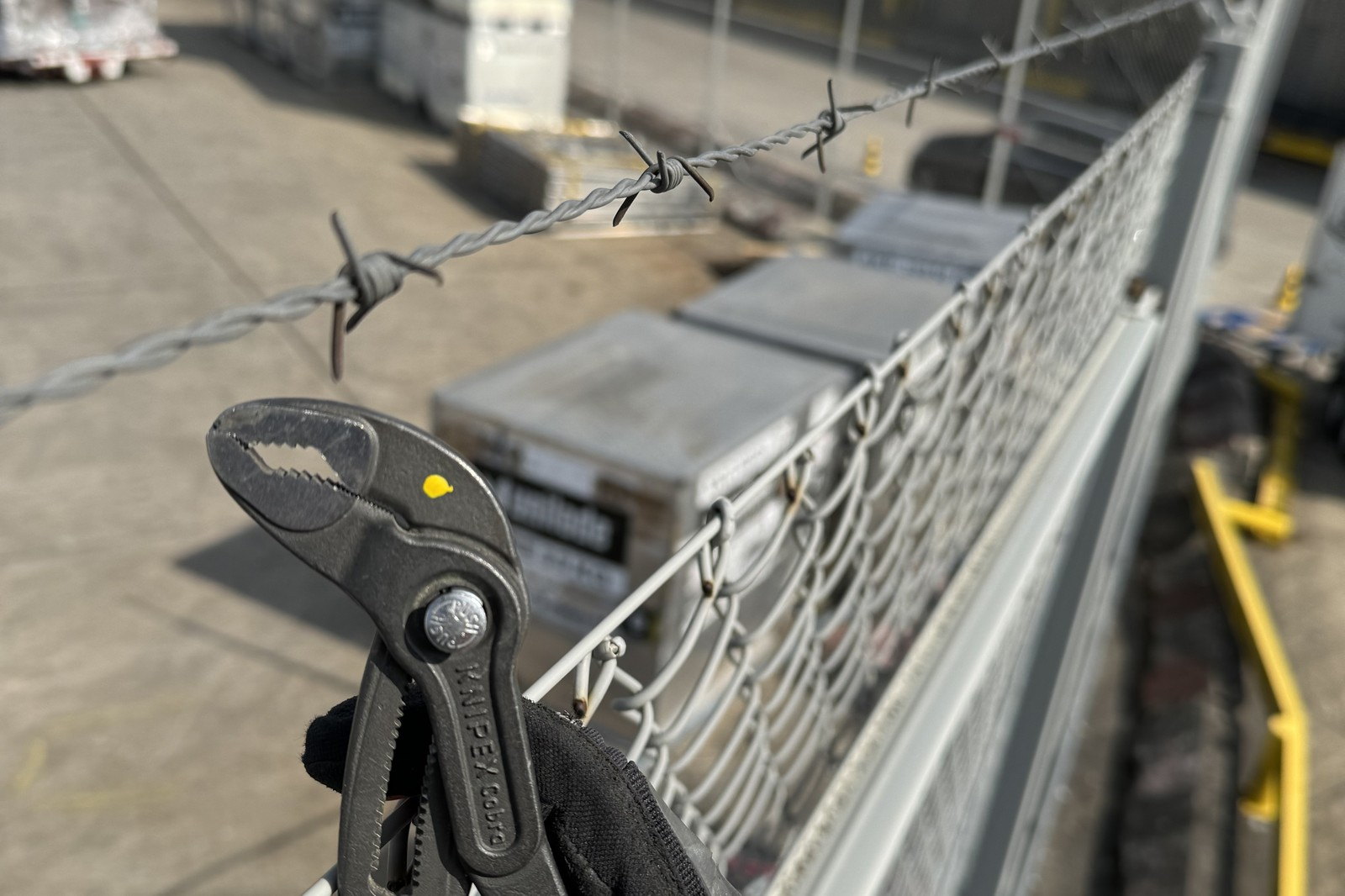
Security fence in a cargo area: retensioning the mesh, checking the turnbuckles – repairs during ongoing operations.
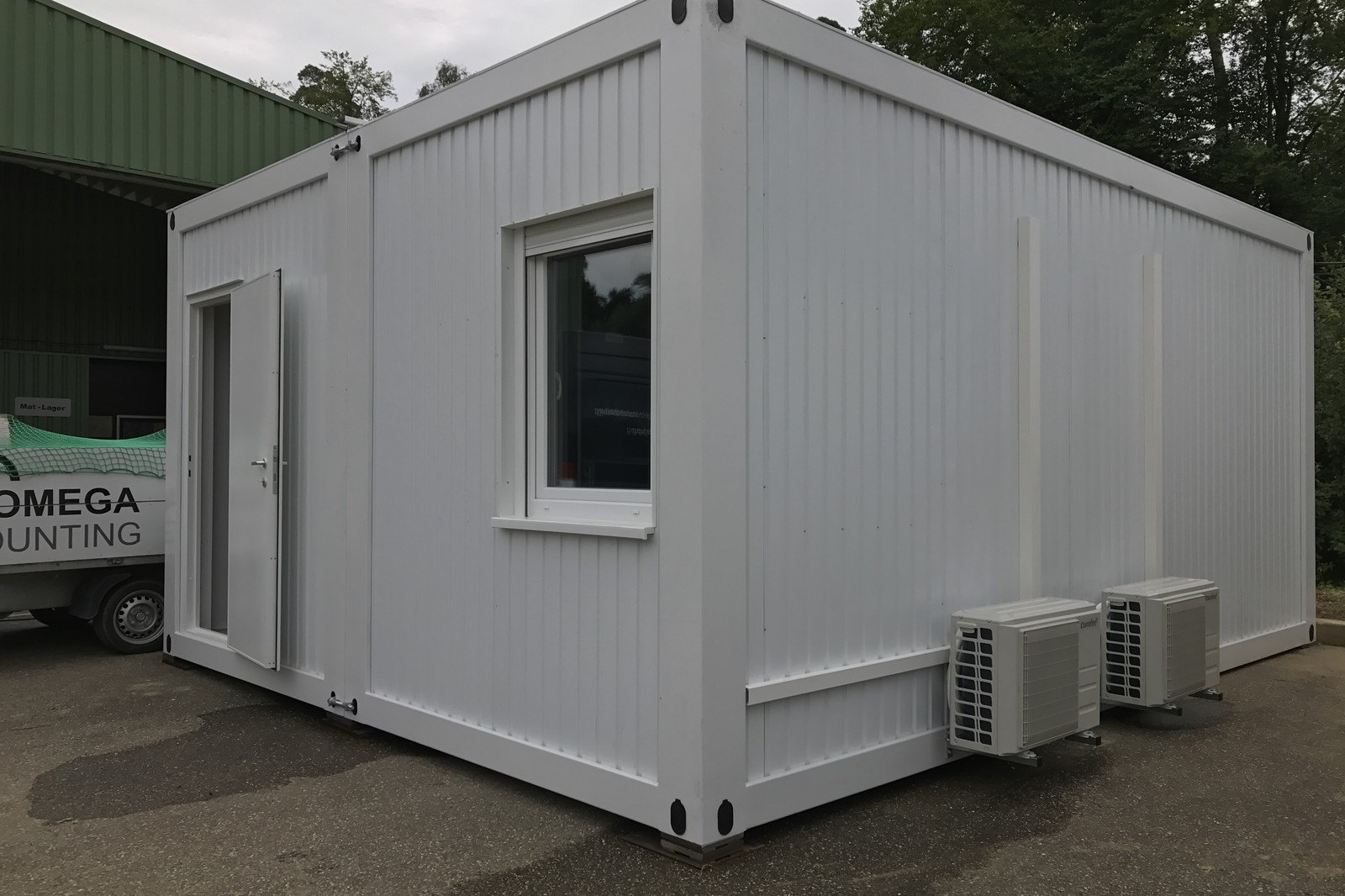
Finished room module: window, door, air conditioning – set up ready for handover.
 English
  German