
- Worth knowing – Moving in standby generators
Moving in standby generators: how a standby power system gets into a data centre
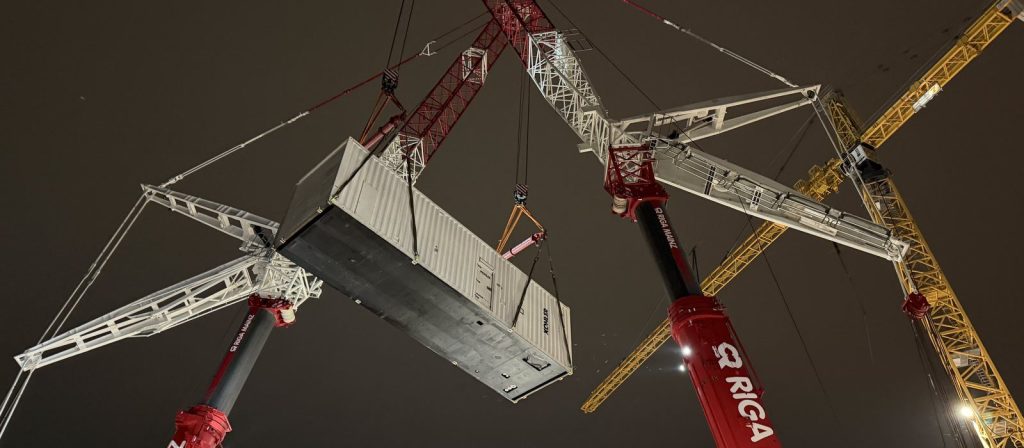
More than 60 generators moved in over three years – from a tandem lift with two 650-tonne cranes to a height of 16 metres through to a standby power system ready for connection
A standby generator has been ordered, built and delivered. It is standing on the low-loader in front of the building. And then the part begins that nobody gave much thought to beforehand: how does a unit weighing more than twenty tonnes get to the second floor of a building?
Two very different clients ask us this question. One group are the operators and general contractors of data centres having a standby power system installed. The other are the manufacturers and suppliers of the generators themselves – specialist firms that build their unit superbly, but do not keep their own installation crew with lifting equipment. For both, Omega Mounting takes on the same section: moving in, positioning, fixing, full assembly and completion to the point where only the manufacturer's commissioning is left.
Over the past three years we have moved in more than 60 standby generators this way. The largest in the 2 to 3 megawatt class, plus numerous smaller units in the megawatt range. The heaviest generator weighed a good 20 tonnes as a bare unit; as a complete container solution we have lifted standby power systems of 54 tonnes.
This article describes how that works – among others on a new-build data centre in the Frankfurt area, where we handled the complete moving-in and assembly of the generators for the general contractor. And it describes why the same task recurs across critical infrastructure: in hospitals, at universities, in government data centres – wherever operations must not depend on the public grid staying up.
Project profile
- Generators moved in: more than 60 in three years
- Power classes: up to 2–3 MW on the largest systems, plus smaller units in the megawatt range
- Heaviest single unit: a good 20 tonnes
- Heaviest container solution: 54 tonnes
- Largest lifting equipment used: tandem lift with two 650-tonne mobile cranes
- Typical lift height to the second floor: around 16 metres
- Team: mechatronics engineers, electricians and industrial mechanics in mixed crews – on large projects continuously on site for months
- Scope of work: moving in, positioning, fixing, complete mechanical assembly of the indoor solution as well as connecting container solutions to the building – through to commissioning readiness
- Client: general contractors and operators of data centres as well as manufacturers and suppliers of standby power systems
What is a standby power system – and why is it more than just a generator?
A standby power system, NEA in German shorthand, is the installation that takes over a building's power supply when the public grid fails. In everyday language it is called an emergency generator or standby generator. Technically it is not a single device but a system of several assemblies that have to work together.
At its core is a diesel engine driving a generator. But it also includes cooling via a radiator, the exhaust run with manifold, silencer and – on modern systems – an SCR system for exhaust after-treatment, the supply of fuel, coolant and AdBlue together with the associated tanks, and the switchgear cabinets through which the unit is controlled and connected to the grid. Only all of it together makes an installation that takes over within seconds when it matters.
One distinction is decisive for the assembly work: container solution or indoor solution.
With the container solution the complete unit arrives in the yard ready to run inside a container. The lift is correspondingly larger – the heaviest container solution we have moved in weighed 54 tonnes. The assembly work then lies in the connections: exhaust, cooling, fuel, control lines and power connections between container and building.
With the indoor solution, also called a room solution, the generator is set up in a room built specially for it inside the building. In data centre construction this is the normal case, because land on the site is expensive and noise control is easier to manage inside the building. But it means every single assembly has to be brought into the building and installed there.
It is exactly this difference that turns a delivery into an installation project.
Why moving in is the critical point in the schedule
Because it is the one step that cannot be moved without moving everything else. A generator room cannot be fitted out while the generator is not yet in it – and the generator no longer gets in once the wall is up. Moving in is a window, not an activity.
We have seen this several times in data centres, and it is the reason we want to be involved in the planning early. During the removal of a spider crane from a data centre basement the building had literally been finished around the machine. In the end two centimetres were missing – despite correct measurements. We solved it with an angled sling on an adjustable chain. Situations like that do not arise from carelessness, but from the fact that months pass between planning and installation, months in which a building changes.
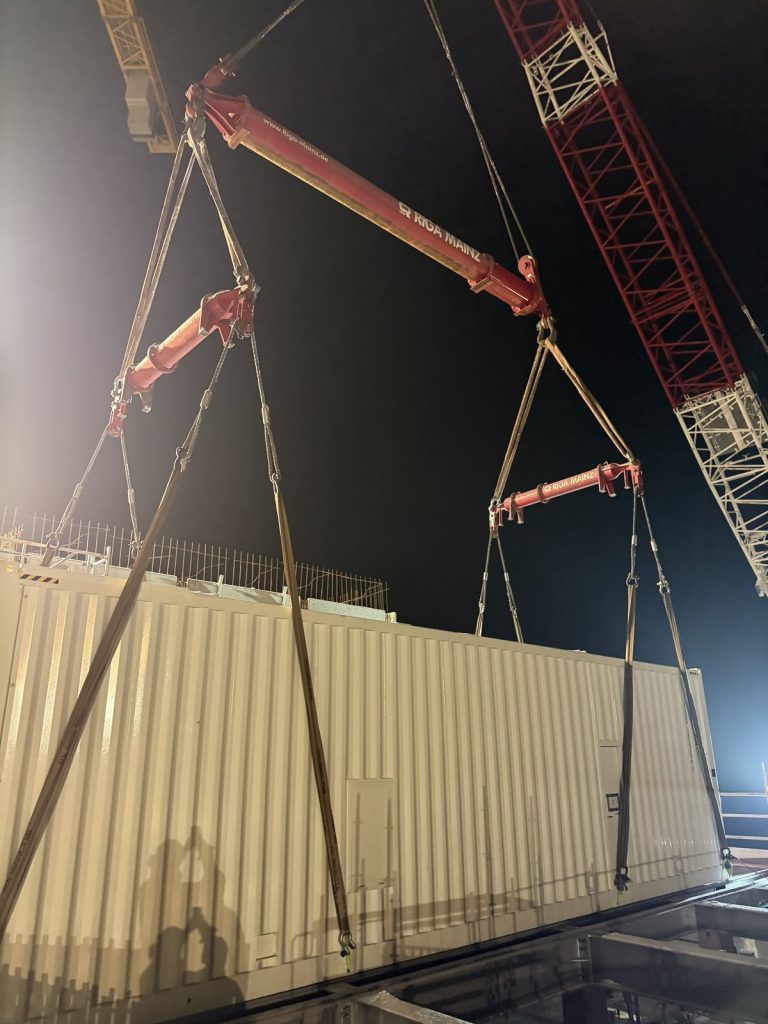
With standby generators there is the added difficulty that they are heavy, bulky and sensitive at the same time. A unit tolerates no point loading on the wrong component, no twisting of the frame and no slinging against housing parts not intended for it. The manufacturer specifies the lifting points, and those are what you use – even when a different geometry would make the lift easier.
There is no spare machine
That is the sentence that separates every generator lift from every other lift. What hangs on the hook is not a steel component you can simply reorder. What hangs on the hook is a unit worth several hundred thousand euros, with long lead times and no replacement on the shelf.
And more depends on it than its purchase value: this unit is the resilience of the entire site. If it is damaged, it is not only a machine that breaks – the commissioning of the data centre then slips by the time it takes to obtain a replacement.
That is why we treat a generator lift differently from a pallet. Every lift is planned in detail in the lift plan: load assumptions, sling geometry, crane position, radius, ground pressure, sequence of movements. And before the lift the entire crew is briefed – not only those standing at the crane, but everyone moving through the area that day. People who know what is about to happen do not step aside on impulse.
This care is not over-caution, it is simply the conclusion of the arithmetic: the hours a proper plan costs are not measurable against the value of the load.
How does a generator get to the second floor? The three methods
There is no such thing as The method. There are three, and which one fits is decided by the building, not by the weight.
1. The crane lift – when the building can be reached from outside
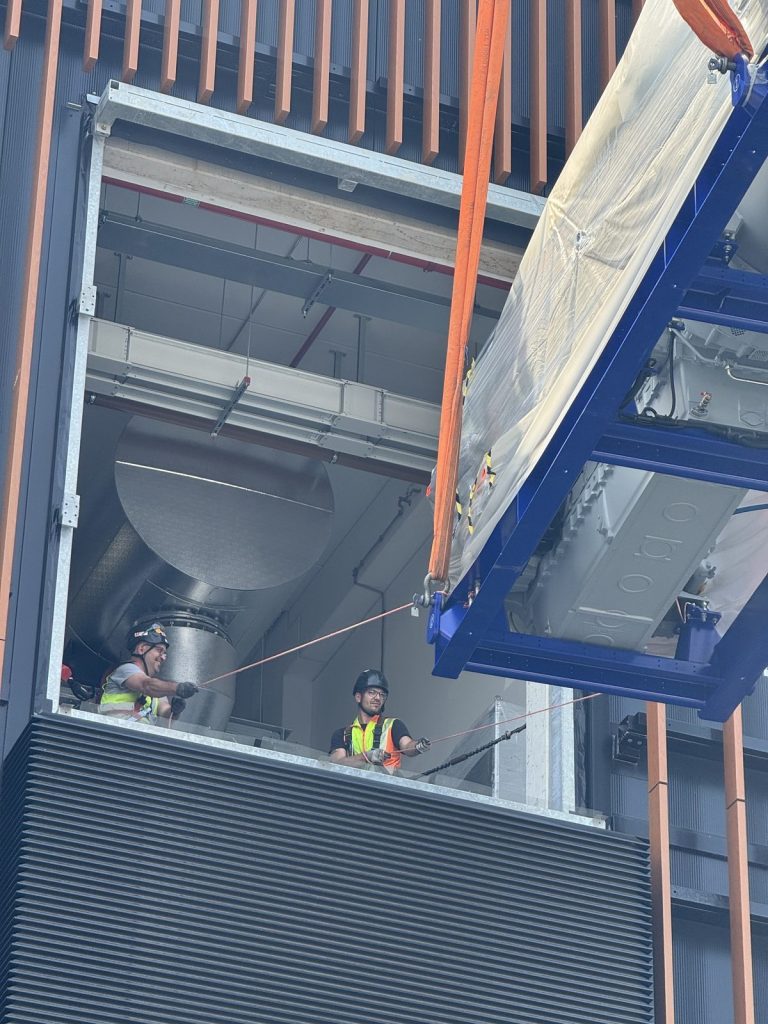
The normal case in new build: as long as the façade is still open or an opening has been provided, a mobile crane lifts the unit straight onto its floor. That is fast and gentle on the component, because it is raised once and set down once.
The work lies in the preparation: check the crane's standing area, calculate outrigger forces against the bearing capacity of the ground, determine radius and load capacity at the target point, select slings to the manufacturer's specification, write the lift plan and have it approved. On lifts in data centre construction this lift plan is not a formality but the basis for the general contractor's approval.
2. The tandem lift – two cranes, one component
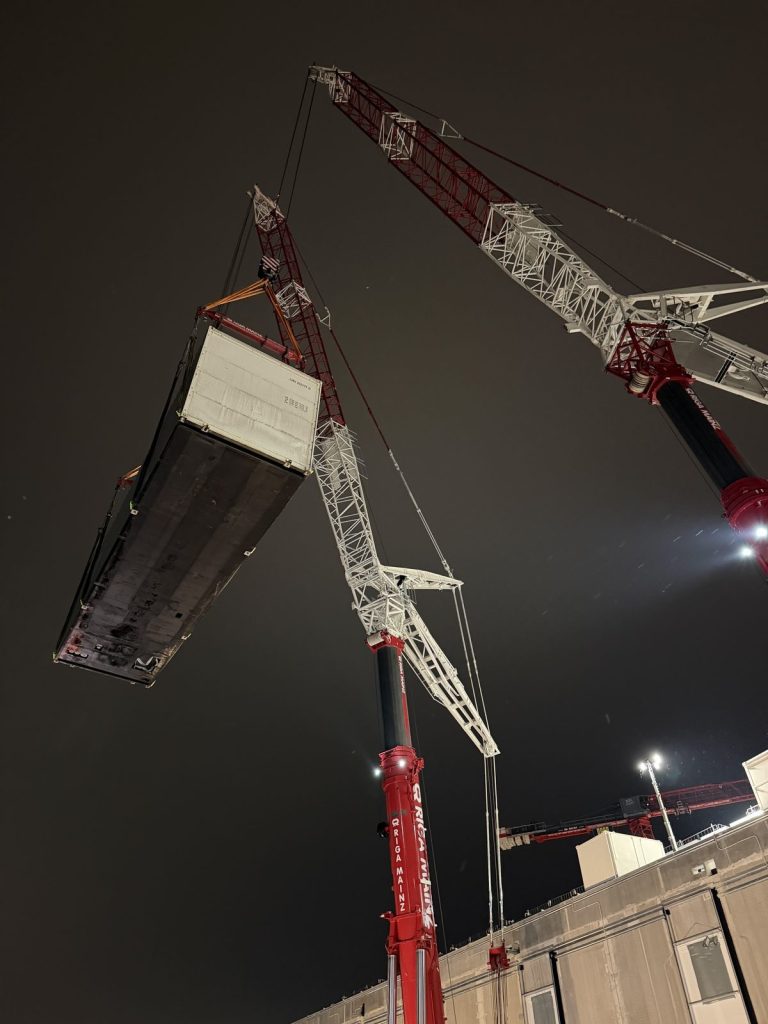
The tandem lift is the supreme discipline of moving in. Two mobile cranes lift the same component at the same time. It is used when one crane alone cannot manage the load at the necessary radius, when the component is so long that it would tip on a single hook, or when it has to be threaded in at a particular attitude.
On our project in the Frankfurt area that was exactly the case: the generator rooms are on the first and second floors, and the units had to go in there by tandem lift. In buildings like these the second floor typically means a lift height of around 16 metres. The largest cranes we have used on tandem lifts were two machines of 650 tonnes capacity each – a figure that says less about the weight of the load than about the radius you have to work at.
Why that is demanding can be said in one sentence: Two cranes are not twice as safe as one, they are twice as complicated. Both machines have to move in sync. If one lags, the load shifts onto the other – and the load distribution set out in the lift plan no longer holds. Every deviation from level changes the forces at both hooks. That is why on a tandem lift exactly one person gives the commands and everyone else carries them out. This role – internationally the lifting supervisor or appointed person – is named at our company, appointed in writing and present on site.
3. Heavy-duty rollers and moving robots – when a crane can no longer reach
Once the building is up, the crane is no longer an option. Then the unit goes in across the floor: it is placed on heavy-duty rollers or machine skates and manoeuvred to its place along the existing routes – through gates, up ramps, along service corridors. For the last few metres and for setting it down on the foundation to the millimetre we use moving robots and lifting devices that still work where there is no room for a forklift.
This method is slower than a crane lift, but it is often the only one left. We have used it among other places on the installation of 160 PDCs in eight data halls and on moving load banks and generators into a data centre in Frankfurt.
One particularity that data centres bring with them and that many underestimate: combustion engines are taboo inside the building. No diesel forklift, no diesel-powered lifting device in the whitespace or in adjacent areas. Whatever goes in runs on electricity – and needs power, which is not always available on a construction site.
What comes after the lift: the complete assembly of the indoor solution
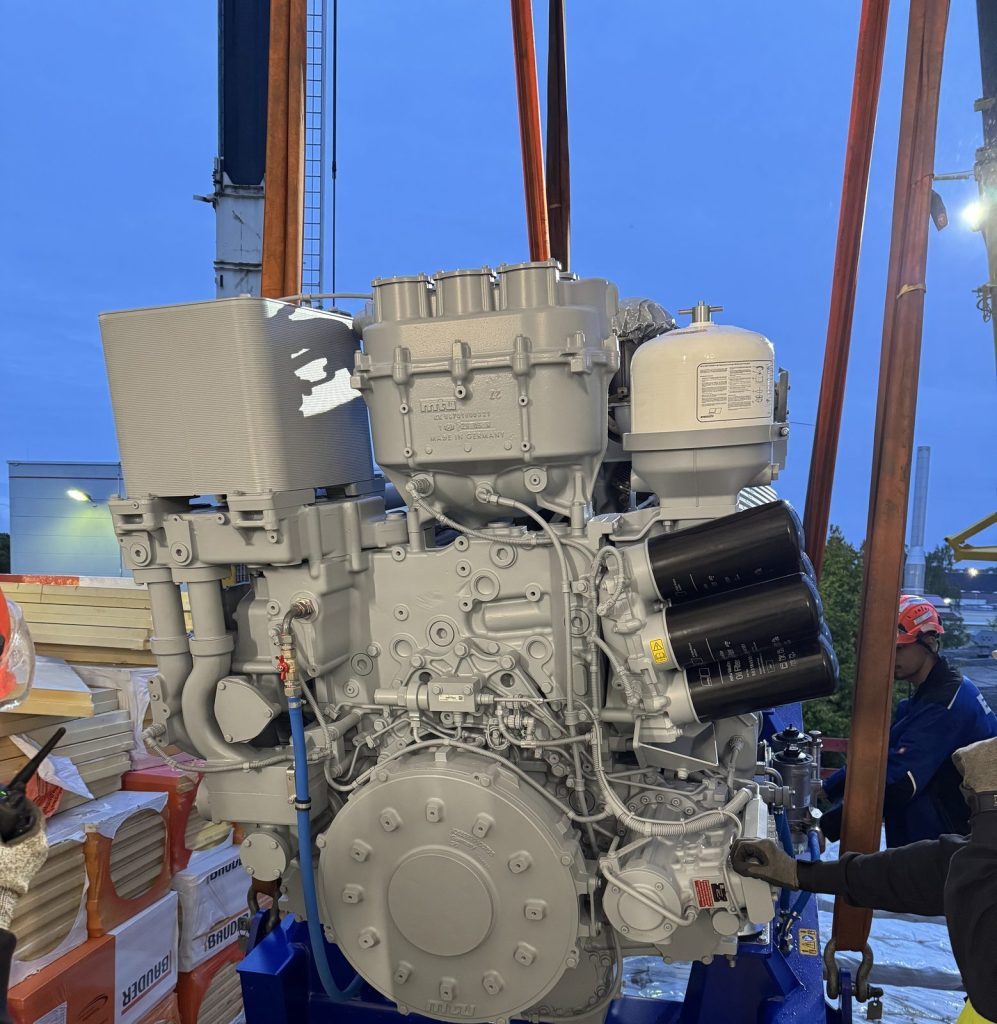
The lift is the visible part. The build-up is the long one. Once all the assemblies were standing in the generator room, we put the installation together – component by component, until the individual parts became a machine.
That included:
- The radiator – the cooling of the unit, together with the pipework to the engine. How sensitive this assembly is can be seen in another job of ours: the radiator repair on a standby generator in Offenbach, where in the end there was only one question – is it tight?
- The SCR system for exhaust after-treatment, which reduces the nitrogen oxide emissions of the diesel engine and is standard on new installations. SCR systems are heavy, have to be mounted on a frame and structurally often sit directly above the generator – which means the connection between the two has to be able to absorb movement.
- The manifold and the rest of the exhaust run. How much work the exhaust side alone can mean is shown by the installation of twelve twin turbo silencers in a data centre in Offenbach – noise control is no side issue for standby power systems in inhabited surroundings.
- All connectors: hoses, lines, coolant supply, AdBlue supply and the associated AdBlue tanks.
- The switchgear cabinets, set, aligned and connected.
At the end there was an installation on which only the commissioning was missing.
Three trades, because a standby power system needs three trades
On these projects industrial mechanics, mechatronics engineers and electricians work in the same crew. That is not a staffing question but a technical one: mechanics set and align, mechatronics takes care of sensors and control, the qualified electrician handles the electrical side. If those were three companies, every interface would be an appointment.
On large data centre projects our teams are therefore not on site by the day but continuously for months – for connecting container solutions to the building just as much as for the complete build-up of entire room solutions on behalf of the suppliers.
Why we do not do the commissioning ourselves – and why that is a strength
Here we deliberately draw a line. Commissioning a standby power system – test run under load, parameter setting, acceptance, handover of the test records – is done by the supplier that built the unit. They know their control system, they are liable for the performance data, and they issue the paperwork.
Our job ends at the point where the installation is ready for commissioning : mechanically complete, aligned, connected, tight, properly documented. The manufacturer arrives and finds an installation they can start on – not a building site they first have to clear.
We have run this model – we install, the specialist firm commissions – in data centres for years and with several partners. It is the reason generator suppliers bring us in: they get an installation crew with its own lifting equipment without having to build one themselves.
What matters when fixing the unit down
A generator is not put down, it is set. In operation it produces vibration, and that vibration must neither travel into the building nor fatigue its own attachments.
In practice that means: the foundation or the base frame has to be level – not roughly, but within the manufacturer's tolerance. We level, shim where necessary and check afterwards. The vibration dampers are loaded evenly, otherwise one of them works alone. And every connection to the unit – exhaust, coolant, fuel – gets a flexible section wherever it joins a moving assembly to a rigid one. Rigid pipework on a vibrating engine will crack. Not immediately, but certainly.
That is another point where experience pays off: you cannot tell from an installation on handover day whether it will still be tight in five years.
Safety: what a lift of this magnitude demands
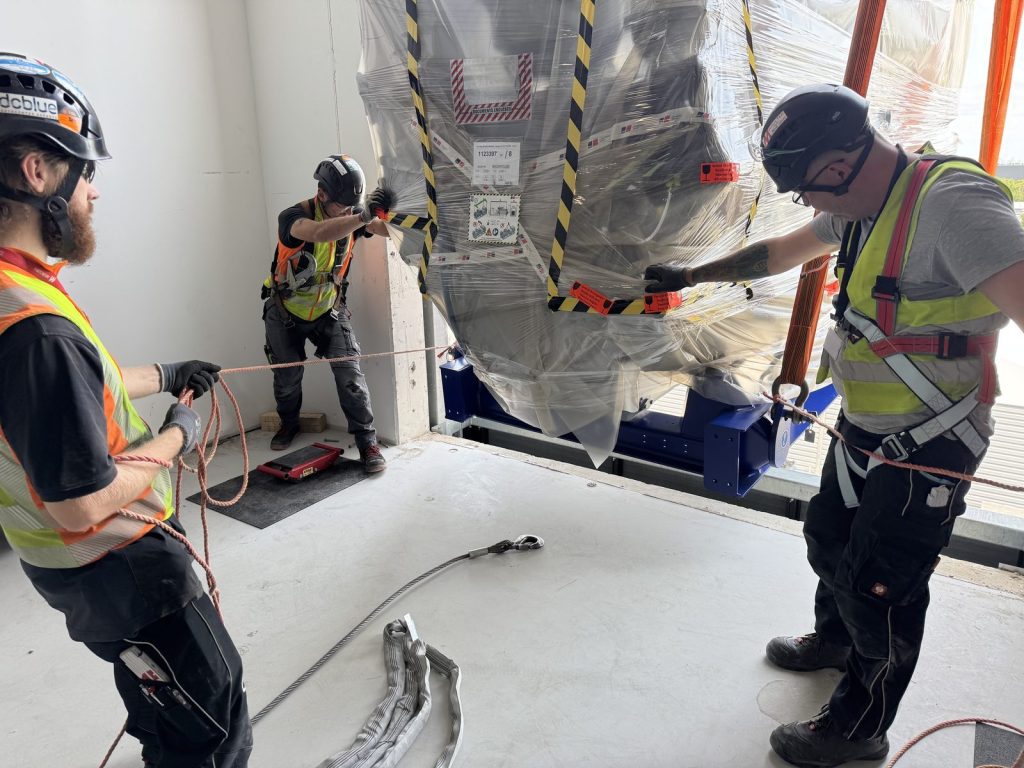
Lifts involving standby generators bring three risks together: high loads, work under a suspended load, and surroundings in which other trades are working in parallel. Our procedure is therefore fixed, not improvised:
- Lift plan before the lift, with load assumptions, sling geometry, crane position, radius and approval. On tandem lifts additionally the load distribution across both cranes and the sequence of movements.
- Briefing for the whole crew before the lift – not only for those slinging and guiding.
- A named lifting supervisor. On a tandem lift exactly one person gives the commands.
- Secondary securing under a suspended load. Where people have to work under or beside a load, it is additionally secured mechanically – timber stacks, timber baulks, a second lifting device. On paper one is enough. For people underneath, on paper is not enough.
- Slings to the manufacturer's specification, not to habit. Chains instead of round slings on sharp edges.
- Documentation to the client’s standard – RAMS, permits, risk assessment, photo documentation, in German or English, whichever the client requires. In data centres this is standard, and we bring it with us instead of having it explained to us.
The same task across critical infrastructure
Data centres are the sector in which we move the most standby power equipment. But the task itself is the same wherever a facility must not fail: in clinics and hospitals, at universities and research institutes, in government buildings, at utilities, in plants with processes that would not survive a grid failure.
The technology is identical. What differs is the setting:
- Operations continue. In a new build the site is the site. In an existing facility you work alongside live operations, often in tightly set windows, at night or at the weekend.
- Access is harder. Existing buildings have no open façade. Then heavy-duty rollers, moving robots and – where there is one – the installation shaft are the way in. On a generator service on a standby power system in the Rhine-Main region we worked through exactly such a shaft with the mobile crane.
- Entry is controlled. Security areas, access control, screened personnel, work permits. For us that is routine – we regularly work under such regimes, among other places at Frankfurt Airport and on sites with access screening.
- Redundancy is the whole point. When an existing installation is replaced, the facility is unprotected in the meantime. What that means we experienced on an emergency call-out on a Sunday evening in Dietzenbach .
What standby power can do when it really matters we have also seen well away from any building site: on the setting up of the power supply for a relief camp in the Ahr valley, around a kilometre of cable and a 63 A distribution board, so that work could be done at all.
Why Omega Mounting?
- More than 60 standby generators moved in over three years – up to 2–3 MW output, up to a good 20 tonnes as a single unit and up to 54 tonnes as a container solution. That is routine, not a reference list.
- Ten documented data centre references – from moving in, through CRAH units and fire suppression systems, to removal from the basement. Access rules, security areas, lift plans and the diesel ban inside the building are everyday business for us, not a special case.
- Standby power equipment across the whole life cycle: moving in, installing, servicing, repairing, replacing. Radiator, exhaust run, SCR system, silencer, load bank test – documented in our own jobs, not as a promise of performance.
- Our own lifting equipment and our own fitters. No brokering, no subcontractor merry-go-round. Mechanical assembly, electrical work and welding come from the same installation team – on large projects continuously on site for months.
- Extended workbench for manufacturers and specialist firms. You supply the unit and commission it, we bring it in and build it up. On request we appear neutrally and report progress to your project management.
- Our own workshop in Rodgau with metalwork shop, welding equipment and milling machine. If a fitting piece, an adapter or a reinforcement is missing on site, we make it rather than wait for a delivery date.
- Rooted in the region: From Rodgau we are quickly on site in Frankfurt, Offenbach, Hanau and Raunheim – and we work across Germany.
Conclusion
A standby generator is not a device you deliver and plug in. It is an installation project that begins with the question of how it gets to its place at all – and that only ends when every assembly is seated, every connection is tight and the installation is ready for commissioning.
We have done that more than 60 times in the last three years: with crane lifts and tandem lifts using up to two 650-tonne machines, with heavy-duty rollers and moving robots where the building was already standing, with units up to a good 20 tonnes and container solutions up to 54 tonnes. On our project in the Frankfurt area that meant tandem lifts into the generator rooms on the first and second floors, around 16 metres up, followed by the complete build-up of the units as an indoor solution – radiator, SCR system, manifold, coolant and AdBlue supply including tanks, switchgear cabinets, all connectors.
The general contractor had one point of contact for the entire chain. The manufacturer found an installation they could start commissioning immediately. And not a single unit was damaged – which, with equipment for which there is no replacement, is the metric that actually counts.
Request a callback for your project now – Omega Mounting GmbH, Rodgau. Whether it is a new-build data centre, the replacement of an existing standby power system or moving a unit into a building that has long been standing: tell us what has to go where, and we will look at the routes before we write a quotation. On site among other places in Frankfurt, Offenbach, Hanau, Raunheim and Aschaffenburg – and across Germany wherever we are needed.
100 % non-binding and free of charge.
Is a generator installation coming up?
Tell us briefly what it is about – we will come back to you with an honest assessment.
100% free and without obligation
Frequently asked questions
Our heaviest single unit moved in weighed a good 20 tonnes, the heaviest complete container solution 54 tonnes. Weight is rarely the limit – what matters is the radius, the standing area for the crane and the load capacity of the route inside the building. On tandem lifts we have worked with two cranes of 650 tonnes each.
On a tandem lift two cranes lift the same component at the same time. It becomes necessary when one crane cannot manage the load at the required radius, when the component would tip on a single hook, or when it has to be threaded in at a particular attitude. A tandem lift demands synchronised crane operation, a lift plan with the load distribution across both machines, and a single person giving the commands.
There is no blanket answer, because it is not the weight that determines the effort but the route. A crane lift with an open façade is a fraction of what it costs to move a unit in on heavy-duty rollers through a finished building. That is why we walk the route from the low-loader to the foundation before quoting, and only then do the sums. A fixed price without a site walk is an estimate in an existing building, not a calculation.
Yes, that is our focus. When a crane can no longer reach the component, we work with heavy-duty rollers, machine skates, moving robots and our own lifting equipment along the existing routes – through gates, up ramps, along service corridors. Where necessary we dismantle far enough for the assemblies to fit through the existing opening and reassemble at the installation point.
No, and for good reason. Commissioning is done by the company that built the unit – they know their control system and are liable for the performance data. We hand the installation over ready for commissioning: mechanically fully assembled, aligned, connected, tight and documented.
Yes, that is a substantial part of this business. Manufacturers and specialist firms book us as an extended workbench for moving in and assembly at the end customer – with our own crew, our own tools and our own lifting equipment. On large projects we provide teams that are continuously on site for months. On request we appear neutrally and report directly to your project management.
With the container solution the unit arrives ready to run in a container and is set in place as a whole – the lift is bigger, the assembly work lies in connecting it to the building. With the indoor solution the generator stands in a room inside the building and is assembled there from its component groups: radiator, exhaust run, SCR system, supply lines, tanks and switchgear cabinets moved in and installed individually. The indoor solution is the normal case in data centre construction and by far the more assembly-intensive route.
Because exhaust gases and soot particles have no place in areas with sensitive technology and a defined air flow. Whatever drives into a data centre runs on electricity. That sounds like a detail, but it changes the planning considerably: electric lifting devices need charging infrastructure, and that is not automatically available on a construction site.
Yes. We are based in Rodgau in the district of Offenbach, in the middle of the Rhine-Main region – the area with the highest density of data centres in Europe. We reach Frankfurt, Offenbach, Hanau, Raunheim and Aschaffenburg quickly, and for larger projects we travel across Germany.
 English
  German