

Proximity switches: inductive, capacitive, PNP or NPN

By Tobias Schott  · 5-minute read · Updated November 2026

A proximity switch reports without contact whether something is there – and because dozens of them release every movement on a conveyor system, it is one of the most common reasons why a system stops.

You encounter proximity switches as “initiators” on conveyor systems, stoppers and switches, as limit switches on doors and hoists, as level sensors on containers. The rating plate bears codes such as PNP, NO, Sn 4 mm or “flush”. Anyone replacing an initiator should know what they mean.

This article explains how proximity switches work, which types exist and why replacing one is more than “same thread, same colour”. How to systematically troubleshoot a conveyor system is covered in the guide Conveyor system down: rectifying the fault.

What is a proximity switch?

A proximity switch is a sensor that detects an object without contact and then sends a switching signal to the control. In everyday operation it is often called an initiator or proximity sensor. It has no moving parts, therefore hardly wears and works reliably even with dirt and vibration.

The signal is usually digital: object present or not. The control links it with other signals and decides whether a cylinder moves or a belt starts. In German it is called Näherungsschalter or Initiator.

Key facts

Inductive, capacitive, magnetic: which sensor detects what

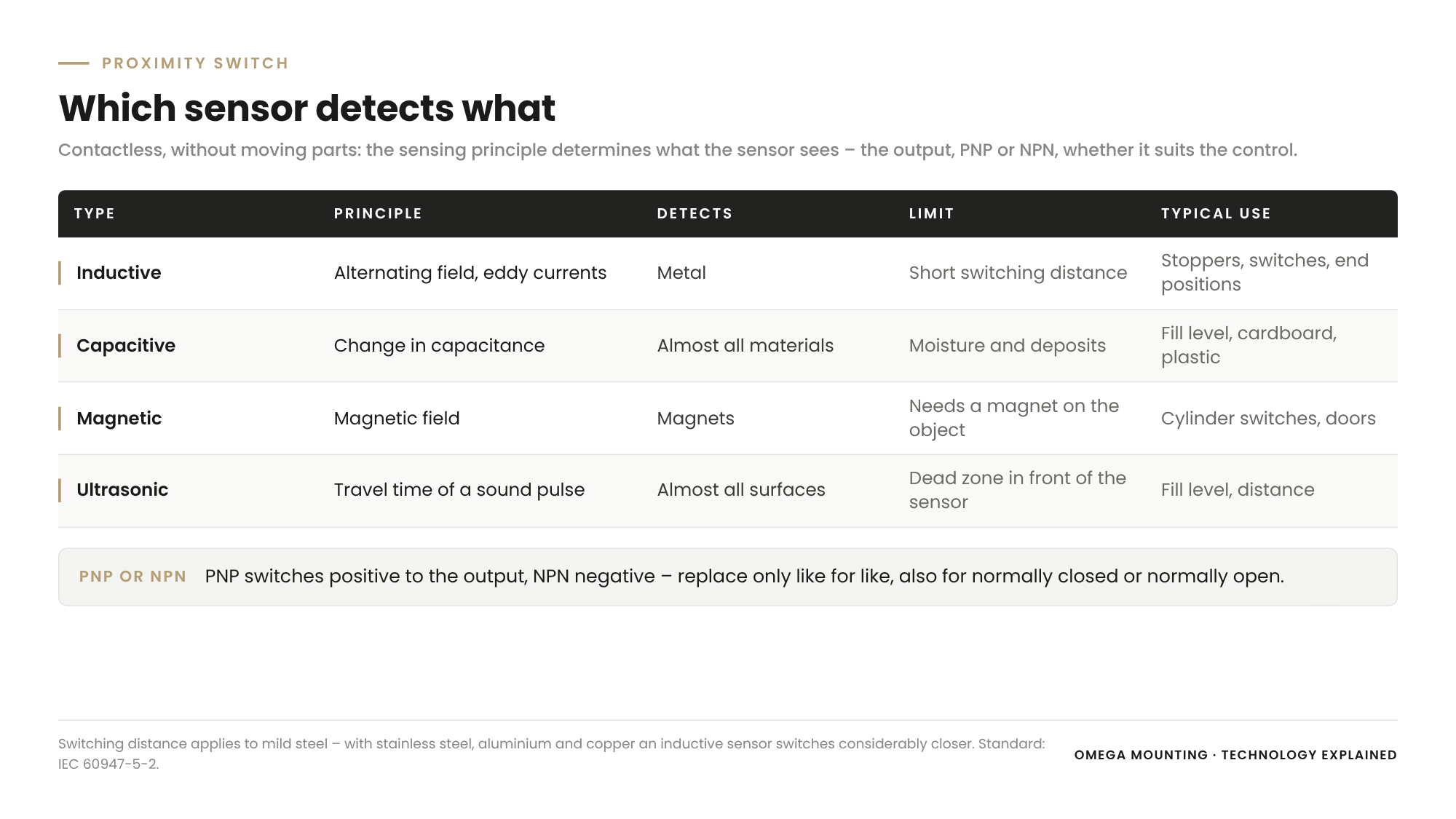
Explanatory graphic: proximity switches compared – inductive, capacitive, magnetic and ultrasonic with principle, limit and typical use
Metal, fill level or magnet: what the sensor is meant to detect decides the sensing principle. Graphic: Omega Mounting

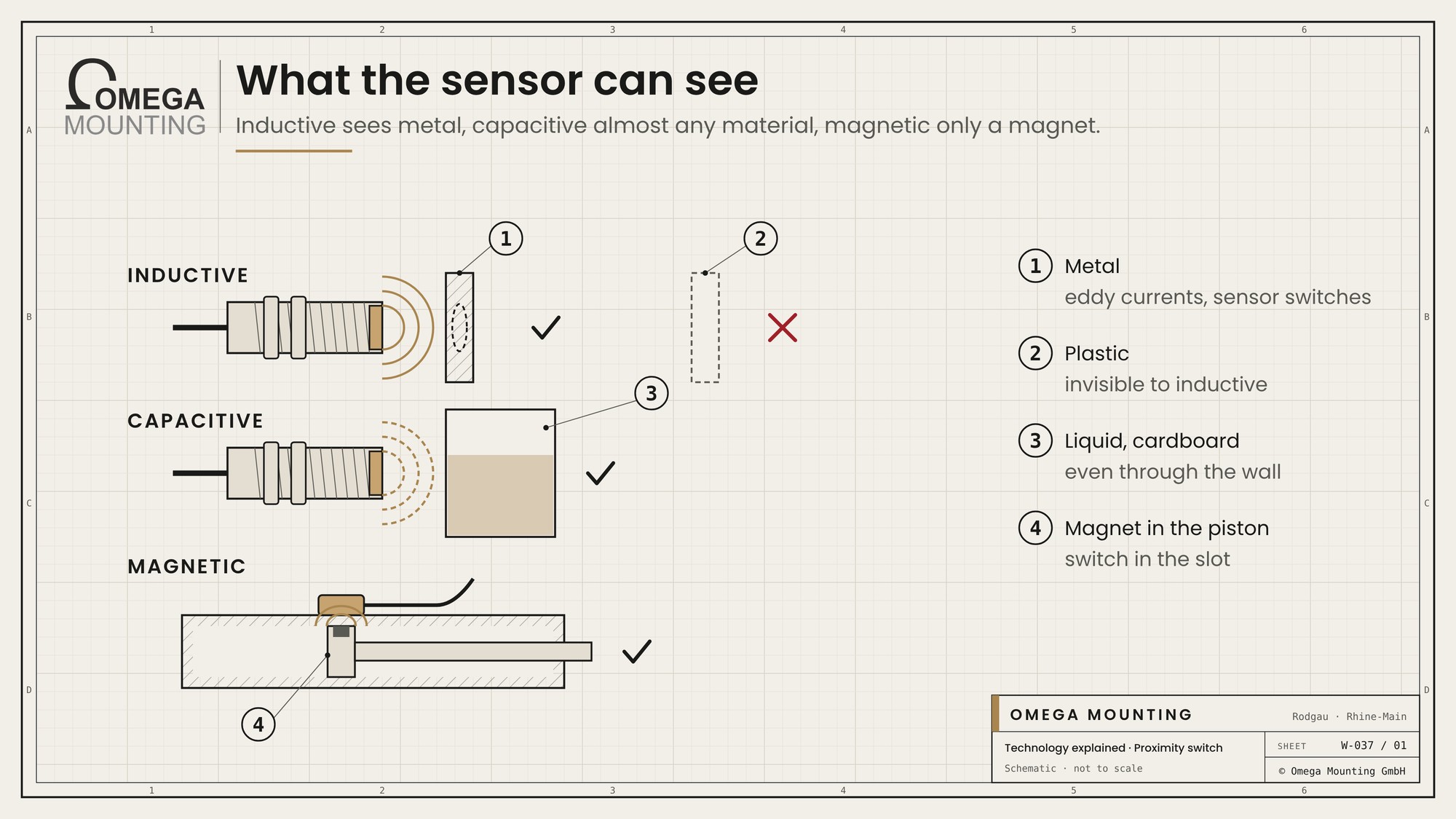
The sensing principle determines what the sensor can see at all.

Technical drawing: an inductive sensor detects a metal plate but not plastic, a capacitive sensor detects a liquid through the container wall, a cylinder switch in the slot detects the magnet in the piston
Inductive sees only metal, capacitive almost any material, magnetic only a magnet – the sensing principle determines what the sensor detects. Graphic: Omega Mounting

Inductive. The sensor generates an alternating magnetic field at its sensing face. If metal enters it, eddy currents arise in it that draw energy from the field – the sensor switches. It only detects metal, is robust and the standard on conveyor systems.

Capacitive. The sensor forms a capacitor with its surroundings. Any material with electrical properties different from air changes its capacitance: plastic, wood, cardboard, liquid. It is suitable for fill levels and non-metallic parts, but also reacts to moisture and dirt.

Magnetic. The sensor reacts to a magnetic field, such as the magnet in the piston of a pneumatic cylinder. This is how cylinder switches work.

TypePrincipleDetectsLimitTypical use
Inductive.Alternating field, eddy currents in the metal.Metal.Short switching distance, lower for non-ferrous metals.Stoppers, switches, end positions, speed.
Capacitive.Change in capacitance.Almost all materials, even through container walls.Sensitive to moisture and deposits.Fill level, cardboard, plastic parts.
Magnetic.Magnetic field.Magnets.Needs a magnet on the object.Cylinder switches, doors.
Ultrasonic.Travel time of a sound pulse.Almost all surfaces, including transparent ones.Dead zone directly in front of the sensor.Fill level, distance, stack height.

Optical sensors such as the light barrier work with light and have considerably longer ranges; we explain them in a separate article.

PNP or NPN, normally closed or normally open: the marking

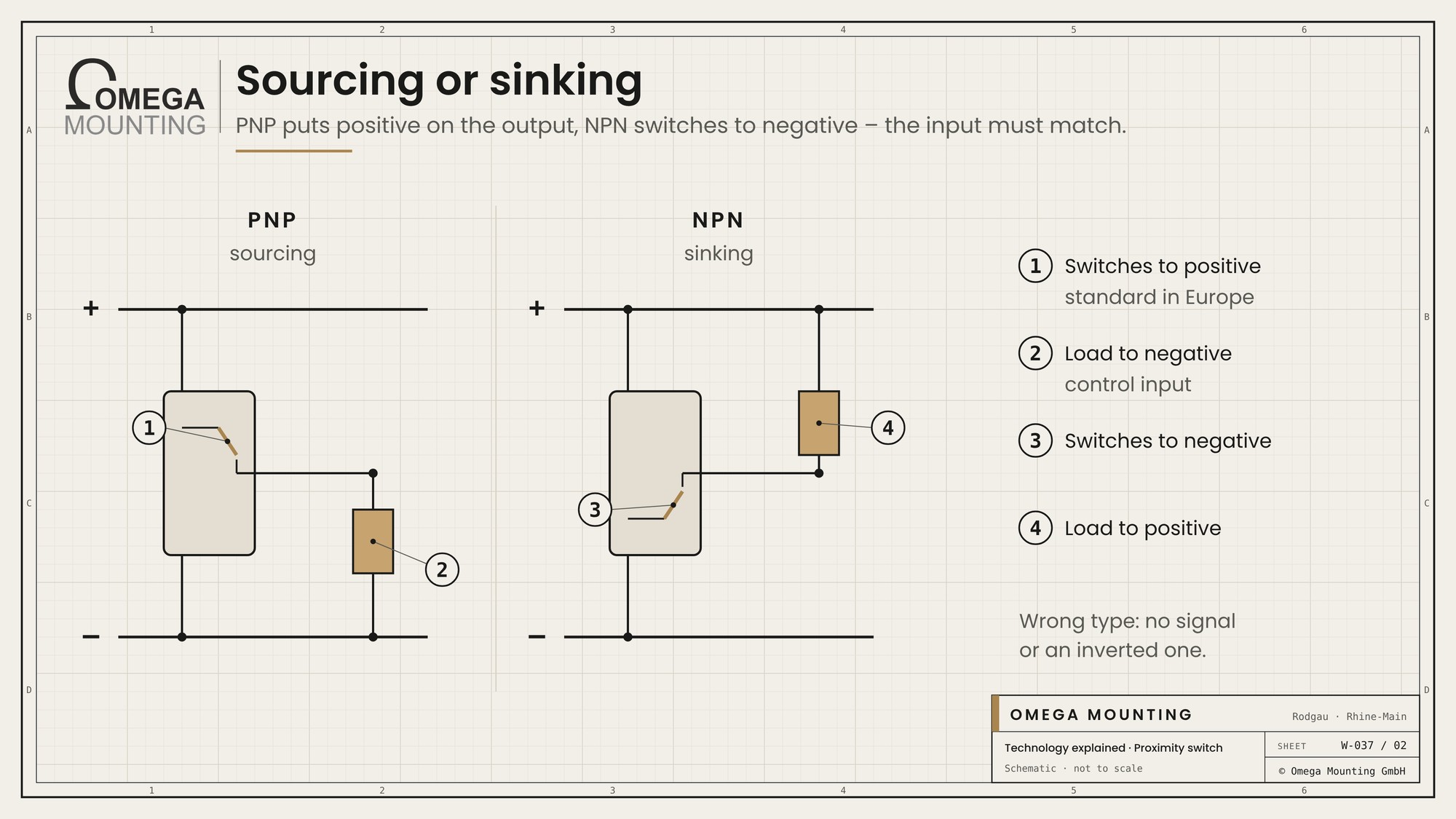
The output decides whether the sensor suits the control – a wrong type does not work at all or works exactly the other way round.

Schematic circuit diagram: on the left a PNP sensor that puts positive on the output, the load is connected to negative; on the right an NPN sensor that switches to negative, the load is connected to positive
PNP switches to positive, NPN to negative – if the type does not suit the control, there is no signal or an inverted one. Graphic: Omega Mounting

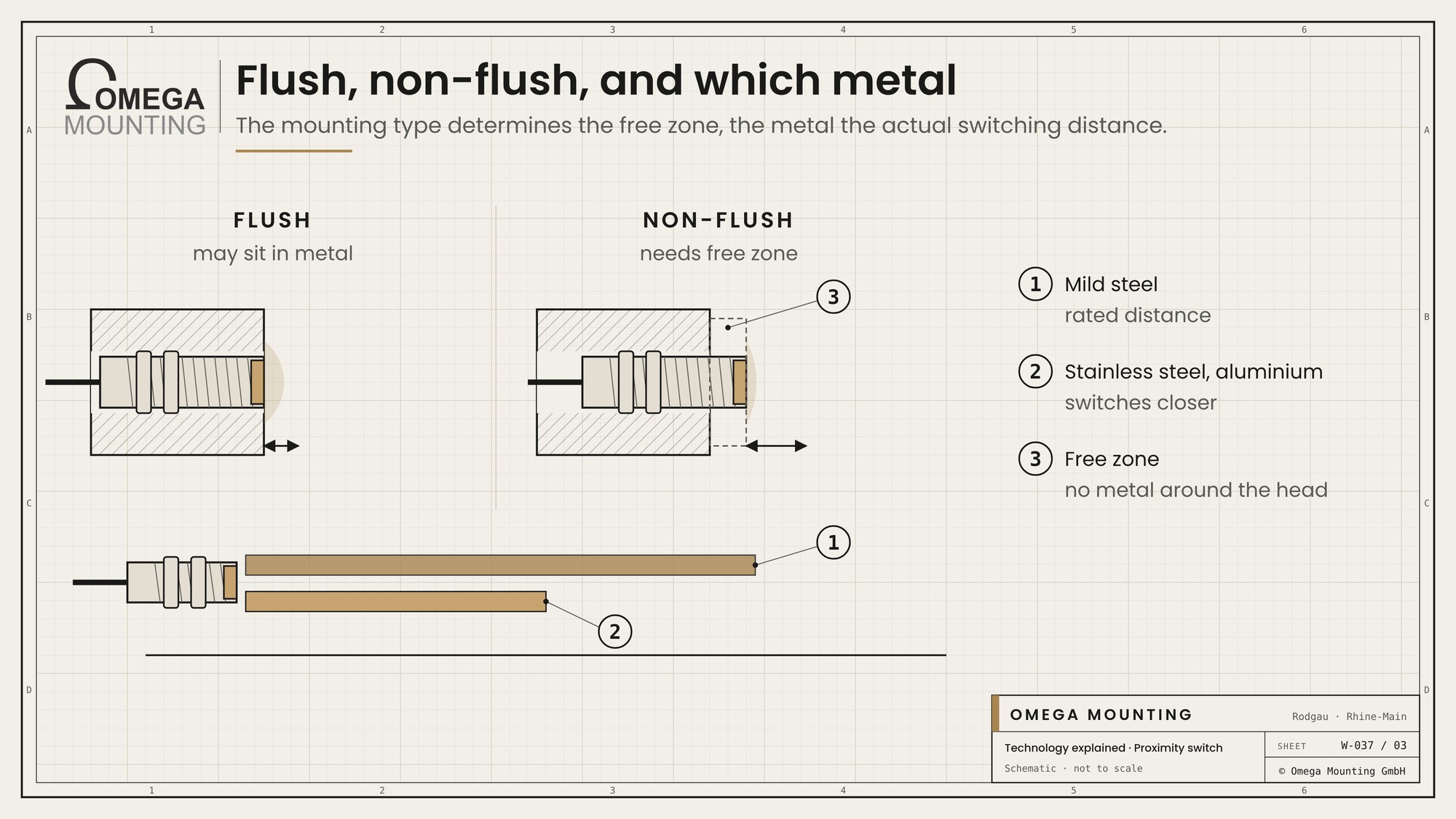
Added to this are the switching distance and mounting type. The rated switching distance applies to a measuring plate made of mild steel; with stainless steel, aluminium or copper an inductive sensor switches considerably closer. A flush sensor may be installed in metal, a non-flush one needs a free zone around the head, but has a longer range in return.

Technical drawing: a sensor installed flush in metal with a short switching distance and a non-flush sensor with free zone and greater switching distance, below it the switching distance for mild steel and the shorter one for stainless steel or aluminium
Flush may sit in metal, non-flush needs a free zone – and with stainless steel or aluminium an inductive sensor switches closer than with mild steel. Graphic: Omega Mounting

Typical faults on conveyor systems

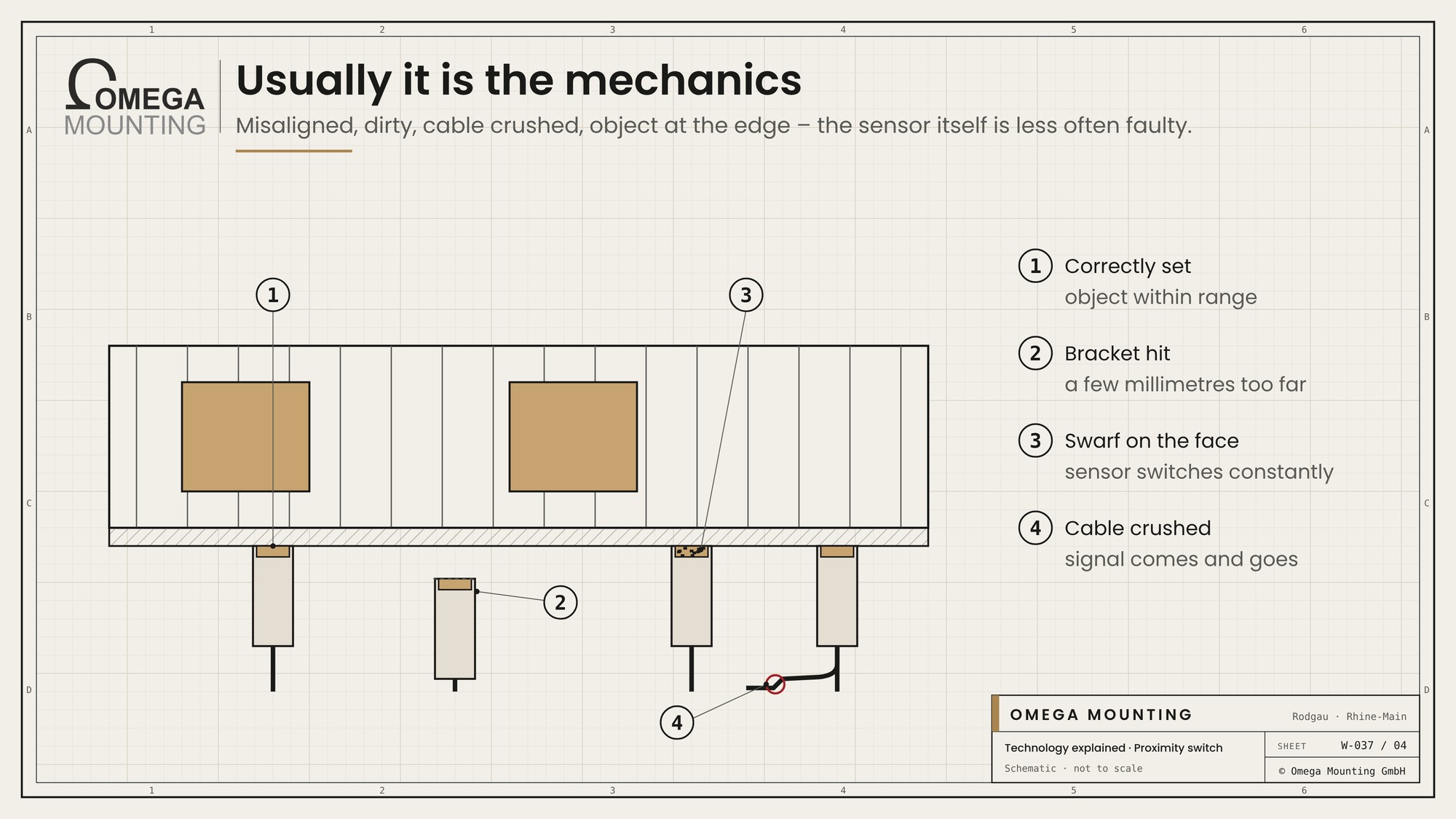
Most sensor faults have a mechanical cause – the sensor itself is less often faulty than it seems.

Technical drawing: conveyor from above with four sensors at the side – one correctly set, one too far away due to a bracket that has been hit, one with swarf on the sensing face, one with a crushed cable
Misaligned, dirty, cable crushed: most sensor faults have a mechanical cause. Graphic: Omega Mounting

What we pay attention to

A sensor is quickly replaced – it is only correctly installed when type, distance and function are right.

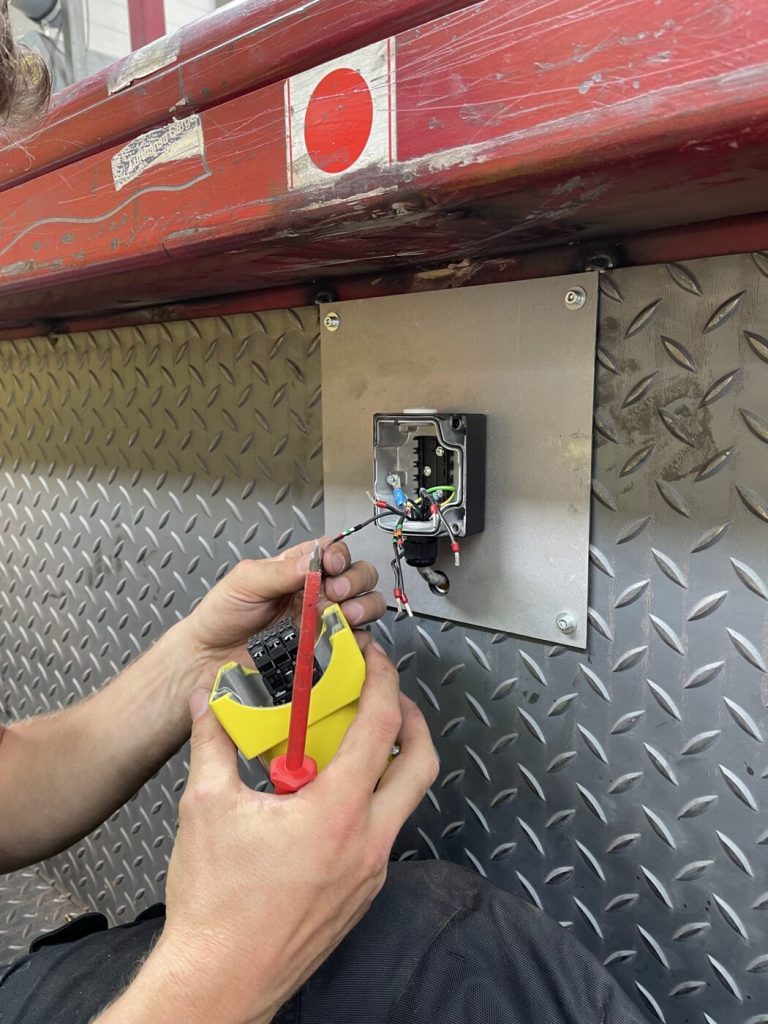
Connecting the cores in the emergency stop housing on the sorting system
Whether emergency stop button or sensor: every device on the conveyor system is connected properly and its function is checked before release.

Where we use it

We install and replace sensors during the maintenance of conveyor and sorting systems. During the extension of a parcel sorting system at Frankfurt Airport two fitters installed and aligned 32 emergency stop buttons and numerous sensors in two working days. The new buttons and sensors were electrically integrated into the existing safety chain; work was carried out during the day in the system’s downtimes. Such work is part of our Maintenance and servicing.

More technology explained

Technology explained

what the control does with the sensor signal.

Guide

the guide for when sensors in the accumulation section trigger faults.

Do you have questions about how this works on your site?

Do you have questions about how this works on your site – for example, which initiator is the right replacement on your conveyor system? We check, replace, adjust and test the function. Request a callback – we will get back to you.

Free, no-obligation callback

Tobias Schott, managing director of Omega Mounting GmbH, on a construction site in front of scaffolding

About the author

Tobias Schott

Managing director of Omega Mounting GmbH, Rodgau · more than 20 years of hands-on experience in installation and maintenance

A trained mechatronics technician, working in maintenance, servicing and industrial installation since 2004 – first alongside his father, and with Omega Mounting since 2012: from overhead conveyors in Frankfurt to the crane system in a new-build hall. He plans and leads lifting operations as an appointed person (AP) in data centers and on industrial sites in the Rhine-Main region, trains and examines operators of cranes, mobile elevating work platforms and telehandlers, and is a qualified occupational safety specialist. On jobs abroad he is known as the “German Troubleshooter” – the person you call when a site gets stuck. He learned what quality means from his father, not from a manual: Made in Germany as a standard for his own work, not a label. That is why quality comes first at Omega Mounting – ahead of speed and price. The Technology explained articles cover the equipment and techniques his team uses every day: what counts on site is in them – what only appears in the brochure is not.

EnglishEnglish