
- Technology explained – Tools and equipment
The angle grinder: disc, guard, kickback
By Tobias Schott · 5-minute read · Updated November 2026
The angle grinder cuts, grinds, deburrs and brushes – hardly any tool is used as often on installation jobs. But it is also one of the most dangerous. The right disc, a correctly set guard and knowing about kickback make the difference.
On site it is often just called the “grinder”. It is used to cut profiles to length, grind down welds, dismantle old plant parts and remove rust. Precisely because it is so commonplace, it is often underestimated.
Here we explain how an angle grinder is built, which disc is meant for what, how kickback occurs and what matters for working safely.
What is an angle grinder?
An angle grinder is a hand-held power tool in which a motor drives a disc at very high speed via an angle gearbox. The name comes from this gearbox: the disc is at right angles to the motor axis.
There are small one-handed tools for discs of around 125 millimetres and large two-handed tools for discs of around 230 millimetres. Small tools are handy and good for fine work. Large tools cut deeper but are heavier and react more violently when jammed.
The angle grinder can be operated with a cable or a battery. The same rules apply to both.
Key facts
- Task: Cutting, rough grinding, grinding, deburring, brushing.
- Design: Motor, angle gearbox, spindle, guard, disc, auxiliary handle.
- Accessories: Cutting disc, grinding disc, flap disc, cup brush, diamond disc.
- Hazards: Kickback, disc breakage, flying sparks, noise, dust.
- Weak points: wrong disc, missing guard, loose workpiece.
- Interfaces: Occupational safety specialist, operator for hot work, manufacturer.
- Our part: Cutting and grinding during dismantling and installation, with permit and fire protection.
How an angle grinder is built
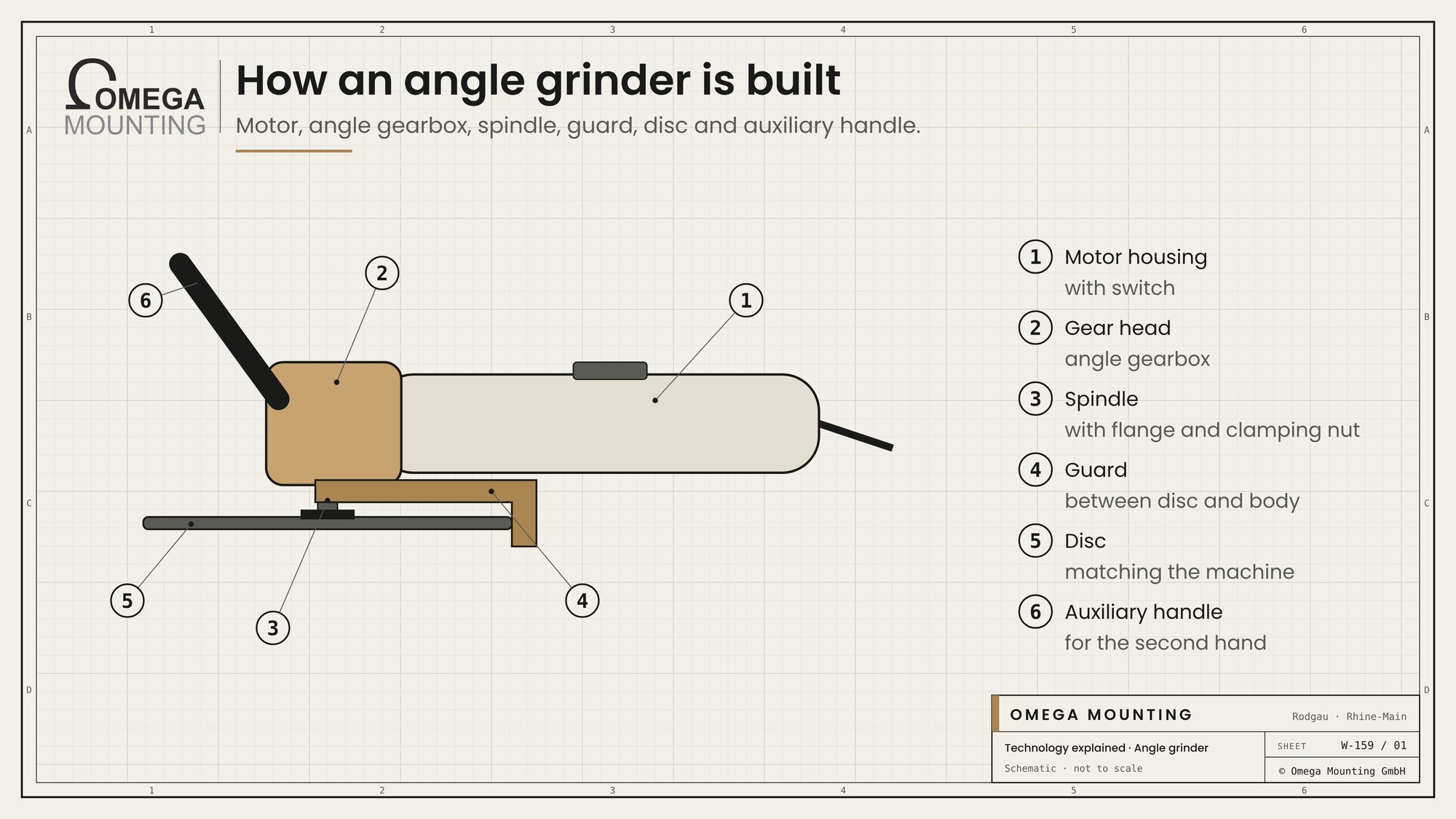
In the motor housing sits the electric motor with its switch. At the front is the gear head with the angle gearbox. From it the spindle projects downwards; the disc sits on it between the flange and the clamping nut .
The guard encloses part of the disc. It catches sparks and fragments if a disc shatters. The auxiliary handle is screwed into the side of the gear head so that the machine can be held with both hands.
Many tools also have a soft start, restart protection after a power failure and a brake that stops the disc faster after switching off.
Which disc for what
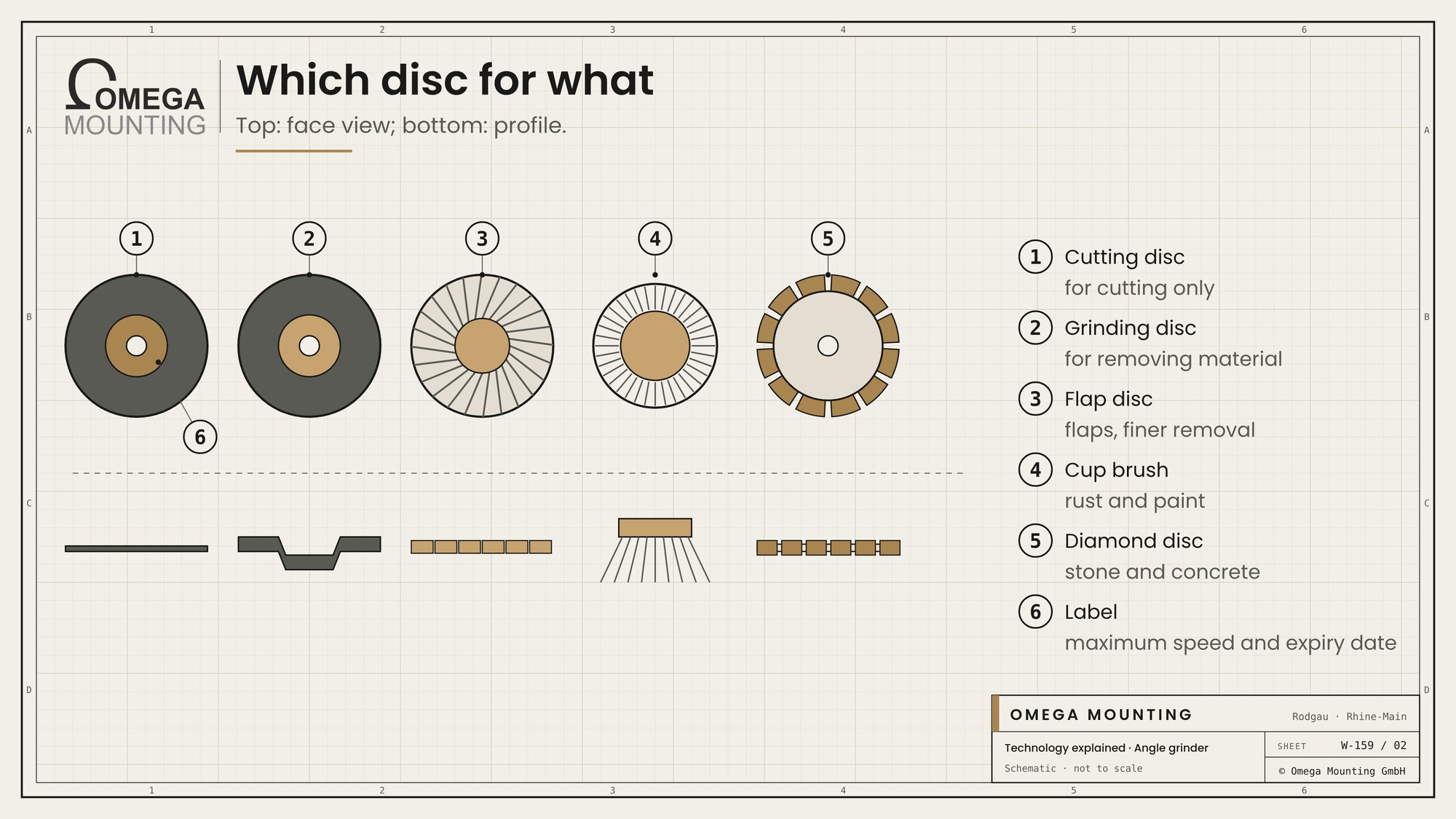
- Cutting disc: thin and flat. For cutting only, never for grinding with the side – it is not built for that and can break.
- Grinding disc: thick, usually with a depressed centre. For removing material, for example when grinding down welds.
- Flap disc: many overlapping abrasive flaps. For finer removal and clean surfaces.
- Cup brush: wire bristles in cup form. For removing rust, paint and scale.
- Diamond disc: with diamond segments. For cutting stone and concrete, not steel.
Every disc is marked with its maximum speed. It must be at least as high as the no-load speed of the machine. Resin-bonded discs also carry an expiry date. A disc that has been dropped, is cracked or has expired is no longer used.
Fitting the disc correctly
Many accidents start with changing the disc. What matters:
- Check first: Inspect the disc before fitting. Cracks, chips or an expired disc do not go on the machine.
- Match: Outside diameter, bore and maximum speed must match the machine. A 230 mm disc has no place on a small tool – there would be no suitable guard there either.
- Flanges: Flange and clamping nut clean and in the position the manufacturer specifies for the disc in question.
- Tightening: with the matching two-pin spanner, not with hammer and punch.
- Test run: after changing, let the machine run freely for a moment, guard towards the body, nobody in the plane of the disc. If the disc runs out of true or vibrates heavily, it is changed.
Also, Dust is an issue: grinding coatings, stainless steel or concrete produces dusts that should not be inhaled. Extraction and respiratory protection are then part of the job.
Kickback: when the disc jams
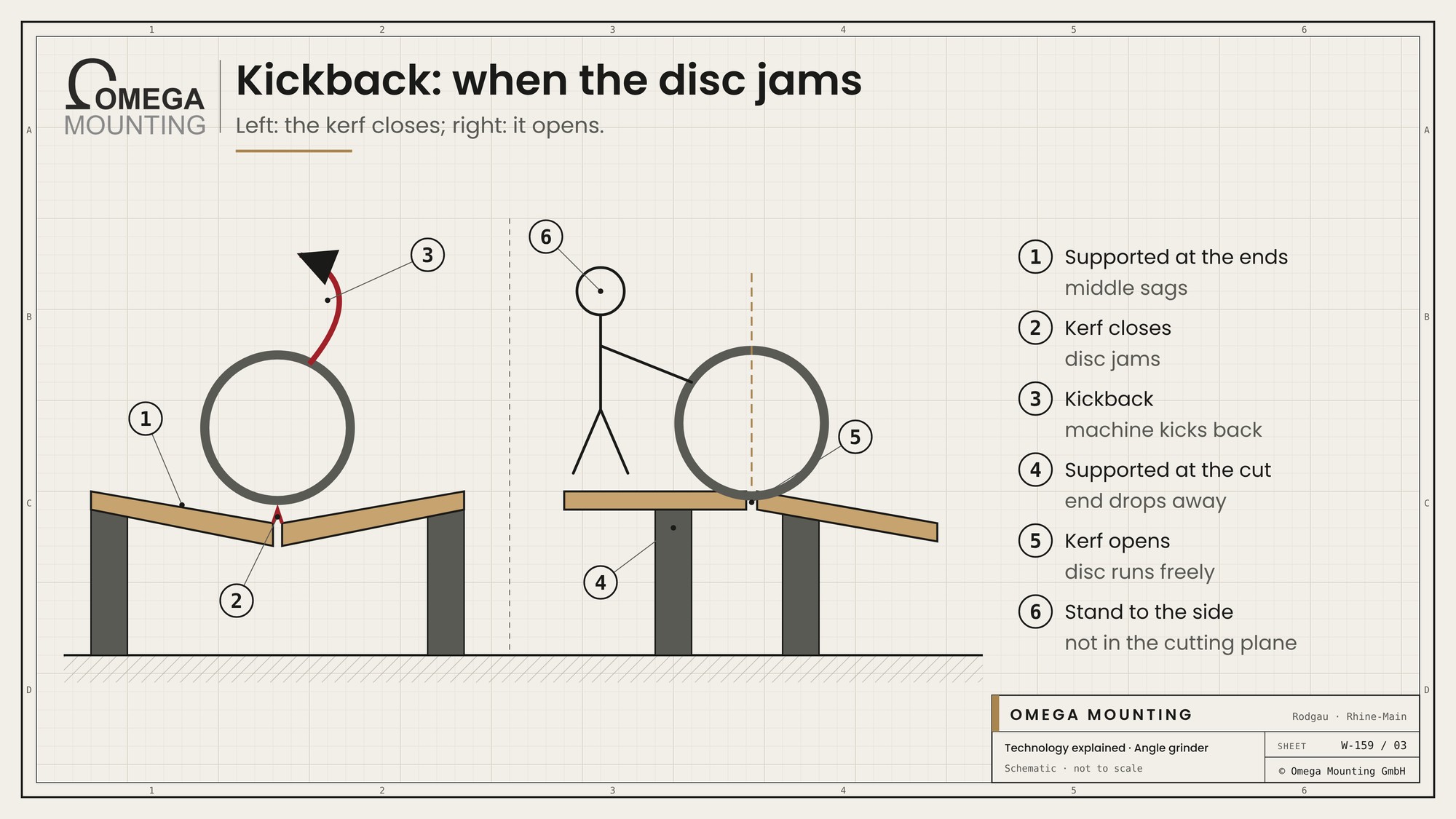
The most dangerous moment with the angle grinder is kickback. If the disc jams in the kerf or catches on an edge, it stops abruptly. The full force of the motor then acts on the machine, which jumps out of the kerf – often towards the operator.
Typical causes:
- Workpiece supported incorrectly: If it is only supported at the ends, it sags in the middle while being cut, the kerf closes and jams the disc.
- Tilting: The machine is twisted in the cut or guided at an angle.
- Too much pressure: The disc is pushed into the material instead of cutting.
- Edges and corners: The disc catches when it is applied.
What helps: support the workpiece close to the cut so that the kerf opens during cutting, hold the machine firmly with both hands and stand so that you are not in the cutting plane.
Working safely
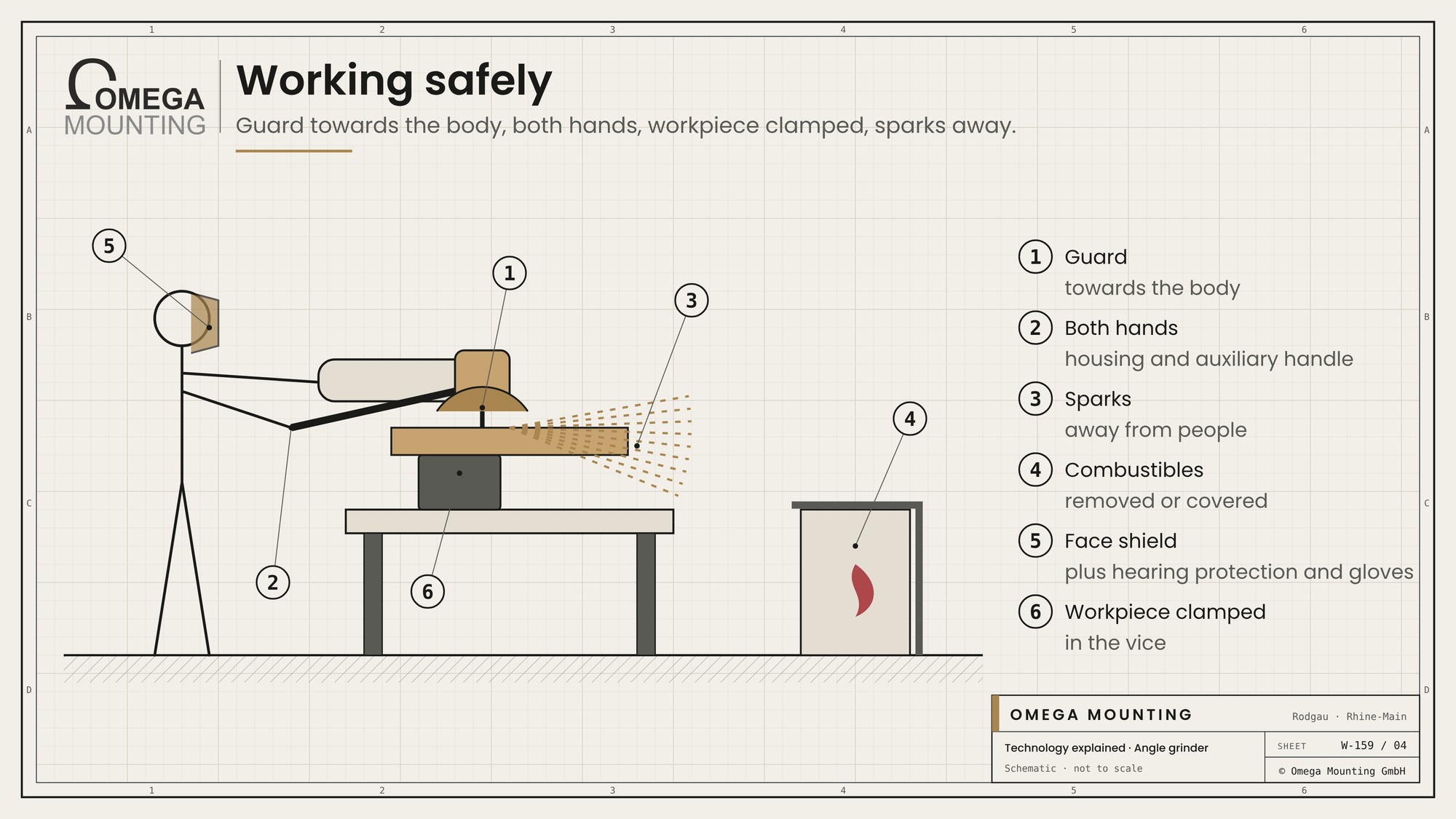
- Guard: always fitted and set so that it lies between disc and body.
- Both hands: one on the housing, one on the auxiliary handle.
- Clamp the workpiece: in a vice or with clamps, never hold it with your hand or foot.
- Changing the disc: only with the plug pulled or the battery removed. Only press the spindle lock when the disc has stopped.
- Let it run down: only put the machine down when the disc has stopped.
- Protective equipment: safety goggles or face shield, hearing protection, gloves, close-fitting clothing.
Then there are the flying sparks. Sparks fly far and are hot enough to ignite dust, packaging or insulation. When cutting in operating plants, a hot work permit is therefore often required, with combustibles covered, fire extinguisher and fire watch. This is determined by the operator.
Typical mistakes
- Guard removed “because it gets in the way”.
- Cutting disc used for side grinding.
- Disc from a larger machine fitted to a smaller one.
- Workpiece held with the foot.
- Machine put down while the disc is still running.
What we pay attention to
When we cut and grind during dismantling and installation, we pay attention to the points that protect fitters and plant.
- We only use discs that suit the machine and the task.
- We never work without guard and auxiliary handle.
- We support workpieces so that the kerf opens.
- We clarify hot work with the operator in advance and cover combustibles.
- We wear face shields, hearing protection and gloves.
Where we use it
During the replacement of two dock levellers in a Frankfurt logistics centre we dismantled the old, manually operated levellers with a cut-off grinder and welded in and connected the new electro-hydraulic levellers – with two mechatronics technicians in one day on site. More about our services is on the page Industrial installation.
More technology explained
Technology explained
protection class, inspection, vibration and noise.
Technology explained
flame cutting, plasma or saw.
Guide
our guide to grinding off zinc and welding cleanly.
Do you have questions about how this works on your site?
A plant is to be dismantled, adapted or welded in? We cut, weld and install. Request a callback.
Free, no-obligation callback

About the author
Tobias Schott
Managing director of Omega Mounting GmbH, Rodgau · more than 20 years of hands-on experience in installation and maintenance
A trained mechatronics technician, working in maintenance, servicing and industrial installation since 2004 – first alongside his father, and with Omega Mounting since 2012: from overhead conveyors in Frankfurt to the crane system in a new-build hall. He plans and leads lifting operations as an appointed person (AP) in data centers and on industrial sites in the Rhine-Main region, trains and examines operators of cranes, mobile elevating work platforms and telehandlers, and is a qualified occupational safety specialist. On jobs abroad he is known as the “German Troubleshooter” – the person you call when a site gets stuck. He learned what quality means from his father, not from a manual: Made in Germany as a standard for his own work, not a label. That is why quality comes first at Omega Mounting – ahead of speed and price. The Technology explained articles cover the equipment and techniques his team uses every day: what counts on site is in them – what only appears in the brochure is not.
 English
 German