
- Technology explained – technology and procedures
Cutting methods in dismantling: oxy-fuel, plasma or saw
By Tobias Schott · 5-minute read · Updated November 2026
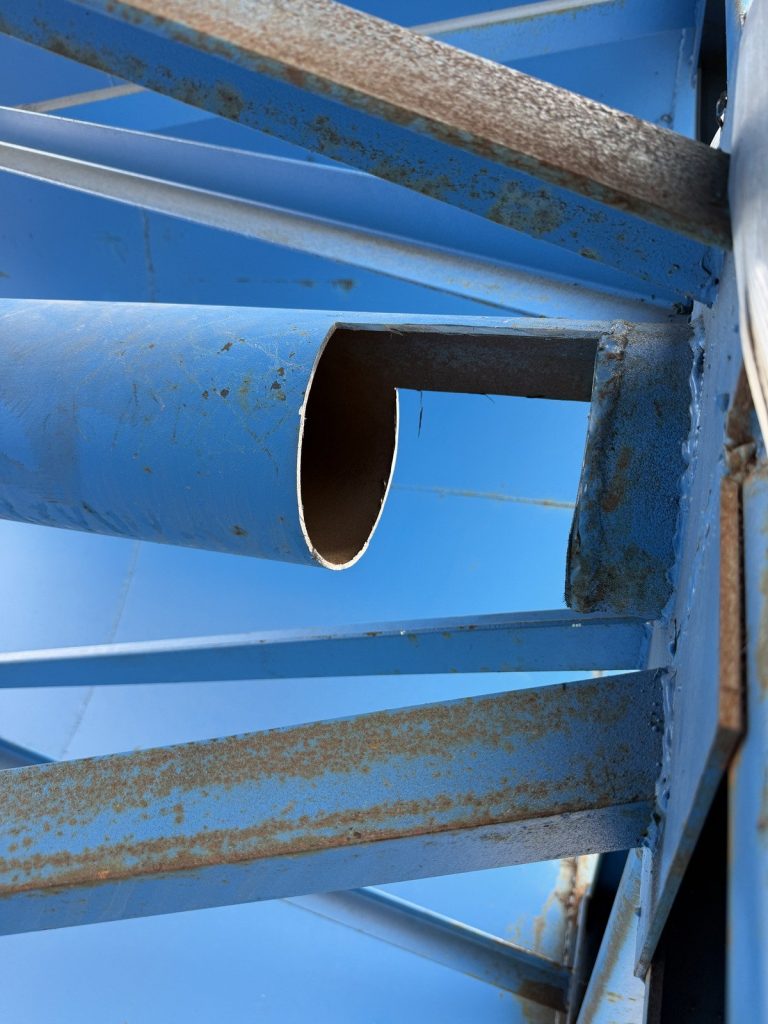
In dismantling, steel is either taken apart at its joints or cut with a cutting method – hot with a torch or plasma, cold with a saw, cut-off grinder or shears; which method fits depends on whether the part will be reused, where the cut is made and what nearby could catch fire.
Whether a plant is being relocated, a platform removed or a damaged component repaired: at some point the question arises whether to unbolt or to cut. A cut is made quickly and cannot be undone. And in a working hall every flame brings its own hazards.
Here we explain when cutting is needed at all in dismantling, how the hot and cold cutting methods work and what must be secured before the first cut is made.
What is a cutting method?
A cutting method is a manufacturing process that divides a workpiece into parts by removing, melting or shearing material. In dismantling it is mainly about cutting steel sections, sheets, pipes and welded structures.
A distinction is made between thermal methods such as oxy-fuel and plasma cutting and mechanical ones such as sawing, abrasive cutting and shearing. In German the generic term is „Trennverfahren“, oxy-fuel cutting is „Brennschneiden“.
Key facts
- Hot: Flame cutting, plasma cutting.
- Cold: reciprocating saw, band saw, cut-off grinder, hydraulic shears.
- Alternative: take apart at screws, bolts and flanges.
- Hot work: need a permit, fire protection and usually a fire watch.
- Hazards: flying sparks, falling parts, fumes, noise, components under tension.
- Clarify beforehand: reuse, media in lines, structural stability of the remaining structure.
Dismantle or cut?

The most important question in dismantling comes before any tool: is the part to be rebuilt later?
- Reassembly planned: Then it is taken apart at the joints – screws, bolts, flanges. Every part is marked and photographed. Cutting only happens where there is no other way.
- Recycling or scrapping: Then cutting is allowed – in such a way that the parts can be transported and lifted safely.
- Repair: The damaged area is cut out precisely, the cut edge prepared and a new part fitted.
Dismantling takes more time than cutting. In return, components, connections and fits are preserved. Anyone who wants to recommission a plant at another location saves that time several times over during reassembly. Seized bolts are therefore first loosened, heated or drilled out – only if that fails is the part cut.
Even when scrapping it pays to look at the sequence. A section cut in the wrong place can tip over or overload the remaining structure.
Hot cutting: oxy-fuel and plasma
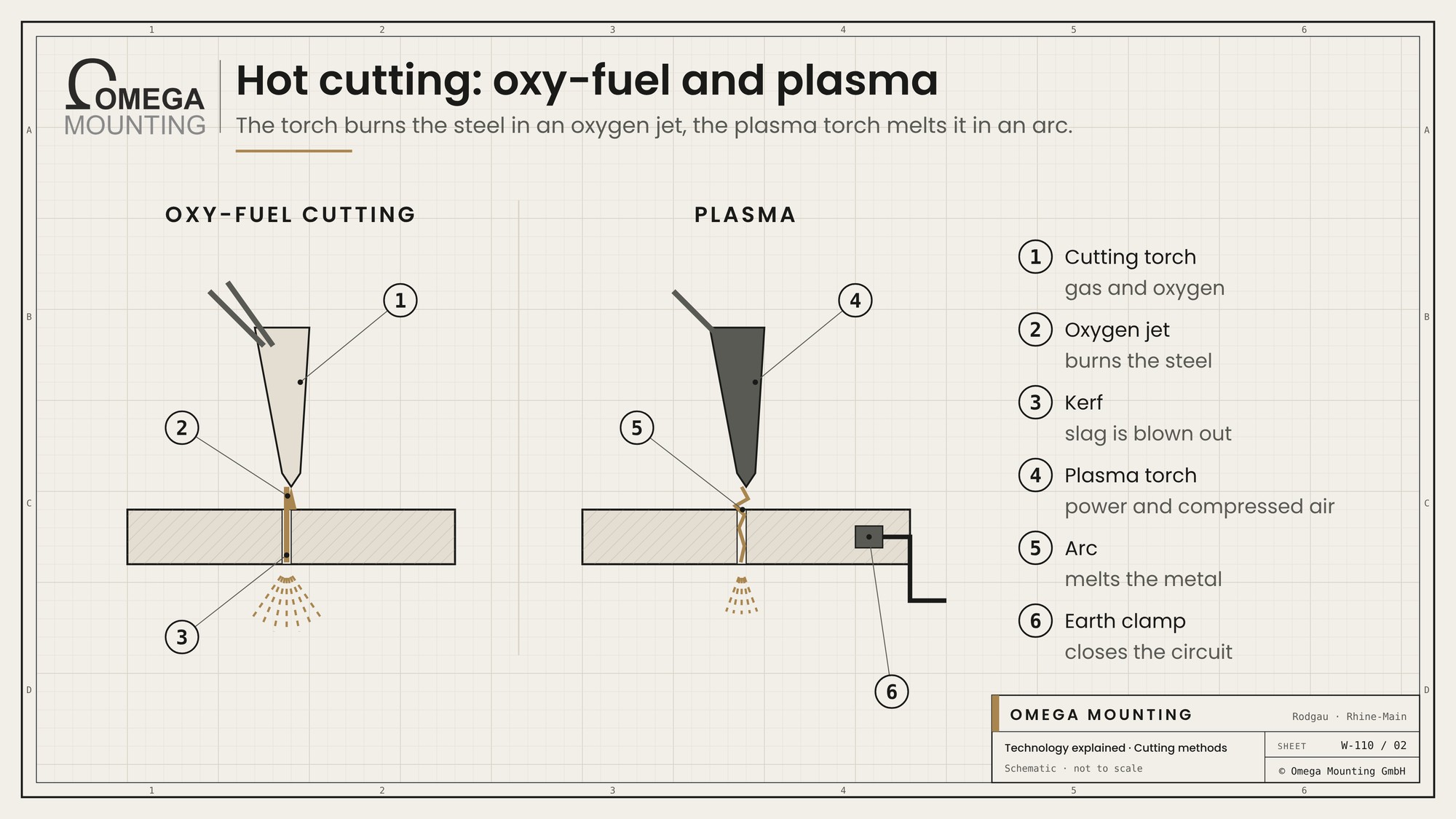
Thermal methods are fast and cope with thick cross-sections.
| Method | How it cuts | Strengths | Limits |
|---|---|---|---|
| Oxy-fuel cutting | Steel is preheated and burned in an oxygen jet. | Very thick steels, simple equipment. | Only non-alloy and low-alloy steel, a lot of heat, flying sparks. |
| Plasma cutting | An arc melts the metal, a gas jet blows it out. | Fast, also stainless steel and aluminium. | Needs power and compressed air, fumes and glare. |
Both methods produce sparks, slag, fumes and heat. In halls with combustible materials, cable trays or insulation this is a serious risk. That is why they count as hot work and are only carried out with a permit and fire protection measures.
Cold cutting: saw, cut-off grinder, shears
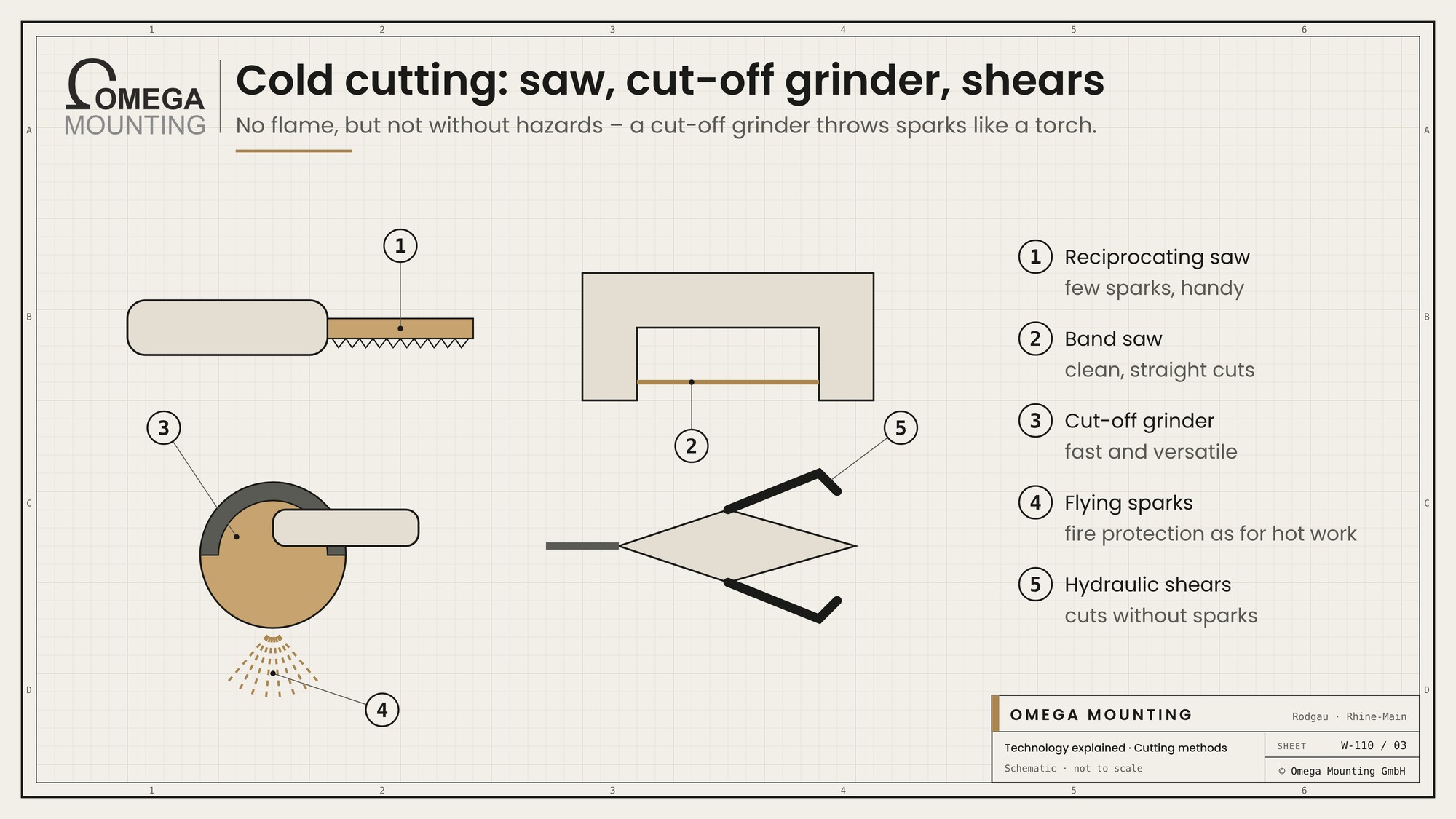
Mechanical methods work without a flame – they are not harmless in every case, but often the better choice in sensitive areas.
- Reciprocating saw: handy, for sections and pipes, hardly any sparks.
- Band saw: clean, straight cuts, also on site as a mobile pipe saw.
- Cut-off grinder: fast and versatile, but with heavy flying sparks – fire protection as for hot work.
- Hydraulic shears: cut sections and sheets without sparks, need space and force.
Cold methods have their own hazards: saw blades jam, cutting discs can break, hydraulic shears develop great forces. Hearing, eye and cut protection are always part of it.
The cut-off grinder is often underestimated. It is not a torch, but it throws sparks far across the hall. In many companies it therefore also counts as hot work.
What is secured when cutting
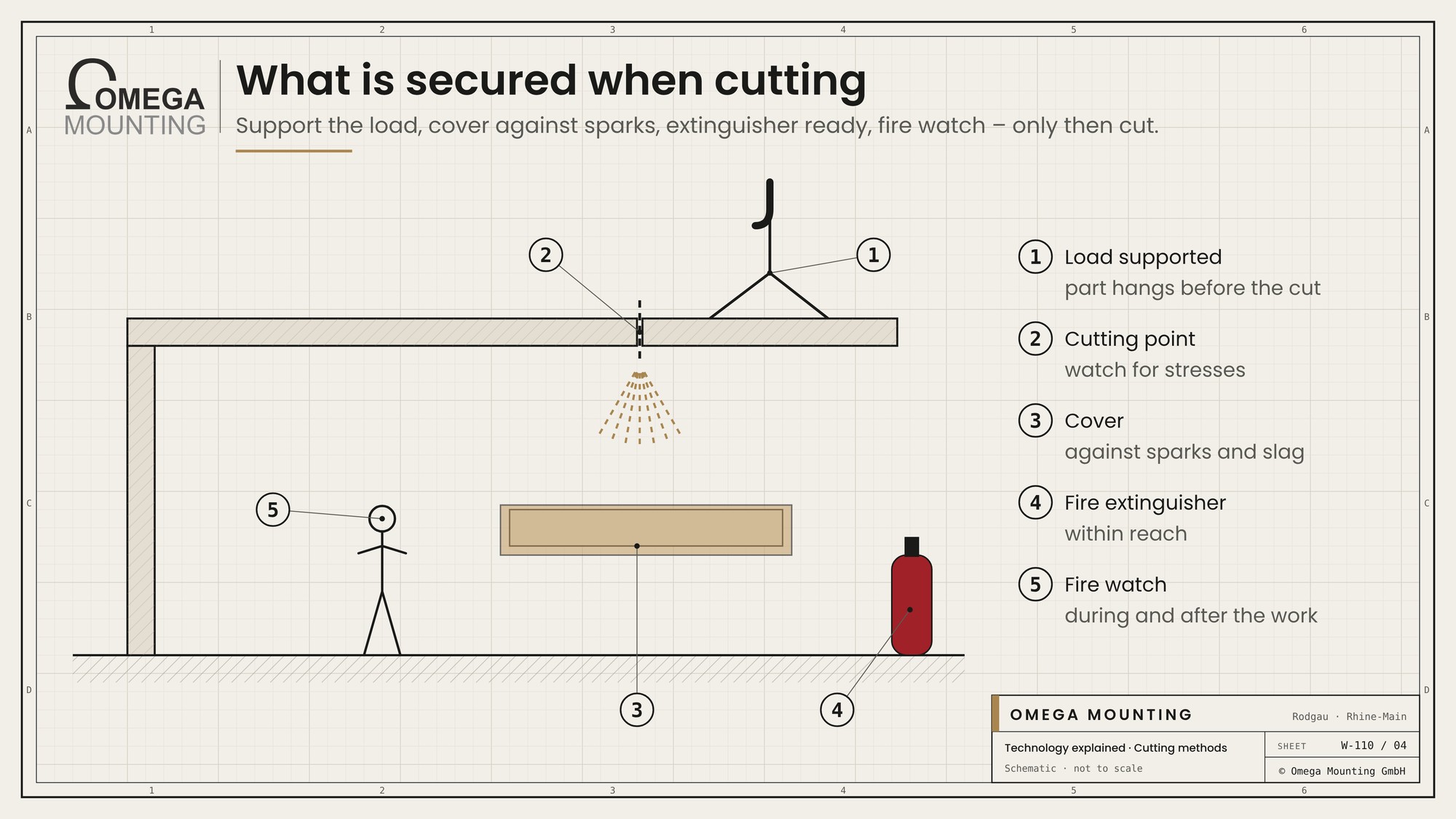
Before a cut is made, it is clarified what could happen.
- Support the load: The part being cut off hangs on the crane or rests on supports – it must not fall.
- Recognise stresses: Sections under tension can spring when cut through.
- Check media: Lines are drained, flushed and released.
- Cover against flying sparks: remove or cover combustible materials, close openings.
- Fire watch: during and after hot work, with extinguishing agent within reach.
- Extract fumes: especially with coated or galvanised steel.
Typical mistakes
- Cut too early: Cut first, then realise the part was supposed to be reused.
- Cut without supporting: The section falls or kicks out.
- Coating forgotten: Paint and zinc give off toxic fumes when burned.
- Fire watch withdrawn too early: Smouldering fires often only start after the work.
Dismantling plan and sequence
Before the first cut is made, there is a dismantling plan. It answers the questions that would otherwise come up in the middle of the work:
- What is kept?: If the installation is to be rebuilt, the cuts are placed where it can be joined again later. For scrapping, only the quick, safe route counts.
- Media and energy: Lines are drained, residual pressures released and the installation isolated before cutting.
- Mark the cuts: Every cut is marked on the component. That way nobody cuts in the wrong place.
- Part weights: The size of the parts depends on the crane, door and means of transport. Each part gets its weight and its lifting point.
- Order: Cutting is done so that nothing is left standing unsecured. Load-bearing parts come last.
- Removal and disposal: Recyclables are collected separately; components for reassembly are marked and loaded protected.
A good dismantling plan does not just save time. It also lowers the risk, because everyone in the team knows which step comes next and where the danger zone is.
What we pay attention to
In dismantling and repairs we do not choose the cutting method on the spot.
- We clarify in advance what will be reused – and dismantle those parts at the joints.
- We measure and photograph the area before cutting.
- We support every part before it is cut off.
- We cover cables, equipment and combustible materials against sparks and grinding dust.
- For hot work we work with a permit and fire watch.
Where we use it
At a logistics centre in Frankfurt we replaced two folding ramps: we cut the old levellers off their steel frame with a cut-off grinder – after decades in service the fastest and cleanest way – and welded the new levellers to the existing steel structure. In the port of Aschaffenburg we repaired the tubular shaft of a cable drum: the damage was photographed and measured beforehand, the damaged area completely removed and ground back to sound base material. We cut the repair parts out of an identical donor drum, and covers kept sparks, weld spatter and grinding dust away from the cable winding. That it can also be done without any cutting is shown by the robot dismantling at a bakery near Fulda: there we took apart and removed an industrial robot including its base. More on this on our page on Industrial dismantling.
More technology explained
Technology explained
what comes after cutting.
Technology explained
the permit for hot work.
Do you have questions about how this works on your site?
Are you planning a dismantling job and want to know what will be taken apart and what will be cut? We plan the sequence and work safely, even during ongoing operations. Request a callback.
Free, no-obligation callback

About the author
Tobias Schott
Managing director of Omega Mounting GmbH, Rodgau · more than 20 years of hands-on experience in installation and maintenance
A trained mechatronics technician, working in maintenance, servicing and industrial installation since 2004 – first alongside his father, and with Omega Mounting since 2012: from overhead conveyors in Frankfurt to the crane system in a new-build hall. He plans and leads lifting operations as an appointed person (AP) in data centers and on industrial sites in the Rhine-Main region, trains and examines operators of cranes, mobile elevating work platforms and telehandlers, and is a qualified occupational safety specialist. On jobs abroad he is known as the “German Troubleshooter” – the person you call when a site gets stuck. He learned what quality means from his father, not from a manual: Made in Germany as a standard for his own work, not a label. That is why quality comes first at Omega Mounting – ahead of speed and price. The Technology explained articles cover the equipment and techniques his team uses every day: what counts on site is in them – what only appears in the brochure is not.
 English
 German