
- Technology explained – machines and equipment
Sectional door at the dock: springs, tracks and dock seal
By Tobias Schott · 6-minute read · Updated November 2026
A sectional door consists of horizontal panels that run in tracks under the hall ceiling when it opens – it is the standard door at the loading dock, and its weight is carried not by the motor but by a tensioned spring.
At every loading bay three things sit on top of each other: the dock leveller, the dock seal and the door. The sectional door is the part that moves most often – at some docks dozens of times per shift. Rollers, cables and springs wear accordingly fast if nobody keeps an eye on them.
Here we explain how a sectional door is built, how it differs from high-speed and roller doors, how the dock seal to the lorry works and which safety devices a door needs.
What is a sectional door?
A sectional door is a door made of several hinged panels that run vertically upwards when opening and then curve into a horizontal position under the ceiling. In German it is called “Sektionaltor”.
Because the door leaf does not swing outwards, it needs no space in front of the opening. That makes it ideal for the dock, where the lorry stands directly in front of the door. The panels are usually insulated, with windows or a wicket door on request.
For the operator, the sectional door is a component that rarely gets attention as long as it works. It opens and closes many times a day, often in wind, in the cold and with forklifts nearby. A door that jams or no longer closes fully costs heating energy, holds up loading and quickly becomes a safety risk. That is why dock doors belong in the maintenance plan just like the dock leveller and the truck restraint, with fixed inspection dates and a look at all moving parts.
Key facts
- Type: Door leaf made of panels, guided in side tracks.
- Counterbalance: Torsion springs on a shaft above the lintel, rarely extension springs.
- Drive: Electric motor on the spring shaft, hand chain on small doors.
- Field of use: Loading docks, hall doors, workshops, fire stations.
- Safety: Spring break, cable break and closing edge protection.
- Inspection: Power-operated doors are inspected by a competent person at least once a year, as set out in the German technical rule for doors and gates (ASR A1.7).
How a sectional door is built

A sectional door consists of the door leaf, tracks, spring shaft and operator.
- Panels: insulated steel or aluminium elements, connected by hinges.
- Running rollers: sit at every hinge and run in the tracks.
- Tracks: vertical beside the opening, curving into the horizontal under the ceiling.
- Torsion spring shaft: above the lintel, with tensioned springs.
- Cable drums and lifting cables: transfer the spring force to the bottom panel.
- Drive: turns the shaft and holds the door in any position.
Correctly adjusted, the door is almost balanced: with the operator disengaged it moves with little effort and stays put at half height. If it drops or rises, the spring tension is wrong. The operator then works against the door and wears faster.
Typical wear points are the rollers, the hinges between the panels and the lifting cables on the cable drum. Then there is impact damage: a forklift that clips the bottom panel often bends it only by a few millimetres. That is enough to make the rollers bind and the door run crooked. Fixing such damage early prevents the door from jumping out of the track in operation.
Sectional, high-speed or roller door?
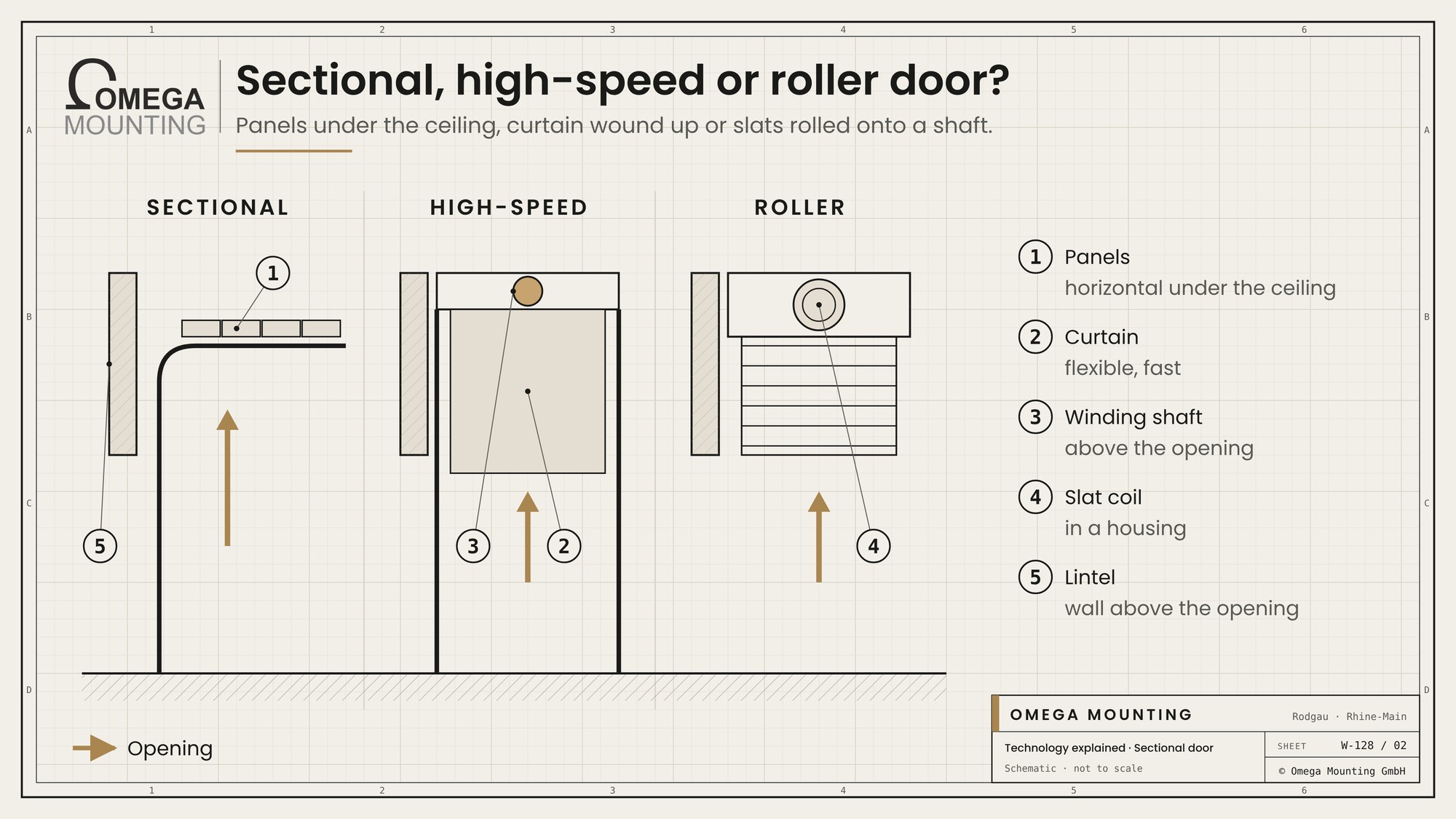
Three door types are common at halls and docks.
| Characteristic | Sectional door | High-speed door | Roller door |
|---|---|---|---|
| Door leaf | Insulated panels. | Flexible plastic curtain. | Steel or aluminium slats. |
| Opening | In tracks under the ceiling. | Wound up vertically. | Rolled onto a shaft above the opening. |
| Speed | Medium | High | Rather slow. |
| Insulation | Good. | Low | Low to medium. |
| Space | Needs ceiling height. | Hardly any space needed. | Hardly any space needed. |
| Typical for | Loading dock, external door. | Internal doors, cold areas, forklift traffic. | Simple halls, protection against break-ins. |
Traffic, temperature and space matter most for the choice. Where many forklifts pass through, a fast door pays off. Where cooling or heating is involved, insulation counts. Combinations are common: a sectional door on the outside for insulation and security, a high-speed door on the inside for day-to-day traffic.
The dock seal to the lorry
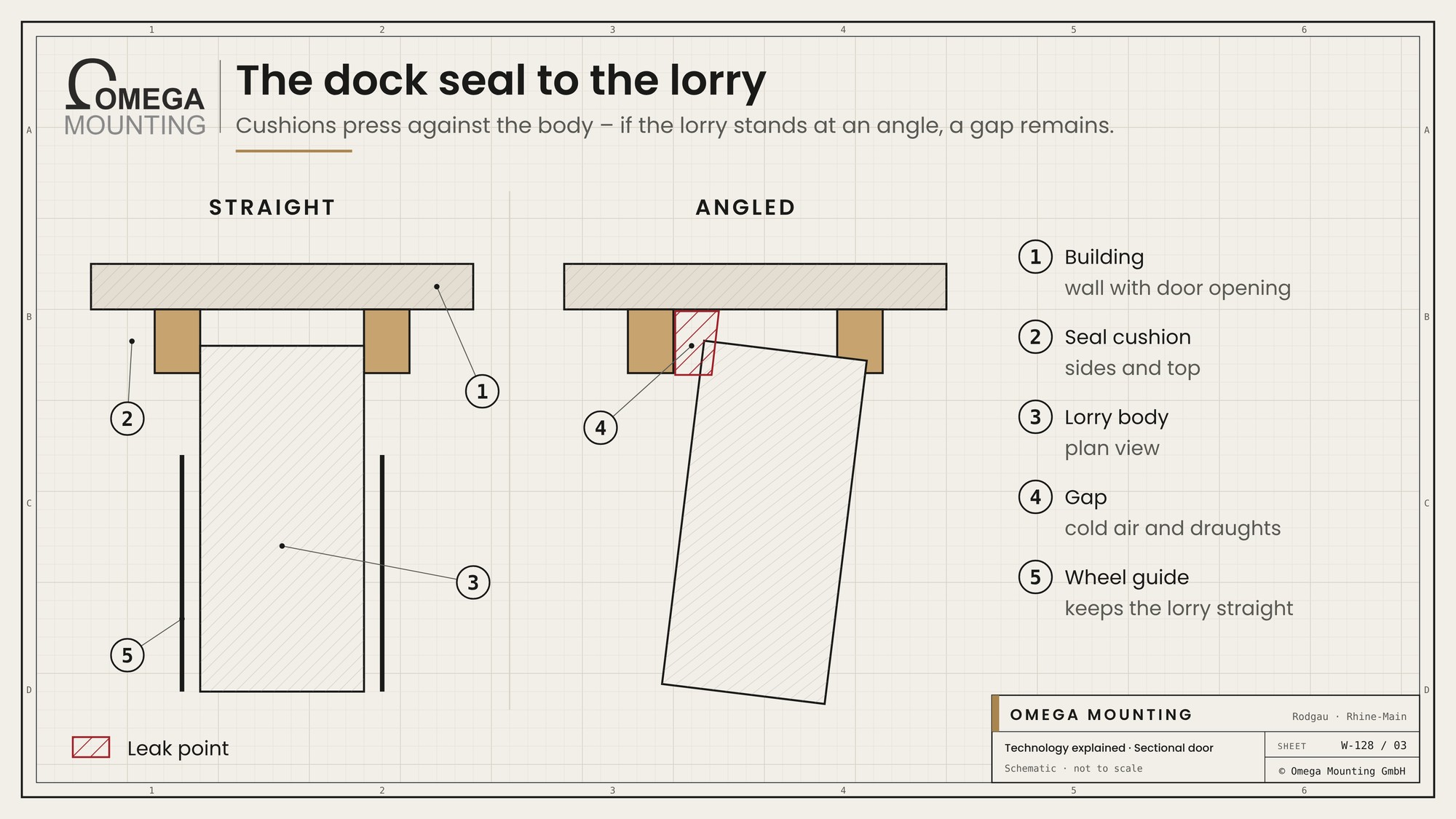
The dock seal closes the gap between the building and the lorry body while loading. There are two basic types:
- Dock seal with cushions: filled pads press against the sides and roof of the body.
- Dock shelter with curtains: curtains on a frame close in when the lorry docks.
- Loading house: a frame built out in front, in which door, leveller and seal sit together.
It only seals if the lorry stands straight and centred. If it stands at an angle, a wedge stays open. That is why wheel guides, dock bumpers and markings belong to the dock. Torn curtains and squashed cushions are usually the result of lorries docking too fast or at an angle.
Spring, cable and closing edge: safety at the door

A sectional door needs three safety devices.
- Spring break device: locks the shaft if a spring breaks so that the door does not fall.
- Cable break device: clamps the door leaf in the track if a lifting cable snaps.
- Closing edge protection: stops and reverses the door when the bottom edge meets an obstacle, often backed up by a light barrier.
The springs are under high tension. Anyone who retensions or replaces them needs the right tools and experience. Work on springs and cables never belongs in untrained hands. Before any work the door is therefore closed, secured against movement and the operator isolated.
Operator, controls and interlocks
Sectional doors are usually driven by an electric motor directly on the spring shaft. In low halls there are also operators mounted at the side that act on the shaft via a chain. In every case the door needs an emergency operation: a hand chain or crank that opens it during a power failure.
A door is controlled in one of two ways:
- Hold-to-run mode: The door only moves while someone presses the button and can see the door.
- Impulse mode: A short press is enough and the door moves on its own. Closing edge protection and a light barrier are then mandatory.
At the dock the door does not work alone. The dock leveller may only extend when the door is open, and the door may only close when the leveller is in its rest position. A traffic light inside and outside shows the lorry driver and the forklift driver when loading may begin. These interlocks run through the loading bay controls and are checked with every alteration.
Anyone replacing just one part, such as an operator or a leveller, must therefore always test the whole chain: door, leveller, traffic light and, where fitted, the truck restraint. A door that closes while the leveller is still resting on the lorry is one of the most expensive misunderstandings at a dock.
What we pay attention to
At doors and loading bays we work to fixed rules.
- We secure the door against movement before working on spring, cable or operator.
- We check the counterbalance with the operator disengaged.
- We replace rollers and cables in pairs, not one at a time.
- We coordinate door, dock leveller and traffic light as one loading bay.
- Our own qualified electricians handle the equipment wiring up to the main switch; the building electrics remain with the operator.
Where we use it
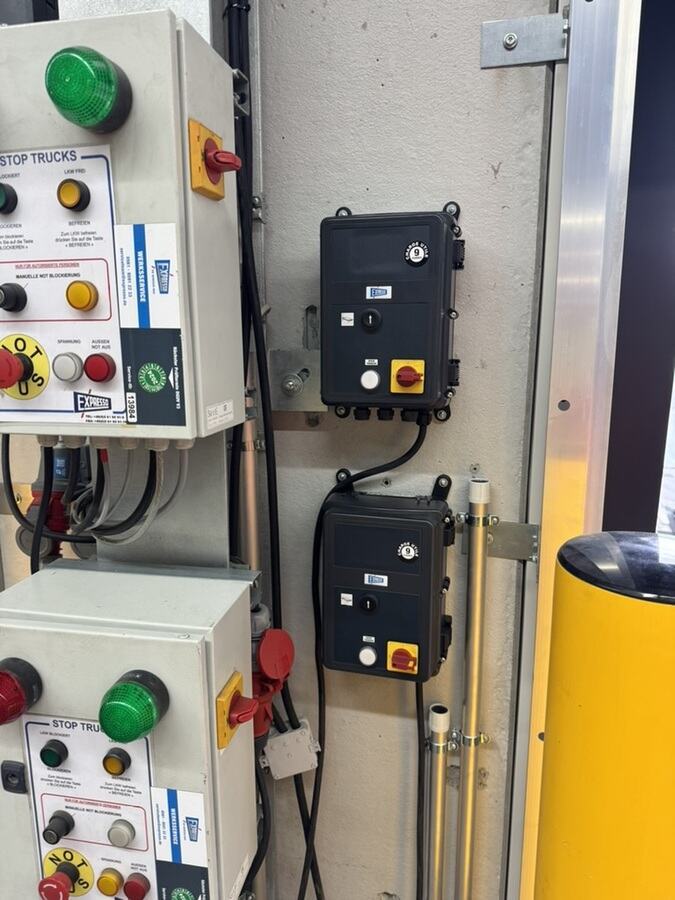
In a logistics centre in Frankfurt we replaced two manual dock levellers with hydraulic ones. This included control boxes “Door Left/Door Right” with traffic lights, the connection to the door control and a look at worn dock bumpers. A loading bay only works as a whole, even if only one part is replaced. More on this on our page on Logistics.
More technology explained
Technology explained
how a lorry is secured at the dock.
Do you have questions about how this works on your site?
Do you have questions about how work on your doors runs while operations continue? We plan dock by dock so that loading carries on. Request a callback.
Free, no-obligation callback

About the author
Tobias Schott
Managing director of Omega Mounting GmbH, Rodgau · more than 20 years of hands-on experience in installation and maintenance
A trained mechatronics technician, working in maintenance, servicing and industrial installation since 2004 – first alongside his father, and with Omega Mounting since 2012: from overhead conveyors in Frankfurt to the crane system in a new-build hall. He plans and leads lifting operations as an appointed person (AP) in data centers and on industrial sites in the Rhine-Main region, trains and examines operators of cranes, mobile elevating work platforms and telehandlers, and is a qualified occupational safety specialist. On jobs abroad he is known as the “German Troubleshooter” – the person you call when a site gets stuck. He learned what quality means from his father, not from a manual: Made in Germany as a standard for his own work, not a label. That is why quality comes first at Omega Mounting – ahead of speed and price. The Technology explained articles cover the equipment and techniques his team uses every day: what counts on site is in them – what only appears in the brochure is not.
 English
 German