
- Technology explained – equipment and protection
The truck restraint system: how a lorry is secured at the dock before the forklift drives in
By Tobias Schott · 5-minute read · Updated November 2026
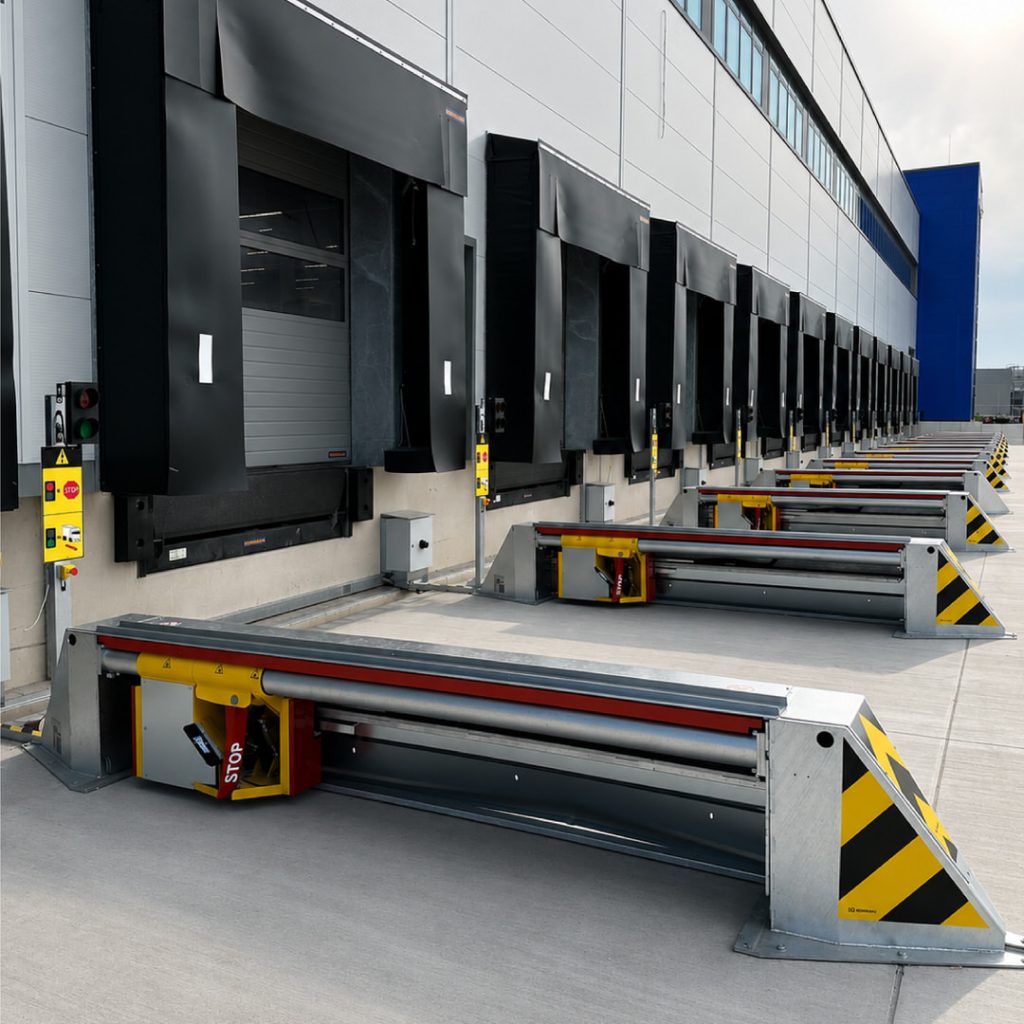
A truck restraint system is a vehicle restraint at the loading bay that mechanically holds a lorry or trailer at the dock and uses traffic lights to show when loading may begin and when the driver may leave again.
Two worlds meet at the loading bay: outside the driver in the lorry, inside the forklift driver in the hall. Neither can see the other. If the lorry pulls away while the forklift is still on the load bed, or a parked trailer slowly creeps away from the dock during loading, the forklift tips into the gap. The truck restraint system prevents exactly that.
Here we explain which types there are, how a system is built, how a loading operation runs and how the system is interlocked with door and dock leveller.
What is a truck restraint system?
A truck restraint system holds a vehicle at the dock during loading and unloading and only releases the loading bay once it is secured. Other names are vehicle restraint, lorry restraint or dock lock; in German it is called a Truckstop-Anlage.
It consists of a mechanical part outside that holds the vehicle and an electrical part inside that controls and indicates. In between there are cable routes, often a hydraulic power pack and two traffic lights: one for the driver, one for the warehouse staff.
Key facts
- Purpose: Prevent the vehicle from driving off or rolling away during loading.
- Types: Wheel chock with sensor, restraint arm at the wheel, hook on the underrun bar.
- Drive: By hand, electrically or hydraulically via a power pack.
- Indication: Outside light for the driver, inside light for the warehouse staff.
- Control: Control panel at the door, control cabinet, often interlocked with dock leveller and door.
- Installation: Mechanics, hydraulics and electrics at each loading bay individually.
Which types are there?
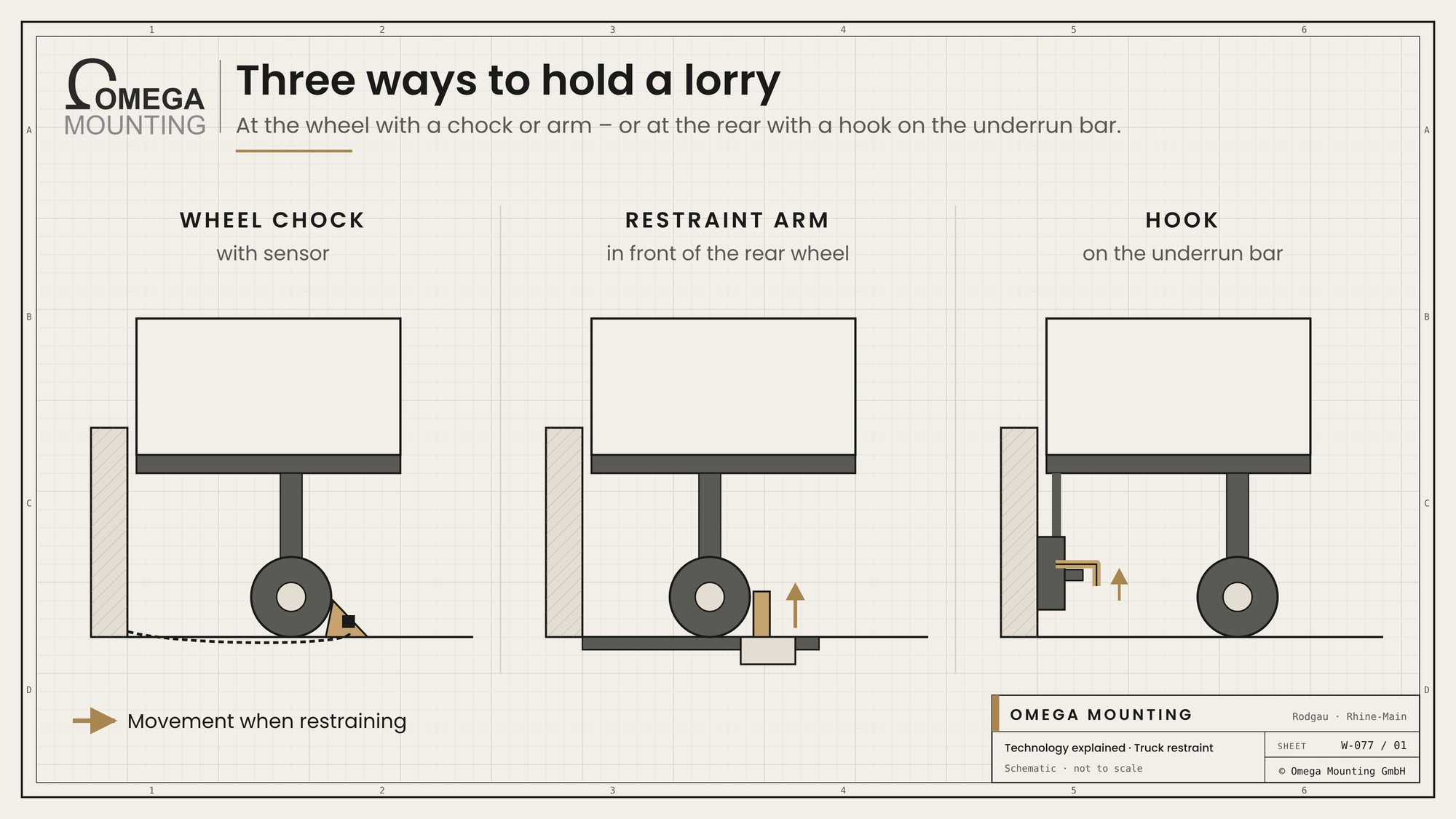
The types differ in where they grip the vehicle.
| Type | How it holds | What it needs |
|---|---|---|
| Wheel chock with sensor | The driver or staff place a chock in front of the rear wheel; a sensor reports that it is positioned correctly. | Discipline when placing it; easy to retrofit. |
| Restraint arm at the wheel | The lorry reverses into a wheel guide, an arm rises in front of the rear wheel and blocks it. | Foundation and wheel guide, usually hydraulics. |
| Hook on the underrun bar | A hook on the dock wall rises and grips the underrun bar at the rear. | A suitable, intact underrun bar on the vehicle. |
The wheel chock with sensor is the simplest solution. The restraint arm holds regardless of the vehicle's rear and works without any action by the driver. The hook is compact but depends on the rear being built for it.
How is a truck restraint system built?
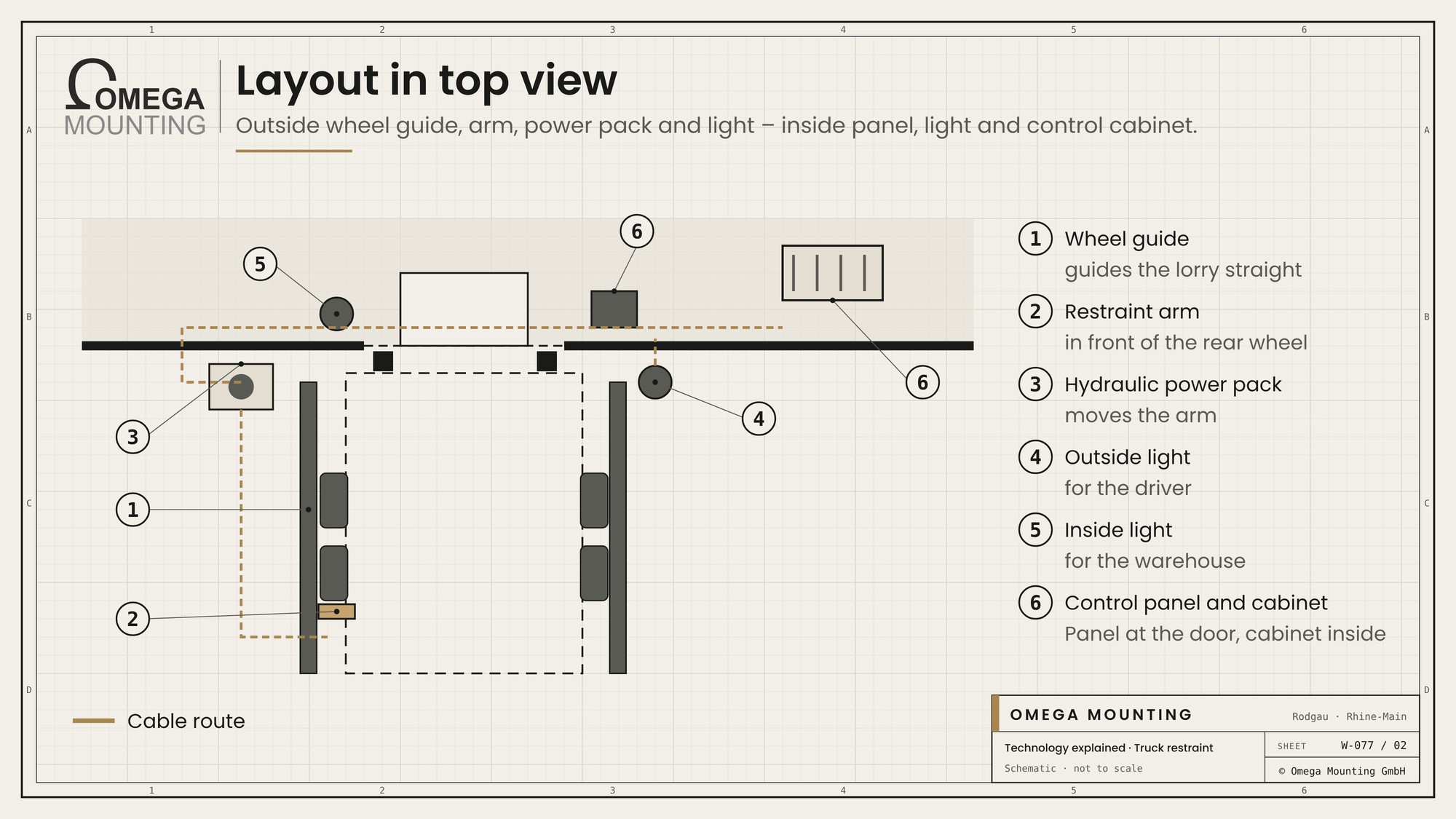
A system with a restraint arm consists of several assemblies distributed outside and inside.
- Wheel guide: rails on the ground that guide the lorry straight to the dock.
- Restraint arm: rises in front of the rear wheel, a sensor detects the wheel.
- Hydraulic power pack: moves the arm, often in a housing on the wall.
- Outside light: shows the driver red as long as they must stay put.
- Inside light: shows the warehouse staff green when the vehicle is secured.
- Control panel and control cabinet: operation at the door, controls and connections in the cabinet.
The cables run from outside to inside and connect arm, power pack, lights and panel. How the hydraulic power pack works is explained in our article on the hydraulic power pack.
How does a loading operation run?
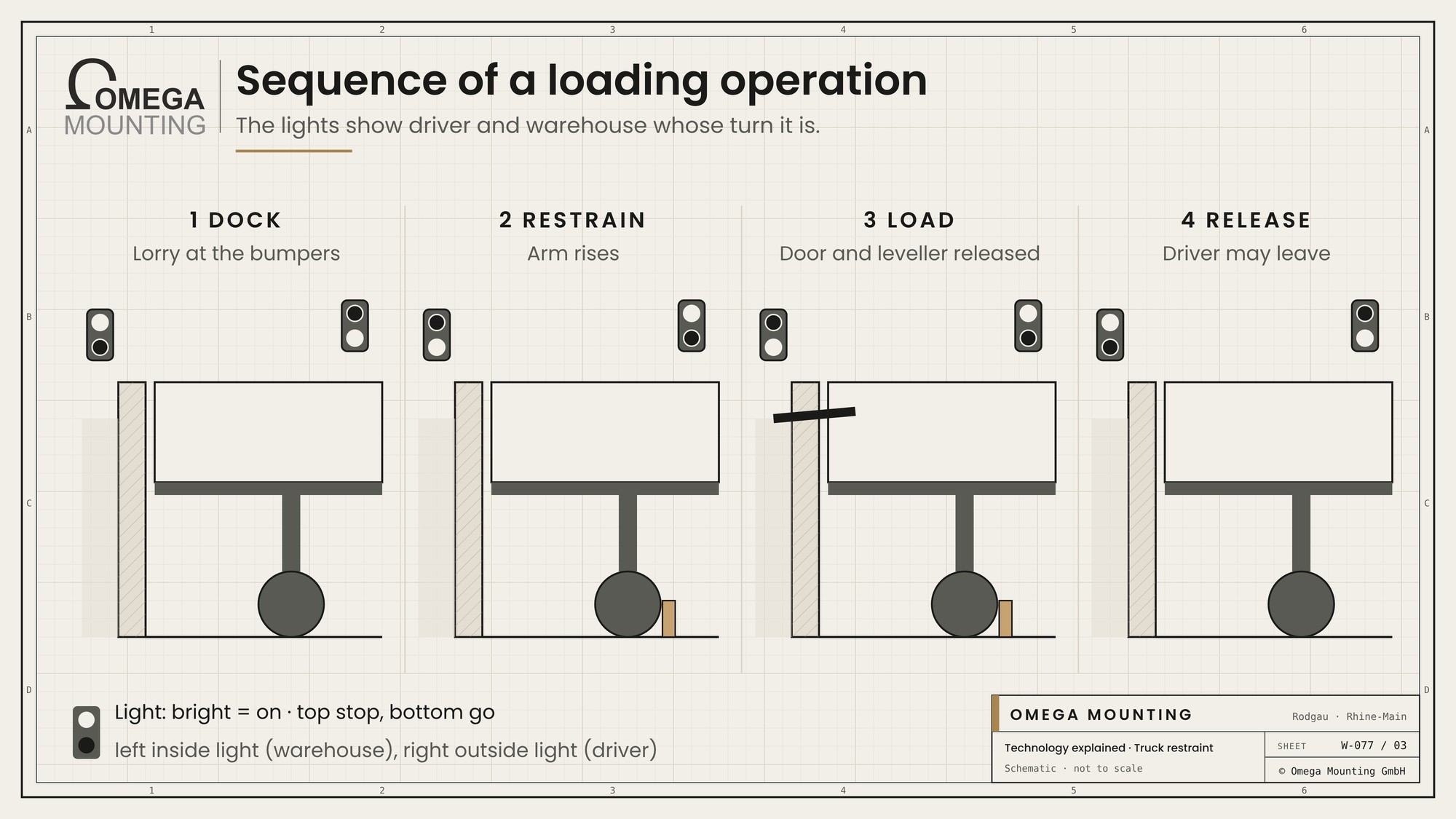
The lights guide driver and warehouse staff through the loading operation – everyone can see whose turn it is.
- Docking: The lorry reverses between the wheel guides until it is against the bumpers. Outside light green, inside light red.
- Secure: The arm rises in front of the rear wheel. Outside light switches to red, inside light to green.
- Loading: Door open, dock leveller extended, forklift drives in.
- Release: Dock leveller back, door closed, arm lowers. Outside light green – the driver may leave.
The most important moment is the last one: only when the dock leveller is in its rest position may the vehicle be released. How the dock leveller itself works is covered in our article on the Dock leveller.
Interlocking with door and dock leveller
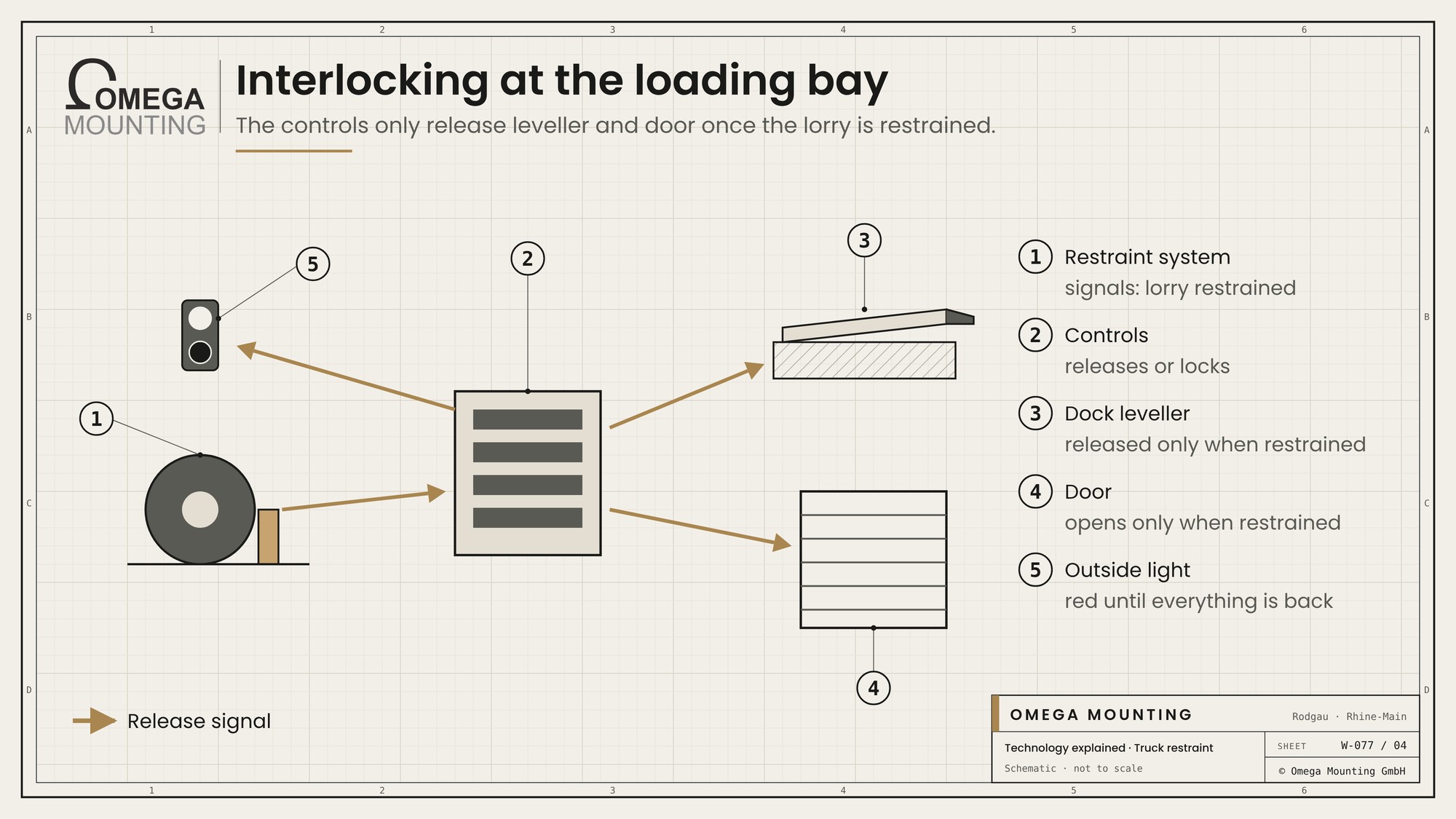
A loading bay is safest when restraint system, dock leveller and door do not work independently but are interlocked via the controls.
- Without a secured vehicle the dock leveller cannot be extended.
- Without a retracted dock leveller the restraint system cannot be released.
- Without a closed door the outside light stays red.
- Fault or sensor without signal: The system stays in the safe state, and the light indicates it.
Which links a system has is set by the manufacturer. During installation, the signals between all assemblies must be wired cleanly and checked individually during commissioning. How safety devices are retrofitted to existing installations is described in our guide on Safety devices.
Inspecting and servicing
A truck restraint is used with every loading – and is often struck by lorries. Maintenance focuses on these points:
- Hook or restraint arm: The component that engages the vehicle is checked for deformation, cracks and free movement.
- Drive: Hydraulics or an electric motor move the restraint arm. Leaks, hoses and end positions belong in every inspection.
- Vehicle detection: Sensors report whether a lorry is standing and secured. Dirty or misaligned sensors cause false signals.
- Traffic lights: The inside and outside lights show the driver and the forklift driver the status. A failed lamp is a safety defect.
- Impact protection: Buffers and bollards in front of the unit absorb impacts. Damaged parts are replaced before the unit itself is hit.
In winter, snow, ice and road salt are added. Iced-up mechanisms move stiffly and salt attacks components. A check before the cold season prevents faults.
It makes sense to service the truck restraint, door and dock leveller in one visit. The interlock between the three systems is then checked at the same time.
What we pay attention to
With many loading bays in a row, what counts is that each one is installed equally cleanly.
- We align wheel guide and restraint arm at each loading bay individually and fix them firmly.
- We place power pack, lights and panel so that driver and staff can see and reach them.
- We lay the cable routes cleanly and protected between outside and inside.
- We wire control cabinets and panels ourselves – without an additional electrical trade.
- We commission each loading bay together with the system manufacturer and check every light phase.
Where we use it
At a logistics centre near Leipzig, for a system manufacturer, we installed 32 vehicle restraint systems – mechanics and electrics from a single source. In the first week eight fitters from mechatronics, mechanics and electrics were on site; after that a well-practised team of three took over final assembly and electrics. The scope included hydraulic power packs, traffic light systems, 32 control panels, control cabinets and all cable routes. We commissioned the systems together with the manufacturer.
More technology explained
Technology explained
the second component at every loading bay.
Technology explained
what protects panel and door from impact.
Technology explained
what moves the restraint arm.
Do you have questions about how this works on your site?
Are you equipping loading bays with vehicle restraint systems – at one door or thirty? We install mechanics, hydraulics and electrics and commission them with the manufacturer. Request a callback.
Our service for this: Logistics installation and maintenance →
Free, no-obligation callback

About the author
Tobias Schott
Managing director of Omega Mounting GmbH, Rodgau · more than 20 years of hands-on experience in installation and maintenance
A trained mechatronics technician, working in maintenance, servicing and industrial installation since 2004 – first alongside his father, and with Omega Mounting since 2012: from overhead conveyors in Frankfurt to the crane system in a new-build hall. He plans and leads lifting operations as an appointed person (AP) in data centers and on industrial sites in the Rhine-Main region, trains and examines operators of cranes, mobile elevating work platforms and telehandlers, and is a qualified occupational safety specialist. On jobs abroad he is known as the “German Troubleshooter” – the person you call when a site gets stuck. He learned what quality means from his father, not from a manual: Made in Germany as a standard for his own work, not a label. That is why quality comes first at Omega Mounting – ahead of speed and price. The Technology explained articles cover the equipment and techniques his team uses every day: what counts on site is in them – what only appears in the brochure is not.
 English
 German