
- Technology explained – machines and equipment
Hydraulic power pack: pump, valves, accumulator – what is inside the box
By Tobias Schott · 5-minute read · Updated November 2026
A hydraulic power unit is the power plant of a hydraulic system: it draws oil from the tank, pressurises it and sends it to the cylinders – and in doing so it stores energy that has to be controlled during every maintenance job.
You encounter the hydraulic power unit on presses, lifting tables, dock levellers and vehicle restraints at the loading bay, on test benches and machine tools. From the outside it is often just a box with a motor, tank and a few valves. Inside, a circuit works in which every component has a clear task.
This article explains the design, the most important components and the hazards. How to maintain hydraulic systems, change oil and find leaks is described in the guide Hydraulic maintenance.
What is a hydraulic power unit?
A hydraulic power unit is a compact assembly of tank, motor, pump, valves and accessories that provides a pressurised oil flow for hydraulic drives. The cylinders or hydraulic motors that work with it are called consumers.
The principle is simple: the pump delivers oil, and only the resistance of the consumer builds up pressure. Because oil is hardly compressible, it transmits large forces precisely and holds a position even under load. In German the unit is called „Hydraulikaggregat“.
Key facts
- Purpose: Provide pressurised oil for cylinders and hydraulic motors.
- Main components: Tank, electric motor, pump, pressure relief valve, directional valves, filter, cooler, pressure gauge.
- Additions: Accumulator, check valves, pressure switch, temperature and oil level monitoring.
- Pump types: Gear, vane and piston pump, as fixed or variable displacement pump.
- Typical applications: Presses, lifting tables, dock levellers, vehicle restraints, test benches, clamping fixtures.
- Standard: ISO 4413 for safety requirements for hydraulic systems.
- Common misconception: Motor off means depressurised – accumulators and trapped lines can hold the pressure.
The components and what they do
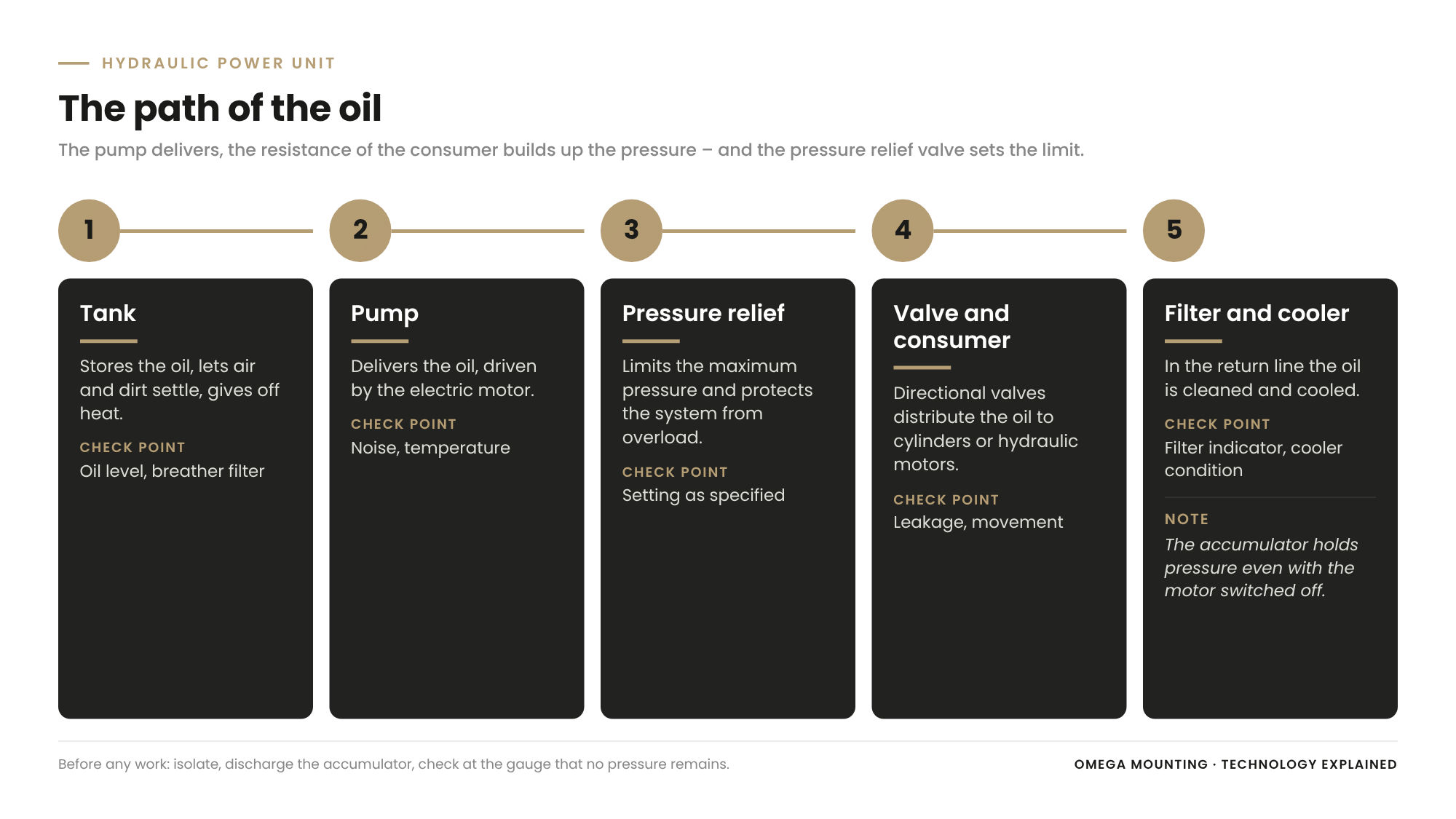
The oil circuit has six stations, and each can be the cause of a fault.
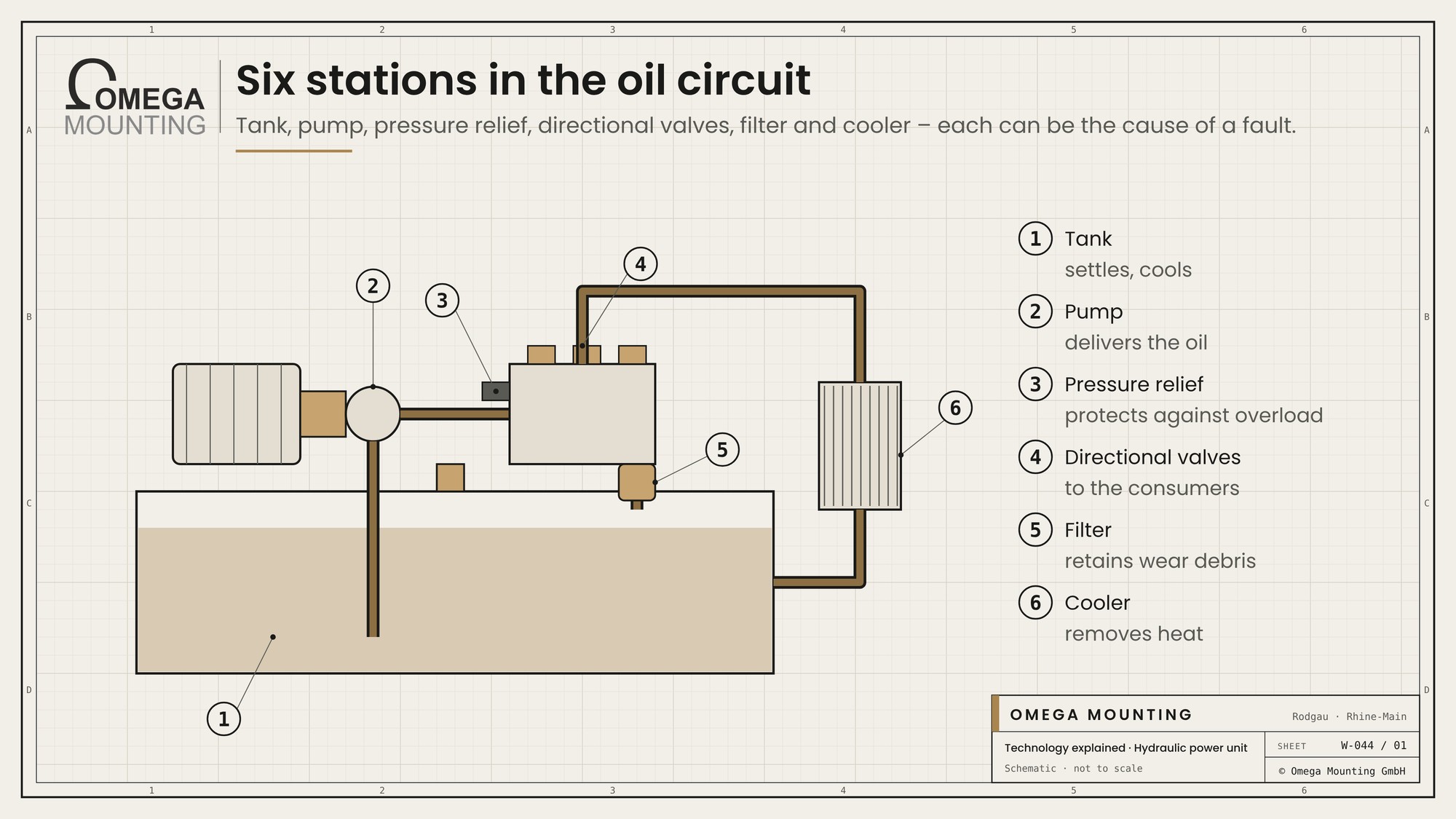
- Tank. It stores the oil, lets air and dirt settle and gives off heat. A breather filter ensures that only clean air flows in when the cylinders extend and retract.
- Pump. It delivers the oil, driven by the electric motor via coupling and pump bracket. Gear pumps are robust and simple, piston pumps work at high pressures and their delivery rate can often be adjusted.
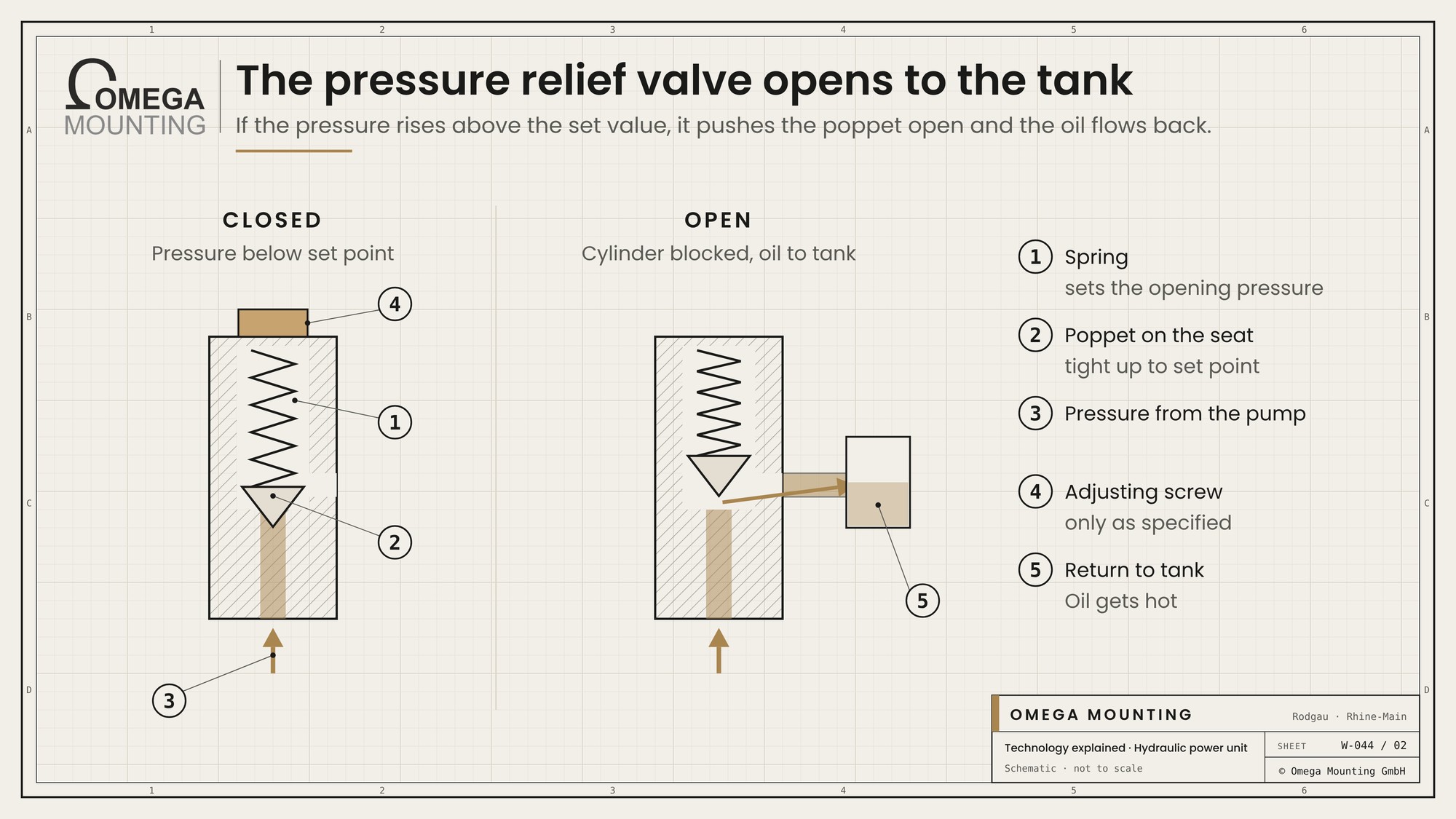
- Pressure relief valve. It limits the maximum pressure in the system and protects pump, lines and cylinders from overload. Without a working pressure relief valve, a blocked cylinder can destroy the system.
- Directional valves. They distribute the oil to the consumers and determine direction and stop.
- Filters. They keep wear debris and dirt out of the oil – in the suction, pressure or return line. A clogging indicator shows when the filter is full.
- Cooler. It removes the heat created by losses in pump, valves and lines.
| Component | Task | Typical mistake | Consequence |
|---|---|---|---|
| Pump. | Deliver oil. | Wear, cavitation due to a dirty suction filter or oil that is too cold. | Noisy running, less pressure, heat. |
| Pressure relief valve. | Limit maximum pressure. | Misadjusted or sticking. | Too little force or overload. |
| Directional valve. | Distribute oil. | Spool sticking due to dirt. | Cylinder does not move or moves wrongly. |
| Filters. | Keep oil clean. | Clogged, bypass valve open. | Dirt in the whole system. |
| Cooler. | Remove heat. | Dirty, fan defective. | Oil gets hot and ages quickly. |
| Accumulator. | Buffer energy. | Pre-charge pressure lost. | Fluctuating pressure, pump switches often. |
The accumulator: stored energy
An accumulator stores oil under pressure and releases it quickly when needed – this way it buffers pressure peaks, supports the pump and keeps functions going during a power failure.
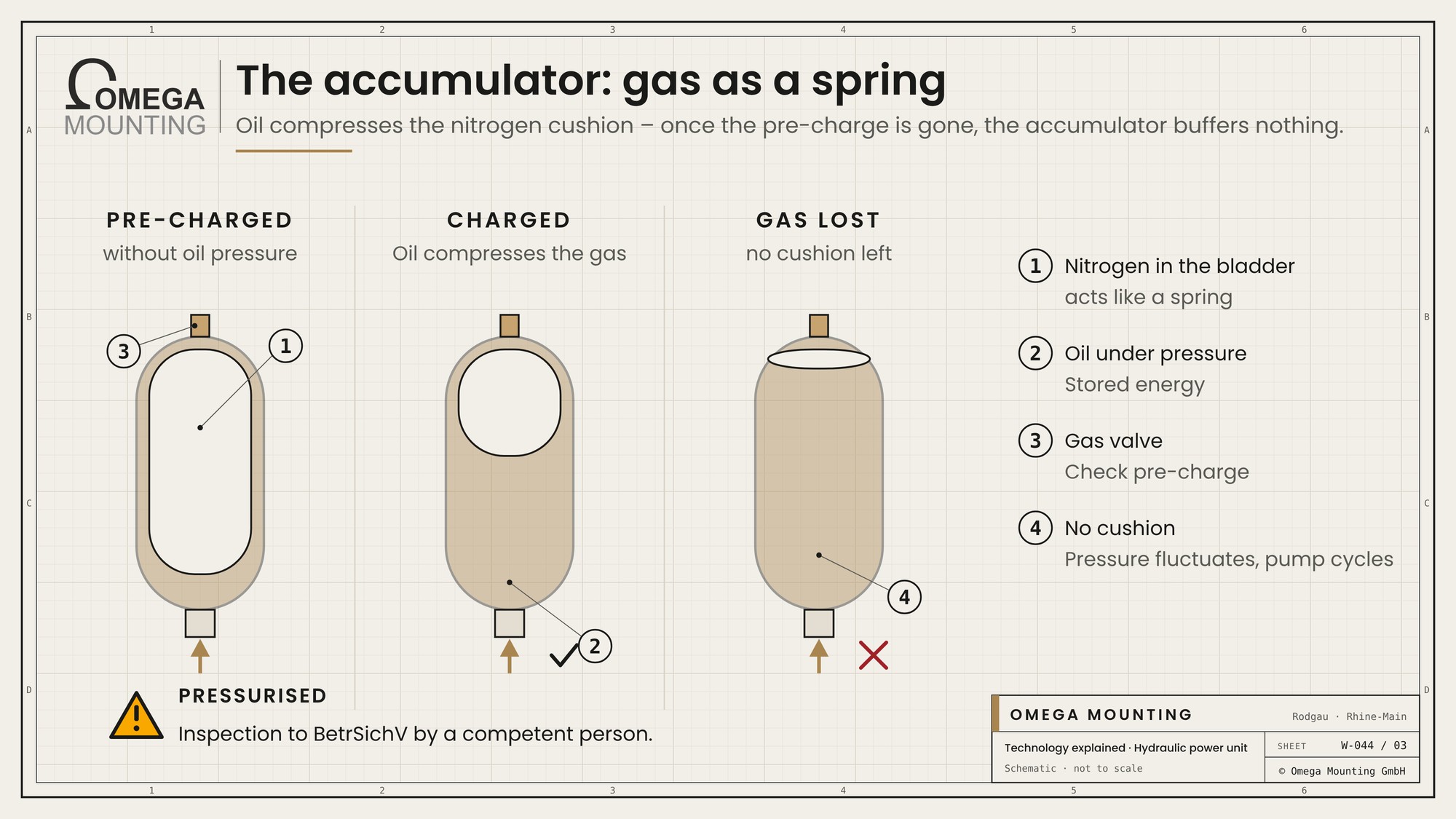
Inside, a bladder, a diaphragm or a piston separates the oil from a gas cushion of nitrogen. When oil is forced in, the gas is compressed and stores the energy. That is exactly what makes the accumulator dangerous: it holds the pressure even when motor and pump have long been switched off.
Accumulators are pressure equipment. Depending on pressure and volume, they must be inspected periodically under the German Ordinance on Industrial Safety and Health (BetrSichV), by a competent person or an approved inspection body. Which inspection applies to your accumulator is determined by the operator in the risk assessment – this is not legal advice, but a classification.
Why temperature and cleanliness decide the service life
Most failures on hydraulic power units start with oil that is too hot or contaminated – long before a component breaks.
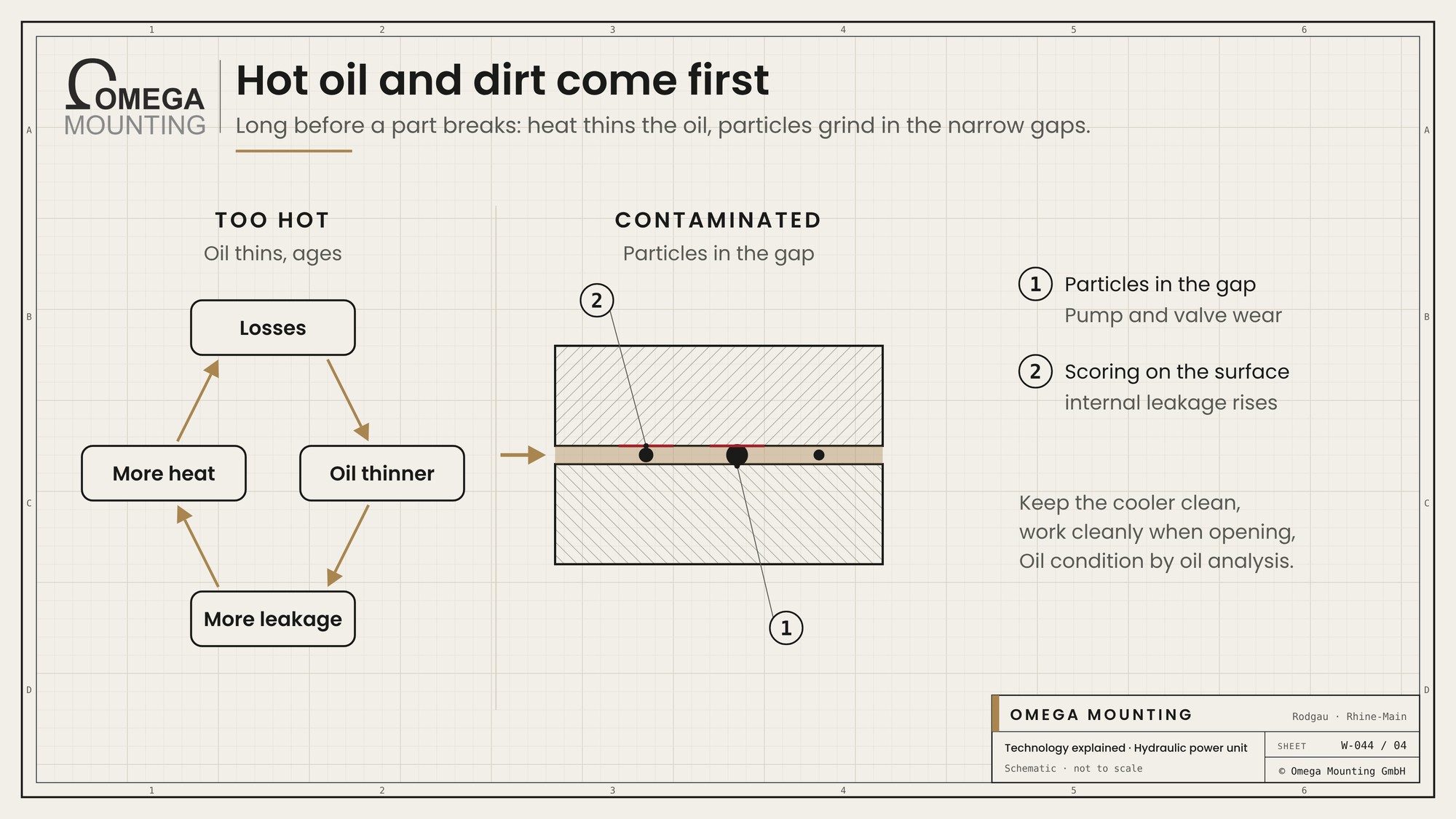
Every power loss in pump, valves and lines turns into heat. If the cooler is dirty or the unit is undersized, the oil temperature rises. Hot oil becomes thinner, seals less well in pump and valves and ages faster. Seals harden, leakage increases, and with it the heat.
Dirt has an even more direct effect. Even fine particles grind in the narrow gaps of pumps and valves, water ages the oil and promotes corrosion. That is why clean work when opening the system, intact breather filters on the tank and regular checks of the filter indicator count more than any single repair. An oil analysis is the most reliable way to show whether the oil can keep running.
Installing and commissioning
A hydraulic power unit is not simply set down and connected. For it to run reliably, we pay attention to these points:
- Location: The unit stands level, easily accessible and away from heat sources. The cooler needs free air.
- Drip tray: Depending on oil quantity and location, a tray is needed that safely catches escaping oil.
- Clean lines: Pipes and hoses are flushed before connection or delivered sealed. Dirt from installation destroys pumps and valves.
- Fill oil through a filter: New oil is filled through a filter, because even fresh oil is not clean enough.
- Bleeding: Pump and lines are bled before the system goes under pressure.
At the first start the pump’s direction of rotation is checked, then the pressure is raised step by step. Leaks, temperature and noise are watched. Our electricians handle the electrical connection up to the main switch; pressure settings follow the manufacturer’s specifications.
What we pay attention to
We only work on a hydraulic power unit when it is safely depressurised.
- We isolate, secure against switching back on and relieve accumulators and lines via the intended drain valves.
- We check at the pressure gauge that there really is no pressure left before we loosen a fitting.
- We work cleanly: sealed line ends, clean containers, filling via a filter.
- We check oil level, oil condition, filter indicator and cooler on every job.
- We route hoses without kinks and chafing points and tighten fittings as specified.
- Pressure equipment inspections and changes to pressure settings are carried out as specified by the manufacturer and operator.
Where we use it
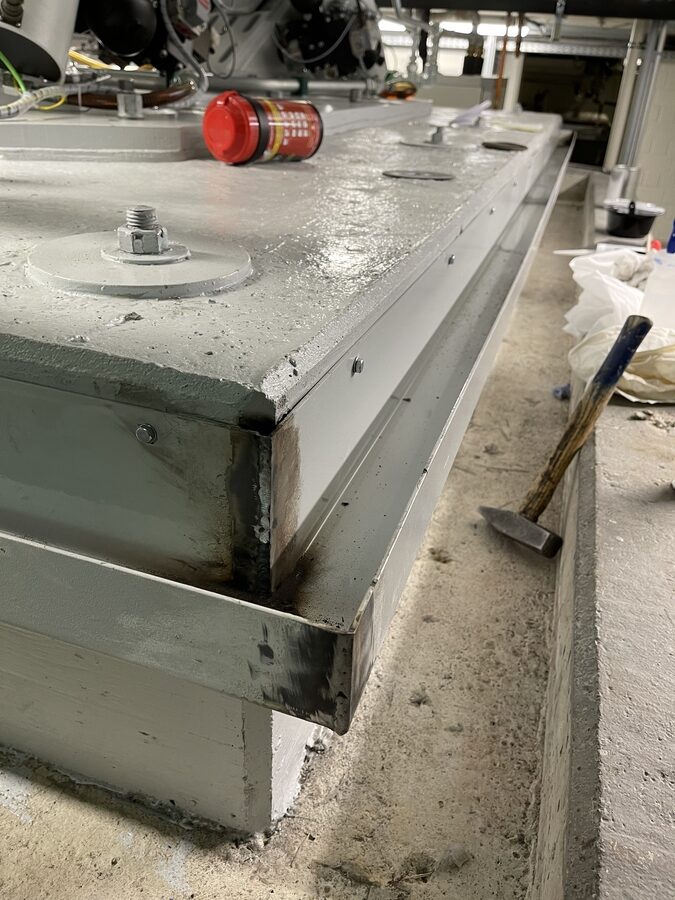
We install and look after hydraulic power units at loading bays, test benches and machines. During the installation of vehicle restraint systems in a logistics centre near Leipzig 32 loading bays came with hydraulic power units, control desks and control cabinets. In the first project week eight people were deployed, then a team of three for the fine installation. During the conversion of a servo-hydraulic test rig we adapted the hydraulic lines and welded an oil tray tight. Both are part of our Maintenance and servicing.
More technology explained
Technology explained
the valves that distribute the oil.
Technology explained
how the condition of the hydraulic oil can be measured.
Guide
the guide to isolating stored energy.
Do you need this machine together with a team on site?
Do you need a team that installs, connects and maintains hydraulic power units? We work depressurised, cleanly and as specified. Request a callback – we will get back to you.
Free, no-obligation callback

About the author
Tobias Schott
Managing director of Omega Mounting GmbH, Rodgau · more than 20 years of hands-on experience in installation and maintenance
A trained mechatronics technician, working in maintenance, servicing and industrial installation since 2004 – first alongside his father, and with Omega Mounting since 2012: from overhead conveyors in Frankfurt to the crane system in a new-build hall. He plans and leads lifting operations as an appointed person (AP) in data centers and on industrial sites in the Rhine-Main region, trains and examines operators of cranes, mobile elevating work platforms and telehandlers, and is a qualified occupational safety specialist. On jobs abroad he is known as the “German Troubleshooter” – the person you call when a site gets stuck. He learned what quality means from his father, not from a manual: Made in Germany as a standard for his own work, not a label. That is why quality comes first at Omega Mounting – ahead of speed and price. The Technology explained articles cover the equipment and techniques his team uses every day: what counts on site is in them – what only appears in the brochure is not.
 English
 German