

Oil analysis: what the lab finds in the oil before the machine fails

By Tobias Schott  · 5-minute read · Updated November 2026

Oil analysis reads in the lubricant what is happening in the machine – which components are wearing, what has got in from outside and whether the oil itself can still do its job.

You come across oil analysis in the lubrication schedule, in the maintenance contract or as a lab report with dozens of figures and a traffic light. For hydraulics, gearboxes, compressors and engines it is the machine’s blood test: a small sample bottle says more about the internal condition than a look through the sight glass.

This article explains how the sample is taken, what the lab measures and how to read the report. Which oil belongs where is covered in our article on oil viscosity; when to change it, in the guide on the lubrication schedule in maintenance.

What is oil analysis?

Oil analysis is the laboratory testing of a lubricant sample for wear particles, contamination and the condition of the oil itself. The oil runs through every bearing, gear and valve and picks up whatever is worn away there. It also carries what gets in from outside: dust, water, coolant, the wrong oil.

A single analysis is a snapshot. It only becomes valuable as a series: sample after sample, taken at the same point, it shows whether damage is developing. In German the method is called “Ölanalyse”; tracking it over time is known as oil condition monitoring.

Key facts

The sample: where most mistakes happen

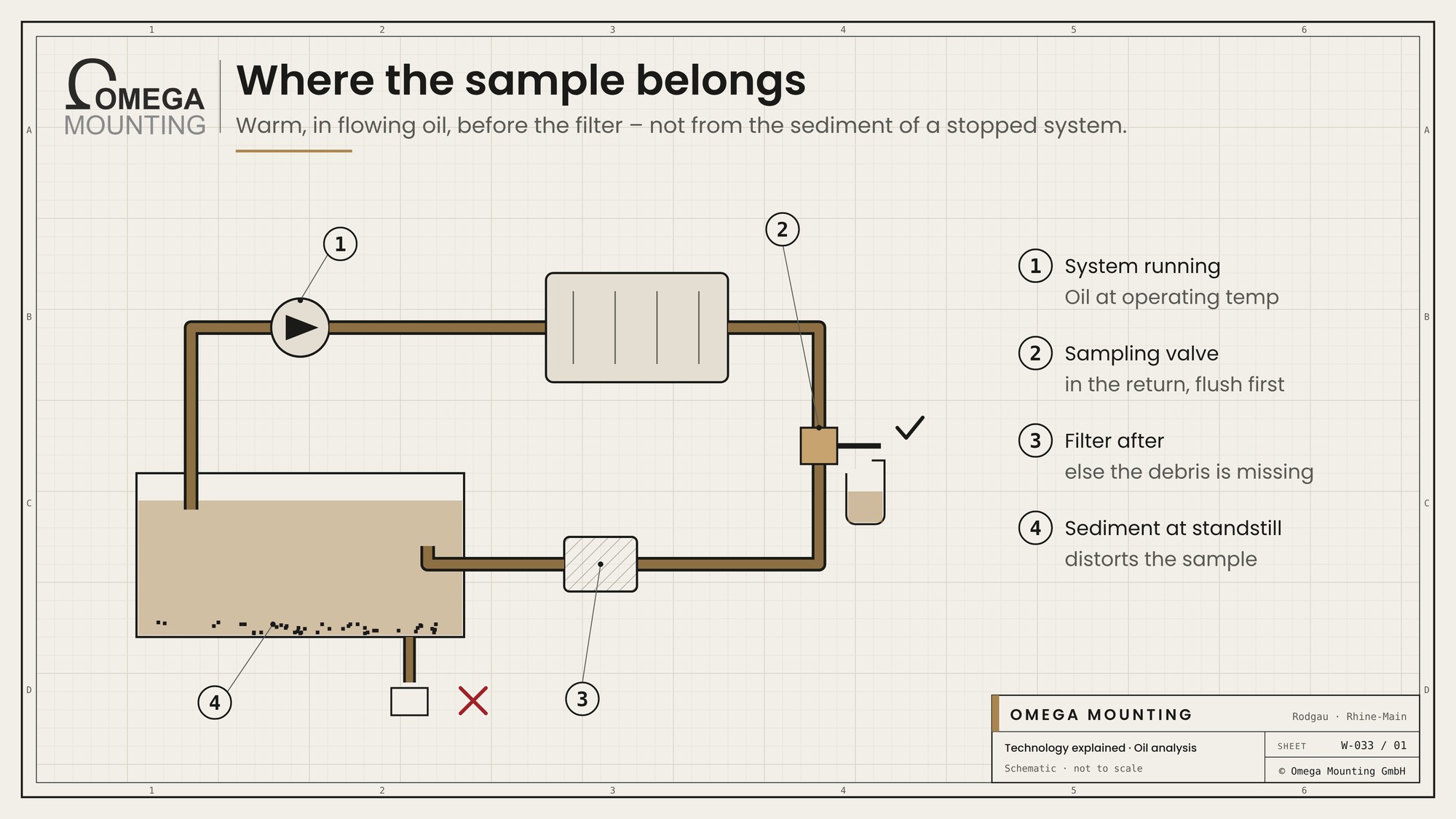
Oil analysis is only as good as the sample – a wrongly taken sample shows a condition the machine does not actually have.

Technical drawing: oil circuit of tank, pump, machine, return line and filter – correct is the sample at the sampling valve in the return line before the filter with the system running, wrong is the sample from the drain at the tank bottom with sediment
At operating temperature, in the return line, before the filter: a sample from the sediment of a stopped system shows a condition the machine does not have. Graphic: Omega Mounting

What the lab measures – and what the values reveal

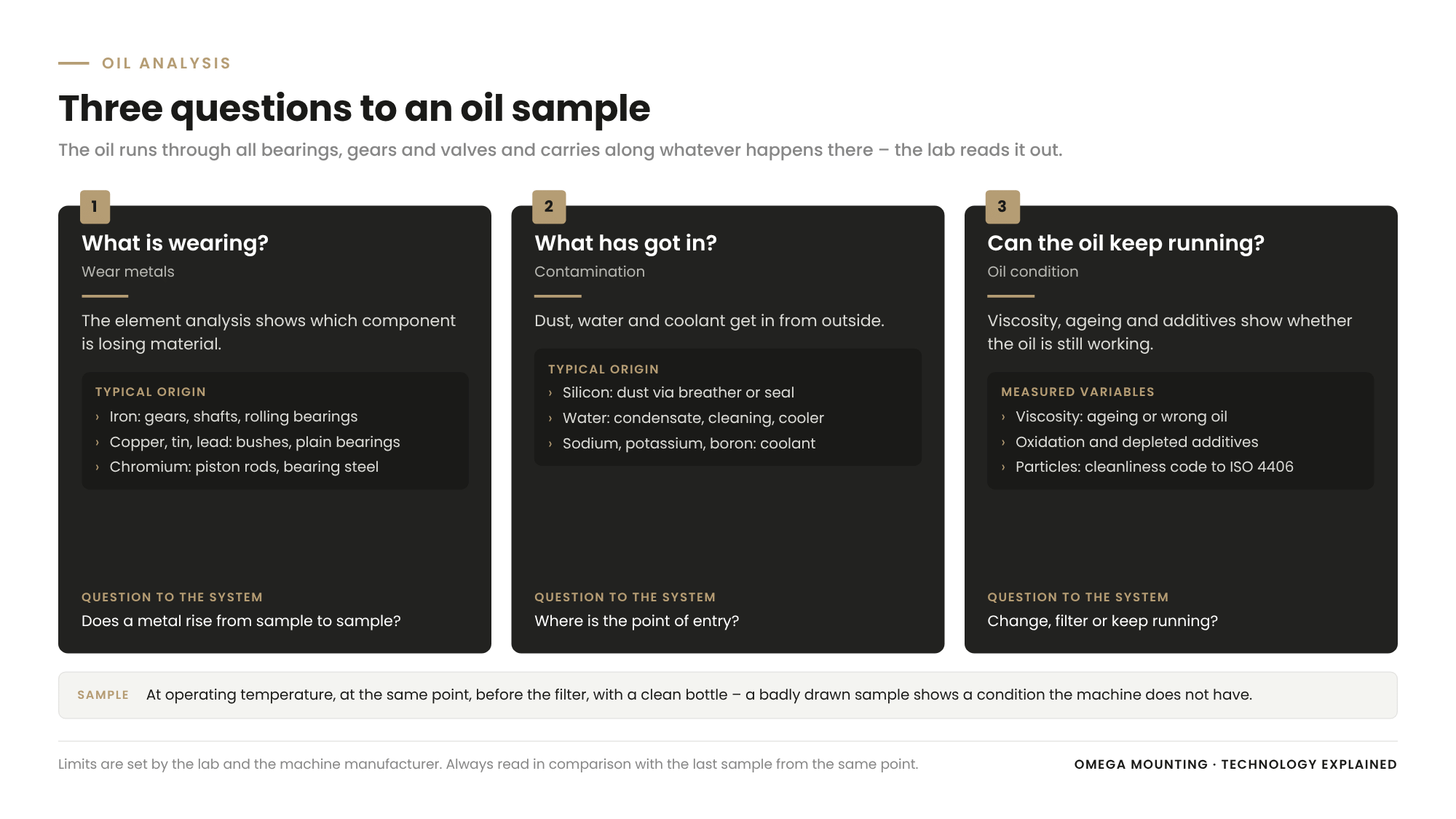
Explainer graphic: oil analysis – wear metals, contamination and oil condition with typical source and meaning for the plant
Three questions, one sample: what is wearing, what has got in, and can the oil keep running? Graphic: Omega Mounting

The lab answers three questions: what is wearing in the machine, what has got in from outside, and can the oil keep running?

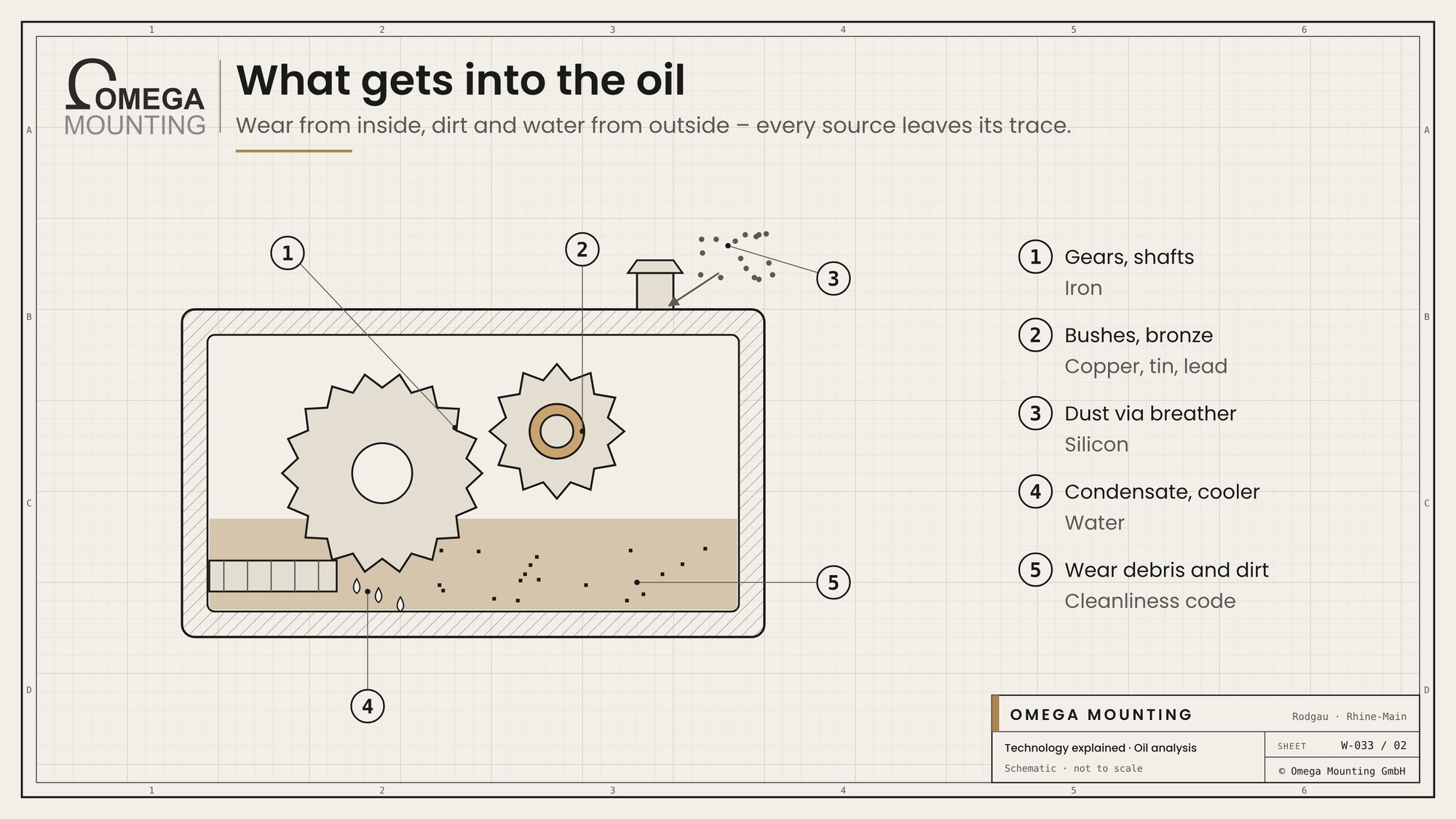
Technical drawing: gearbox in section with gears as a source of iron, a bronze bush for copper and tin, dust via the breather for silicon, a cooler for water and wear particles in the oil
Iron from gears, copper from bushes, silicon from dust, water from condensate or cooler: every source leaves its trace in the oil. Graphic: Omega Mounting
Measured quantityTypical source or meaningQuestion for the plant
IronGears, shafts, rolling bearings, cylinders and pump partsWhich steel part is wearing?
Copper, tin, leadBushes, plain bearings and bronze parts; copper also from coolersIs a plain bearing or worm wheel wearing in?
ChromiumPiston rings, chrome-plated piston rods, alloyed bearing steelIs a cylinder or bearing wearing?
SiliconUsually dust, i.e. a leaking breather or sealWhere is dirt getting in?
WaterCondensation, cleaning, leaking coolerIs a cooler or seal leaking?
Sodium, potassium, boronSigns of coolant in the oil, especially in engine oilIs a seal to the coolant circuit defective?
Particles and cleanliness classWear debris and dirt, counted by sizeIs the filtration adequate?
ViscosityAgeing, mixing with another oil, dilutionIs the right oil still in the plant?
Ageing and additivesOxidation, depleted additives such as zinc, phosphorus or calciumCan the oil keep running?

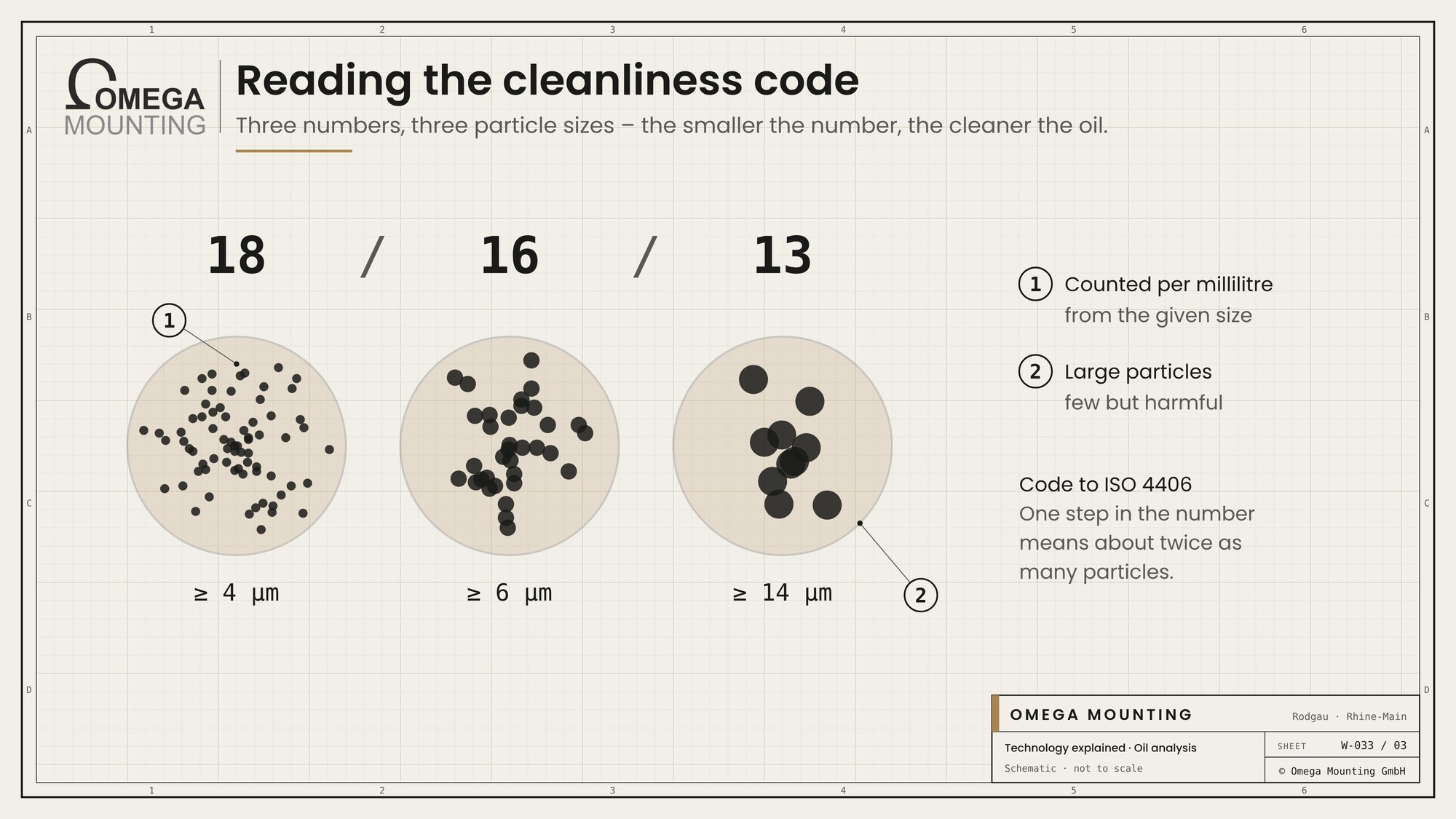
The lab usually determines the metals by spectral analysis in milligrams per kilogram. It measures the water content by the Karl Fischer method. The cleanliness class to ISO 4406 is given as three numbers in a row, for example “18/16/13”. They indicate how many particles of four, six and 14 micrometres and above float in one millilitre. Smaller numbers mean cleaner oil.

Schematic drawing: cleanliness code 18/16/13 – three circles with particles from 4, from 6 and from 14 micrometres, many small and few large particles
Three numbers, three particle sizes: the smaller the number, the cleaner the oil. Graphic: Omega Mounting

Reading the report: trend before limit value

A lab report is read together with the previous sample, not on its own – what matters is what has changed.

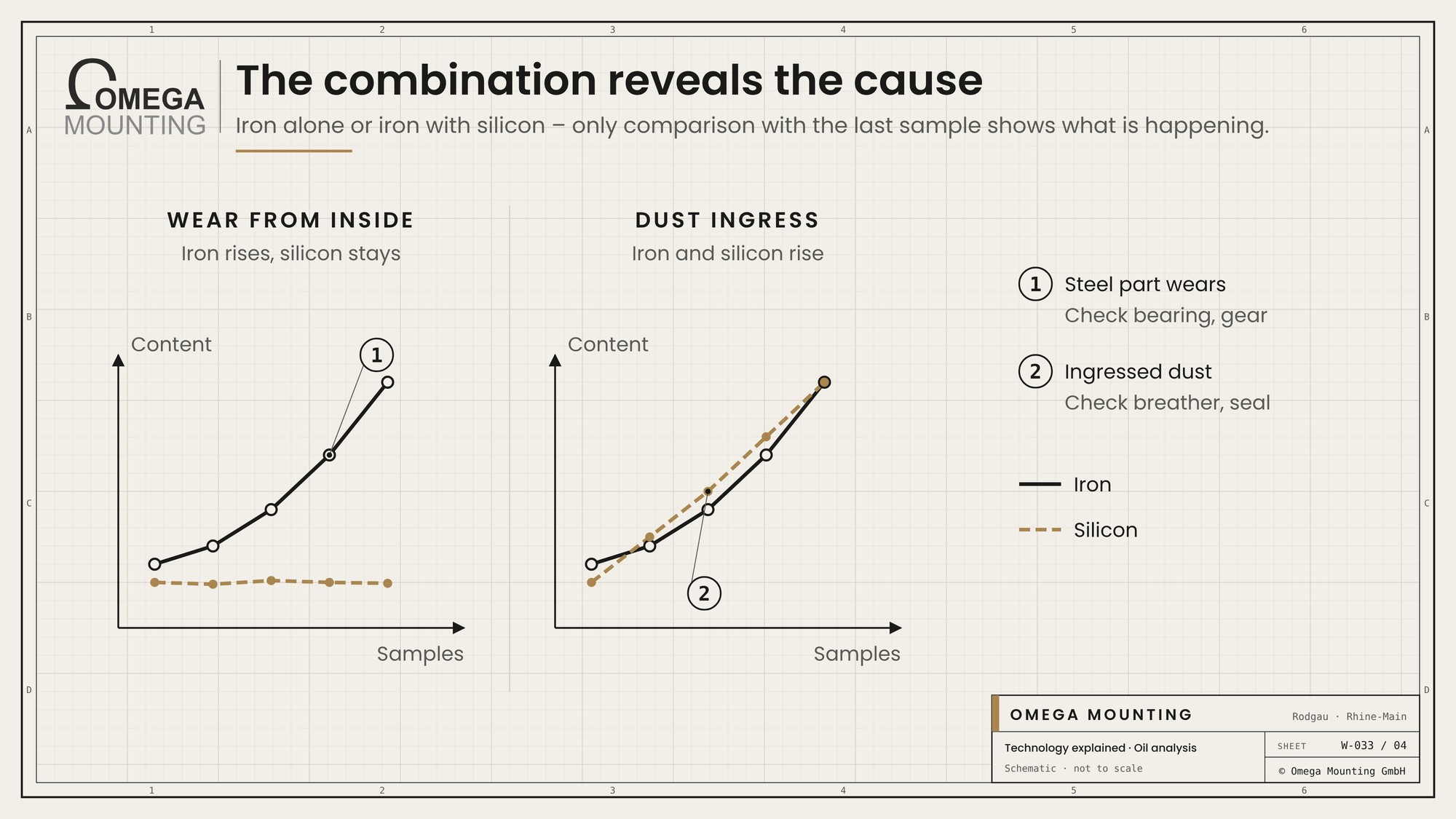
If iron rises from sample to sample while silicon stays the same, a steel part is wearing from the inside. If silicon and iron rise together, ingressed dust is grinding. If copper suddenly appears, it is worth looking at bushes and coolers. These combinations are more valuable than any single value.

The traffic light in the report is based on limit values set by the lab and the machine manufacturer. Amber means: look more closely, resample, find the cause. Red means: act. An oil change alone only removes the symptom. If a seal lets water in, the new oil will soon be just as wet.

Schematic diagrams: on the left iron rises from sample to sample while silicon stays the same – wear from inside; on the right iron and silicon rise together – ingressed dust
Iron alone points to a wearing steel part, iron with silicon to ingressed dust. Graphic: Omega Mounting

What we pay attention to

We take samples where the customer wants them and carry out repairs based on the lab findings.

Hydraulic piping of the test rig above the newly installed drip tray
Where hydraulic oil works under pressure, oil analysis shows wear on pump, valves and cylinders before they fail.

Where we use it

The value of oil analysis shows most clearly in hydraulics, where pump, valves and cylinders depend on clean oil. Take the conversion of a servo-hydraulic test rig – we adapted the hydraulic lines and welded a continuous, leak-tight oil sump around the foundation. A simple rule applied there: oil must never escape uncontrolled. Drain cocks allow the oil to be drained into a container in a controlled way. Work like this is part of our Maintenance and servicing.

More technology explained

Technology explained

the oil type and its designation shown at the top of the report.

Technology explained

the method that shows the same bearing damage from the outside.

Do you have questions about how this works on your site?

Questions about how this works in your plant – for example, what the amber value in your oil report means for the plant? We find the cause, carry out the repair and make sure the next sample stays comparable. Request a callback – we will get back to you.

Free, no-obligation callback

Tobias Schott, managing director of Omega Mounting GmbH, on a construction site in front of scaffolding

About the author

Tobias Schott

Managing director of Omega Mounting GmbH, Rodgau · more than 20 years of hands-on experience in installation and maintenance

A trained mechatronics technician, working in maintenance, servicing and industrial installation since 2004 – first alongside his father, and with Omega Mounting since 2012: from overhead conveyors in Frankfurt to the crane system in a new-build hall. He plans and leads lifting operations as an appointed person (AP) in data centers and on industrial sites in the Rhine-Main region, trains and examines operators of cranes, mobile elevating work platforms and telehandlers, and is a qualified occupational safety specialist. On jobs abroad he is known as the “German Troubleshooter” – the person you call when a site gets stuck. He learned what quality means from his father, not from a manual: Made in Germany as a standard for his own work, not a label. That is why quality comes first at Omega Mounting – ahead of speed and price. The Technology explained articles cover the equipment and techniques his team uses every day: what counts on site is in them – what only appears in the brochure is not.

EnglishEnglish