Oil viscosity: which oil belongs in hydraulics, gearboxes and chains

By Tobias Schott  ·  Reading time approx. 8 minutes  ·  As of: November 2026

Hydraulic cylinders and piping on the underside of the test rig
In every hydraulic cylinder oil works as the pressure medium – and only with the right viscosity does the pressure stay where it belongs.

Viscosity says how thick an oil is – and only together with the type of oil does it decide whether a hydraulic system, a gearbox or a compressor is protected or wears.

Behind the keyword oil viscosity lies a question that comes up in every maintenance job: which oil belongs in which machine? The container bears codes such as HLP 46, CLP or 15W-40. They look similar but belong to different systems.

What ISO VG is and what an oil consists of is explained in our article Lubricants in maintenance. When which oil is changed is covered in the guide lubrication schedule in maintenance. This article is about the applications: which type of oil belongs where and what the wrong viscosity does.

What is viscosity?

Viscosity is the internal flow resistance of an oil – it describes how thick it is and how thick the lubricating film becomes that it builds up between two surfaces. Data sheets usually give the kinematic viscosity in square millimetres per second (mm²/s), formerly called centistokes. There is also the dynamic viscosity in millipascal seconds. The kinematic viscosity is the dynamic viscosity divided by the density.

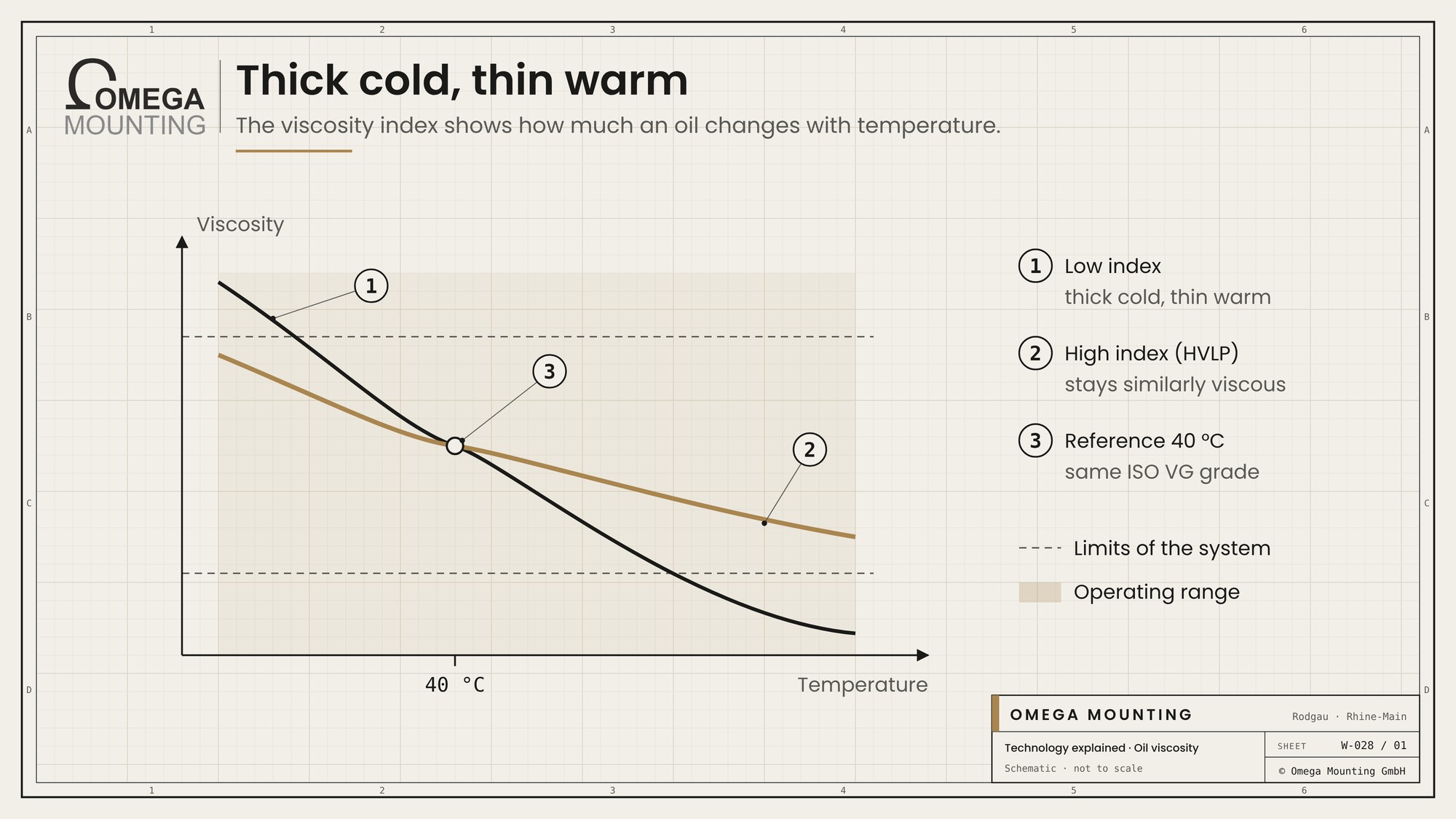
Viscosity depends strongly on temperature: cold oil is thick, warm oil thin. How much an oil changes with temperature is described by the viscosity index (VI). A high VI means: the oil stays similarly viscous over a wide temperature range. In German the terms are Viskosität and Viskositätsindex, hydraulic oil is Hydrauliköl and gear oil Getriebeöl.

Key facts

Oil viscosity by application: which type of oil belongs where

Every machine needs an oil type with suitable additives and a viscosity grade that matches load, speed and temperature – both are given in the operating instructions. The code letters follow the system of DIN 51502: one letter names the type of oil, further letters the additives, the number after them the viscosity grade.

Technical drawing: viscosity over temperature for two oils of the same grade – an oil with a low viscosity index becomes very thick when cold and very thin when warm, an oil with a high index stays similarly viscous in the operating range of the system, both meet at the reference point 40 °C
Same ISO VG grade, different behaviour: a high viscosity index keeps the oil within the limits of the system in cold and heat. Graphic: Omega Mounting

Hydraulic oil. In hydraulics, oil is pressure medium, lubricant and coolant at the same time. DIN 51524 distinguishes HL with corrosion and ageing protection, HLP with additional wear protection for high pressures and HVLP with a high viscosity index. Hydraulic oils are usually in the middle range of the viscosity grades, often ISO VG 32, 46 or 68.

Gear oil. There is high surface pressure between tooth flanks. Gear oils for industrial gearboxes carry the designation CLP according to DIN 51517: corrosion and ageing protection plus additives against seizing, known as extreme pressure (EP). They are usually in much higher, often three-digit grades than hydraulic oil. Special care is needed with worm gearboxes with a bronze wheel: some additives attack non-ferrous metals, so the manufacturer’s approval counts here.

Compressor oil. In the compressor, oil gets hot and comes into contact with atmospheric oxygen and moisture. It must be resistant to ageing, form few residues and separate again from air and water. Refrigerant compressors need their own oils matched to the refrigerant – that is a matter for the refrigeration contractor.

Circulating and turbine oil. Large quantities of oil circulate here over a long time. Resistance to ageing and fast separation of water and air are required. The oils tend to be thin.

Chain and adhesive oil. On the chain, oil must creep into the joint and adhere on the outside without being flung off.

ApplicationType of oil / designationTypical requirementConsequence of wrong oil
Hydraulics with pump, valves and cylinders.Hydraulic oil HLP, medium VG grade.Wear protection under pressure, air and water separation, high cleanliness.Too thick: pump cavitates at cold start. Too thin: internal leakage, heat, wear.
Hydraulics with large temperature changes.Hydraulic oil HVLP with high viscosity index.Viscosity remains stable over a wide temperature range.Normal HLP becomes too thick when cold and too thin when warm.
Industrial gearboxes.Gear oil CLP, higher VG grade.Load-bearing film under high surface pressure, protection against seizing.Too thin: pitting and seizing on the tooth flanks. Too thick: churning losses and heat.
Screw and piston compressors.Compressor oil as approved by the manufacturer.Ageing-resistant at high compression temperature, few residues.Carbon deposits on valves, clogged separators, in extreme cases fire risk in the discharge line.
Circulating lubrication and turbine.Circulating or turbine oil, rather low VG grade.Long service life, fast water and air separation.Foam, emulsion, bearing damage.
Chain and open gears.Chain or adhesive oil.Creeps into the joint, adheres on the outside.Oil flung off, dry joints, rapid chain elongation.
Diesel engine in a generator set or vehicle.Engine oil according to SAE grade and engine approval.Lubricates cold and hot, keeps soot in suspension.Poor cold start, wear, deposits.
Food sector.H1-registered oil of the appropriate type.As above, additionally approved for incidental food contact.Contamination of the product.

Engine oil and SAE grades: why 15W-40 is not an ISO VG

Engine oil is classified according to SAE grades, a separate system that cannot be compared with ISO VG. The standard for this is SAE J300. In a multigrade oil such as 15W-40, the number before the W stands for the behaviour in the cold, the W for winter. The number after it describes the viscosity at 100 °C, i.e. at operating temperature.

The numbers look like ISO VG grades, but they are not. An engine oil also contains additives for soot, acids and combustion residues that have no place in a hydraulic system. Therefore: engine oil belongs in the engine, industrial oil in the industrial plant.

The standby generator set in the plant room before dismantling
The diesel engine of a standby generator runs on engine oil according to SAE grade – a separate scale that has nothing to do with ISO VG.

Too thick or too thin: what the wrong viscosity does

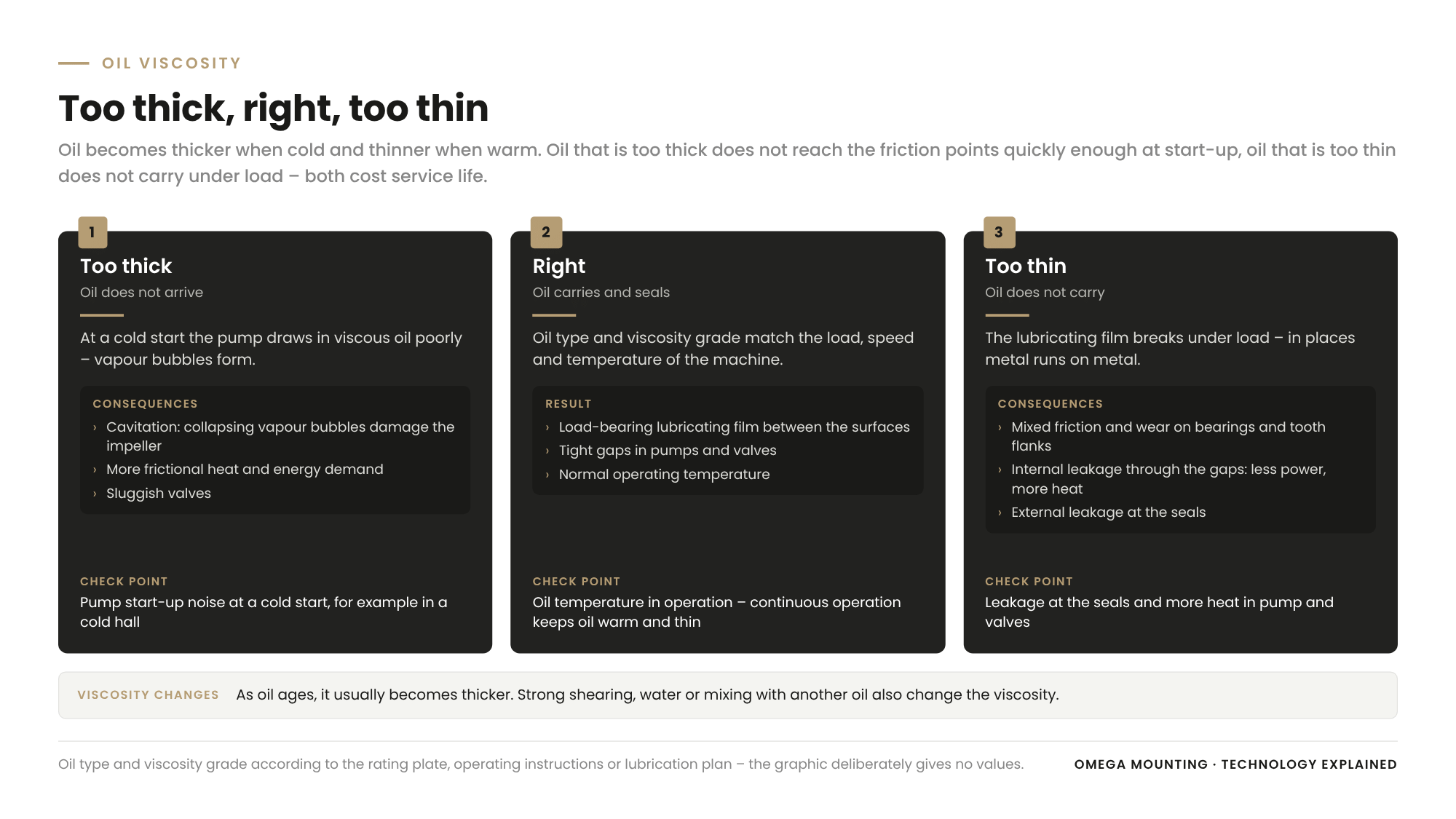
Explanatory graphic: oil viscosity compared – consequences of oil that is too thick, right and too thin for pump, bearings and seals
Viscosity is a window, not a maximum: oil that is too thick does not arrive, oil that is too thin does not carry. Graphic: Omega Mounting

Oil that is too thick does not reach the friction points quickly enough at start-up, oil that is too thin does not carry under load – both cost service life.

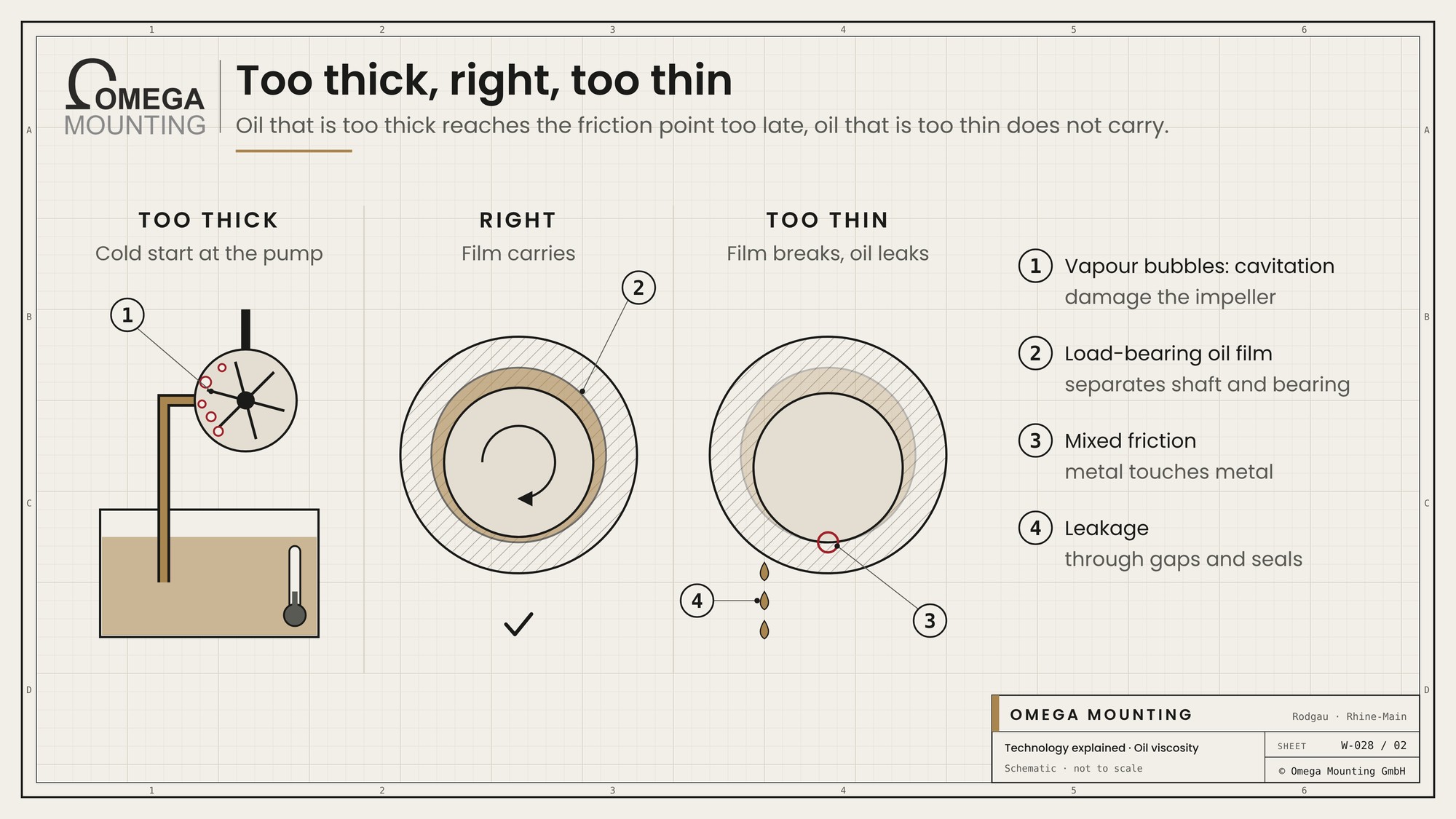
Technical drawing: on the left oil that is too thick at cold start with vapour bubbles at the pump, in the middle a load-bearing oil film between shaft and bearing, on the right oil that is too thin with contact between shaft and bearing and oil drops at the seal
Too thick: the pump cavitates at a cold start. Too thin: the film breaks, metal touches metal, oil leaks. Graphic: Omega Mounting

Viscosity also changes in operation. A hall in winter makes the oil thick at start-up, multi-shift operation keeps it permanently warm and thin. As oil ages, it usually becomes thicker. Strong shearing, water or mixing with another oil also change it.

Checking oil condition: colour, water, particles and oil analysis

You check the oil condition first with your eyes and nose, but reliably only with an oil analysis in the lab.

An oil analysis measures viscosity, water content, particles, wear metals and the condition of the additives. Over several samples it shows whether the oil can continue to run or whether damage is developing. Oil is changed according to the manufacturer’s data or based on findings – topping up does not help with spent oil.

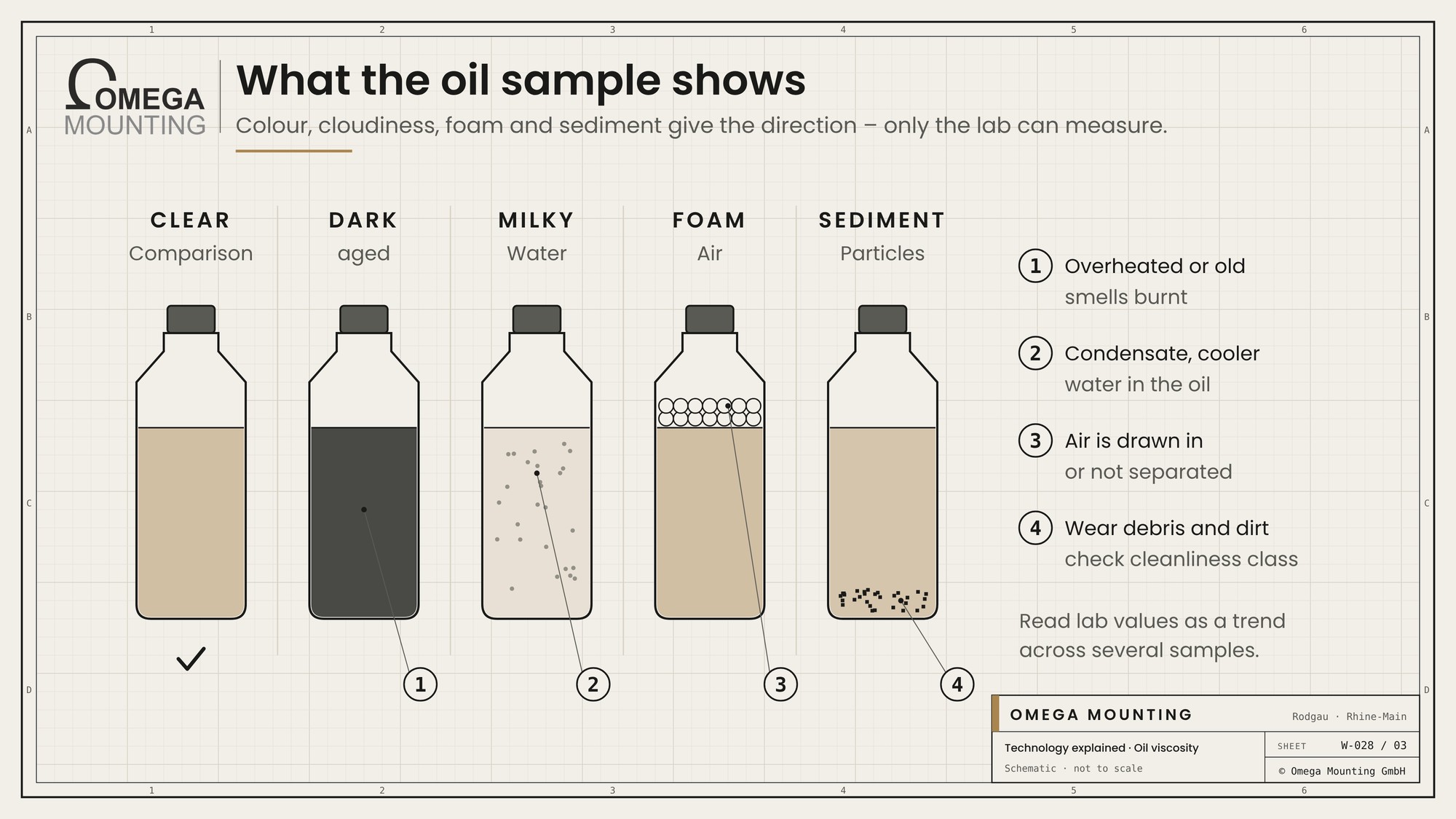
Technical drawing: five oil samples compared – clear oil as reference, dark aged oil, milky oil with water, oil with foam from air and oil with sediment from particles
Dark, milky, foaming, with sediment: the visual check shows the direction, the oil analysis in the lab provides the values. Graphic: Omega Mounting

What we pay attention to

We treat oil like a spare part with a type designation.

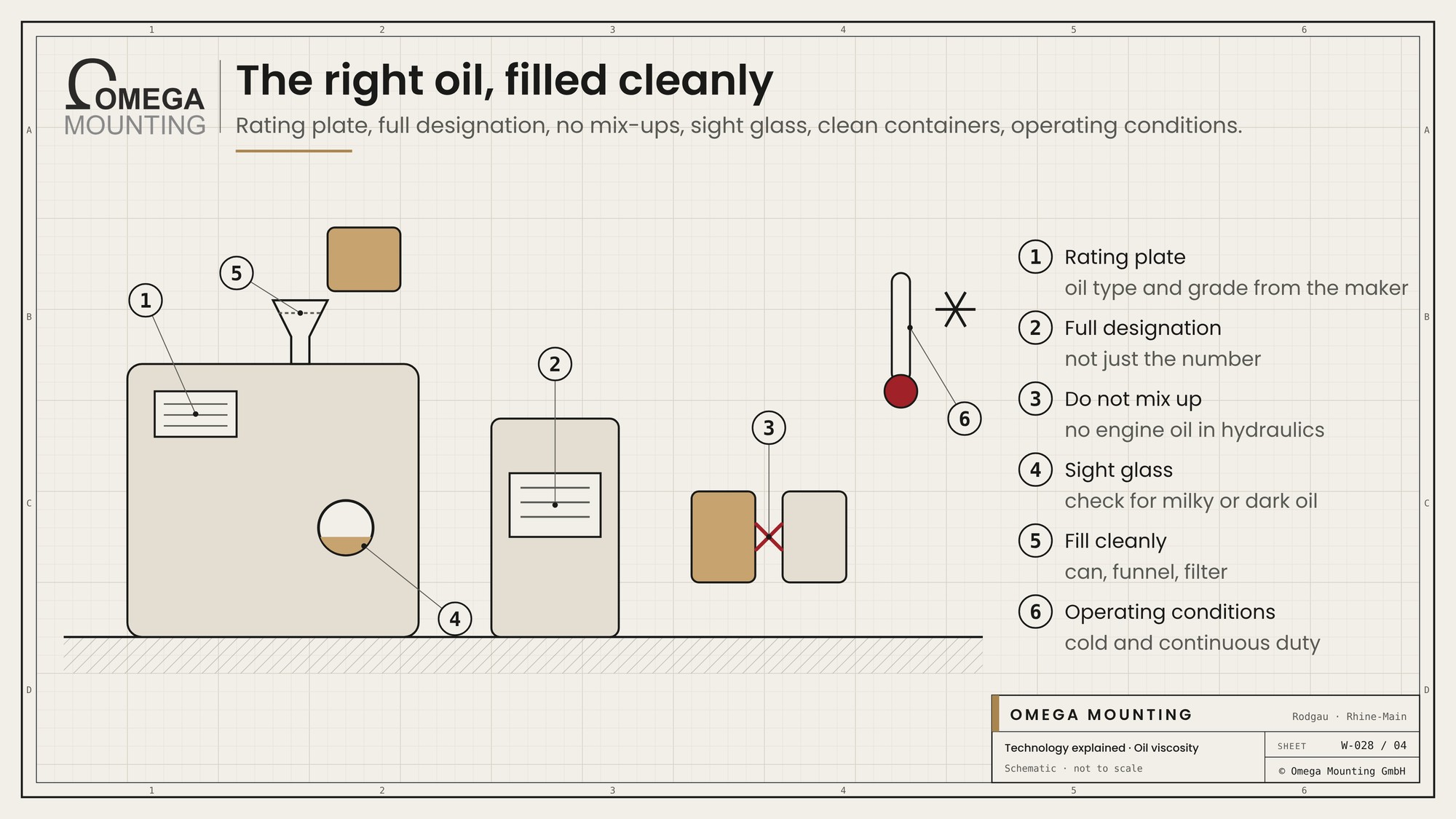
Technical drawing of Oil viscosity with numbered check points: Rating plate, Full designation, Do not mix up, Sight glass, Fill cleanly, Operating conditions
Rating plate, full designation, no mix-ups, sight glass, clean containers, operating conditions. Graphic: Omega Mounting

Where we use it

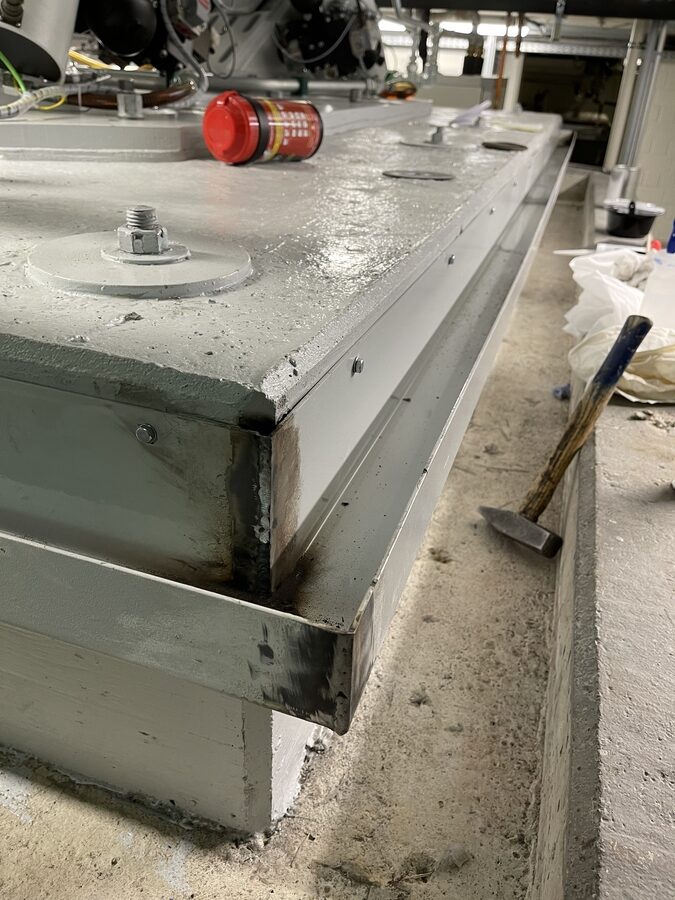
We encounter oil wherever we modify hydraulics, repair drives or service generator sets. During the conversion of a servo-hydraulic test rig we adapted the hydraulic lines to the new configuration. Around the foundation, two fitters installed a surrounding oil pan in three project days and welded it tight. It catches the hydraulic oil in the event of a leak; via drain cocks the oil goes into a container for disposal or recycling. Such work is part of our Maintenance and servicing.

Freshly welded corner of the drip tray on the concrete foundation of the test rig
Where hydraulic oil is under pressure, a tight drip pan belongs with it – every corner and every joint is welded.

More technology explained

Technology explained

the materials science with base oil, ISO VG and H1.

Technology explained

the machine element on which adhesive oil shows what it can do.

Do you have questions about how this works on your site?

Do you have questions about how this works on your site – for example, whether the oil in your hydraulics still suits the system? We check oil condition, lines and seals and work with the approved oil. Request a callback – we will get back to you.

Free, no-obligation callback

Tobias Schott, managing director of Omega Mounting GmbH, on a construction site in front of scaffolding

About the author

Tobias Schott

Managing director of Omega Mounting GmbH, Rodgau · more than 20 years of hands-on experience in installation and maintenance

A trained mechatronics technician, working in maintenance, servicing and industrial installation since 2004 – first alongside his father, and with Omega Mounting since 2012: from overhead conveyors in Frankfurt to the crane system in a new-build hall. He plans and leads lifting operations as an appointed person (AP) in data centers and on industrial sites in the Rhine-Main region, trains and examines operators of cranes, mobile elevating work platforms and telehandlers, and is a qualified occupational safety specialist. On jobs abroad he is known as the “German Troubleshooter” – the person you call when a site gets stuck. He learned what quality means from his father, not from a manual: Made in Germany as a standard for his own work, not a label. That is why quality comes first at Omega Mounting – ahead of speed and price. The Technology explained articles cover the equipment and techniques his team uses every day: what counts on site is in them – what only appears in the brochure is not.

EnglishEnglish