
- Technology explained – equipment and protection
Lubricants in maintenance: oil, grease, paste – what is in the container
By Tobias Schott · Reading time approx. 8 minutes · As of: November 2026
A lubricant is not simply “oil” or “grease” but a formulation of base oil, additives and often a thickener – and anyone who does not know the formulation will mix, store and replace it wrongly.
You encounter lubricants everywhere in maintenance: in the grease gun, in the gearbox, on the chain, as paste during assembly. The container bears codes such as ISO VG 46 or NLGI 2, the data sheet lists base oil, thickener and additives. Anyone who can read this understands why two apparently identical greases are not the same.
This article is the materials science: what lubricants consist of, what they do and where they get damaged. Which lubricant belongs where and at what interval is covered in the guide lubrication schedule in maintenance – we do not repeat that here.
What is a lubricant?
A lubricant is a substance that forms a separating film between two surfaces moving against each other and so reduces friction and wear. Lubricants come in liquid form as lubricating oil, in pasty form as grease or paste and in solid form as solid lubricant. Almost all are based on a base oil that does the actual lubricating work. Additives and thickeners adapt it to the task.
In German the lubricant is called “Schmierstoff”, grease “Schmierfett”, base oil “Grundöl” and the thickener “Verdicker”.
Key facts
- Purpose: Separate friction surfaces, dissipate heat, protect against corrosion, seal against dirt and water.
- Types: Lubricating oil, grease, paste, solid lubricant and special lubricants.
- Design: Base oil plus additives; grease also contains a thickener, paste a high proportion of solid lubricant.
- Marking: Viscosity grade ISO VG for oils, consistency class NLGI for greases, details in the technical data sheet.
- Duties in handling: Safety data sheet, operating instructions, skin protection and separate collection of used oil.
- Ready for discard: Discoloured, hardened, bled, contaminated or containing water – then out with it, do not top up.
- Common misconception: Same class means same lubricant – yet the class says nothing about compatibility.
What do lubricants do? Separate, cool, protect, seal
Lubricants separate the friction surfaces, dissipate heat, protect against corrosion and seal against dirt and water. How well the separation works is described by three friction states:
- Dry friction: Metal on metal without a lubricating film. The roughness peaks weld together and tear apart again – the surfaces seize.
- Mixed friction: The film only partly carries the load, roughness peaks still touch. Typical when starting, with slow movement and high load – i.e. on pins, joints and guides.
- Fluid friction: A closed film separates the surfaces completely.
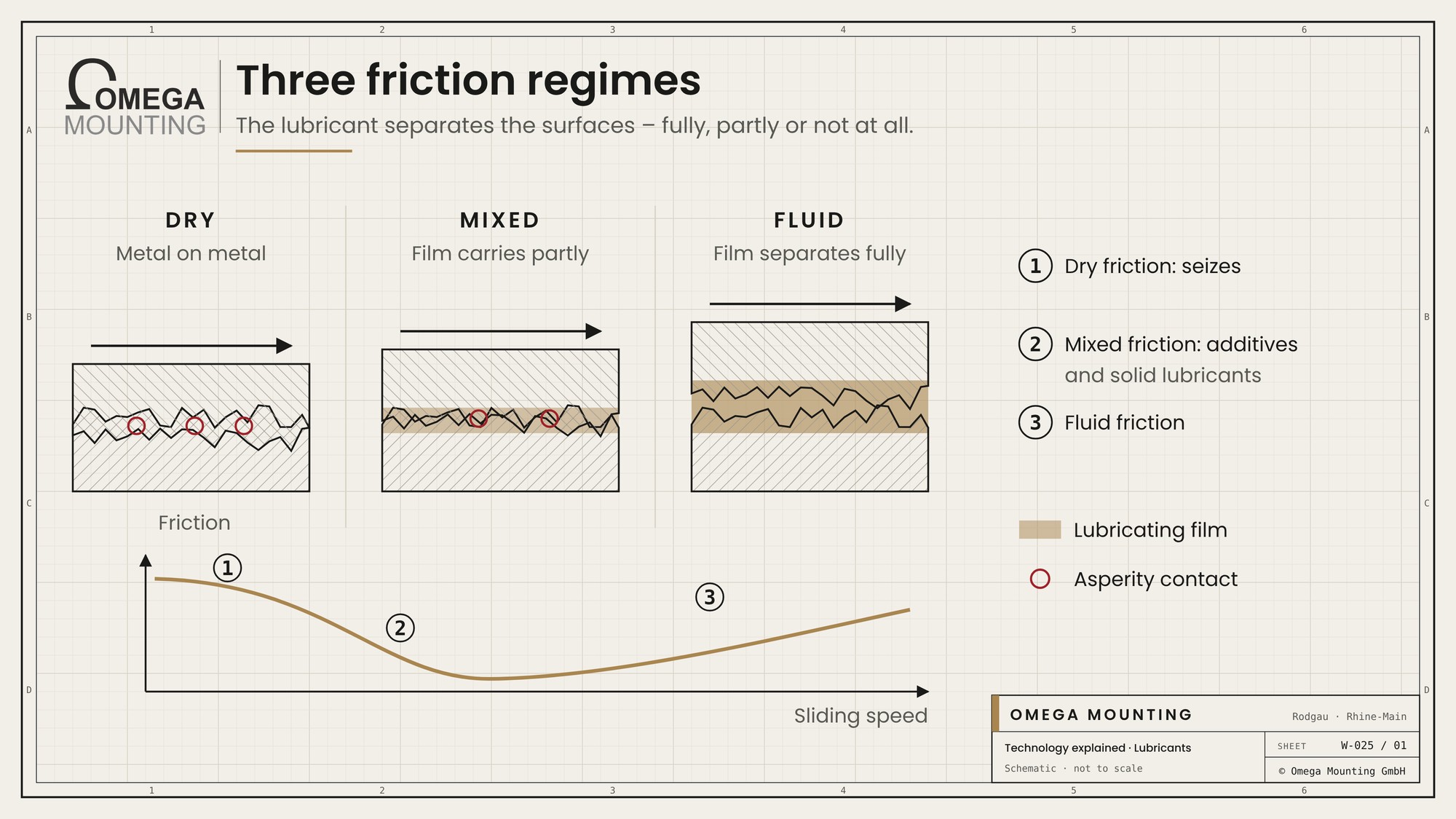
The transition is shown by the Stribeck curve. What counts in practice: slowly swivelling parts never reach fluid friction. There additives and solid lubricants provide the protection. If the lubricant is missing altogether, mixed friction becomes dry friction. The wear debris then acts like grinding paste and accelerates wear.

What lubricants consist of: oil, grease and paste compared
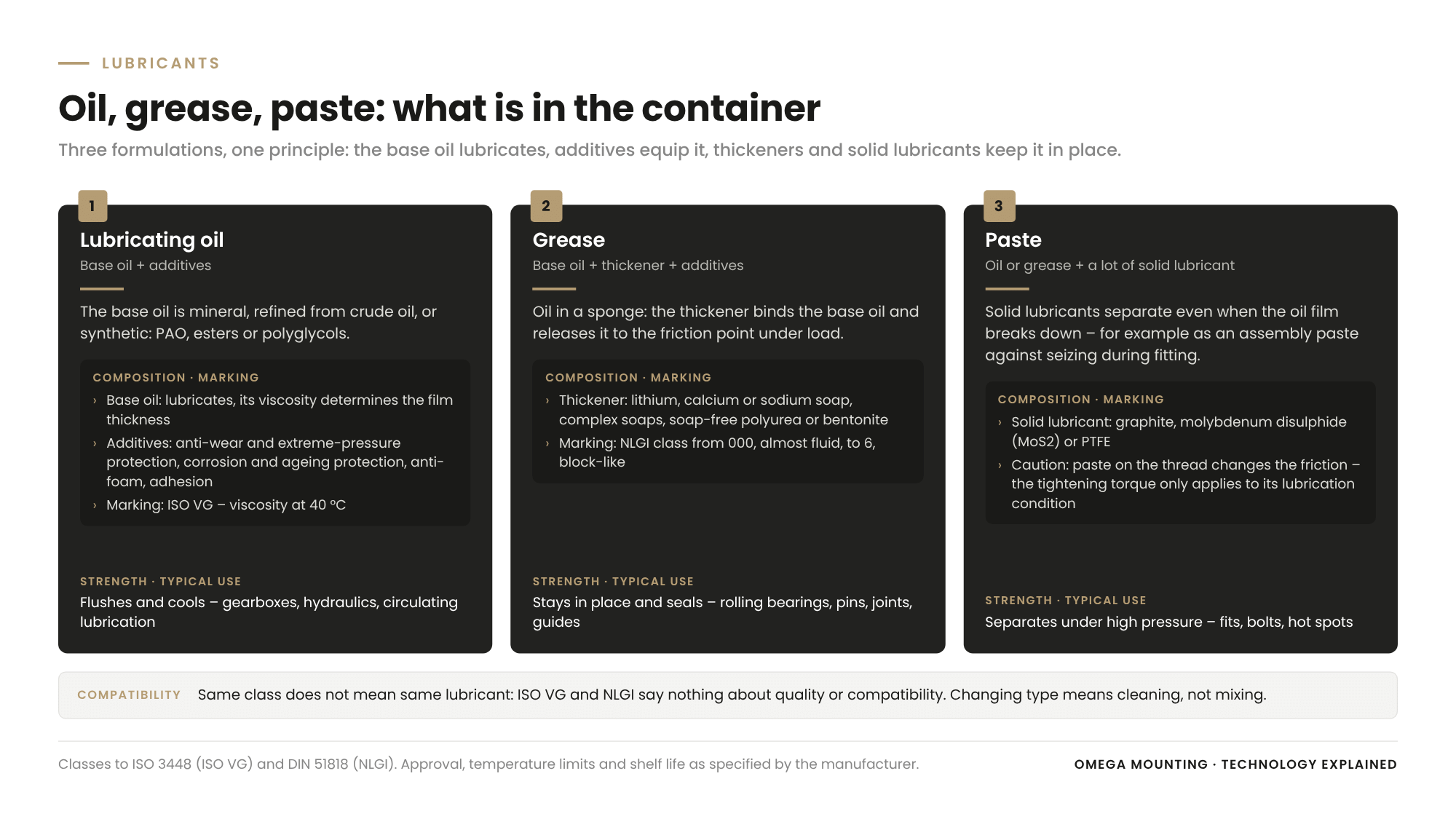
Every lubricant consists of a base oil that lubricates and additives that equip it for its task; grease and paste also contain a thickener or solid lubricant.
Lubricating oil: base oil and additives. The base oil is mineral, i.e. refined from crude oil, or synthetic: polyalphaolefins (PAO), esters or polyglycols. Synthetic base oils usually age more slowly and have a higher viscosity index – they thin out less when warm. Additives provide what the base oil cannot do alone: wear and extreme pressure protection, corrosion and ageing protection, anti-foaming, adhesion.
Viscosity and ISO VG. Viscosity is the thickness of the oil and determines how thick the lubricating film becomes. The grades according to ISO 3448 classify industrial oils by their kinematic viscosity at 40 °C. The number after ISO VG is the mean value in square millimetres per second, with a tolerance of plus/minus ten per cent. ISO VG 46 therefore lies between 41.4 and 50.6. Each grade increases by around half: 22, 32, 46, 68, 100. The grade says nothing about quality.
Grease: oil in a sponge. Grease is base oil bound in a thickener – like water in a sponge. Under load the thickener releases oil to the friction point. Thickeners include metal soaps such as lithium, calcium or sodium soap, complex soaps for higher loads and non-soap thickeners such as polyurea or bentonite, a mineral clay.
NLGI class. How firm a grease is is indicated by the consistency class according to DIN 51818. What is measured is the worked penetration: how deep a standardised cone sinks into the worked grease. The scale ranges from 000, almost fluid, to 6, block-solid. Class 2 is widespread for rolling bearing greases.
Paste and solid lubricant. Solid lubricants such as graphite, molybdenum disulphide (MoS2) and PTFE separate even when the oil film breaks down. A paste is oil or grease with a high proportion of solid lubricant, for example as an assembly paste against seizing when joining. Caution: paste on the thread changes the friction – a tightening torque only applies to the lubrication condition it was calculated for.
| Type of lubricant | Design | Strength | Typical use |
|---|---|---|---|
| Mineral oil | Base oil from crude oil plus additives. | Widely usable, compatible with common seals. | Gearboxes, hydraulics, circulating lubrication. |
| Synthetic oil | Synthetic base oil plus additives. | High viscosity index, slow ageing. | High or changing temperatures. |
| Grease | Base oil in thickener plus additives. | Stays in place, seals. | Rolling bearings, pins, joints, guides. |
| Fluid grease | Grease of the lowest NLGI classes. | Flows almost like oil, seals better. | Central lubrication systems, small enclosed gearboxes. |
| Adhesive lubricant | Oil with tackifier, often with an evaporating carrier. | Creeps into joints, adheres. | Chains, open gears. |
| Paste | Oil or grease with a lot of solid lubricant. | Separates under high contact pressure. | Fits, bolts, hot spots. |
| Solid lubricant | Graphite, MoS2 or PTFE as powder or bonded coating. | Lubricates dry, does not bind dust. | Dusty environment, slow movement. |
What special lubricants are there?
Special lubricants are designed for conditions where standard oil and standard grease fail: open chains, high heat, proximity to food and environmentally sensitive areas.
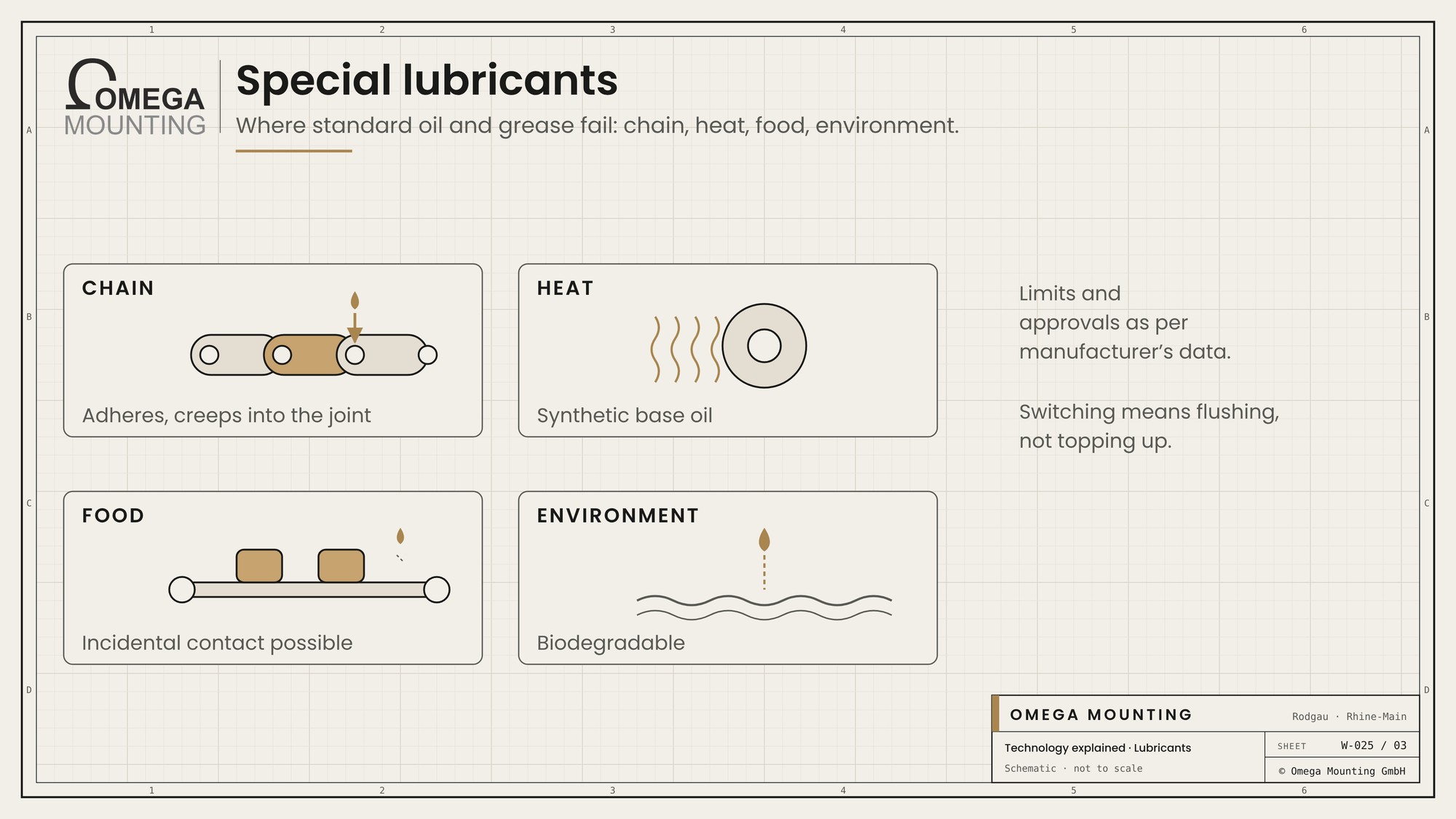
- Chain: An adhesive lubricant creeps into the joint between pin and sleeve and adheres on the outside without being flung off.
- Heat: At high heat the base oil evaporates or cokes. High-temperature greases use synthetic base oils and heat-resistant thickeners; the limits apply according to the manufacturer’s data.
- Food: An H1 lubricant is registered for points where incidental, technically unavoidable contact with food is possible. H2 refers to lubricants for points without any contact. Hygienic manufacture is described in ISO 21469. H1 does not mean that the substance is a food – more on this in the guide Maintenance in food production.
- Environment: Readily biodegradable lubricants are usually based on esters or vegetable oils. They are used where leaks can reach soil or water. Switching means flushing, not topping up.
Mixing, storing, disposing: where lubricants get damaged
Lubricants get damaged mainly in three places: when incompatible types are mixed, when stored incorrectly and in handling on site.
Compatibility. Greases with different thickeners can destroy each other. The mixture becomes soft and runs out of the bearing point, or it hardens and no longer releases oil. In both cases the bearing runs dry even though it is full. For oils this applies to the base oil: polyglycols are not compatible with mineral oil and attack some paints and seals. A change of type therefore means: remove the old grease completely, clean the bearing point, drain the oil and flush – or have the compatibility confirmed by the manufacturer.
Storage. Containers remain closed and are stored dry, frost-free and protected from sunlight. Open containers absorb moisture and dust. Grease can bleed during long storage – then oil that has separated from the thickener stands on the surface. The storage period depends on the manufacturer’s data.
Handling. Every lubricant comes with a safety data sheet with 16 sections, from which the operating instructions are derived. You avoid skin contact with gloves and skin protection; the hazard from skin contact is covered by TRGS 401. Caution with high pressure: a jet from a grease gun or hydraulic line can inject lubricant under the skin – a case for the doctor, even with a small wound. Used oil is collected separately without mixing in other substances. This is not legal advice; the duties in detail are set out in the safety data sheet and in your risk assessment.
What we pay attention to
We treat lubricants like a component with a designation and a limit.
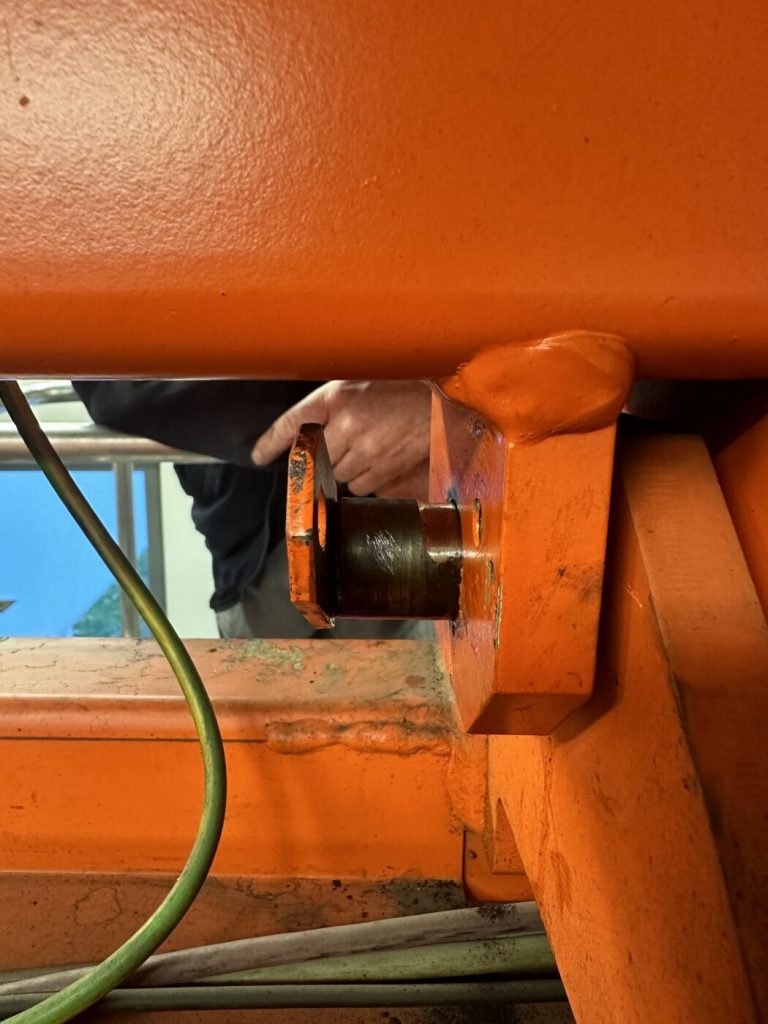
- We only lubricate with the lubricant that the manufacturer or operator has approved for the point – and ask if the information is missing.
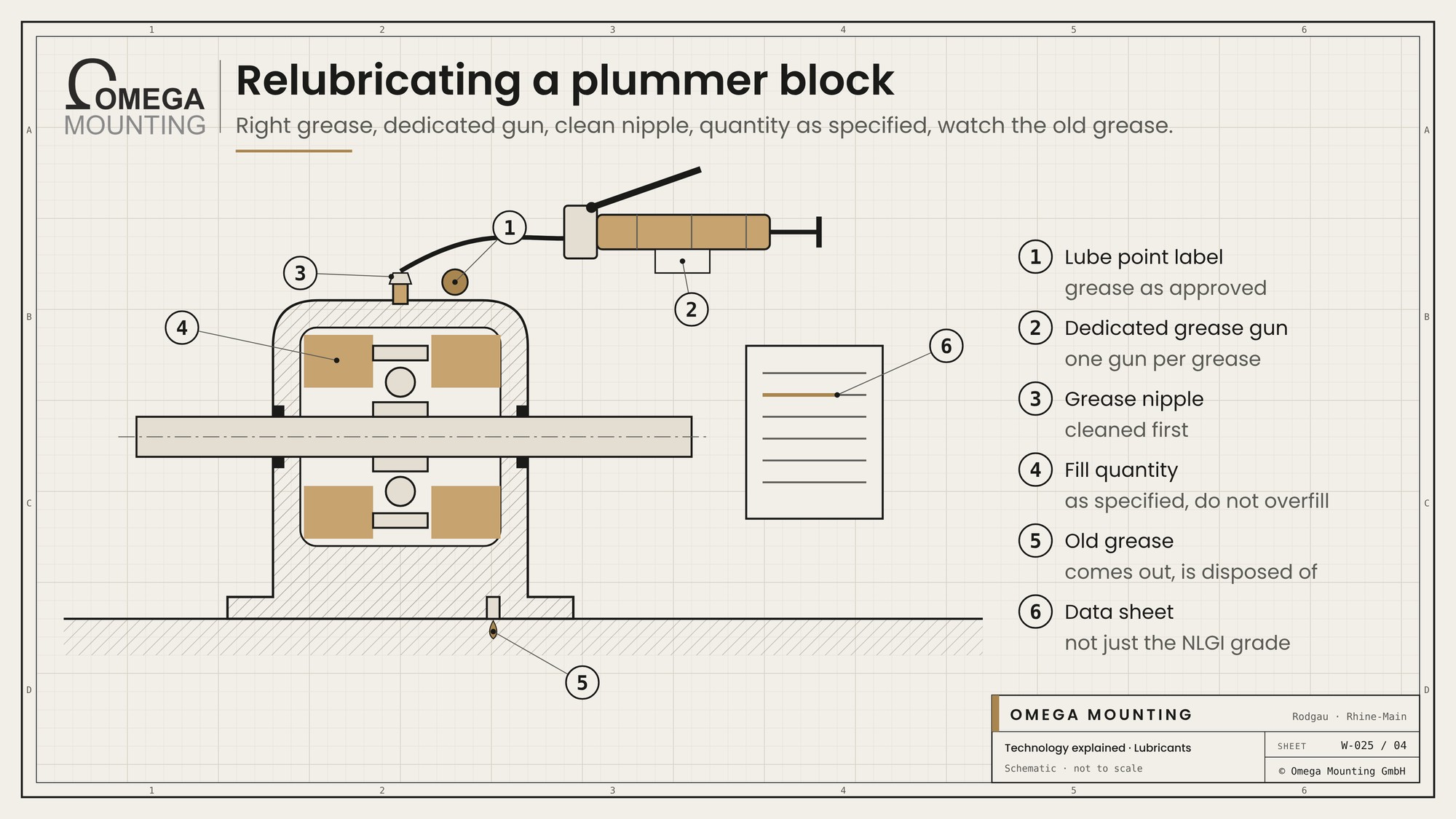
- We read the data sheet before relubricating. The same NLGI class is no proof of compatibility for us.
- We do not mix types. If a change is needed, we clean the lubrication point completely.
- We do not accept “maintenance-free” without checking and look to see whether lubricant is still there.
- In food areas we keep H1 lubricants, guns and containers separate from all others.
- Before the job we clarify who disposes of used oil, cartridges and oily cleaning rags.
Where we use it
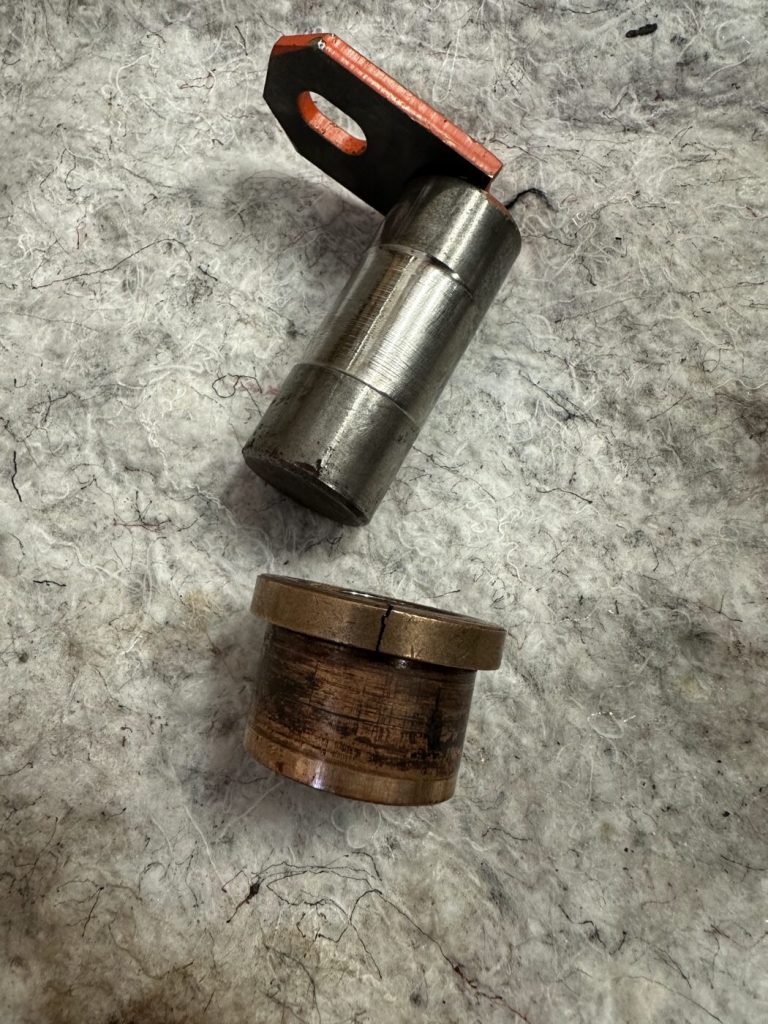
With the worn monorail pins in a food plant the pins were considered maintenance-free, the lubrication was practically gone. Grease ages through heat, wear debris and the environment – without relubrication the pin runs dry. Pins and bushings on all 80 vehicles had to be replaced. During the Cleaning of 25 drive stations with dry ice nobody had lubricated for over 20 years; caked-on dirt and oil had to come off before fresh lubrication was possible. Both jobs are part of our Maintenance and servicing.
More technology explained
Technology explained
where lubrication appears as servicing among the four basic measures.
Technology explained
the machine element on which an adhesive lubricant shows what it can do.
Guide
the guide for when you decide which lubricant belongs where and when.
Do you have questions about how this works on your site?
Do you have questions about how this works on your site – for example, whether a new grease is compatible with the old one? We assess lubrication points, clean them and lubricate with the approved product. Request a callback – we will get back to you.
Free, no-obligation callback

About the author
Tobias Schott
Managing director of Omega Mounting GmbH, Rodgau · more than 20 years of hands-on experience in installation and maintenance
A trained mechatronics technician, working in maintenance, servicing and industrial installation since 2004 – first alongside his father, and with Omega Mounting since 2012: from overhead conveyors in Frankfurt to the crane system in a new-build hall. He plans and leads lifting operations as an appointed person (AP) in data centers and on industrial sites in the Rhine-Main region, trains and examines operators of cranes, mobile elevating work platforms and telehandlers, and is a qualified occupational safety specialist. On jobs abroad he is known as the “German Troubleshooter” – the person you call when a site gets stuck. He learned what quality means from his father, not from a manual: Made in Germany as a standard for his own work, not a label. That is why quality comes first at Omega Mounting – ahead of speed and price. The Technology explained articles cover the equipment and techniques his team uses every day: what counts on site is in them – what only appears in the brochure is not.
 English
 German