
- Technology explained – technology and procedures
The drive chain: tight side, slack side and when it is ready for discard
By Tobias Schott · Reading time approx. 8 minutes · As of: November 2026
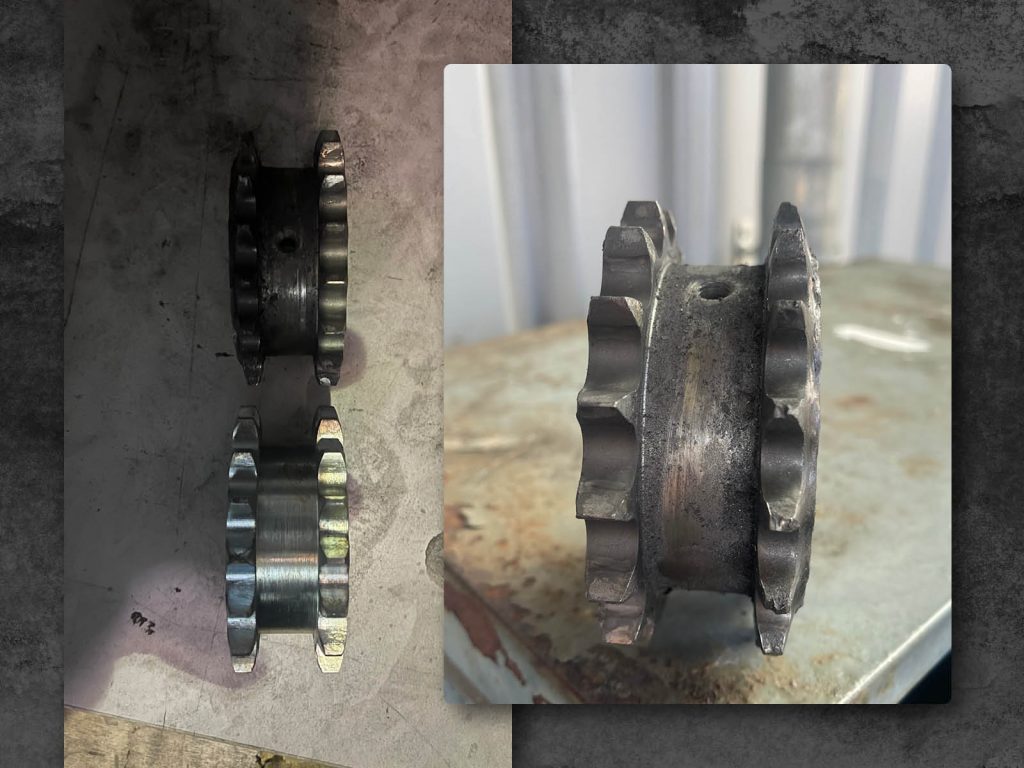
A drive chain transmits the force of a motor positively from sprocket to sprocket – and anyone who knows the tight side, the slack side and the signs of discard will see its failure coming a long way off.
Drive chains are found in roller conveyors, hoists, stacker cranes, paternosters and geared motors on packaging lines. They usually sit behind a guard and only get noticed when they rattle, jump or break – and then often the whole line stops.
Here we explain the chain as a machine element: structure, tight side and slack side, sprocket and discard. How to measure, tension and replace it is covered in our guide.
What is a drive chain?
A drive chain is a traction element made of articulated links that transmits rotary motion and force positively between two or more sprockets. Positively means: the teeth engage the chain, nothing slips – unlike a belt, which works by friction. In English the most common type is called a roller chain, the wheel a sprocket.
Three chain families are often confused. The drive chain drives, the conveyor chain carries the goods with attachments, the load chain lifts a load in the hoist. Lifting chains made of round steel are subject to their own inspection rules again.
Key facts
- Principle: Positive power transmission via chain links and teeth, without slip.
- Types: Roller chain as simplex, duplex or triplex chain, bush chain without roller, special chains for heat, wet conditions or food areas.
- Key parameters: Pitch, number of strands, breaking load, number of teeth and centre distance of the sprockets.
- Standards: Roller chains of European design to DIN 8187, of American design to DIN 8188, combined internationally in ISO 606.
- Field of use: Roller and chain conveyors, hoists, stacker cranes, storage and sorting technology.
- Wear parts: Elongation through joint wear, worn teeth, stiff joints – the limit is set by the manufacturer.
- Who works on it: Trained fitters; our own qualified electricians disconnect and reconnect the motor, the control stays with the manufacturer.
How is a roller chain built?
A roller chain consists of alternating inner links and outer links, connected by pins and bushes so they can articulate. The inner link has two inner plates with press-fitted bushes on which the rollers rotate freely. The outer link has two outer plates with press-fitted pins that run through the bushes of the neighbouring link.
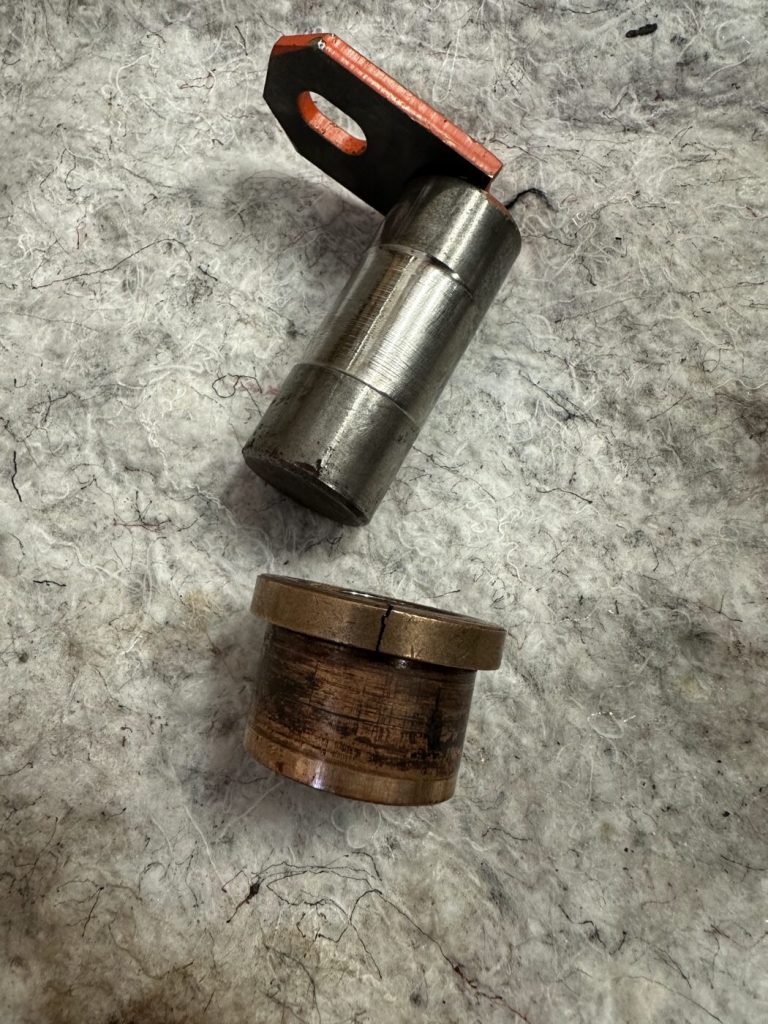
So every joint is a small plain bearing: the pin turns in the bush as soon as the link runs onto the sprocket or leaves it. The roller lets the chain roll on the tooth instead of sliding.

The dimension that determines everything is the pitch – the distance from pin centre to pin centre. It is part of the designation: in “08B-1” the 08 means a pitch of eight sixteenths of an inch, i.e. ½ inch or 12.7 millimetres; the B stands for the European design, the 1 for the simplex chain. Duplex and triplex chains run two or three strands on common pins and transmit more force at the same pitch.
| Component | Task | Typical wear pattern |
|---|---|---|
| Pin | Forms the joint with the bush and holds the outer plates. | Worn running surface, resulting in play and elongation. |
| Bush | Bearing shell for the pin, carries the roller. | Worn bore, scoring, dry friction. |
| Role | Rolls on the tooth root and protects the tooth flanks. | Flattened, cracked, broken or seized. |
| Inner and outer plate | Transmit the tensile force from link to link. | Cracks at the bores, side wear, corrosion. |
| Connecting link | Closes the chain into a loop. | Loose locking element, bent spring clip. |
| Sprocket | Engages the rollers with its teeth and drives or guides the chain. | Hook-shaped worn teeth, known as hooked teeth. |
Tight side and slack side: which side pulls, which side sags?

The tight side is the section of chain that the driving sprocket pulls in under tension; the slack side is the section that runs out of the driving sprocket and back almost without load. In German the strands are called Lasttrum and Leertrum – “Trum” simply means the strand between two sprockets.
Imagine the driving sprocket as a hand pulling in a rope. The section between hand and load is pulled taut – that is the tight side. What the hand lets go behind it sags loosely – that is the slack side. On the chain it is just the same: the entire driving force runs through the tight side, the slack side carries little more than its own weight.
Three rules follow from this:
- Sag belongs in the slack side. A chain needs some sag, otherwise joints and bearings run under constant tension. It is measured on the slack side; the correct value is specified by the manufacturer.
- Tensioners sit in the slack side. A tensioner sprocket or tensioner rail takes up excess length there. In the tight side the tensioner would have to carry the full tensile force and would wear quickly.
- Lubricate in the slack side. There the joints are relieved and the lubricant can creep between pin and bush.
On horizontal drives the tight side is usually at the top. If the slack side is at the top, an elongated chain can hit the tight side or climb the small sprocket. If a drive runs in both directions, tight and slack side swap with every change of direction. The tensioning then has to cope with both cases, for example via an adjustable centre distance.
What does the sprocket decide?
The sprocket decides the transmission ratio, smooth running and service life of the chain. The ratio results from the numbers of teeth: a small sprocket on the motor and a large one on the output reduce the speed and increase the torque.
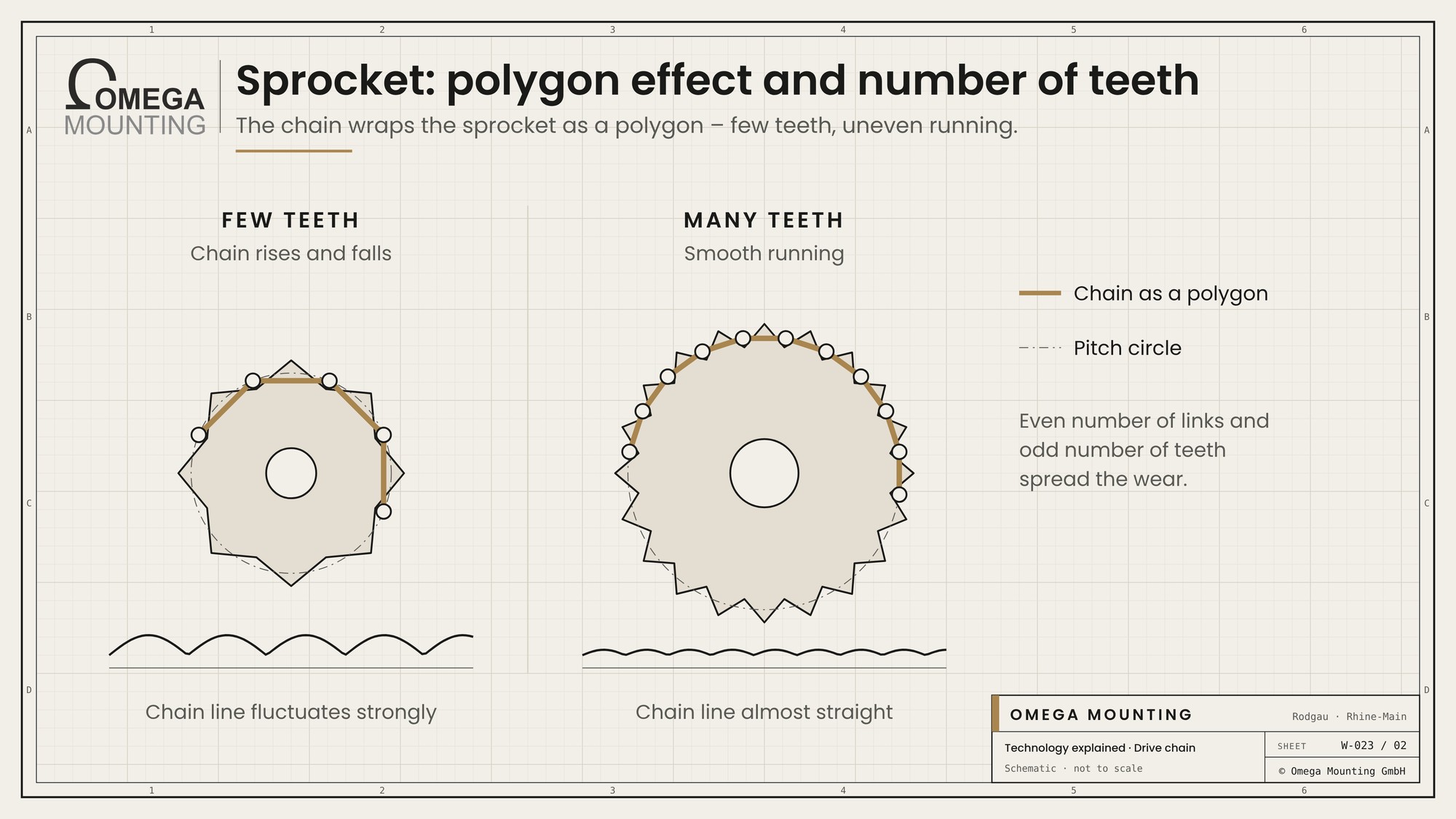
Less obvious is the polygon effect. The chain does not wrap around the sprocket as a circle but as a polygon of straight links. As a result, the chain speed fluctuates slightly with every tooth and the chain rises and falls in rhythm. The fewer the teeth, the stronger the fluctuation; more teeth mean smoother running and less shock in the joints.
The wrap also matters – how many teeth are engaged at the same time. On the small sprocket the force is spread over only a few teeth. A combination of an even number of links and an odd number of teeth ensures that the same links do not always meet the same teeth.
How do you recognise a drive chain ready for discard?
A drive chain is ready for discard when its elongation reaches the manufacturer’s limit or a component is visibly damaged. Ready for discard means: it is no longer re-tensioned but replaced.

Elongation is not caused by stretched plates but by wear in the joints. Pins and bushes wear away, and over many links the play adds up to a measurably longer chain. An elongated chain no longer sits in the tooth root but higher up on the flank – until it jumps over the tooth tip.
The signs at a glance:
- Elongation reached: The value measured over several pitches is at the manufacturer’s limit; there is no universal figure.
- Cracks in plates: Fine incipient cracks, usually starting from the bores – one crack is enough.
- Broken or missing rollers: The chain then slides directly on the tooth.
- Stiff joints: Links no longer articulate freely, for example due to corrosion or gummed-up lubricant; the chain runs jerkily and whips.
- Side wear: Shiny plate flanks indicate misaligned sprockets.
- Hooked teeth on the sprocket: Hook-shaped worn teeth wear out any new chain quickly.
That is why chain and sprockets belong together as a set. A new chain on old sprockets quickly wears into their wear pattern. How to measure elongation and plan the replacement during a shutdown is covered in our guide to wear on conveyor chains.
Unlike a lifting chain, the drive chain is not a load-handling device but a machine element; its limits are given in the manufacturer’s documentation.
What we pay attention to
On a chain drive we look at the interaction of chain, sprockets and tension, not at a single part:
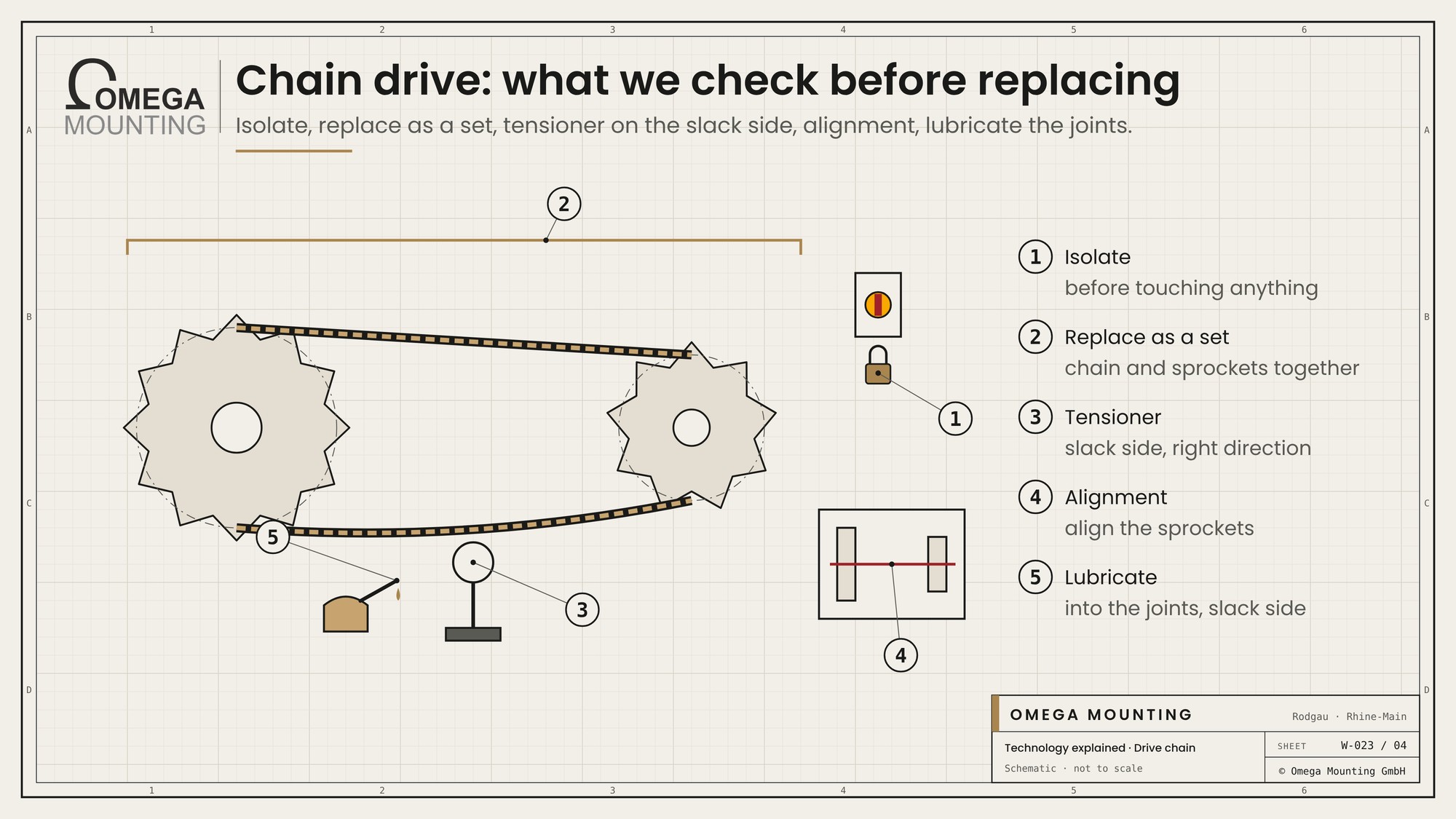
- Isolate first. Before any work on the chain or sprocket, the drive is switched off and secured against being switched back on; stored energy such as a hanging counterweight is supported.
- A set, not a single part. If a sprocket is worn, we replace chain and sprockets together – otherwise the damage returns within a short time.
- Check tensioner and direction of travel. We check whether the tensioner sits in the slack side and whether the direction of rotation still matches the arrangement after modifications.
- Check alignment. Side wear on plates and tooth flanks means: align the sprockets before fitting the new chain.
- Lubricant into the joint. We lubricate on the relieved slack side and clean gummed-up chains first so that the lubricant reaches the gap between pin and bush.
Where we use it
In the Rhine-Main region drive chains are mainly a topic in the maintenance of conveyor and storage technology. In an emergency at a high-bay warehouse at Frankfurt Airport, a gear of the drive unit was worn, the drive chain jammed and partly jumped – chain conveyor and high-bay racking came to a standstill. We dismantled the conveyor, replaced all drive chains and gears with new parts and adjusted the chain systems, as described in the repair of the drive unit of a high-bay warehouse. In another job, 25 complete drive stations were cleaned with dry ice after more than 20 years without maintenance: documented in the report on dry-ice blasting of drives. What we maintain on conveyor systems and machines is described on our page Maintenance and servicing.
More technology explained
Technology explained
the discard criteria for lifting chains, slings and PPE, which follow their own inspection rules.
Technology explained
a conveyor system in which pins, bushes and hoist chains wear in a similar way.
Guide
the guide to wear points, spare parts and maintenance windows on conveyor systems.
Do you have questions about how this works on your site?
Do you have questions about how this works on your drive – whether the chain will still hold or is already taking the sprocket with it? We look at chain, sprockets and tension and tell you what needs doing. The quickest way is a callback – briefly describe the system, the drive and the time window.
Free, no-obligation callback

About the author
Tobias Schott
Managing director of Omega Mounting GmbH, Rodgau · more than 20 years of hands-on experience in installation and maintenance
A trained mechatronics technician, working in maintenance, servicing and industrial installation since 2004 – first alongside his father, and with Omega Mounting since 2012: from overhead conveyors in Frankfurt to the crane system in a new-build hall. He plans and leads lifting operations as an appointed person (AP) in data centers and on industrial sites in the Rhine-Main region, trains and examines operators of cranes, mobile elevating work platforms and telehandlers, and is a qualified occupational safety specialist. On jobs abroad he is known as the “German Troubleshooter” – the person you call when a site gets stuck. He learned what quality means from his father, not from a manual: Made in Germany as a standard for his own work, not a label. That is why quality comes first at Omega Mounting – ahead of speed and price. The Technology explained articles cover the equipment and techniques his team uses every day: what counts on site is in them – what only appears in the brochure is not.
 English
 German