
- Technology explained – technology and procedures
The electrified monorail: track, trolley, switch – how the EMS runs
By Tobias Schott · 8-minute read · Updated October 2026
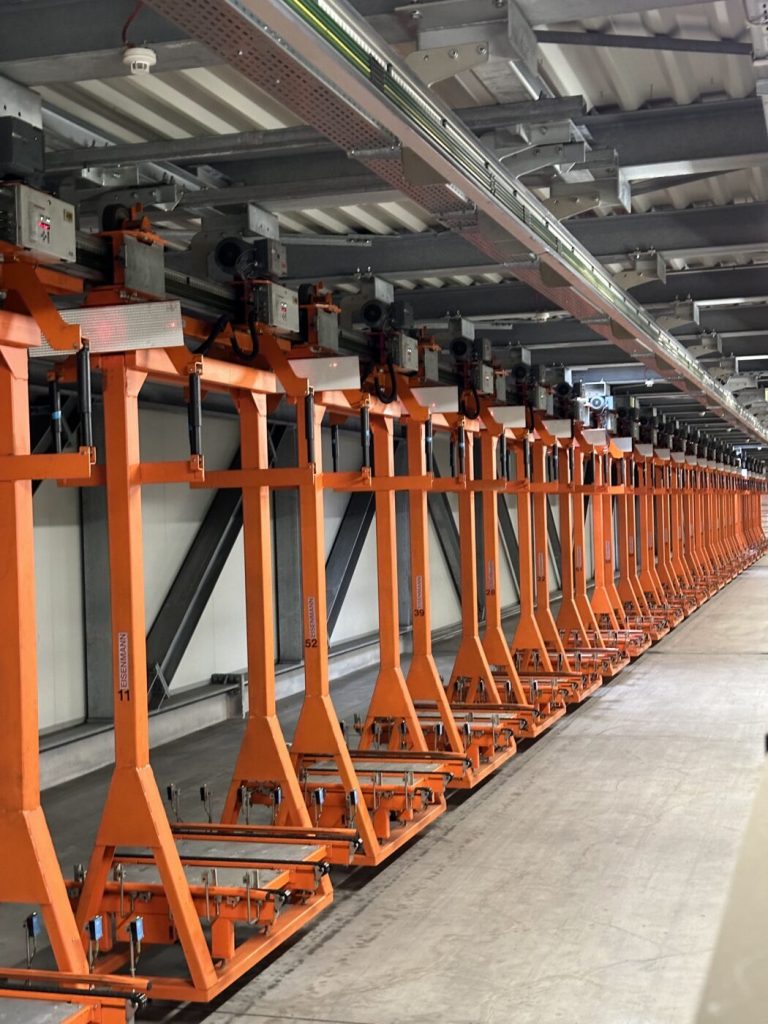
An electrified monorail carries loads with independently driven vehicles on a rail below the hall ceiling – and only keeps production and logistics running as long as trolleys, switches and conductor rail are in good order. In assembly halls, warehouses and food plants you often first notice the electrified monorail as a sound overhead. Vehicle after vehicle passes along the rail below the ceiling, carrying car bodies, containers or hanging products in the carrier. For maintenance staff the electrified monorail is a system with hundreds of identical parts that all age at the same time.
Here we explain what an electrified monorail is, what it consists of, how a vehicle finds its way and what wears on it – the technology behind the maintenance guide.
What is an electrified monorail?
An electrified monorail (German: Elektrohängebahn, EHB) is an overhead conveyor system in which individual vehicles with their own electric drive run on a running rail suspended from the ceiling and carry their load in the carrier below. In English it is called an electrified monorail system (EMS). Overhead means the hall floor stays free for forklifts, workstations and walkways.
The difference from other overhead conveyors lies in the drive. On a power-and-free conveyor – a circulating conveyor with a continuous chain – one central chain pulls all trolleys together. On an electrified monorail each vehicle drives, stops and is controlled individually. With the suspension crane it only shares the ceiling rail: the crane moves one load freely, the monorail moves many loads on fixed routes.
Key facts
- Principle: Individual vehicles with their own drive on a running rail; power and signals are supplied via conductor lines in or on the rail.
- Components: Running rail with suspension, trolley, drive, conductor rail with current collector, carrier, switches, lift and lowering stations, buffers, control.
- Typical load capacity: Per vehicle from a few hundred kilograms up to several tonnes; heavier loads hang on coupled trolleys – given as a range, not as system data.
- Field of use: Automotive production and assembly lines, warehouses and distribution centres, food plants; baggage and sorting systems at airports are relatives.
- Requirements: Load-bearing hall structure for rail, vehicles and load, clear height for carrier and lift, access at height.
- Inspection and maintenance: The electrified monorail is work equipment within the meaning of the German Ordinance on Industrial Safety and Health (BetrSichV); the operator sets the scope and intervals of inspection in the risk assessment, the electrics are inspected by a qualified electrician – this is not legal advice.
- Who works on it: Trained fitters and qualified electricians with access at height via mobile elevating work platform or maintenance platform; control software and parameters remain with the manufacturer.
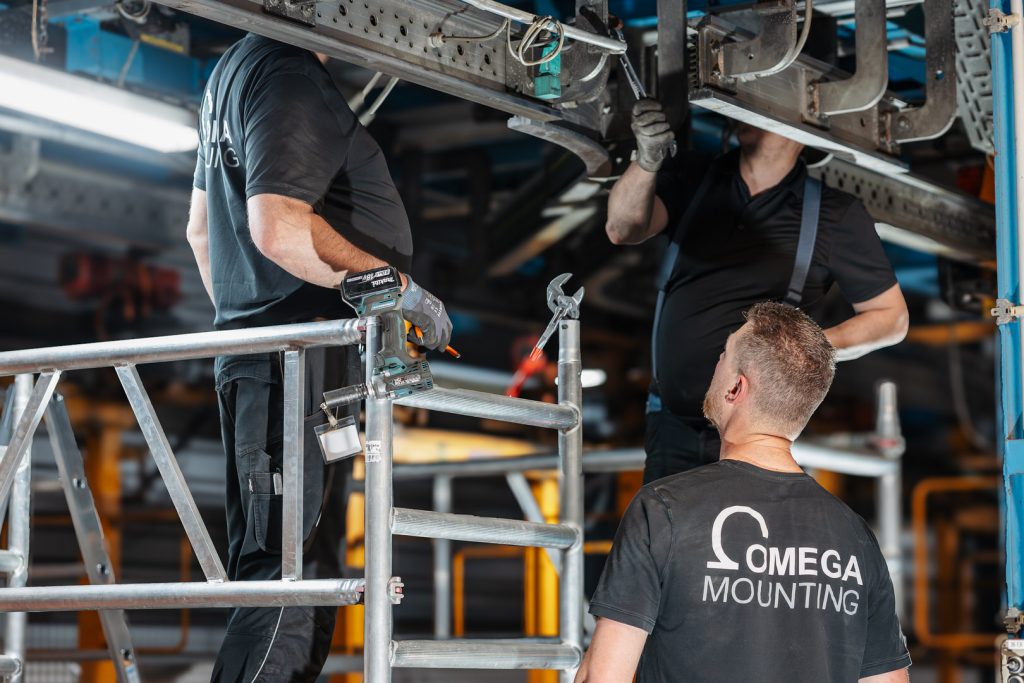
What does an electrified monorail consist of?
An electrified monorail consists of rail, trolley, drive, power supply and carrier as well as the track elements switch, lift station and buffer. Each part has a task – and a typical way of wearing:
| Part | Task | Typical wear |
|---|---|---|
| track | Carries and guides the vehicles; often a profile with chambers for the conductor lines. | Grooves on the running surface, offset at rail joints, cracks on curved sections. |
| Suspension | Connects the rail to roof trusses or columns and compensates for height differences. | Loose bolted connections, cracked welds, bent brackets. |
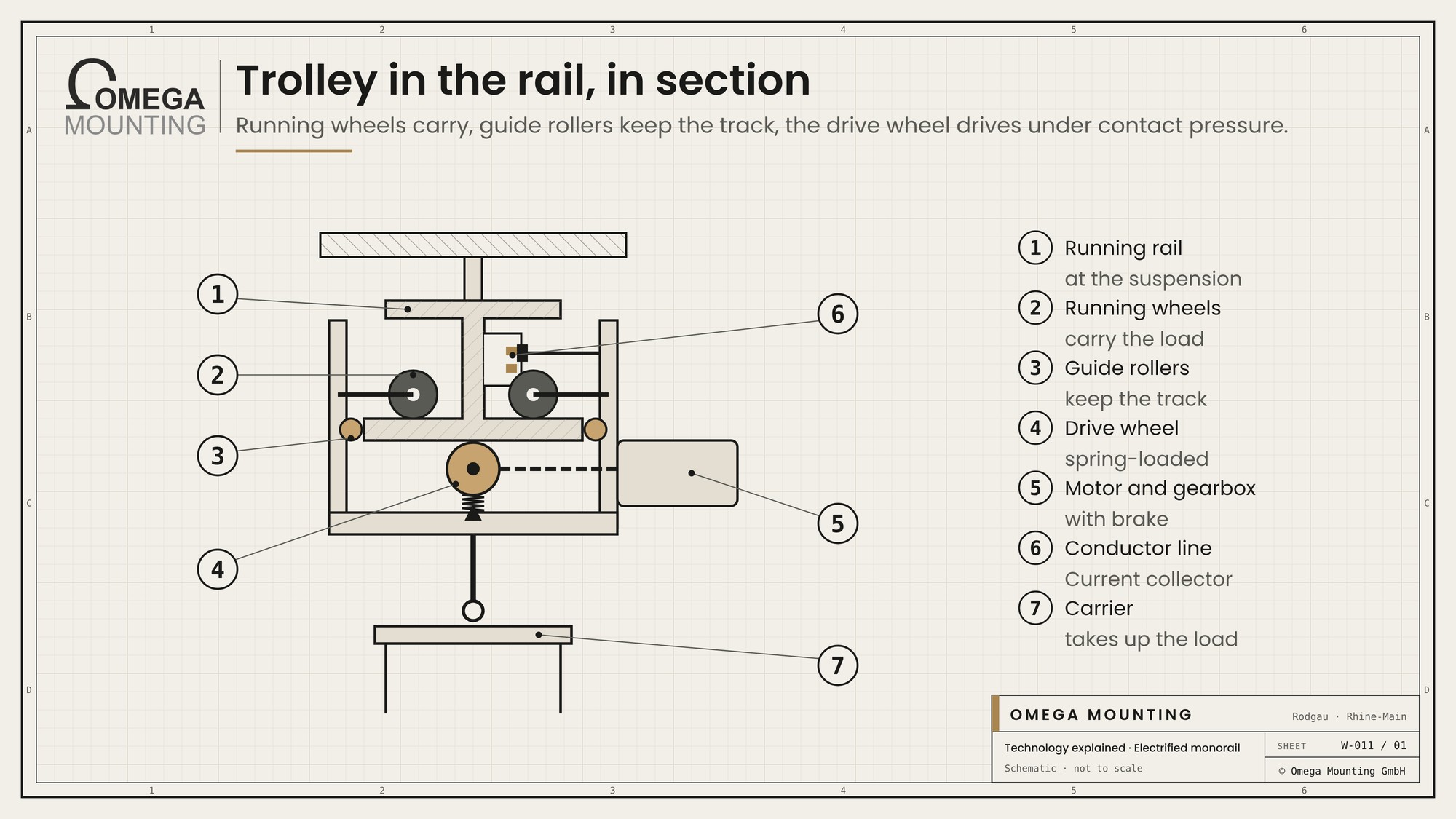
| Trolley | Load wheels carry the load, guide rollers keep the track, the drive wheel transmits the force. | Worn or broken rollers, loose axles, grooves in the drive wheel. |
| Drive and gearbox | Motor and gearbox turn the drive wheel, a brake holds the vehicle. | Oil loss, bearing noise, decreasing braking effect. |
| Conductor rail and collector | Conductor lines carry power and signals, current collectors with carbon brushes pick them up. | Worn carbon brushes, abrasion and deposits in the line, contact burn. |
| Carrier | Takes up the load: hook, frame or container holder, mounted so that it can rotate or swing. | Worn pins and bushings, play in the joints, squeaking. |
| Switch | Branches the track; a movable rail section connects the selected exit. | Worn switch shoes and pins, misadjusted end positions, faulty limit switches. |
| Lift and lowering station | Lowers a rail section with vehicle to working height and raises it again. | Elongated chains, worn guides, loosened counterweight safety device. |
We only name the control – from the system control to data transmission to the vehicle – as a term. Software and parameters belong to the manufacturer; we repair the mechanics and the system electrics on the vehicle with our own qualified electricians.
How does an electrified monorail move?
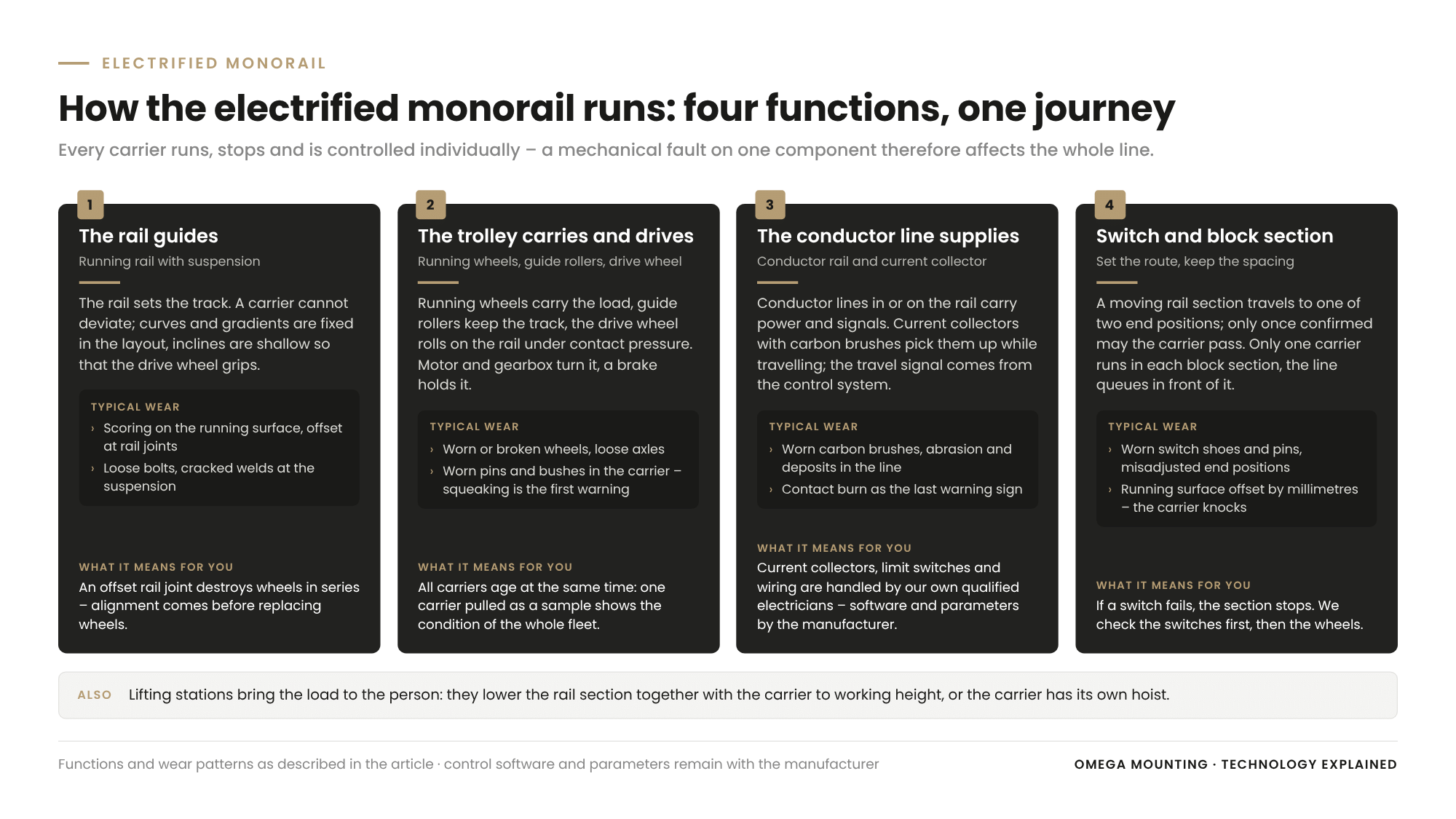
An electrified monorail vehicle moves by its drive wheel rolling on the rail under contact pressure, while load wheels carry the load and guide rollers keep the vehicle on track. It draws power from the conductor line and the travel signal from the control. Four things determine the route:
- The rail sets the track. A vehicle cannot swerve; curves and gradients are fixed in the course of the rail; inclines are shallow so that the drive wheel grips.
- Switches set the route. At a switch a movable rail section moves into one of two end positions. Only when the end position has been reached and confirmed may the vehicle pass over it. If it is not right, the running surface is offset by millimetres – and the vehicle collides.
- Block sections keep the distance. The track is divided into sections, and only one vehicle runs in each. In front of an occupied section the vehicles queue up and move on as soon as it is free. How the distance is detected is a matter for the control.
- Lift stations bring the load to people. At workstations a lift station lowers the rail section together with the vehicle, or the vehicle carries its own hoist. In this way the track stays up and the work stays at working height.
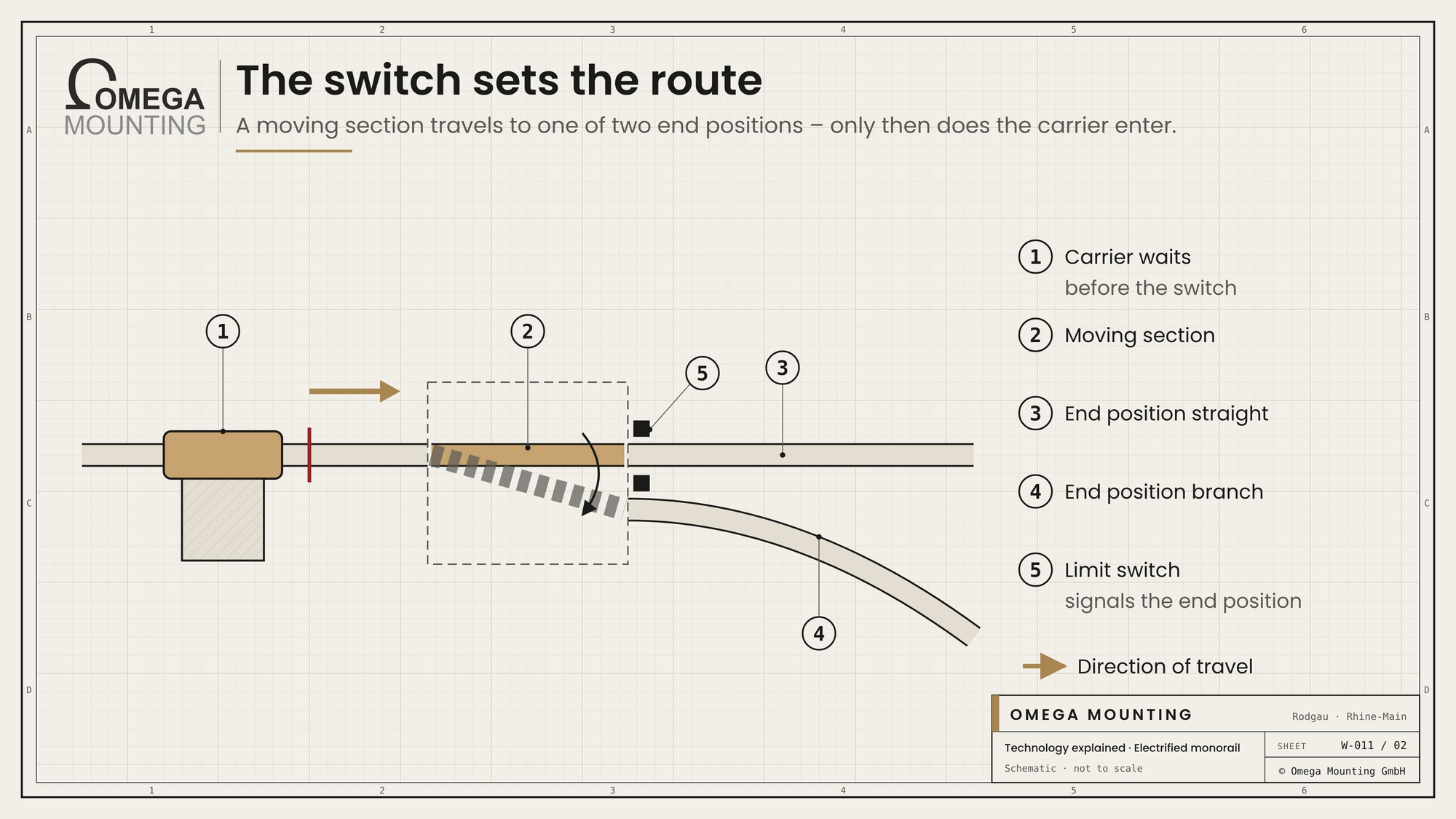
This principle makes the electrified monorail sensitive: if one switch fails, the section stops and the vehicles back up. A mechanical fault on one component affects the whole line.
Electrified monorail, power and free, suspension crane: what is the difference?
The three systems share the ceiling rail but differ in drive and controllability:
| System | Drive | Route and control | Typical use |
|---|---|---|---|
| electrified monorail | Each vehicle has a motor, gearbox and brake. | Fixed rail with switches; vehicles individually controllable, queuing in block sections possible. | Assembly lines with changing cycle times, warehouses with many destinations. |
| Power-and-free conveyors | A circulating chain pulls the trolleys along. | Fixed rail; trolleys can uncouple and couple, otherwise a common cycle. | Painting and drying lines, long circuits with the same rhythm. |
| Suspension crane on crane runway | Crane trolley and hoist, operated by the crane operator. | Free travel over the hall area, no switches, one load per crane. | Single lifts, machine loading, assembly of heavy parts. |
So the electrified monorail is a vehicle system on rails. That is its strength – many loads at the same time – and its weakness: every vehicle brings its own rollers, pins and carbon brushes that need maintenance.
What wears on an electrified monorail?
On an electrified monorail the parts that transmit force through friction wear first: load wheels, drive wheel, carbon brushes and the pins in the carriers. Added to this are rail joints and suspensions, which every vehicle feels as an impact.
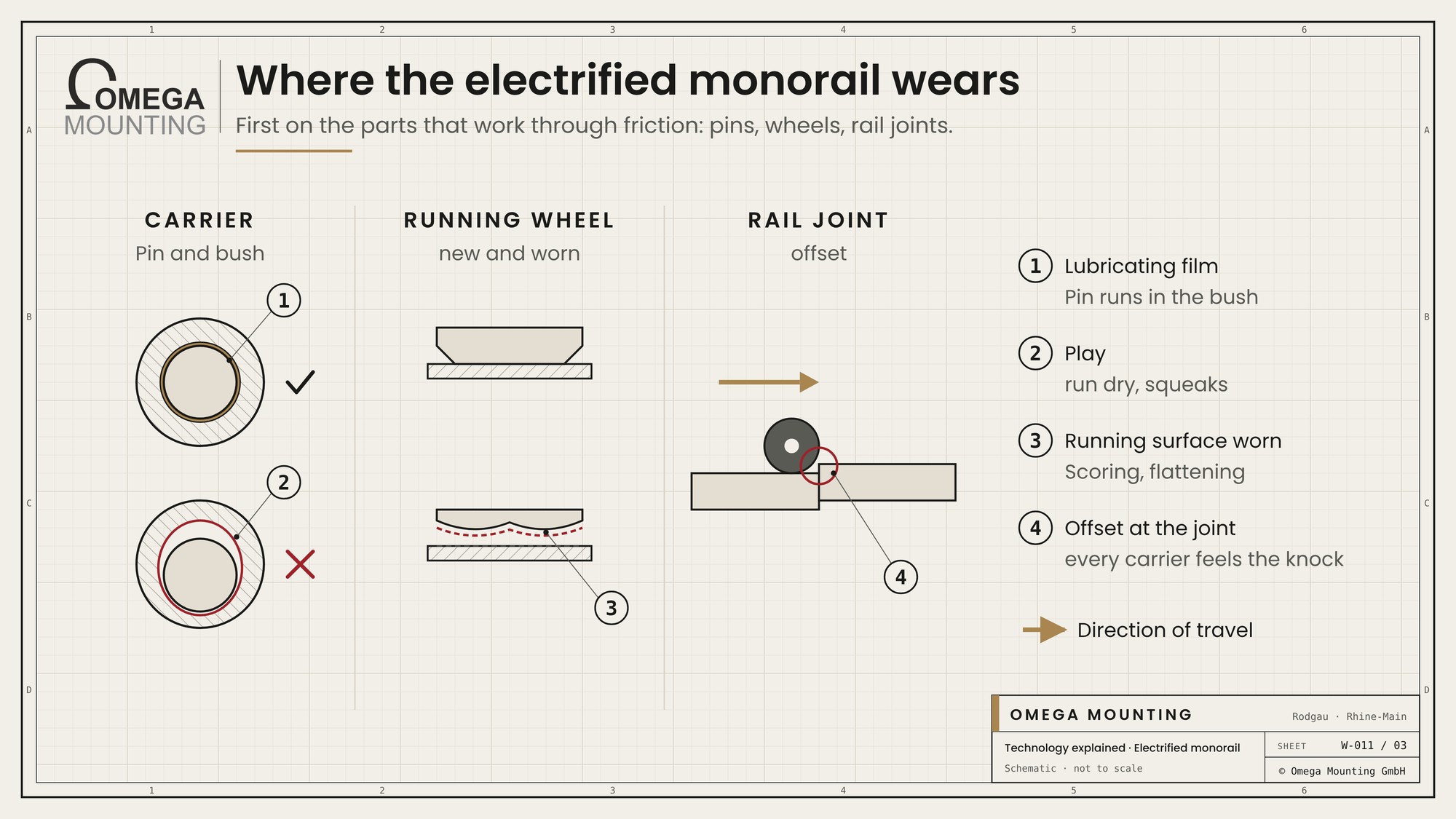
On the track this shows as grooves on the running surface, offset rail joints and cracks on highly loaded curved sections. Switches suffer twice: their switch shoes wear in, and worn running surfaces shift the end position. A locally worn rail section can sometimes be offset by a few centimetres instead of being replaced.
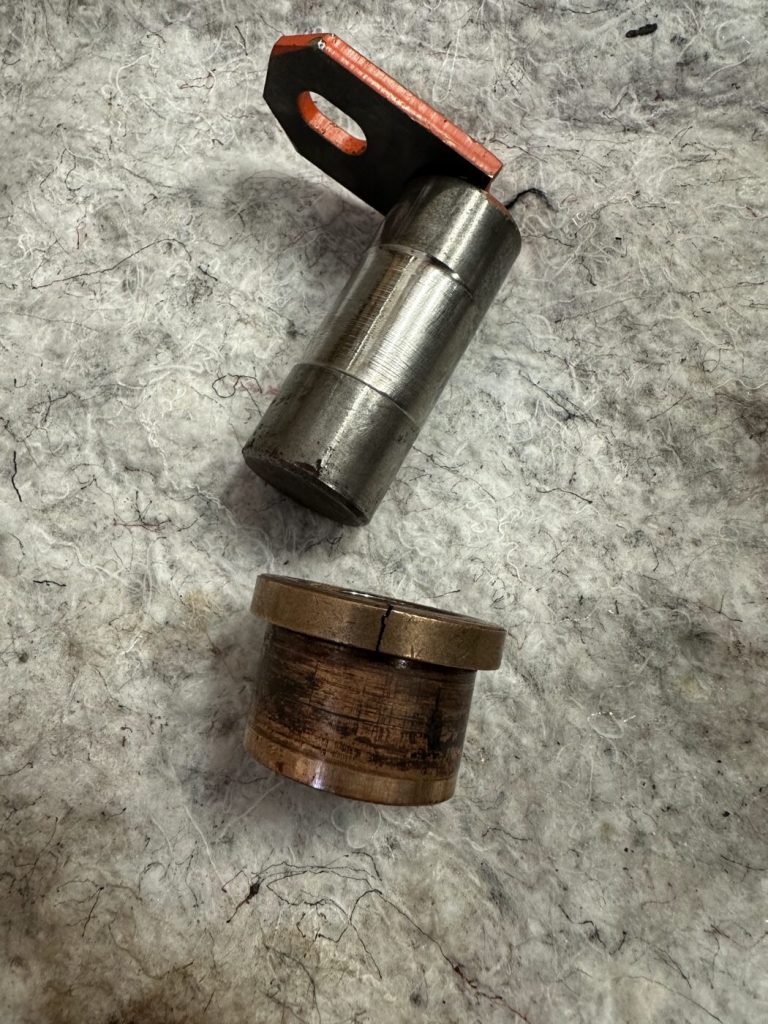
On the vehicle it is rollers and pins. Pin and bushing in the carrier form a plain bearing pair that runs under load in mixed friction – partly on a lubricating film, partly metal on metal. Without lubrication it runs dry, wears in, develops play and squeaks. This squeaking is the early warning sign; if ignored, the pin can shear off in extreme cases.
In the conductor line, abrasion and hall air form a deposit; contact burn is the latest warning sign. What is repaired and what is replaced is explained in our guide to Wear on the electrified monorail; for the next maintenance window there is the overhead conveyor maintenance checklist.
What we pay attention to
On an electrified monorail, the view of the whole system decides, not the individual part. This is what we check and plan before we go to work on the system:
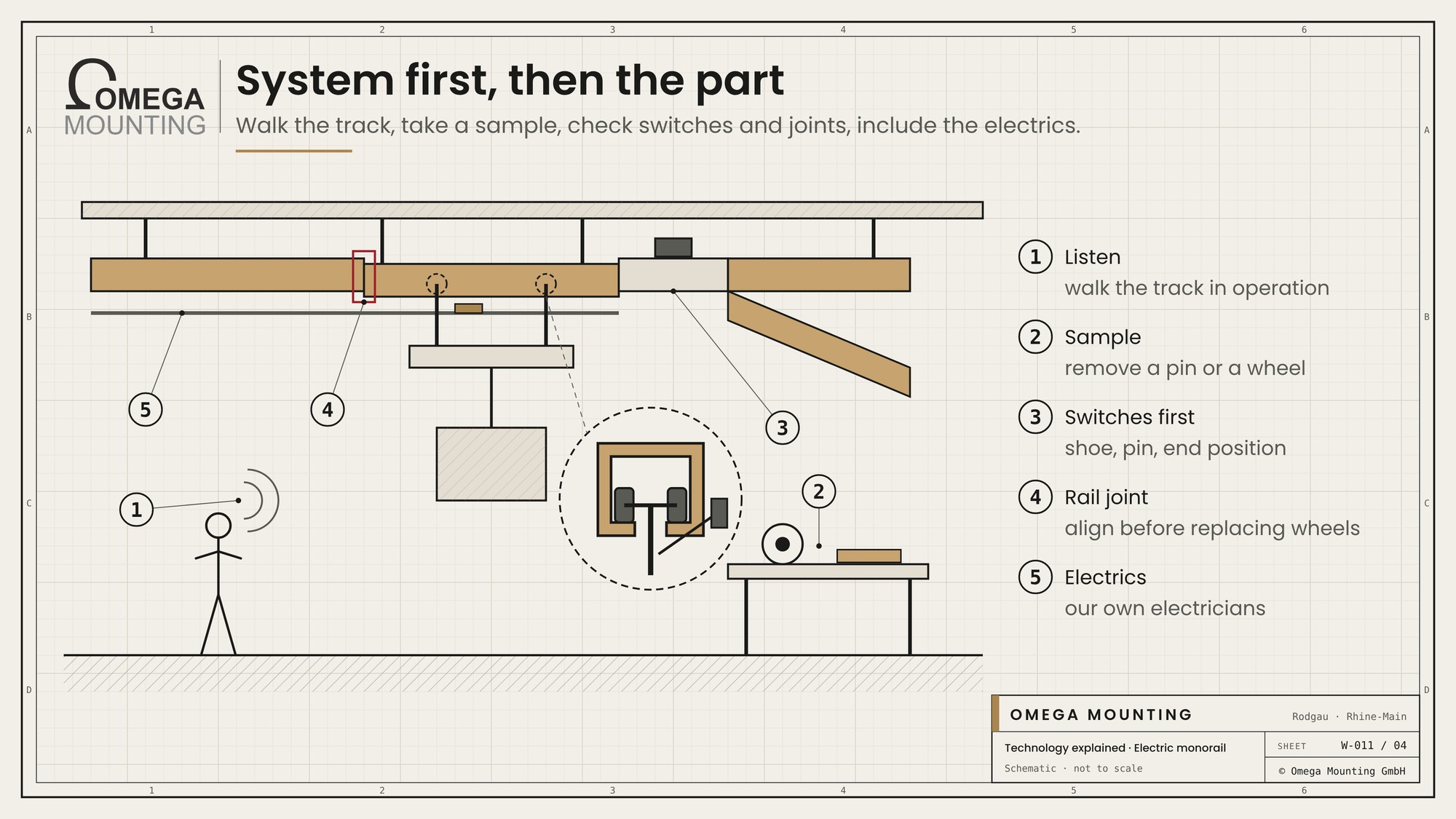
- Listen before dismantling. Squeaking, rattling at rail joints and knocks at switches reveal more than any data sheet. We walk the track during operation.
- Take a sample. One pulled pin or one removed roller shows the condition of the whole fleet, because all vehicles age at the same time.
- Switches first. A shut-down switch costs track, a misadjusted end position costs vehicles. We check switch shoes, pins and end positions before we replace rollers.
- See the rail as a whole. An offset rail joint destroys rollers in series. Alignment comes before replacing rollers, otherwise the damage returns.
- Mechanics and electrics from a single source. We repair rollers, pins, brackets, switches and rails. Our qualified electricians take care of current collectors, limit switches and wiring; we clarify software and parameters with the manufacturer before the job.
Where we use it
For us the electrified monorail is a maintenance topic – we keep existing systems running. At an industrial plant in Hesse we repaired an electrified monorail of around 30 years with 100 switches in two operating areas over several weekends: replaced rollers, switch shoes and pins, aligned rails, set end positions – with four technicians per weekend and sometimes only around 36 hours until restart, as described in the report on the maintenance of an overhead monorail system in Frankfurt. In a food plant two to three fitters refurbished all 80 monorail vehicles, ten to fifteen per weekend: documented in the pin repair on the electrified monorail. What we maintain on conveyor systems and machines is described on our page Maintenance and servicing.
More technology explained
Technology explained
the other ceiling rail: one crane, one load, free travel instead of a fixed route.
Technology explained
how loads are moved on the floor when there is no rail above them.
Guide
the guide with the maintenance points for each assembly and the procedure in the maintenance window.
Do you have questions about how this works on your site?
Do you have questions about how this works on your system – whether the switches still set correctly or the pins still hold? We look at your electrified monorail in operation and tell you what needs doing. The quickest way is a callback – briefly describe the system, its age and your time window.
Our service for this: Overhead conveyor maintenance and repair →
Free, no-obligation callback

About the author
Tobias Schott
Managing director of Omega Mounting GmbH, Rodgau · more than 20 years of hands-on experience in installation and maintenance
A trained mechatronics technician, working in maintenance, servicing and industrial installation since 2004 – first alongside his father, and with Omega Mounting since 2012: from overhead conveyors in Frankfurt to the crane system in a new-build hall. He plans and leads lifting operations as an appointed person (AP) in data centers and on industrial sites in the Rhine-Main region, trains and examines operators of cranes, mobile elevating work platforms and telehandlers, and is a qualified occupational safety specialist. On jobs abroad he is known as the “German Troubleshooter” – the person you call when a site gets stuck. He learned what quality means from his father, not from a manual: Made in Germany as a standard for his own work, not a label. That is why quality comes first at Omega Mounting – ahead of speed and price. The Technology explained articles cover the equipment and techniques his team uses every day: what counts on site is in them – what only appears in the brochure is not.
 English
 German