
- Technology explained – technology and procedures
Directional valves: what 3/2, 5/2 and 5/3 mean
By Tobias Schott · 5-minute read · Updated November 2026
A directional valve decides where compressed air or oil flows – and its short designation reveals how many ports it has, how many positions it knows and what the cylinder does when the signal drops out.
You encounter directional valves on every pneumatic and hydraulic system: as a solenoid valve on a cylinder, as a valve terminal in the control cabinet, as a hand lever on the hydraulic power unit. The valve and the circuit diagram bear designations such as 3/2, 5/2 or 5/3. They look like fractions but are very easy to read.
This article explains the designation, the ports, the circuit symbols and why the centre position is so important. How the cylinder controlled by the valve is built is explained in our article on the Pneumatic cylinder: single- or double-acting and what that means.
What is a directional valve?
A directional valve is a valve that opens, closes or diverts the path of a pressure medium and thus determines start, stop and direction of an actuator. Inside, usually a piston – the spool – moves and connects different ports with each other.
The designation always has two numbers: the first gives the number of ports, the second the number of switching positions. A 5/2 directional valve therefore has five ports and two positions. In German it is called Wegeventil, the 5/2 valve 5/2-Wegeventil.
Key facts
- Purpose: Direct compressed air or oil to the actuator, shut it off or exhaust it.
- Designation: Ports/switching positions, such as 3/2, 5/2, 5/3, in hydraulics often 4/2 or 4/3.
- Actuation: Solenoid, hand lever, push button, roller, pneumatic signal; return usually by spring.
- Types: Single valve, valve terminal with many valves on a base plate, direct-acting or pilot-operated.
- Services: 1 pressure, 2 and 4 working ports, 3 and 5 exhaust, 12 and 14 pilot ports.
- Standard: ISO 5599-3 for port designation, ISO 1219-1 for circuit symbols.
- Common misconception: Same designation means same behaviour – yet return and centre position decide what happens in a power failure.
3/2 and 5/2: which valve for which cylinder
The number of ports follows the cylinder: a single-acting cylinder needs a 3/2 directional valve, a double-acting one a 5/2 or 5/3 directional valve.
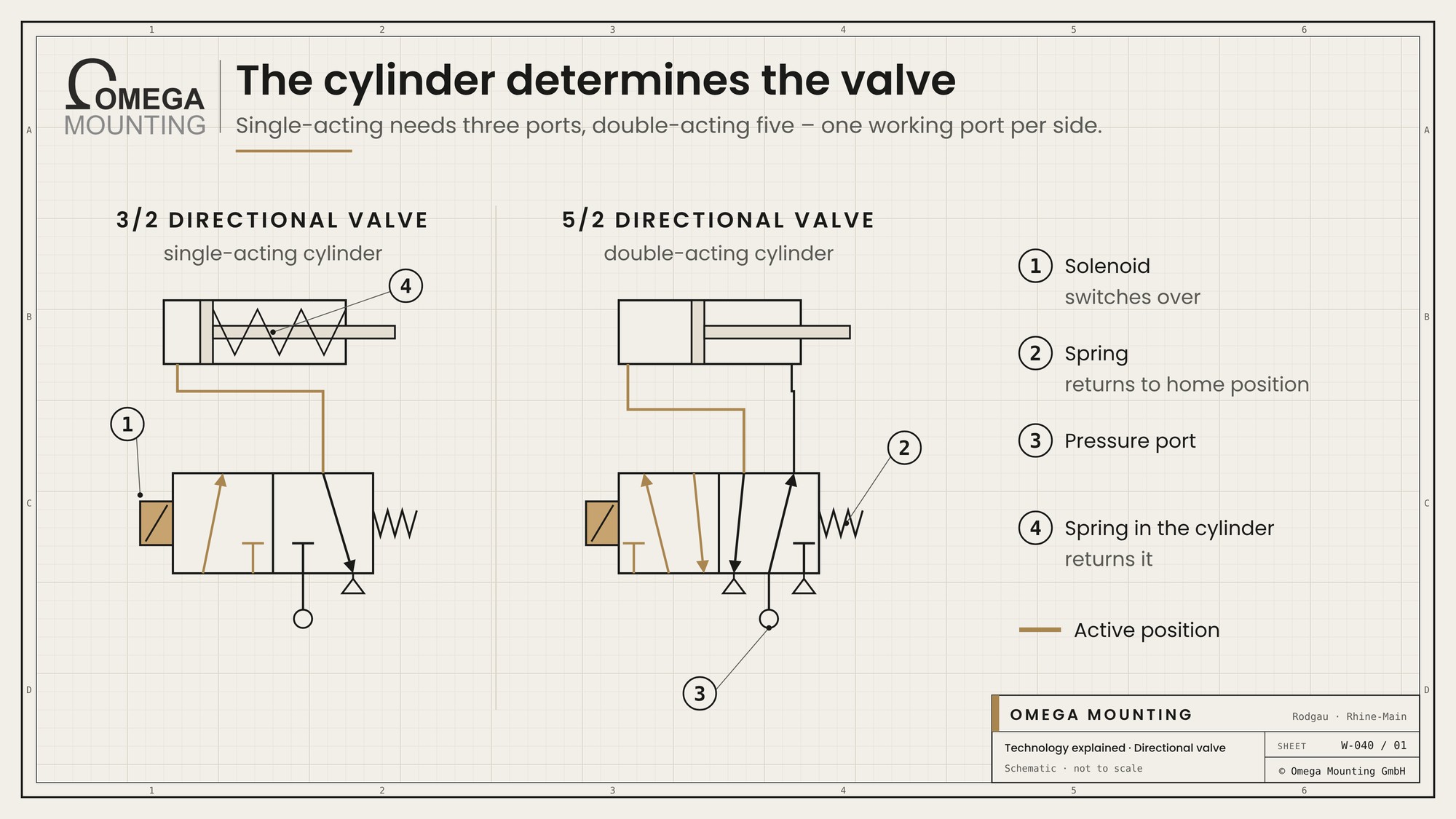
3/2 directional valve. Three ports – pressure, working port, exhaust – and two positions. In one position air flows to the cylinder, in the other it escapes. A single-acting cylinder extends and returns with its spring. If the valve is closed at rest, this is called normally closed.
5/2 directional valve. Five ports – pressure, two working ports, two exhausts – and two positions. It always pressurises one side of the cylinder and exhausts the other. This allows a double-acting cylinder to move in both directions.
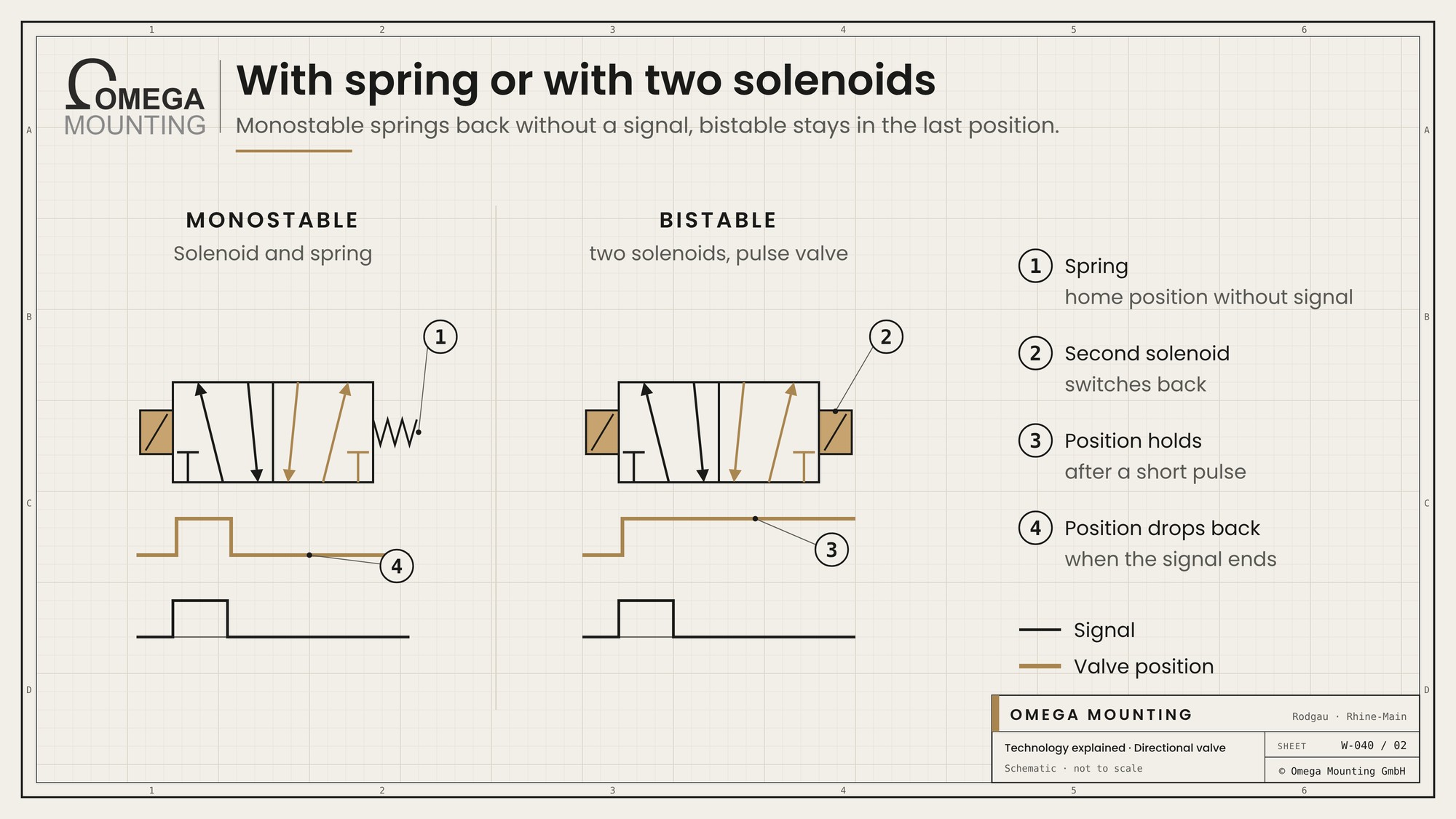
Monostable or bistable. A monostable valve has a spring: if the signal drops out, it springs back to its home position. A bistable valve, also called a pulse valve, has two solenoids and stays in the position it was last switched to – even without power. Both have their purpose, but they may only be replaced like for like.
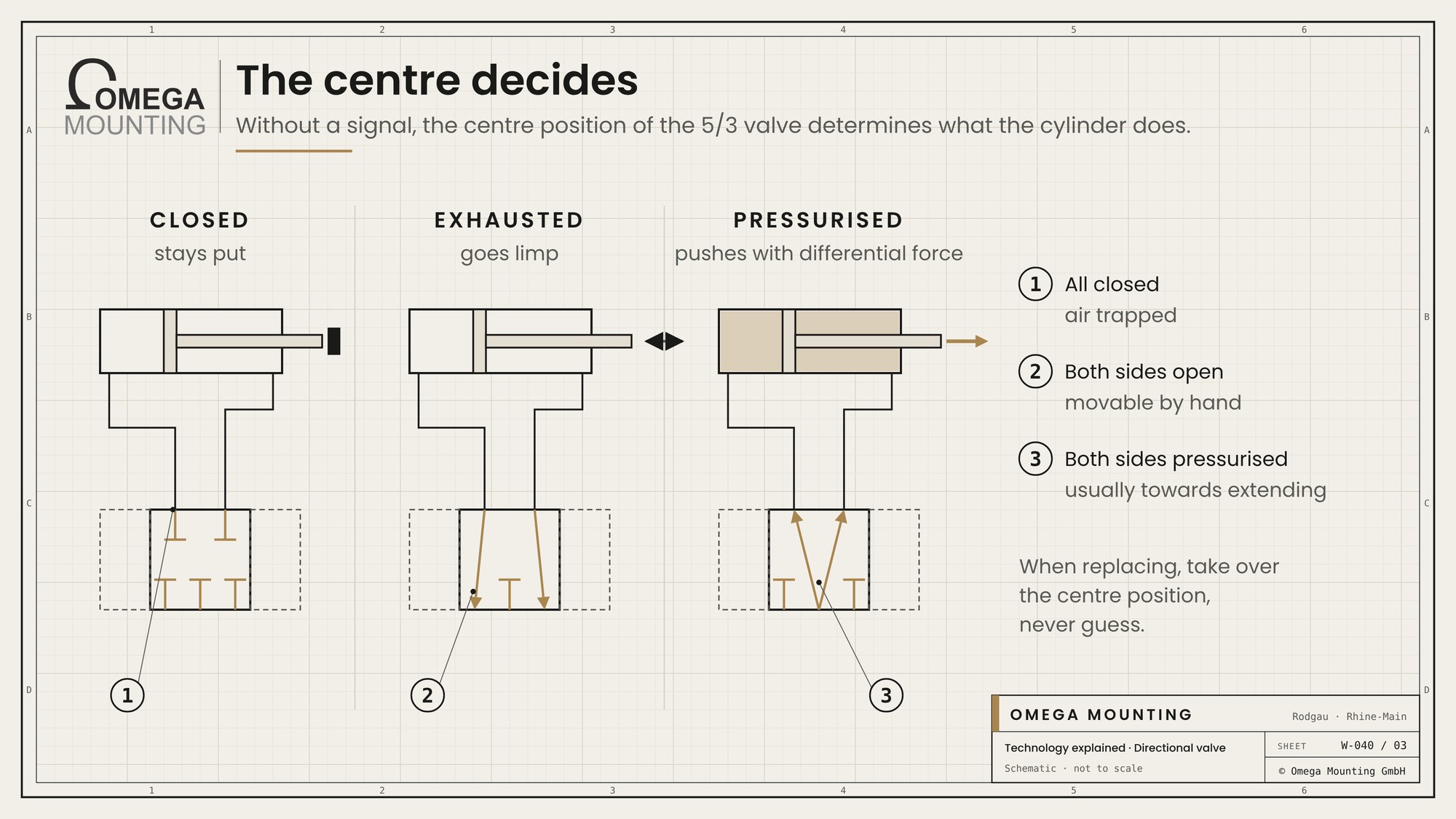
5/3 directional valve: what the centre position does to the cylinder
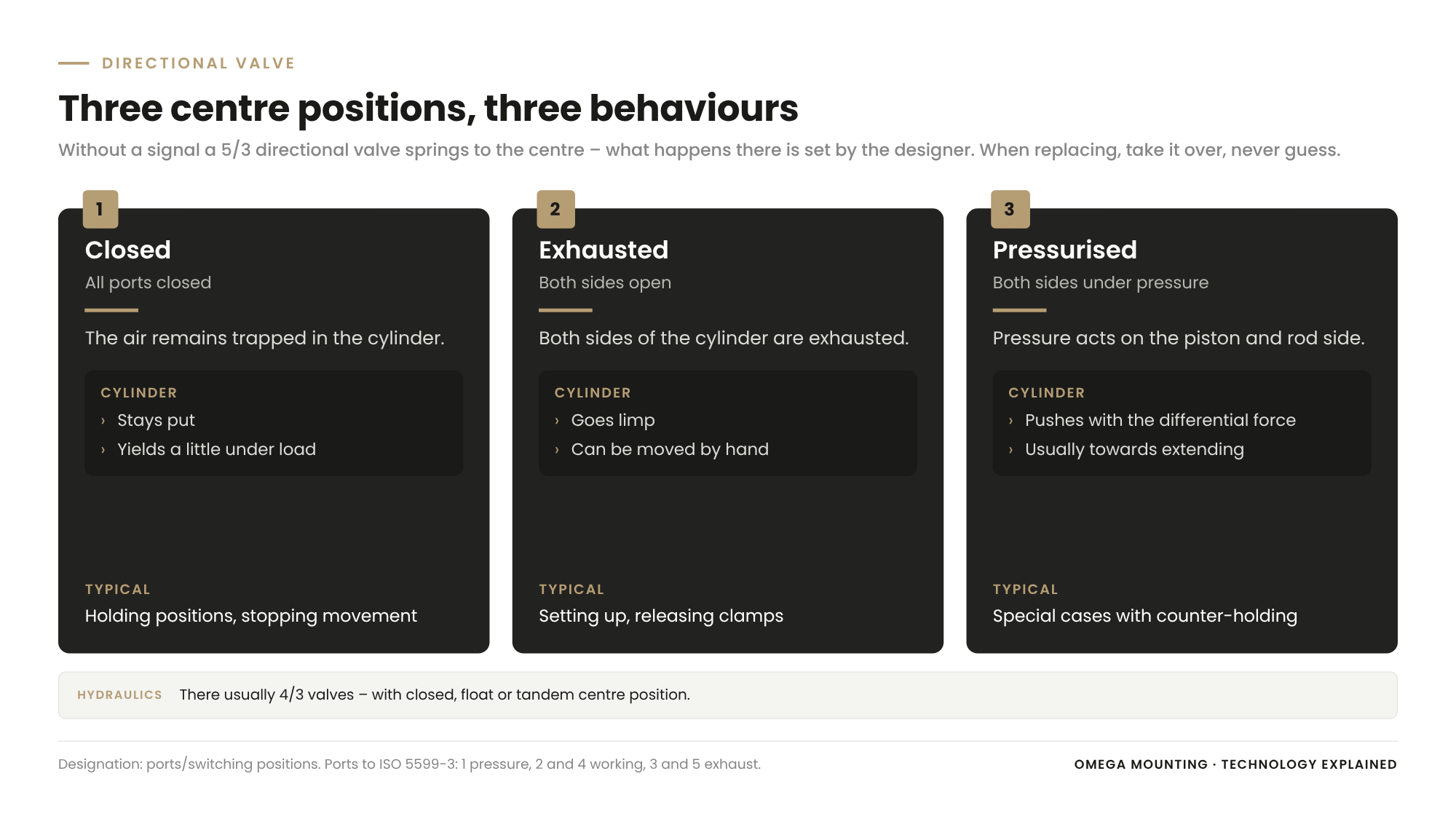
The 5/3 directional valve has a third position in the centre, to which it springs back without a signal – and this centre position determines what the cylinder then does.
| Centre position | What happens | Behaviour of the cylinder | Typical use |
|---|---|---|---|
| Closed. | All ports closed. | Stays put, the air is trapped; under load it yields a little. | Holding positions, stopping movement. |
| Exhausted. | Both sides of the cylinder exhausted. | Goes limp and can be moved by hand. | Setting up, releasing, opening clamps. |
| Pressurised. | Both sides under pressure. | Pushes with the differential force, usually towards extending. | Special cases, for example with counter-holding. |
In hydraulics the valves are usually 4/3, because only one return to the tank is needed there. Common centre positions are closed, float, in which the cylinder can move freely, and tandem, in which the pump delivers to the tank without pressure.
Which centre position a system needs is determined by the designer from the risk assessment. When replacing and troubleshooting: take over the centre position from the old valve, never guess.
How to read the circuit symbol
In the circuit diagram each square stands for a switching position – anyone who counts the squares and follows the arrows can read any directional valve.
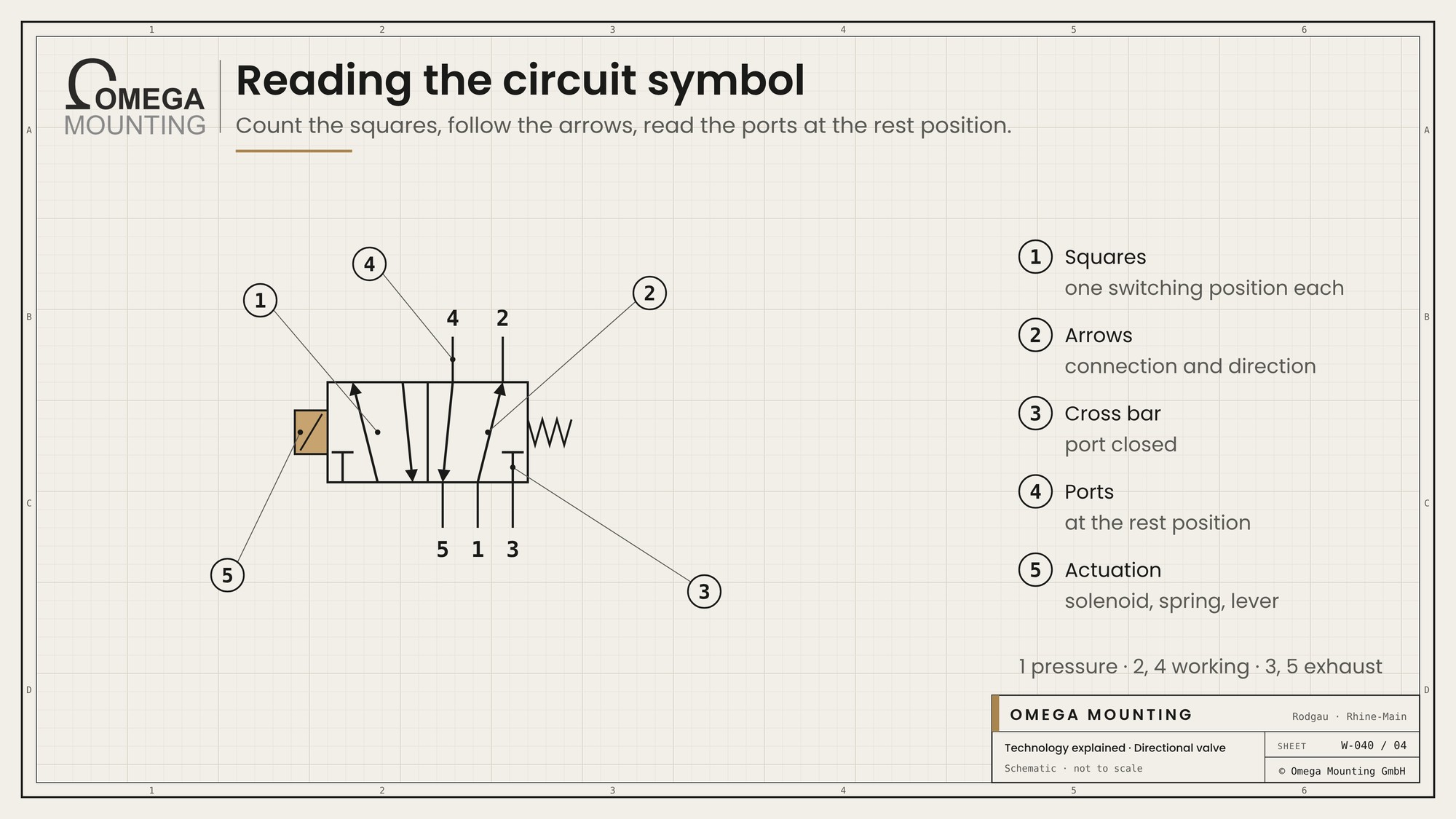
- Squares: Two squares mean two positions, three squares mean three positions.
- Arrows: They show which ports are connected in this position and in which direction the medium flows.
- Cross bars: A T symbol means this port is closed.
- Services: They are drawn on the square of the rest position, i.e. the position without a signal.
- Actuation: At the side of the symbol: solenoid, spring, hand lever, roller or pneumatic signal.
Replacing directional valves and finding faults
When a cylinder does not do what it should, the valve is often to blame – but not always. We look for the fault in this order:
- Is there air?: Check the pressure at the service unit and at the valve inlet. A closed shut-off valve is found faster than a faulty valve.
- Is there a signal?: If the indicator on the solenoid lights up, the signal is arriving. Whether it is correct is clarified by the electrician.
- Manual override: Many valves can be switched by hand. If the cylinder then moves, the fault lies more likely in the control.
- Exhaust: If a valve exhausts continuously, a seal in the valve or in the cylinder is often leaking.
- Hoses: Swapped or kinked lines are a common fault after alterations.
When replacing: depressurise the system, mark the lines, fit the same valve or an equivalent replacement with an identical symbol. Afterwards every movement is tested individually and slowly before the system runs in automatic mode again.
What we pay attention to
A sticking valve often looks like a defective cylinder in operation – that is why we check the whole chain.
- We first check signal, coil and manual override: if the valve switches by hand, the fault usually lies before it.
- We listen to the exhaust: a valve that blows off constantly is leaking internally.
- We replace according to the complete type designation: ports, positions, return, centre position, coil voltage.
- We make sure the compressed air is clean and dry, because water and oil make spools stick.
- We only work depressurised and secured against being switched back on; trapped air in cylinders is stored energy.
- Control and safety functions remain with the manufacturer or control system builder.
Where we use it
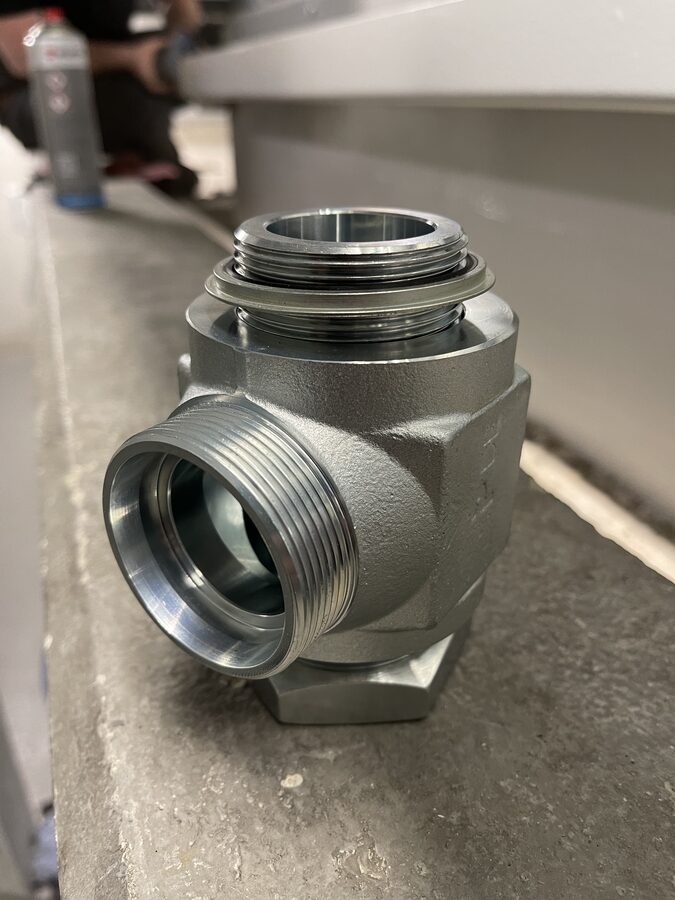
We replace and adapt valves, lines and fittings when we repair conveyor systems, fixtures and test stands. During the conversion of a servo-hydraulic test rig we adapted the hydraulic lines to the new configuration and welded an oil pan tight around the foundation. We replace pneumatic valves during the maintenance of roller conveyors and sorting systems. Both are part of our Maintenance and servicing.
More technology explained
Technology explained
the actuator that the valve controls.
Technology explained
how the control decides when the valve switches.
Guide
the guide to valves, lines and oil in hydraulics.
Do you have questions about how this works on your site?
Do you have questions about how this works on your site – for example, why a valve on your system is sticking? We check valve, cylinder and compressed air and replace like for like. Request a callback – we will get back to you.
Free, no-obligation callback

About the author
Tobias Schott
Managing director of Omega Mounting GmbH, Rodgau · more than 20 years of hands-on experience in installation and maintenance
A trained mechatronics technician, working in maintenance, servicing and industrial installation since 2004 – first alongside his father, and with Omega Mounting since 2012: from overhead conveyors in Frankfurt to the crane system in a new-build hall. He plans and leads lifting operations as an appointed person (AP) in data centers and on industrial sites in the Rhine-Main region, trains and examines operators of cranes, mobile elevating work platforms and telehandlers, and is a qualified occupational safety specialist. On jobs abroad he is known as the “German Troubleshooter” – the person you call when a site gets stuck. He learned what quality means from his father, not from a manual: Made in Germany as a standard for his own work, not a label. That is why quality comes first at Omega Mounting – ahead of speed and price. The Technology explained articles cover the equipment and techniques his team uses every day: what counts on site is in them – what only appears in the brochure is not.
 English
 German