
- Technology explained – technology and procedures
Pneumatic cylinder: single- or double-acting and what that means
By Tobias Schott · 5-minute read · Updated November 2026
A pneumatic cylinder converts compressed air into straight-line motion – and whether it is single- or double-acting decides how it moves, how it holds and what happens if pressure fails.
You encounter pneumatic cylinders on conveyor systems as stoppers and lifting units, on sorting systems as switch drives, in fixtures as clamps and on doors as locks. The cylinder bears piston diameter and stroke, the catalogue terms such as standard cylinder, end-position cushioning and cylinder switch.
This article explains how a pneumatic cylinder is built, which designs exist and what makes it wear. How the valves that control it work is explained in our article on Directional valves: what 3/2, 5/2 and 5/3 mean.
What is a pneumatic cylinder?
A pneumatic cylinder is an actuator in which compressed air moves a piston in a barrel and generates linear force and motion via the piston rod. The force results from air pressure times piston area. A larger piston therefore pushes harder at the same pressure.
The cylinder consists of the cylinder barrel, piston with seal, piston rod with guide and wiper, and two end caps with the air ports. In German it is called Pneumatikzylinder, the double-acting version doppeltwirkender Zylinder.
Key facts
- Purpose: Generate straight-line motion – push, lift, clamp, stop, lock.
- Characteristics: Piston diameter and stroke in millimetres, permissible operating pressure, port thread.
- Types: Single-acting, double-acting, rodless, compact, round and standard cylinders.
- Accessories: End-position cushioning, cylinder switches for the end positions, mountings such as foot, flange or clevis.
- Typical applications: Stoppers and lifting units in roller conveyors, switches in sorting systems, clamping fixtures.
- Standard: ISO 15552 for standard cylinders, plus separate standards for round and compact cylinders.
- Common misconception: A slow cylinder is faulty – often it is the throttle, hose or too little pressure.
Single-acting, double-acting, rodless: the designs
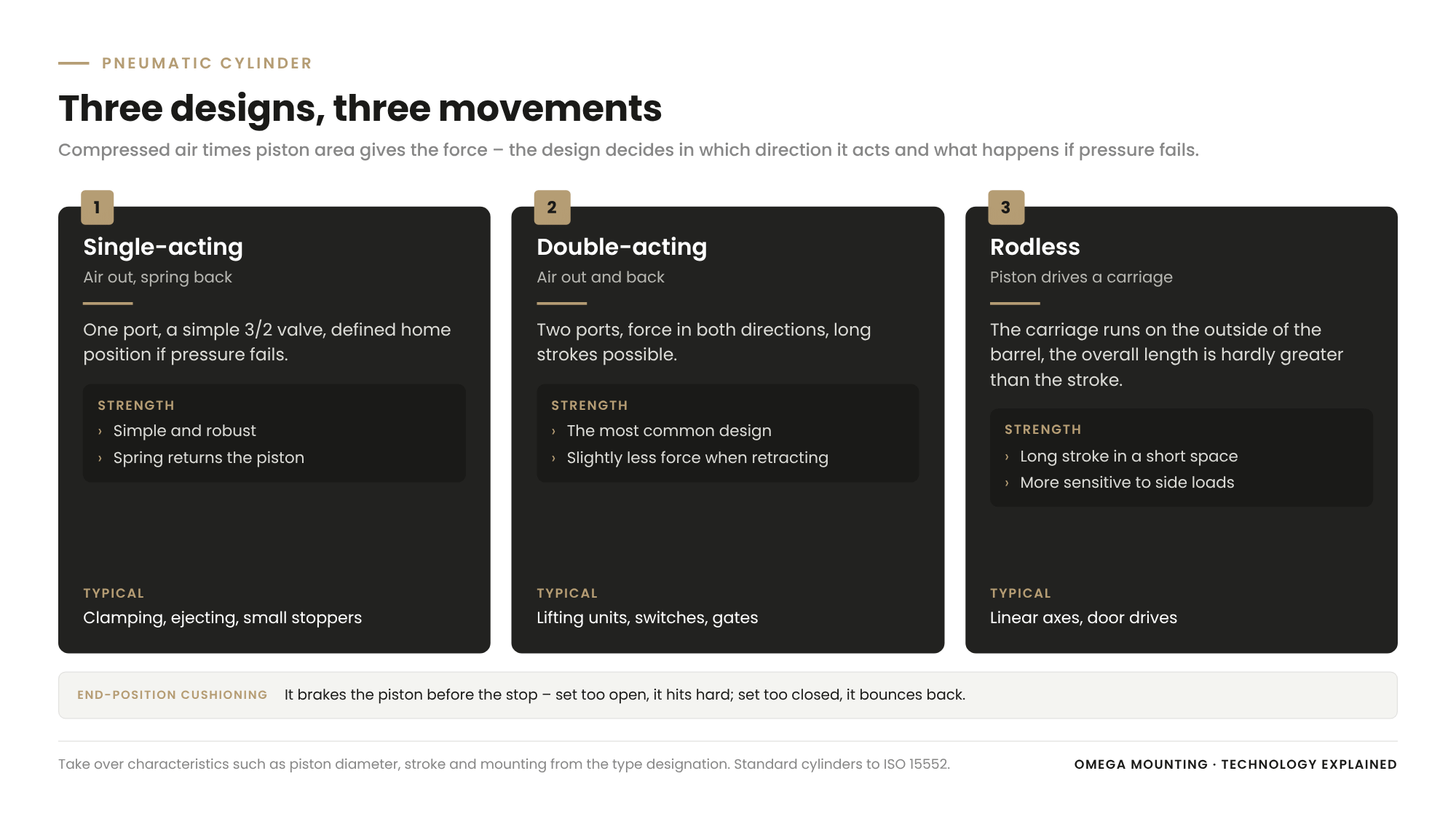
The design says how many air ports the cylinder has and how it retracts.
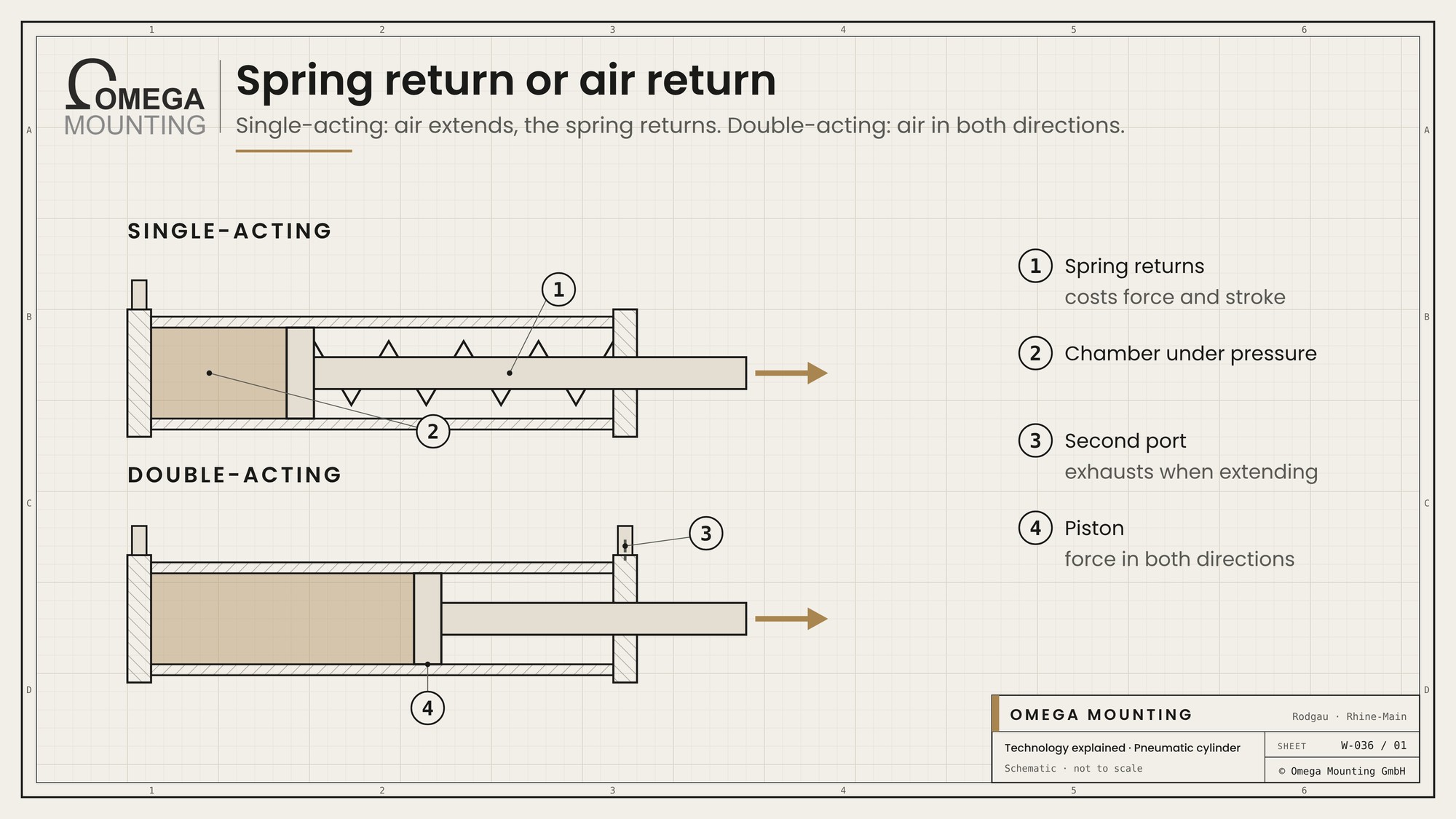
Single-acting. Compressed air moves the piston in one direction only, a spring returns it. It needs only one port and a simple valve. If the compressed air fails, the spring moves the cylinder to its home position. The spring costs force, however, and limits the stroke.
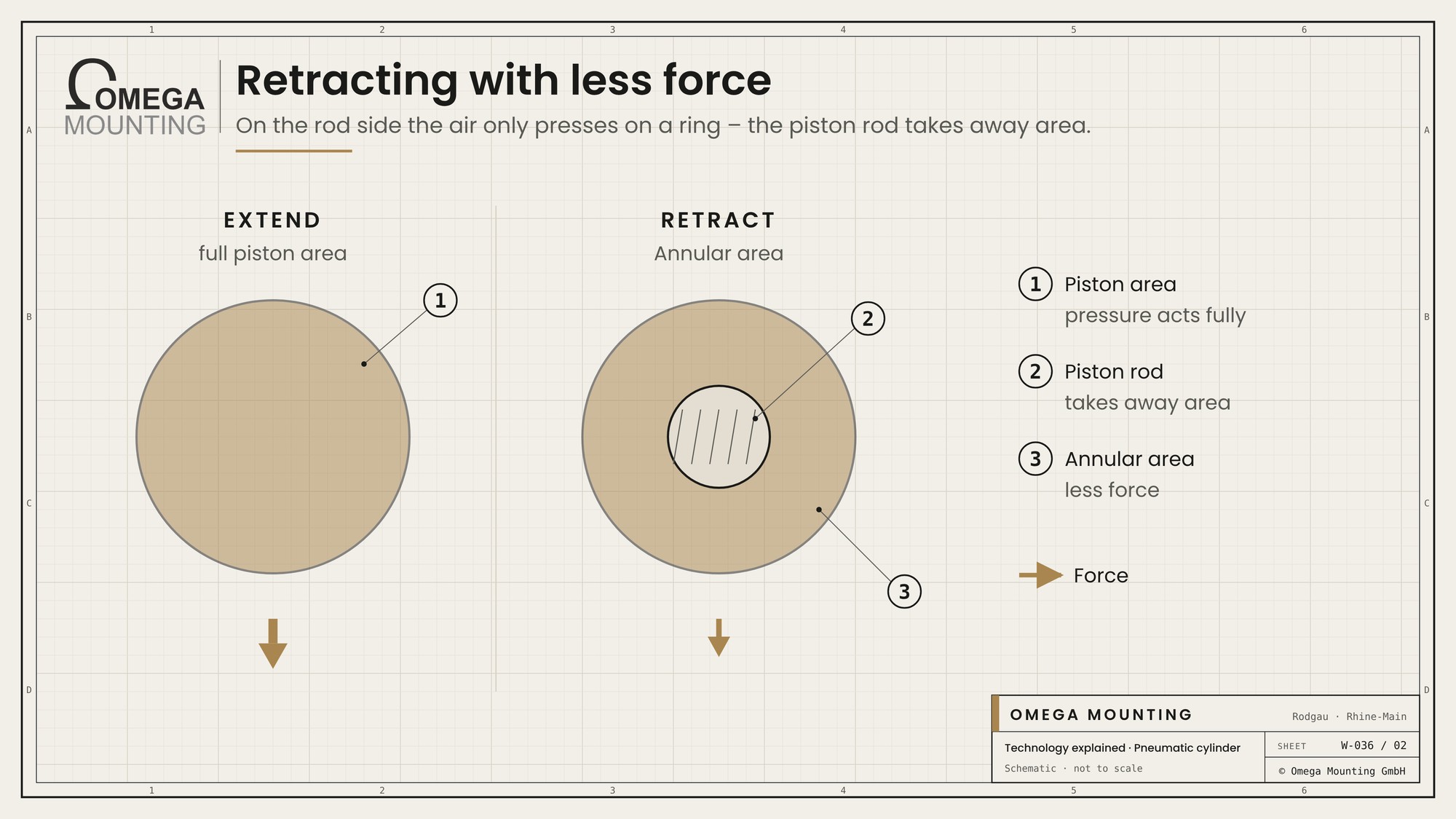
Double-acting. Compressed air moves the piston in both directions, with one port per side. This is the most common design because it has force in both directions and allows long strokes. When retracting the force is slightly lower, because the piston rod takes away area on this side.
Rodless. The piston drives a carriage on the outside of the barrel. The cylinder is only as long as its stroke plus end pieces and is suitable for long travel in confined spaces.
| Type | Principle | Strength | Limit | Typical use |
|---|---|---|---|---|
| Single-acting. | Air out, spring back. | Simple, defined home position if pressure fails. | Short stroke, spring force is lost. | Clamping, ejecting, small stoppers. |
| Double-acting. | Air out and back. | Force in both directions, long stroke. | No safe position without additional measures if pressure fails. | Lifting units, switches, gates. |
| Rodless. | Piston drives an external carriage. | Long stroke, short overall length. | More sensitive to side loads and dirt. | Linear axes, door drives, handling. |
| Compact and short-stroke cylinders. | Double- or single-acting, very short. | Little installation space. | Short stroke. | Stoppers, clamps. |
End-position cushioning and cylinder switches
End-position cushioning brakes the piston shortly before the stop so that it does not hit the end cap hard – it protects cylinder, load and system.
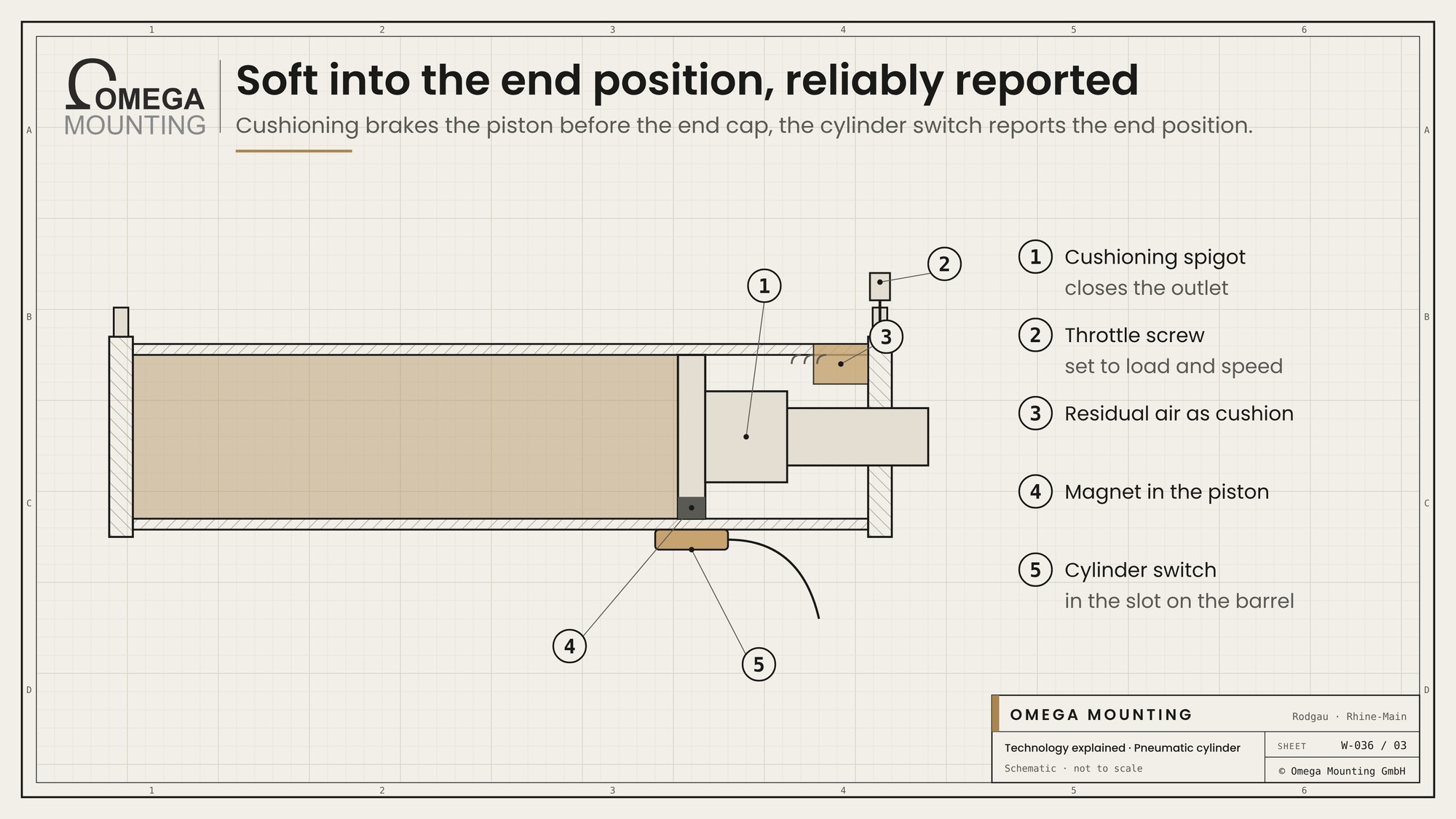
With elastic cushioning, a rubber buffer catches the piston. With pneumatic cushioning, a cushioning spigot closes the air outlet shortly before the end. The residual air then only escapes via a small throttle screw, and the piston runs in softly. This screw must suit the load and speed: too far open means a hard stop, too far closed means the piston bounces back or reaches the end position too slowly.
Cylinder switches tell the control whether a cylinder is extended or retracted. There is a magnet in the piston and a sensor in a slot on the outside of the barrel. If the switch is in the wrong position, it reports an end position too early or not at all – a common reason for faults that look like a defective cylinder.
Pneumatics or hydraulics: what is the difference?
Pneumatic cylinders are fast, clean and simple, hydraulic cylinders strong and precise – the difference lies in the pressure medium.
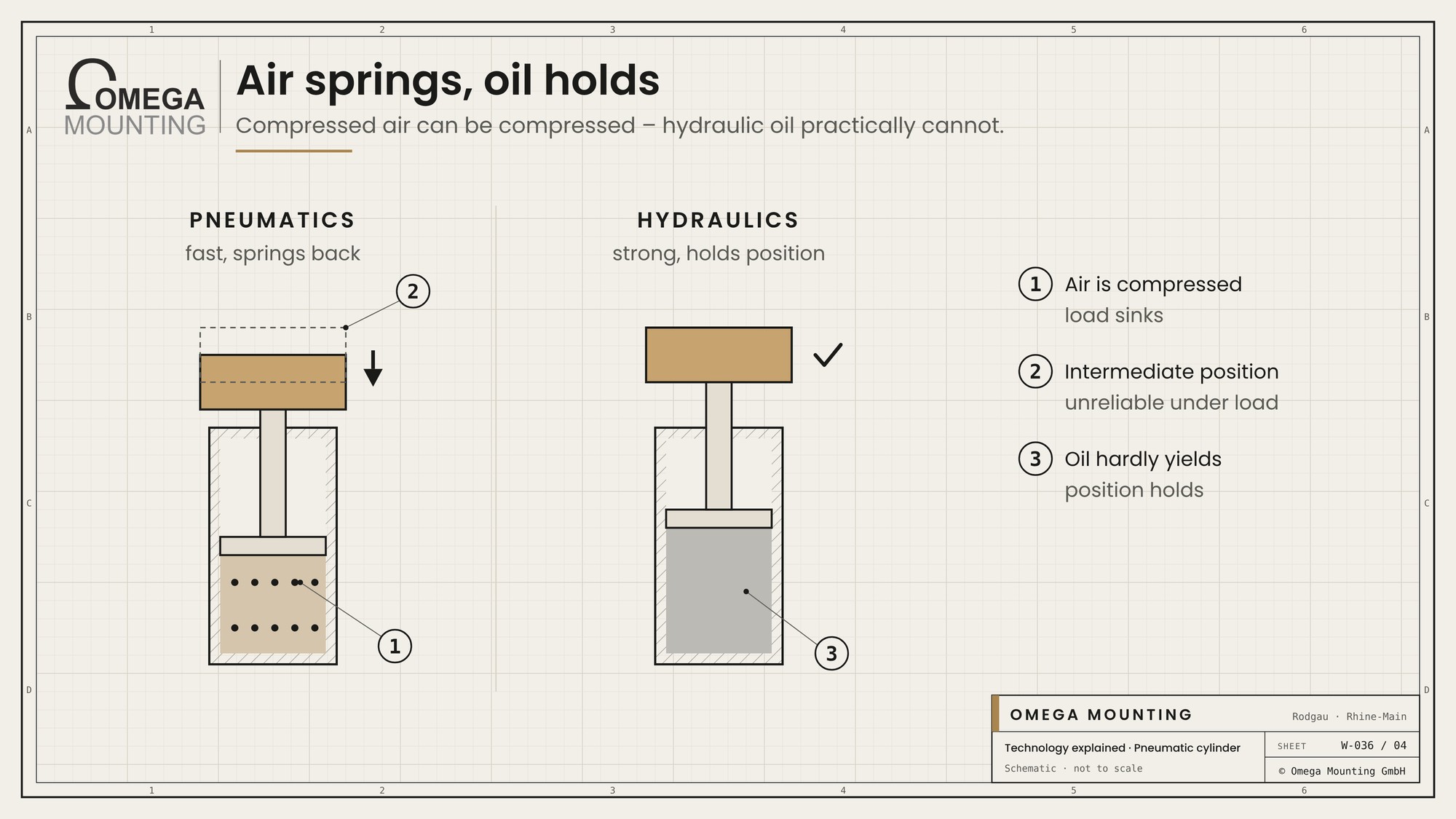
Compressed air is compressible. A pneumatic cylinder therefore springs back a little and holds an intermediate position under load only poorly. In return it is fast, light and tolerates overload without damage. The operating pressure in industry is typically a few bar.
Hydraulic oil is practically incompressible. A hydraulic cylinder holds its position even under high load and works with a multiple of the pressure. It generates very large forces in a small space, but needs a power unit, tight lines and clean oil.
Maintenance and typical faults
Pneumatic cylinders run for a long time if the air and installation are right. The most common faults have recurring causes:
- Leaking piston rod: The wiper seal wears from dirt on the rod. A bellows protects it in dusty surroundings.
- Jerky movement: Too little air, exhaust throttled too much or dry seals make the piston judder.
- Hard impact: If the cushioning is misadjusted, the piston slams into the end position. That damages the cylinder and the machine.
- Side loads: A rod loaded sideways wears the guide and seal. Rod eyes and guides take up the forces.
- Wrong switching point: Shifted cylinder switches report the end position too early or not at all.
Before any work on a cylinder, the system is depressurised and secured. Even a switched-off cylinder can move as long as there is still air in the system. When replacing it, the new cylinder goes onto the machine in the same mounting position and with the same connections – otherwise stroke and switching points no longer match.
What we pay attention to
We replace cylinders according to their type designation and check beforehand whether the cylinder really is to blame.
- We first check pressure, hoses, throttles and valve before classifying a cylinder as defective.
- We recognise a worn piston seal by air escaping on the opposite side while holding.
- We replace according to the designation: design, piston diameter, stroke, mounting and cushioning must match.
- We align the piston rod so that it is not subjected to side loads; inclined installation destroys guide and seal.
- After replacement we readjust the end-position cushioning and the cylinder switches and check the movement in a test run.
- We only work on a depressurised section secured against being switched back on; residual pressure in the cylinder is stored energy.
Where we use it
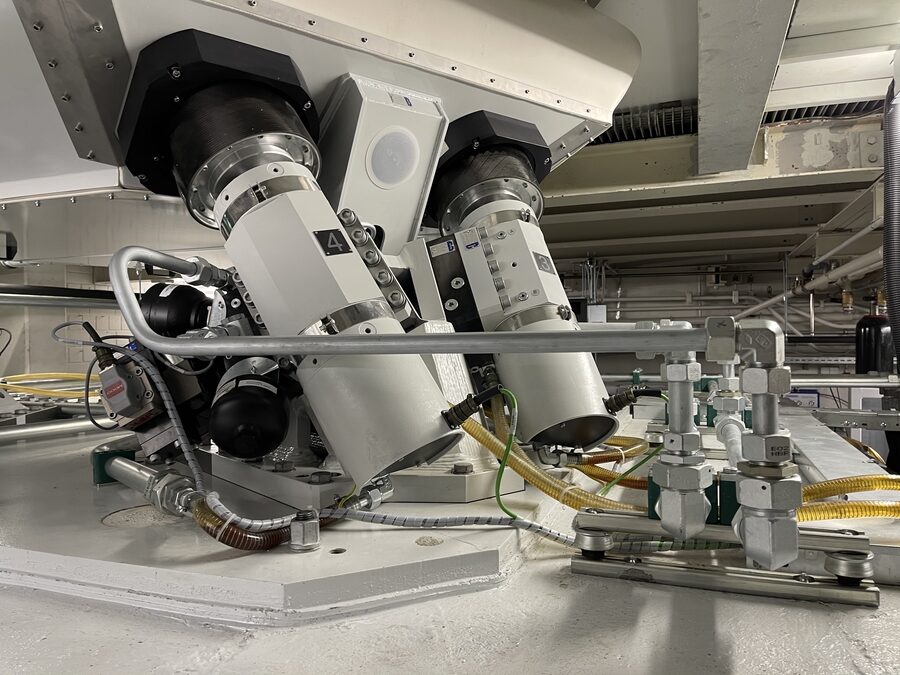
We encounter cylinders in roller conveyors, sorting systems, fixtures and test stands. During the conversion of a servo-hydraulic test rig we adapted the hydraulic lines to the cylinders to the new configuration and welded a surrounding oil pan tight. We replace, adjust and cushion pneumatic cylinders during the maintenance of conveyor systems. Both are part of our Maintenance and servicing.
More technology explained
Technology explained
the valves that control the cylinder.
Technology explained
the compressed air quality that every cylinder depends on.
Guide
the guide to cylinders and valves in the accumulation section.
Do you have questions about how this works on your site?
Do you have questions about how this works on your site – for example, why a cylinder on your conveyor system moves too slowly? We look for the cause, replace and adjust. Request a callback – we will get back to you.
Free, no-obligation callback

About the author
Tobias Schott
Managing director of Omega Mounting GmbH, Rodgau · more than 20 years of hands-on experience in installation and maintenance
A trained mechatronics technician, working in maintenance, servicing and industrial installation since 2004 – first alongside his father, and with Omega Mounting since 2012: from overhead conveyors in Frankfurt to the crane system in a new-build hall. He plans and leads lifting operations as an appointed person (AP) in data centers and on industrial sites in the Rhine-Main region, trains and examines operators of cranes, mobile elevating work platforms and telehandlers, and is a qualified occupational safety specialist. On jobs abroad he is known as the “German Troubleshooter” – the person you call when a site gets stuck. He learned what quality means from his father, not from a manual: Made in Germany as a standard for his own work, not a label. That is why quality comes first at Omega Mounting – ahead of speed and price. The Technology explained articles cover the equipment and techniques his team uses every day: what counts on site is in them – what only appears in the brochure is not.
 English
 German