
- Technology explained – equipment and protection
Impact protection: bollard, hoop, barrier – what each type of guard stops
By Tobias Schott · 5-minute read · Updated November 2026

Impact protection absorbs a vehicle's impact before it hits a machine, a rack or a person – but only if type, clearance and anchoring suit the location.
Impact protection stands in every hall where forklifts, pallet trucks or tow tractors drive: yellow bollards at doors, hoops in front of control cabinets, barriers along walkways, corner guards on rack uprights. It is often only bought after something has happened. And it is often installed in a way that it will not hold at the next impact.
Here we explain which types there are, how steel and plastic behave on impact, which dimensions must not be overlooked and which installation errors make the protection worthless.
What is impact protection?
Impact protection is a fixed barrier that keeps vehicles away from machines, building components, racks or walkways and absorbs the force of an impact. Other names are collision protection, crash barrier or vehicle guard; in German it is called Rammschutz or Anfahrschutz.
It is neither a fence nor a guardrail. A guardrail protects people from falling, impact protection protects objects and walkways from vehicles. It is usually marked yellow and black, as the German workplace rule ASR A1.3 provides for obstacles.
Key facts
- Purpose: Protecting machines, racks, building components and walkways from vehicle impact.
- Types: Bollard, hoop, barrier, corner and column guard, floor rail; custom-made solutions for special locations.
- Materials: Steel, usually galvanised or coated, or plastic with flexible properties.
- Fixing: Base plates with heavy-duty anchors in the structural concrete, special solutions bolted or welded.
- Marking: Yellow and black or safety yellow, clearly visible from the direction of travel.
- Inspection: Visual check after every impact, replace damaged parts.
Which types are there?
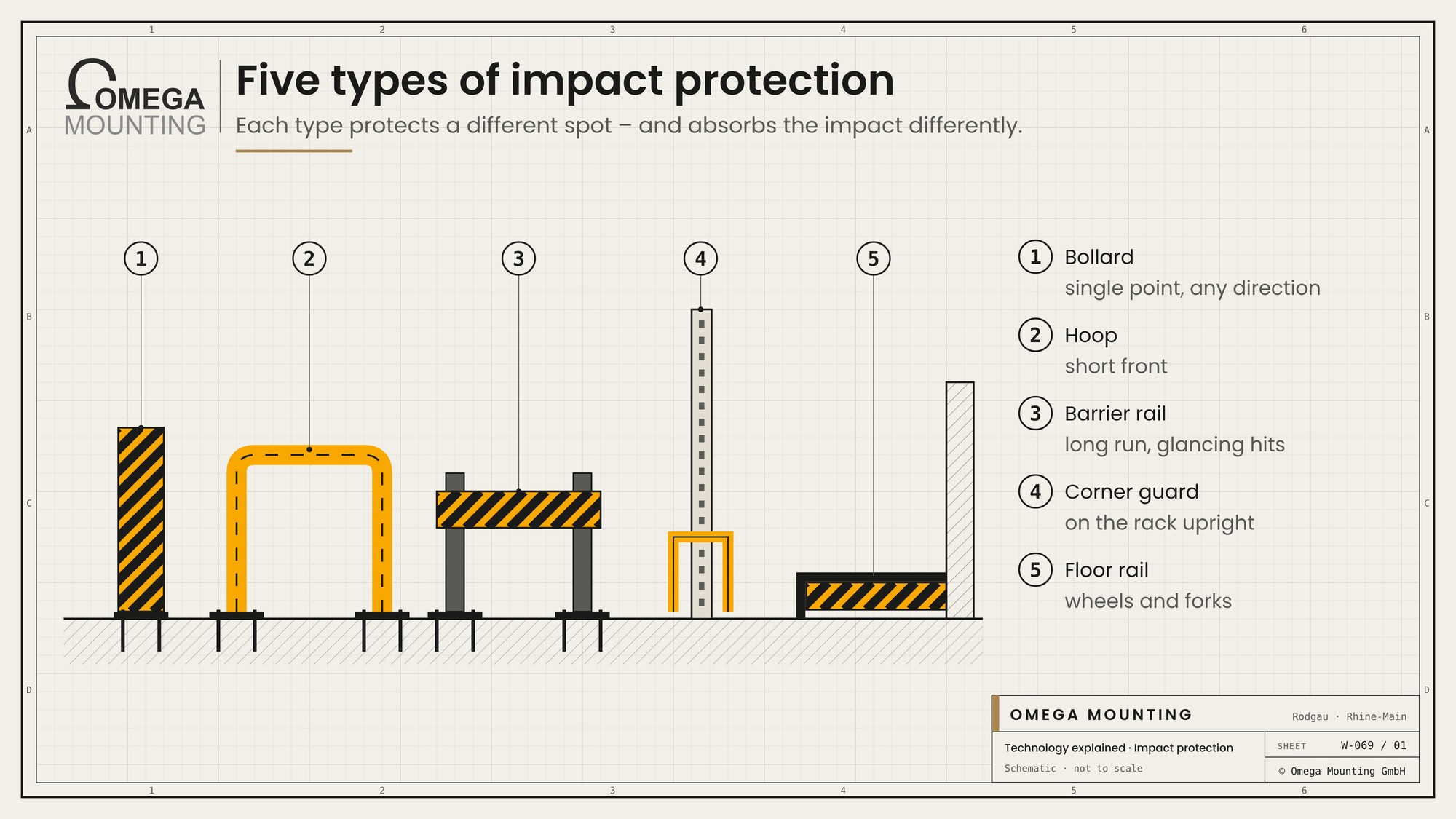
The types differ in which location they protect and from which side the impact comes.
| Type | Where it stands | What it stops |
|---|---|---|
| Bollard | At doors, corners, in front of columns. | Point impact from any direction. |
| Hoop | In front of control cabinets, machine corners, pipework. | Impact on a short front. |
| Barrier | Along roadways, in front of machine rows and walkways. | Glancing impact over a long stretch. |
| Corner and column guard | On rack uprights and hall columns. | Impact on the load-bearing column. |
| Floor rail | On the floor in front of walls and machines. | Wheels and forks close to the floor. |
Where no standard product fits, a custom-made solution helps: a frame of steel tube on an anchored floor rail, or a solid square tube with chamfered ends that acts like a deflection ramp and spreads the force over the whole length.
Steel or plastic: what happens on impact
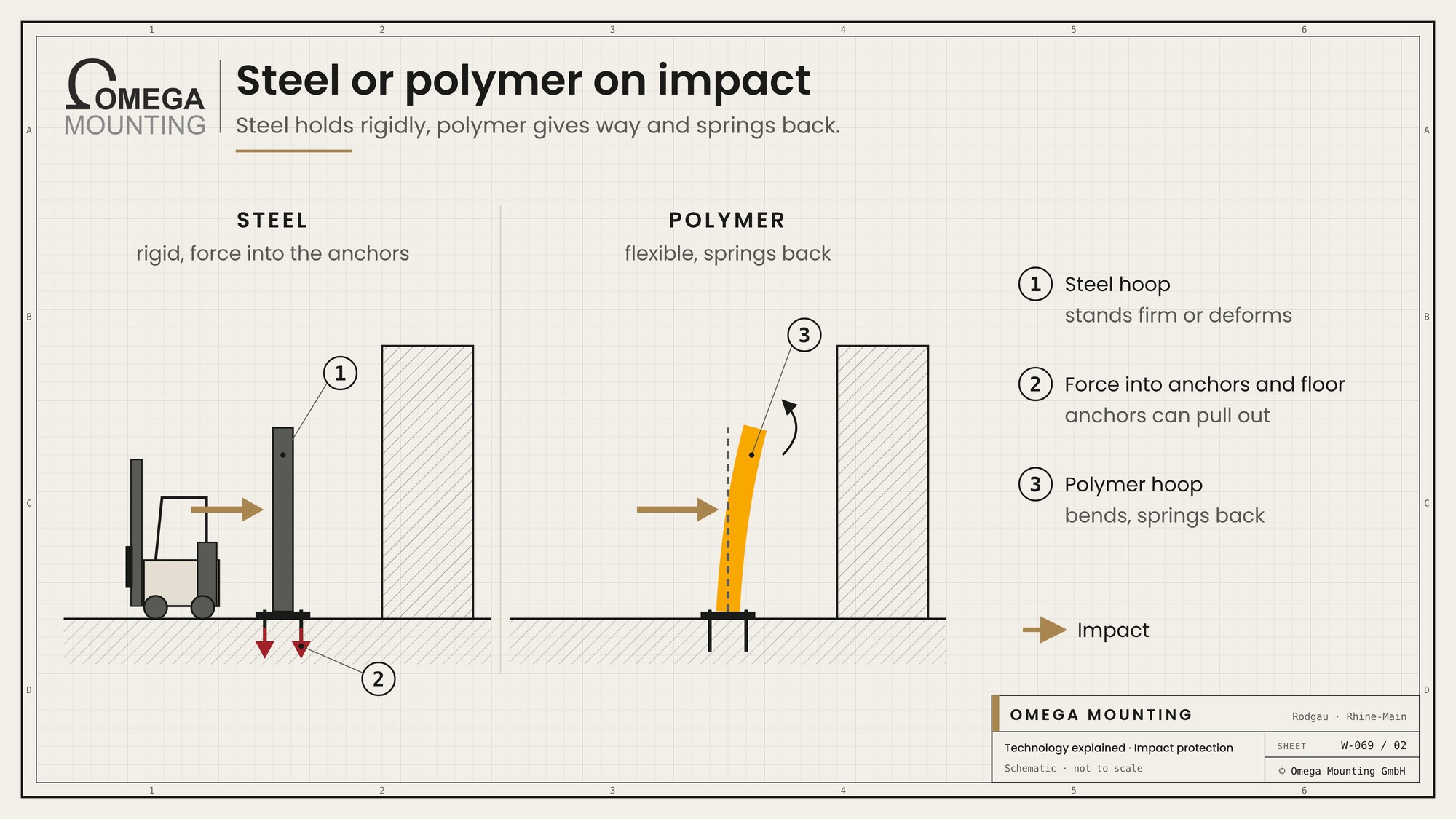
Steel holds rigidly and passes the force on to anchors and floor, plastic gives way, absorbs energy and springs back.
A Steel impact protection stays in place as long as anchors and floor hold. A heavy impact deforms it permanently or tears the anchors out of the floor. In return it is robust, can be made to measure and withstands hard continuous use.
A Plastic impact protection bends on impact, absorbs part of the energy and then returns to its shape. Anchors and floor are loaded less, vehicle and driver get a softer jolt. In return it needs room to give way and has its limits with heavy vehicles and high speeds.
Which material suits which location is answered in our guide Impact protection: plastic or steel? step by step.
Clearance and height: the two underestimated dimensions
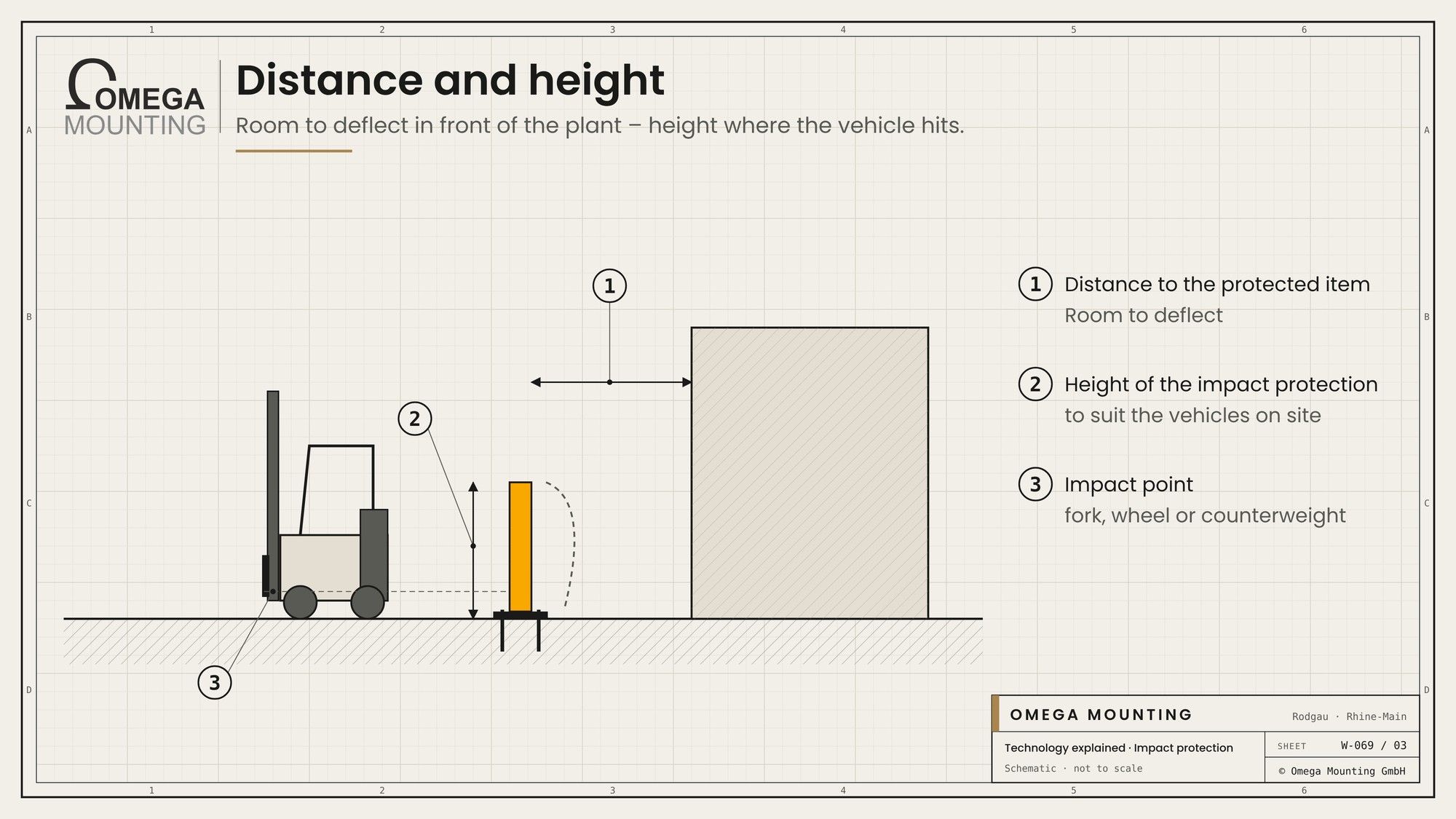
Impact protection only works if it stands at a distance from what it protects and sits at the height at which the vehicle hits.
Clearance. Every impact protection gives a little on impact – plastic clearly, steel slightly, the anchors too. If it stands directly against the machine, it passes the impact on instead of absorbing it. How much clearance is needed is stated in the manufacturer's data and depends on the vehicle.
Height. A forklift hits with its forks, wheels or counterweight, a pallet truck lower down, a lorry higher up. A hoop that is too low gets driven over, one that is too high gets driven under. The right height follows from the vehicles that actually drive there.
Typical installation errors
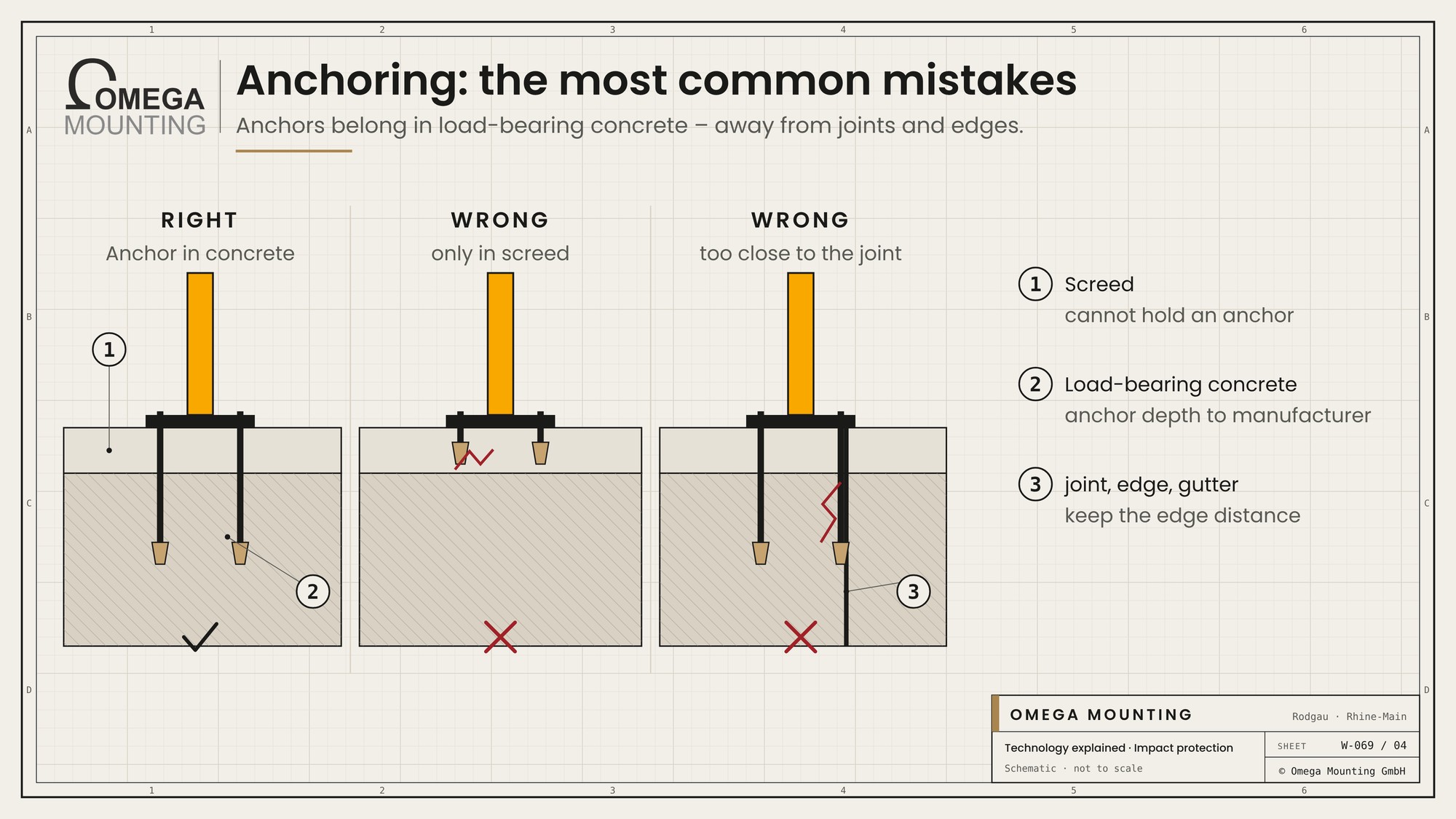
Most impact protection fails not because of the material, but because of the installation.
- Anchors in the screed only. If there is screed on top of the structural concrete, an anchor that is too short only holds in the top layer and tears out at the first impact.
- Too little edge distance. Anchors right next to joints, edges or gutters break out the concrete.
- No clearance from what it protects. The impact protection stands against the machine and passes the impact on.
- Gaps. Between two elements there is just enough room for a fork to pass through.
- Wrong height for the vehicles that actually drive there.
- Damaged elements stay in place. A bent hoop will not hold the next impact.
After an impact
Impact protection is there to be hit. What matters is what happens afterwards:
- Visual check: Bent bollards, displaced rails and cracked welds are reported immediately.
- Anchoring: An impact can loosen anchors or break out concrete. The fixing is checked, not just the component.
- What is protected: If the protection gave way, the rack, column or line behind it is looked at too.
- Replace, do not straighten: Deformed steel has used up its reserve. It is replaced, not bent back.
- Find the cause: If the same spot is hit again and again, the traffic route is wrong. Then better guidance helps more than stronger steel.
Having spare parts in stock for frequently hit spots shortens the time a column or rack remains unprotected. For racks, the rack inspection also applies – a damaged upright is unloaded before it gives way.
What we pay attention to
Before we install impact protection, we look at the location and the traffic.
- We clarify which vehicles come, how fast and from which direction.
- We check the floor: concrete thickness, screed, joints, cables and reinforcement.
- We choose anchors according to the manufacturer's specifications and keep the edge distances.
- We plan the clearance from what is protected and the height according to the vehicles.
- We build custom-made solutions in our workshop in Rodgau when standard products do not fit.
Where we use it
For a manufacturing company near Offenbach we built solid custom-made impact protection: an anchored floor rail of steel angle and a frame of steel tube, welded in Rodgau, installed on site with heavy-duty anchors and painted safety yellow. At a loading dock at Frankfurt Airport, our metalworkers placed a square tube with a 10 millimetre wall thickness in front of the installation, which spreads the impact force of the dollies over its surface. You will find more on custom-made solutions under Custom fabrication.
More technology explained
Guide
the decision step by step.
Technology explained
why the end upright needs protection.
Technology explained
protection at the platform edge.
Do you have questions about how this works on your site?
Is one spot in your hall hit again and again, or does the existing impact protection not hold? We look at the location and build the right protection – off the shelf or made to measure. Request a callback.
Free, no-obligation callback

About the author
Tobias Schott
Managing director of Omega Mounting GmbH, Rodgau · more than 20 years of hands-on experience in installation and maintenance
A trained mechatronics technician, working in maintenance, servicing and industrial installation since 2004 – first alongside his father, and with Omega Mounting since 2012: from overhead conveyors in Frankfurt to the crane system in a new-build hall. He plans and leads lifting operations as an appointed person (AP) in data centers and on industrial sites in the Rhine-Main region, trains and examines operators of cranes, mobile elevating work platforms and telehandlers, and is a qualified occupational safety specialist. On jobs abroad he is known as the “German Troubleshooter” – the person you call when a site gets stuck. He learned what quality means from his father, not from a manual: Made in Germany as a standard for his own work, not a label. That is why quality comes first at Omega Mounting – ahead of speed and price. The Technology explained articles cover the equipment and techniques his team uses every day: what counts on site is in them – what only appears in the brochure is not.
 English
 German