
- Technology explained – equipment and protection
Pallet racking: upright, beam, safety pin – and what the load sign says
By Tobias Schott · 5-minute read · Updated November 2026
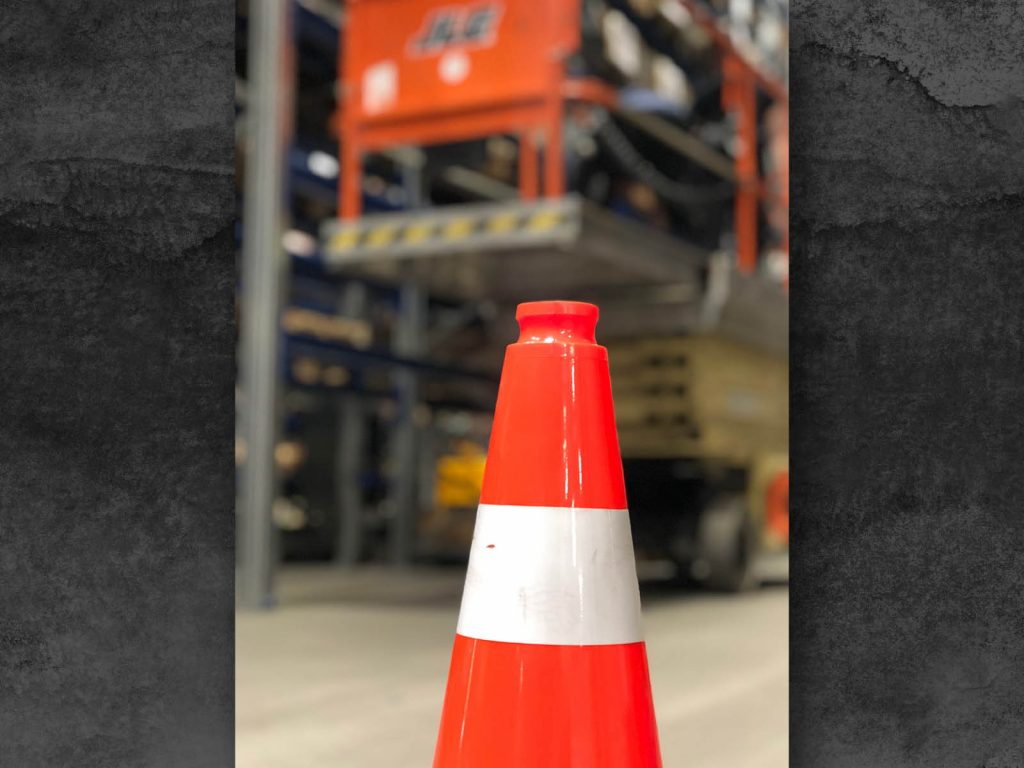
Pallet racking carries tonnes on a few millimetres of steel – that is why every component, every dent and every figure on the load sign matters.
Pallet racking stands in almost every warehouse, production hall and spare parts store. It looks simple: blue or grey frames, orange beams, pallets on top. The forklift drives past it hundreds of times a day. That is exactly why it is the component that gets damaged most often in a warehouse – and noticed least often.
Here we explain how pallet racking is built, what the details on the load sign mean, which damage counts in a racking inspection and why a small safety pin makes such a difference.
What is pallet racking?
Pallet racking is steel shelving in which pallets are stored on horizontal members, the beams, between vertical frames. In German it is called Palettenregal; when it gets very high, people also speak of high-bay racking.
Every pallet is individually accessible, and the forklift can reach every storage position directly. That distinguishes pallet racking from block storage, where pallets stand on top of each other, and from flow racking, where they move forward on rollers.
Key facts
- Purpose: Storing pallets individually accessible and on top of each other.
- Components: Frames of two uprights with bracing, beams with safety pins, base plates with floor anchors, impact protection, load sign.
- Marking: Load sign with permitted level load and bay load, clearly visible on the rack.
- Inspection: Regular visual checks by the operator, at least once a year an inspection by a competent person according to DIN EN 15635.
- Damage rating: Traffic light in three levels – monitor, repair soon, unload immediately.
- Repair: Damaged parts are replaced, not straightened or welded.
How is pallet racking built?
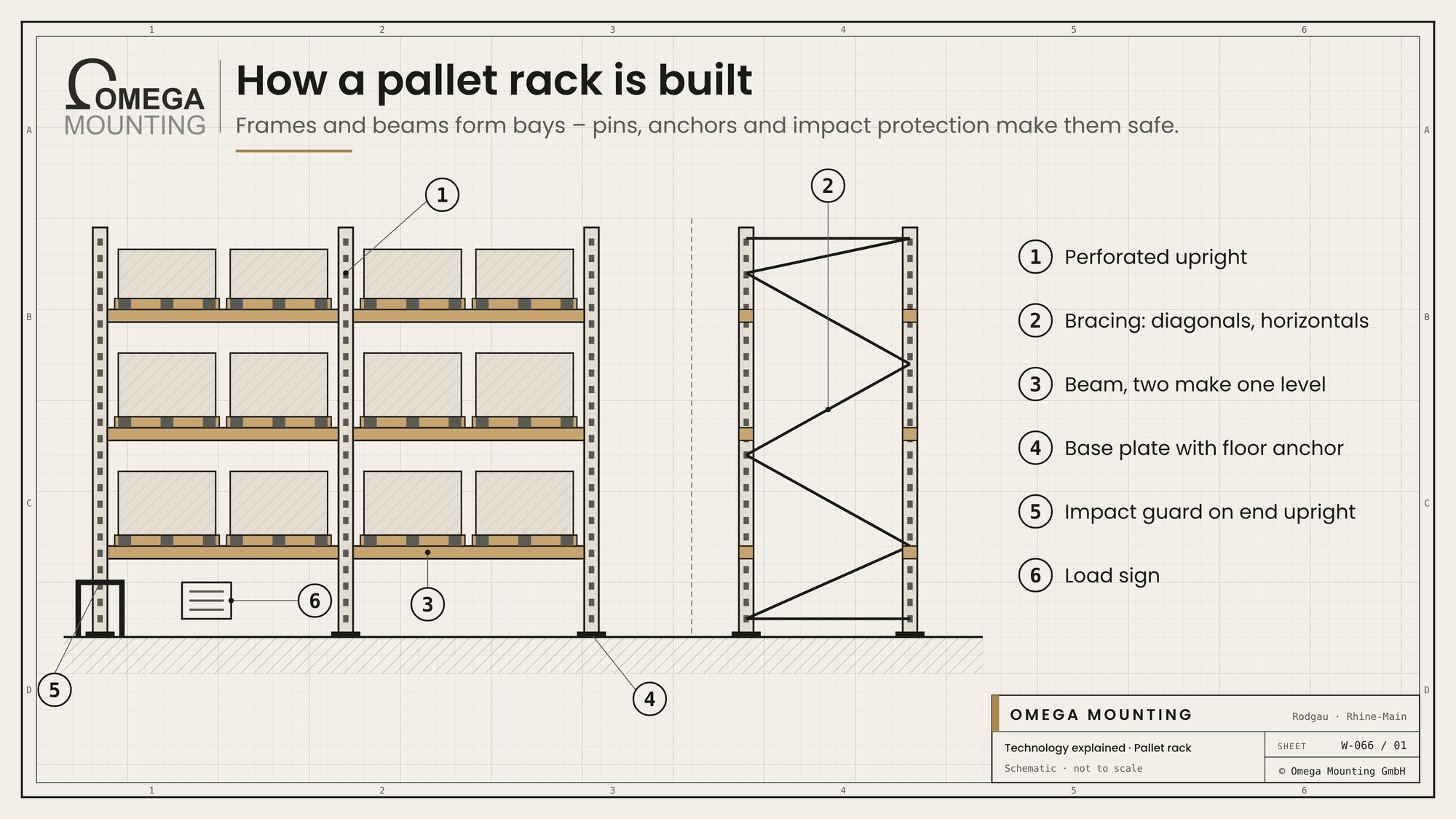
Pallet racking consists of frames and beams that together form bays.
A The frame is the vertical end: two uprights connected by bracing of diagonal and horizontal members. The uprights have perforations at a fixed pitch into which the beams are hooked. At the bottom, every upright stands on a base platethat is anchored to the floor.
The Spreader beams – in racking simply called beams – are the horizontal members between two frames. Every two beams form a level on which the pallets sit. A safety pin at each beam end prevents the beam from being lifted out of the perforation.
Then there are accessories that make the difference: the Impact protection on the end uprights of the aisles, back stops or mesh so that nothing falls out at the back, and the load sign.
Level load, bay load and the load sign
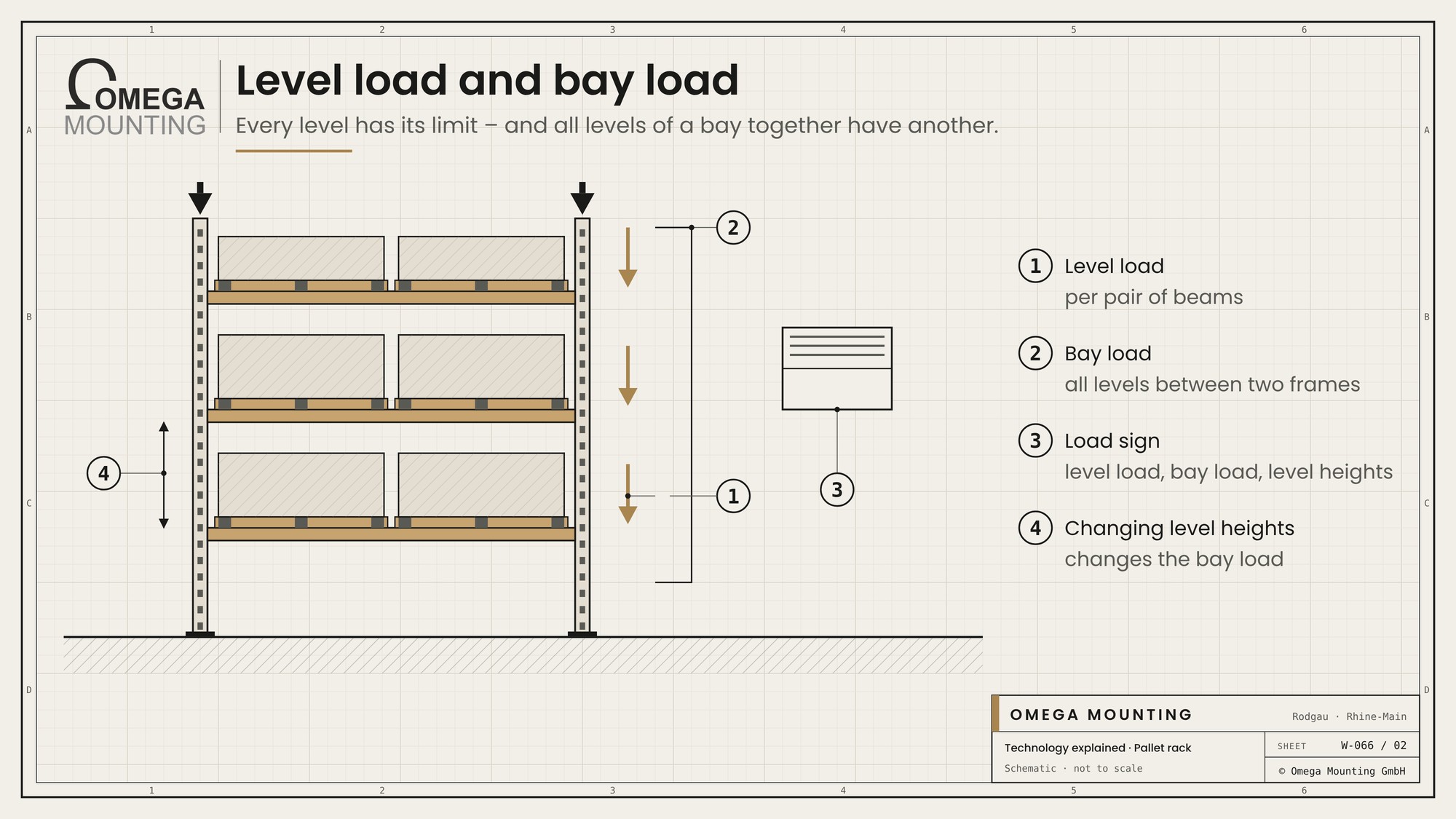
The load sign says how much one level and how much a whole bay may carry – two different figures that must both be observed.
| Detail | What it means | How it gets exceeded |
|---|---|---|
| Level load | Maximum load on one pair of beams, usually the sum of the pallets on the level. | Pallets too heavy, one pallet too many on the level. |
| Bay load | Maximum load of all levels between two frames together. | Each level fine on its own, but all together too heavy. |
| Level heights | The beam spacing for which the loads apply. | Beams moved without authorisation. |
The third point is overlooked most often. The load capacity of a frame depends on how high the lowest beam sits and how the levels are distributed. Moving beams or leaving out a level changes the bay load. That is why a new, matching load sign belongs on the rack after every alteration – issued on the basis of the manufacturer's data.
Which damage counts in a racking inspection?
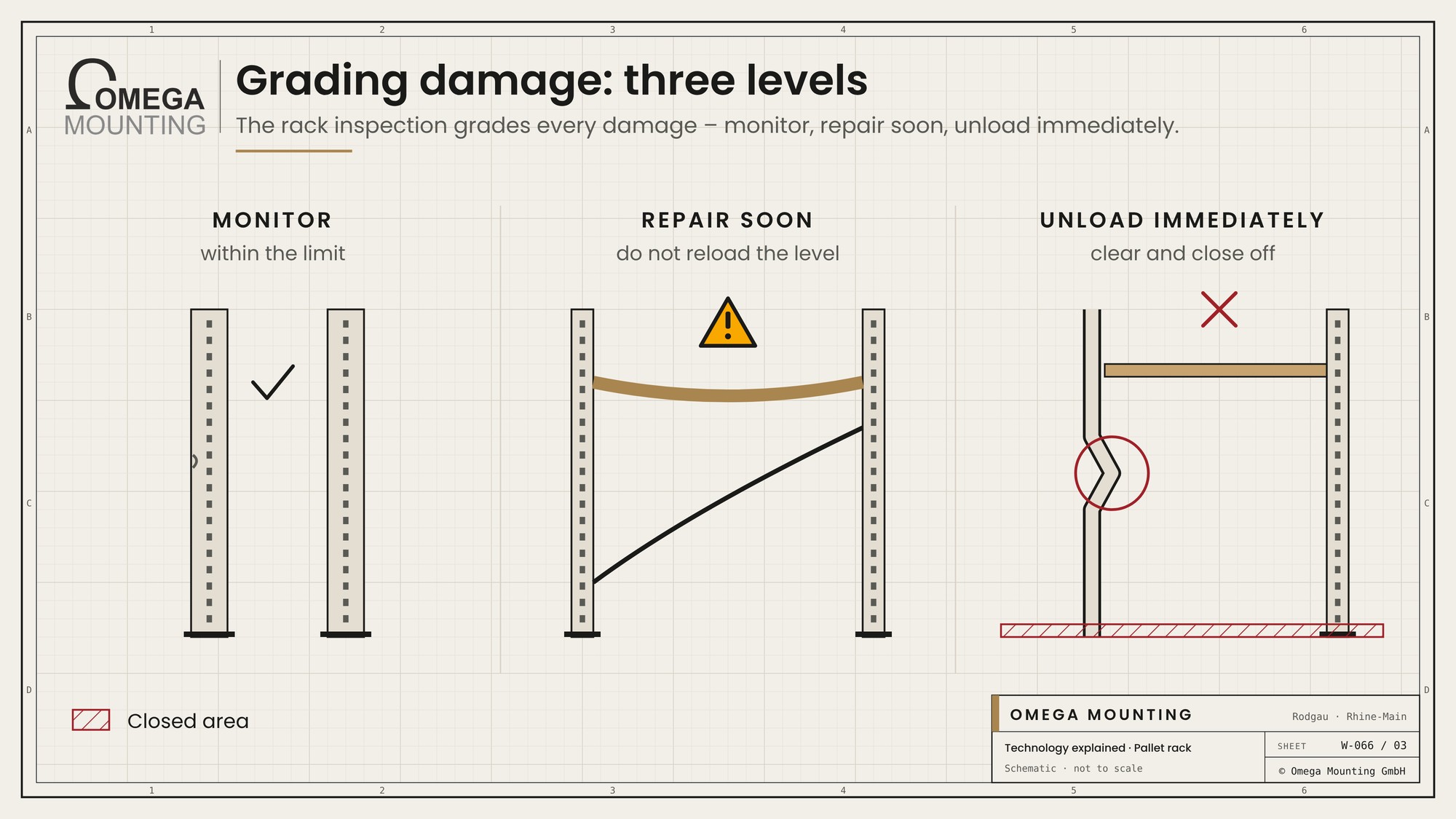
A racking inspection counts all damage that reduces load capacity – above all deformed uprights, bent bracing members, deflected beams and missing locks.
The racking inspection according to DIN EN 15635 grades each damage in one of three levels:
- Green – monitor. The damage is within the permitted limits. It is recorded and looked at again in the next inspection.
- Amber – repair soon. The level must not be reloaded after unloading; the repair follows promptly.
- Red – unload immediately. The affected area is cleared and closed off immediately until the repair is complete.
The most common causes are impact damage from forklifts and pallet trucks to uprights and diagonals. A dent in an upright looks harmless, but it takes buckling resistance away from the profile. How the inspection works and who may carry it out is explained in our guide racking inspection and in the article on the competent person.
Why the safety pin matters so much
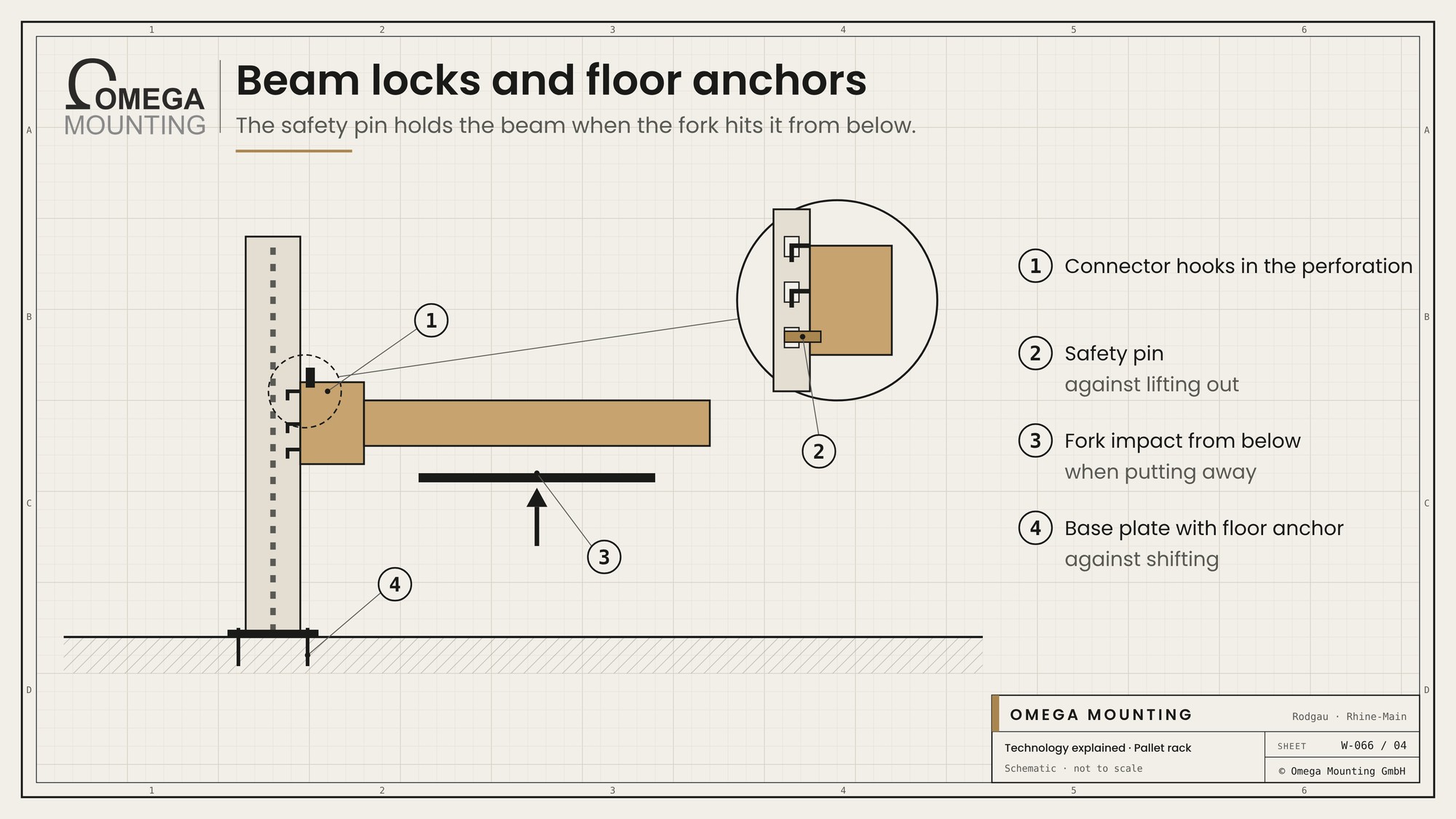
The safety pin holds the beam in the perforation when it is hit from below – and that happens all the time during put-away.
The beam hangs with hooks in the upright perforation and is pulled down by its own weight and the load on it. If a forklift fork hits the beam from below during put-away, it can jump out of the hooks. The safety pin prevents this. Without it, the next pallet lies on a beam that is only hooked in.
The floor anchors are just as important: a rack that is not anchored can shift after an impact. Missing pins and loose anchors are therefore among the points every visual check covers.
What we pay attention to
When we repair or alter pallet racking, we work from the findings and with a cleared aisle.
- We work from the inspection report and replace damaged parts instead of straightening or welding them.
- We use spare parts that match the manufacturer's system.
- We clear and close off the aisle we are working in, so that operations continue in the other aisles.
- We work at height with a mobile elevating work platform and harness.
- We fit every safety pin and check the floor anchors before releasing a level.
- We point it out when a load sign is missing or no longer fits after an alteration.
Where we use it
In a warehouse in Fulda we worked through the defect list after a racking inspection. For years the installation had not been properly inspected and maintained, and damage had built up. We replaced uprights, beams and bracing part by part – during operation, emptying and closing off aisle after aisle, with an elevating work platform and harness. You will find more on our services for warehousing and logistics under Logistics.
More technology explained
Guide
how an inspection report turns into a repair.
Technology explained
who may inspect the racking.
Technology explained
what protects uprights from the forklift.
Do you have questions about how this works on your site?
Has your racking inspection found defects, or do you want to alter your pallet racking without closing the warehouse? We replace damaged parts aisle by aisle and tell you what to look out for. Request a callback.
Free, no-obligation callback

About the author
Tobias Schott
Managing director of Omega Mounting GmbH, Rodgau · more than 20 years of hands-on experience in installation and maintenance
A trained mechatronics technician, working in maintenance, servicing and industrial installation since 2004 – first alongside his father, and with Omega Mounting since 2012: from overhead conveyors in Frankfurt to the crane system in a new-build hall. He plans and leads lifting operations as an appointed person (AP) in data centers and on industrial sites in the Rhine-Main region, trains and examines operators of cranes, mobile elevating work platforms and telehandlers, and is a qualified occupational safety specialist. On jobs abroad he is known as the “German Troubleshooter” – the person you call when a site gets stuck. He learned what quality means from his father, not from a manual: Made in Germany as a standard for his own work, not a label. That is why quality comes first at Omega Mounting – ahead of speed and price. The Technology explained articles cover the equipment and techniques his team uses every day: what counts on site is in them – what only appears in the brochure is not.
 English
 German