
- Technology explained – Tools and equipment
The magnetic core drill: drilling in steel on site
By Tobias Schott · 5-minute read · Updated November 2026
A magnetic core drill stands with a strong magnet directly on the steel it drills into. This produces large, accurate holes in girders, plates and tubes – on site, without a pillar drill. For this to work safely, the annular cutter, cooling and holding force are what count.
In the workshop, the component comes to the drilling machine. On installation jobs it is the other way round: the girder is already hanging, the bracket is already welded on, the impact protection is already in front of the plant. Here the drilling machine is brought to the component.
Here we explain how a magnetic core drill is built, why the annular cutter is so efficient, what the holding force depends on and how a clean hole is made.
What is a magnetic core drill?
A magnetic core drill is a portable drilling machine with a magnetic base. The magnet holds the machine firmly on the steel workpiece, similar to the base of a pillar drill on the table. Above it sits a slide with motor, which is moved down evenly via a feed handle.
It usually works with an annular cutter, hence the name. However, many machines can also take twist drills, and some have forward and reverse rotation for tapping threads.
The magnet only works on magnetic steel. On stainless steel, aluminium or concrete the machine does not hold by itself – there you need vacuum plates, clamping devices or a different tool.
Key facts
- Task: Drilling large, accurate holes in steel, directly on the component.
- Stop: Electromagnet or permanent magnet in the base.
- Tools: Annular cutter with pilot pin, depending on the machine also twist drills.
- Use: Steel construction, installation, repair, retrofitting.
- Weak points: material too thin, paint and scale under the magnet, missing safety strap.
- Interfaces: Structural engineer for holes in load-bearing components, operator, manufacturer.
- Our part: Drilling, tapping and bolting on site.
How a magnetic core drill is built

- Magnetic base: holds the machine on the workpiece. With an electromagnet it is switched on with its own switch before the motor runs.
- Column with slide: a guide on which the motor moves up and down.
- Motor with gearbox: drives the cutter, often with several gears.
- Feed handle: moves the slide and thus the cutter evenly downwards.
- Annular cutter with pilot pin: cuts the hole.
- Coolant tank: supplies the cutting edges with coolant via the pilot pin.
This includes a safety strap, which holds the machine on the component if the magnet weakens.
Annular cutter instead of twist drill
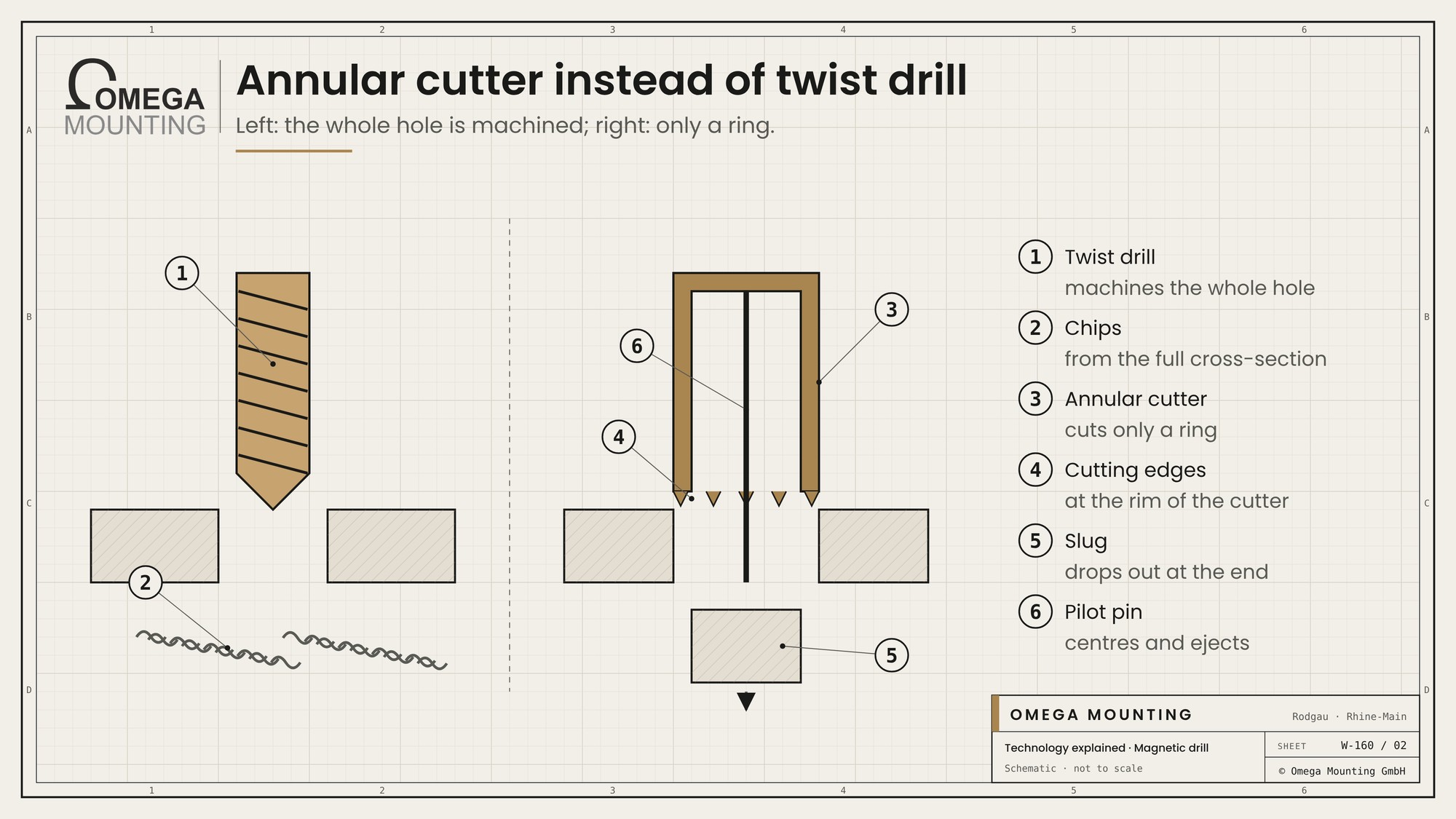
A twist drill machines the entire hole. Every millimetre of the diameter turns into chips. With large holes this takes a lot of force, a lot of time and often several pilot holes.
A annular cutter, also called a hollow drill or ring cutter, cuts only a narrow ring. The centre remains as a slug and drops out at the end. Because much less material is machined, this is faster and needs less force – even with large diameters and without pilot holes.
A pilot pin in the centre has two jobs: it helps with precise positioning on the centre-punch mark, and it ejects the slug at the end. Caution: the slug is sharp-edged and hot and can drop out with momentum.
Annular cutters are available in high-speed steel and with carbide cutting edges. Which one fits depends on the material and the number of holes.
The chips show whether everything is right: even, continuous chips show that speed, feed and cooling are correct. Blue or powdery chips indicate too much pressure, too little cooling or blunt cutting edges. Then the work is stopped and checked before the cutter is damaged.
Holding force: what the magnet depends on

The holding force of the magnet is stated in the operating instructions. But it only applies under good conditions:
- Material thickness: Thick steel holds best. On thin sheet the holding force drops significantly because the magnetic field does not find enough material.
- Surface: Paint, scale, rust, chips or unevenness form a gap between magnet and steel. Even a small gap weakens the grip.
- Bearing: The magnetic base must sit flat over its full area, not on an edge or weld seam.
- Power: An electromagnet loses its force in a power failure.
On vertical surfaces and overhead, the machine is therefore always additionally secured with the safety strap . Anyone drilling into load-bearing components clarifies this beforehand with the structural engineer. This is not legal advice.
Work sequence
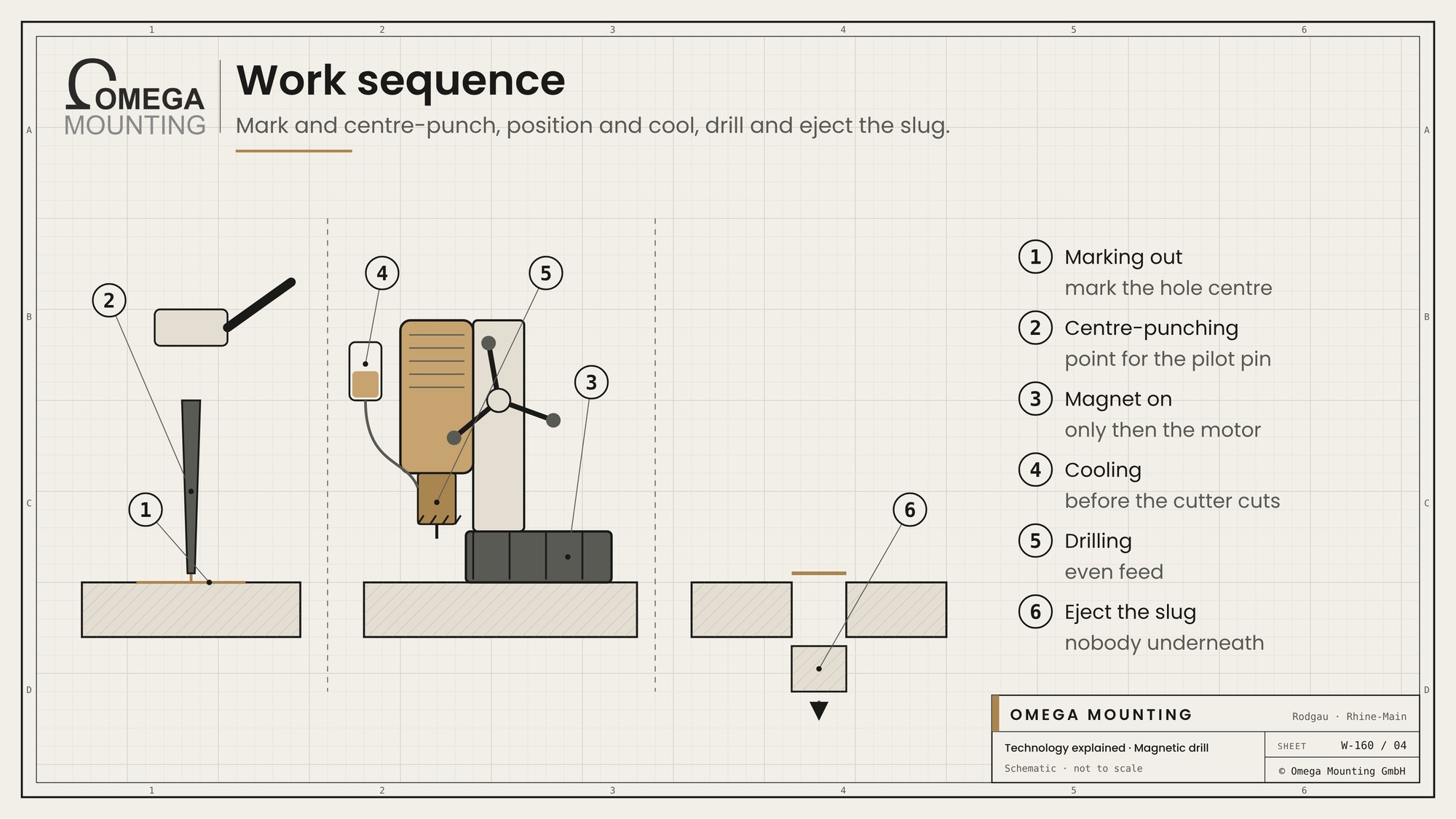
- Marking out and centre-punching: mark the centre of the hole and centre-punch it.
- Positioning: pilot pin on the punch mark, align the machine, switch on the magnet.
- Secure: attach the safety strap, chips and cables out of the way.
- Cooling: open the coolant before the cutter starts cutting.
- Drill: with an even, not too high feed. The cutter should cut, not push.
- Ejecting the slug: retract the cutter, the slug drops out – nobody stands underneath.
The hole is then deburred. If a thread is to go in, tapping follows – with a suitable machine, directly with it.
Magnetic drill, pillar drill or hand drill?
| Characteristic | Magnetic core drill | Pillar drill | Hand drill |
|---|---|---|---|
| Place of use | directly on the component | workshop | anywhere |
| Hole size | large | large | small |
| Accuracy | high, guided vertically | high | depends on the hand |
| Position | horizontal, vertical, overhead | horizontal only | any |
| Workpiece | magnetic steel | must fit on the table | any |
The magnetic drill closes the gap between the two: it drills as accurately as a pillar drill but gets to where the component is already installed. For individual small holes a hand drill is often enough; for rows of large holes in thick steel the magnetic drill is the tool of choice.
Typical mistakes
- Machine positioned on paint, scale or a weld seam.
- Drilling on thin sheet without additional fastening.
- Working on a vertical surface without a safety strap.
- Drilling without cooling, cutting edges burnt.
- Slug allowed to drop uncontrolled.
What we pay attention to
When we drill into steel on installation jobs, we pay attention to the points that protect dimensions, tools and people.
- We clean the contact surface before the magnet is set.
- We always secure the machine with a strap on vertical surfaces and overhead.
- We drill with cooling and an even feed.
- We clarify holes in load-bearing components in advance.
- We cordon off the area below the drilling point.
Where we use it
For a impact protection on a loading dock at Frankfurt Airport our fitters pre-drilled square tube with a 10 mm wall thickness and the existing dock with a magnetic drill – hole by hole, on site and adapted to the existing installation. This was followed by tapping, bolting and welding; three fitters were on site for four days. More about our services is on the page Industrial installation.
More technology explained
Technology explained
protection class, inspection, vibration and noise.
Do you have questions about how this works on your site?
A steel component is to be drilled, adapted or bolted on site? We bring the machine and the experience. Request a callback.
Free, no-obligation callback

About the author
Tobias Schott
Managing director of Omega Mounting GmbH, Rodgau · more than 20 years of hands-on experience in installation and maintenance
A trained mechatronics technician, working in maintenance, servicing and industrial installation since 2004 – first alongside his father, and with Omega Mounting since 2012: from overhead conveyors in Frankfurt to the crane system in a new-build hall. He plans and leads lifting operations as an appointed person (AP) in data centers and on industrial sites in the Rhine-Main region, trains and examines operators of cranes, mobile elevating work platforms and telehandlers, and is a qualified occupational safety specialist. On jobs abroad he is known as the “German Troubleshooter” – the person you call when a site gets stuck. He learned what quality means from his father, not from a manual: Made in Germany as a standard for his own work, not a label. That is why quality comes first at Omega Mounting – ahead of speed and price. The Technology explained articles cover the equipment and techniques his team uses every day: what counts on site is in them – what only appears in the brochure is not.
 English
 German