
- Guide – Lift & Shift
Core drilling in industry: penetrations for cables, pipes and cranes
By Tobias Schott · Reading time approx. 21 minutes · As of: November 2026
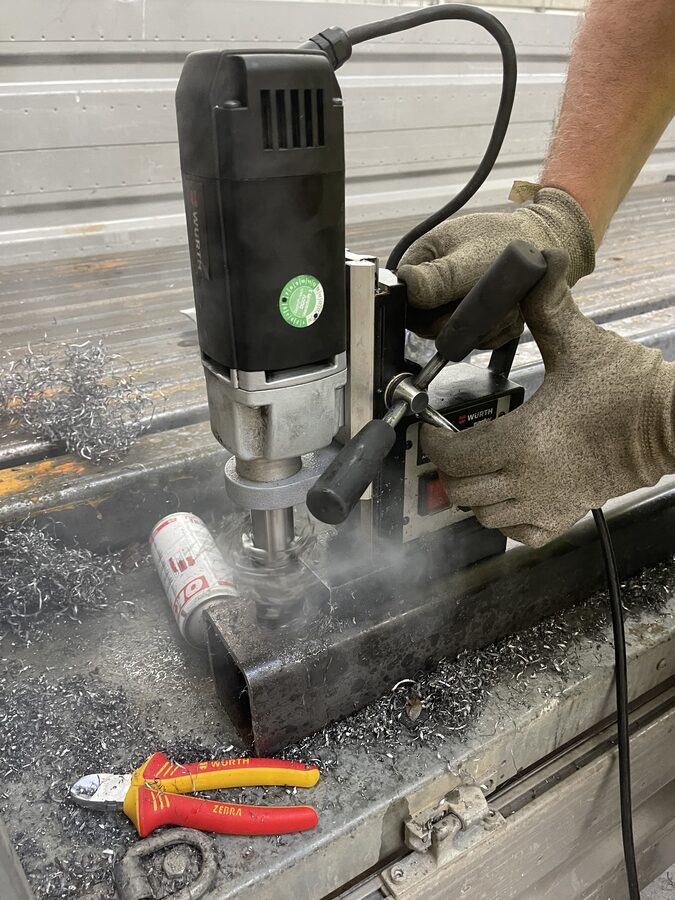
A core hole is a clean, round hole through concrete, masonry or steel – without chiselling and with little vibration. We drill them for crane anchors, for cables from outside to inside and for pipes between two rooms. What matters is not the drilling but everything before and after it.
At first glance, core drilling looks like a minor detail. A hole in the wall, a pipe through it, done. In practice, a whole installation often depends on that hole. The vehicle restraint system at the loading dock only works once its cables reach the control cabinet inside the building. The jib crane only stands safely once its anchors hold in the foundation. And the machine next door only runs once cooling water and compressed air come through the wall.
If you search for core drilling, you find plenty of drilling services and few answers to the real questions. May we drill at this point? What is inside the wall? How does the penetration become watertight? And who is responsible for fire protection? This guide answers these questions from the point of view of an installation contractor that drills core holes itself as part of its installations.
It is written for project and site managers, planners, maintenance managers, buyers and plant engineers – in short, for anyone who has to take an installation through a wall, a slab or into a foundation.
Key points at a glance
- Core drilling cuts a ring out of the component with a core bit. The core is removed in one piece. The hole is round, smooth and accurate.
- Three typical cases for us: anchors and recesses for crane systems, cables from outdoor equipment to control cabinets inside the building, pipework between two rooms.
- Before drilling, we locate, obtain approval and cordon off. Reinforcement, services and voids must be known before the bit touches the surface.
- Load-bearing components are only drilled after approval by the structural engineer. We do not drill until that approval is in place.
- Wet or dry depends on the surroundings. Wet drilling cools and binds dust but needs a plan for the water.
- The penetration must be sealed – against water and gas by us, against fire by an approved specialist contractor.
- Good planning saves a second visit: spare capacity in the cross-section, a fall to the outside and a draw wire cost little and save a lot.
What is core drilling?

Core drilling is a drilling method in which a hollow core bit cuts only a narrow ring out of the material. The core remains in the middle and is pulled out as a cylinder at the end. The cutting edge of the bit carries diamond segments. They grind through concrete, natural stone, masonry and reinforcing steel.
The drill motor sits on a drill stand. The stand is fixed to the component with an anchor or a vacuum plate. This keeps the bit running straight and puts the hole exactly where it should be. Smaller holes can be drilled freehand; everything else needs the stand.
Core drilling, hammer drilling or chiselling?
There are three ways to make a hole through concrete. Hammer drilling works by impact and suits small holes, such as for plugs and anchors. Chiselling breaks the material out, is noisy, causes vibration and leaves irregular edges. Core drilling cuts cleanly and almost without vibration.
In practice: next to running production, sensitive equipment or in a data center, core drilling is almost always the better route. The edges are smooth, seals sit properly and the room next door hardly notices.
What core drilling cannot do
Core drilling does not replace planning. It cannot decide whether a component can take the hole. Nor can it see what is inside the wall. And it does not automatically make a penetration watertight. These three points – approval, locating, sealing – are the real core of the job.
What we drill core holes for: three typical cases
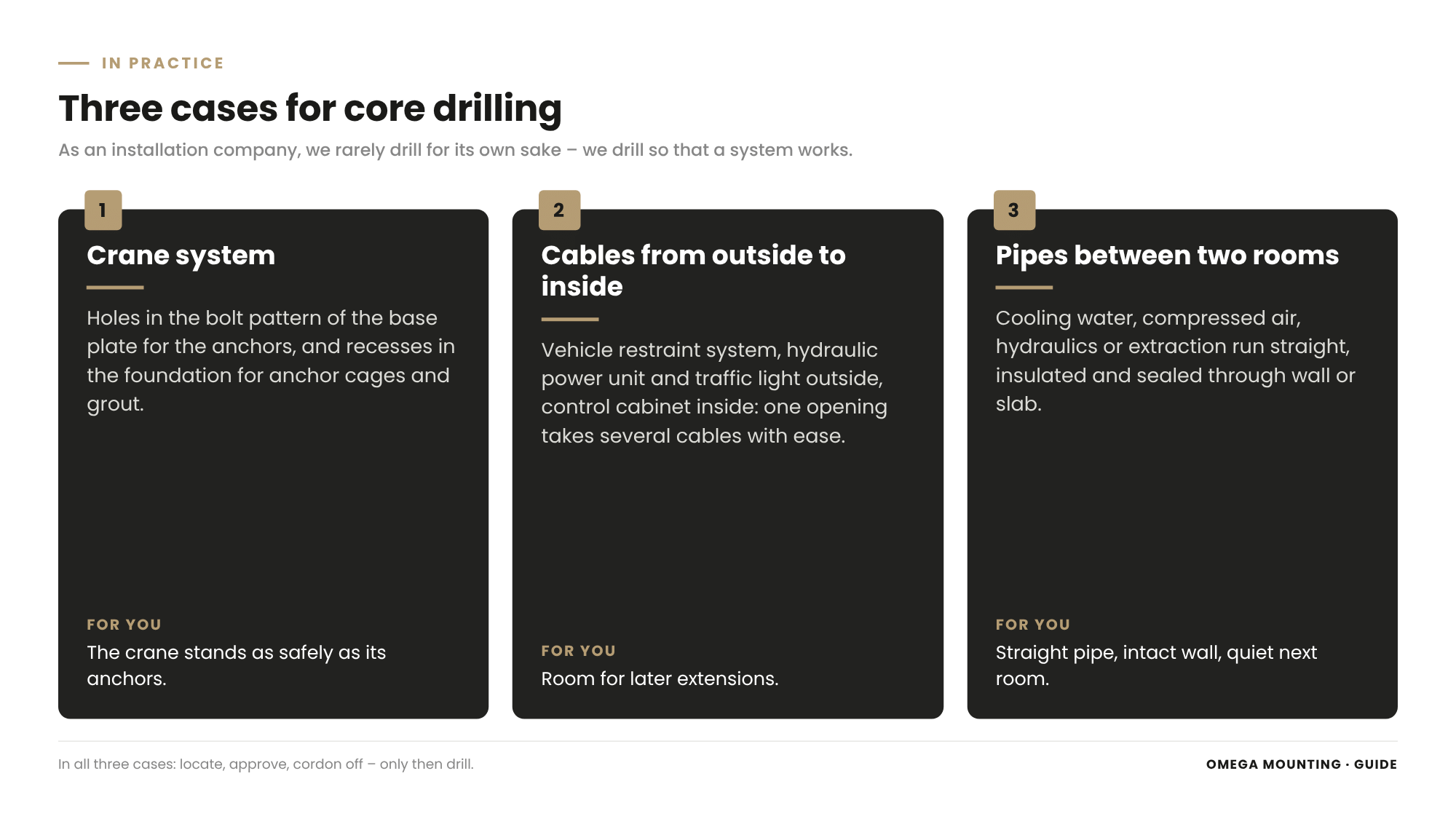
As an installation contractor, we rarely drill for drilling's sake. For us, a core hole is almost always part of an installation. Three cases come up particularly often.
Crane systems: anchors and foundation recesses
Pillar jib cranes and crane runway columns stand on a base plate that is anchored in the foundation or floor slab. The anchors need holes in the bolt pattern of the base plate. For larger anchors and densely reinforced slabs we use core drilling. Then there are recesses, for example for anchor cages or for grouting under the base plate.
Outdoor equipment with a control cabinet inside
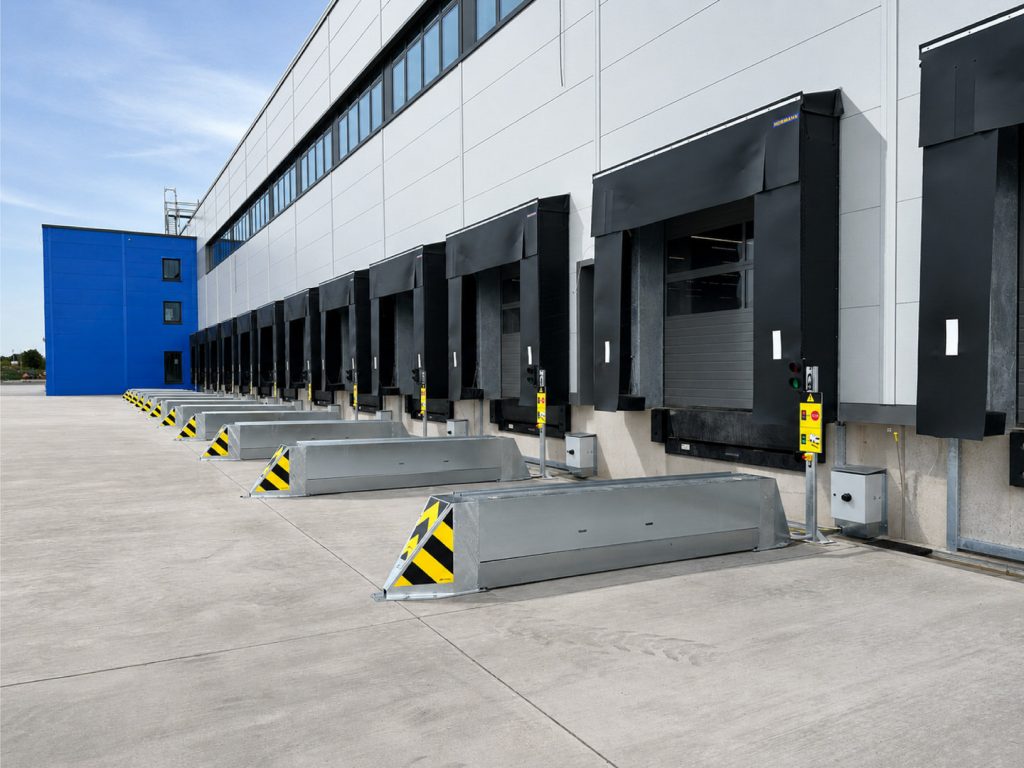
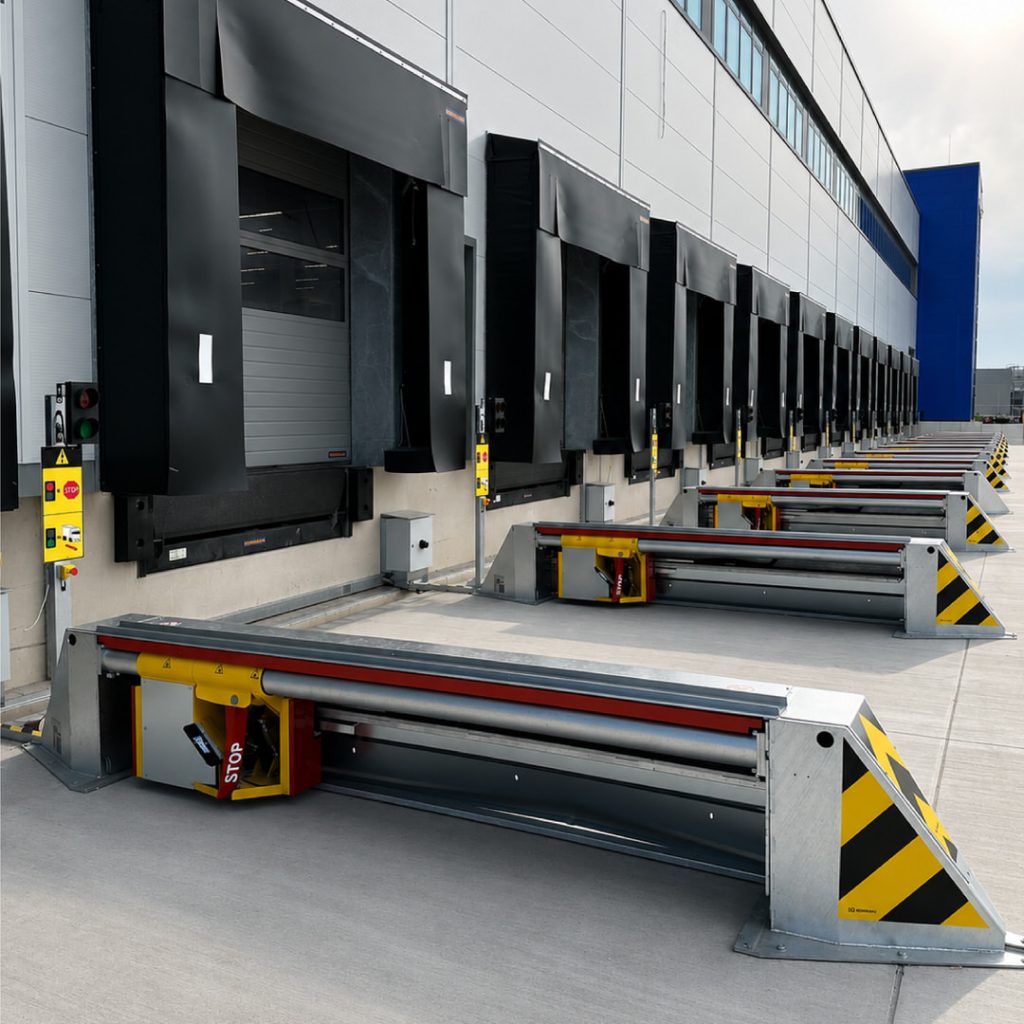
Vehicle restraint systems, hydraulic power units, outside signal lights and other equipment at the loading dock stand outside. Control cabinets and operator panels are inside. In between is the outer wall. A core hole gives us a passage through which several cables can easily be pulled – now and for later extensions.
Pipework between two rooms
Plant and machines often depend on utilities from the next room. Cooling water, compressed air, hydraulic oil or extraction have to pass through a wall or slab. A core hole of the right diameter takes the pipe including insulation and seal. The pipe stays straight and the wall stays intact.
Core drilling for crane systems: anchors and foundation recesses
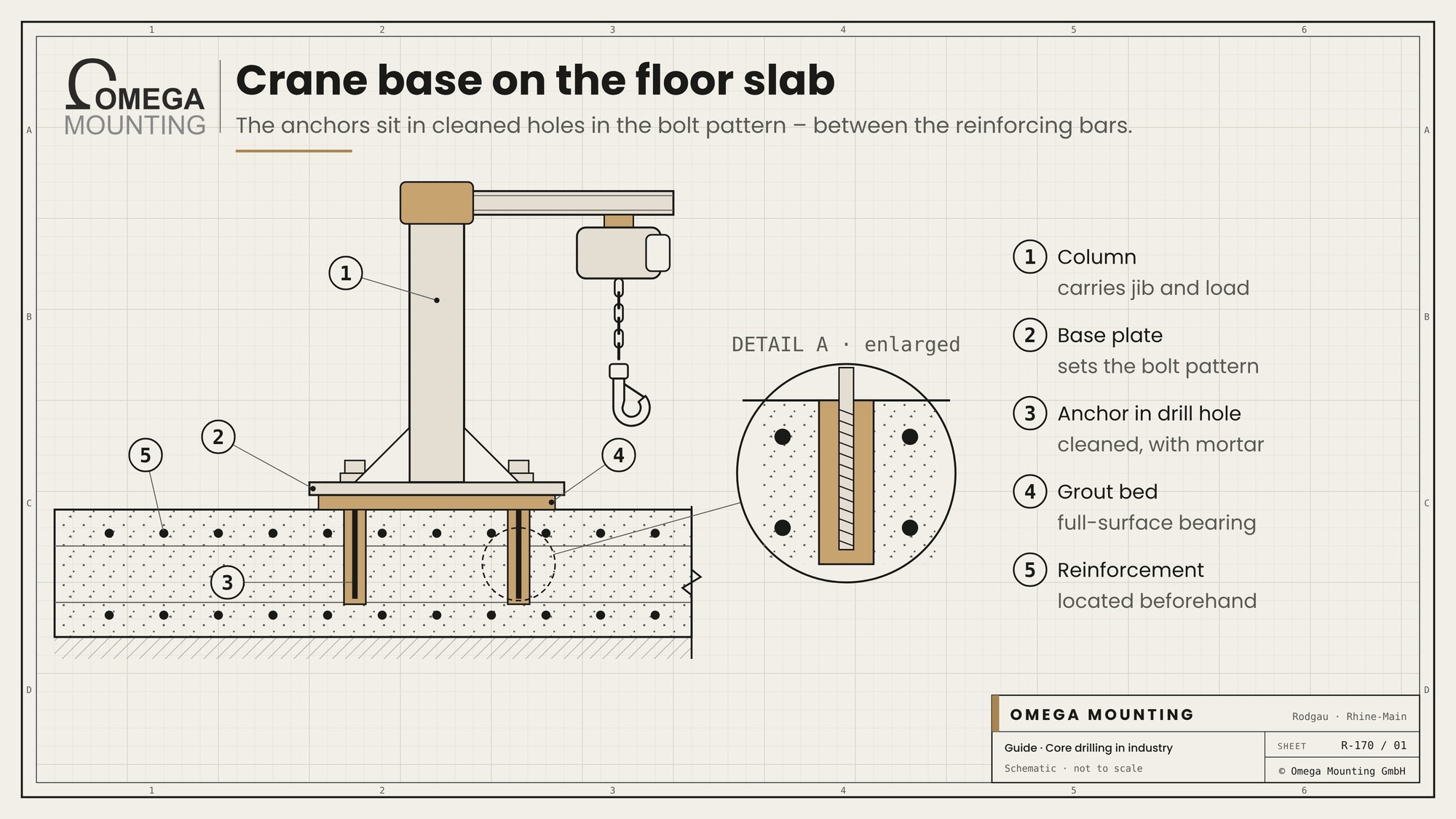
A pillar jib crane does not load its base evenly. What the jib lifts acts as a bending moment on the pillar and from there on the base plate. Depending on where the jib is, the anchors pull on one side and press on the other. That is why the anchorage decides the safety of the whole crane.
What must be settled before drilling
Before we drill for a crane system, we need four pieces of information: the crane manufacturer's requirements for the base, the build-up of the floor slab, the position of the reinforcement and approval for the anchorage. If the slab is too thin or too lightly reinforced, no anchor will help. Then a separate foundation is needed. That is decided by the structural engineer, not the fitter.
Drilling in the bolt pattern
The base plate defines the bolt pattern. We transfer it to the floor, locate the reinforcement and drill. If a reinforcing bar lies exactly in the way, the position is not simply moved. We then clarify with the structural engineer whether the bar may be cut or whether the base plate is placed differently.
After drilling, the holes are cleaned – blown out and brushed out. Only then does the bonding mortar go in. A dusty drill hole is the most common reason why an anchor does not reach the holding force it should.
Recesses and grouting
For some crane systems, anchor cages are set into the foundation or recesses are needed for later grouting. Core drilling helps here too: it creates round, clean openings that are easy to grout. How the base plate is then aligned and made load-bearing with grout is described in our guide Aligning and anchoring a machine. More on grout itself in our article on Grouting.
Cables from outside to inside: core drilling through the outer wall
At the loading dock of a logistics centre, two worlds meet. Outside, a vehicle restraint system holds the lorry; inside, a signal light shows warehouse staff that the lorry is secured. Control cabinet and operator panel hang on the inside wall. How such a system is built is explained in our article on Truck restraint system.
Where the hole should be
The core hole goes where the cable route outside and inside is shortest and best protected. Outside, it should sit above the splash zone and outside the vehicles' approach area. Inside, it should be near the control cabinet without clashing with racking, doors or ladders.
Plan for reserve
We drill the passage so that several cables fit through easily. A tight hole saves a moment today and costs a whole visit tomorrow. If a second signal light, a sensor or an extra control cable is added later, the space is already there. A draw wire left in place makes later pulling easy.
For large-section cables, the bending radius counts too. A thick control or hydraulic cable cannot be pulled sharply round a corner. The hole should therefore be placed so that the cable can continue in a gentle curve inside and outside.
Pulling in and connecting cables
We pull the cables through the hole, run them in conduit and on the cable tray to the cabinet and seal the penetration. Our own electricians make the connection in the control cabinet at the same time. That keeps the whole link, from the equipment outside to the cabinet inside, with one contractor. How cable routes are run neatly in the building is shown in our article on Cable route.
Pipework between two rooms
Many machines are not where their supply comes from. The compressor is in the plant room, the machine in the hall. The dry cooler is outside, the plant inside. The extraction is behind the wall. Each of these connections needs a route through the building element.
Choosing the right diameter
The hole diameter depends on more than the pipe. Insulation, conduit, seal and an annular gap for installation all count. A pipe that sits in the hole without clearance transmits vibration to the wall and cannot be sealed properly. If the hole is too large, sealing becomes laborious.
Straight, aligned, with a fall
Pipework should run straight through the wall and arrive at the right point on both sides. That is why we set out from both sides before drilling. For condensate or waste water lines, the fall comes on top. The core hole can be drilled at an angle if the line requires it.
Several lines at one point
If several pipes run into the same room, it pays to group the penetrations. Two or three holes side by side are easier to seal and easier to identify later than scattered single holes. The spacing between the holes matters, so that the component between them stays stable. If in doubt, the structural engineer sets it.
Decoupling vibration and noise
Pipes transmit vibration from pumps, compressors and machines. If a pipe sits rigidly in the wall, the hum travels into the next room. We therefore run pipes through the hole with an elastic insert. The line stays flexible, the penetration sealed and the next room quiet. On lines with temperature changes, such as cooling or hot water, the insert also absorbs the change in length.
Before drilling: locate, approve, cordon off
Most problems with core drilling arise not during drilling but before it. If you drill without locating, sooner or later you hit something that should not have been hit.
Locating: what is inside the component?
Before every hole, we scan the component with a detector. We look for reinforcement, prestressing steel, electrical cables, water and heating pipes and voids. We use existing as-built drawings but do not rely on them alone. Drawings show what was planned. Scanning shows what is actually there.
If a cable lies near the drilling point, it is isolated or the hole is moved. Isolation follows your procedure – by our qualified electrician or yours.
Approval: may we drill here?
Whether a component is load-bearing is decided by the structural engineer. In walls, columns, downstand beams and slabs with a load-bearing function, we only drill with their approval. Prestressed concrete slabs are a special case: a cut tendon cannot be repaired. Locating and approval are particularly careful here.
If the hole is in a fire wall or a slab between two fire compartments, fire protection belongs in the planning from the start. Who will install the fire stopping later should be settled before drilling.
Cordoning off: both sides in view
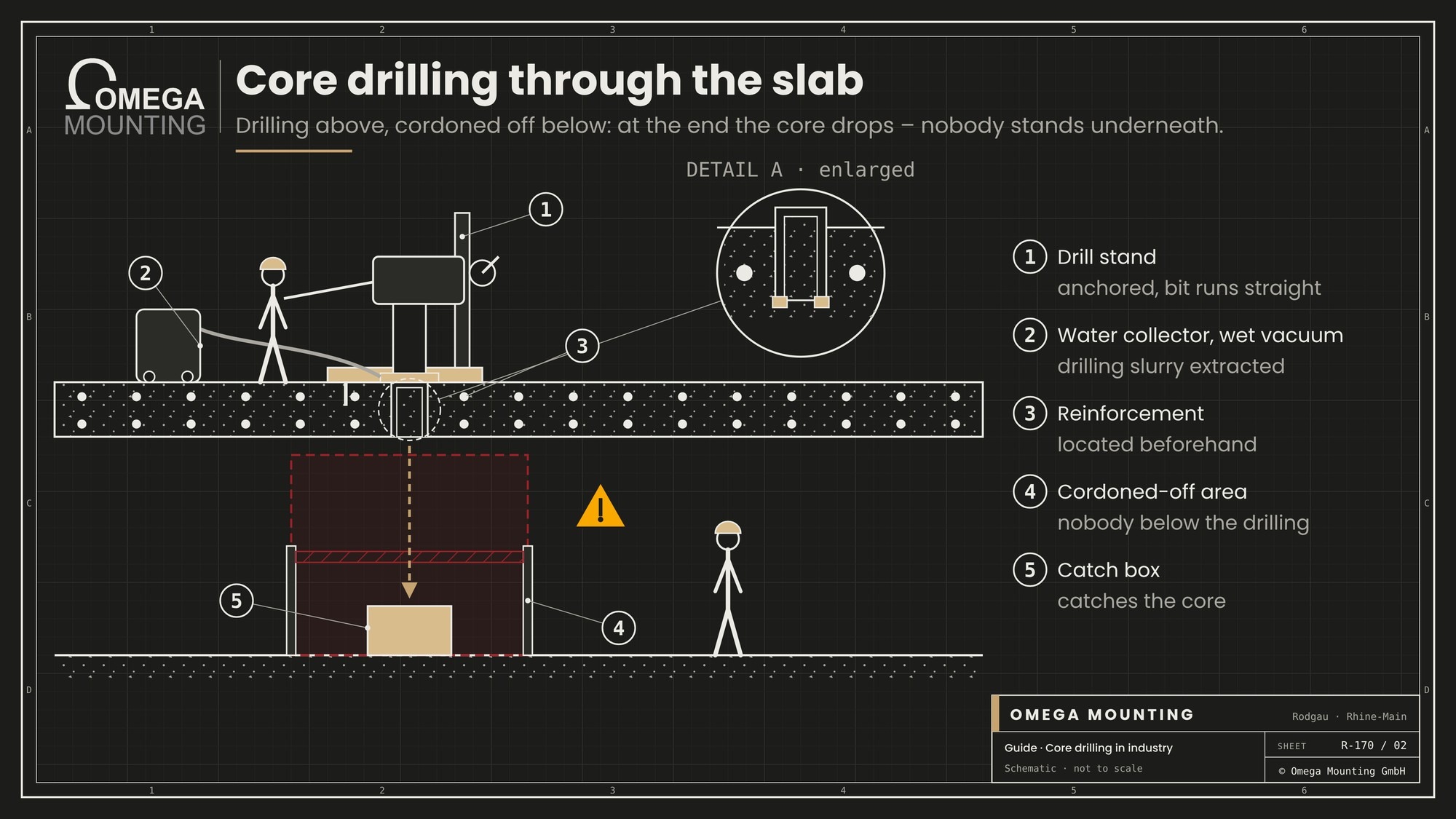
A core hole always has two sides. On the far side the core drops out at the end, and with it water or dust. We therefore cordon off both sides, secure the core against falling and make sure nobody is standing behind it. This applies especially to holes in slabs. Below the slab, the area is cordoned off and the core is caught.
Fixing the drill stand securely
The drill stand holds the machine throughout the drilling. If it comes loose, the bit kicks and the machine can twist. We therefore fix the stand with an anchor suited to the component, or with a vacuum plate on smooth surfaces. For overhead holes or on high walls, we work from a safe standing position such as a mobile elevating work platform or scaffold. A ladder is not a workplace for this.
Wet or dry: water, dust and running operations
Diamond core bits need cooling. In wet drilling, water does this job. It cools the bit, flushes out the drilling dust and binds it. In dry drilling, extraction removes the dust.
Wet drilling: clean, but with water
Wet drilling is the standard for concrete. It is gentle on the bit and keeps the air clean. In return it produces drilling slurry that has to be collected and vacuumed up. We use a water collector ring and a wet vacuum for this. Next to control cabinets, servers or sensitive electronics, the surroundings are also covered.
Dry drilling: when no water is allowed
In some rooms no water may flow – in a data center, for example, or next to open equipment. Then we drill dry with extraction. That takes longer and wears the bit more. Drilling in concrete produces quartz dust. The German technical rule on quartz dust requires it to be extracted at source. Our fitters wear respiratory protection while doing it.
Noise, power and working hours
Core drilling is quieter than chiselling, but not silent. Next to offices or sensitive production, we agree drilling times with you. The drill needs a strong power supply. If there is no suitable connection on site, we clarify this in advance – more on this in the guide Planning construction site power.
Core drilling in steel: the magnetic drill
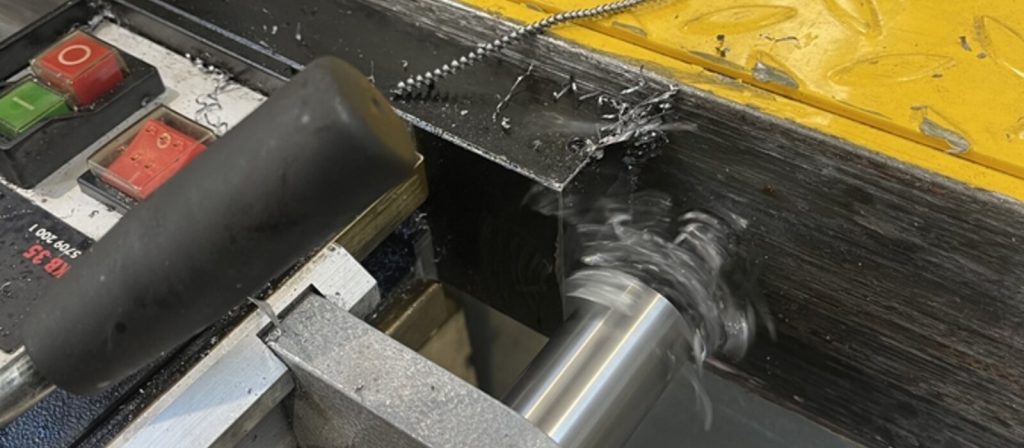
Not every core hole goes through concrete. On steel structures, loading systems, crane runways and steel platforms we drill with a magnetic drill. Its magnetic base clamps directly onto the steel and guides the annular cutter vertically into the material.
Why an annular cutter in steel
A twist drill has to machine the whole hole. An annular cutter only cuts the ring – as in concrete. That saves force, spares the machine and gives clean, accurate holes. Cooled with cutting oil, it produces precise holes in series, even in thick-walled material.
On site instead of in the workshop
The big advantage: we drill where the component is. Instead of pre-drilling parts in the workshop and hoping everything fits on site, we adapt directly on the installation. The magnetic drill also serves as a guide for thread cutting. That way every bolted joint sits exactly.
Corrosion protection after drilling
Every hole in galvanised or painted steel opens the coating. Sooner or later, rust starts at the bare edge of the hole. We therefore deburr the holes and protect the edges with a suitable coating before bolting. For outdoor installations, at loading docks or in damp halls, this step is particularly important. It takes little time and significantly extends the life of the joint.
Sealing: against water, gas and fire

A core hole is only finished when the penetration is sealed. What “sealed” means depends on what it is sealed against.
Against water and gas
In outer walls and components in contact with the ground, the penetration must be watertight. We fit a wall sleeve into the hole and seal the annular gap between sleeve and cable or pipe. Annular seals press against the pipe and the hole wall when tightened. For cable bundles there are sealing inserts with several openings.
We drill the hole in the outer wall with a slight fall to the outside. If water does run along the line, it runs outside and not into the building. Outside, the penetration is also protected against rain.
Against fire: fire stopping by the specialist contractor
If the hole passes through a wall or slab with a fire resistance requirement, it needs an approved fire stopping system. Which system fits depends on the component, the type of service and the approval. The German guideline on service installations (Leitungsanlagen-Richtlinie) describes what has to be observed. For us, this fire stopping is installed by an approved specialist contractor. We agree the hole with them so that their fire stopping fits.
Documenting
We document every penetration with a photo, its position and its contents. Anyone who later adds a cable or inspects the fire stopping then knows what runs through which hole. This matters especially for series, such as many loading docks side by side.
Who does what in core drilling?
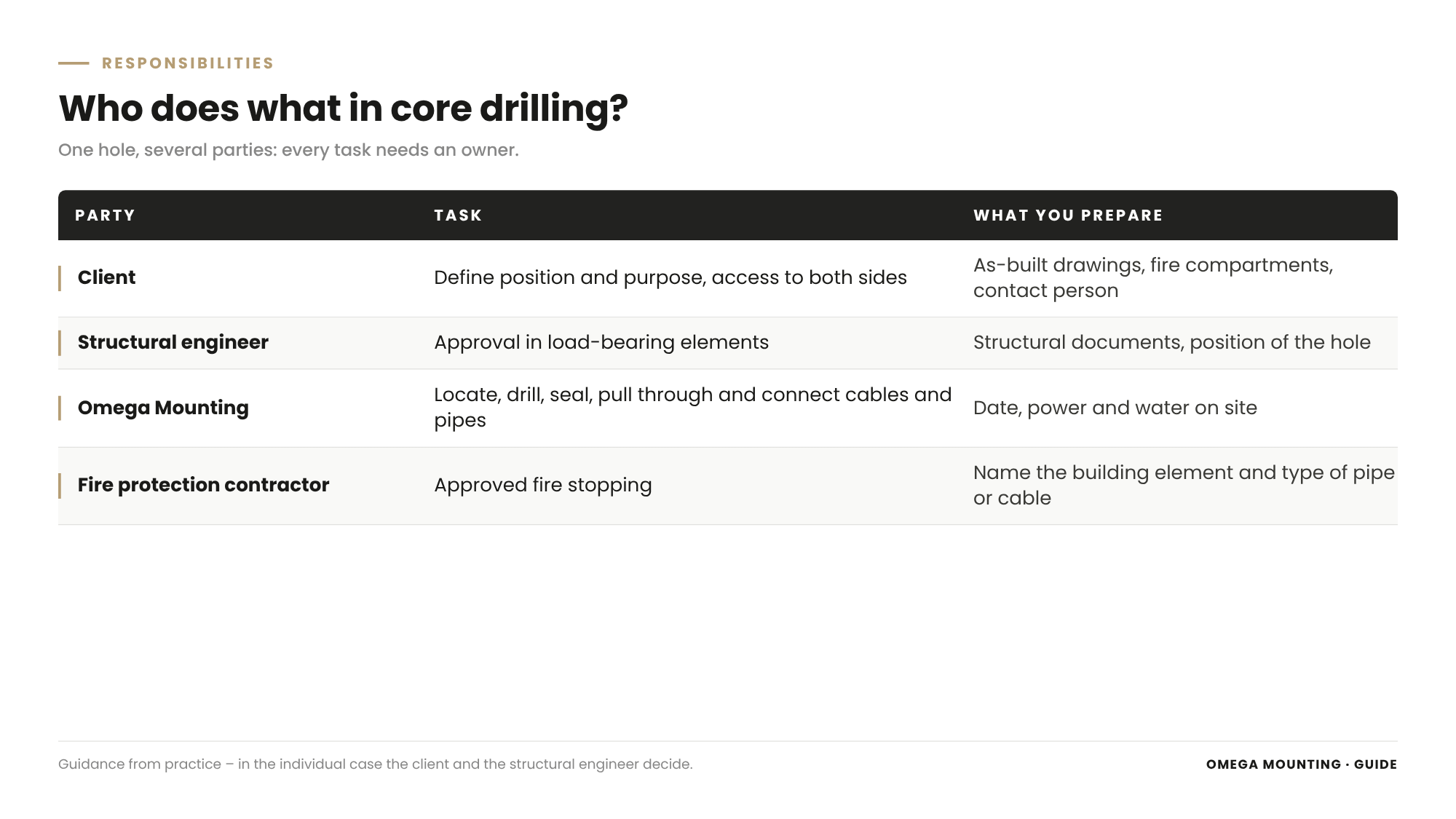
More parties are involved in a core hole than you might think. Clear responsibilities prevent a situation where, in the end, nobody is responsible for the approval or the fire stopping. This overview is practical guidance, not legal advice.
Client
You decide where and why holes are drilled. You provide as-built drawings, identify load-bearing components and fire compartments and clarify who gives the structural approval. You provide access to both sides of the hole and arrange isolation of services according to your procedure.
Structural engineer
The structural engineer decides whether a load-bearing component can take the hole and approves position, size and any compensating measures. Without this approval we do not drill in load-bearing components.
Omega Mounting
We locate, drill with our own equipment, cordon off, dispose of the core and slurry, fit wall sleeves, seal against water and gas and pull cables and pipes through. Our own electricians isolate cables at the drilling point and connect the cables pulled through. We coordinate the dates with the other parties.
Fire protection contractor
Fire stopping in fire walls and fire-rated slabs is installed by an approved specialist contractor.
Core drilling: what it means for your planning
Core drilling is easy to plan – if it enters the planning early enough. Four points make the difference.
Decide early instead of searching late
The earlier the position is fixed, the easier approval and locating become. In new buildings, penetrations can be provided for in the formwork. In existing buildings, locating and approval are needed. If you only start looking on installation day for where the cables should go through, you lose time.
Spare capacity in the cross-section
A slightly larger hole costs hardly more than a tight one. A second hole later costs a new visit, new locating and possibly a new approval. Allow space for extensions.
Both sides accessible
We need access to both sides of the hole – for setting out, cordoning off and sealing. If there is a store, a cold room or another tenant's area behind the wall, clarify access in advance.
Clarify interfaces in advance
Who approves the structure, who installs the fire stopping, who connects? If these questions are answered before the date, the core drilling runs through in one go. How to think about installation routes, openings and slab loads early is described in our guide Planning a move-in.
Typical mistakes in core drilling
- Drilling without locating. Hitting services or cutting prestressing steel is expensive and dangerous.
- Drilling into load-bearing components without approval. Whether a component can take the hole is not for the drilling service to decide.
- Forgetting the far side. Falling cores, water and slurry in the next room.
- Drilling too tight. No room for seal, insulation or later cables.
- No fall on the outside. Water runs along the line into the building.
- Leaving fire protection until later. The fire stopping does not fit the hole, and the hole has to be redrilled.
- Not cleaning the drill hole. Anchors in a dusty hole do not reach their holding force.
The mistake behind the mistakes
Almost all of these mistakes have the same cause: the core hole is treated as a minor detail and only planned on installation day. If you plan it as part of the installation, with approval, locating and sealing, you avoid most of them.
Core drilling in the Rhine-Main region: how we do it
From Rodgau we quickly reach Frankfurt, Offenbach, Darmstadt, Hanau, Aschaffenburg and Wiesbaden. We usually drill core holes as part of an installation – for crane systems, at loading docks, when setting up machines and when connecting plant to its utilities.
Before the date, we clarify position, purpose and approvals with you. On the day, we locate, cordon off both sides, drill and dispose of the core and slurry. Then we fit wall sleeves, seal and pull cables or pipes through. Where fire stopping is needed, we coordinate with the specialist contractor. How else we work is on our page on Industrial installation.
On our sites nobody works alone – not even when drilling. One drills, one secures the far side. That way there is always someone on the other side of the wall who sees what happens.
Project examples
Three jobs from our project diary show where drilling plays a role in installation.
Vehicle restraint systems near Leipzig: many loading docks, one system
In a logistics centre near Leipzig, we installed a large series of vehicle restraint systems. Each loading dock had a restraint arm, hydraulic power unit, signal lights, control panel and control cabinet – and the cable routes between them. The equipment outside had to be connected to the cabinets inside – mechanically and electrically, both from one contractor. That is exactly what we drill core holes through the outer wall for: planned properly once, in the same place at every dock, with room for all cables.
Pillar jib cranes: the anchorage decides
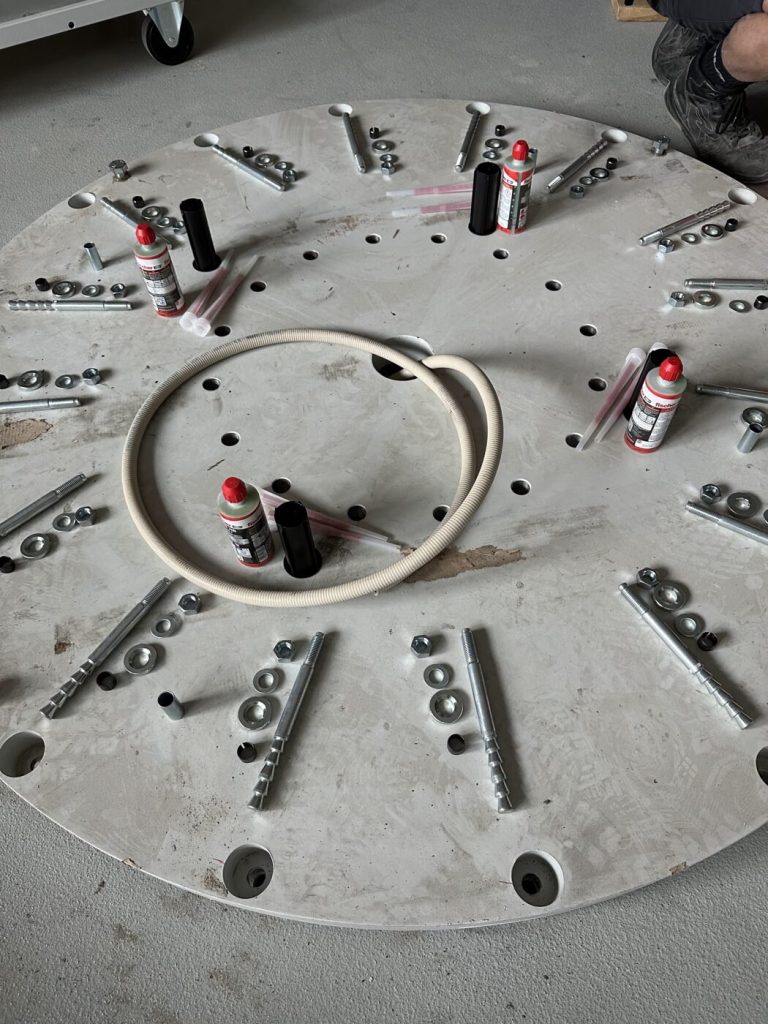
In a workshop in a nuclear facility, we installed two pillar jib cranes. The pillars stand on their own base plates, anchored with bonded anchors in the hall floor. There, a hammer drill was enough for the bolt pattern. The holes were cleaned, the anchor sleeves set with bonding mortar and the base plate fine-adjusted with shims. For larger anchors, densely reinforced slabs or foundation recesses, we use core drilling for the same task.
Impact protection at Frankfurt Airport: annular cutter in steel
At a loading facility at Frankfurt Airport, we installed custom-made impact protection from thick-walled square tube. Tubes and installation were drilled on site with the magnetic drill and annular cutter, hole by hole, adapted to the existing structure. Then came thread cutting, bolting, welding in the corner ramps and painting.
Do you have a core hole coming up?
Send us a short note on what needs to go through which component – we will tell you which information and approvals we need. Get in touch now.
What this means for your role
Project and site managers: Before the drilling date, clarify who gives the structural approval and who installs the fire stopping. Make sure both sides of the hole are accessible and can be cordoned off.
Planners: Fix penetrations early – with spare capacity in the cross-section, a fall to the outside and distance from doors, racking and traffic routes. In new buildings, many holes can be replaced by recesses.
Maintenance managers: Record which penetration carries which line. For extensions, that saves you the search and sometimes a new hole.
Buyers: Compare quotes not only by price per hole. Ask whether locating, cordoning off, slurry disposal, wall sleeve and sealing are included.
Plant engineers: Report services near the drilling point that are not on any drawing. Your knowledge of the existing building is often more accurate than any drawing.
Core drilling approval: template on request
For your next drilling date, we have put together the core drilling approval form. On one page it covers position and purpose of the hole, the approvals needed, locating and services, wet or dry execution and completion with sealing and documentation. You fill it in before the date, and we start without follow-up questions. Request the template via our contact form – keyword “Core drilling approval”.
Why Omega Mounting?
With over twenty years of experience in installation, move-in and maintenance, we know that core drilling is rarely the main job, but often the point where an installation gets stuck. That is why we do it ourselves – with our own equipment, with locating, with both sides cordoned off and with proper sealing. We pull cables and pipes through at the same time, and our electricians connect them. For you, that means one point of contact from the hole to the finished installation. Talk to us about your project – get in touch.
Conclusion
A core hole is drilled quickly, but it is only good if everything around it is right. Beforehand, position, approval and locating must be settled. During drilling, both sides must be cordoned off and water or dust collected. Afterwards, the penetration must be sealed – against water and gas by us, against fire by the specialist contractor.
Whether anchors for the crane system, cables from the vehicle restraint system to the control cabinet or pipes between two rooms: if you plan the core hole as part of the installation, you save the second visit. If you have a penetration coming up, get in touch with us.
Planning a move-in, installation or maintenance in the Rhine-Main region?
Tell us briefly what you need – we'll come back with an honest assessment.
Free, no-obligation callback
You may also be interested in these guides

About the author
Tobias Schott
Managing director of Omega Mounting GmbH, Rodgau · more than 20 years of hands-on experience in installation and maintenance
A trained mechatronics technician, working in maintenance, servicing and industrial installation since 2004 – first alongside his father, and with Omega Mounting since 2012: from overhead conveyors in Frankfurt to the crane system in a new-build hall. He plans and leads lifting operations as an appointed person (AP) in data centers and on industrial sites in the Rhine-Main region, trains and examines operators of cranes, mobile elevating work platforms and telehandlers, and is a qualified occupational safety specialist. On jobs abroad he is known as the “German Troubleshooter” – the person you call when a site gets stuck. He learned what quality means from his father, not from a manual: Made in Germany as a standard for his own work, not a label. That is why quality comes first at Omega Mounting – ahead of speed and price. He writes these guides from that practice: what works on our sites is in them – what exists only on paper is not.
Frequently asked questions
In non-load-bearing components, usually not. In load-bearing components it needs the structural engineer's approval, and in fire walls and fire-rated slabs an approved fire stopping system. Whether any further permit is needed is clarified by the building owner.
Core holes range from small holes for single cables to large openings for ventilation ducts and thick pipe bundles. What matters is not what the machine can manage but what the component can take. For load-bearing components, the structural engineer decides.
Technically, the diamond bit also cuts reinforcing steel. Whether a bar may be cut is decided by the structural engineer. That is why we locate first and clarify any hits before we continue drilling.
Fire stopping in fire walls and fire-rated slabs is installed by an approved specialist contractor. We agree the hole with them beforehand so that their fire stopping fits.
Wet drilling keeps the air cleaner and spares the bit, but needs a plan for the water. Where no water may flow, for example next to open equipment, we drill dry with extraction.
With a wall sleeve, an annular seal and a slight fall to the outside. Water running along the line then flows outside instead of into the building.
Yes. On steel structures, crane runways and loading systems we drill with a magnetic drill and annular cutter – directly on site, adapted to the existing structure.
Yes. From Rodgau we quickly reach the whole Rhine-Main region – Frankfurt, Offenbach, Darmstadt, Hanau, Aschaffenburg and Wiesbaden. For us, core drilling is usually part of an installation.
Tell us what needs to go through which component, where the hole should be and whether drawings exist. We will come back with our questions on approval and locating and an assessment. Go to the contact form.
 English
 German