
- Guide – Health & Safety
Planning site power: distribution boards, protection and lighting for the installation site
By Tobias Schott · 24-minute read · Updated October 2026
If you want to plan site power, you have to answer four questions before the first installation day. Where does the power come from, how much is needed at the same time, how far does it have to be transported and who inspects and takes responsibility for the system? Everything else follows from that.
The crane is in position, the team has been briefed – and the core drill trips the fuse on its first start. Or the client's supply provides a single 16-amp socket for three trades. Or the hall is still a shell and pitch dark from 4 pm. If you have to plan site power, you know these situations. On many sites, power and lighting are taken as “provided by others” – until it turns out they are not.
For you as site manager, buyer or project manager, this is a question of deadlines and safety. Without a supply the installation stops; without lighting, certain work may not start. And without inspected distribution boards and RCD protection, your team works on an installation that does not protect them if a fault occurs.
This guide explains how a site power supply is structured and which protective devices and inspections the regulations require. It shows how to estimate capacity and cable sizes, when a generator makes more sense than a mains connection and what the workplace rule requires for site lighting. It builds on our guide to choosing an installation contractor in the Rhine-Main region. Power and lighting are among the things we supply from Rodgau together with the installation.
Key points at a glance
- Site power starts at the supply point: either a temporary connection provided by the network operator or a generator – both need lead time, the mains connection usually much more.
- Every socket on a construction site must be supplied via a residual current device (RCD); for sockets up to 32 amps, the rated residual current must not exceed 30 milliamps.
- A generator is not sized by the sum of the rating plates but by the loads running at the same time, including starting currents, heating and lighting.
- The cable size depends on how many loads hang off the cable and how long the route is – on long runs, voltage drop is the real problem.
- Site distribution boards, cables and generators are electrical equipment subject to inspection under DGUV Regulation 3; on construction sites, short inspection intervals apply, plus a function test of the RCDs every working day.
- Lighting is health and safety: the German Technical Rule for Workplaces grades minimum illuminance by visual task, and glare, shadows and the stability of the lighting towers are part of the planning.
- Site power belongs on the client's site layout plan – and if you get power, lighting and installation from one contractor, you save interfaces.
What is site power?

Site power is the temporary electrical supply of a construction or installation site, running from the supply point via site distribution boards and portable cables to the end loads. It is installed, protected and inspected to the special requirements for construction sites. The term therefore covers not just the connection but the whole chain down to the power tool.
This chain consists of a few clearly distinct levels: the supply point is either the network operator's temporary connection or a generator. From the supply point, the main cable runs to the main site distribution board, the first site distribution board with meter or main isolator and the central protective devices. From there, area or floor cables run to sub-distribution boards, which stand close to the workplaces. Only from the sub-distribution boards do the equipment cables run to the loads.
Legally, site power is an electrical installation within the meaning of DGUV Regulation 3 “Electrical installations and equipment”. It is installed to the recognised rules of electrical engineering, for construction sites specifically to DIN VDE 0100-704. DGUV Information 203-006 “Selection and operation of electrical installations and equipment on construction and installation sites” turns this into practical rules for site managers and fitters. It is the source this guide is based on. In practice: if a tender or an old safety concept still refers to the technical rule TRBS 2131 (electrical hazards), that points to outdated documents. It has been withdrawn; what counts are the accident prevention regulation and the electrical engineering standards.
Planning site power: mains connection or generator?
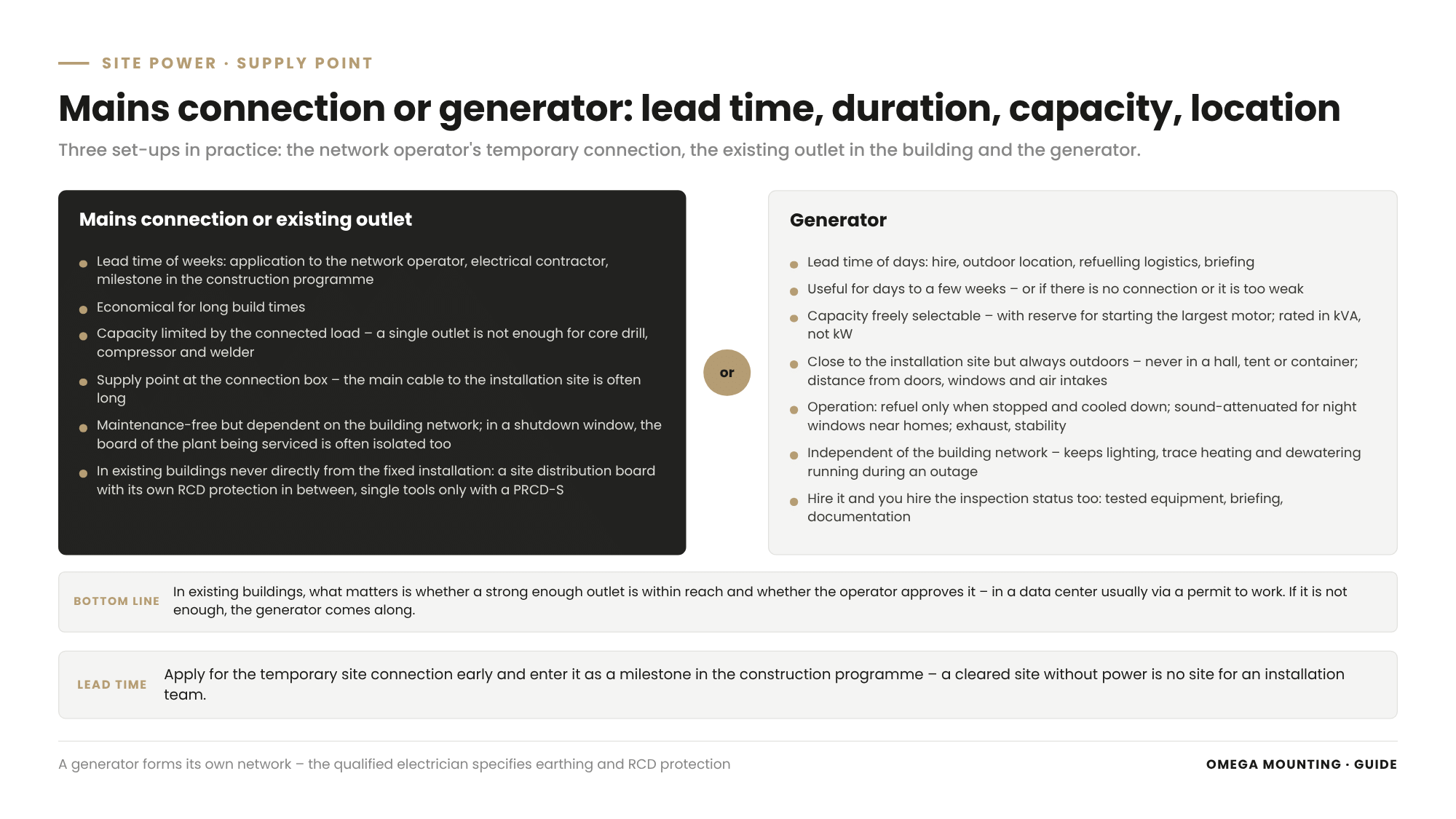
The choice between a temporary connection and a generator depends on lead time, duration of the works, power demand and location. It has to be made early, because a mains connection takes weeks, a generator only days. In practice, three set-ups are typical.
Set-up 1: the network operator's temporary connection
For new builds and longer projects, the temporary connection is the norm. The network operator provides a connection box with fixed-terminated cables and a meter, and a registered electrical installation company connects the main site distribution board. Apply for the temporary site connection early, enter it as a milestone in the construction programme and state the capacity realistically. The position of the connection box determines how long the main cable to the installation site will be. For an installation team, a cleared site without power is not a site.
Set-up 2: the existing supply in the building
For installations in production halls, logistics centres or data centers, there is usually an existing installation. The question is whether a strong enough outlet is within reach and whether the operator approves its use. In a data center where work takes place in a live environment, this usually goes through a permit to work for the plant areas (grey space). In our experience, a single 16-amp outlet is not enough for a team with a core drill, compressor and welder.
On top of this comes a rule that the BG BAU/BAuA module “Site set-up – utility supply” stresses explicitly. Supplying a construction or installation site directly from an existing fixed installation is not permitted. Site power needs a dedicated supply point – that is, a site distribution board with its own RCD protection between the building network and the tool. For single tools at existing sockets, a portable residual current device (PRCD-S) allows safe use. The hall socket on its own is not site power.
Set-up 3: the generator
A generator is the right choice if no connection is available or it is too weak, or if the installation site is too far from the nearest distribution board. It also keeps safety-relevant loads such as lighting, trace heating or dewatering running independently of the building network. It needs an outdoor location, refuelling logistics and a deliberately established protective measure. A generator forms its own network, whose earthing and RCD protection must be specified by the qualified electrician.
| Criterion | Mains connection / existing outlet | Generator |
|---|---|---|
| Lead time | Weeks (application, network operator, electrical contractor). | Days (hire, location, briefing). |
| Duration of the works | Economical for long build times. | Useful for days to a few weeks. |
| Service | Limited by the connected load. | Freely selectable, with reserve for starting currents. |
| Installation site | At the connection box, main cable often long. | Close to the installation site, but always outdoors. |
| Operation | Maintenance-free. | Refuelling, noise, exhaust fumes, stability. |
| Availability | Dependent on the building network. | Independent; a building network outage has no effect. |
Important in existing buildings: if the installation runs in a shutdown window, the distribution board of the plant being serviced is often isolated too. Our guide on the topic – Maintenance during live operations – explains why the installation team's supply is therefore planned independently of the plant being serviced.
Which distribution boards and protective devices do the regulations require?
For construction sites, the regulations require site distribution boards to the product standard DIN EN 61439-4, an RCD for every socket circuit and rugged cables approved for harsh use. These three requirements are the minimum. A distribution board from a DIY store or a multi-socket adapter from the office does not meet them.
The site distribution board
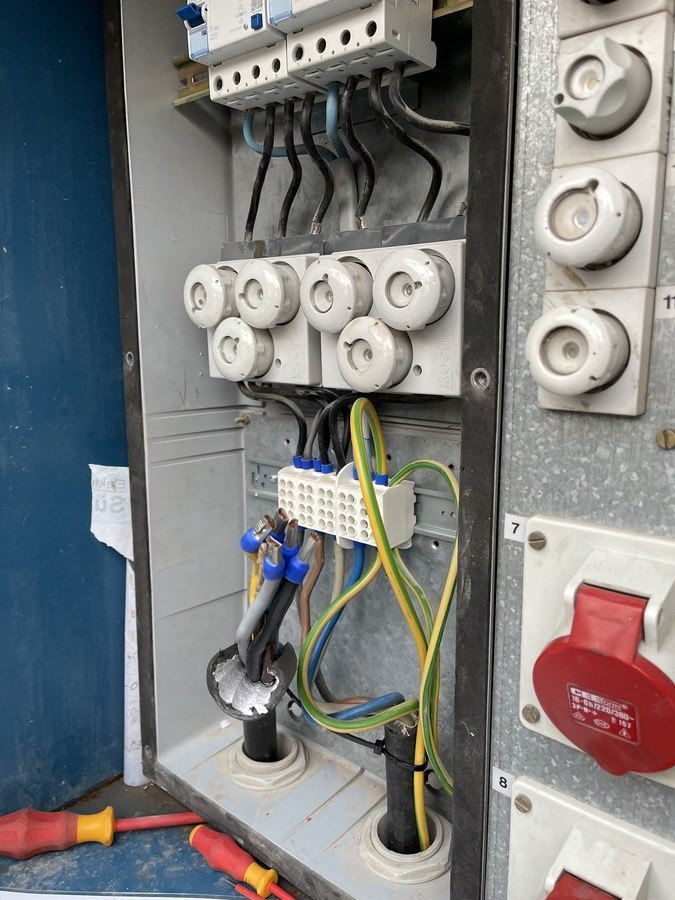
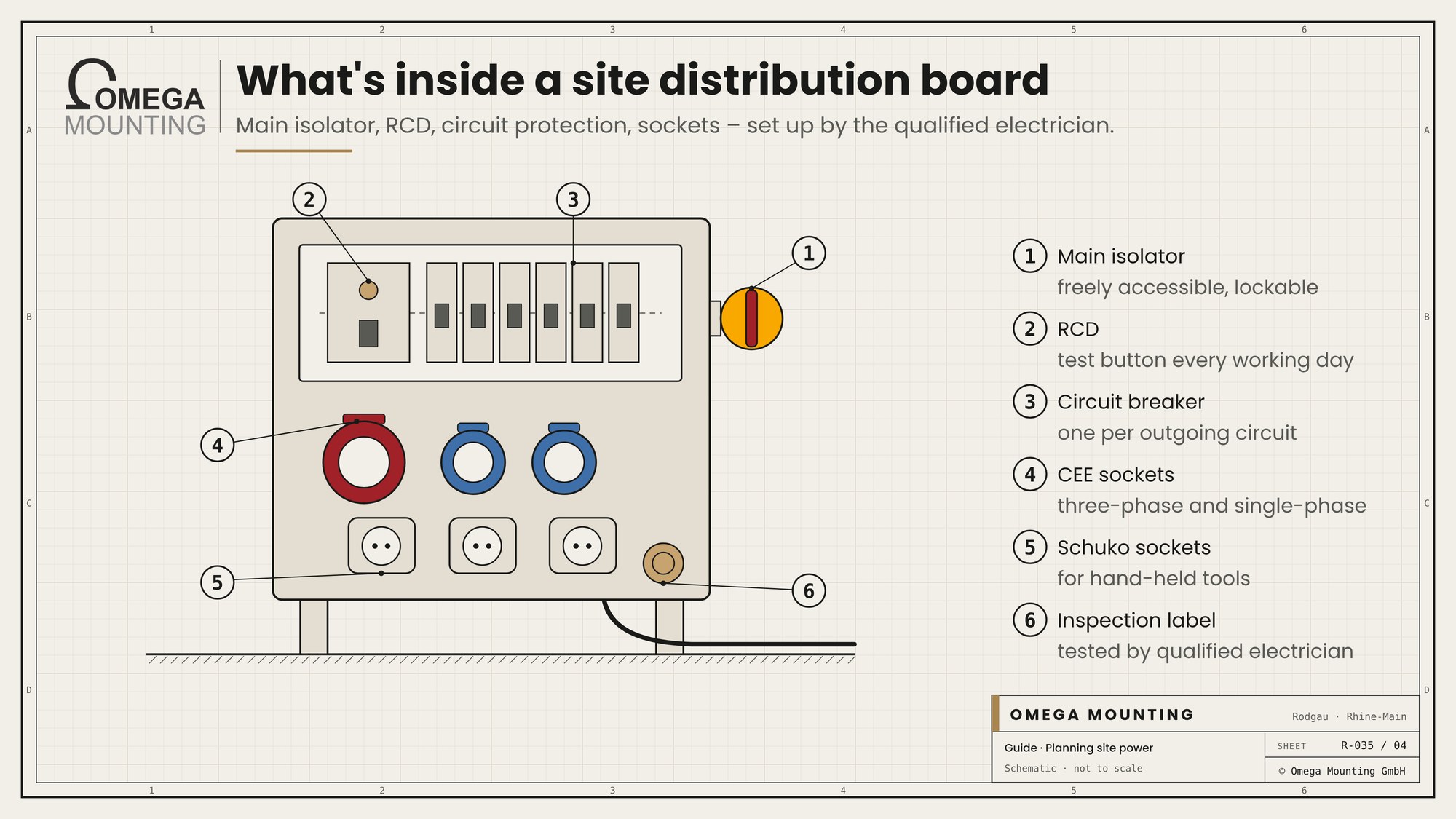
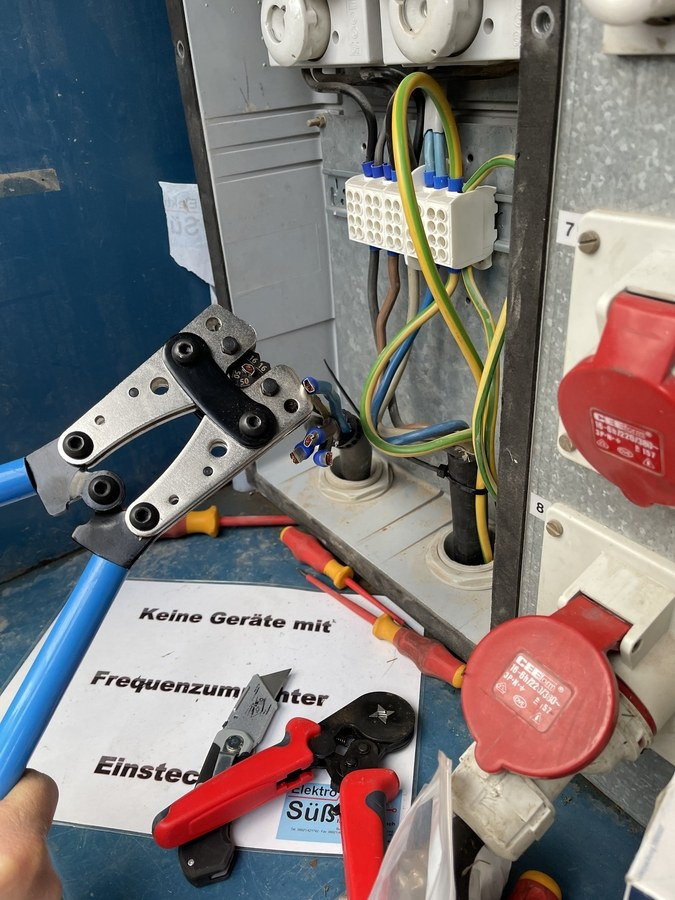
A site distribution board is an enclosed, impact- and splash-proof housing with main isolator, circuit breakers (the overload and short-circuit protection for each cable), RCDs and CEE and Schuko outlets. CEE connectors (IEC 60309) are the colour-coded industrial connectors – blue for 230 volts, red for 400-volt three-phase. They lock, seal and are designed for higher currents.
RCD protection
The residual current device – RCD for short, in German usage often called an FI switch – compares the current flowing out and back. It switches off as soon as part of it leaks away through a fault, for example through a person. On construction sites, sockets up to and including 32 amps must be supplied via an RCD with a rated residual current of no more than 30 milliamps (30 mA). For sockets above 32 amps, an RCD of up to 500 milliamps is permitted, which then provides fire protection, not personal protection.
Two practical pitfalls belong in every plan. First, several large loads on one RCD trip it together because their operational leakage currents add up. That is why outgoing circuits are spread over several RCDs. Second, frequency inverters in compressors, pumps or drives can produce smooth DC fault currents that a standard type A RCD does not detect. A type B RCD, sensitive to all current types, is then required. The qualified electrician clarifies both – provided they know which equipment will run.
An RCD also only protects if the earthing is right. It is agreed with the network operator; an earth rod next to the connection cabinet is usual. Small site distribution boards in particular are often not earthed properly in practice. One more reason why only the qualified electrician makes the connection.
The lines
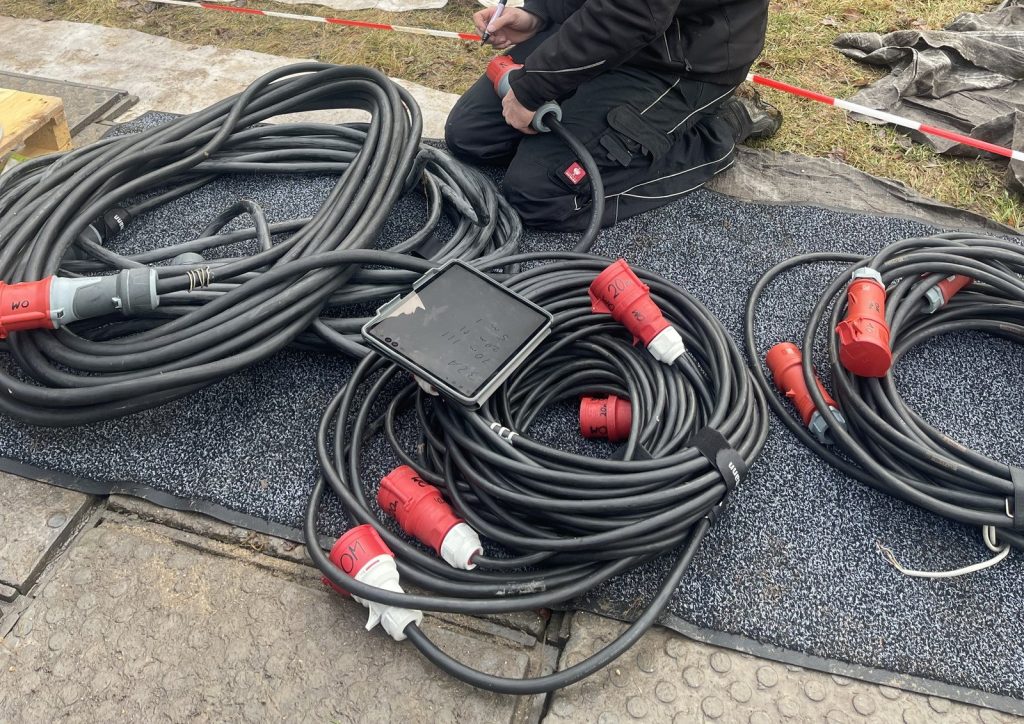
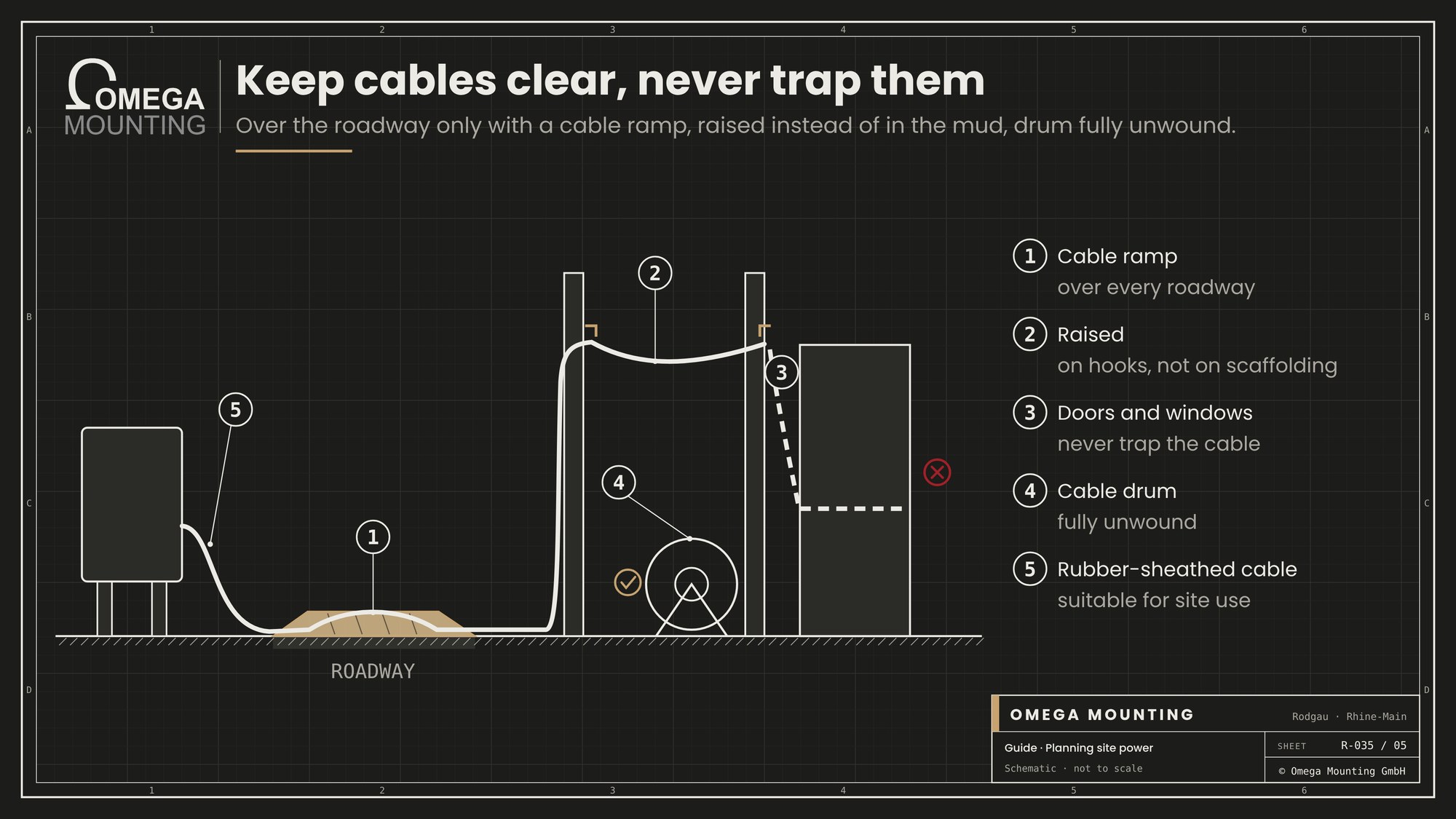
On construction sites, heavy rubber-sheathed cables belong on the ground – approved for mechanical stress, wet conditions and outdoor use. Cable drums are fully unwound, because a coiled cable under load turns into a heating coil. Damaged cables are tagged and taken out of use, not patched.
One role is responsible for all of this: Qualified electrician. Only they may install, modify and inspect site power installations. If whoever sets up the boards is not allowed to connect them, you need a second trade. That is a time waster we avoid, because our fitters combine mechanical and electrical work.
Planning site power by demand: how much power does an installation site need?

The power needed comes from the loads running at the same time, plus the starting currents of motors, heating and lighting. Not from adding up all the rating plates. If you just add up, you choose a generator that is too big and pay for nothing. If you forget starting currents, you choose one that is too small and are left in the dark at the first compressor start.
kVA and kW: two figures, one generator
Generators are rated in kilovolt-amperes (kVA), loads in kilowatts (kW). kVA is the apparent power, including the reactive power of motors and transformers. kW is the real power that does the work. At a typical power factor of 0.8, a 110 kVA generator delivers around 88 kW, about 158 amps on the 400-volt network.
Simultaneity
What matters is what runs at the same moment. An installation team may run a core drill, angle grinder and lighting in parallel, but not welder, compressor and heating at full load all at once.
Starting currents
Three-phase motors draw a multiple of their rated current when starting. Compressors, pumps and core drills are therefore assessed by their starting behaviour. For generators, the rule is: better one size bigger, so that the start of the largest motor does not make the voltage collapse.
The voltage question
Above a certain equipment size, the voltage decides. Core drills, large compressors, site heaters and many welders need 400-volt three-phase. In our practice, generators from 7.3 kVA have a 400-volt CEE outlet. Below that, it is about tools, lights and chargers.
A sound demand calculation therefore follows this order:
- List all loads with rated power, voltage and number of phases, together with their usage window. Take the connected loads of large equipment from the data sheets, and the demand of office and welfare containers from their occupancy.
- Identify the largest motor and allow for its start.
- Add heating and lighting as continuous loads and plan in a reserve.
- Protect circuits separately and decide whether consumption is metered separately. That is common on sites with several companies, so that each subcontractor pays their share. Cranes and other loads that must keep running during a fault get their own supply cable with a separate set of main fuses.
- Agree the result with the supplier's qualified electrician.
How are cable sizes and cable routes planned correctly?
The cable size does not depend on what hangs at the end of the cable but on how much still comes after it and how long the route is. The main cable from the supply point to the main site distribution board carries the whole site current, the equipment cable at the end only that of one tool. Cable size and connectors are graded accordingly.
The four levels in practice
In our practice, grading by the rated current of the CEE connectors has proven itself:
- 125 amps for the main cable from the large generator or connection to the main distribution board.
- 63 amps for area and floor cables to sub-distribution boards.
- 32 amps for individual powerful tools such as a core drill or compressor.
- 16 amps for the last connection to the tool.
Each level has its own cable size and its own protection in the distribution board upstream.
Voltage drop
Voltage is lost over long routes – the more so, the smaller the cable size and the higher the current. Voltage drop is the difference between the voltage at the distribution board and at the tool. It makes motors at the end of a cable that is too thin run hot and sends frequency inverters into fault. From about 100 metres of route, the cable size becomes the decisive factor. That is why the distance from the generator location or the connection to the last work point is a mandatory item in every site power enquiry.
Cable routing
Cable routes are planned, not just laid. In practice, this means:
- Route cables away from traffic routes, protect crossings with cable ramps and edges and door sills with edge protection.
- Place connectors in dry spots and document routes so that following trades do not damage them.
During a move-in, the transport route of the load and the cable routes cross. Our guide on the sequence of the move-in day shows why power and lighting are therefore already on the site plan in the preparation week. Not only once the mobile crane is standing on the crane pad.
What belongs on the site layout plan for site power?

The site layout plan shows the supply point, connection cabinet, cable routing, sub-distribution boards, outlets and the generator location. To scale and marked, so that every trade knows where to get power and where there are cables that nobody may drive over.
The baua: Praxis guide “Planning the site set-up safely and economically” counts site power among the services the client settles before awarding contracts. The client decides who installs and maintains the connection and lets others share it. They assign the service to a lot and document the split in the scope of works. Utility connections are shared facilities that the health and safety coordinator under the Construction Site Ordinance has planned at a higher level. In practice: check at the site visit which connections actually exist. And clarify who is responsible for installing and getting approval for the connection – additional demand is reported before the first compressor starts.
Protecting services
Buried cables are marked, overground ones are marked and protected against being driven over. Either buried, in protective ducts under the roadway or on a cable bridge, which according to the module should leave 4.5 metres of headroom. Inspection chambers stay clear, and the network operator's contact details are kept ready for emergencies. In flood areas, connection cabinets are raised, and overground cables are secured against theft at night.
Which inspections are required for site power installations?
Site power installations and all equipment run on them are work equipment subject to inspection. They must be inspected before first use, after modifications and at regular intervals by a qualified electrician or under their supervision. The legal basis is the German Industrial Safety Ordinance (BetrSichV), which requires inspections based on the risk assessment, and DGUV Regulation 3, whose implementation notes give guide values for inspection intervals. This is supplemented by operating instructions for handling site distribution boards and the generator, and a briefing for users. On data center sites, this often takes the form of a toolbox talk at the start of the shift.
Inspection intervals on construction sites
For portable electrical equipment – extension cables, equipment cords and power tools – the implementation notes of the accident prevention regulation give a guide value of three months on construction sites. The BAuA module on utility supply gives six months as a general guide value for installations and equipment and refers to the regulations for shorter intervals. The employer sets the specific intervals in the risk assessment. RCDs in non-stationary installations must be checked for function every working day by pressing the test button. The user may and should do this themselves. The measurement test, for example of tripping time and tripping current, remains the job of the qualified electrician.
What is checked
The inspection covers a visual check, protective conductor test, insulation measurement, function test of the protective devices and documentation with an inspection label or record. The generator is work equipment like any other. Under the German technical rule for inspecting work equipment, it is inspected before use each time it is set up at a new location. At changing locations, proof can be provided by the label or a copy of the inspection record. The label only shows that it was inspected, however, not that nothing has been damaged since. For you as site manager, this means: every distribution board, every cable and the generator carry a valid inspection label. You may demand that from every trade.
Hire the inspection status instead of managing it
If you hire site power – distribution boards, cables, generator – you hire the inspection status with it. The hire company supplies tested equipment, gives a briefing and documents the condition. An advantage over your own stock, where inspection intervals get lost in the routine.
How much light does a construction site need under ASR A3.4?
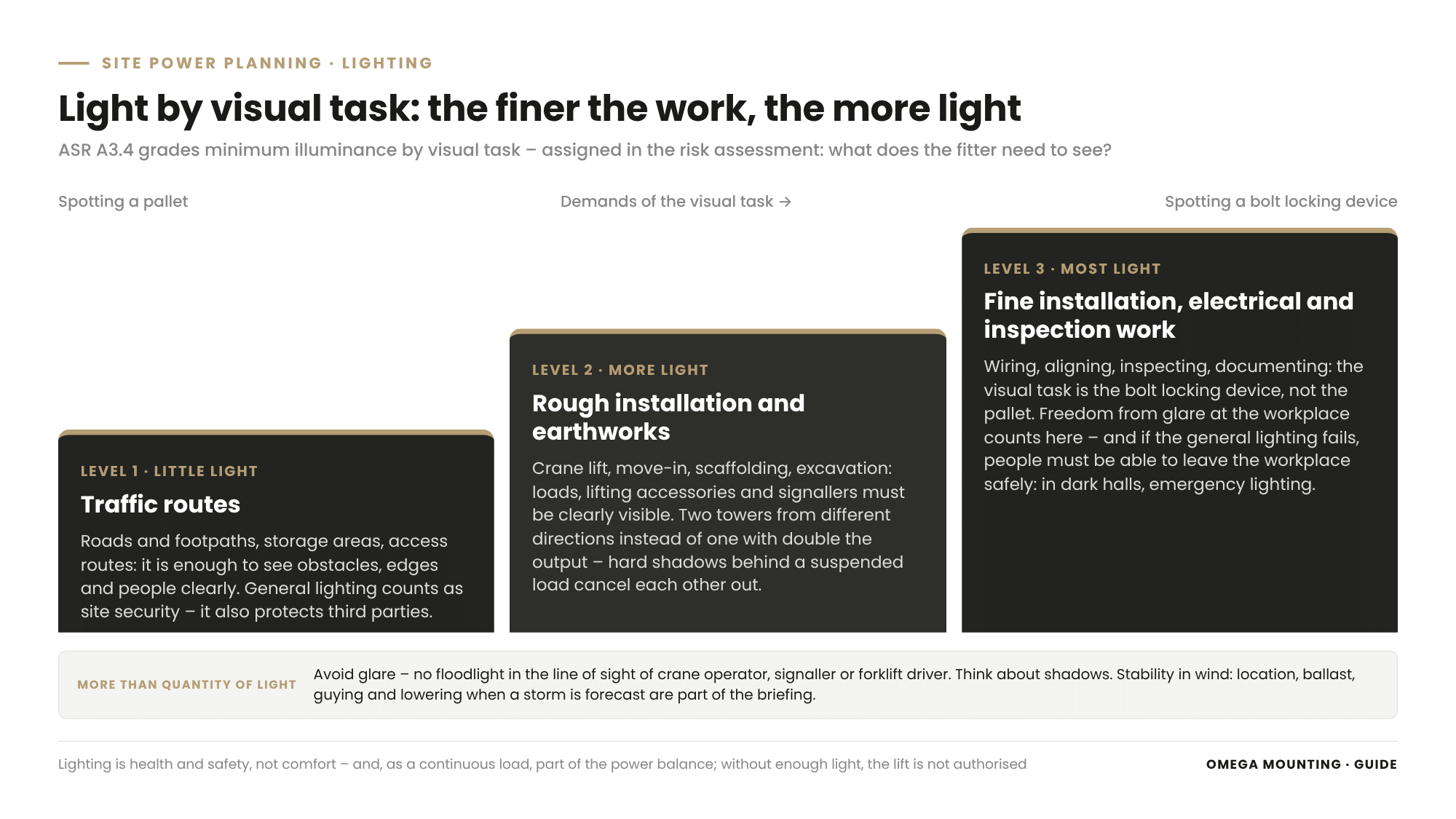
A construction site needs as much light as the visual task requires. The German Technical Rule for Workplaces ASR A3.4 “Lighting” grades minimum illuminance exactly by this. Traffic routes need little, rough installation and earthworks need more, fine installation, electrical and inspection work needs the most. Lighting is therefore health and safety, not comfort. In the winter half of the year, it decides how many working hours a day has at all.
Illuminance
Illuminance is the quantity of light that reaches a surface, measured in lux. The rule gives minimum values for each activity, which can be assigned via the visual task in the risk assessment. What does the fitter need to see – a pallet or a bolt locking device? The rule also requires that people can leave the workplace safely if the general lighting fails. In dark halls, that means emergency lighting.
Glare, shadows, stability
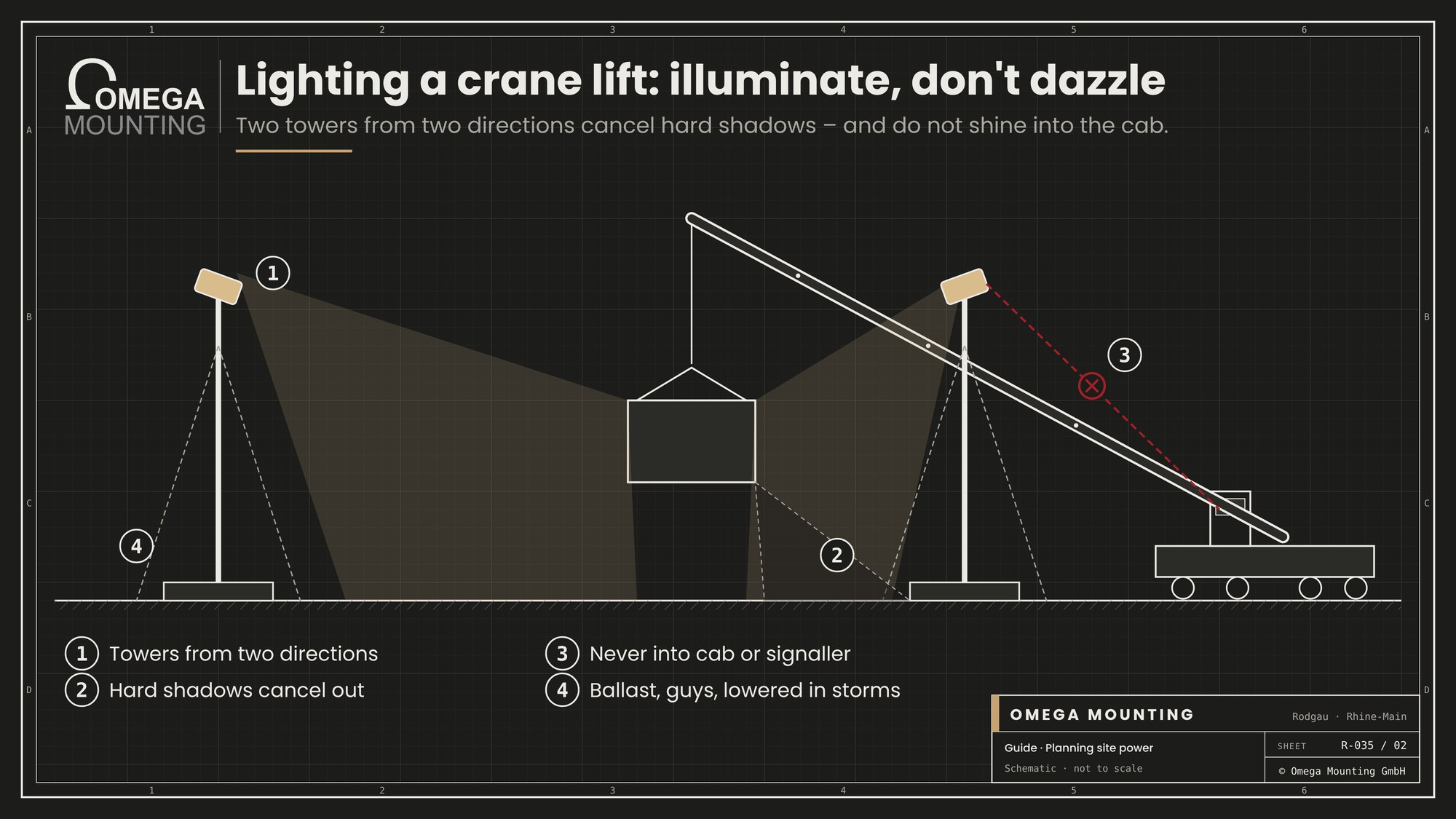
In practice, three things matter more than the sheer quantity of light:
- Avoid glare: A floodlight shining into the line of sight of the crane operator, signaller or forklift driver is more dangerous than too little light. Towers light up the work area, not people's eyes.
- Think about shadows: Two lighting towers from different directions are better than one with double the output, because hard shadows behind a suspended load cancel each other out.
- Stability in wind: Lighting towers catch the wind. Location, ballast, guying and lowering when a storm is forecast are part of the briefing.
Light as site security
The BG BAU/BAuA module “Site set-up – site security” counts the general site lighting among the safety measures – it also protects third parties. Pedestrian tunnels at the site must be lit at night, and for civil engineering work in built-up areas, the street lighting is kept in operation. If you use traffic areas, you secure them according to the traffic authority order with yellow warning lights – red only for a full closure. For a move-in that reaches beyond the factory fence, the lighting for the crane pad and exclusion zone goes on the same plan as the lighting in the hall.
Lighting belongs in the power balance
Lighting runs as long as work goes on and is therefore a continuous load in the sizing of the generator or connection. LED floodlights need less than halogen lamps, but several towers on long routes add up. In night and weekend windows – such as a maintenance window in a data center – lighting is also part of the permission to work. Without enough light, the lift is not authorised.
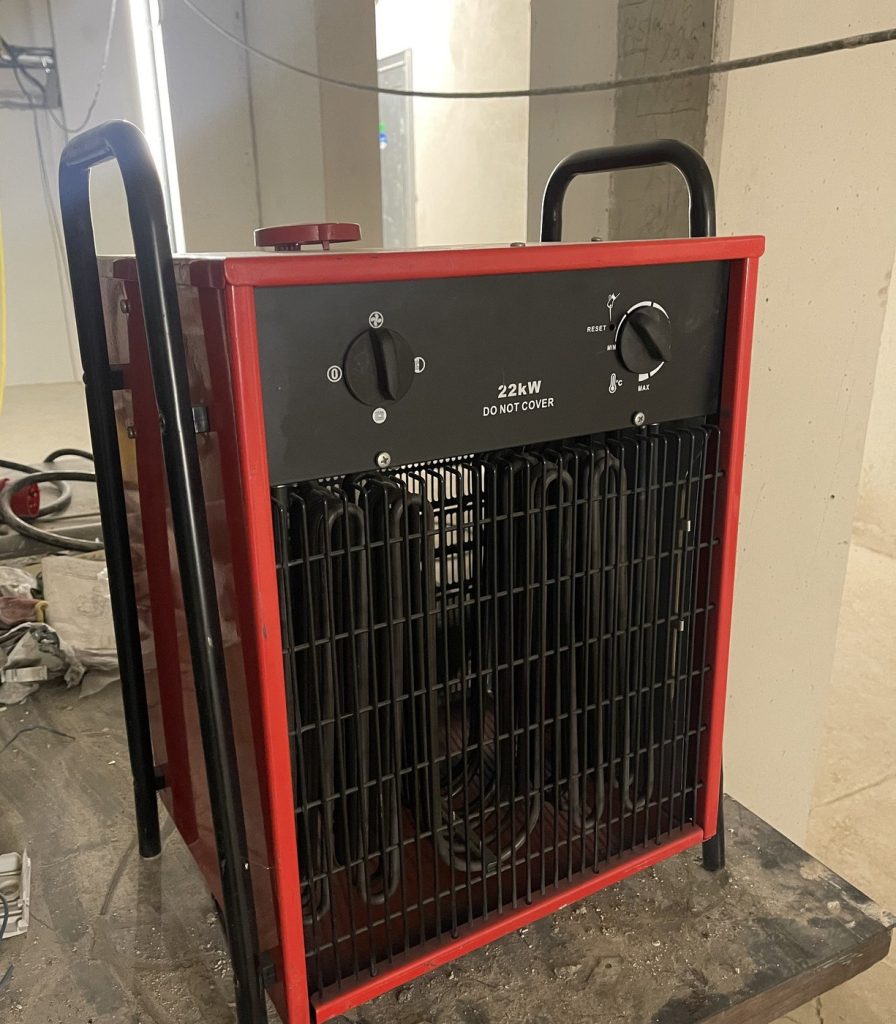
What do you need to consider with site heating?
Site heating often decides the size of the generator more than the machines themselves, because an electric site heater is a continuous load with high output. A 22-kilowatt electric heater draws around 32 amps at 400 volts and so takes up a complete 32-amp outlet. That is roughly half of what a 48 kVA generator can usefully deliver.
There are three heating options: Electric heaters are clean and quiet but need three-phase power and plenty of capacity. Diesel space heaters deliver high heat output without needing power but require exhaust routing. Gas heaters are independent of the power supply but require ventilation and safe handling of gas cylinders. Which option fits must be decided before the generator is ordered. For winter installations also because grouts and sealants have minimum application temperatures.
Which safety rules apply around the generator?

Around a generator, three rules apply that are not negotiable: no combustion generator in enclosed spaces, planned cable routes and refuelling only when stopped.
Rule 1 – location outdoors: Combustion generators never belong in enclosed spaces, tents, containers or enclosures. Carbon monoxide is odourless and can kill within a short time. The location is chosen by wind direction, with distance from doors, windows and the intakes of ventilation systems. In a data center, this point is especially important because outside air is drawn in there.
Rule 2 – secure the danger zone: The area around the generator and main distribution board is a danger zone: fenced off, signed, with a fire extinguisher and named in the site emergency plan as an isolation point. The cables from there follow the planned cable routes. A crushed cable is a short circuit with personal injury.
Rule 3 – refuel only when stopped: Refuelling only when the generator is stopped and cooled down, with a drip tray and away from welding and cutting areas. For longer construction phases, refuelling logistics are agreed in writing before the hire starts: consumption, refuelling interval, responsibility.
Then there is noise: a sound-attenuated generator is a must for night windows near homes. Technically, a site generator is a small relative of the generators whose maintenance we cover in our guide Standby generator maintenance, repair and replacement in detail.
Project examples
In our practice, the topic of site power grew out of a bottleneck of our own. And out of a relief deployment that needed more infrastructure than some industrial sites. Both cases are documented in our project diary.
From our own bottleneck to a service
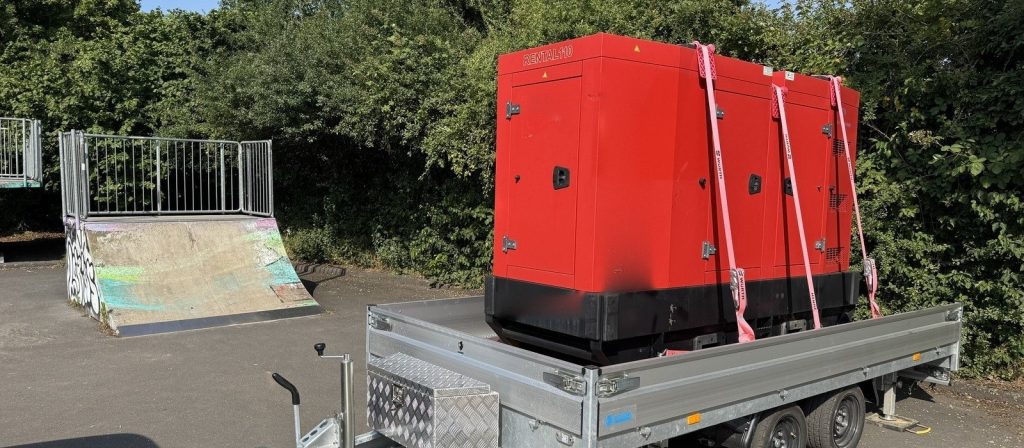
During a crane lift in a data center in the Rhine-Main region, we faced exactly the situation this guide describes. The existing supply was not enough for the equipment running in parallel. The solution lay within our own group of companies. It gave rise to our service for Site power and site lighting in the Rhine-Main region. Together with our sister company Eventwerk Rodgau, we now keep generators in five sizes from 2 to 110 kVA, with a 400-volt CEE outlet from 7.3 kVA. Plus lighting towers, site distribution boards, power cables from 16 to 125 amps, cable ramps and site heaters. The largest generator is sound-attenuated, rated for continuous operation and mounted on a trailer. We deliver and set up within around 40 kilometres of Rodgau. The difference from pure hire: our mechatronics technicians connect the distribution board, put it into operation and brief your team.
Almost a kilometre of cable for a relief camp
How far site power planning can go was shown by our deployment after the 2021 floods. For an aid organisation's camp in Rupperath, we set up the complete power supply for a relief camp on site. Almost a kilometre of cable was laid underground, with trenches dug by excavator and partly by hand. Ducts were installed, distribution boards fitted and everything connected to generators. The industrial kitchen, storage containers, office containers, storage tents and campers were supplied via 63-amp main cables and numerous branch circuits. With the same routine that goes into every site power plan for industrial clients today: plan routes, choose cable sizes by distance, boards close to the loads, generators outdoors.
Do you have an installation, move-in or maintenance job coming up where the power question is still open? Then get in touch with us. With a list of your equipment and a site plan, we can usually clarify in one phone call whether the existing supply is enough or a generator comes along.
What this means for your role
For buyers: Put site power and lighting into the scope of works as a separate item with a clear item description instead of hiding them under “by others”. The interface list names who provides the supply point, distribution boards, cables, inspection and refuelling. A provisional item for a generator is better than daywork after the event. Assign site power clearly to one lot, regulate shared use and separate metering, and ask for inspection records for distribution boards and cables.
For designers: Plan supply points where installation will take place later – not where the network operator finds it easiest to set the connection box. Enter outlets, cable routes and the generator location, marked, on the site layout plan. In existing buildings, reserve three-phase outlets near access openings and plant areas, because every future equipment replacement will need site power there again. Plan generator locations at a distance from air intakes.
For project managers and site managers: The project manager secures the lead time: application to the network operator, the operator's approval, generator hire, coordination with the health and safety coordinator on shared connections. The site manager secures operation. They check the inspection labels and the earthing of the distribution boards during site set-up. They set cable routes and cable ramps and include the test button, lighting towers and generator in the site rules.
For maintenance managers: Plan the installation team's supply independently of the plant being serviced, via a dedicated supply point instead of the hall socket. Check the inspection intervals of your own cables and distribution boards. Keep a known, inspected three-phase outlet ready for breakdown call-outs.
For occupational safety specialists and HSE coordinators: Include site power and lighting as a hazard in their own right in the risk assessment and the health and safety plan: RCD protection, earthing, cable routing, inspection status, generator location, illuminance and glare. During site walks, check the end of the chain – the multi-socket adapter behind the last CEE coupler is the most common defect.
For operations and plant managers: If outside contractors regularly carry out installations in your plant, an installation power standard pays off. Fixed three-phase outlets in known places, a rule for generators outdoors, one contact person for approvals.
Site power requirements list: template on request
Our site power requirements list is a one-page template that site managers and buyers use to record all the information needed to size a site power supply. Loads with voltage and simultaneity, the largest motor, heating and lighting demand, distances, type of supply and generator location. This clarifies the enquiry to the supplier in one go, and the risk assessment has its electrical part. Request the requirements list via our contact form – quoting “site power requirements list”.
Why Omega Mounting?
We are based in Rodgau near Frankfurt and reach industrial plants, logistics centres and data centers in Offenbach, Hanau, Dietzenbach, Seligenstadt and Aschaffenburg without an overnight stay. Site power is experience from our own projects. Our fitters combine mechanical and electrical work, and the infrastructure comes, together with Eventwerk Rodgau, from the same site as our workshop and vehicles. Standby power systems are part of our core business in industrial installation for energy and standby power. You can reach us by phone or WhatsApp – a message also gets through at the weekend if the supply fails and the installation cannot wait. In practice, this means a single point of contact for power, lighting and installation, one appointment instead of three, and fitters who don't just set the distribution board down but connect it and brief your team.
Conclusion
Planning site power means answering four questions early: where does the power come from, how much is needed at the same time, how far does it have to travel and who inspects and is responsible for the installation. If you settle these questions with a requirements list before the first installation day and anchor site power in the site layout plan, you avoid idle teams, tripped fuses and dark halls. And you meet the regulations' requirements for protection, inspection and lighting. Send us your equipment list, the site plan with distances and your deployment date. We'll come back with an honest assessment of whether the existing supply is enough and what we bring along.
Further reading: New in the knowledge base: Planning construction site lighting.
Planning a move-in, installation or maintenance in the Rhine-Main region?
Tell us briefly what you need – we'll come back with an honest assessment.
Free, no-obligation callback
You may also be interested in these guides

About the author
Tobias Schott
Managing director of Omega Mounting GmbH, Rodgau · more than 20 years of hands-on experience in installation and maintenance
A trained mechatronics technician, working in maintenance, servicing and industrial installation since 2004 – first alongside his father, and with Omega Mounting since 2012: from overhead conveyors in Frankfurt to the crane system in a new-build hall. He plans and leads lifting operations as an appointed person (AP) in data centers and on industrial sites in the Rhine-Main region, trains and examines operators of cranes, mobile elevating work platforms and telehandlers, and is a qualified occupational safety specialist. On jobs abroad he is known as the “German Troubleshooter” – the person you call when a site gets stuck. He learned what quality means from his father, not from a manual: Made in Germany as a standard for his own work, not a label. That is why quality comes first at Omega Mounting – ahead of speed and price. He writes these guides from that practice: what works on our sites is in them – what exists only on paper is not.
Frequently asked questions
It means deciding before the first day on site where the power comes from, which loads run at the same time and which voltage they need. Plus how long the cable routes are and who installs, inspects and operates the installation. The result is a requirements list from which the distribution boards, cables and, if needed, the generator are sized.
Sockets up to and including 32 amps must be supplied via an RCD with a rated residual current of no more than 30 milliamps. For sockets above 32 amps, an RCD of up to 500 milliamps is permitted. The basis is DGUV Information 203-006.
The German Industrial Safety Ordinance requires inspections before first use, after modifications and at regular intervals based on the risk assessment. The implementation notes to DGUV Regulation 3 give a guide value of three months for portable equipment on construction sites. RCDs in non-stationary installations must be checked every working day using the test button.
A generator is the better choice if no connection is available, the existing outlet is too weak or the installation site is too far from the distribution board. Also if the works only last days to a few weeks. For long build times, the mains connection is usually more economical – but it needs weeks of lead time.
The rule grades minimum illuminance by visual task. Traffic routes need the least light, rough installation and earthworks more, fine installation, electrical and inspection work the most. The values are in the annex to the rule and are assigned in the risk assessment. Freedom from glare and shadows and the stability of the lighting towers in wind are at least as important.
No. Combustion generators always belong outdoors, at a distance from doors, windows and the intakes of ventilation systems. Carbon monoxide is odourless and can kill within a short time in enclosed spaces. If power is needed inside the building, the main cable runs from the generator outdoors to the distribution board inside.
From Rodgau, we supply generators, distribution boards, cables and lighting towers together with Eventwerk Rodgau within a radius of around 40 kilometres. Offenbach, Frankfurt, Hanau, Dietzenbach, Seligenstadt and Aschaffenburg are covered as standard. Our fitters connect the distribution board and put it into operation. On request, we also supply on a pure hire basis.
Not directly. For construction and installation sites, the regulations require dedicated supply points: a site distribution board with its own RCD protection belongs between the building network and the tool. For single tools at an existing socket, a portable residual current device (PRCD-S) is the permitted solution.
In principle, the client. Before awarding contracts, the client decides who installs and maintains the connection, assigns the service to a lot and has shared connections planned via the health and safety coordinator. As a subcontractor, check on the site layout plan where your outlet is and whether your consumption is metered separately. Report additional demand early.
With a short enquiry containing three items: the list of equipment that will run at the same time (with voltage and power). A site plan with the distance from the existing connection to the work point. And the deployment date. We check the information with our qualified electrician and, if needed, inspect the location for a generator. Then we send you a written assessment with a proposal for distribution boards, cables and lighting. Your contact is Tobias Schott – reachable via our contact form.
 English
 German