
- Technology explained – equipment and protection
The cable route: cable tray, wire mesh tray, cable ladder
By Tobias Schott · 6-minute read · Updated November 2026
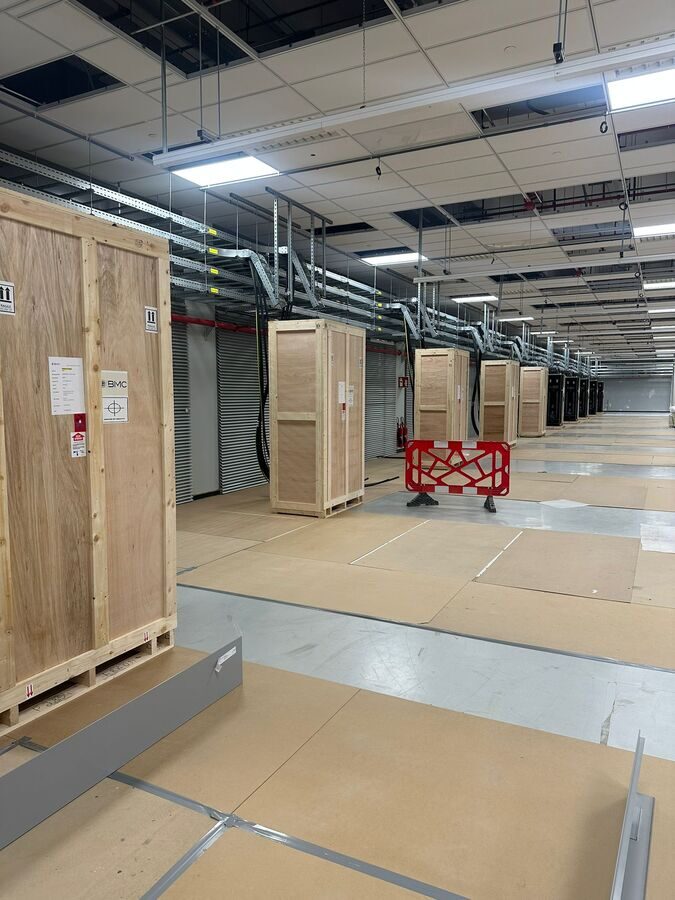
A cable route is the support system on which cables are run through halls, data centers and plant rooms – it determines how much fits, how easily cables can be added later and whether the cables hold in a fire.
Cables need a path. In a data center thousands of cables run from the distribution boards to the racks, in a factory from the control cabinets to the machines. They lie on cable routes that hang below the ceiling, sit on the wall or run in the raised floor. The cable route is a mechanical component: it is planned, hung, aligned and connected before the first cable is pulled in.
Here we explain the three types, the fixing, correct cable fill and fire safety on the route.
What is a cable route?
A cable route is a continuous system of support and fixing elements on or in which cables are run. In German it is called “Kabeltrasse”; the main components are cable trays and cable ladders.
The route includes the route elements themselves, bends, branches and crossings, couplers, dividers and the fixings to wall, ceiling or floor. Trunking with covers for office installations does not count. A cable route is made for many heavy cables.
Cable routes are installed early in construction, often before ceilings are closed and equipment is positioned. Later they are hard to reach: ventilation ducts hang above the route, racks or machines stand below it. Anything not right at installation can therefore hardly be corrected later. A route that hangs crooked or has too little space stays with the building for decades.
Cable routes are rarely the most-discussed topic in a project. Yet a lot depends on them. If a route is too small, too weakly fixed or in the wrong place, cables later have to be rerouted, ceilings opened or fire stops replaced. In data centers, factories and logistics halls, cable route planning is therefore coordinated early with electrical, ventilation and sprinklers, and installation follows a plan, not a feel on site.
Key facts
- Types: Cable tray, wire mesh tray, cable ladder.
- Materials: galvanised steel, stainless steel, aluminium, less often plastic.
- Fixing: Wall brackets, ceiling hangers with cantilever arm, floor supports.
- Accessories: Bends, branches, couplers, dividers, covers.
- Characteristics: Width, height, permissible load per metre at a given span.
- Interfaces: Electrical trade, fire protection, ventilation, sprinklers.
- Responsibility: Route mechanically by fitters, cables and connection by qualified electricians.
Cable tray, wire mesh tray, cable ladder
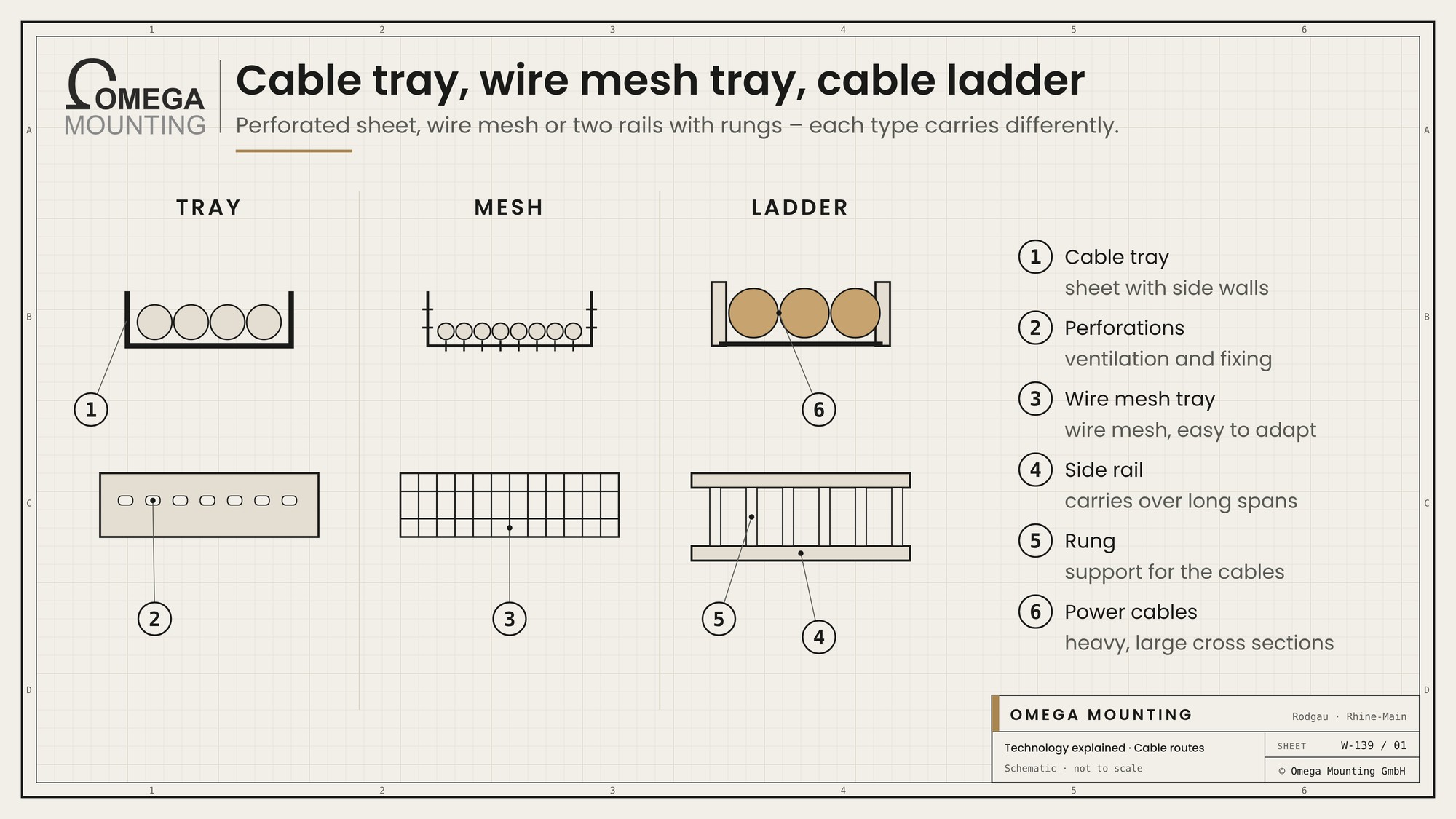
The three types differ in construction and load-bearing behaviour.
| Characteristic | Cable tray | Wire mesh tray | Cable ladder |
|---|---|---|---|
| Design | Perforated sheet with side walls. | Wire mesh. | Two side rails with rungs. |
| Span | Short to medium. | Short. | Long. |
| Ventilation | Medium | Very good | Very good |
| Cables | Many small and medium. | Data and control cables. | Heavy power cables. |
| Adapting on site | Cutting and fittings. | Easy, with bolt cutters. | Fittings required. |
| Typical for | Industry, building services. | Data center, raised floor. | Large halls, power plants, industrial plants. |
Cable weight, span between supports and environment determine the choice. In damp or aggressive areas, stainless steel or hot-dip galvanised steel is chosen. In a data center all three often occur: cable ladders for the heavy power cables between distribution boards, wire mesh trays for data and fibre cables above the racks.
Fixing: brackets, hangers, span
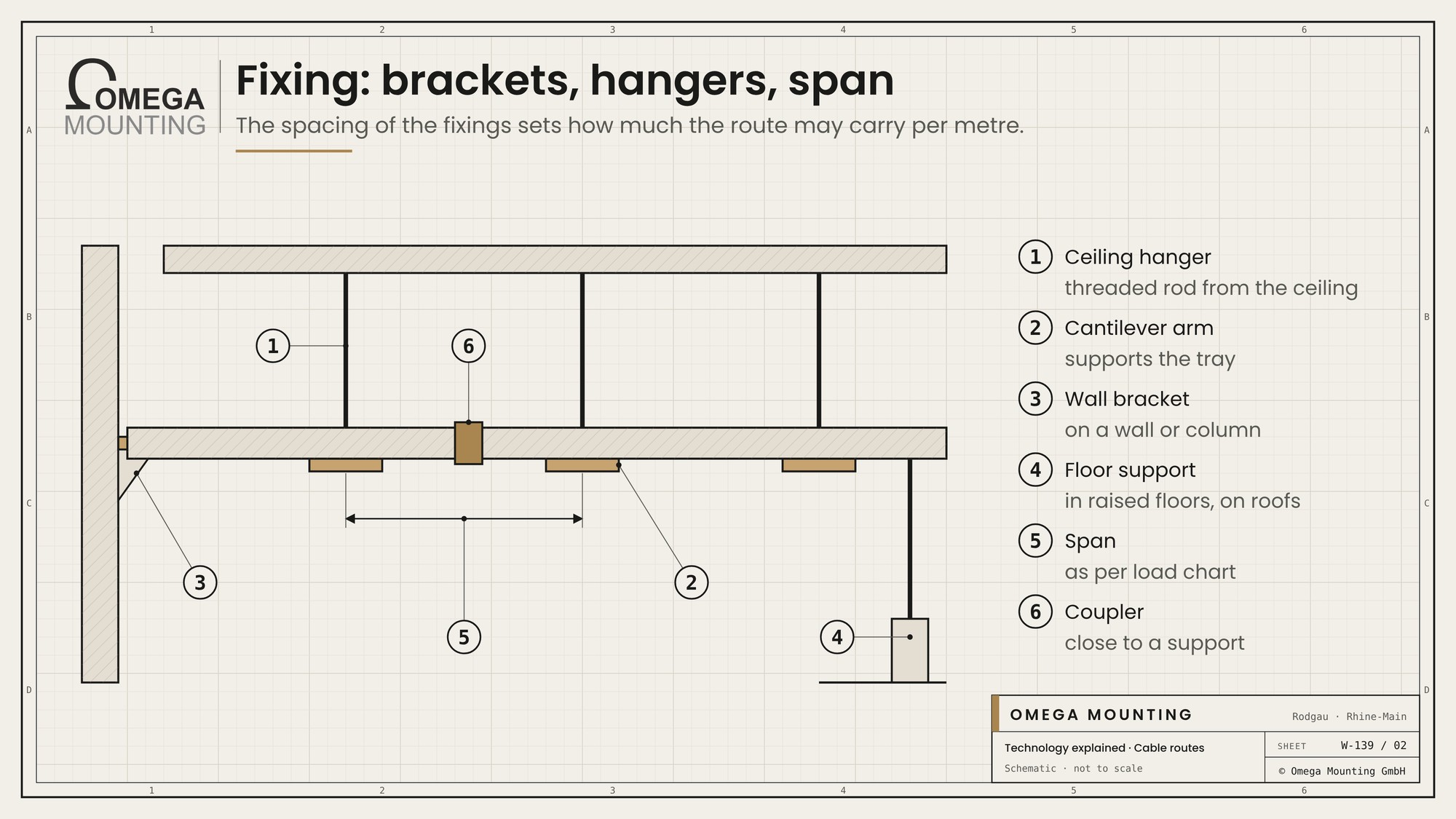
A cable route is only as strong as its fixings.
- Wall brackets: carry the route on a wall or column.
- Ceiling hangers: threaded rods or profiles from the ceiling with a cantilever arm at the bottom.
- Floor supports: in the raised floor or on the roof.
- Couplers: join the route sections together with a load-bearing connection.
The span is the distance between two supports. The larger it is, the less load the route may carry per metre. The permissible values are given in the system's load charts. Joints should be close to a support, not in the middle of the span. The anchors in the ceiling must suit the load and the base material. In prestressed concrete slabs, drilling is often only allowed at approved points so that no tendons are hit.
Fill, separation and spare capacity
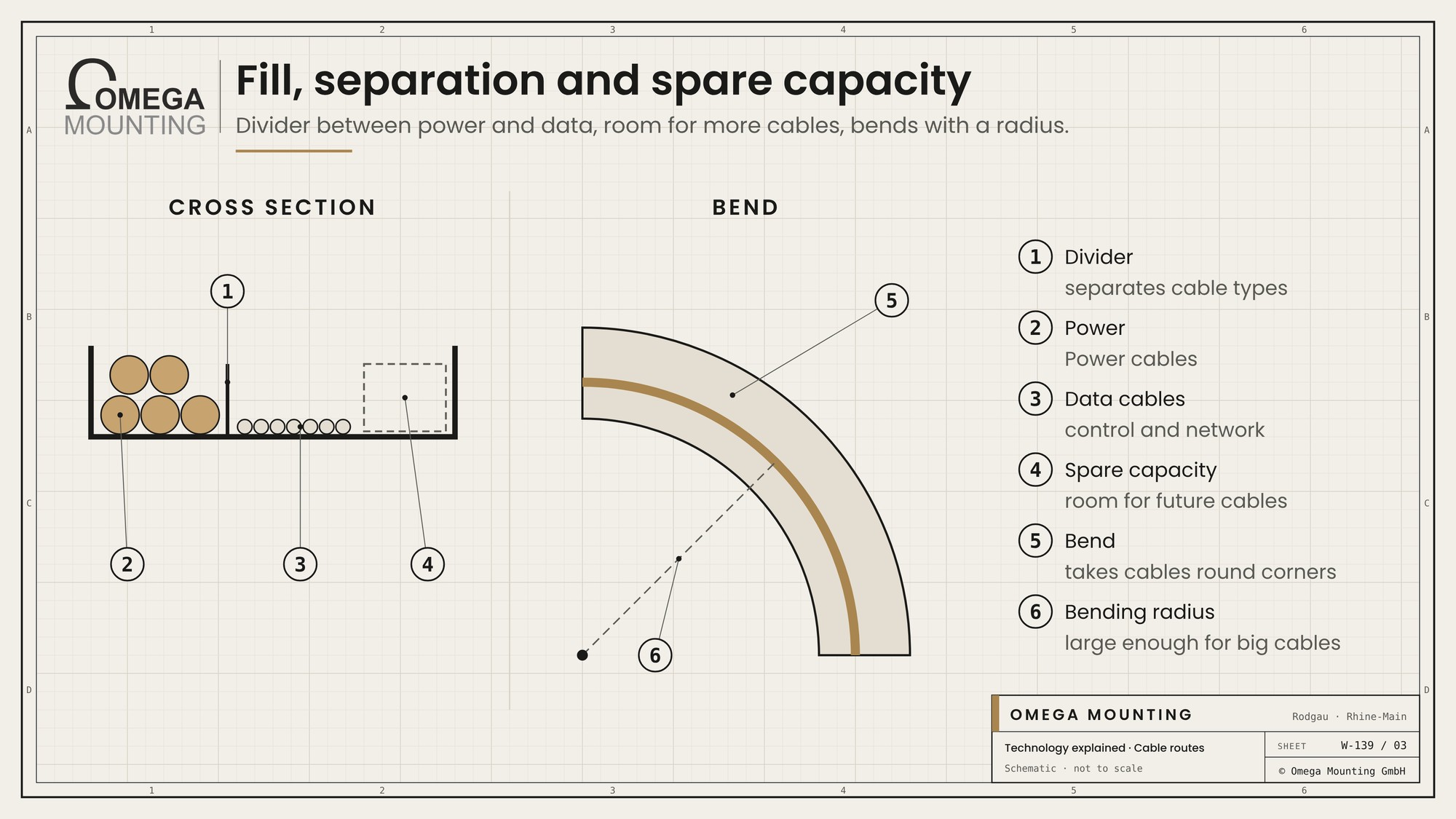
What goes into a route is planned, not just laid in.
- Separation: Power and data cables are separated by dividers or separate routes to avoid interference.
- Spare capacity: Every route keeps room for future cables. Full routes are the most common reason for later alterations.
- Bending radius: Bends must be large enough that the thickest cables are not kinked.
- Height: Cables cannot be stacked indefinitely, otherwise they overheat.
- Access: Space is left above the route so that cables can be pulled in later.
In data centers with A and B supply, the two paths run in separate routes. If they share one, they become just one path in a fire.
Fire safety on the cable route
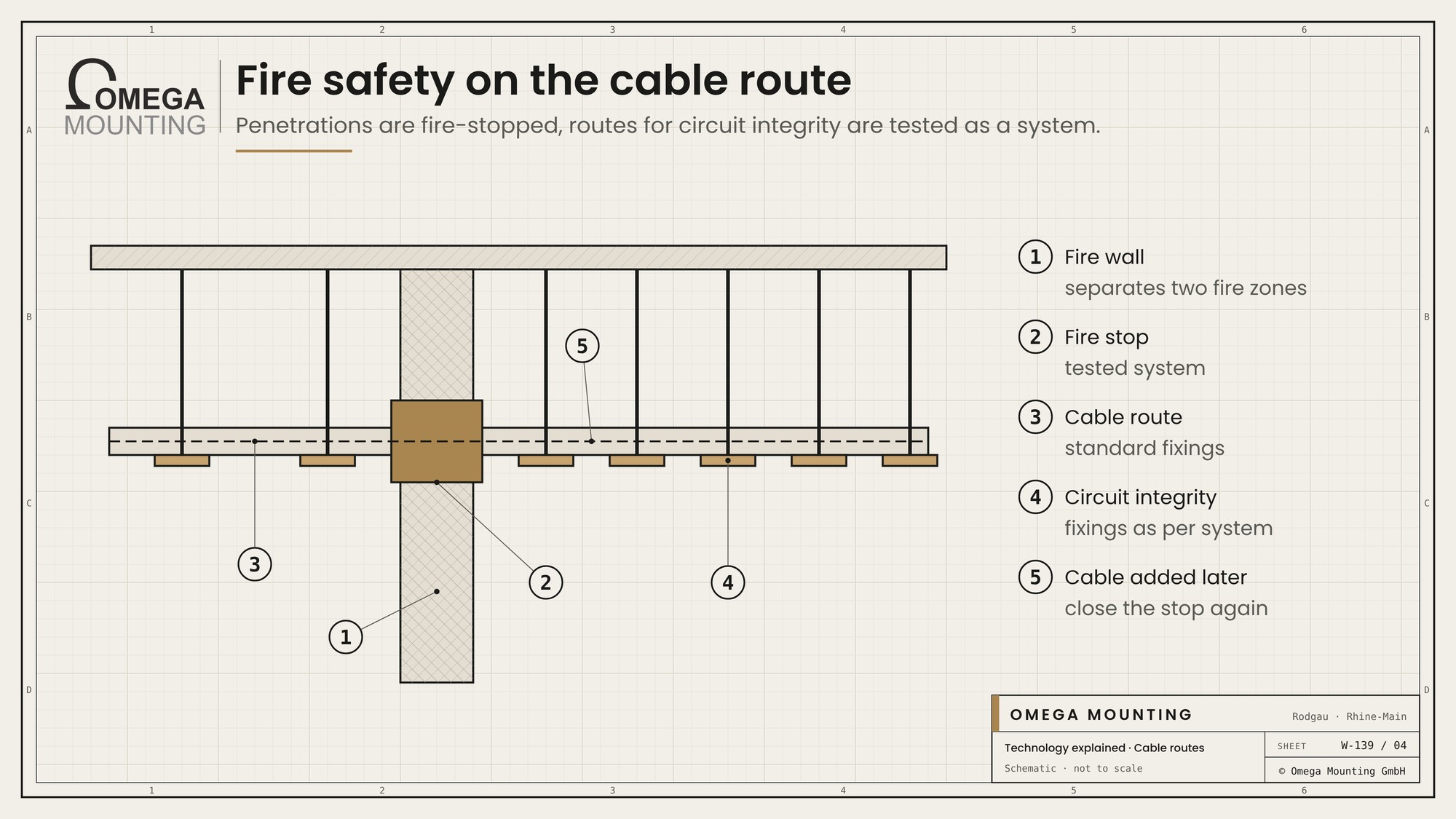
Cable routes touch fire safety in two places.
- Penetrations: Where a route passes through a fire wall or ceiling, an opening is created. It is closed again with a tested system, a fire stop. Every cable added later must be fire-stopped cleanly again.
- Circuit integrity: Cables for safety systems must keep working for a certain time in a fire. A fire-resistant cable alone is not enough. The entire route including its fixings must be tested as a system for this purpose, and it is installed exactly to that system's specifications.
Which requirements apply is set out in the building's fire safety concept.
Cable routes in data centers
In a data center, cable routes are particularly densely packed and particularly strictly planned.
- Above the racks: Routes hang in line with the rack rows so that every cabinet gets its cables from above. Power and data usually run on separate levels.
- With containment: Cable routes and cold aisle containment must not get in each other's way. Penetrations through the roof or side panels are sealed.
- In the raised floor: Cables in the floor obstruct air distribution. That is why only as many cables as necessary run there.
- With spare capacity: Data centers grow. Routes are sized from the start for later expansion stages.
In series rollouts, routes are often installed before the racks and released section by section. Every hall looks the same, every route is in the same place. That saves time during connection but requires very precise surveying.
Coordination with the other trades is important. Sprinkler pipes, lighting, fire detectors and air ducts share the space below the ceiling. A joint plan of who occupies which height prevents a cable route having to be built round a duct at the end.
What we pay attention to
For cable route work we keep the mechanical side clean and the interfaces clear.
- We hang routes to the drawings, in line and with the specified span.
- We set anchors to suit the load and base material.
- We deburr cut edges so that no cable is damaged.
- We keep clear of ventilation, sprinklers and light fittings.
- Cables, equipotential bonding and testing are handled by qualified electricians.
Where we use it
During the installation of 160 PDCs in a data center in the Rhine-Main region the cable routes on the ceiling were already in place. Our task was to set down every cabinet on a laser-surveyed position exactly below its cable outlet so that the electrical trade could connect straight away – without rework. For that, the routes and the positioning have to match to the centimetre. More on this on our page on Industrial installation.
More technology explained
Technology explained
how power gets to the rack in a data center.
Technology explained
what it carries and what it does not.
Do you have questions about how this works on your site?
Do you have questions about how cable routes and positioning fit together in your project? We coordinate the mechanical installation with your electrical trade. Request a callback.
Free, no-obligation callback

About the author
Tobias Schott
Managing director of Omega Mounting GmbH, Rodgau · more than 20 years of hands-on experience in installation and maintenance
A trained mechatronics technician, working in maintenance, servicing and industrial installation since 2004 – first alongside his father, and with Omega Mounting since 2012: from overhead conveyors in Frankfurt to the crane system in a new-build hall. He plans and leads lifting operations as an appointed person (AP) in data centers and on industrial sites in the Rhine-Main region, trains and examines operators of cranes, mobile elevating work platforms and telehandlers, and is a qualified occupational safety specialist. On jobs abroad he is known as the “German Troubleshooter” – the person you call when a site gets stuck. He learned what quality means from his father, not from a manual: Made in Germany as a standard for his own work, not a label. That is why quality comes first at Omega Mounting – ahead of speed and price. The Technology explained articles cover the equipment and techniques his team uses every day: what counts on site is in them – what only appears in the brochure is not.
 English
 German