
- Technology explained – technology and procedures
PDC and e-house: how power gets to the rack in a data center
By Tobias Schott · 5-minute read · Updated November 2026
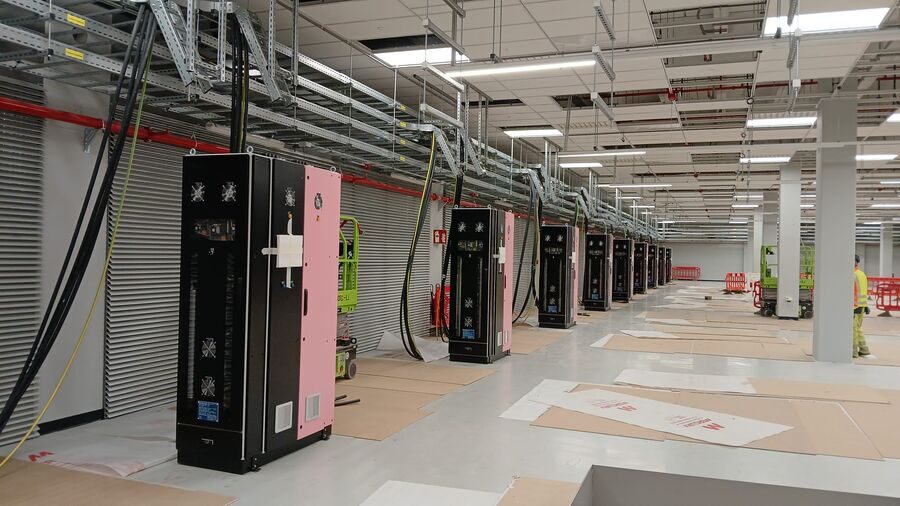
A PDC is the power distribution cabinet in the data hall that divides the energy from the main distribution among the server racks; an e-house is a prefabricated switchroom in which the distribution equipment arrives on site installed and tested at the factory.
In a data center, power does not simply flow from the wall into the rack. It passes through several stages: transformer, main distribution, uninterruptible power supply, sub-distribution. Each stage sits in its own cabinet or room. PDC and e-house are two terms that come up all the time – and are often confused.
Here we explain the path of the power, what is inside a PDC, what an e-house is and what matters when setting cabinets in a row.
What is a PDC?
A PDC – power distribution cabinet – is a distribution cabinet in the data hall that takes the energy from the main distribution and distributes it in a controlled way to the server racks. In German terms it is a sub-distribution board.
The cabinets are full of switching and distribution equipment and correspondingly heavy and sensitive. In modern data centers they stand in long rows along the data halls, connected via cable trays on the ceiling or in the raised floor.
The PDC must not be confused with the PDU. The PDU is the power strip in the rack that the individual servers are plugged into. The PDC supplies many racks, the PDU a single one.
Key facts
- PDC: sub-distribution in the data hall, supplies a row or group of racks.
- E-house: prefabricated switchroom with built-in distribution equipment, delivered as a container or module.
- Position in the power path: after transformer, main distribution and UPS, before the PDU in the rack.
- Connection: incomer and outgoing circuits via cable tray or raised floor.
- Installation: to the millimetre, below the cable outlet and in line with the row.
- Trades: bringing in and setting mechanically, connection by the qualified electrician.
The path of the power
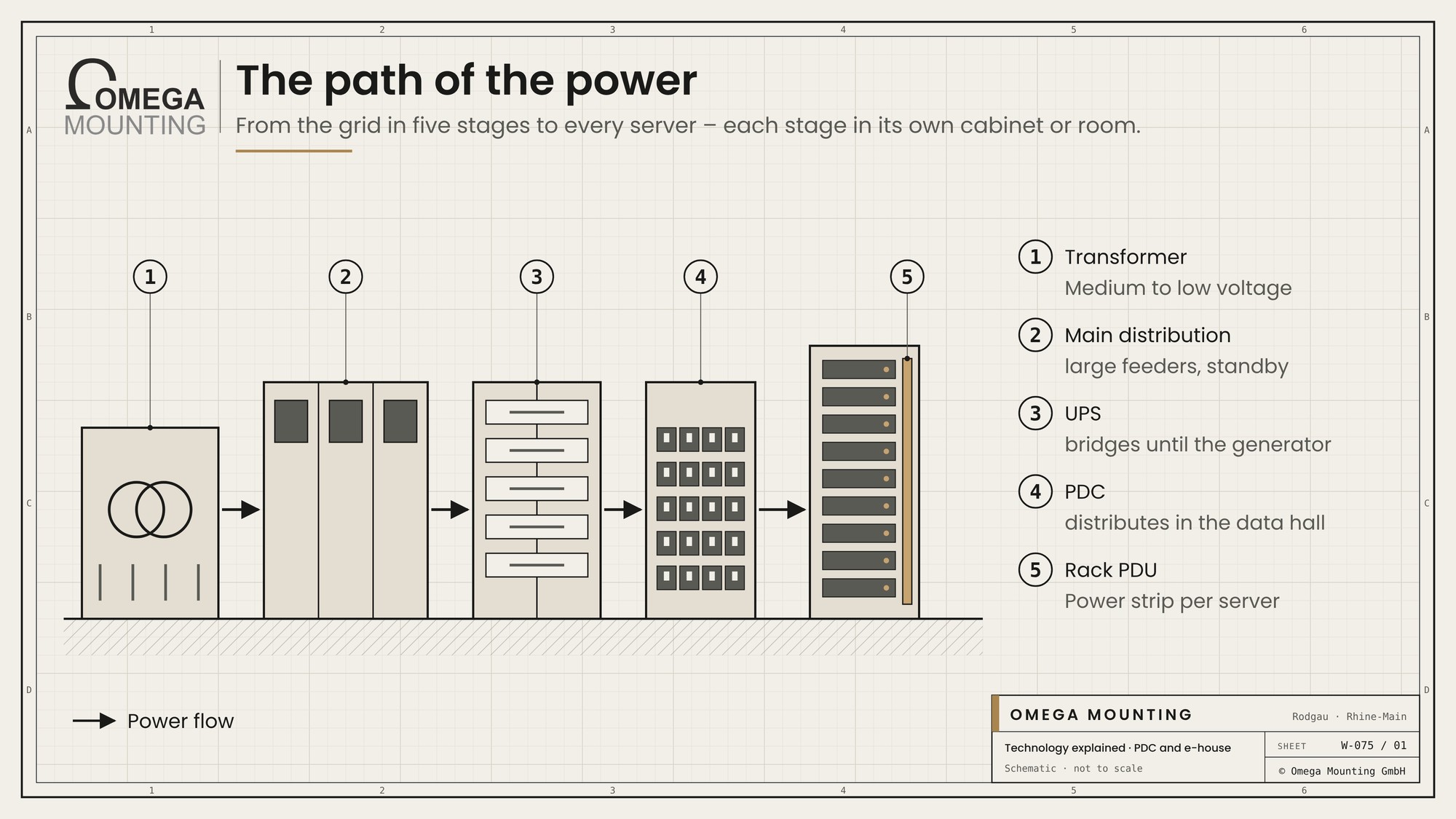
Power comes from the grid at high voltage and is brought to the server in several stages.
- Transformer: steps the medium voltage from the grid down to low voltage.
- Low-voltage main distribution: distributes the power to large outgoing circuits; this is also where the standby power system is switched in.
- UPS: the uninterruptible power supply bridges the seconds until the generator takes over and smooths the voltage.
- PDC: divides the protected power in the data hall into many circuits.
- PDU in the rack: brings the power to every single server.
Many data centers build this path twice, as A and B supply. Each rack is then connected to two PDCs, so that one path can fail or be serviced without a server going down. How standby power and the generator fit in is explained in our article on the Standby power system.
What is inside a PDC?

A PDC distributes one large incomer to many small outgoing circuits and monitors them.
- Supply: the cable from the main distribution or UPS, usually from above out of the tray.
- Main switch: isolates the whole cabinet, for example for maintenance.
- Outgoing breakers: miniature or moulded-case circuit breakers, one per circuit to the rack.
- Metering: current, voltage and power per outgoing circuit, often connected to the building management system.
- Cable outlets: the cables to the racks, again via the tray.
Because the cables arrive exactly above the cabinet, the PDC must stand exactly below. A few centimetres off, and the cables no longer fit.
What is an e-house?

An e-house – electrical house – is a prefabricated building or container module in which switchgear, distribution boards and often UPS and air conditioning are installed, wired and tested at the factory.
On site it only needs to be set, aligned and connected. This saves time on site and moves work into the factory, where it runs under better conditions.
| Characteristic | PDC | E-house |
|---|---|---|
| What it is | One cabinet in the data hall. | A whole switchroom with many cabinets. |
| Where it stands | In the building, in a row. | Next to the building or on the roof, on a foundation or steel frame. |
| How it arrives | Packed, brought in and set. | Complete, set by crane. |
For installation this means: an e-house is a classic crane lift with a heavy, sensitive load. PDCs are series work – the same precise sequence, many times in a row.
Setting in a row
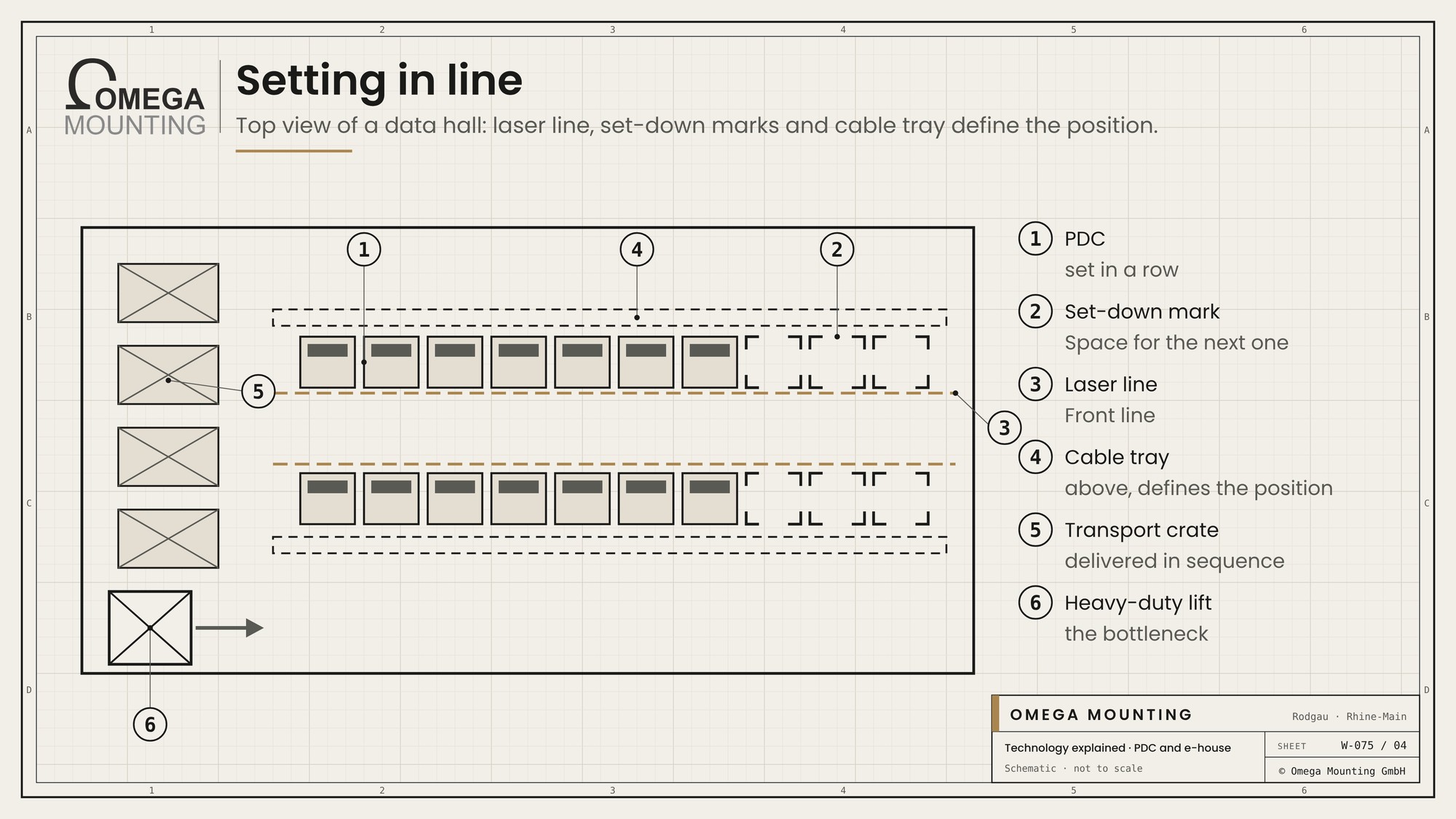
Whether a PDC stands correctly is decided before the first lift.
- Laser survey: the hall is surveyed, rows and set-down positions are marked on the floor.
- Set-down marks: every cabinet has its place, derived from the cable outlet above it.
- Alignment: all cabinets in a row stand on one line, front to front.
- Height and level: the cabinet stands level, doors close, neighbours fit together.
- Logistics: which crate reaches which level when is planned like the installation itself.
How the survey works is explained in our article on Laser alignment. If the cabinets stand on a raised floor, its load capacity also matters.
Moving in and transport
PDCs and E-houses arrive on site largely pre-wired. That is exactly why transport is sensitive, because damage to the switchgear is often only noticed at commissioning:
- Weight and centre of gravity: Switchgear panels, transformers and busbars distribute the weight unevenly. The centre of gravity is stated in the transport documents and determines the slinging method.
- Lifting points: Lifting is done only at the designated points, often with a spreader beam. Slings must not load doors, ventilation grilles or roof edges.
- Access route: Width, height and load capacity of the route are checked beforehand. Inside the building, heavy-duty skates and skidding equipment are often used.
- Shocks: Switching devices and instrumentation do not tolerate hard impacts. Lowering slowly and cushioned supports protect the internals.
- Moisture: If a module stands for a long time before connection, condensation can form. Covers and anti-condensation heating protect the equipment.
Large units are split into transport sections and mechanically joined on site: aligning, bolting, sealing joints. Electricians handle the electrical connections between the sections and the connection up to the main switch; the supply from the grid remains with the operator.
What we pay attention to
With PDCs, routine is the enemy – the same sequence, many times, without fatigue leading to mistakes.
- We survey the hall and mark all set-down positions before the first crate is opened.
- We schedule the logistics so that the lift does not become a bottleneck and crates are not in the way.
- We protect the hall floor and the cable trays already installed.
- We lift the cabinets off the pallet in a controlled way and set them on their mark.
- We hand over each row aligned and ready for connection by the qualified electrician.
Where we use it
In a data center in the Rhine-Main region we 160 PDCs moved in and installed – spread over 8 data halls on four levels from the basement to the second floor. Each hall received 20 PDCs in two rows. Six lift-and-shift mechanics distributed the cabinets via the heavy-duty lift, unpacked them from the wooden crates, lifted them off the pallets with a lifting frame of aluminium beams and set them on the laser-surveyed positions. More under series installation in data centers.
More technology explained
Technology explained
where power comes from in an emergency.
Technology explained
how the set-down positions are created.
Technology explained
what heavy cabinets stand on.
Do you have questions about how this works on your site?
Are you expanding a data center and need to set many cabinets to the millimetre – or lift in an e-house? We plan logistics and lifts and set everything until the electricians can connect. Request a callback.
Our service for this: Data center installation and maintenance →
Free, no-obligation callback

About the author
Tobias Schott
Managing director of Omega Mounting GmbH, Rodgau · more than 20 years of hands-on experience in installation and maintenance
A trained mechatronics technician, working in maintenance, servicing and industrial installation since 2004 – first alongside his father, and with Omega Mounting since 2012: from overhead conveyors in Frankfurt to the crane system in a new-build hall. He plans and leads lifting operations as an appointed person (AP) in data centers and on industrial sites in the Rhine-Main region, trains and examines operators of cranes, mobile elevating work platforms and telehandlers, and is a qualified occupational safety specialist. On jobs abroad he is known as the “German Troubleshooter” – the person you call when a site gets stuck. He learned what quality means from his father, not from a manual: Made in Germany as a standard for his own work, not a label. That is why quality comes first at Omega Mounting – ahead of speed and price. The Technology explained articles cover the equipment and techniques his team uses every day: what counts on site is in them – what only appears in the brochure is not.
 English
 German