
- Technology explained – technology and procedures
Grouting: why grout belongs under every base plate
By Tobias Schott · 5-minute read · Updated November 2026
Grouting is a layer of free-flowing grouting mortar that fills the gap between a base plate and the foundation over its full area – only then does the plate bear fully, transfer its load evenly into the ground and keep the structure level for the long term.
Crane columns, steel platforms, machines and racks stand on base plates. No hall floor is so flat that a steel plate bears on it everywhere. After alignment gaps and voids remain, often only a few millimetres, sometimes more. If they are not filled, the plate only bears at a few points.
Here we explain what grouting is for, how it is placed, how grouting mortar differs from other mortars and why grouting fails.
What is grouting?
Grouting is the full-area filling between a base plate or machine frame and the foundation with a free-flowing, non-shrink mortar. It transfers the load to the ground with a force-fit connection.
In German it is called „Unterguss“, the mortar „Vergussmörtel“. The grout is only placed once the structure has been aligned. It does not replace the anchoring but makes sure the plate bears everywhere.
Key facts
- Task: fill the gap under the base plate over its full area and spread the load.
- Equipment: free-flowing, high-strength, non-shrink grouting mortar.
- Use: crane columns, steelwork, machines, pumps, bearing blocks.
- Process: align, set formwork, pour, let cure, retighten anchors.
- Time required: curing time as specified by the manufacturer, depending on temperature.
- Enemies: air pockets, dirt, cold, loading too early.
What grouting is for
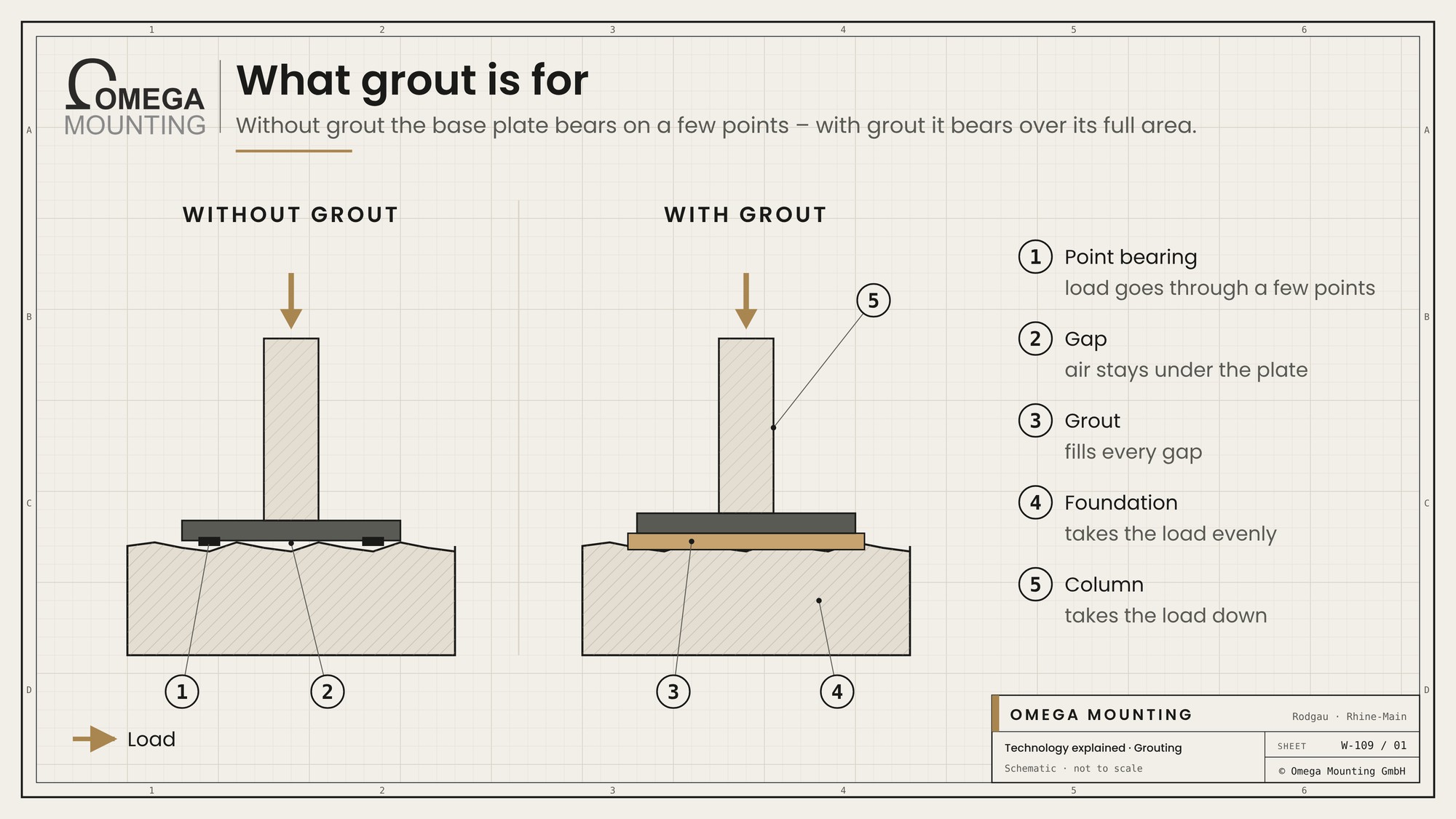
Grouting turns a base plate that stands on a few points into a plate that bears over its whole area.
- Spread the load: Without grout the load goes into the ground through a few points or the levelling screws. High pressures occur there.
- Hold the alignment: Under load, shims and wedges settle. The cured mortar holds the height.
- Damp vibration: A machine that bears fully vibrates less than one standing on points.
- Relieve the anchors: The anchors hold the plate down, the grout carries the compressive force.
This is particularly important for cranes. The columns take alternating loads from lifting and travel. A column that does not bear fully moves a little with every lift – over time the anchors work loose.
How grout is placed
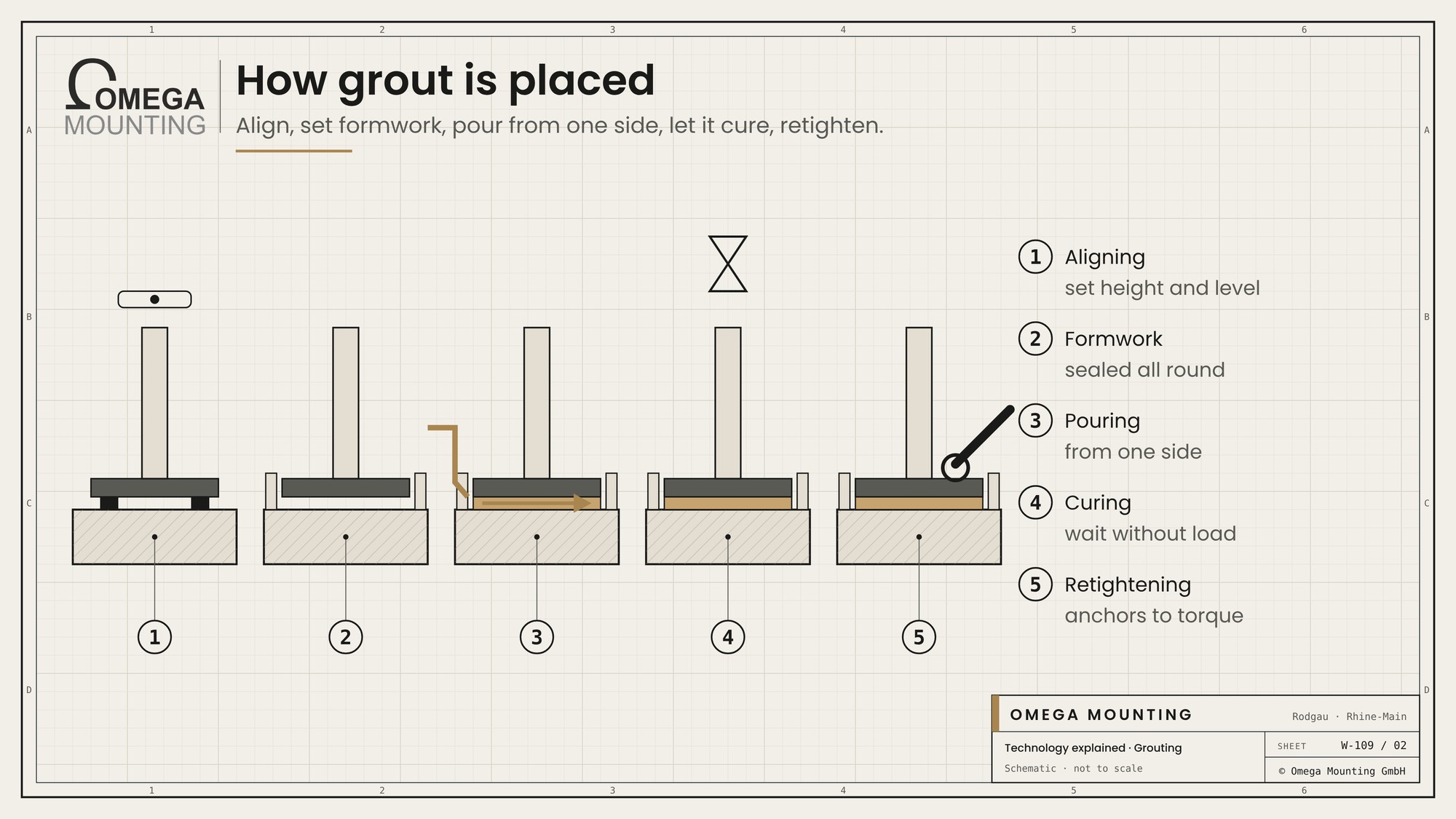
The sequence is decisive. Align, pour, let cure, retighten.
- Aligning: The structure is brought to height and level with levelling screws, wedges or shims, for cranes also checked diagonally by laser.
- Preparing the substrate: clean the floor, remove loose parts, oil and dust, pre-wet depending on the mortar.
- Setting formwork: Formwork around the plate holds the mortar and leaves one side open for pouring.
- Pouring: The mortar is mixed and poured in from one side until it comes out on the other side. This lets the air escape.
- Cure: The structure stays unloaded until the mortar has the necessary strength.
- Retightening: Only then are the anchors tightened to the final torque.
If grout is poured from all sides at once, an air bubble remains in the middle. The plate does not bear there.
Grouting mortar, bonding mortar, concrete

Three materials are often confused, although they have different tasks.
| Material | Where it sits | What it does |
|---|---|---|
| Grout | In the gap under the base plate. | Fills the full area, does not shrink, carries compression. |
| Bonding mortar | In the drill hole around the anchor rod. | Bonds the anchor to the wall of the drill hole. |
| Concrete | In the foundation itself. | Carries the full load, is formed and compacted. |
Grouting mortar is formulated so that it flows without segregating and does not shrink as it cures. Ordinary cement mortar would shrink and leave a new gap.
Why grouting fails

Poor grouting often looks fine from the outside – the defect lies under the plate.
- Air pockets: poured from several sides or mixed too thick.
- Dirty substrate: Oil, dust or cement laitance prevent the bond to the floor.
- Too cold: Below the minimum temperature the mortar cures too slowly or not properly at all.
- Loaded too early: Anchors retightened or load applied too early – the mortar cracks.
- Wrong mortar: Shrinking mortar comes away from the plate.
Typical mistakes
- Levelling screws as permanent support: The plate stays on the screws and the grout does not share the load.
- Shims stacked: Many thin shims settle under load.
- No formwork: The mortar runs away and the gap stays partly empty.
- Manufacturer’s instructions ignored: Water quantity, mixing time and temperature are not negotiable.
Checks after curing
Once the grout has cured, a short check shows whether it is doing its job. The following are checked:
- Voids: Tapping around the edges reveals areas where the grout is not in full contact. They are reworked.
- Cracks and spalling: Fine surface cracks are often harmless; wide cracks or loose edges are not. They are assessed and documented.
- Position of the machine: Height and level are measured again. The grout must not have changed the alignment.
- Tighten the anchors: The anchors are only tightened to their torque after curing. Before that the base plate would lift off the soft grout.
- Relieve the levelling screws: Where specified, levelling screws or wedges are released so that the load is carried by the grout and not by individual points.
Finally the formwork and excess material are removed and the edges finished cleanly. The record notes the grout, batch, temperature, date and the result of the check – so it can later be traced how the machine was installed.
What we pay attention to
When erecting cranes, steel structures and machines we plan grouting as a separate work step.
- We align completely first and then pour, never the other way round.
- We clean the base and set tight formwork.
- We pour from one side until the mortar comes out opposite.
- We let the grout cure and plan this time into the schedule.
- Only then do we retighten the anchors with a torque wrench.
Where we use it
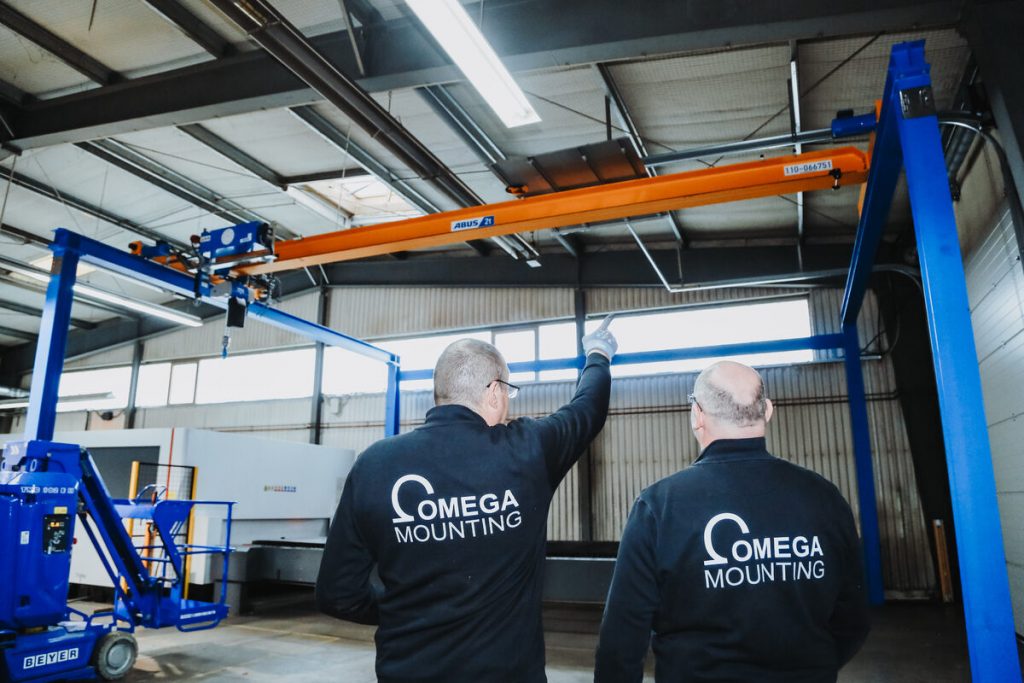
At a steel fabrication company in Babenhausen we installed a gantry crane on its own steel columns. After laser measurement of height and diagonals we grouted the base plates with a high-strength, non-shrink grouting mortar – it fills every gap over the full area and creates the force-fit connection to the floor. The grout cured overnight, and crane installation and electrics followed on the second day. With the pillar jib crane in a nuclear facility the other side showed: there bonding mortar held the anchors in the drill hole, and it too needed its curing time. Such work is part of our Crane installation.
More technology explained
Technology explained
the alternative without grouting.
Technology explained
what holds the plate down.
Do you have questions about how this works on your site?
Are you setting up a crane, a platform or a machine and want it to stand for the long term? We align, grout and anchor. Request a callback.
Free, no-obligation callback

About the author
Tobias Schott
Managing director of Omega Mounting GmbH, Rodgau · more than 20 years of hands-on experience in installation and maintenance
A trained mechatronics technician, working in maintenance, servicing and industrial installation since 2004 – first alongside his father, and with Omega Mounting since 2012: from overhead conveyors in Frankfurt to the crane system in a new-build hall. He plans and leads lifting operations as an appointed person (AP) in data centers and on industrial sites in the Rhine-Main region, trains and examines operators of cranes, mobile elevating work platforms and telehandlers, and is a qualified occupational safety specialist. On jobs abroad he is known as the “German Troubleshooter” – the person you call when a site gets stuck. He learned what quality means from his father, not from a manual: Made in Germany as a standard for his own work, not a label. That is why quality comes first at Omega Mounting – ahead of speed and price. The Technology explained articles cover the equipment and techniques his team uses every day: what counts on site is in them – what only appears in the brochure is not.
 English
 German