
- Technology explained – equipment and protection
The machine mount: how a machine gets level – and stays put
By Tobias Schott · 5-minute read · Updated November 2026
A machine mount is the component between machine and floor that brings the machine to height, levels it and, depending on the type, damps it or anchors it firmly.
Every machine that is installed ends up standing on something: on feet, mounts, wedges, dampers or anchors. That something decides whether it runs smoothly, whether guides and shafts are in line and whether it is still where it was installed a year later. Anyone looking for a support for a machine foundation is usually looking for exactly this.
Here we explain which types there are, how a machine is aligned, when to damp and when to anchor – and why the floor under the mount has a say too.
What is a machine mount?
A machine mount is a bearing element on which a machine stands and with which its height is set at each support point. Other names are levelling element, machine foot, levelling foot or wedge mount; in German it is called Maschinenschuh.
It has three possible tasks: setting the height, spreading the load onto the floor and decoupling vibrations between machine and floor. Not every mount can do all three. Which task comes first decides the type.
Key facts
- Purpose: Bring the machine to height, level it, spread the load and, depending on the type, damp vibrations.
- Types: Levelling foot with swivel pad, wedge mount, damping element, anchor foot with floor anchor.
- Adjustment: Via threaded spindle, wedge or adjusting screw, usually accessible from the side.
- Selection: By weight per support, vibration behaviour of the machine and forces in operation – according to the manufacturer's data.
- Ground: Load-bearing, level floor; no joints under the mount.
- Check: Readjust after running in, check lock nuts and anchors.
Which types are there?
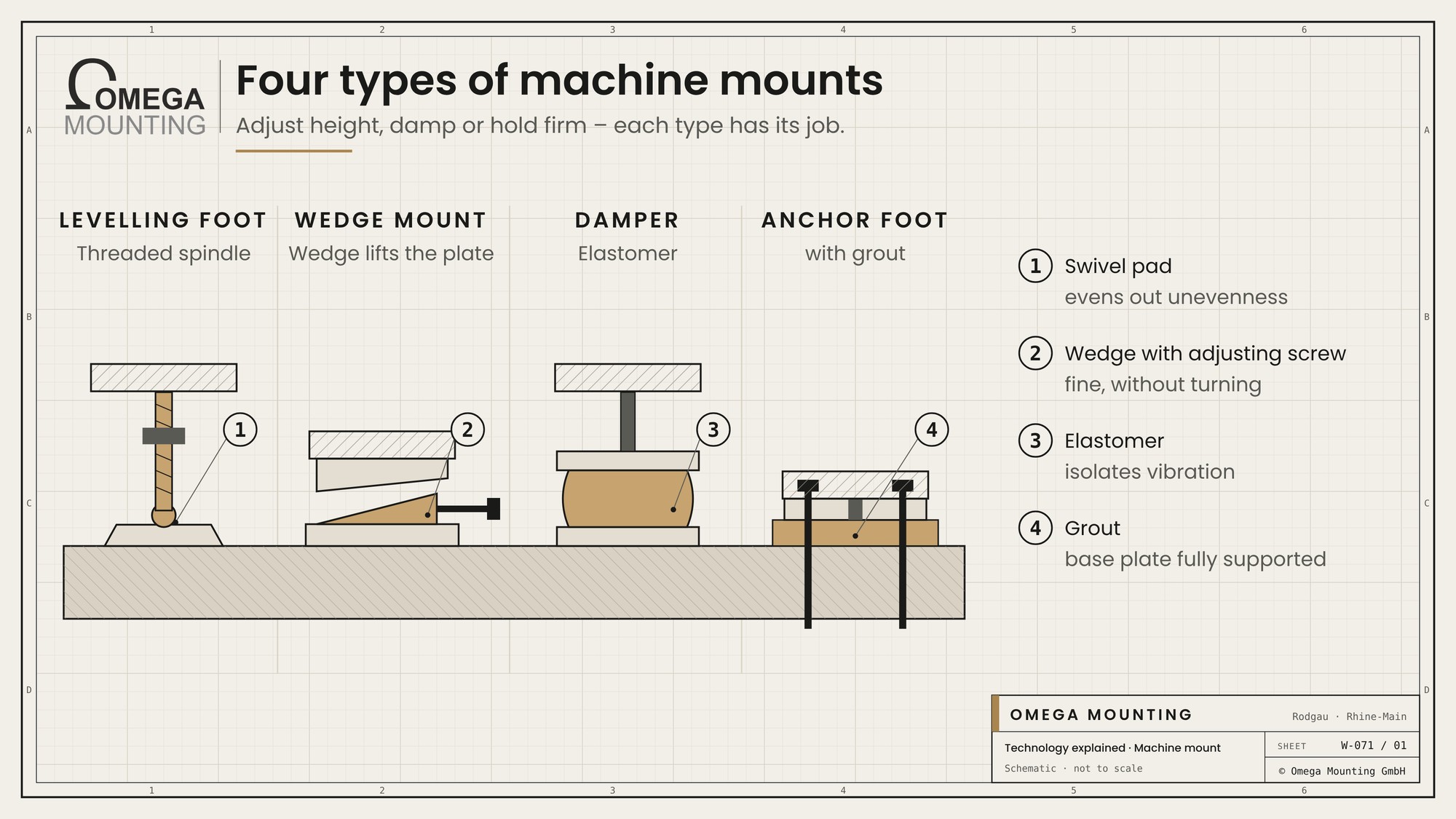
The types differ in how the height is set and whether the mount damps or holds firm.
| Type | How it adjusts | What it suits |
|---|---|---|
| Levelling foot with swivel pad | Threaded spindle, pad compensates for unevenness. | Light to medium machines, equipment that gets moved. |
| Wedge mount | A wedge slides via a screw and lifts the top plate. | Heavier machines, fine height adjustment without turning the machine. |
| Damping element | Elastomer or spring between two plates, often with an adjusting screw. | Machines that vibrate or impact, and vibration-sensitive neighbours. |
| Anchor foot | Base plate with floor anchor, height via adjusting screws, then grouted. | Machines with high process forces, risk of tipping, exact position. |
Many mounts combine two tasks, such as a damping element with a built-in adjusting screw. Which type and size fits is specified by the machine manufacturer or follows from weight and vibration behaviour.
Alignment: height, level, line
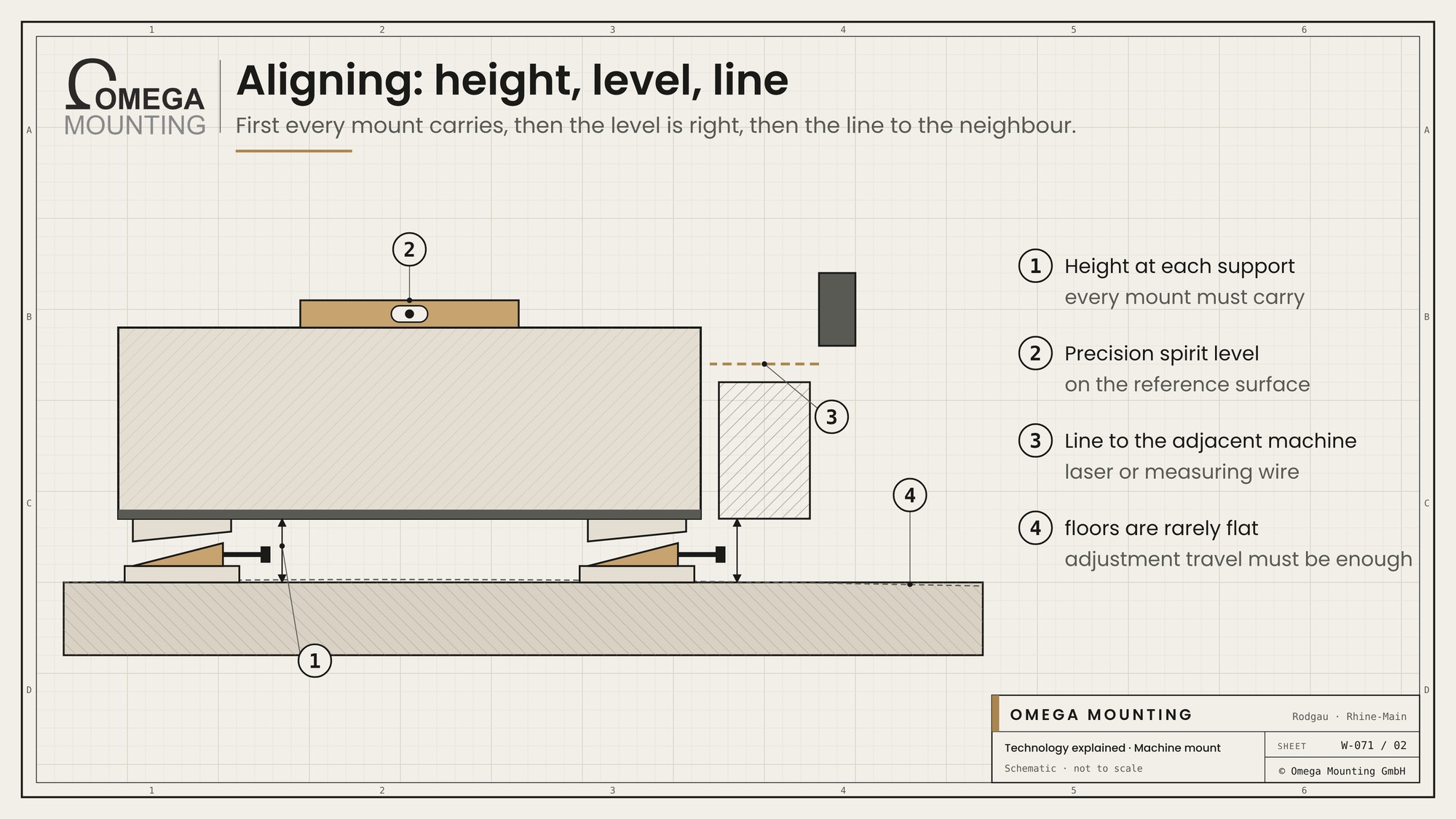
Alignment is done in three steps: first each corner to height, then the level, then the line to neighbouring machines.
First the machine stands roughly on its mounts. Then the height is set at each support point until all mounts carry evenly. Otherwise a machine on four feet soon stands on three – the fourth hangs in the air and the frame twists.
Then the level is checked, with a precision spirit level on a machined reference surface of the machine or with a laser. With linked lines, the line comes in as well: conveyors, guides and shafts must fit each other, not just the hall. How laser measurement helps is explained in our article on Laser alignment.
Finally, lock nuts are tightened so that the setting does not shift in operation.
Damped or firmly anchored?
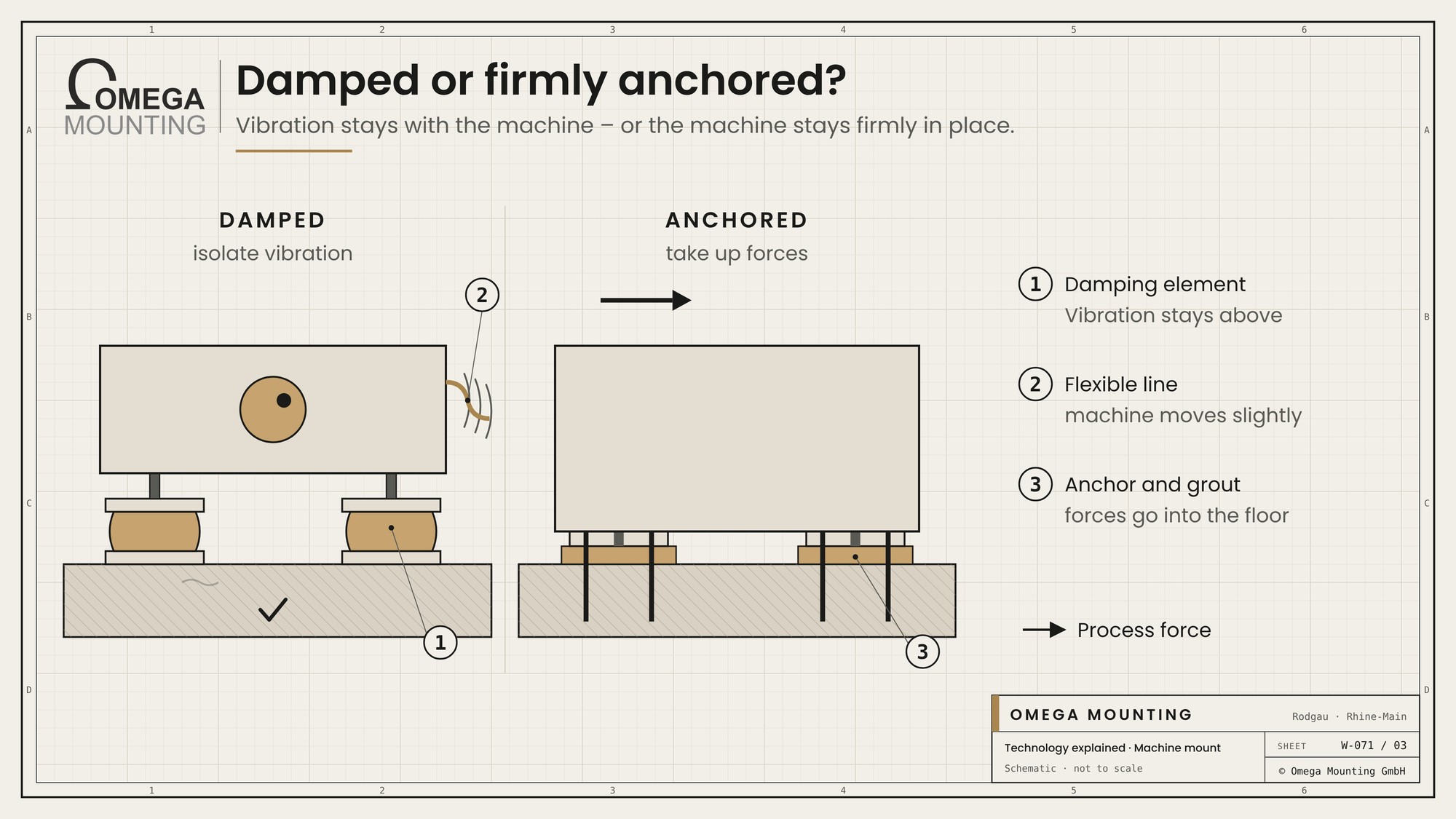
A machine is mounted on dampers when its vibrations should not go into the floor – and firmly anchored when it has to take forces or must not move.
Damped. Presses, compressors or machines with imbalance give off vibrations. On damping elements these stay with the machine instead of travelling through the hall floor to measuring machines or neighbouring equipment. In return, the machine moves minimally on its mounts – connections then need flexible lines.
Anchored. Machines with high process forces, a risk of tipping or an exact position relative to neighbouring equipment are fixed with floor anchors. So that the base plate bears over its full area, the gap below is filled with non-shrink grout after the machine has been aligned.
How vibrations are measured is explained in our article on Vibration analysis.
The floor under the mount
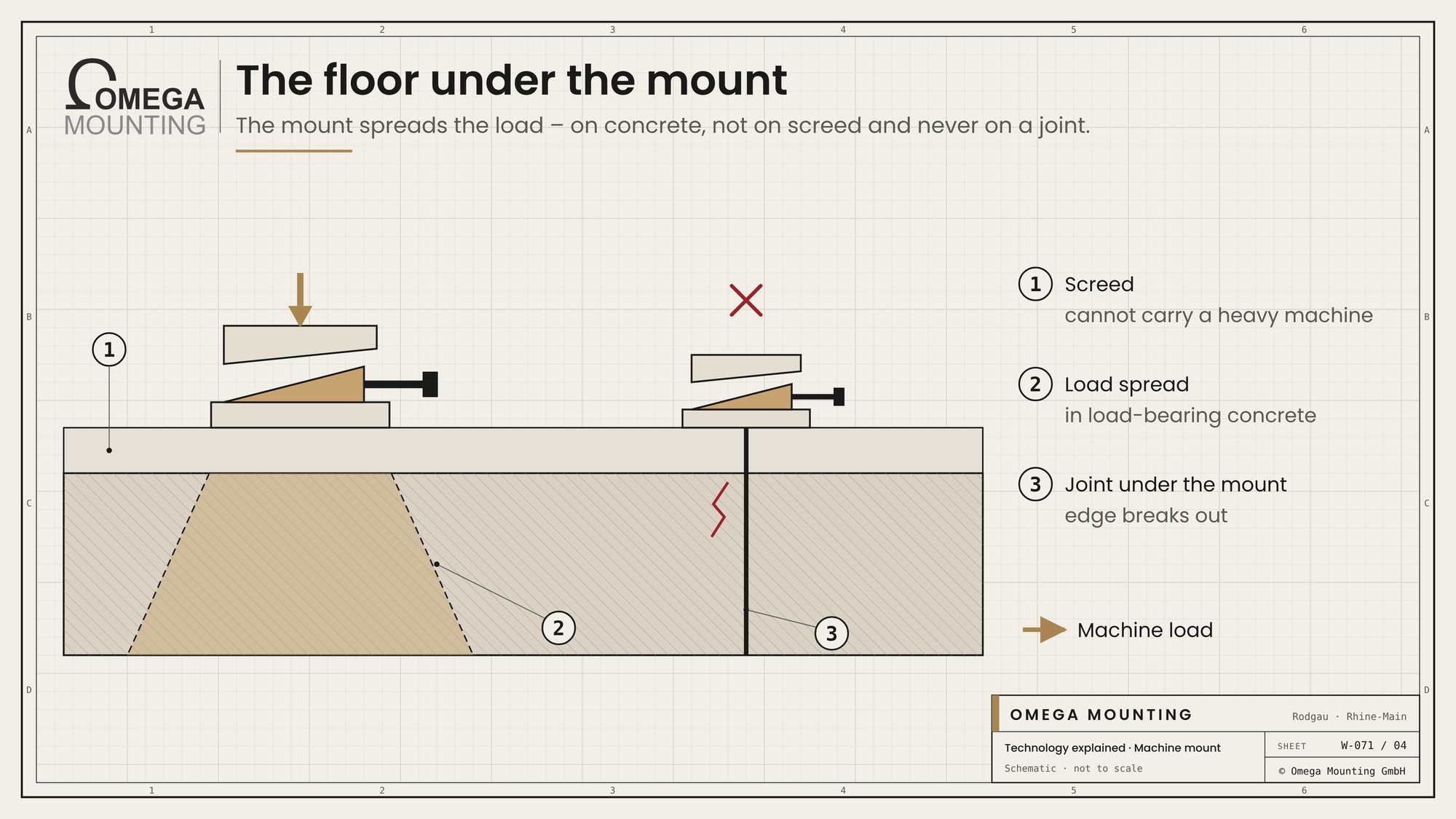
A machine mount spreads the load over a larger area – but only onto a floor that can carry it.
If there is screed on the structural concrete, with heavy machines it is the concrete that carries, not the screed. Joints and edges under a mount are weak points where the floor breaks out. And a hall floor is rarely as level as it looks: the adjustment range of the mounts must be able to take up the unevenness. For very heavy machines, a structural engineer clarifies whether the floor is sufficient or a dedicated foundation is needed.
Checks during operation
A machine mount is not a component that lasts for ever. In operation the machine, floor and dampers change. These points show whether a machine is still standing correctly:
- Loose lock nuts: Vibration loosens bolted connections. A loose lock nut lets the adjusting screw creep, and the machine loses its height.
- Aged dampers: Elastomers become hard or cracked over time. They then damp less well, and vibrations pass into the floor.
- Oil and coolant: Some rubber compounds swell when oil or emulsion gets onto them. Contaminated mounts are cleaned and replaced if necessary.
- Settlement: A mount that slowly presses into a soft floor changes the level. A check measurement shows this early.
- Creeping machine: If a machine slides on loose mounts, connections and feeds shift. Marks on the floor give the movement away.
After every alteration, after a tool change with a clearly different weight or after a collision, the machine is levelled again. The readings go into the record so that next time it is clear what has changed.
What we pay attention to
When installing machines, we work from the floor upwards.
- We look at the floor: concrete or screed, joints, cables, flatness.
- We fit the mounts specified by the manufacturer and check that every mount carries.
- We align for height, level and line and record the values.
- We lock the setting and tighten anchors as specified.
- We only grout anchored base plates after alignment.
- We recommend measuring again after running in.
Where we use it
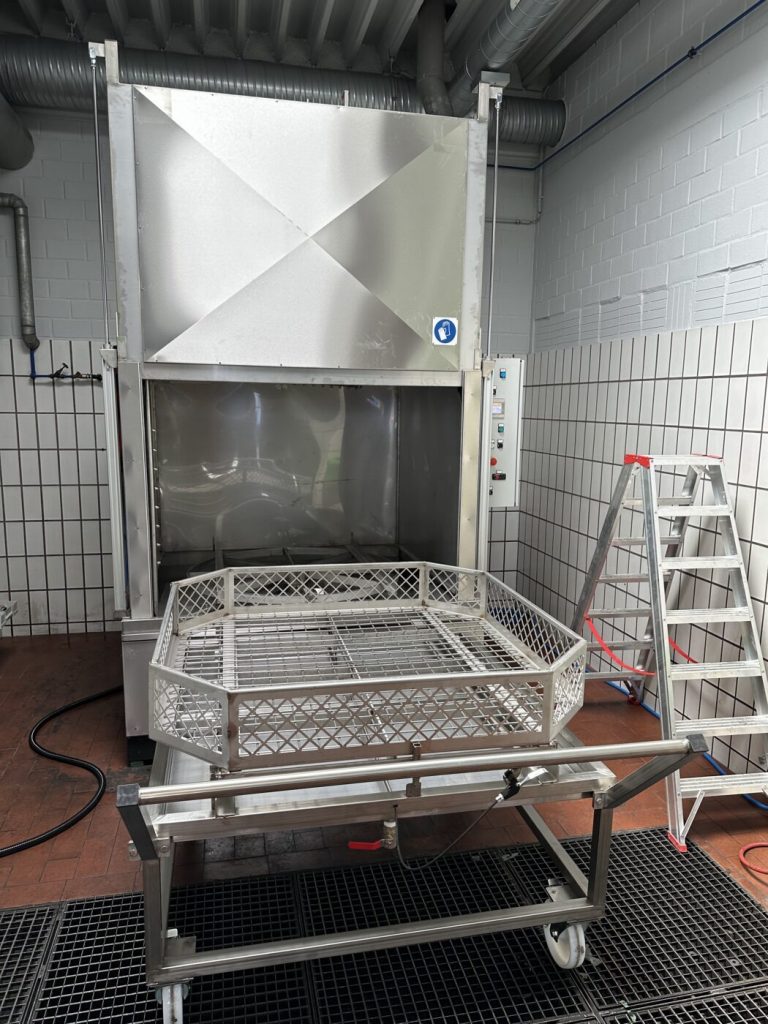
At a vehicle workshop in Kassel we brought in, aligned and connected a parts washer – everything had to be level so that the wash basket rolls cleanly into the machine. During the relocation of automated storage systems in Frankfurt we measured and levelled every gear rack, guide and shaft during reassembly before the sensors came into play. More under Machinery relocation.
More technology explained
Guide
the procedure step by step.
Technology explained
how measuring is done.
Technology explained
Vibration analysis: how imbalance and bearing damage give themselves away
when a machine runs roughly.
Read the article →
Do you have questions about how this works on your site?
Are you installing a machine or relocating, and it should run smoothly and accurately afterwards? We bring it in, align it and anchor it. Request a callback.
Free, no-obligation callback

About the author
Tobias Schott
Managing director of Omega Mounting GmbH, Rodgau · more than 20 years of hands-on experience in installation and maintenance
A trained mechatronics technician, working in maintenance, servicing and industrial installation since 2004 – first alongside his father, and with Omega Mounting since 2012: from overhead conveyors in Frankfurt to the crane system in a new-build hall. He plans and leads lifting operations as an appointed person (AP) in data centers and on industrial sites in the Rhine-Main region, trains and examines operators of cranes, mobile elevating work platforms and telehandlers, and is a qualified occupational safety specialist. On jobs abroad he is known as the “German Troubleshooter” – the person you call when a site gets stuck. He learned what quality means from his father, not from a manual: Made in Germany as a standard for his own work, not a label. That is why quality comes first at Omega Mounting – ahead of speed and price. The Technology explained articles cover the equipment and techniques his team uses every day: what counts on site is in them – what only appears in the brochure is not.
 English
 German