
- Technology explained – technology and procedures
Heavy-duty anchors and bonded anchors: what really holds in concrete
By Tobias Schott · 5-minute read · Updated November 2026

A heavy-duty anchor transfers large forces from a component into the concrete – by expansion, by an undercut or by bonding mortar; whether it holds depends on the right anchor type, properly cleaned drill holes, the distances to the edge and to each other and correct tightening as per the approval.
Impact protection is only as strong as its anchoring. The same applies to a tank, a machine, a rack or a steel column. If a forklift hits the guard or the wind pulls at the tank, the load has to go into the ground through a few anchors. If something is set wrongly there, the anchor tears out – or takes part of the concrete with it.
Here we explain how anchors hold in concrete, which types there are, how they are set correctly and why distances matter so much.
What is a heavy-duty anchor?
A heavy-duty anchor is a fastener for high loads in concrete. Unlike a simple plug, it is designed for large tensile and shear forces, for impacts and often also for cracked concrete.
The load an anchor may carry is stated in its approval, for example a European Technical Assessment (ETA). It also specifies drill diameter, embedment depth, distances and tightening torque. These values are not a recommendation but a condition for the load to apply.
Key facts
- Purpose: transfer large forces safely into concrete.
- Types: Expansion anchor, undercut anchor, bonded anchor.
- Standard: Approval with loads, embedment depth, distances and torque.
- Most important step: Clean the drill hole thoroughly.
- Critical: Distance to the edge and to the next anchor.
- Check: Torque, seating, proof load if needed.
How an anchor holds in concrete
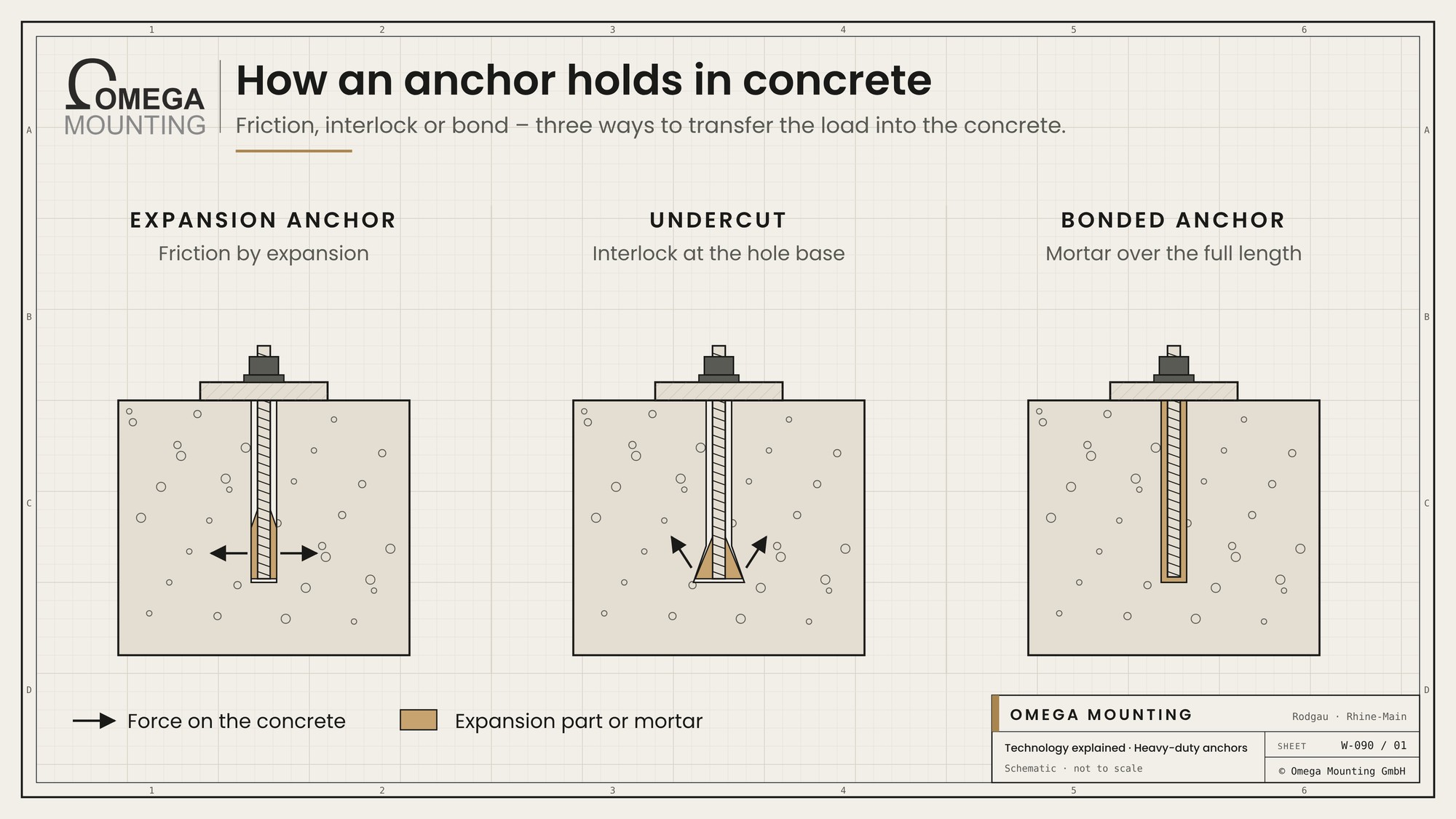
There are three principles.
| Anchor type | How it holds | Typical for |
|---|---|---|
| Expansion anchor | A sleeve expands when tightened and presses against the drill hole wall – held by friction. | Steel structures, impact protection, guardrails. |
| Undercut anchors | An undercut is made at the bottom of the drill hole, and the anchor interlocks with it. | Very high loads, dynamic loads. |
| Bonded anchor | Mortar bonds anchor rod and concrete over the full length. | Small edge distances, alternating loads, post-installed rebar. |
Expansion anchors can be loaded immediately. Bonded anchors need a curing time that depends on the temperature – in return they exert no expansion pressure and tolerate smaller edge distances and spacings.
Setting in five steps
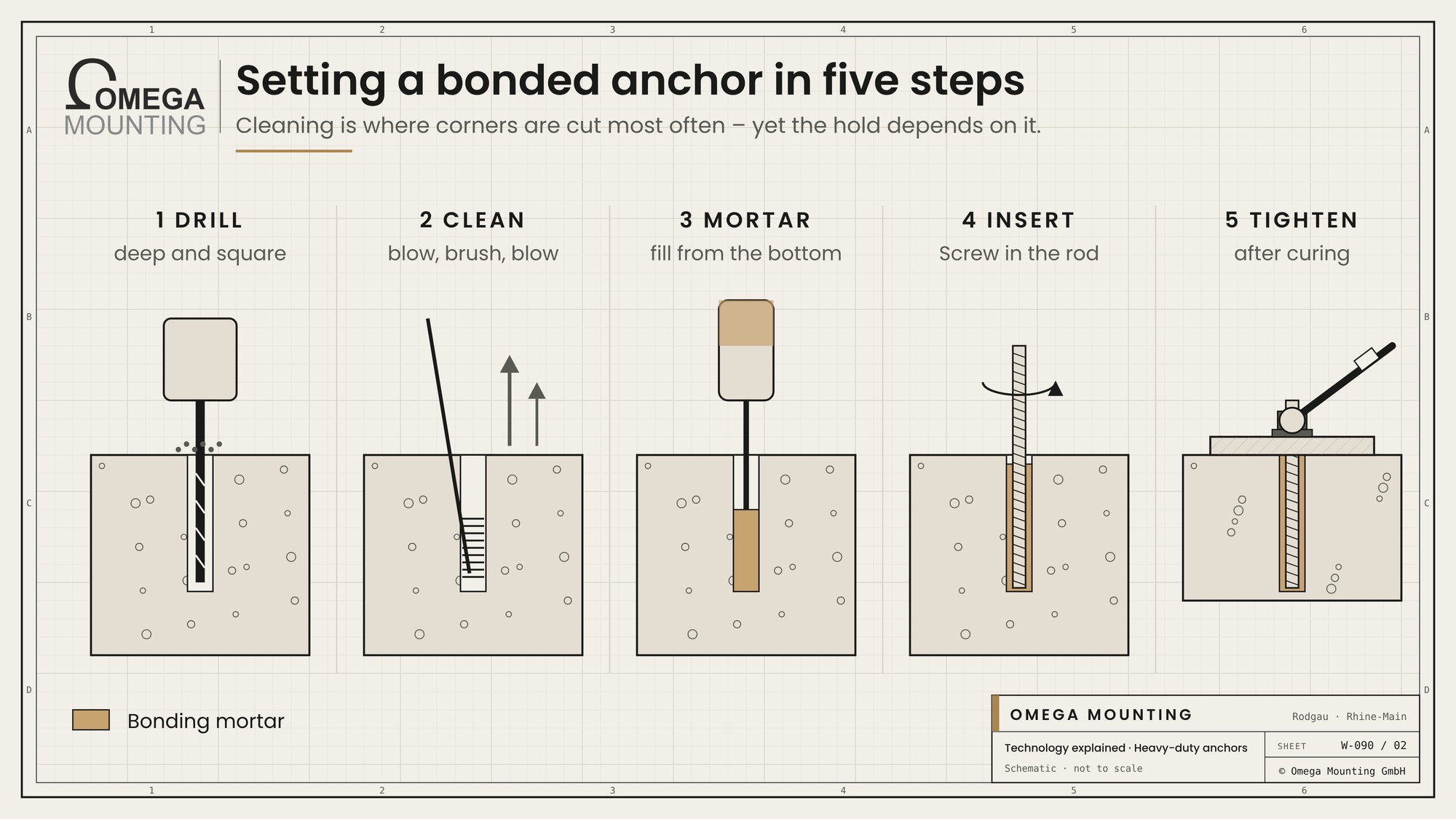
- Drill: to the right diameter and depth, at right angles to the surface. If reinforcement is hit, the hole is moved as specified.
- Clean: Blow out the drilling dust, brush, blow out again. Drilling dust acts like a lubricant – the anchor holds only a fraction.
- Insert: Drive in the expansion anchor, or inject bonding mortar from the bottom and press the anchor rod in with a twisting motion.
- Cure: Load bonded anchors only after the curing time has elapsed.
- Tighten: with a torque wrench to the specified torque – not by feel.
Cracked or uncracked concrete
Concrete develops fine cracks under load – on the tension side of a slab, in hall floors due to shrinkage or temperature. These hairline cracks are often not visible. If a crack runs through the drill hole, a simple expansion plug loses much of its hold.
For load-bearing fixings, anchors approved for cracked concrete are therefore used. They re-expand when the hole widens, or hold by interlock or bond. If in doubt, assume cracked concrete.
Edge distance and spacing

Under load, an anchor pulls a cone of concrete with it. If this cone is too close to an edge or overlaps with the cone of the neighbouring anchor, the concrete breaks out earlier than the anchor alone would fail.
- Edge distance: the distance from the anchor to the concrete edge.
- Spacing: the distance between two anchors.
- Member thickness: A thin slab can break out on the underside.
If the distances cannot be maintained – on a narrow plinth, for example – a different anchor, a different layout or a separate design is needed. Bonded anchors are often the better choice here because they exert no expansion pressure on the edge. With old foundations it is also worth looking at the concrete quality: if the surface crumbles or the edge is already damaged, the anchoring goes further in.
Where we anchor
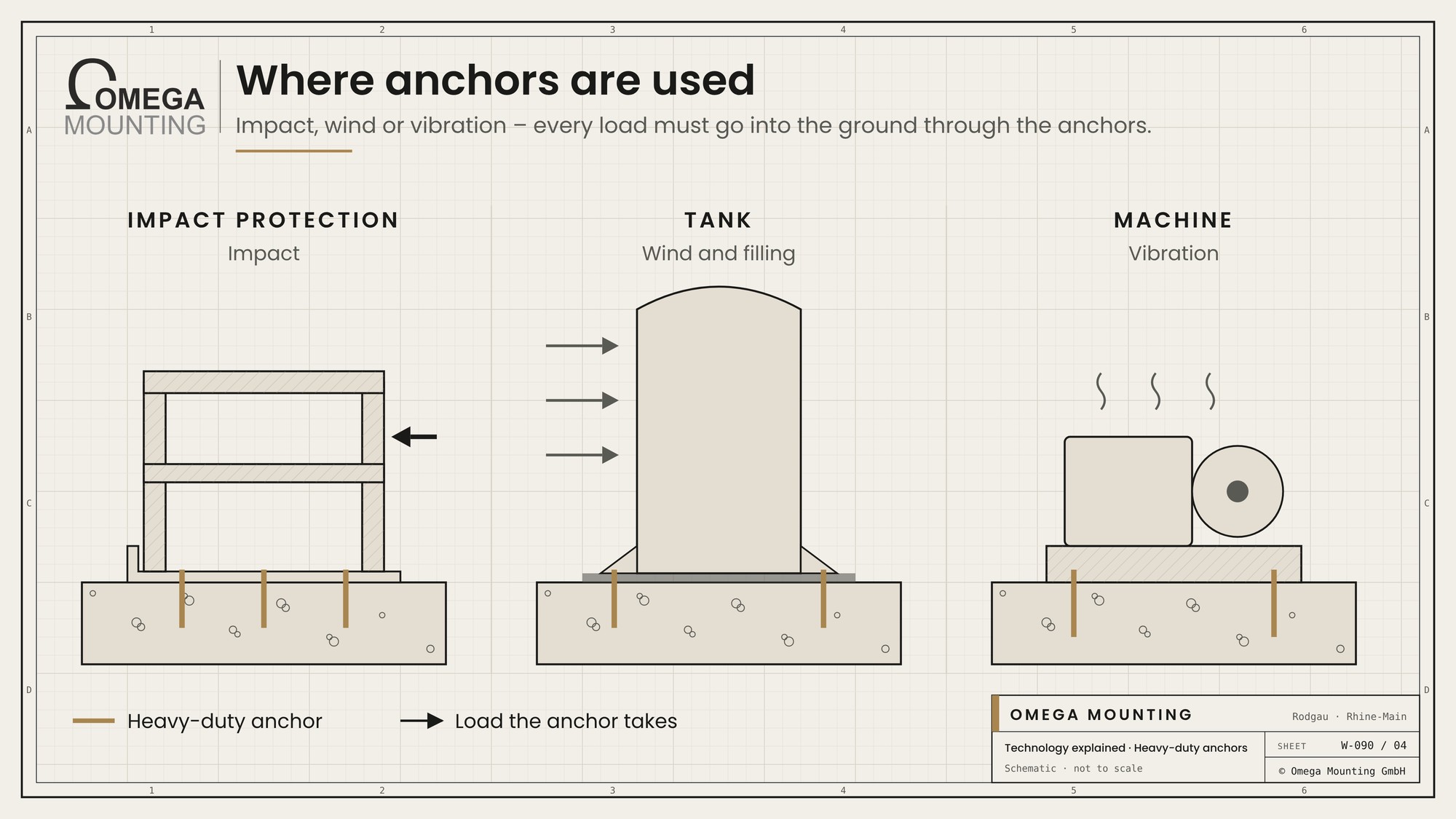
- Impact protection: The floor rail must absorb a forklift's impact – buckling and tearing out are the dangers.
- Tanks and silos: Wind, filling and operation pull and push on the vessel.
- Machines: Vibration loosens poorly set anchors over time.
- Racks and steelwork: Loads and impacts go into the floor through the base plates.
How a machine is aligned and anchored is described in our guide Aligning and anchoring a machine.
Typical mistakes
- Drill hole not cleaned: the most common mistake, often with a big effect.
- Too close to the edge: The concrete breaks out before the anchor carries.
- Tightened by feel: too loose does not hold, too tight can split the concrete.
- Bonded anchor loaded too early: The mortar has not yet cured.
- Wrong substrate: Screed or masonry instead of structural concrete.
Proof and documentation
An anchor is only as safe as the way it was installed. Because this cannot be seen from outside, the installation is recorded in a traceable way:
- Approval: Every anchor has an approval or assessment with details of the concrete, drill hole and setting procedure. It is installed exactly according to these details.
- Structural engineer’s specifications: Number, position and type of anchors come from the design. If the situation on site differs, the engineer is consulted.
- Hole cleaning: With bonded anchors in particular, cleaning decides the load capacity. That is why it belongs in the record.
- Torque: The anchor is tightened to the specified torque with a calibrated torque wrench.
- Proof load: Where required, a tension test is carried out on individual anchors and the result recorded.
An installation record with anchor type, drill diameter, cleaning, torque and date makes the work verifiable. For bonded anchors, curing time and temperature are added, because the anchor may only be loaded afterwards.
What we pay attention to
- We choose the anchor by load, substrate and distances – not by what is in stock.
- We set as per the approval: drilling depth, cleaning, torque.
- We check foundations beforehand and clean the bearing surfaces.
- We tighten with a torque wrench and document it.
- We protect anchor points against corrosion afterwards.
Where we use it
For a manufacturing company near Offenbach we built custom-made impact protection in our Rodgau workshop. The base is a solid steel angle serving as a floor rail, through which the whole impact protection is anchored in the floor with heavy-duty anchors – against buckling and tearing out on impact. In Fulda we set up GRP tanks: on cleaned concrete foundations, with a protective mat underneath and fixed with heavy-duty anchors so that they stand safely in wind, during filling and in operation. More on planning in our guide on custom-made impact protection.
More technology explained
Technology explained
Impact protection: bollard, hoop, barrier – what each type of guard stops
what is anchored.
Read the article →
Technology explained
Corrosion protection for steel: prime, coat or galvanise?
protecting anchor points.
Read the article →
Technology explained
Pallet racking: upright, beam, safety pin – and what the load sign says
racks secure in the floor.
Read the article →
Do you have questions about how this works on your site?
Do you need to anchor impact protection, a tank or a machine securely in the floor? We plan, drill and set as per the approval – and document it. Request a callback.
Our service for this: Industrial installation →
Free, no-obligation callback

About the author
Tobias Schott
Managing director of Omega Mounting GmbH, Rodgau · more than 20 years of hands-on experience in installation and maintenance
A trained mechatronics technician, working in maintenance, servicing and industrial installation since 2004 – first alongside his father, and with Omega Mounting since 2012: from overhead conveyors in Frankfurt to the crane system in a new-build hall. He plans and leads lifting operations as an appointed person (AP) in data centers and on industrial sites in the Rhine-Main region, trains and examines operators of cranes, mobile elevating work platforms and telehandlers, and is a qualified occupational safety specialist. On jobs abroad he is known as the “German Troubleshooter” – the person you call when a site gets stuck. He learned what quality means from his father, not from a manual: Made in Germany as a standard for his own work, not a label. That is why quality comes first at Omega Mounting – ahead of speed and price. The Technology explained articles cover the equipment and techniques his team uses every day: what counts on site is in them – what only appears in the brochure is not.
 English
 German